

Media Asset Management Market Report 2026
Global Outlook – By Deployment (On-Premise, Cloud (SaaS)), By Organization Size (Small And Medium Enterprises (SMEs), Large Enterprises), By End-User (Media And Entertainment, BFSI, Government, Healthcare, Retail, Manufacturing, Other End-Users) – Market Size, Trends, Strategies, and Forecast to 2030
Media Asset Management Market Overview
• Media Asset Management market size has reached to $7.18 billion in 2025 • Expected to grow to $19.5 billion in 2030 at a compound annual growth rate (CAGR) of 22% • Growth Driver: Digital Advertising Surge Fuels Media Asset Management Market Growth • Market Trend: Strategic Collaborations And Partnerships Driving Expansion In The Asset Management Market • North America was the largest region in 2025 and Asia-Pacific is the fastest growing region.Market Gains By 2030 – Top Opportunities By Segment
Market Gain identifies the most promising market opportunities by highlighting the segments or products expected to generate the highest incremental revenue growth over the next five years.
What Is Covered Under Media Asset Management Market?
A media asset management (MAM) is a program used to store and manage high-volume video and multimedia files in an organization to form a media library to provide unified and centralized access to important files and saves time in asset retrieval. This centralized approach not only streamlines workflows but also enhances collaboration and efficiency across teams, allowing for quicker decision-making and improved content delivery. The media asset management is deployed on-premises and cloud in SMES (small and medium enterprises) and large enterprises. On-premises refers to software applications and IT infrastructures hosted within the organization or on-site. On-premises media asset management simply deliver digital content with the flexibility of scalable storage and on-demand support services. The media asset management is used by media and entertainment, BFSI, government, healthcare, retail, manufacturing, and other end-users.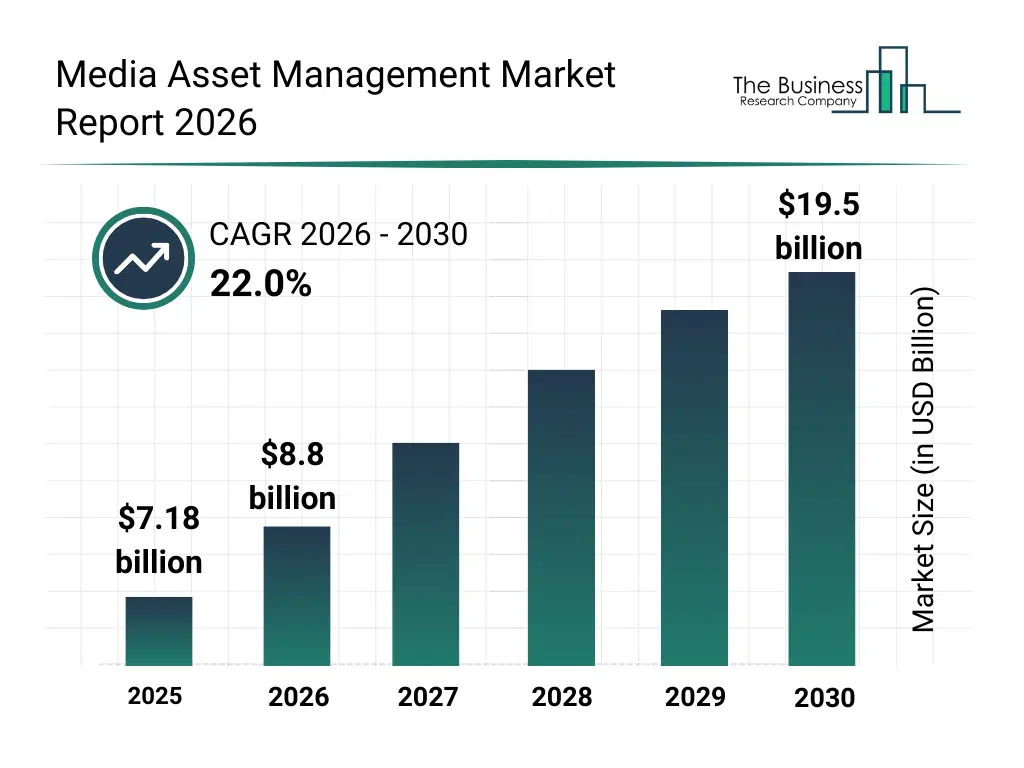
What Is The Media Asset Management Market Size and Share 2026?
The media asset management market size has grown exponentially in recent years. It will grow from $7.18 billion in 2025 to $8.8 billion in 2026 at a compound annual growth rate (CAGR) of 22.4%. The growth in the historic period can be attributed to increasing digital content production volumes, expansion of broadcast and streaming platforms, adoption of centralized content storage systems, rising demand for faster asset retrieval, growth of multi-format media workflows.What Is The Media Asset Management Market Growth Forecast?
The media asset management market size is expected to see exponential growth in the next few years. It will grow to $19.5 billion in 2030 at a compound annual growth rate (CAGR) of 22.0%. The growth in the forecast period can be attributed to increasing investments in cloud-native content platforms, rising adoption of ai-based media analytics, expansion of immersive content formats, growing focus on remote collaboration, increasing need for scalable media storage solutions. Major trends in the forecast period include increasing adoption of cloud-based media libraries, rising demand for ai-driven content tagging, growing integration of collaborative workflow tools, expansion of high-resolution video asset management, enhanced focus on secure digital rights management.
Global Media Asset Management Market Segmentation
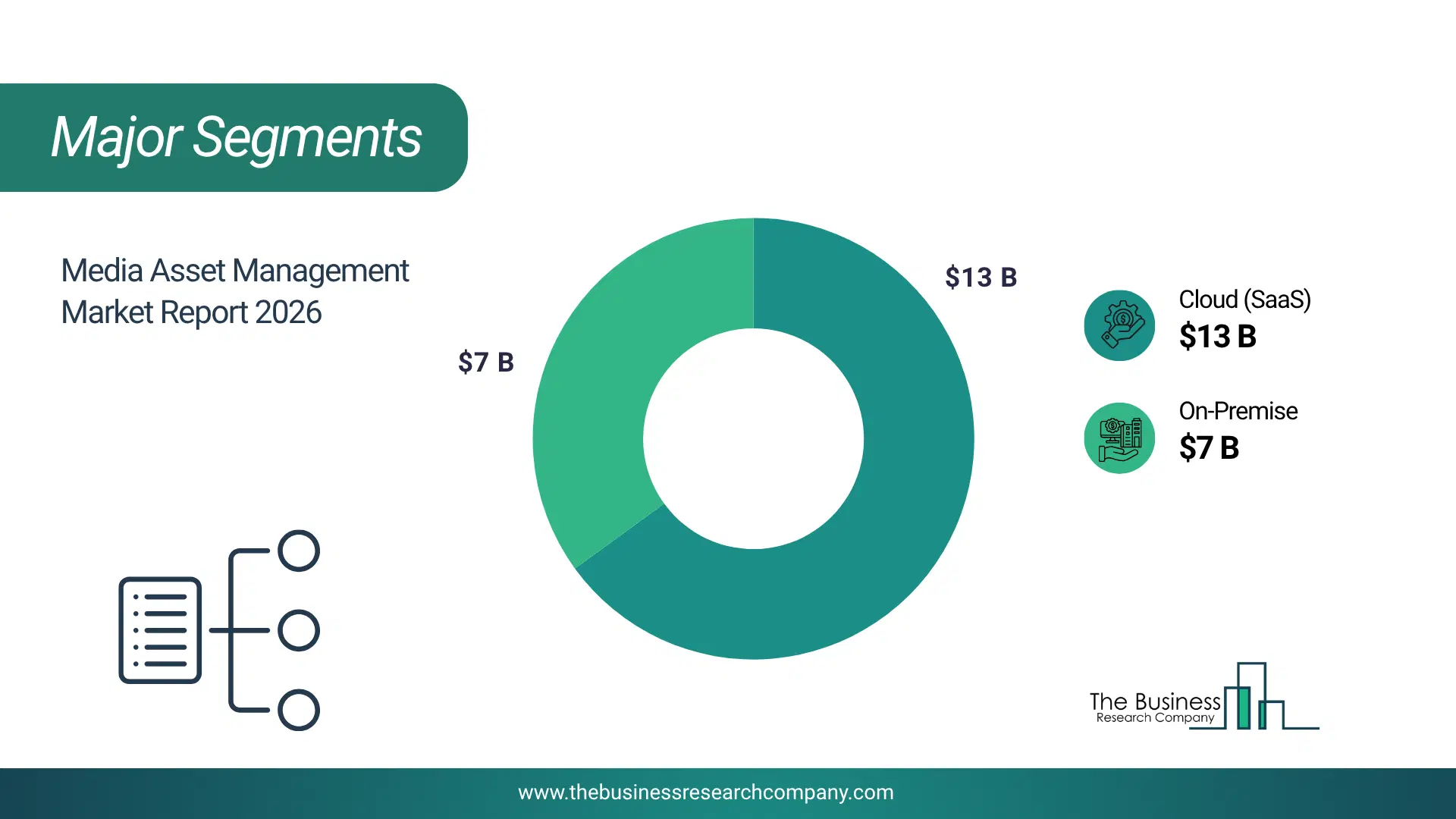
1) By Deployment: On-Premise, Cloud (SaaS) 2) By Organization Size: Small And Medium Enterprises (SMEs), Large Enterprises 3) By End-User: Media And Entertainment, BFSI, Government, Healthcare, Retail, Manufacturing, Other End-Users Subsegments: 1) By On-Premise: Self-Hosted Solutions, Customizable Infrastructure, Integration With Existing Systems 2) By Cloud (SaaS): Subscription-Based Services, Scalable Solutions, Accessibility And Collaboration Features The top segments in the media asset management market will be: • Cloud (SaaS) will reach $12.83 Billion by 2030. • On-Premise will reach $6.55 Billion by 2030.What Is The Driver Of The Media Asset Management Market?
The growing digital advertising is driving the growth of the media asset management market. Digital advertising is the marketing that takes place on websites, streaming media, and other online platforms in text, image, audio, and video formats, which helps businesses with the marketing funnel, brand awareness, consumer engagement, and other business operations. Media asset management in digital advertising helps broadcast media archive, store video assets, and distribution large volumes of multimedia content. Additionally, media asset management provides digital advertising agencies with content security, sharing media files quickly and easily, creating metadata, and enabling asset retrieval. For instance, in April 2024, according to the Interactive Advertising Bureau, a US-based media company, internet advertising revenues reached a record-high of $225 billion, increasing by 7.3% year-over-year overall (YoY) between 2022 and 2023. Therefore, such a rise in digital advertising will increase demand for media asset management.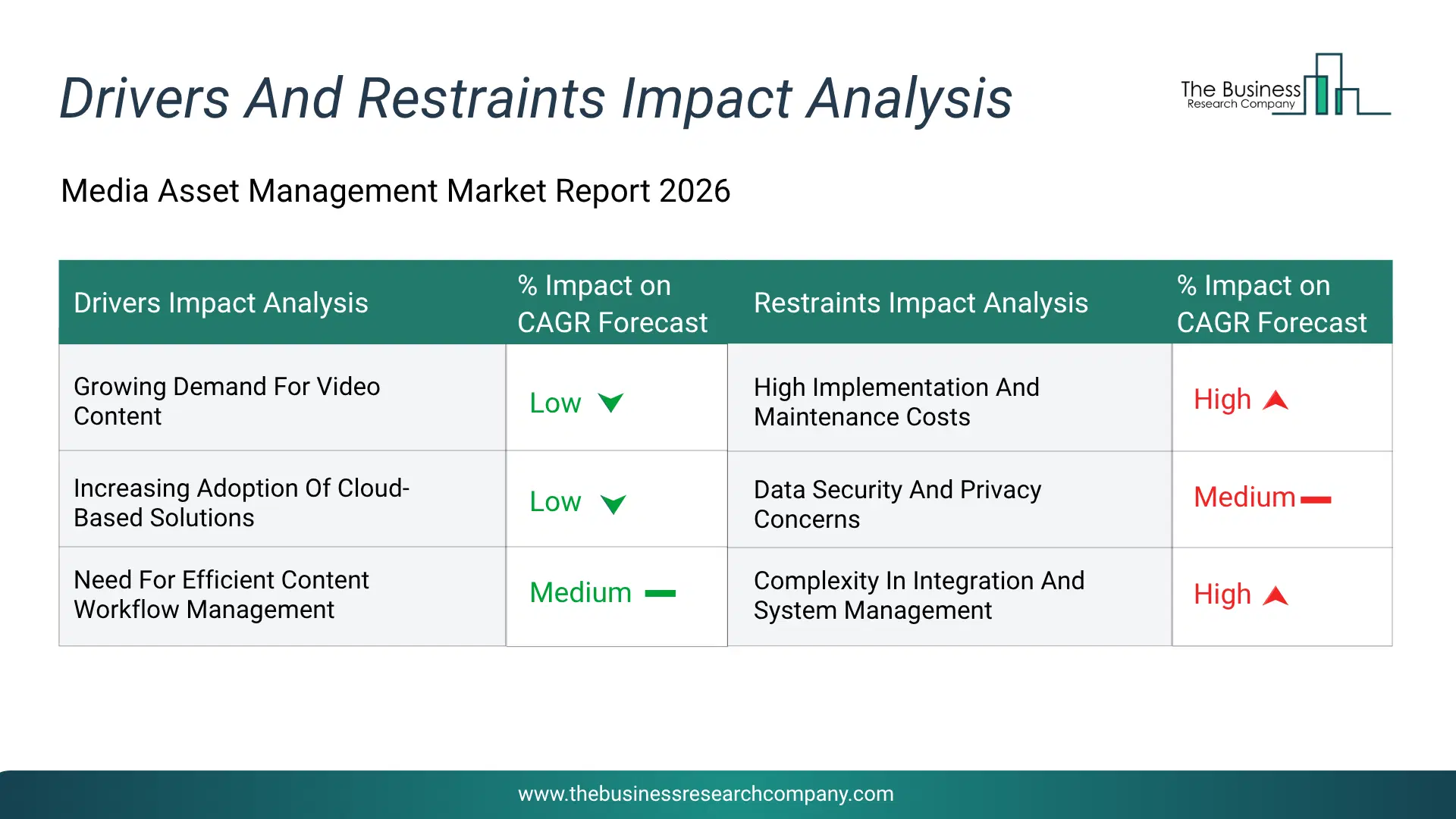
Infographic Chart Showing Key Market Drivers Analysis And Restraints For Media Asset Management Market
The chart presents an impact analysis of key drivers and restraints, quantifying their relative influence on the market's growth rate and helping assess the balance between growth enablers and limiting factors. This chart offers a high-level perspective; the full report contains more detailed insights.
How Will The Drivers Impact Growth In The Global Media Asset Management Market?
• Growing Demand For Video Content (Low) – During the forecast period, the growing demand for video content is expected to become a key growth driver for the media asset management market by 2030. The rapid increase in digital video consumption across OTT platforms, social media, and enterprise communications is significantly boosting the need for MAM solutions. Organizations are generating large volumes of multimedia assets daily, which require efficient storage and retrieval systems. MAM platforms enable centralized access, faster searchability, and improved collaboration across teams. This helps reduce time spent on asset retrieval and enhances productivity. As content libraries expand, manual management becomes inefficient, making automated systems essential. The growing reliance on video-driven communication further strengthens adoption. • Increasing Adoption Of Cloud-Based Solutions (Low) – During the forecast period, the increasing adoption of cloud-based solutions is expected to emerge as a major factor driving the expansion of the media asset management market by 2030. The transition toward cloud-based infrastructure is accelerating the adoption of MAM systems. Cloud deployment allows organizations to scale storage capacity without heavy upfront investments in physical infrastructure. It also enables remote accessibility, supporting distributed teams and real-time collaboration. Businesses benefit from lower operational costs, improved system flexibility, and easier updates. Additionally, cloud-based MAM solutions offer enhanced disaster recovery and backup capabilities. As digital transformation initiatives grow, cloud integration continues to drive demand for MAM platforms. • Need For Efficient Content Workflow Management (Medium) – During the forecast period, the need for efficient content workflow management is expected to act as a key growth catalyst for the media asset management market by 2030. MAM systems store large volumes of sensitive and proprietary media files, raising concerns about data security. Risks such as cyberattacks, unauthorized access, and data breaches can impact adoption. Organizations must implement strong security measures to protect digital assets, especially in cloud environments. Compliance with data protection regulations adds complexity and cost. Any compromise in security can lead to financial losses and reputational damage. These concerns make some organizations hesitant to fully adopt MAM solutions.How Will The Restraints Impact Growth In The Global Media Asset Management Market?
• High Implementation And Maintenance Costs (Low) – During the forecast period, high implementation and maintenance costs are significantly restricting the growth of the media asset management market. The requirement for advanced software platforms, storage infrastructure, licensing fees, and ongoing system upgrades is creating financial burdens for organizations, particularly small and mid-sized enterprises. • Data Security And Privacy Concerns (Low) – During the forecast period, data security and privacy concerns are significantly restricting the growth of the media asset management market. Increasing risks related to unauthorized access, data breaches, and regulatory compliance requirements are making organizations cautious about adopting centralized media management systems. • Complexity In Integration And System Management (Medium) – During the forecast period, complexity in integration and system management is significantly restricting the growth of the media asset management market. Challenges in integrating with legacy systems, third-party tools, and multi-platform distribution networks are increasing deployment time, operational difficulty, and overall system management costs.Key Players In The Global Media Asset Management Market
Major companies operating in the media asset management market are Dalet SA; Imagen Ltd.; Prime Focus Technologies Ltd.; Sony Group Corporation; Microsoft Corporation; VSN Video Stream Networks SL; Bynder BV; Amazon.com Inc.; IBM Corporation; SI-MEDIASrl; Oracle Corporation; Square Box Systems Ltd.; Quantum Corporation; Tedial SL; Adam Software Inc.; Canto Inc.; Celum GmbH; OpenText Corporation; North Plains Systems Inc.; QBank; Webdam Inc.; MediaBeacon Inc.; Widen Enterprises Inc.; Adobe Inc.; Aprimo Inc.; Nuxeo SA; MediaValet Inc.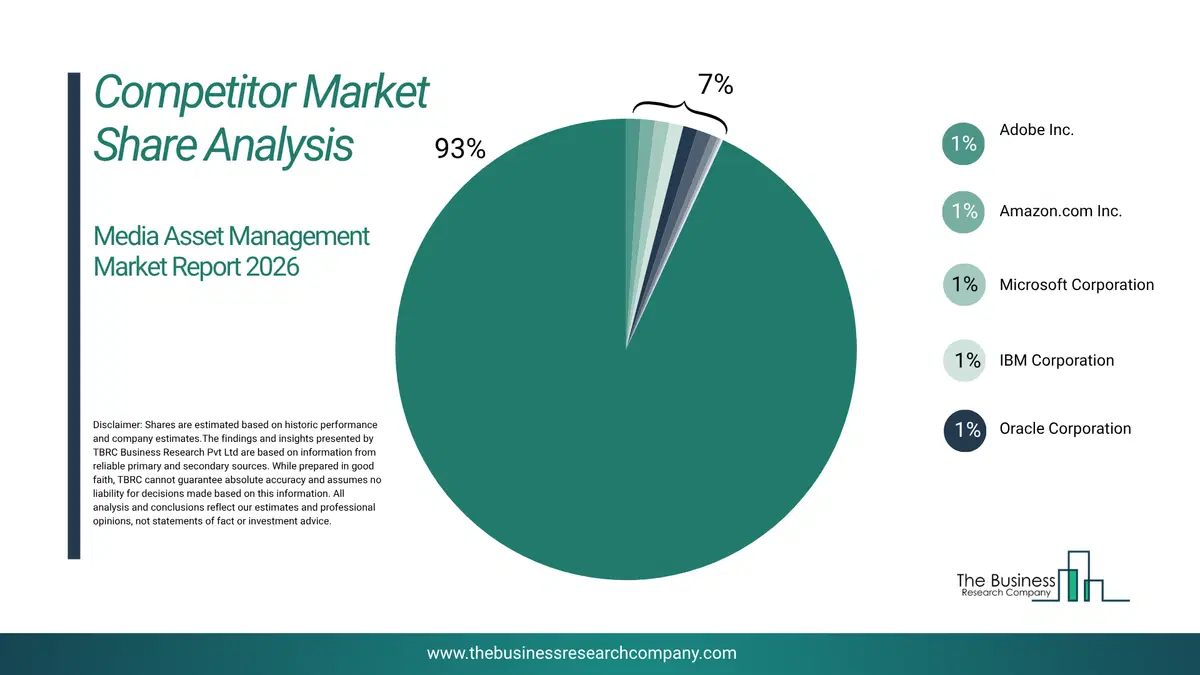
This chart is for illustrative purposes; the full report includes a detailed competitor analysis and comprehensive overview of the top 10 companies in the market.
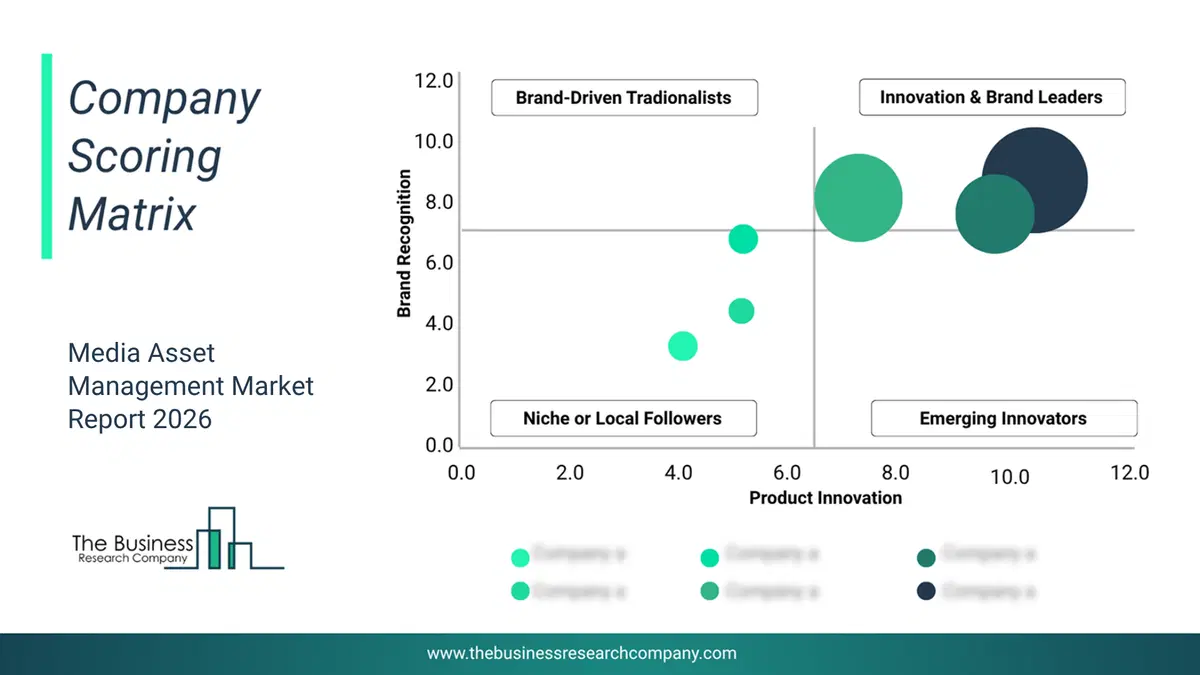
This chart maps companies by product innovation and brand strength, with bubble size indicating relative revenue, helping identify market leaders, challengers, and niche players. This is an illustrative chart; the full report provides a complete and accurate competitive analysis.
Global Media Asset Management Market Trends and Insights
Major companies are strategically entering partnerships and collaborations with start-ups and mid-sized companies in the media asset management market to broaden the products and services offered by the company. Strategic collaborations and partnership agreements help companies expand their existing product portfolio and geographical reach. For instance, in April 2023, Aegon Asset Management, a UK-based Capital market company entered a strategic partnership with UK based credit investment firm, Lakemore Partners Ltd. The partnership aims to expand Aegon AM's leading credit capabilities through the growth of its US CLO platform. Further, the partnership grows Lakemore's repertoire of top-tier institutional clients.What Are Latest Mergers And Acquisitions In The Media Asset Management Market?
In June 2023, Thomson Reuters, a Canada-based content and technology company, acquired Imagen Ltd. for an undisclosed amount. With this acquisition, Thomson Reuters aims to enhance its media asset management offerings by integrating Imagen’s cloud-native platform, enabling improved storage, manipulation, and controlled distribution of digital media content to better serve Reuters News Agency clients. Imagen Ltd. is a UK-based provider of cloud-native media asset management solutions.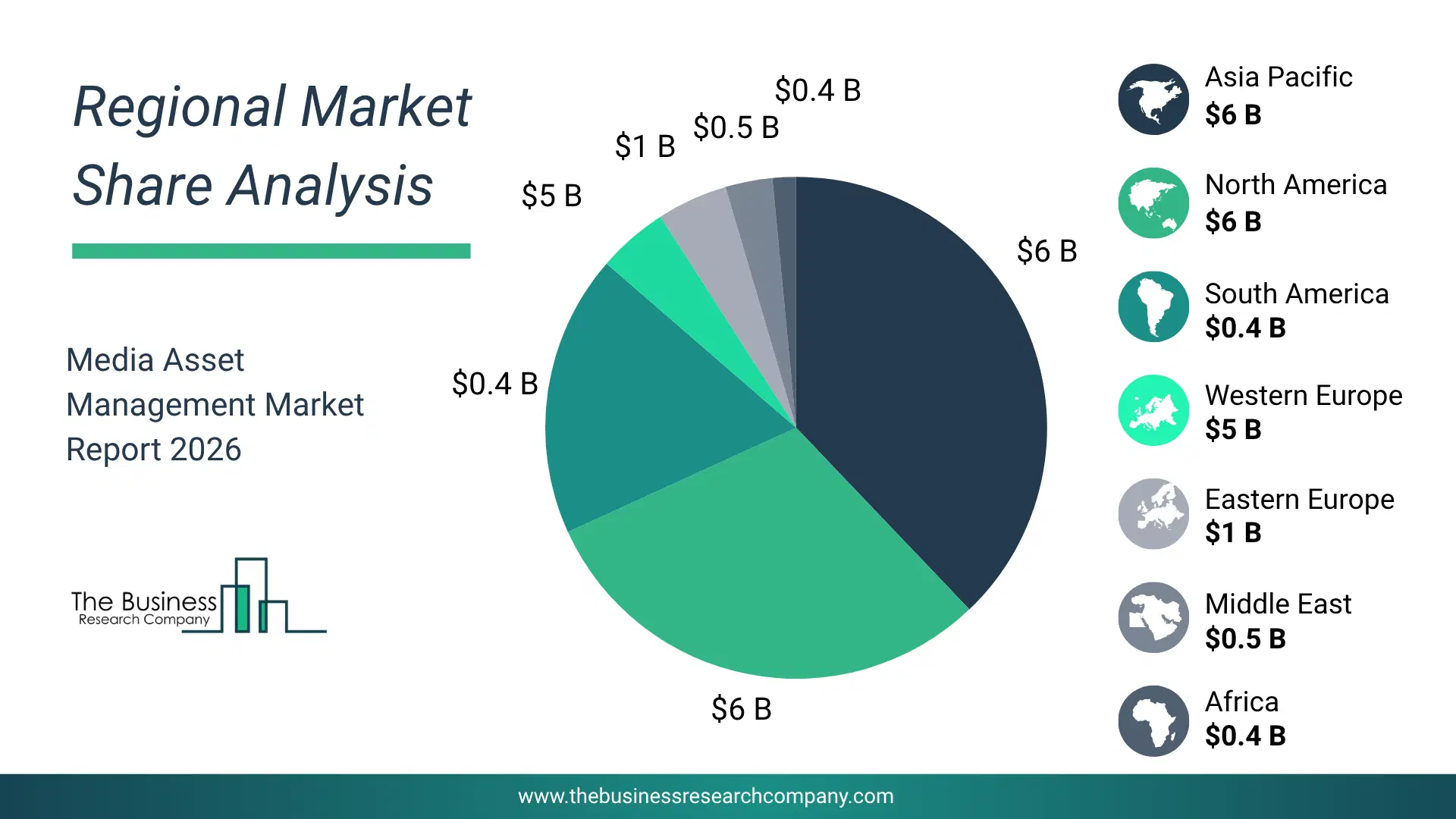
Regional Insights
North America was the largest region in the media asset management market in 2025. Asia-Pacific is expected to be the fastest-growing region in the forecast period. The regions covered in this market report are Asia-Pacific, South East Asia, Western Europe, Eastern Europe, North America, South America, Middle East, Africa. The countries covered in this market report are Australia, Brazil, China, France, Germany, India, Indonesia, Japan, Taiwan, Russia, South Korea, UK, USA, Canada, Italy, SpainWhat Defines the Media Asset Management Market?
The media asset management (MAM) market includes revenues earned by entities by management of rich-media assets' life cycles and their ingestion, storage, retrieval, collaboration, and coordination. The market value includes the value of related goods sold by the service provider or included within the service offering. Only goods and services traded between entities or sold to end consumers are included.How is Market Value Defined and Measured?
The market value is defined as the revenues that enterprises gain from the sale of goods and/or services within the specified market and geography through sales, grants, or donations in terms of the currency (in USD unless otherwise specified). The revenues for a specified geography are consumption values that are revenues generated by organizations in the specified geography within the market, irrespective of where they are produced. It does not include revenues from resales along the supply chain, either further along the supply chain or as part of other products.
This chart presents market attractiveness based on a quantitative evaluation of growth, competition, strategic alignment, and risk, offering a clear view of opportunity areas for decision-making. This chart is for illustrative purposes; the full report contains the complete analysis.

This chart highlights the Total Addressable Market (TAM) by estimating the maximum revenue opportunity using an assumption-driven approach, supporting strategic planning and opportunity sizing across markets. The chart is illustrative; the full report provides a more comprehensive analysis.
What Key Data and Analysis Are Included in the Media Asset Management Market Report 2026?
The media asset management market research report is one of a series of new reports from The Business Research Company that provides market statistics, including industry global market size, regional shares, competitors with the market share, detailed market segments, market trends and opportunities, and any further data you may need to thrive in the media asset management industry. The market research report delivers a complete perspective of everything you need, with an in-depth analysis of the current and future state of the industry.Media Asset Management Market Report Forecast Analysis
| Report Attribute | Details |
|---|---|
| Market Size Value In 2026 | $8.8 billion |
| Revenue Forecast In 2030 | $19.5 billion |
| Growth Rate | CAGR of 22.4% from 2026 to 2030 |
| Base Year For Estimation | 2025 |
| Actual Estimates/Historical Data | 2020-2025 |
| Forecast Period | 2026 - 2030 |
| Market Representation | Revenue in USD Billion and CAGR from 2026 to 2030 |
| Segments Covered | Deployment, Organization Size, End-User |
| Regional Scope | Asia-Pacific, Western Europe, Eastern Europe, North America, South America, Middle East, Africa |
| Country Scope | The countries covered in the report are Australia, Brazil, China, France, Germany, India, Indonesia, Japan, Taiwan, Russia, South Korea, UK, USA, Canada, Italy, Spain. |
| Key Companies Profiled | Dalet SA; Imagen Ltd.; Prime Focus Technologies Ltd.; Sony Group Corporation; Microsoft Corporation; VSN Video Stream Networks SL; Bynder BV; Amazon.com Inc.; IBM Corporation; SI-MEDIASrl; Oracle Corporation; Square Box Systems Ltd.; Quantum Corporation; Tedial SL; Adam Software Inc.; Canto Inc.; Celum GmbH; OpenText Corporation; North Plains Systems Inc.; QBank; Webdam Inc.; MediaBeacon Inc.; Widen Enterprises Inc.; Adobe Inc.; Aprimo Inc.; Nuxeo SA; MediaValet Inc. |
| Customization Scope | Request for Customization |
| Pricing And Purchase Options | Explore Purchase Options |