
Military Embedded Systems Market Report 2026
Global Outlook – By Component (Hardware, Software), By Installation Type (New installation, Upgradation), By Platform (Land, Airborne, Naval, Space), By Technology (Edge Computing, Fog Computing, Mist Computing), By Application (Intelligence, Surveillance, And Reconnaissance (ISR), Command And Control, Communication And Navigation, Electronic Warfare (EW), Weapon And Fire Control, Wearable, Other Applications) – Market Size, Trends, Strategies, and Forecast to 2030
Military Embedded Systems Market Overview
• Military Embedded Systems market size has reached to $1.89 billion in 2025 • Expected to grow to $2.77 billion in 2030 at a compound annual growth rate (CAGR) of 8% • Growth Driver: Global Terrorism Propels Demand For Military Embedded Systems • Market Trend: Advancements In Ruggedized Computing Technologies Strengthen Operational Reliability In Military Embedded Systems • North America was the largest region in 2025 and Asia-Pacific is the fastest growing region.Market Gains By 2030 – Top Opportunities By Segment
Market Gain identifies the most promising market opportunities by highlighting the segments or products expected to generate the highest incremental revenue growth over the next five years.
What Is Covered Under Military Embedded Systems Market?
A military embedded system is a set of hardware and software developed to tackle the majority of military applications. A military embedded system is used to carry out specific tasks such as electronic warfare, surveillance via surveillance satellites, radar systems, or military traffic systems. The main types of military embedded systems are hardware and software. The hardware of an embedded system consists of components such as a user interface, input/output interfaces, a display, and memory. The various types of installation include new installations and upgrades that use platforms including land, airborne, naval, and space. The various technologies include edge computing, fog computing, and mist computing, which are used in intelligence, surveillance, and reconnaissance (ISR), command and control, communication, and navigation, electronic warfare, weapon and fire control, wearable technology, and other applications.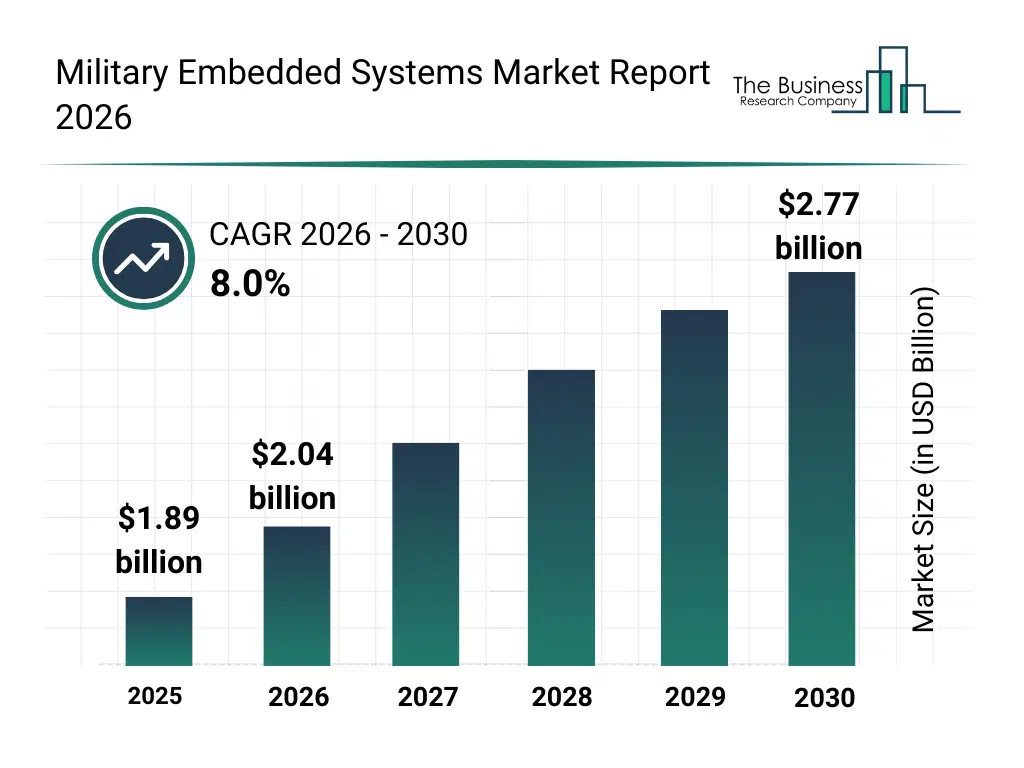
What Is The Military Embedded Systems Market Size and Share 2026?
The military embedded systems market size has grown strongly in recent years. It will grow from $1.89 billion in 2025 to $2.04 billion in 2026 at a compound annual growth rate (CAGR) of 8.1%. The growth in the historic period can be attributed to rising deployment of embedded systems to support intelligence and reconnaissance missions, increased integration of embedded computing platforms in radar and navigation systems, growth in demand for rugged and mission-critical hardware capable of operating in extreme environments, advancements in real-time processing technologies enhancing battlefield decision-making, expansion of command-and-control modernization programs requiring reliable embedded architectures.What Is The Military Embedded Systems Market Growth Forecast?
The military embedded systems market size is expected to see strong growth in the next few years. It will grow to $2.77 billion in 2030 at a compound annual growth rate (CAGR) of 8.0%. The growth in the forecast period can be attributed to growing adoption of AI-enabled embedded systems for autonomous threat detection and mission execution, increasing demand for modular open systems architecture enabling rapid system upgrades, expansion of embedded solutions supporting multi-domain operations and data fusion, rising investment in cyber-secure embedded platforms to protect mission-critical information, development of high-performance and low-power embedded processors optimized for next-generation defense applications. Major trends in the forecast period include real-time data processing and analysis, integration of multi-sensor systems, miniaturization and low-power hardware, enhanced cybersecurity for embedded systems, modular and upgradable embedded platforms.
Global Military Embedded Systems Market Segmentation
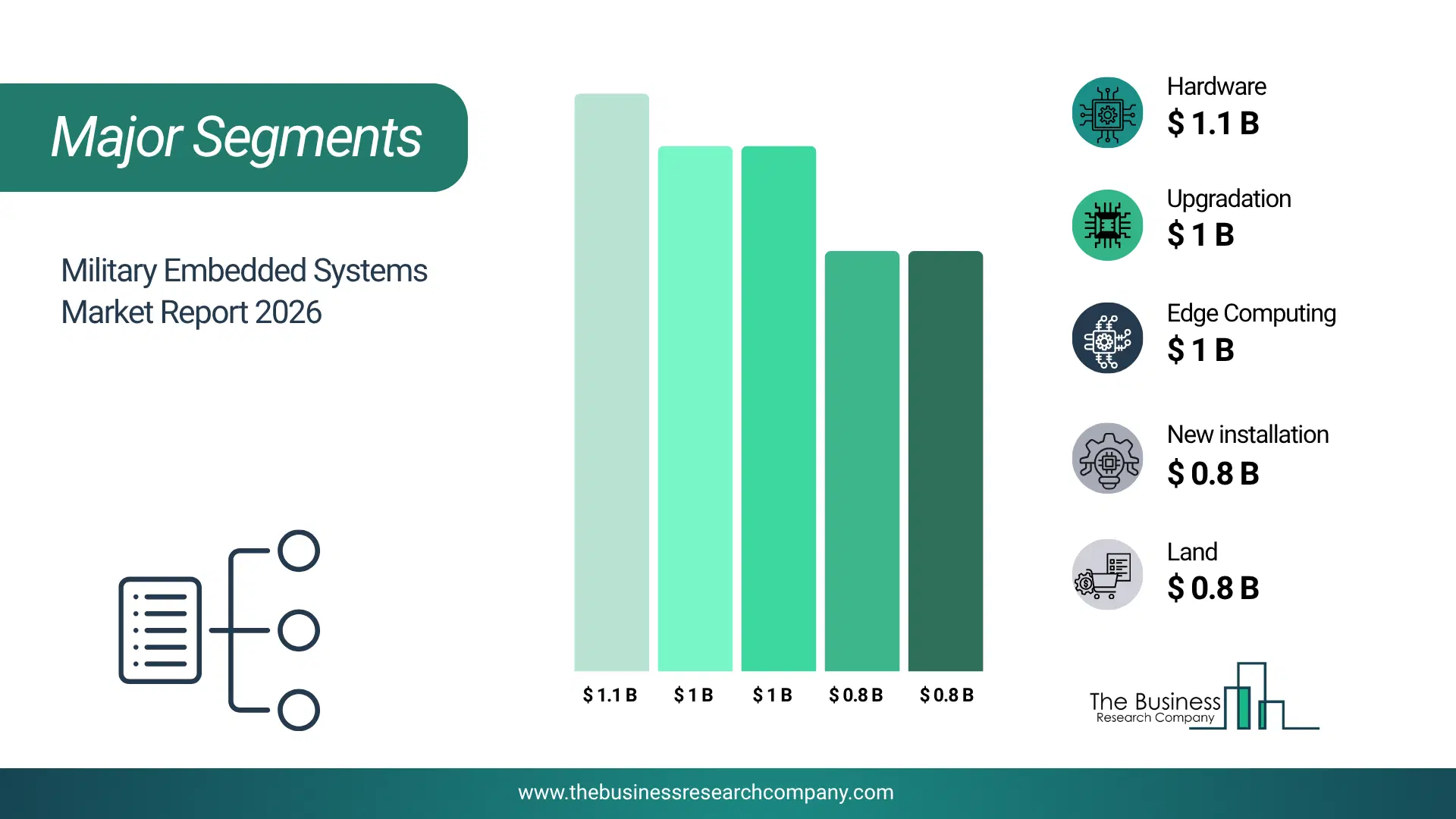
1) By Component: Hardware, Software 2) By Installation Type: New installation, Upgradation 3) By Platform: Land, Airborne, Naval, Space 4) By Technology: Edge Computing, Fog Computing, Mist Computing 5) By Application: Intelligence, Surveillance, And Reconnaissance (ISR), Command And Control, Communication And Navigation, Electronic Warfare (EW), Weapon And Fire Control, Wearable, Other Applications Subsegments: 1) By Hardware: Processors, Memory, Input Or Output Devices, Communication Interfaces, Sensors 2) By Software: Operating Systems, Middleware, Application Software, Development Tools The top segments in the military embedded systems market will be: • Hardware will reach $1137.83 Million by 2025. • Upgradation will reach $1043.98 Million by 2025. • Edge Computing will reach $1020.89 Million by 2025. • New installation will reach $851.64 Million by 2025. • Land will reach $808.35 Million by 2025.What Is Driver Of The Military Embedded Systems Market?
The increasing global terrorism is expected to propel the growth of the military embedded systems market going forward. Terrorism refers to a non-state actor who threatens or uses illegal force and violence to achieve a political, economic, religious, or social purpose through fear, compulsion, or intimidation. The rising threat of terrorist activities is primarily driven by the expansion of extremist groups across conflict zones and unstable regions, which increases the frequency and complexity of coordinated attacks targeting civilian populations and critical infrastructure. Military embedded systems aid in countering terrorism by providing real-time ISR capabilities that help forces detect, track, and neutralize threats swiftly while enhancing communication, data analysis, and precision targeting for quicker and more effective mission responses. For instance, in February 2024, according to the Institute for Economics & Peace (IEP), an Australia-based non-profit think tank, terrorism continues to pose a significant global threat, with total deaths rising to 8,352 in 2023, up from 6,823 in 2022. Therefore, the rising terrorism in the world drives the military embedded systems industry.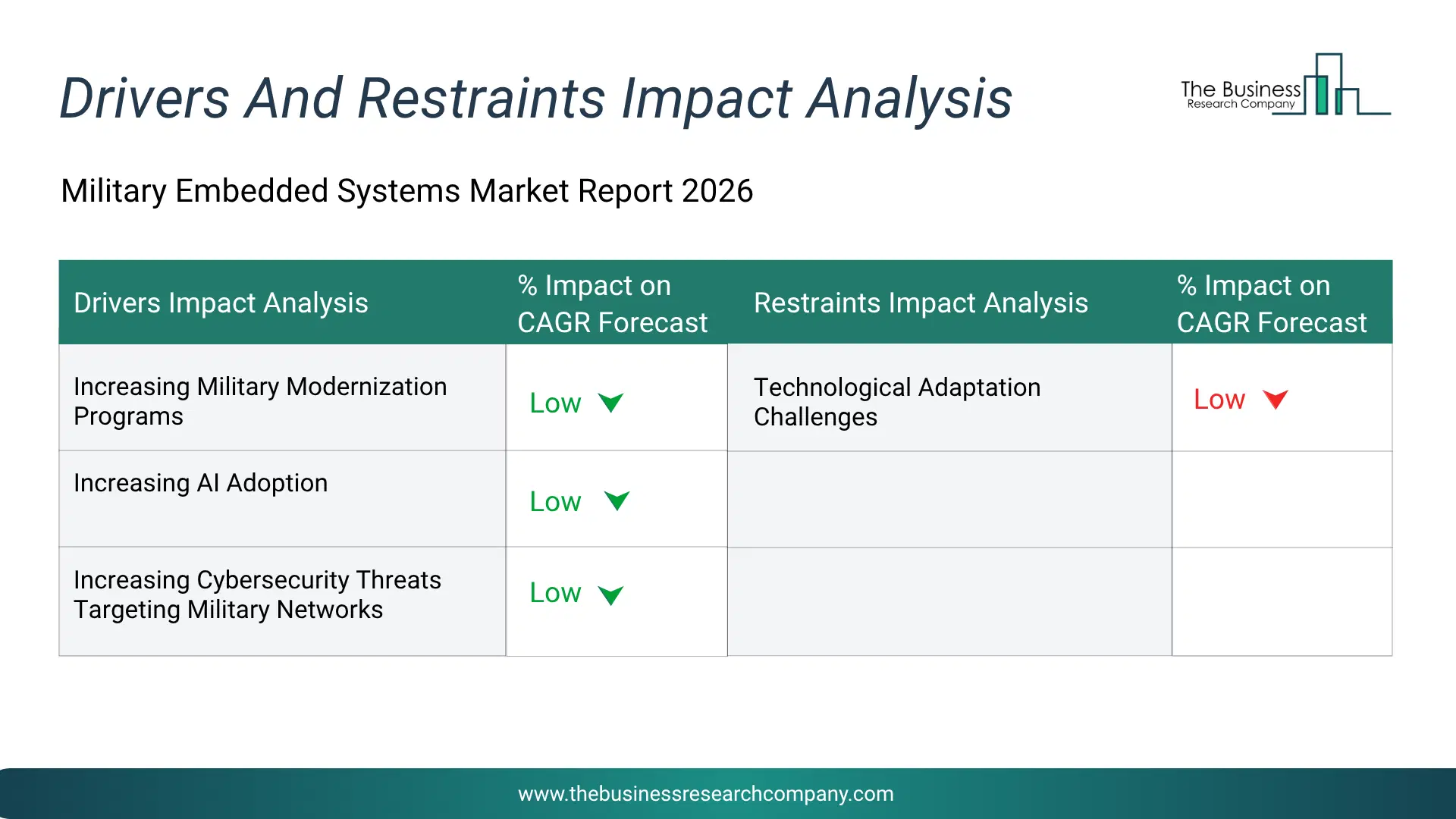
Infographic Chart Showing Key Market Drivers Analysis And Restraints For Military Embedded Systems Market
The chart presents an impact analysis of key drivers and restraints, quantifying their relative influence on the market's growth rate and helping assess the balance between growth enablers and limiting factors. This chart offers a high-level perspective; the full report contains more detailed insights.
How Will The Drivers Impact Growth In The Global Military Embedded Systems Market?
• Increasing Military Modernization Programs (Low) – The increasing military modernization programs will become a key driver of growth in the military embedded systems market by 2030. Military modernization programs refer to strategic initiatives aimed at upgrading defense capabilities through advanced technologies, equipment and operational frameworks to enhance national security and combat readiness. Increasing military modernization programs are driven by rising geopolitical tensions, rapid technological advancements, evolving warfare strategies and the need to replace aging defense infrastructure. Military embedded systems play a crucial role in modernization by enabling real-time data processing, advanced automation and enhanced battlefield communication, ensuring superior situational awareness and decision-making capabilities. As a result, the rising military modernization programs growth is anticipated to contributing to a 0.8% annual growth in the market. • Increasing AI Adoption (Low) – The increasing artificial intelligence (AI) adoption will emerge as a major factor driving the expansion of the market by 2030. Artificial intelligence (AI) adoption refers to the integration and utilization of artificial intelligence (AI) technologies across various sectors to enhance automation, decision-making and operational efficiency. Military embedded systems facilitate AI adoption by providing high-performance computing, real-time processing and secure infrastructure necessary to support artificial intelligence (AI) - driven applications in defense, including autonomous systems, threat detection and mission-critical decision-making. Consequently, the increase in smart city initiatives growth is projected to contributing to a 0.6% annual growth in the market. • Increasing Cybersecurity Threats Targeting Military Networks (Low) – The increasing cybersecurity threats targeting military networks will serve as a key growth catalyst for the market by 2030. Increasingly sophisticated cyber warfare, artificial intelligence (AI) -powered attacks, and interconnected defense systems heighten risks. Embedded systems help counter these threats through advanced encryption, real-time threat detection, and secure communication protocols, ensuring the protection of mission-critical networks from cyber intrusions and electronic warfare. Therefore, this rise in cybersecurity threats growth is projected to supporting to a 0.3% annual growth in the market. • Favorable Government Initiatives (High) – The favorable government initiatives will become a significant driver contributing to the growth of the market by 2030. Government-led military modernization initiatives prioritize replacing outdated technologies with advanced solutions, such as next-generation embedded technologies to strengthen national security and military capabilities. Consequently, the favorable government initiatives growth is projected to contributing to a 0.3% annual growth in the market.How Will The Restraints Impact Growth In The Global Military Embedded Systems Market?
• Regulatory Compliance (Low) – Regulatory Compliance will restrict the growth of the Military Embedded Systems market during the forecast period. Military embedded systems must comply with stringent regulatory requirements for security, reliability, and certification. Compliance with military standards adds significant time and cost to product development and certification processes. Regulatory complexity can delay product deployment and limit the participation of smaller suppliers, affecting market growth. • Complex Systems (Low) – Complex Systems will restrict the growth of the Military Embedded Systems market during the forecast period. Military embedded systems involve complex hardware and software integration, creating challenges in development, testing, and maintenance. The complexity of modern military systems can lead to extended development cycles and increased costs. Integration challenges with existing platforms and interoperability requirements further complicate system deployment, affecting market growth. • Technological Adaptation Challenges (Low) – Technological Adaptation Challenges will restrict the growth of the Military Embedded Systems market during the forecast period. The rapid pace of technology evolution requires continuous adaptation of military embedded systems, creating challenges for procurement and maintenance. Outdated systems may not be compatible with new technologies, requiring costly upgrades or replacements. Technological adaptation challenges can affect system lifecycle management and limit the adoption of advanced embedded solutions.Key Players In The Global Military Embedded Systems Market
Major companies operating in the military embedded systems market are Xilinx Inc., Mercury Systems Inc., Curtiss-Wright Corporation, Kontron (S&T), SMART Embedded Computing, Advantech Co Ltd., Thales Group, Abaco Systems, Microsemi Corporation, General Micro Systems Inc., BAE Systems, Intel Corporation, Radisys Corporation, Telephonics Corporation, General Dynamics Corporation, Raytheon Company, Rockwell Collins, AMETEK, Saab AB, Boeing, Concurrent Technologies, Crystal Group Inc., Elma Electronic Inc., Excalibur Systems, Northrop Grumman Corporation, ECRIN Systems, Harris Corporation, Honeywell International Inc., IBM Corporation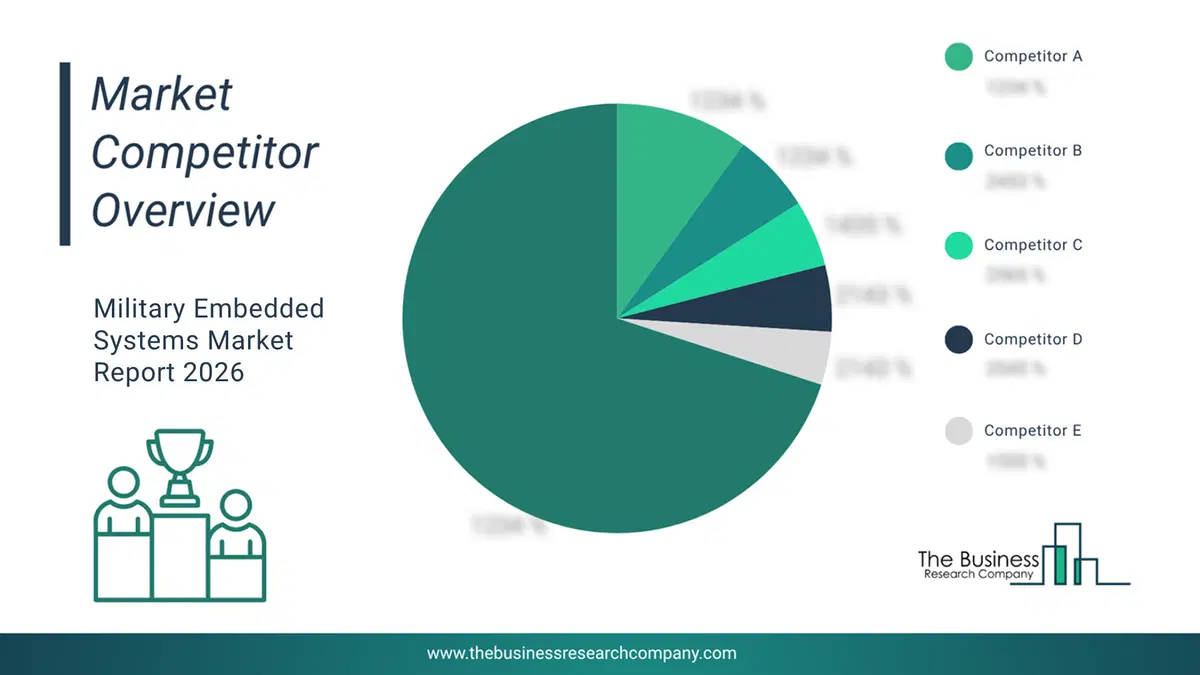
This chart is for illustrative purposes; the full report includes a detailed competitor analysis and comprehensive overview of the top 10 companies in the market.
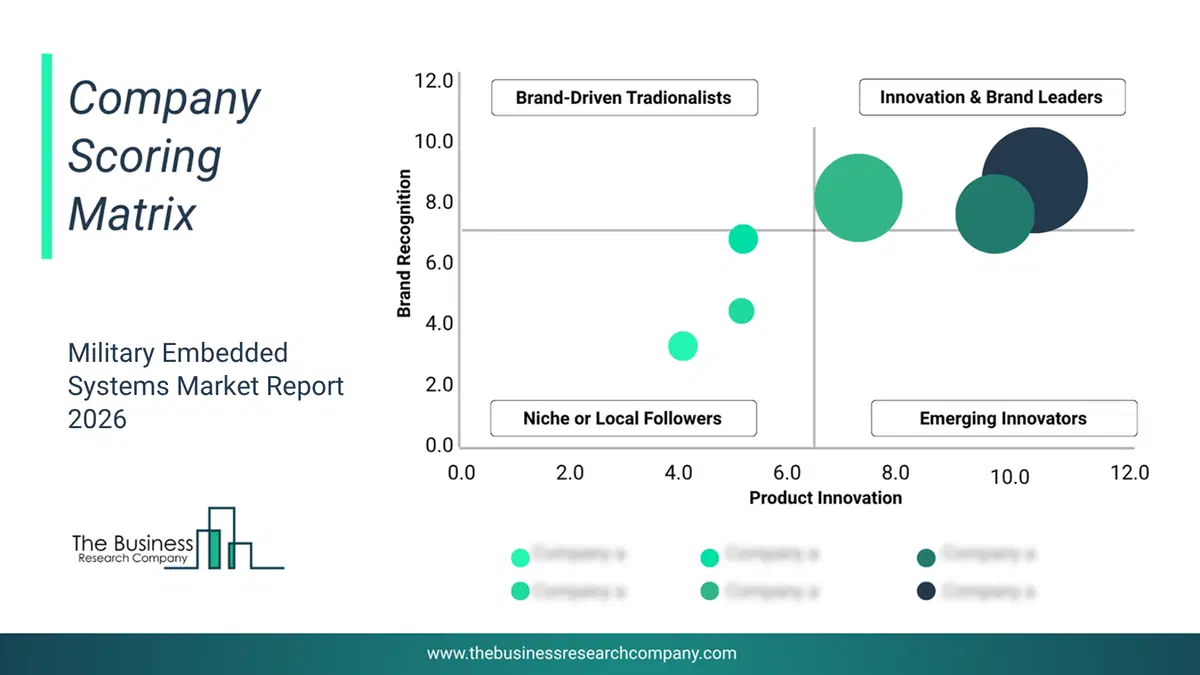
This chart maps companies by product innovation and brand strength, with bubble size indicating relative revenue, helping identify market leaders, challengers, and niche players. This is an illustrative chart; the full report provides a complete and accurate competitive analysis.
Global Military Embedded Systems Market Trends and Insights
Major companies operating in the military embedded systems market are focusing on developing advanced solutions such as extreme-rugged, waterproof embedded computing platforms to enhance mission resilience and operational reliability. The rugged, waterproof, embedded computing platforms are designed to withstand harsh environments and use robust sealing ratings, hardened chassis materials, and military-grade shock and vibration compliance so that they can operate reliably under extreme conditions. For instance, in February 2024, Neousys Technology, a Taiwan-based provider of rugged embedded systems, launched its SEMIL-2000 series featuring IP69K-rated waterproof and shock-hardened embedded computers. The new SEMIL-2000 series supports Intel 14th/13th/12th Gen LGA1700 processors and offers a variant with NVIDIA L4 GPU. The chassis combines corrosion-proof stainless steel and aluminum, and the system meets MIL-STD-810H for shock and vibration in dusty, humid, and corrosive environments. The systems can operate across 40°C to 70°C, and the IP69K rating enables survival of high-pressure 80°C water jets from various angles. They support a DC input of 8 V to 48 V with ignition power control and reverse polarity protection, use M12 connectors, and include seven Ethernet ports (two 10 GbE, one GbE, and four 2.5 GbE PoE+) plus two USB 3.2 Gen1 Type-C ports with DisplayPort alternate mode.What Are Latest Mergers And Acquisitions In The Military Embedded Systems Market? Honeywell Bolsters Aerospace And Defense Capabilities With CAES Systems Purchase
In September 2024, Honeywell International Inc., a US-based industrial technology company, acquired CAES Systems Holdings LLC (CAES) for $1.9 billion. The acquisition allows Honeywell to bolster its defense and aerospace portfolio by integrating CAES' advanced radio frequency (RF) technologies. CAES Systems Holdings LLC (CAES) is a US-based military electronic equipment provider specializing in embedded systems.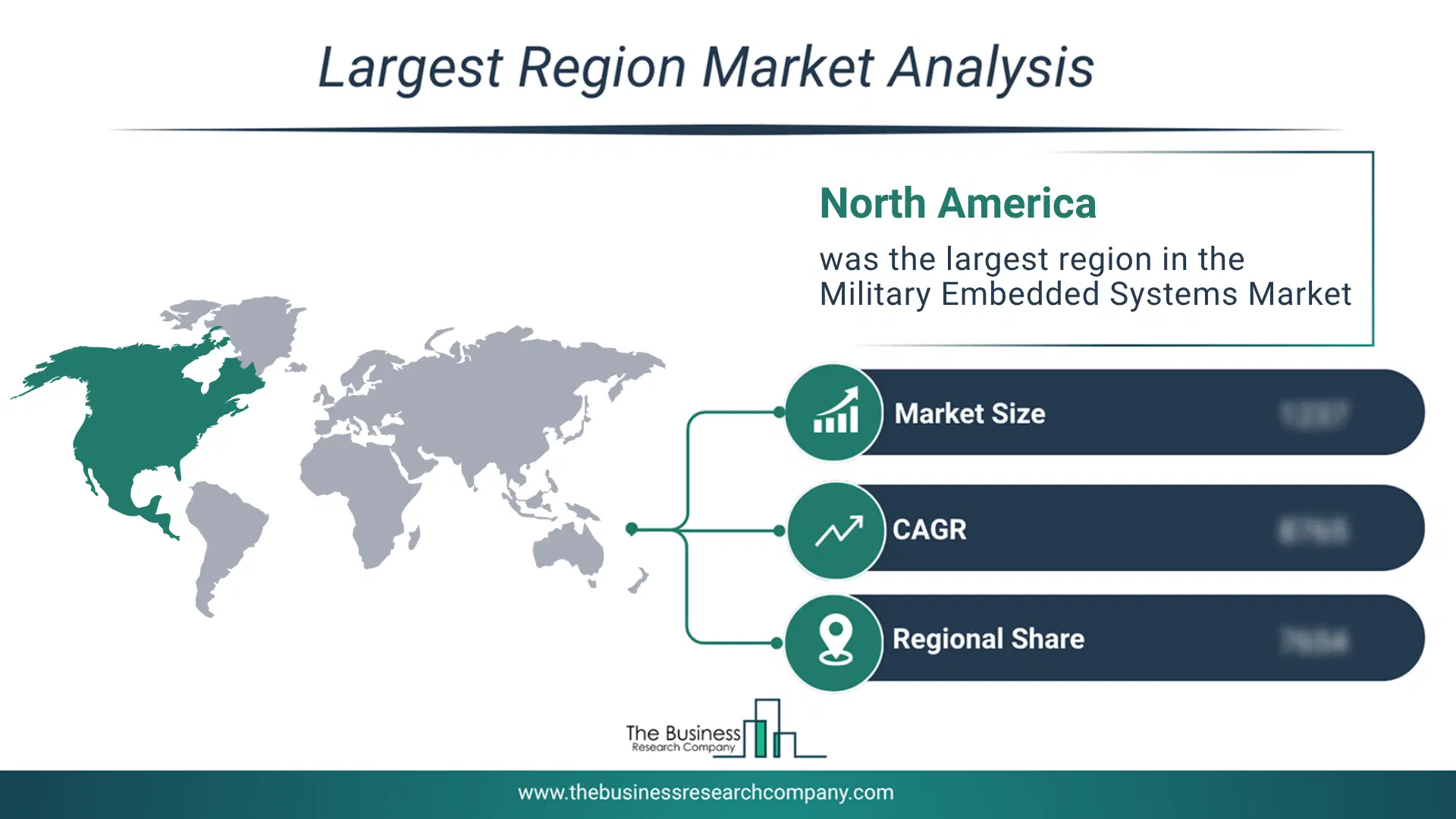
Regional Insights
North America was the largest region in the military embedded systems market in 2025. Asia-Pacific is expected to be the fastest-growing region in the military embedded systems market report during the forecast period. The regions covered in this market report are Asia-Pacific, South East Asia, Western Europe, Eastern Europe, North America, South America, Middle East, Africa. The countries covered in this market report are Australia, Brazil, China, France, Germany, India, Indonesia, Japan, Taiwan, Russia, South Korea, UK, USA, Canada, Italy, SpainWhat Defines the Military Embedded Systems Market?
The military embedded systems market includes revenues earned by entities by providing services such as intelligence, surveillance, reconnaissance (ISR), communication, navigation, command, and control. The market value includes the value of related goods sold by the service provider or included within the service offering. Only goods and services traded between entities or sold to end consumers are included.How is Market Value Defined and Measured?
The market value is defined as the revenues that enterprises gain from the sale of goods and/or services within the specified market and geography through sales, grants, or donations in terms of the currency (in USD unless otherwise specified). The revenues for a specified geography are consumption values that are revenues generated by organizations in the specified geography within the market, irrespective of where they are produced. It does not include revenues from resales along the supply chain, either further along the supply chain or as part of other products.
This chart presents market attractiveness based on a quantitative evaluation of growth, competition, strategic alignment, and risk, offering a clear view of opportunity areas for decision-making. This chart is for illustrative purposes; the full report contains the complete analysis.

This chart highlights the Total Addressable Market (TAM) by estimating the maximum revenue opportunity using an assumption-driven approach, supporting strategic planning and opportunity sizing across markets. The chart is illustrative; the full report provides a more comprehensive analysis.
What Key Data and Analysis Are Included in the Military Embedded Systems Market Report 2026?
The military embedded systems market research report is one of a series of new reports from The Business Research Company that provides market statistics, including industry global market size, regional shares, competitors with the market share, detailed market segments, market trends and opportunities, and any further data you may need to thrive in the military embedded systems industry. The market research report delivers a complete perspective of everything you need, with an in-depth analysis of the current and future state of the industry.Military Embedded Systems Market Report Forecast Analysis
| Report Attribute | Details |
|---|---|
| Market Size Value In 2026 | $2.04 billion |
| Revenue Forecast In 2030 | $2.77 billion |
| Growth Rate | CAGR of 8.1% from 2026 to 2030 |
| Base Year For Estimation | 2025 |
| Actual Estimates/Historical Data | 2020-2025 |
| Forecast Period | 2026 - 2030 |
| Market Representation | Revenue in USD Billion and CAGR from 2026 to 2030 |
| Segments Covered | Component, Installation Type, Platform, Technology, Application |
| Regional Scope | Asia-Pacific, Western Europe, Eastern Europe, North America, South America, Middle East, Africa |
| Country Scope | The countries covered in the report are Australia, Brazil, China, France, Germany, India, Indonesia, Japan, Taiwan, Russia, South Korea, UK, USA, Canada, Italy, Spain. |
| Key Companies Profiled | Xilinx Inc., Mercury Systems Inc., Curtiss-Wright Corporation, Kontron (S&T), SMART Embedded Computing, Advantech Co Ltd., Thales Group, Abaco Systems, Microsemi Corporation, General Micro Systems Inc., BAE Systems, Intel Corporation, Radisys Corporation, Telephonics Corporation, General Dynamics Corporation, Raytheon Company, Rockwell Collins, AMETEK, Saab AB, Boeing, Concurrent Technologies, Crystal Group Inc., Elma Electronic Inc., Excalibur Systems, Northrop Grumman Corporation, ECRIN Systems, Harris Corporation, Honeywell International Inc., IBM Corporation |
| Customization Scope | Request for Customization |
| Pricing And Purchase Options | Explore Purchase Options |