

Military Land Vehicles Market 2026
By Product Type (Infantry Fighting Vehicles, Armored Personnel Carriers, Main Battle Tanks, Light Multi-Role Vehicles, Tactical Trucks, Other Product Types), By Offering (Platforms, Services), By Application (Defense, Transportation, Others), And By Region, Opportunities And Strategies – Global Forecast To 2035
Military Land Vehicles Market Definition
Military land vehicles are ground-based vehicles specifically designed and engineered for defense, combat, and tactical support operations. They include categories such as main battle tanks, armored personnel carriers (APCs), infantry fighting vehicles (IFVs), self-propelled artillery, reconnaissance vehicles, and logistics trucks. These vehicles are built to provide mobility, protection, and combat effectiveness across diverse terrains and conflict scenarios. The primary purpose of military land vehicles is to support armed forces by enhancing mobility, firepower, and survivability in combat zones. The military land vehicles market consists of sales by entities (organizations, sole traders and partnerships) of military land vehicles that are used by national defense forces, paramilitary units, internal security forces and peacekeeping contingents. They are utilized during combat operations, training exercises, border patrols, humanitarian missions and internal security activities.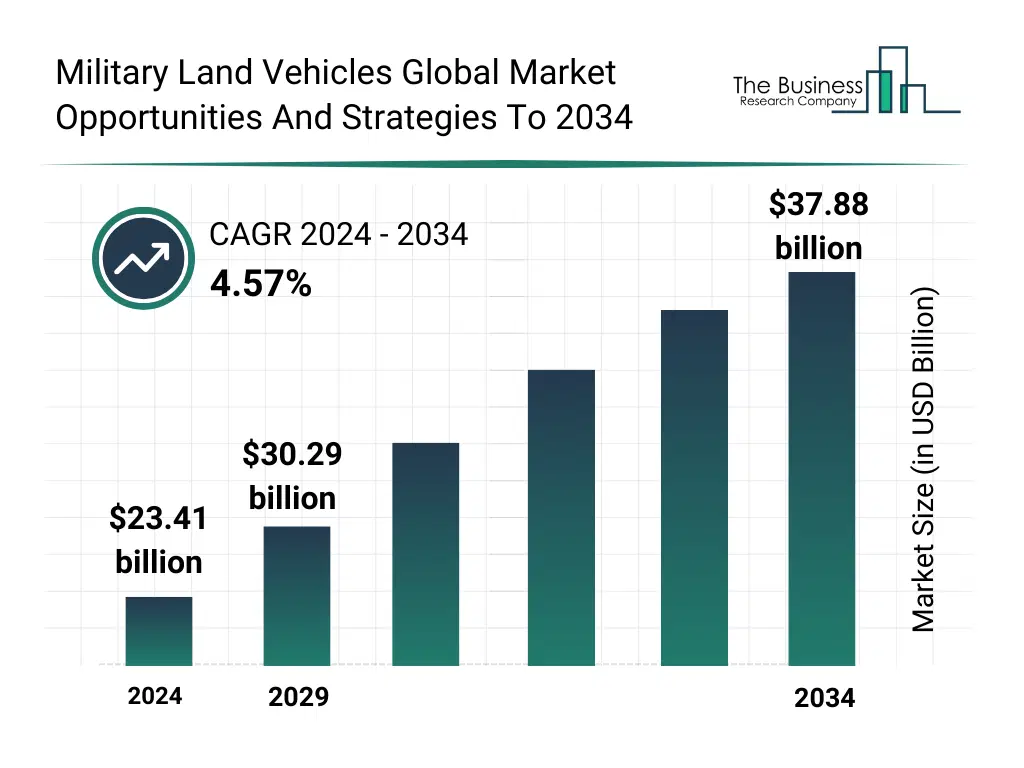
Military Land Vehicles Market Size
The global military land vehicles market reached a value of nearly $23,408.34 million in 2024, having grown at a compound annual growth rate (CAGR) of 3.64% since 2019. The market is expected to grow from $23,408.34 million in 2024 to $30,288.34 million in 2029 at a rate of 5.29%. The market is then expected to grow at a CAGR of 4.57% from 2029 and reach $37,879.65 million in 2034. Growth in the historic period resulted from the expanding military modernization programs, rising geopolitical tensions, rise in urban unrest and riot situations and surge in cross-border smuggling and trans bordering. Factors that negatively affected growth in the historic period were high procurement costs and strict military standards and certifications. Going forward, the expansion of military forces, rising homeland disaster and crisis response, rise in counter-terrorism operations and rising defense budgets will drive the growth. Factors that could hinder the growth of the military land vehicles market in the future include training and crew readiness gaps, maintenance challenges in harsh terrains and impact of trade war and tariff.Military Land Vehicles Market Drivers
The key drivers of the military land vehicles market include: Rising Defense Budgets During the forecast period, rising defense budgets will propel the growth of the military land vehicles market. As nations commit larger shares of their national budgets to bolster military readiness and capability, defense ministries will allocate more funds toward capital-intensive assets like land platforms. The uptick in defense spending makes procurement of upgraded armored vehicles, logistics carriers and tactical transport units more feasible, turning budget increases into concrete investments in land-based military infrastructure. The rising defense budgets growth contribution during the forecast period in 2024 is 2.00%.Military Land Vehicles Market Restraints
The key restraints on the military land vehicles market include: Maintenance Challenges In Harsh Terrains During the forecast period, maintenance challenges in harsh terrains will restrict the growth of the military land vehicles market. Vehicles operating in deserts, mountains, jungles and frozen zones face accelerated wear, corrosion, component fatigue and increased risk of mechanical failure. Ensuring vehicle availability under such conditions demands highly rugged designs, frequent overhauls and well-stocked spare parts, which escalate both operational and life-cycle costs. When logistical networks are stretched or infrastructure lacking, the time and expense of repair multiply, reducing mission readiness and inflating total ownership costs. These maintenance burdens can discourage procurement of advanced but fragile systems and lead to prioritizing simpler or lower-capacity vehicles over more capable platforms. Growth affected by maintenance challenges in harsh terrains across regions during the forecast period in 2024 is -2.25%.Military Land Vehicles Market Trends
Major trends shaping the military land vehicles market include: Launch Of All-Terrain Vehicle For Extreme Battlefield Mobility Major companies in the military land vehicles market are focusing on the launch of all-terrain vehicles for extreme battlefield mobility. An all-terrain vehicle (ATV) is a small, motorized vehicle designed to travel on a wide variety of surfaces, dirt, sand, mud, snow, rocky trails, and other off-road conditions, where normal cars or motorcycles can’t easily go. For example, in September 2025, Patria, a Finnish defense firm that provides lifecycle support, technology solutions, and products for military, aviation, and security applications, introduced TRACKX, a tracked all-terrain vehicle the company describes as its “ultimate” platform for extreme battlefield mobility. Designed to operate across snow, forests, roads, and water, the vehicle carries up to 12 troops, including a driver and a commander, and offers NATO (North Atlantic Treaty Organization)-standard protection against ballistics and mines. Emergence Of Amphibious And Modular IFVs For Multi-Terrain Flexibility Key companies in the infantry fighting vehicles (IFV) segment are increasingly developing amphibious and modular platforms that can be reconfigured for missions across water, urban and off-road terrain, boosting operational flexibility for mechanized forces. For instance, in September 2025, Excalibur Army, a Czechia-based armored vehicle manufacturer, unveiled the Pandur II 8×8 EVO, a modular variant of its Pandur II IFV at International Defence and Security Technologies Fair (IDET) 2025. This version features a new unmanned 30 mm turret, advanced protection up to Standardization Agreement (STANAG) Level 4, improved suspension and amphibious capabilities, along with digital architecture for battlefield management. By integrating modularity and terrain adaptability, the Pandur II EVO helps armies reduce fleet diversity and respond quickly to changing mission profiles while aligning with NATO standards.Opportunities And Recommendations In The Military Land Vehicles Market
Opportunities – The top opportunities in the military land vehicles market segmented by product type will arise in the infantry fighting vehicles segment, which will gain $2,402.83 million of global annual sales by 2029. The top opportunities in the military land vehicles market segmented by offering will arise in the platform segment, which will gain $4,107.35 million of global annual sales by 2029. The top opportunities in the military land vehicles market segmented by application will arise in the defense segment, which will gain $4,637.87 million of global annual sales by 2029. The military land vehicles market size will gain the most in the USA at $1,025.88 million. Recommendations- To take advantage of the opportunities, The Business Research Company recommends the military land vehicles companies to focus on developing all-terrain vehicles for extreme battlefield operations, focus on amphibious and modular infantry fighting vehicles for multi-terrain operations, focus on next-generation tactical trucks with enhanced mobility and connectivity, focus on autonomous and teleoperated military ground vehicles for logistics, focus on light armored multi-role vehicles for rapid deployment and export, focus on digital battlefield management integration in armored platforms, focus on MRAP-level protection and multi-role armored vehicles, focus on next-generation infantry fighting vehicles with digital integration, focus on platform development for multi-mission flexibility, expand in emerging markets, continue to focus on developed markets, provide competitively priced offerings, continue to use B2B promotions, participate in trade shows and events and focus on battlefield support and modular upgrades.
Military Land Vehicles Market Segmentation
The military land vehicles market is segmented by product type, by offering and by application.By Product Type –
The military land vehicles market is segmented by product type into:
- a) Infantry Fighting Vehicles
- b) Armored Personnel Carriers
- c) Main Battle Tanks
- d) Light Multi-Role Vehicles
- e) Tactical Trucks
- f) Other Product Types
By Offering –
The military land vehicles market is segmented by offering into:
- a) Platforms
- b) Services
By Application –
The military land vehicles market is segmented by application into:
- a) Defense
- b) Transportation
- c) Others
By Geography - The military land vehicles market is segmented by geography into:
- • China
- • India
- • Japan
- • Australia
- • Indonesia
- • South Korea
- • USA
- • Canada
- • Brazil
- • France
- • Germany
- • UK
- • Italy
- • Spain
- • Russia
-
o Asia Pacific
o Africa