
Military Optical Fiber Sensor Market Report 2026
Global Outlook – By Type (Intrinsic Sensors, Extrinsic Sensors), By Platform (Airborne, Naval, Ground), By Application (Temperature Sensing, Pressure Sensing), By End-User (Defense, Homeland Security) – Market Size, Trends, Strategies, and Forecast to 2030
Military Optical Fiber Sensor Market Overview
• Military Optical Fiber Sensor market size has reached to $1.29 billion in 2025 • Expected to grow to $2.08 billion in 2030 at a compound annual growth rate (CAGR) of 10% • Growth Driver: Increasing Adoption Of Unmanned Systems Fueling The Growth Of The Market Due To Rising Demand For Precision And Stealth In Defense Operations • Market Trend: Real-Time Fiber-Optic Monitoring Enhances Defense Infrastructure Protection • North America was the largest region in 2025 and Asia-Pacific is the fastest growing region.What Is Covered Under Military Optical Fiber Sensor Market?
Military optical fiber sensor refers to a sensing device that uses optical fibers to detect physical, chemical, or environmental changes in military applications. These sensors are valued for their high sensitivity, immunity to electromagnetic interference, lightweight nature, and ability to function in harsh environments, making them suitable for defense systems such as structural health monitoring, perimeter security, and underwater surveillance. The main types of military optical fiber sensors are intrinsic sensors and extrinsic sensors. Intrinsic sensors operate by detecting changes within the optical fiber itself. These sensors are utilized across various platforms, including airborne, naval, and ground systems. They are primarily used for applications such as temperature and pressure sensing, for varied end users including defense and homeland security.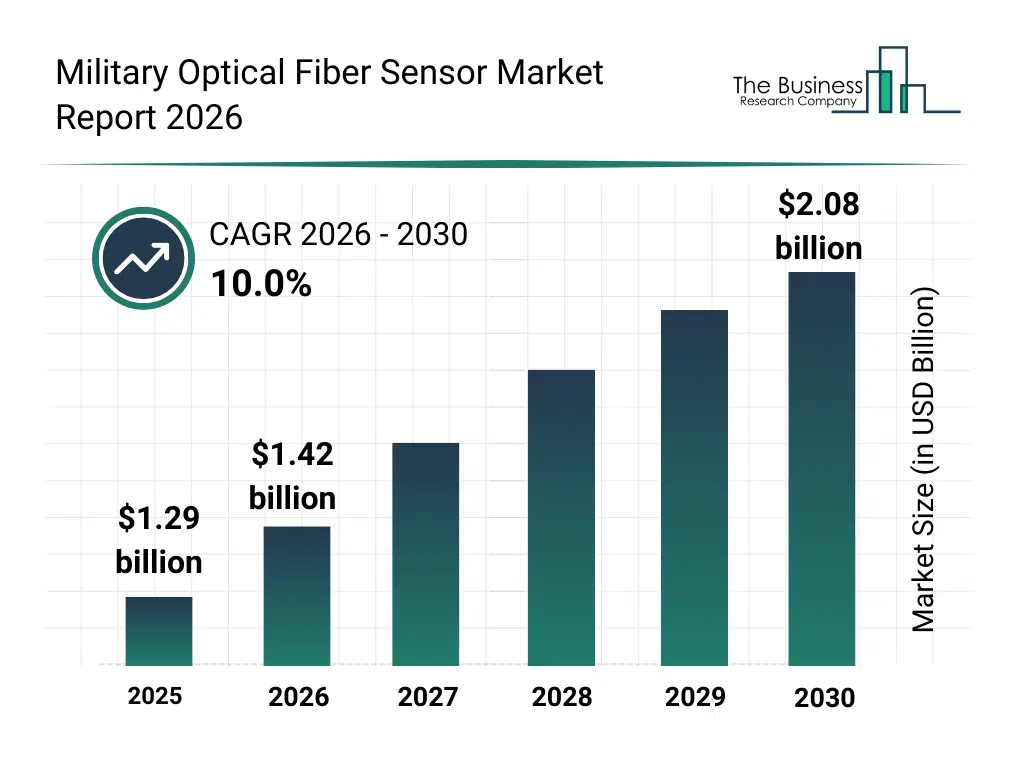
What Is The Military Optical Fiber Sensor Market Size and Share 2026?
The military optical fiber sensor market size has grown rapidly in recent years. It will grow from $1.29 billion in 2025 to $1.42 billion in 2026 at a compound annual growth rate (CAGR) of 10.1%. The growth in the historic period can be attributed to growing adoption of optical fiber sensors for structural health monitoring in military platforms, increasing use of distributed acoustic sensing for perimeter and underwater surveillance, advancements in fiber bragg grating technology improving measurement accuracy, rising need for electromagnetic interference–immune sensors in electronic warfare environments, expansion of defense research programs supporting development of advanced fiber sensing solutions.What Is The Military Optical Fiber Sensor Market Growth Forecast?
The military optical fiber sensor market size is expected to see rapid growth in the next few years. It will grow to $2.08 billion in 2030 at a compound annual growth rate (CAGR) of 10.0%. The growth in the forecast period can be attributed to growing demand for high-resolution distributed temperature sensing in critical defense infrastructure, increasing integration of optical fiber sensors into autonomous and unmanned defense systems, rising investment in multi-parameter sensing solutions for enhanced battlefield awareness, expansion of military modernization efforts requiring advanced sensing technologies, accelerating innovation in ruggedized and miniaturized fiber sensor designs for harsh operational environments. Major trends in the forecast period include increased deployment of distributed acoustic sensing (das) for perimeter and border surveillance, rising demand for fbg-based structural health monitoring across military platforms, growth in underwater fiber-optic sensing systems for naval intelligence and anti-submarine missions, integration of optical fiber sensors into advanced missile and uav guidance systems, adoption of ruggedized fiber-optic sensor solutions for extreme battlefield environments.
Global Military Optical Fiber Sensor Market Segmentation
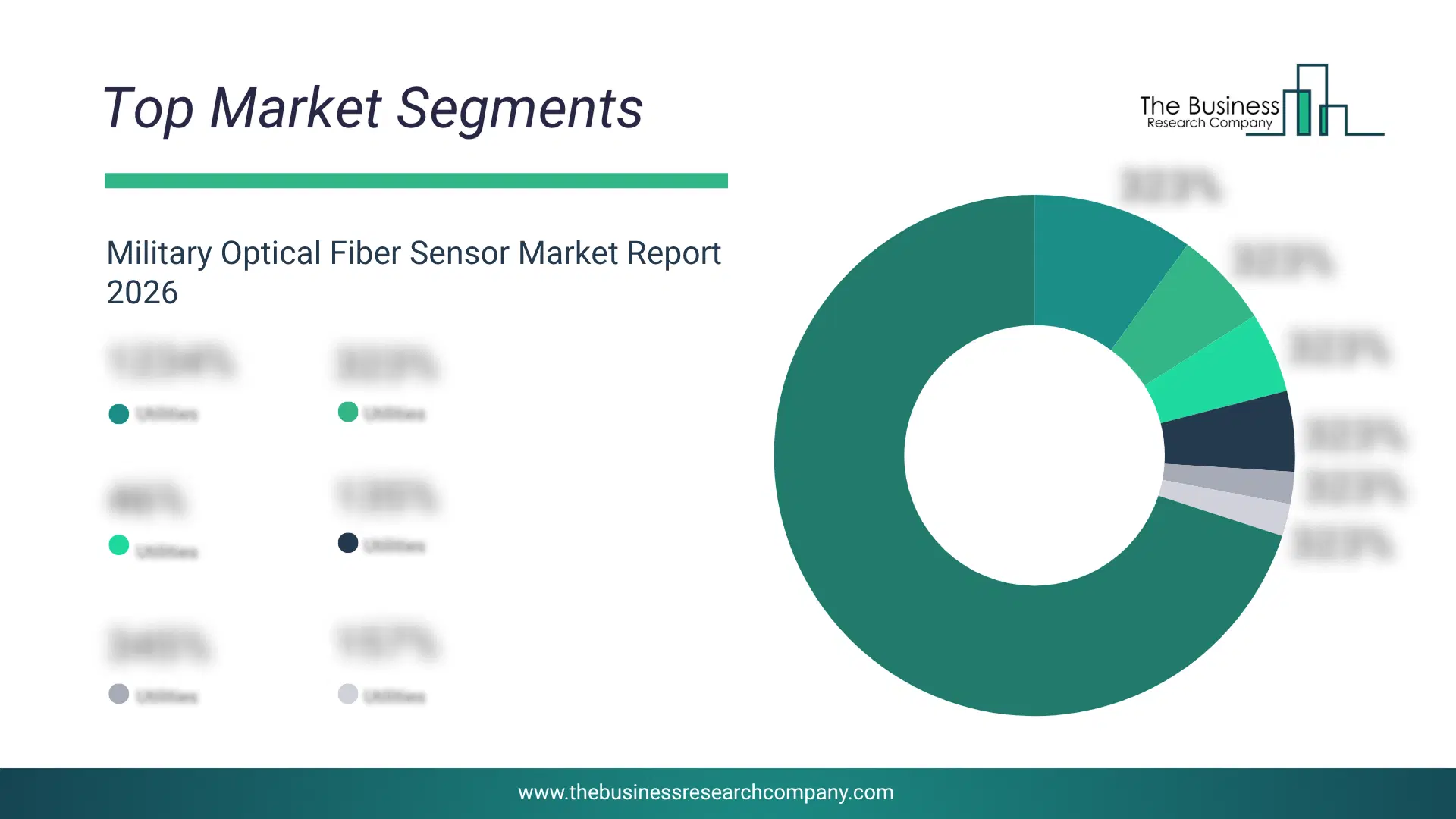
1) By Type: Intrinsic Sensors, Extrinsic Sensors 2) By Platform: Airborne, Naval, Ground 3) By Application: Temperature Sensing, Pressure Sensing 4) By End-User: Defense, Homeland Security Subsegments: 1) By Intrinsic Sensors: Fiber Bragg Grating (FBG) Sensors, Distributed Temperature Sensors (DTS), Distributed Acoustic Sensors (DAS), Interferometric Sensors 2) By Extrinsic Sensors: Intensity-Modulated Sensors, Phase-Modulated Sensors, Polarization-Modulated Sensors, Wavelength-Modulated SensorsWhat Is Driver Of The Military Optical Fiber Sensor Market?
The increasing adoption of unmanned systems is expected to propel the growth of the military optical fiber sensor market going forward. Unmanned systems are remotely operated or autonomous platforms deployed across air, land, sea, or space to carry out surveillance, reconnaissance, and combat without requiring a human operator onboard. Adoption of unmanned systems is rising due to the ability to undertake high-risk missions while minimizing danger to human personnel, improving safety and operational efficiency. Military optical fiber sensors enhance the performance of unmanned systems by providing precise sensing and communication functions with low electromagnetic interference, which is vital for stealth and mission-critical applications. For instance, in May 2024, the International Trade Administration, a US-based government agency, there was a 40% rise in the global number of commercially operated drones between 2022 and 2030. Therefore, the increasing adoption of unmanned systems drives the growth of the military optical fiber sensor industry.Key Players In The Global Military Optical Fiber Sensor Market
Major companies operating in the military optical fiber sensor market are Northrop Grumman Corporation, Honeywell International Inc., Prysmian Group, Corning Incorporated, AFL Telecommunications LLC, Exail Holding, Gooch & Housego PLC., KVH Industries Inc., Luna Innovations Incorporated., NKT Photonics A/S, Opsens Solutions Inc., FISO Technologies Inc., Timbercon Inc., Roctest Ltd., AP Sensing GmbH, Ava Risk Group Limited, ITF Technologies Inc., MagiQ Technologies Inc., FBGS Technologies GmbH, Fiber SenSys Inc,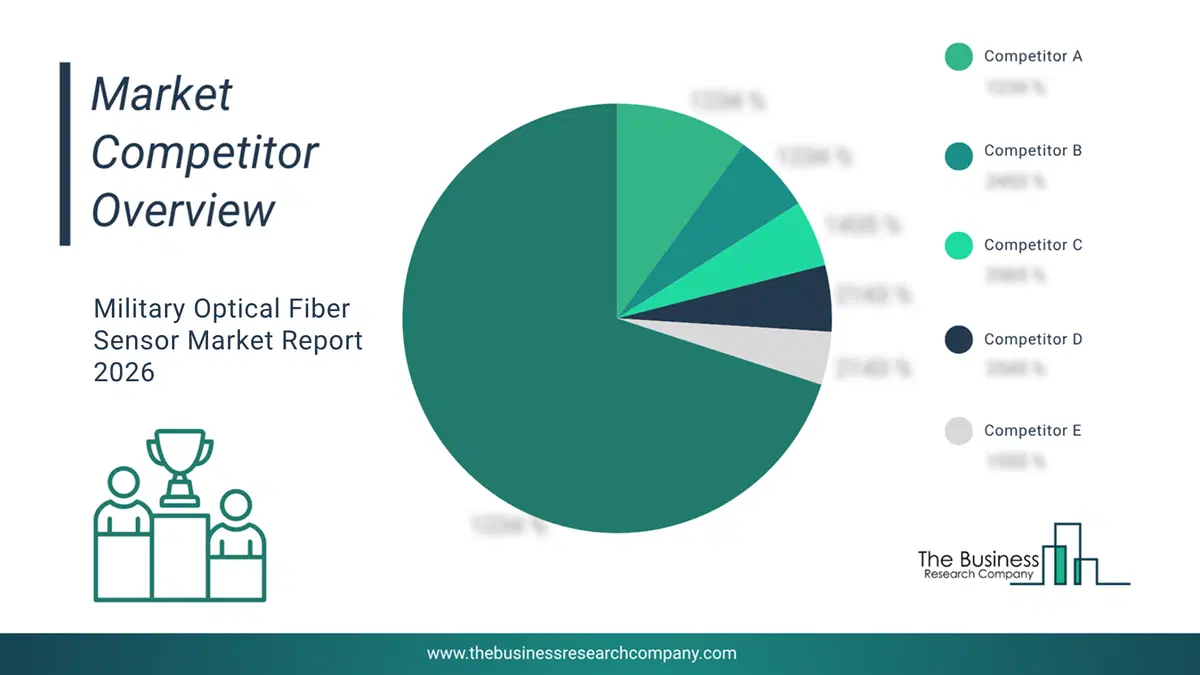
This chart is for illustrative purposes; the full report includes a detailed competitor analysis and comprehensive overview of the top 10 companies in the market.
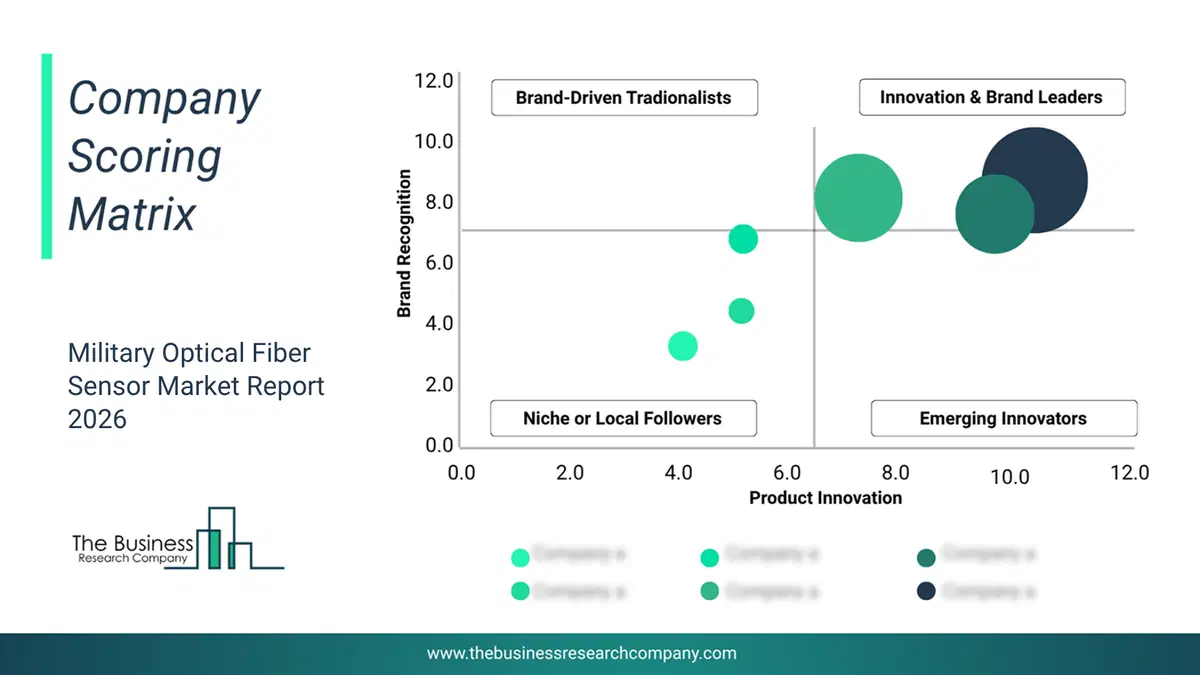
This chart maps companies by product innovation and brand strength, with bubble size indicating relative revenue, helping identify market leaders, challengers, and niche players. This is an illustrative chart; the full report provides a complete and accurate competitive analysis.
Global Military Optical Fiber Sensor Market Trends and Insights
Major companies operating in the military optical fiber sensors market are focusing on developing innovative solutions such as real-time, distributed fiber-optic monitoring systems to enhance threat detection, structural health monitoring, and situational awareness across defense platforms. A real-time, distributed fiber-optic monitoring system is a sensing technology that utilizes optical fibers to continuously and simultaneously detect physical changes such as strain, temperature, or vibration along their entire length in real-time. For instance, in July 2024, VIAVI Solutions Inc., a US-based communications equipment company, launched NITRO fiber sensing for real-time, distributed fiber-optic monitoring in the military and critical infrastructure. This solution delivers continuous, real-time critical infrastructure monitoring using advanced fiber-optic cable and fiber-enabled technologies to detect, pinpoint, and mitigate threats, reducing downtime and lowering ownership costs. Its proactive alerting and accurate location capabilities support rapid response and maintenance, improving efficiency, security, and asset protection across multiple industries.What Are Latest Mergers And Acquisitions In The Military Optical Fiber Sensor Market? Luna Innovations Acquired Silixa To Boost Global Fiber Optic Sensing Capabilities
In December 2023, Luna Innovations Incorporated, a US-based aerospace company, acquired Silixa Ltd. for an undisclosed amount. Through this acquisition, Luna Innovations Incorporated seeks to enhance its global footprint and drive innovation in fiber optic sensing. Silixa Ltd. is a UK-based manufacturing company specializing in distributed fiber optic sensing technologies for military applications.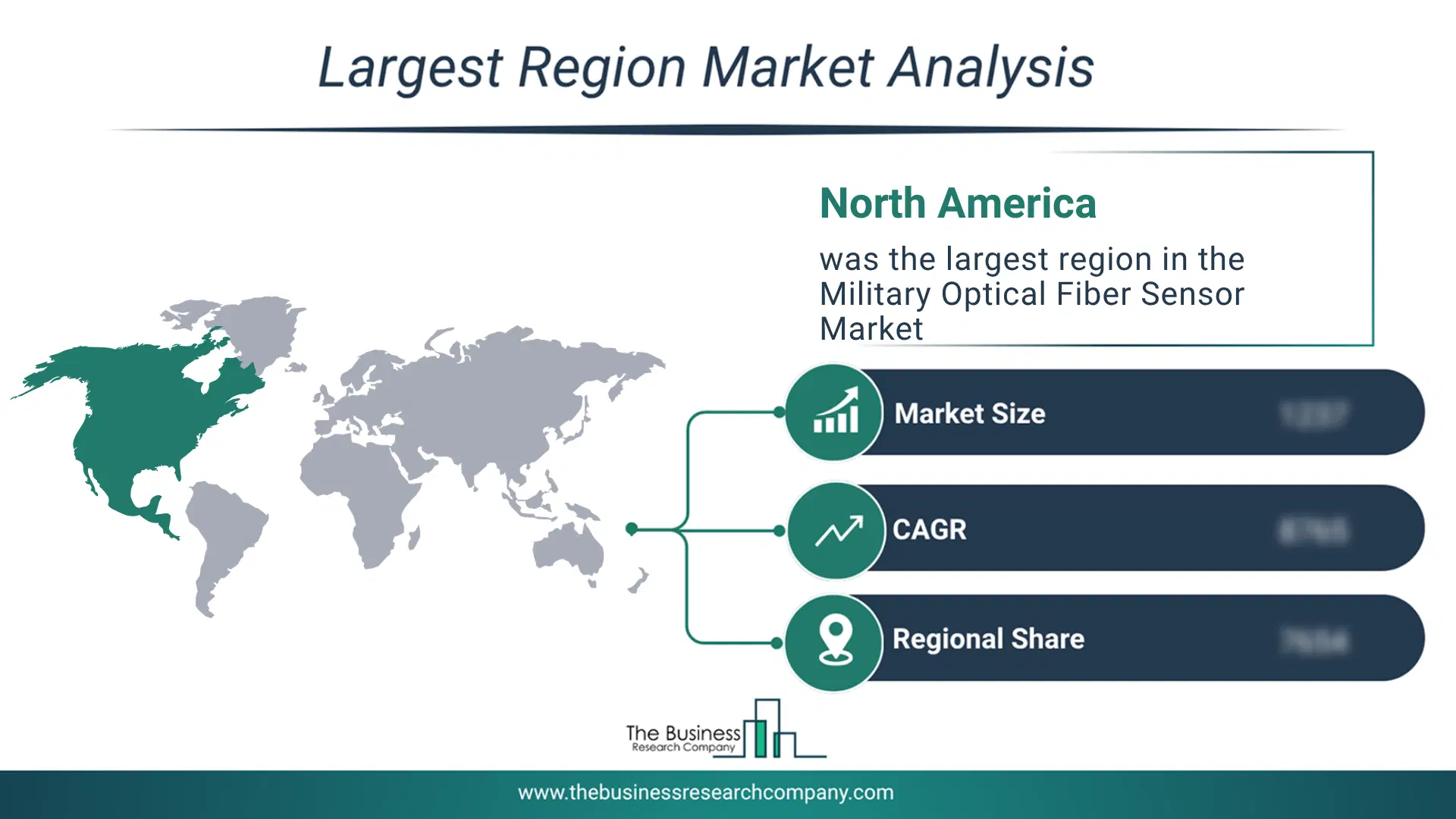
Regional Insights
North America was the largest region in the military optical fiber sensor market in 2025. Asia-Pacific is expected to be the fastest-growing region in the forecast period. The regions covered in this market report are Asia-Pacific, South East Asia, Western Europe, Eastern Europe, North America, South America, Middle East, Africa. The countries covered in this market report are Australia, Brazil, China, France, Germany, India, Indonesia, Japan, Taiwan, Russia, South Korea, UK, USA, Canada, Italy, SpainWhat Defines the Military Optical Fiber Sensor Market?
The military optical fiber sensor market consists of revenues earned by entities by providing services such as thermal monitoring, electronic warfare support, and seismic activity monitoring. The market value includes the value of related goods sold by the service provider or included within the service offering. The military optical fiber sensor market also includes sales of fiber bragg grating (FBG) sensors, distributed temperature sensors, and distributed acoustic sensors. Values in this market are ‘factory gate’ values, that is, the value of goods sold by the manufacturers or creators of the goods, whether to other entities (including downstream manufacturers, wholesalers, distributors, and retailers) or directly to end customers. The value of goods in this market includes related services sold by the creators of the goods.How is Market Value Defined and Measured?
The market value is defined as the revenues that enterprises gain from the sale of goods and/or services within the specified market and geography through sales, grants, or donations in terms of the currency (in USD unless otherwise specified). The revenues for a specified geography are consumption values that are revenues generated by organizations in the specified geography within the market, irrespective of where they are produced. It does not include revenues from resales along the supply chain, either further along the supply chain or as part of other products.
This chart presents market attractiveness based on a quantitative evaluation of growth, competition, strategic alignment, and risk, offering a clear view of opportunity areas for decision-making. This chart is for illustrative purposes; the full report contains the complete analysis.

This chart highlights the Total Addressable Market (TAM) by estimating the maximum revenue opportunity using an assumption-driven approach, supporting strategic planning and opportunity sizing across markets. The chart is illustrative; the full report provides a more comprehensive analysis.
What Key Data and Analysis Are Included in the Military Optical Fiber Sensor Market Report 2026?
The military optical fiber sensor market research report is one of a series of new reports from The Business Research Company that provides market statistics, including industry global market size, regional shares, competitors with the market share, detailed market segments, market trends and opportunities, and any further data you may need to thrive in the military optical fiber sensor industry. The market research report delivers a complete perspective of everything you need, with an in-depth analysis of the current and future state of the industry.Military Optical Fiber Sensor Market Report Forecast Analysis
| Report Attribute | Details |
|---|---|
| Market Size Value In 2026 | $1.42 billion |
| Revenue Forecast In 2030 | $2.08 billion |
| Growth Rate | CAGR of 10% from 2026 to 2030 |
| Base Year For Estimation | 2025 |
| Actual Estimates/Historical Data | 2020-2025 |
| Forecast Period | 2026 - 2030 |
| Market Representation | Revenue in USD Billion and CAGR from 2026 to 2030 |
| Segments Covered | Type, Platform, Application, End-User |
| Regional Scope | Asia-Pacific, Western Europe, Eastern Europe, North America, South America, Middle East, Africa |
| Country Scope | The countries covered in the military optical fiber sensor market report are Australia, Brazil, China, France, Germany, India, Indonesia, Japan, Taiwan, Russia, South Korea, UK, USA, Canada, Italy, Spain |
| Key Companies Profiled | Northrop Grumman Corporation, Honeywell International Inc., Prysmian Group, Corning Incorporated, AFL Telecommunications LLC, Exail Holding, Gooch & Housego PLC., KVH Industries Inc., Luna Innovations Incorporated., NKT Photonics A/S, Opsens Solutions Inc., FISO Technologies Inc., Timbercon Inc., Roctest Ltd., AP Sensing GmbH, Ava Risk Group Limited, ITF Technologies Inc., MagiQ Technologies Inc., FBGS Technologies GmbH, Fiber SenSys Inc, |
| Customization Scope | Request for Customization |
| Pricing And Purchase Options | Explore Purchase Options |