
Military Rechargeable Battery Market Report 2026
Global Outlook – By Battery Chemistry (Lithium-Ion Batteries, Nickel-Cadmium Batteries, Nickel-Metal Hydride Batteries, Lead-Acid Batteries, Sodium-Ion Batteries), By Form Factor (Standard Size Batteries, Custom Or Specialized Designs, Modular Battery Packs, Portable Power Devices), By Capacity (Below 1000 mAh, 1000 mAh to 5000 mAh, 5000 mAh to 10000 mAh, Above 10000 mAh), By Application (Communication Systems, Surveillance Equipment, Unmanned Aerial Vehicles (UAVs), Ground Vehicles, Weapon Systems), By End-Use (Army, Navy, Air Force, Special Forces, Defense Contractors) – Market Size, Trends, Strategies, and Forecast to 2030
Military Rechargeable Battery Market Overview
• Military Rechargeable Battery market size has reached to $1.53 billion in 2025 • Expected to grow to $2.21 billion in 2030 at a compound annual growth rate (CAGR) of 7.6% • Growth Driver: Rising Adoption Of Unmanned Aerial Vehicles Fuels Growth In The Market Due To Increasing Demand For Reliable, Long-Endurance Power Solutions • Market Trend: Advancements In Lightweight Lithium-Ion Battery Technology Enhancing Power Efficiency In Defense Applications • North America was the largest region in 2025 and Asia-Pacific is the fastest growing region.What Is Covered Under Military Rechargeable Battery Market?
A military rechargeable battery refers to an energy storage device specifically designed for military applications, capable of being recharged and reused multiple times. These batteries are engineered to deliver high performance, durability, and reliability under extreme environmental conditions and are used in various systems such as communication equipment, unmanned vehicles, weapon systems, and portable electronic devices in defense operations. The main battery chemistry types of military rechargeable batteries are lithium-ion batteries, nickel-cadmium batteries, nickel-metal hydride batteries, lead-acid batteries, and sodium-ion batteries. Lithium-ion batteries are rechargeable energy storage devices that utilize lithium ions for electrochemical reactions, offering high energy density, low weight, and long lifespan. It is available in different form factors, ranging from standard-size batteries and custom or specialized designs to modular battery packs and portable power devices with varied capacities including below 1000 milliampere hour (mAh), 1000 milliampere hour (mAh) to 5000 milliampere hour (mAh), 5000 milliampere hour (mAh) to 10000 milliampere hour (mAh), and above 10000 milliampere hour (mAh). These batteries are used in a variety of applications such as communication systems, surveillance equipment, unmanned aerial vehicles (UAVs), ground vehicles, and weapon systems for different end users, including the army, navy, air force, special forces, and defense contractors.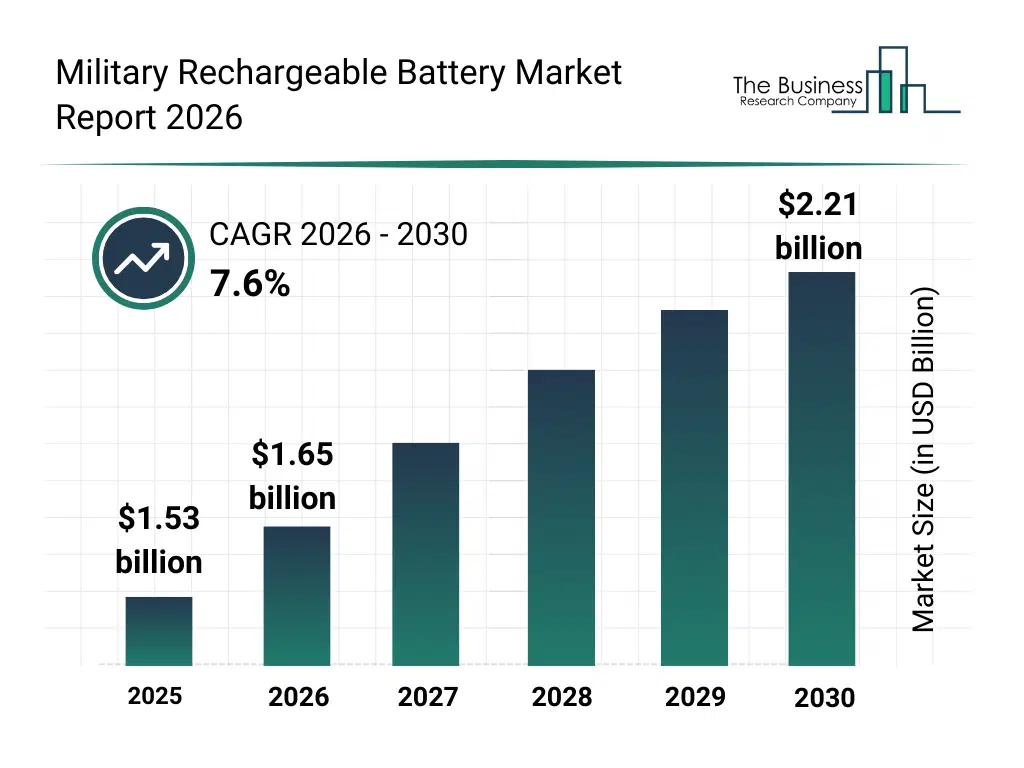
What Is The Military Rechargeable Battery Market Size and Share 2026?
The military rechargeable battery market size has grown strongly in recent years. It will grow from $1.53 billion in 2025 to $1.65 billion in 2026 at a compound annual growth rate (CAGR) of 7.8%. The growth in the historic period can be attributed to increasing deployment of portable military electronics requiring reliable rechargeable power sources, rising adoption of lithium-based batteries for higher energy density in defense systems, growth in unmanned vehicles and sensor networks boosting demand for durable batteries, advancements in rugged battery designs improving performance in extreme conditions, expanding defense budgets supporting procurement of advanced rechargeable battery technologies.What Is The Military Rechargeable Battery Market Growth Forecast?
The military rechargeable battery market size is expected to see strong growth in the next few years. It will grow to $2.21 billion in 2030 at a compound annual growth rate (CAGR) of 7.6%. The growth in the forecast period can be attributed to growing development of solid-state batteries offering enhanced safety and energy density, rising demand for long-endurance power solutions for autonomous military platforms, increasing investment in lightweight and high-capacity battery chemistries such as lithium-sulfur, expansion of electrification initiatives across military vehicles and weapon systems, accelerating innovation in flow battery technologies for scalable battlefield energy storage. Major trends in the forecast period include shift toward high-energy-density and lightweight battery chemistries, growing demand for ruggedized and extreme-environment battery designs, increasing focus on long-life, low-maintenance military power solutions, expansion of multi-chemistry and modular battery architectures for mission flexibility, rising emphasis on compliance with stringent military safety and certification standards.
Global Military Rechargeable Battery Market Segmentation
1) By Battery Chemistry: Lithium-Ion Batteries, Nickel-Cadmium Batteries, Nickel-Metal Hydride Batteries, Lead-Acid Batteries, Sodium-Ion Batteries 2) By Form Factor: Standard Size Batteries, Custom Or Specialized Designs, Modular Battery Packs, Portable Power Devices 3) By Capacity: Below 1000 mAh, 1000 mAh to 5000 mAh, 5000 mAh to 10000 mAh, Above 10000 mAh 4) By Application: Communication Systems, Surveillance Equipment, Unmanned Aerial Vehicles (UAVs), Ground Vehicles, Weapon Systems 5) By End-Use: Army, Navy, Air Force, Special Forces, Defense Contractors Subsegments: 1) By Lithium-Ion Batteries: Lithium Cobalt Oxide (Lco), Lithium Manganese Oxide (Lmo), Lithium Iron Phosphate (Lfp) 2) By Nickel-Cadmium Batteries: Vented Cells, Sintered Plate, Sealed Cells 3) By Nickel-Metal Hydride Batteries: Cylindrical Cells, Flat Cells, Prismatic Cells 4) By Lead-Acid Batteries: Valve-Regulated Lead-Acid (Vrla), Gel Cells, Flooded Lead-Acid 5) By Sodium-Ion Batteries: Prussian Blue Analogue (Pba)-Based, Hard Carbon Anode-Based, Layered Oxide-BasedWhat Is Driver Of The Military Rechargeable Battery Market?
The increasing use of unmanned aerial vehicles is expected to propel the growth of the military rechargeable battery market going forward. Unmanned aerial vehicles (UAVs) refer to aircraft operated without an onboard human pilot, managed remotely or autonomously for diverse military, surveillance, and commercial applications. The unmanned aerial vehicles is rising is attributed to their capability to execute high-risk missions without endangering human lives, particularly in defense and reconnaissance scenarios. Military rechargeable batteries support unmanned aerial vehicles' operations by delivering dependable, lightweight, and long-lasting energy solutions for extended flight and mission effectiveness. For instance, in May 2024, the International Trade Administration, a US-based government agency, there was a 40% rise in the global number of commercially operated drones between 2022 and 2030. Therefore, the increasing use of unmanned aerial vehicles drives the growth of the military rechargeable battery industry.Key Players In The Global Military Rechargeable Battery Market
Major companies operating in the military rechargeable battery market are Exide Industries Limited, Teledyne Technologies Inc., GS Yuasa Corporation, EnerSys, Saft Groupe S.A., Inventus Power Inc., EaglePicher Technologies LLC, Tuthill Corporation, Ultralife Corporation, Arotech Corporation, Concorde Battery Corporation, Tenergy Corporation, Baseponite, Mathews Associates Inc., Coremax Tech, Denchi Group, BST Systems Inc., Emerging Power Inc., Epsilor-Electric Fuel Ltd., Bentork Industries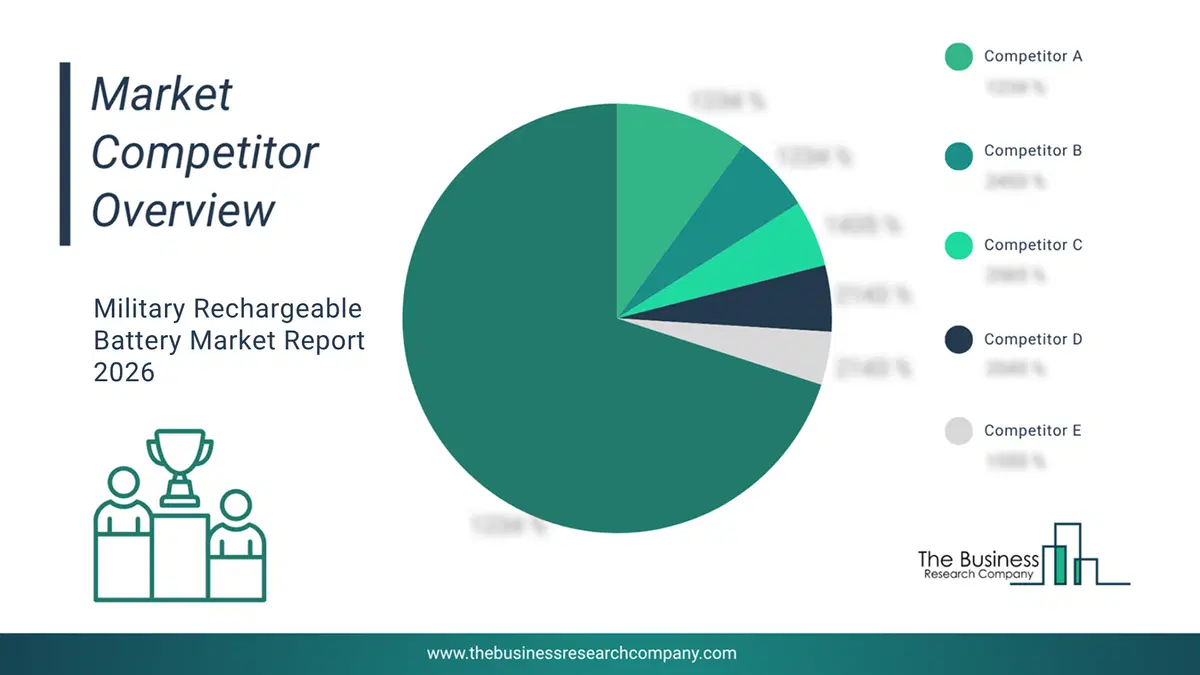
This chart is for illustrative purposes; the full report includes a detailed competitor analysis and comprehensive overview of the top 10 companies in the market.
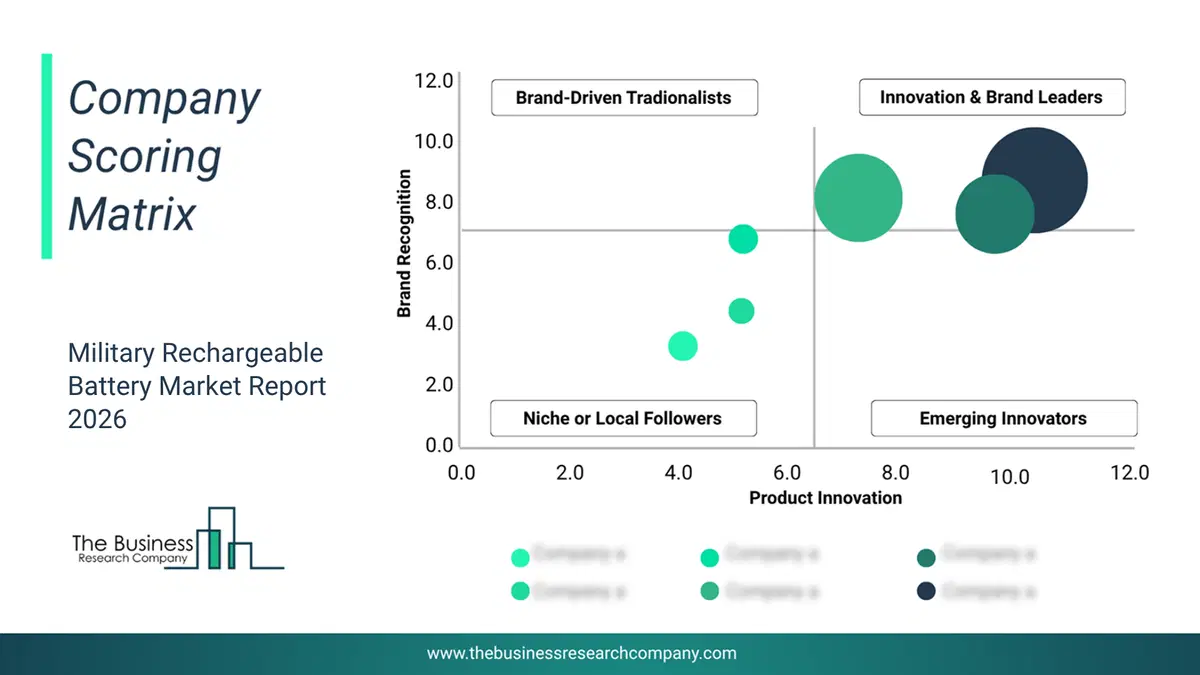
This chart maps companies by product innovation and brand strength, with bubble size indicating relative revenue, helping identify market leaders, challengers, and niche players. This is an illustrative chart; the full report provides a complete and accurate competitive analysis.
Global Military Rechargeable Battery Market Trends and Insights
Major companies operating in the military rechargeable battery market are focusing on developing lightweight, high-energy-density lithium-ion solutions that enhance power efficiency, durability, and reliability for advanced defense platforms, while ensuring compliance with stringent military standards and reducing overall maintenance costs. A lithium-ion battery is a rechargeable energy storage device that uses lithium ions to transfer charge between its electrodes, offering high energy density and efficiency. For instance, in September 2025, EnerSys, a US-based stored energy solution providing company, expanded its Hawker portfolio with the launch of Hawker ARMASAFE iON-X 24-volt batteries for military vehicle applications. Available in 105 Ah and 162 Ah models, these advanced rechargeable lithium-ion batteries are designed to deliver high power for vehicle starting and energy storage for mission-critical onboard systems. Lightweight yet energy-dense, the batteries leverage over two decades of lithium-ion expertise and comply with MIL-PRF-32565C standards. Ideal for tactical vehicles, robotics, and weapon systems, the iON-X series enhances operational reliability, supports silent watch missions, and reduces maintenance and operational costs.What Are Latest Mergers And Acquisitions In The Military Rechargeable Battery Market? Enersys Acquired Bren-Tronics To Expand Lithium Portfolio And Strengthen Military Market Presence
In July 2024, EnerSys, a US-based battery manufacturing company, acquired Bren-Tronics Inc. for an undisclosed amount. Through this acquisition, EnerSys seeks to reinforce its role as a key contributor to the energy transition, accelerate the growth of its lithium product portfolio, and enhance its presence and profitability in the expanding military and defense sector. Bren-Tronics Inc. is a US-based company that specializes in high-performance military rechargeable batteries.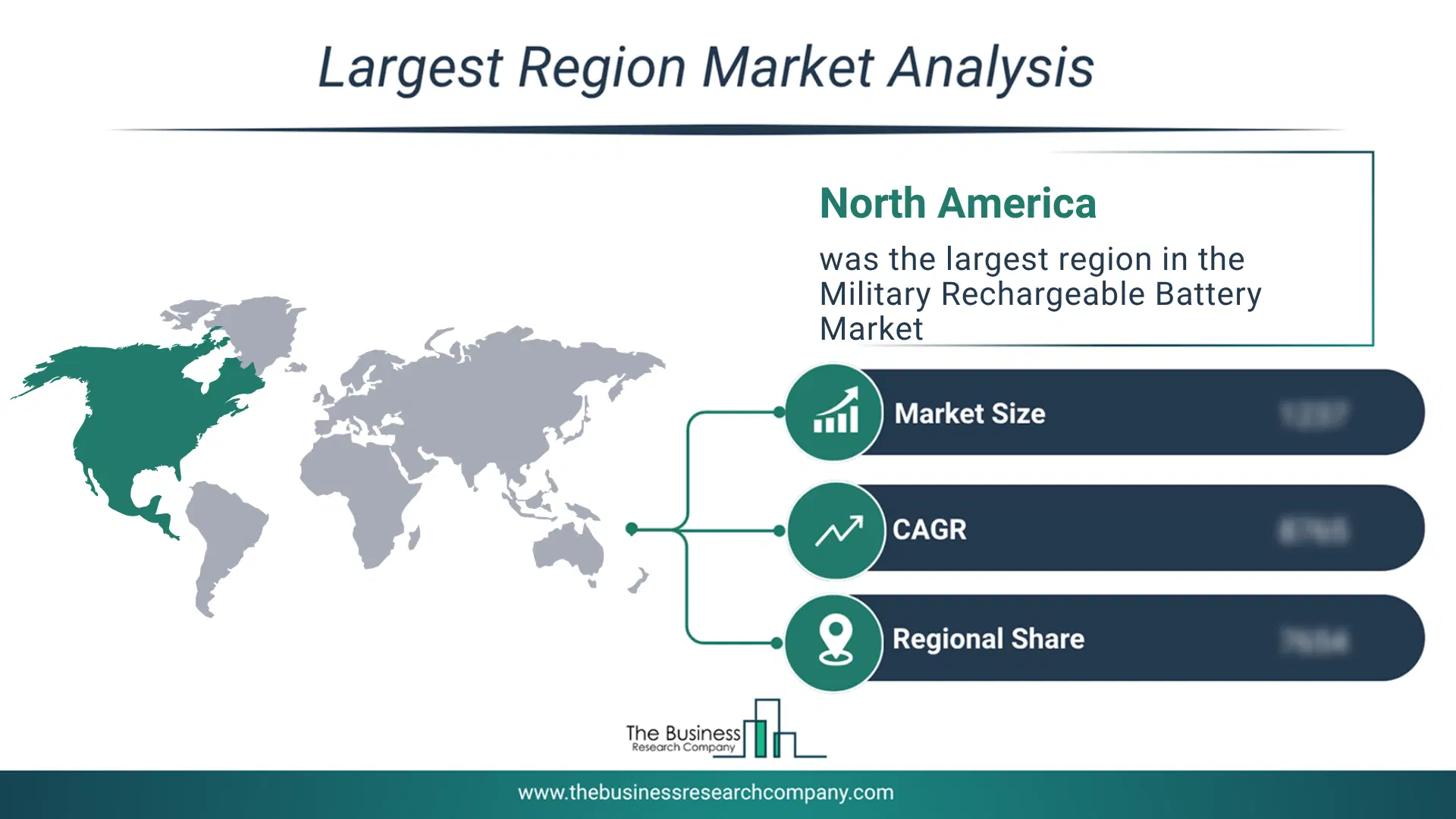
Regional Insights
North America was the largest region in the military rechargeable battery market in 2025. Asia-Pacific is expected to be the fastest-growing region in the forecast period. The regions covered in this market report are Asia-Pacific, South East Asia, Western Europe, Eastern Europe, North America, South America, Middle East, Africa. The countries covered in this market report are Australia, Brazil, China, France, Germany, India, Indonesia, Japan, Taiwan, Russia, South Korea, UK, USA, Canada, Italy, SpainWhat Defines the Military Rechargeable Battery Market?
The military rechargeable battery market consists of sales of solid-state batteries, lithium-sulfur batteries, zinc-air rechargeable batteries, and flow batteries. Values in this market are ‘factory gate’ values, that is, the value of goods sold by the manufacturers or creators of the goods, whether to other entities (including downstream manufacturers, wholesalers, distributors, and retailers) or directly to end customers. The value of goods in this market includes related services sold by the creators of the goods.How is Market Value Defined and Measured?
The market value is defined as the revenues that enterprises gain from the sale of goods and/or services within the specified market and geography through sales, grants, or donations in terms of the currency (in USD unless otherwise specified). The revenues for a specified geography are consumption values that are revenues generated by organizations in the specified geography within the market, irrespective of where they are produced. It does not include revenues from resales along the supply chain, either further along the supply chain or as part of other products.
This chart presents market attractiveness based on a quantitative evaluation of growth, competition, strategic alignment, and risk, offering a clear view of opportunity areas for decision-making. This chart is for illustrative purposes; the full report contains the complete analysis.

This chart highlights the Total Addressable Market (TAM) by estimating the maximum revenue opportunity using an assumption-driven approach, supporting strategic planning and opportunity sizing across markets. The chart is illustrative; the full report provides a more comprehensive analysis.
What Key Data and Analysis Are Included in the Military Rechargeable Battery Market Report 2026?
The military rechargeable battery market research report is one of a series of new reports from The Business Research Company that provides market statistics, including industry global market size, regional shares, competitors with the market share, detailed market segments, market trends and opportunities, and any further data you may need to thrive in the military rechargeable battery industry. The market research report delivers a complete perspective of everything you need, with an in-depth analysis of the current and future state of the industry.Military Rechargeable Battery Market Report Forecast Analysis
| Report Attribute | Details |
|---|---|
| Market Size Value In 2026 | $1.65 billion |
| Revenue Forecast In 2030 | $2.21 billion |
| Growth Rate | CAGR of 7.6% from 2026 to 2030 |
| Base Year For Estimation | 2025 |
| Actual Estimates/Historical Data | 2020-2025 |
| Forecast Period | 2026 - 2030 |
| Market Representation | Revenue in USD Billion and CAGR from 2026 to 2030 |
| Segments Covered | Battery Chemistry, Form Factor, Capacity, Application, End-Use |
| Regional Scope | Asia-Pacific, Western Europe, Eastern Europe, North America, South America, Middle East, Africa |
| Country Scope | The countries covered in the military rechargeable battery market report are Australia, Brazil, China, France, Germany, India, Indonesia, Japan, Taiwan, Russia, South Korea, UK, USA, Canada, Italy, Spain |
| Key Companies Profiled | Exide Industries Limited, Teledyne Technologies Inc., GS Yuasa Corporation, EnerSys, Saft Groupe S.A., Inventus Power Inc., EaglePicher Technologies LLC, Tuthill Corporation, Ultralife Corporation, Arotech Corporation, Concorde Battery Corporation, Tenergy Corporation, Baseponite, Mathews Associates Inc., Coremax Tech, Denchi Group, BST Systems Inc., Emerging Power Inc., Epsilor-Electric Fuel Ltd., Bentork Industries |
| Customization Scope | Request for Customization |
| Pricing And Purchase Options | Explore Purchase Options |