
Military Vehicle Simulations Market Report 2026
Global Outlook – By Type (Military Vehicles Simulations Platforms, Military Vehicles Simulations Systems, Military Vehicles Simulations Maintenances, Other Types), By Vehicle Type (Armored Vehicles, Trucks and Transport Vehicles, Tanks, Light Tactical Vehicles, Reconnaissance Vehicles), By Technology (Artificial Intelligence, Augmented Reality, Virtual Reality, Cloud-Based Simulation, Data Analytics And Big Data), By Application (Training And Education, Mission Planning, Operational Support, Research And Development, Testing And Evaluation), By End User (Defense Forces, Government Agencies, Private Contractors, Educational Institutions, Research Organizations) – Market Size, Trends, Strategies, and Forecast to 2030
Military Vehicle Simulations Market Overview
• Military Vehicle Simulations market size has reached to $5.22 billion in 2025 • Expected to grow to $7.67 billion in 2030 at a compound annual growth rate (CAGR) of 7.9% • Growth Driver: Growing Geopolitical Tensions Fueling The Growth Of The Market Due To Increasing Demand For Combat Readiness And Training Efficiency • Market Trend: Strategic Partnership Between Rheinmetall And BISim To Enhance Military Vehicle Simulation Capabilities • Asia-Pacific was the largest region in 2025.What Is Covered Under Military Vehicle Simulations Market?
Military vehicle simulations refer to digital or virtual representations created to mimic the functions, behaviors, and operational environments of defense-related transport systems. These simulations are developed using advanced modeling techniques to replicate realistic scenarios, enabling accurate analysis of performance and responses under varying conditions. The main types of military vehicle simulations include military vehicle simulation platforms, military vehicle simulation systems, military vehicle simulation maintenance, and others. Military vehicle simulation platforms are comprehensive environments designed to deliver immersive simulation experiences for military vehicle operations. These are categorized by vehicle type into armored vehicles, trucks and transport vehicles, tanks, light tactical vehicles, and reconnaissance vehicles and use various technologies, including artificial intelligence, augmented reality, virtual reality, cloud-based simulation, and data analytics and big data. These are applied for training and education, mission planning, operational support, research and development, and testing and evaluation, serving a range of end users, including defense forces, government agencies, private contractors, educational institutions, and research organizations.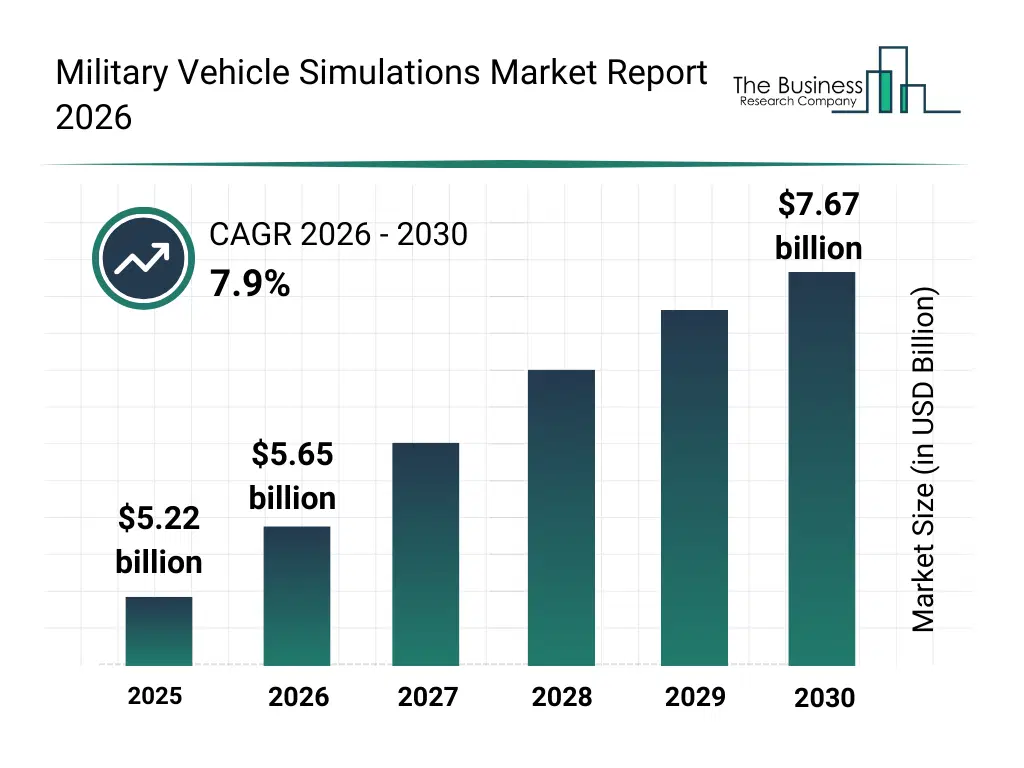
What Is The Military Vehicle Simulations Market Size and Share 2026?
The military vehicle simulations market size has grown strongly in recent years. It will grow from $5.22 billion in 2025 to $5.65 billion in 2026 at a compound annual growth rate (CAGR) of 8.2%. The growth in the historic period can be attributed to increasing adoption of simulation-based training to reduce operational training costs, growth in demand for realistic vehicle cabin replicas enhancing driver preparedness, advancements in visual display systems improving training immersion, rising use of simulations for performance testing under diverse battlefield conditions, expansion of defense training programs requiring scalable simulation platforms.What Is The Military Vehicle Simulations Market Growth Forecast?
The military vehicle simulations market size is expected to see strong growth in the next few years. It will grow to $7.67 billion in 2030 at a compound annual growth rate (CAGR) of 7.9%. The growth in the forecast period can be attributed to growing integration of artificial intelligence for adaptive and scenario-based simulation training, increasing demand for networked simulations enabling joint and multi-vehicle training environments, rising investment in virtual reality and augmented reality technologies to enhance realism, expansion of simulation-based readiness assessments for modernized military fleets, accelerating development of modular simulation systems allowing rapid configuration for multiple vehicle types. Major trends in the forecast period include increasing adoption of integrated multi-vehicle simulation suites, shift from live exercises to cost-optimized synthetic training environments, growing emphasis on interoperability and joint-force / multi-nation simulation, customization and localization of training scenarios to national doctrines and terrains, expansion of long-term simulation maintenance, upgrades, and support contracts.
Global Military Vehicle Simulations Market Segmentation
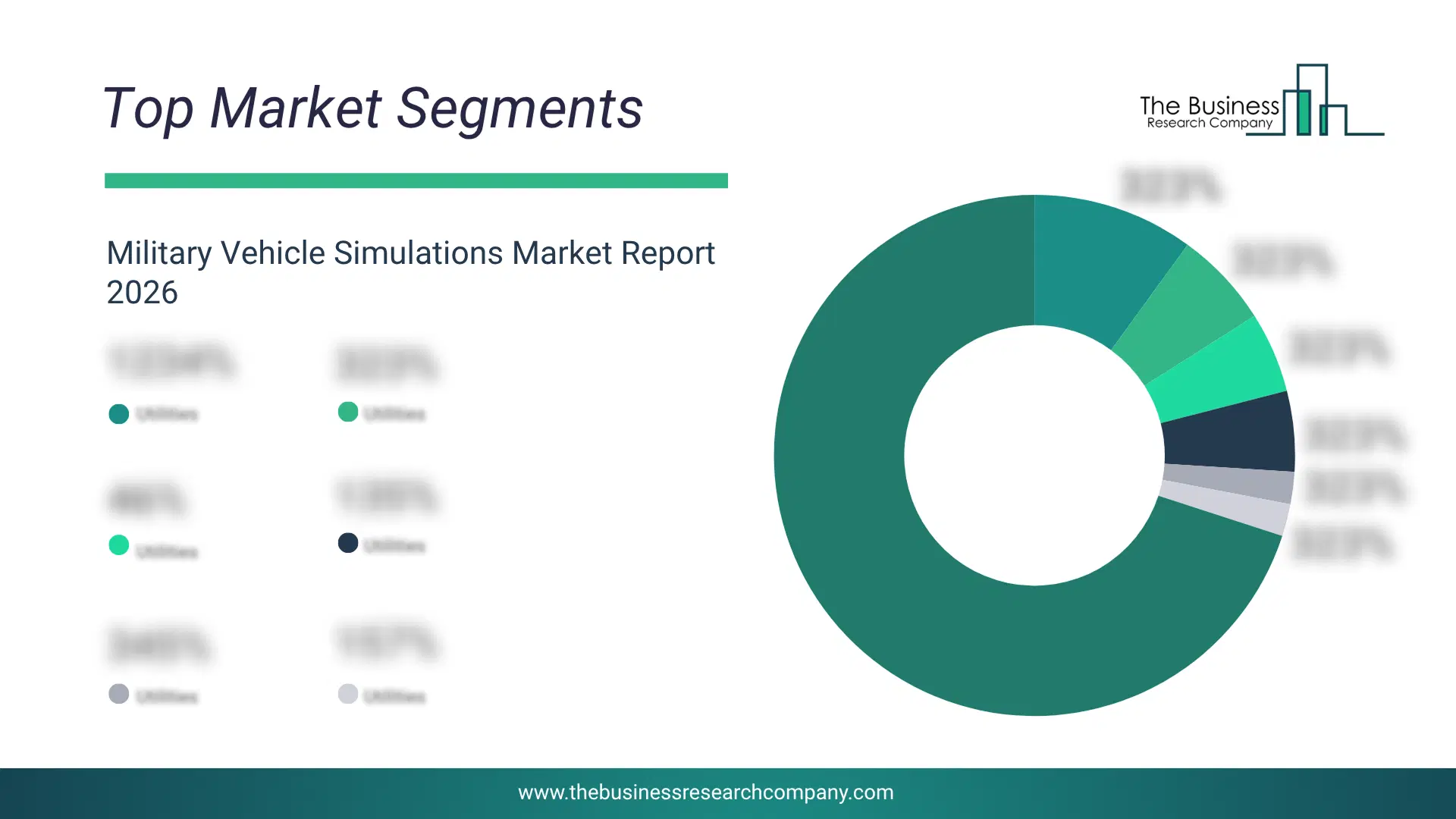
1) By Type: Military Vehicles Simulations Platforms, Military Vehicles Simulations Systems, Military Vehicles Simulations Maintenances, Other Types 2) By Vehicle Type: Armored Vehicles, Trucks and Transport Vehicles, Tanks, Light Tactical Vehicles, Reconnaissance Vehicles 3) By Technology: Artificial Intelligence, Augmented Reality, Virtual Reality, Cloud-Based Simulation, Data Analytics And Big Data 4) By Application: Training And Education, Mission Planning, Operational Support, Research And Development, Testing And Evaluation 5) By End User: Defense Forces, Government Agencies, Private Contractors, Educational Institutions, Research Organizations Subsegments: 1) By Military Vehicles Simulations Platforms: Desktop-Based Simulation Platforms, Full Mission Simulators-global-market-report" target="_blank">simulators, Mobile Training Units, Cloud-Based Simulation Platforms 2) By Military Vehicles Simulations Systems: Driver Training Systems, Gunnery Training Systems, Command And Control Simulators, Navigation And Convoy Training Systems 3) By Military Vehicles Simulations Maintenances: Predictive Maintenance Simulation, Virtual Maintenance Trainers (VMT), Diagnostics And Repair Simulation, Troubleshooting Training Systems 4) By Other Types: Mixed Reality Simulators, Artificial Intelligence (AI)-Integrated Simulation Systems, Logistics And Supply Chain Simulators, Multi-Domain Integration SimulatorsWhat Is Driver Of The Military Vehicle Simulations Market?
The growing geopolitical tensions are expected to propel the growth of the military vehicle simulation market going forward. Geopolitical tensions refer to conflicts or strained relations between nations that may escalate into military confrontations or prolonged defense posturing. Geopolitical tensions are rising due to growing competition over critical resources such as energy, rare earth minerals, and water as nations seek to secure strategic advantages amid global supply chain vulnerabilities. Military vehicle simulation enhances strategic preparedness by enabling realistic training and scenario planning, helping nations navigate geopolitical tensions with reduced risk of direct conflict. For instance, in December 2024, according to a report published by the International Institute for Strategic Studies (IISS), a UK-based international research institute focusing on defense and security issues, the number of deaths caused by violent events worldwide surged by 37% from July 2023 to June 2024 with the total approaching 200,000. Therefore, the growing geopolitical tensions are driving the growth of the military vehicle simulation industry.Key Players In The Global Military Vehicle Simulations Market
Major companies operating in the military vehicle simulations market are Raytheon Technologies Corp., Boeing Co., Lockheed Martin Corporation, General Dynamics Corp., Northrop Grumman Corp., Collins Aerospace Companies, BAE Systems plc, Thales Group, L3Harris Technologies Inc., Leonardo S.p.A., ST Engineering Ltd., Rheinmetall AG, Israel Aerospace Industries Ltd., Saab AB, CAE Inc., FlightSafety International Inc., Arotech Corporation, FAAC Incorporated, Frasca International Inc., AVT Simulation Inc.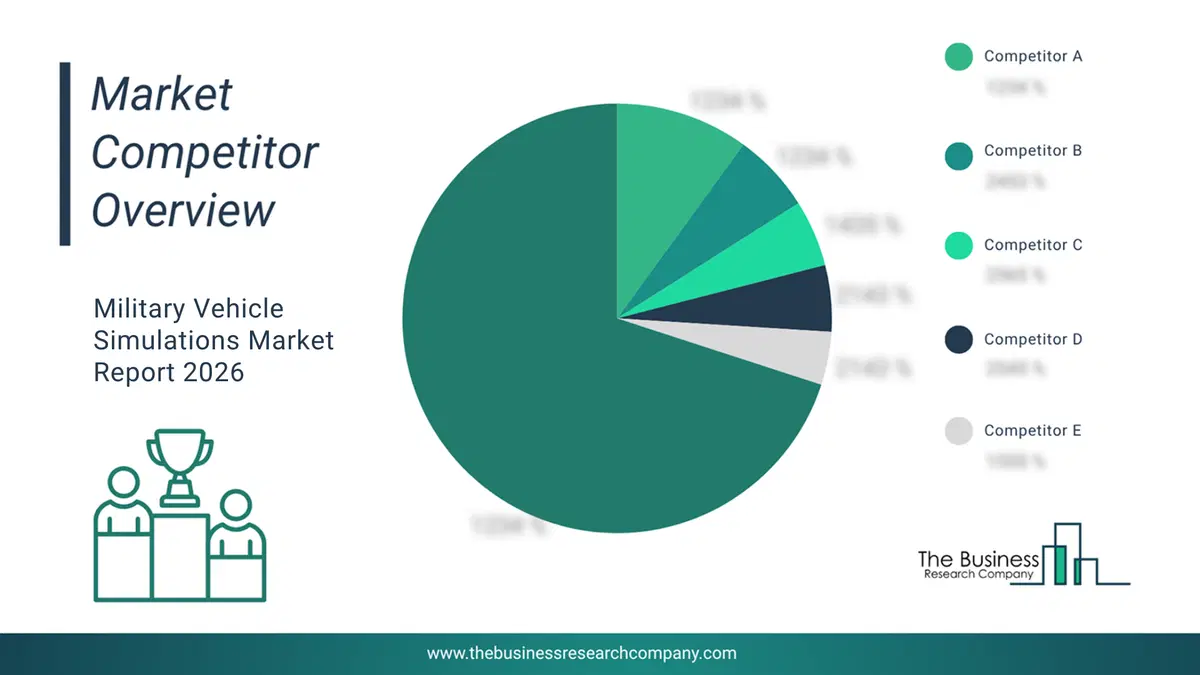
This chart is for illustrative purposes; the full report includes a detailed competitor analysis and comprehensive overview of the top 10 companies in the market.
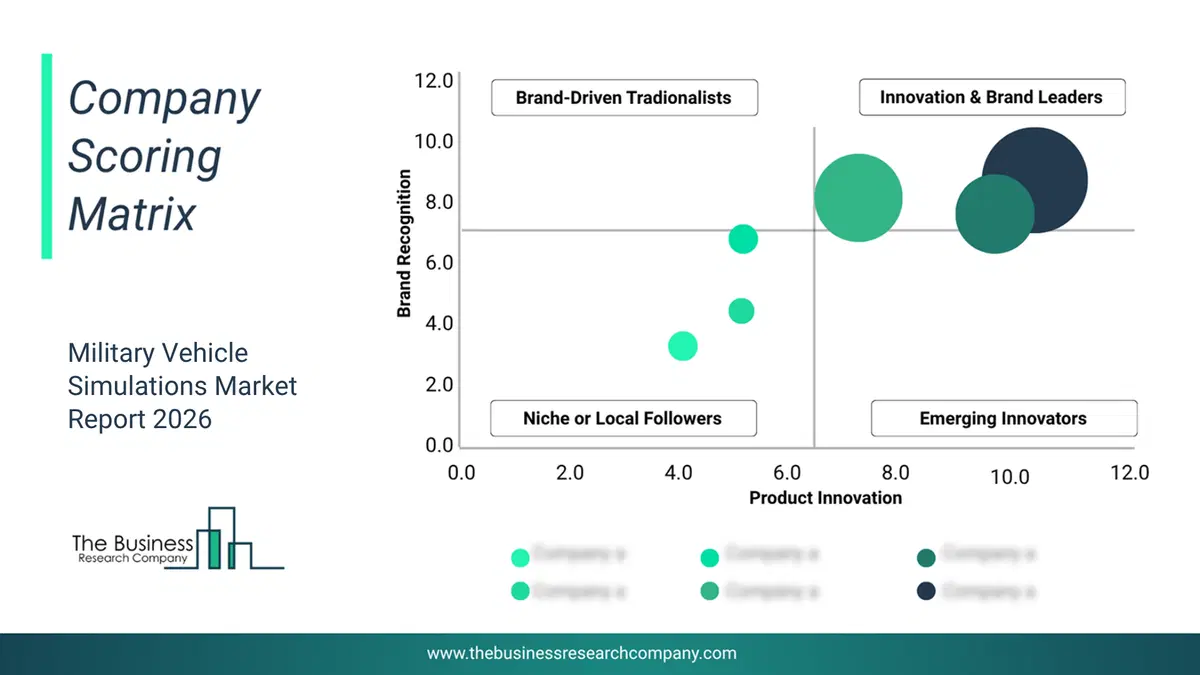
This chart maps companies by product innovation and brand strength, with bubble size indicating relative revenue, helping identify market leaders, challengers, and niche players. This is an illustrative chart; the full report provides a complete and accurate competitive analysis.
Global Military Vehicle Simulations Market Trends and Insights
Major companies operating in the military vehicle simulation market are focusing on developing strategic partnerships to reduce operational costs. Strategic partnerships are long-term collaborations between two or more organizations formed to achieve shared objectives by leveraging each other’s strengths and resources. For instance, in January 2025, Rheinmetall AG, a Germany-based technology company, partnered with Bohemia Interactive Simulations (BISim), a Czech Republic-based provider of military vehicle simulations, to advance technologies used in defense simulations. The collaboration aims to deliver hyper-realistic, scalable, and interoperable training environments that support a wide range of mission scenarios, from individual soldier training to large-scale joint force exercises. Leveraging BISim’s modular simulation software and Rheinmetall’s real-world defense systems, the partnership is set to accelerate innovation in synthetic training, enabling armed forces to train more effectively, safely, and cost-efficiently in complex, multi-domain operations.What Are Latest Mergers And Acquisitions In The Military Vehicle Simulations Market? Applied Virtual Simulation Acquires AFV Sim To Strengthen Armored Vehicle Training And Defense Simulation Capabilities
In August 2025, Applied Virtual Simulation Pty Ltd, an Australia-based simulation technology company, acquired AFV Sim for an undisclosed amount. With this acquisition, AVS aims to enhance its defense simulation capabilities by integrating AFV Sim’s expertise in armored vehicle control systems, thereby expanding its production capacity, global footprint, and long-term customer support. AFV Sim is a UK-based provider of advanced simulation and control system technologies for armored vehicle training and defense applications.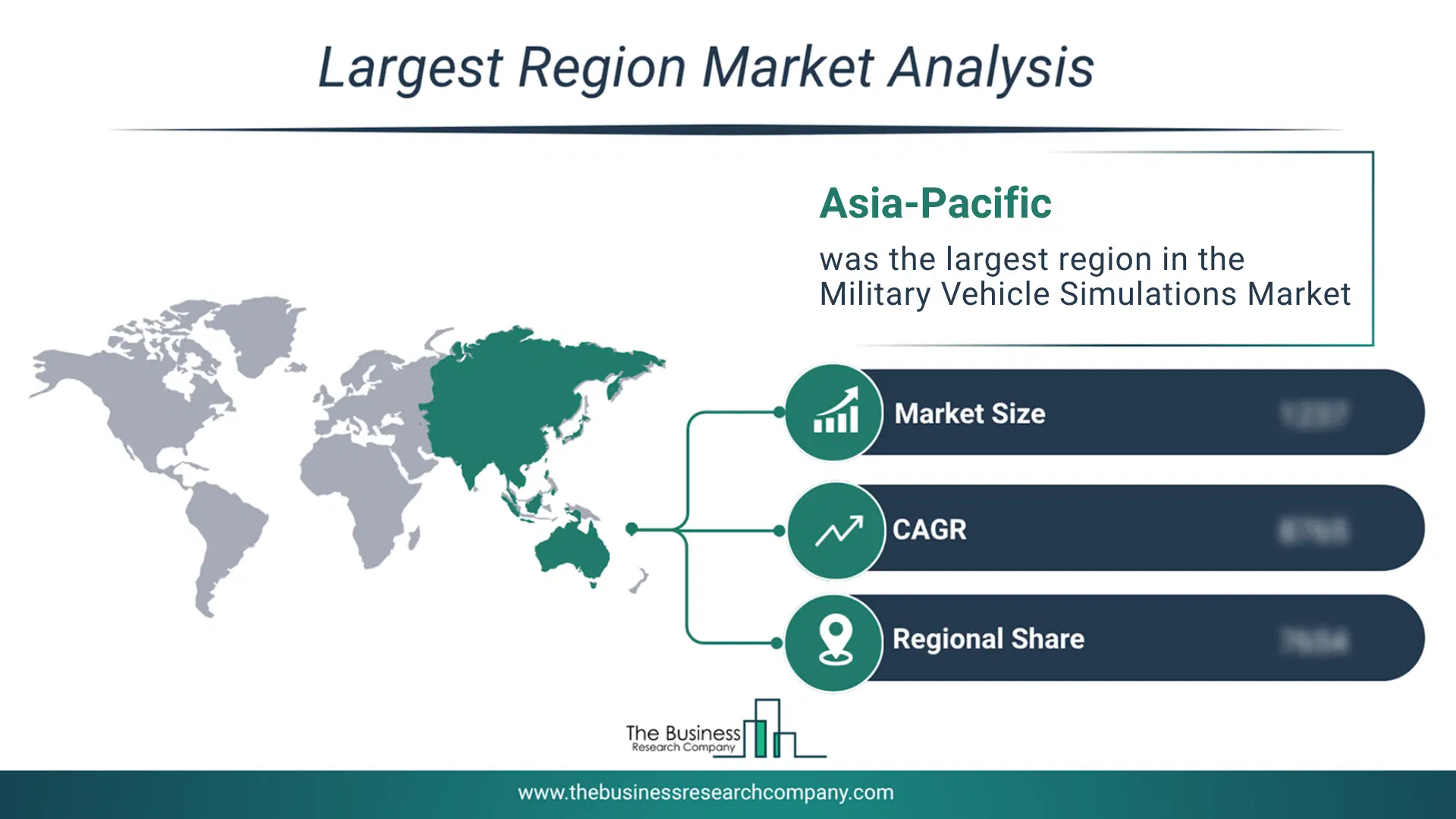
Regional Insights
Asia-Pacific was the largest region in the military vehicle simulations market in 2025. The regions covered in this market report are Asia-Pacific, South East Asia, Western Europe, Eastern Europe, North America, South America, Middle East, Africa. The countries covered in this market report are Australia, Brazil, China, France, Germany, India, Indonesia, Japan, Taiwan, Russia, South Korea, UK, USA, Canada, Italy, SpainWhat Defines the Military Vehicle Simulations Market?
The military vehicle simulations market consists of revenues earned by entities by providing services such as training systems integration, scenario generation, performance analysis, and consulting. The market value includes the value of related goods sold by the service provider or included within the service offering. The military vehicle simulations market also includes sales of visual display systems, vehicle cabin replicas, tracking devices, and audio systems. Values in this market are ‘factory gate’ values, that is the value of goods sold by the manufacturers or creators of the goods, whether to other entities (including downstream manufacturers, wholesalers, distributors and retailers) or directly to end customers. The value of goods in this market includes related services sold by the creators of the goods.How is Market Value Defined and Measured?
The market value is defined as the revenues that enterprises gain from the sale of goods and/or services within the specified market and geography through sales, grants, or donations in terms of the currency (in USD unless otherwise specified). The revenues for a specified geography are consumption values that are revenues generated by organizations in the specified geography within the market, irrespective of where they are produced. It does not include revenues from resales along the supply chain, either further along the supply chain or as part of other products.
This chart presents market attractiveness based on a quantitative evaluation of growth, competition, strategic alignment, and risk, offering a clear view of opportunity areas for decision-making. This chart is for illustrative purposes; the full report contains the complete analysis.

This chart highlights the Total Addressable Market (TAM) by estimating the maximum revenue opportunity using an assumption-driven approach, supporting strategic planning and opportunity sizing across markets. The chart is illustrative; the full report provides a more comprehensive analysis.
What Key Data and Analysis Are Included in the Military Vehicle Simulations Market Report 2026?
The military vehicle simulations market research report is one of a series of new reports from The Business Research Company that provides market statistics, including industry global market size, regional shares, competitors with the market share, detailed market segments, market trends and opportunities, and any further data you may need to thrive in the military vehicle simulations industry. The market research report delivers a complete perspective of everything you need, with an in-depth analysis of the current and future state of the industry.Military Vehicle Simulations Market Report Forecast Analysis
| Report Attribute | Details |
|---|---|
| Market Size Value In 2026 | $5.65 billion |
| Revenue Forecast In 2030 | $7.67 billion |
| Growth Rate | CAGR of 7.9% from 2026 to 2030 |
| Base Year For Estimation | 2025 |
| Actual Estimates/Historical Data | 2020-2025 |
| Forecast Period | 2026 - 2030 |
| Market Representation | Revenue in USD Billion and CAGR from 2026 to 2030 |
| Segments Covered | Type, Vehicle Type, Technology, Application, End User |
| Regional Scope | Asia-Pacific, Western Europe, Eastern Europe, North America, South America, Middle East, Africa |
| Country Scope | The countries covered in the military vehicle simulations market report are Australia, Brazil, China, France, Germany, India, Indonesia, Japan, Taiwan, Russia, South Korea, UK, USA, Canada, Italy, Spain |
| Key Companies Profiled | Raytheon Technologies Corp., Boeing Co., Lockheed Martin Corporation, General Dynamics Corp., Northrop Grumman Corp., Collins Aerospace Companies, BAE Systems plc, Thales Group, L3Harris Technologies Inc., Leonardo S.p.A., ST Engineering Ltd., Rheinmetall AG, Israel Aerospace Industries Ltd., Saab AB, CAE Inc., FlightSafety International Inc., Arotech Corporation, FAAC Incorporated, Frasca International Inc., AVT Simulation Inc. |
| Customization Scope | Request for Customization |
| Pricing And Purchase Options | Explore Purchase Options |