
Milk Substitutes (Non dairy milk) Market Report 2026
Global Outlook – By Type (Soy Milk, Almond Milk, Rice Milk, Other Types), By Formulation (Plain-Sweetened, Plain-Unsweetened, Flavored-Sweetened, Other Formulations), By Distribution Channel (Supermarkets, Hypermarkets, Convenience Stores, Specialty Stores, Online Retail Stores, Other Distribution Channels ), By Application (Food, Beverages ) – Market Size, Trends, Strategies, and Forecast to 2030
Milk Substitutes (Non dairy milk) Market Overview
• Milk Substitutes (Non dairy milk) market size has reached to $44.45 billion in 2025 • Expected to grow to $90.17 billion in 2030 at a compound annual growth rate (CAGR) of 15.3% • Growth Driver: Growing Consumer Demand For Vegan Milk Substitutes Shapes Market Growth • North America was the largest region in 2025 and Western Europe is the fastest growing region.What Is Covered Under Milk Substitutes (Non dairy milk) Market?
The milk substitutes (non-dairy milk) market refers to a segment of the food industry that offers alternatives to traditional dairy milk, derived from plant sources such as almonds, soy, and oats. The milk substitutes (non-dairy milk) market is used to provide lactose-free and vegan alternatives for those with dietary restrictions or preferences. The milk substitutes (nondairy milk) market covered in this report is segmented by type into soy milk, almond milk, rice milk, and others. It is also segmented by application into food and beverages, by distribution channel into supermarkets, hypermarkets, convenience stores, specialty stores, online retail stores, and others, and by formulation into plain-sweetened, plain-unsweetened, flavored-sweetened, and others.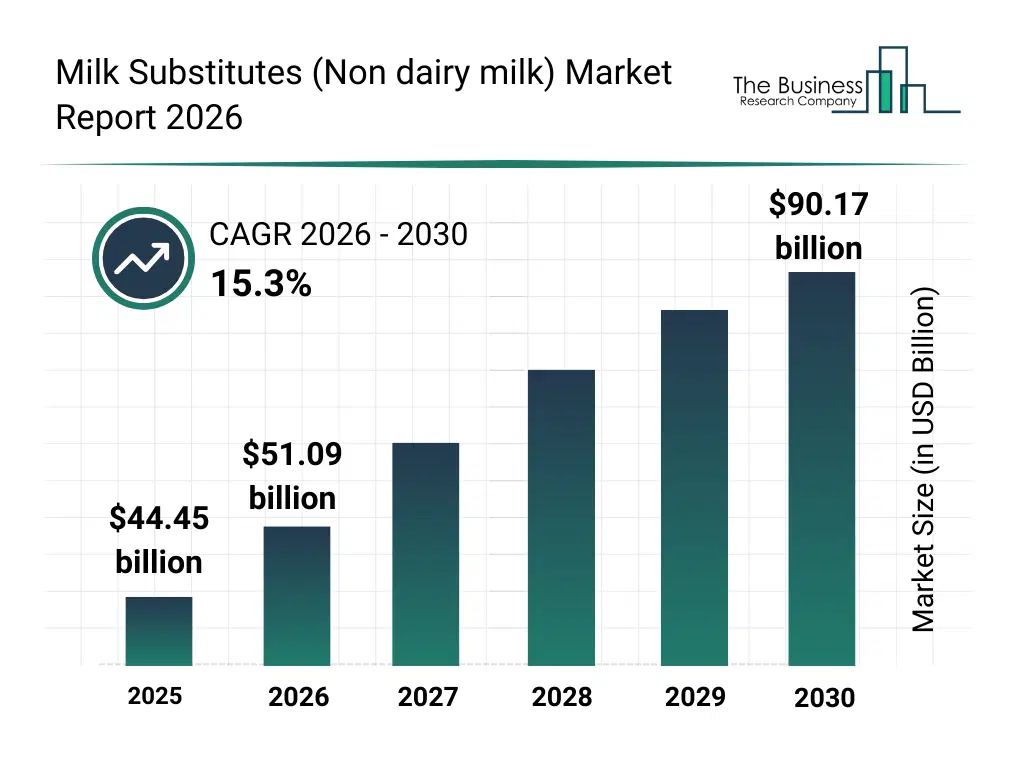
What Is The Milk Substitutes (Non dairy milk) Market Size and Share 2026?
The milk substitutes (non dairy milk) market size has grown rapidly in recent years. It will grow from $44.45 billion in 2025 to $51.09 billion in 2026 at a compound annual growth rate (CAGR) of 14.9%. The growth in the historic period can be attributed to growth in lactose intolerance awareness, rising vegan and flexitarian populations, expansion of specialty food retail channels, development of plant-based processing technologies, increased consumer focus on health-conscious diets.What Is The Milk Substitutes (Non dairy milk) Market Growth Forecast?
The milk substitutes (non dairy milk) market size is expected to see rapid growth in the next few years. It will grow to $90.17 billion in 2030 at a compound annual growth rate (CAGR) of 15.3%. The growth in the forecast period can be attributed to increasing demand for sustainable plant-based beverages, rising innovation in alternative protein sources, expansion of non-dairy applications in foodservice, growing investment in functional fortification, increasing global adoption of plant-based nutrition. Major trends in the forecast period include increasing demand for plant-based dairy alternatives, rising adoption of oat and almond milk variants, growing focus on lactose-free and vegan diets, expansion of fortified non-dairy beverages, enhanced emphasis on clean-label ingredients.
Global Milk Substitutes (Non dairy milk) Market Segmentation
1) By Type: Soy Milk, Almond Milk, Rice Milk, Other Types 2) By Formulation: Plain-Sweetened, Plain-Unsweetened, Flavored-Sweetened, Other Formulations 3) By Distribution Channel: Supermarkets, Hypermarkets, Convenience Stores, Specialty Stores, Online Retail Stores, Other Distribution Channels 4) By Application: Food, Beverages Subsegments: 1) By Soy Milk: Unsweetened Soy Milk, Sweetened Soy Milk, Flavored Soy Milk 2) By Almond Milk: Unsweetened Almond Milk, Sweetened Almond Milk, Flavored Almond Milk 3) By Rice Milk: Original Rice Milk, Flavored Rice Milk, Organic Rice Milk 4) By Other Types: Coconut Milk, Oat Milk, Hemp Milk, Cashew Milk, Pea MilkWhat Are The Drivers Of The Milk Substitutes (Non dairy milk) Market?
The increasing consumer's preference for vegan food is driving the milk substitute market. Consumers are increasingly becoming aware of animal abuse at dairy farms and are avoiding animal-based products. Vegan milk is cholesterol-free, rich in vitamin D and proteins and provides more calcium than animal milk. For instance, in April 2024, the Good Food Institute, a US-based non-profit organization, reported that in 2023, the US plant-based milk category, the largest segment within plant based foods, reached US$2.9 billion in retail sales, with nearly 44% of US households buying plant-based milk at least once during the year. Thus, the rising consumer's preference for vegan food is driving the milk substitute market going forward. The increasing incidence of lactose intolerance is expected to propel the growth of the milk substitutes (non-dairy milk) market going forward. Lactose intolerance is a digestive condition in which people have difficulty digesting lactose, the sugar found in milk and other dairy products. Milk substitutes are used in lactose intolerance to replace milk, which contains lactose and meets individual needs and preferences. For instance, in June 2023, the National Dairy Council (NDC), a US-based non-profit organization, about 70% of the global adult population exhibits lactase non-persistence (i.e., lactose malabsorption), a condition that often leads to lactose intolerance. Therefore, increasing incidence of lactose intolerance will drive the milk substitutes (non-dairy milk) market.Key Players In The Global Milk Substitutes (Non dairy milk) Market
Major companies operating in the milk substitutes (non dairy milk) market are Hain Celestial Group Inc., Blue Diamond Growers Inc., SunOpta Inc., Chobani LLC, Vitasoy International Holdings Limited, Oatly AB, Freedom Foods Group Limited, Sanitarium Health and Wellbeing Company, Valsoia S.p.A., Califia Farms LLC, Eden Foods Inc., Earth’s Own Food Company, Ripple Foods Inc., Good Karma Foods LLC, Elmhurst 1920 Inc., Pacific Foods of Oregon LLC, Silk North America LLC, Alpro (UK) Limited, So Delicious Dairy Free, Forager Project LLC, Milkadamia Inc., Mooala Brands LLC, Rude Health Inc., Sproud Limited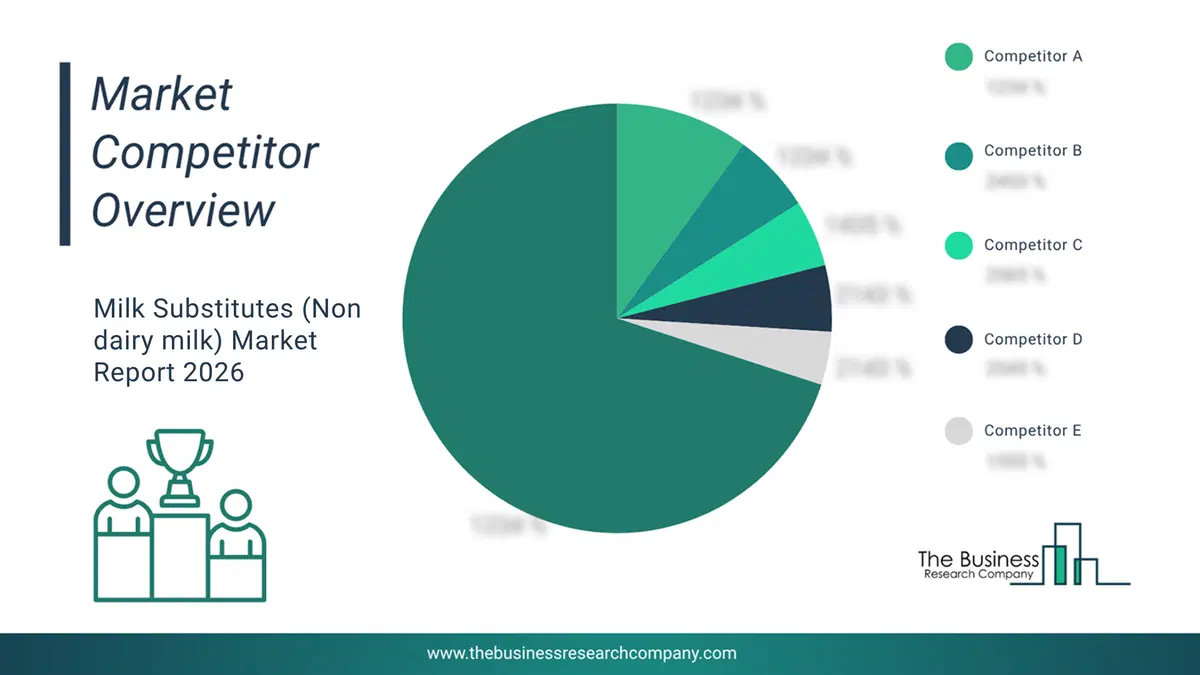
This chart is for illustrative purposes; the full report includes a detailed competitor analysis and comprehensive overview of the top 10 companies in the market.
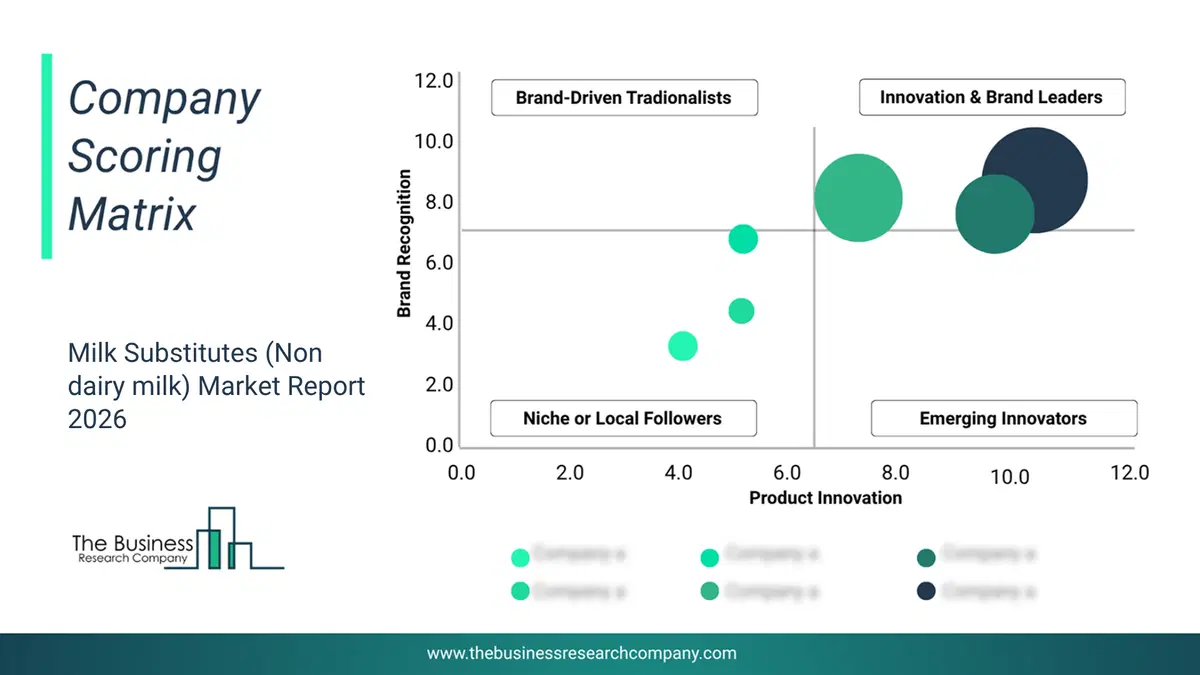
This chart maps companies by product innovation and brand strength, with bubble size indicating relative revenue, helping identify market leaders, challengers, and niche players. This is an illustrative chart; the full report provides a complete and accurate competitive analysis.
What Are Latest Mergers And Acquisitions In The Milk Substitutes (Non dairy milk) Market?
In October 2023, Oddlygood Global Oy, a Finland-based producer of plant-based food and drinks, acquired Planti, a Finland-based plant-based food company, for an undisclosed amount. With this acquisition, Oddlygood aims to strengthen its position in the plant-based dairy alternatives market by broadening its product range and expanding into new subsegments such as spoonable snacks and cooking products. Planti is a Finland-based producer of plant-based dairy alternatives that specializes in non-dairy milks, yogurt-style products, and cooking-friendly dairy-free foods.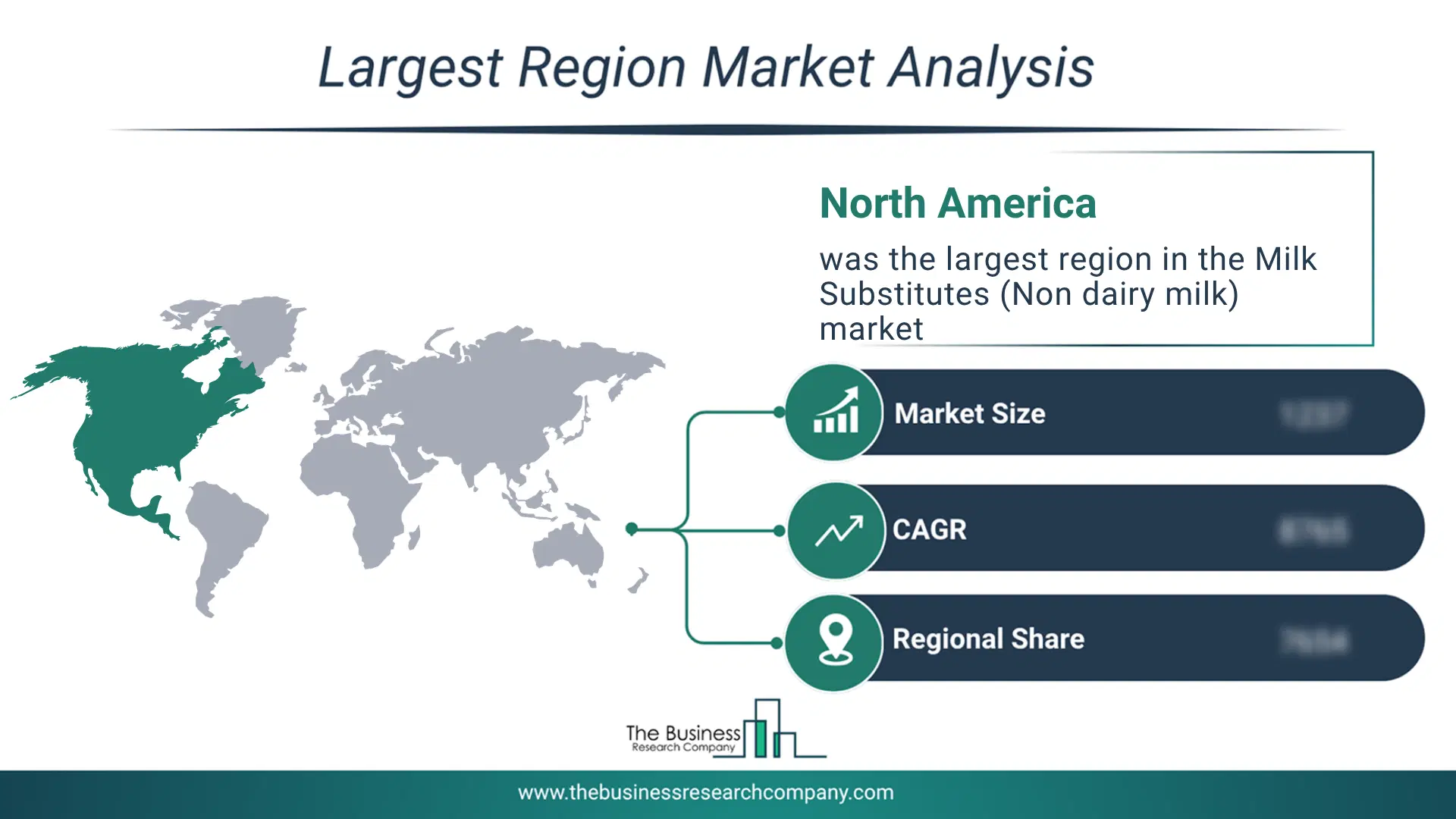
Regional Outlook
North America was the largest region in the milk substitutes (nondairy milk) market in 2025. Western Europe was the second largest region in the global milk substitutes (nondairy milk) market share. The regions covered in this market report are Asia-Pacific, South East Asia, Western Europe, Eastern Europe, North America, South America, Middle East and Africa. The countries covered in this market report are Australia, Brazil, China, France, Germany, India, Indonesia, Japan, Taiwan, Russia, South Korea, UK, USA, Italy, Spain, CanadaWhat Defines the Milk Substitutes (Non dairy milk) Market?
The milk substitutes (non-dairy milk) market consists of sales of soy milk, nut milk, oat milk, rice milk. Values in this market are factory gate values, that is the value of goods sold by the manufacturers or creators of the goods, whether to other entities (including downstream manufacturers, wholesalers, distributors, and retailers) or directly to end customers. The value of goods in this market includes related services sold by the creators of the goods.How is Market Value Defined and Measured?
The market value is defined as the revenues that enterprises gain from the sale of goods and/or services within the specified market and geography through sales, grants, or donations in terms of the currency (in USD unless otherwise specified). The revenues for a specified geography are consumption values that are revenues generated by organizations in the specified geography within the market, irrespective of where they are produced. It does not include revenues from resales along the supply chain, either further along the supply chain or as part of other products.
This chart presents market attractiveness based on a quantitative evaluation of growth, competition, strategic alignment, and risk, offering a clear view of opportunity areas for decision-making. This chart is for illustrative purposes; the full report contains the complete analysis.

This chart highlights the Total Addressable Market (TAM) by estimating the maximum revenue opportunity using an assumption-driven approach, supporting strategic planning and opportunity sizing across markets. The chart is illustrative; the full report provides a more comprehensive analysis.
What Key Data and Analysis Are Included in the Milk Substitutes (Non dairy milk) Market Report 2026?
The milk substitutes (non dairy milk) market research report is one of a series of new reports from The Business Research Company that provides market statistics, including industry global market size, regional shares, competitors with the market share, detailed market segments, market trends and opportunities, and any further data you may need to thrive in the milk substitutes (non dairy milk) industry. The market research report delivers a complete perspective of everything you need, with an in-depth analysis of the current and future state of the industry.Milk Substitutes (Non dairy milk) Market Report Forecast Analysis
| Report Attribute | Details |
|---|---|
| Market Size Value In 2026 | $51.09 billion |
| Revenue Forecast In 2030 | $90.17 billion |
| Growth Rate | CAGR of 14.9% from 2026 to 2030 |
| Base Year For Estimation | 2025 |
| Actual Estimates/Historical Data | 2020-2025 |
| Forecast Period | 2026 - 2030 |
| Market Representation | Revenue in USD Billion and CAGR from 2026 to 2030 |
| Segments Covered | Type, Formulation, Distribution Channel, Application |
| Regional Scope | Asia-Pacific, Western Europe, Eastern Europe, North America, South America, Middle East, Africa |
| Country Scope | The countries covered in the report are Australia, Brazil, China, France, Germany, India, Indonesia, Japan, Taiwan, Russia, South Korea, UK, USA, Canada, Italy, Spain. |
| Key Companies Profiled | Hain Celestial Group Inc., Blue Diamond Growers Inc., SunOpta Inc., Chobani LLC, Vitasoy International Holdings Limited, Oatly AB, Freedom Foods Group Limited, Sanitarium Health and Wellbeing Company, Valsoia S.p.A., Califia Farms LLC, Eden Foods Inc., Earth’s Own Food Company, Ripple Foods Inc., Good Karma Foods LLC, Elmhurst 1920 Inc., Pacific Foods of Oregon LLC, Silk North America LLC, Alpro (UK) Limited, So Delicious Dairy Free, Forager Project LLC, Milkadamia Inc., Mooala Brands LLC, Rude Health Inc., Sproud Limited |
| Customization Scope | Request for Customization |
| Pricing And Purchase Options | Explore Purchase Options |