
Naval Integrated Mast Market Report 2026
Global Outlook – By Component (Radar Systems, Communication Systems, Electronic Warfare Systems, Navigation Systems, Structural Components, Other Components), By Platform (Destroyers, Frigates, Corvettes, Offshore Patrol Vessels, Aircraft Carriers, Other Platforms), By Material (Composite, Steel, Aluminum, Other Materials), By Installation Type (New Installation, Retrofit), By End User (Naval Forces, Coast Guard, Other End-Users) – Market Size, Trends, Strategies, and Forecast to 2030
Naval Integrated Mast Market Overview
• Naval Integrated Mast market size has reached to $1.48 billion in 2025 • Expected to grow to $2.32 billion in 2030 at a compound annual growth rate (CAGR) of 9.2% • Growth Driver: Increasing Defense Budgets Driving The Market Growth Due To Naval Modernization Requirements • Market Trend: Integrated Command Systems Enhance Naval Situational Awareness And Response • North America was the largest region in 2025 and Asia-Pacific is the fastest growing region.What Is Covered Under Naval Integrated Mast Market?
A naval integrated mast is a unified structure on a warship that combines radar, sensors, and communication systems into one enclosure, providing a compact and efficient solution. It minimizes radar visibility by replacing multiple exposed units with a streamlined design that reduces detection and improves survivability. The configuration also enhances efficiency, reliability, and ease of maintenance during operations, while supporting better performance in demanding maritime environments. The main components of naval integrated masts are radar systems, communication systems, electronic warfare systems, navigation systems, structural components, and other components. Radar systems are sensing technologies that transmit and receive radio signals to detect, track, and provide comprehensive situational awareness in all-weather conditions. They are deployed on platforms including destroyers, frigates, corvettes, offshore patrol vessels, aircraft carriers, and other vessels, and are made from materials such as composites, steel, aluminum, and other materials. They can be installed as new installations or retrofits, and are utilized by end-users including naval forces, coast guards, and other defense organizations.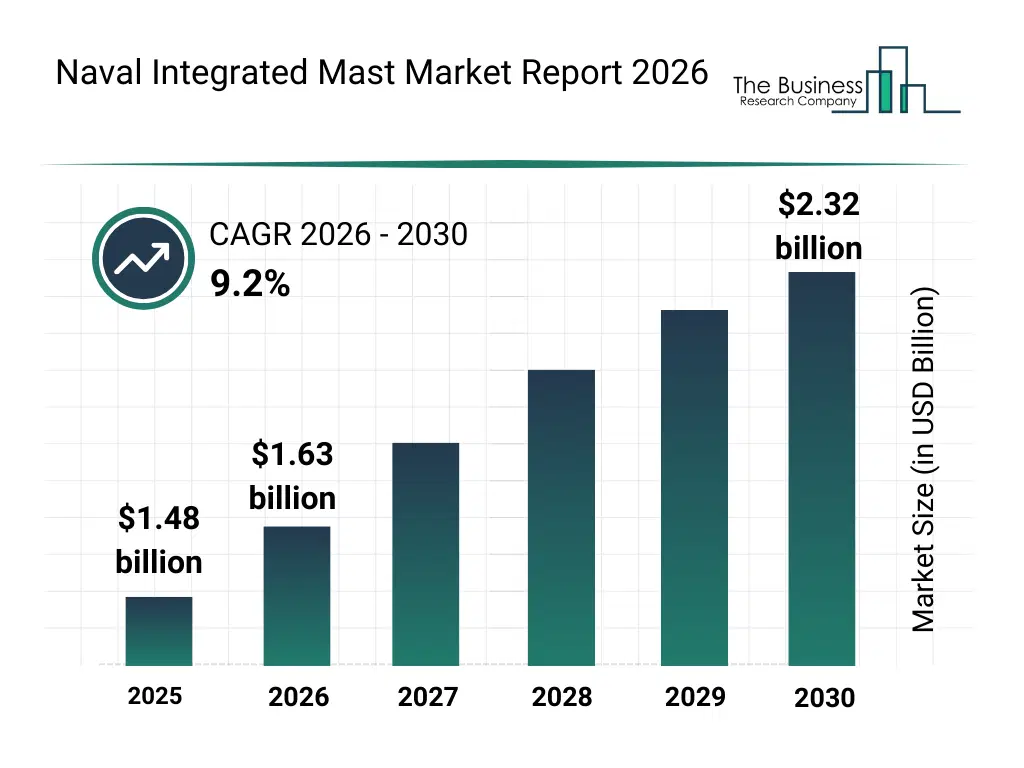
What Is The Naval Integrated Mast Market Size and Share 2026?
The naval integrated mast market size has grown strongly in recent years. It will grow from $1.48 billion in 2025 to $1.63 billion in 2026 at a compound annual growth rate (CAGR) of 9.5%. The growth in the historic period can be attributed to shift from conventional masts to integrated mast designs, adoption of multifunction radar modules, emphasis on stealth capabilities, rising naval fleet modernization, demand for compact sensor and communication solutions.What Is The Naval Integrated Mast Market Growth Forecast?
The naval integrated mast market size is expected to see strong growth in the next few years. It will grow to $2.32 billion in 2030 at a compound annual growth rate (CAGR) of 9.2%. The growth in the forecast period can be attributed to deployment of AI-driven sensor fusion in masts, adoption of modular mast architectures, integration with autonomous naval vessels, increasing demand for low-observable stealth designs, growth in electronic warfare-capable mast systems. Major trends in the forecast period include adoption of multifunction composite mast structures, integration of advanced electronic warfare and eo/ir suites, shift toward modular plug-and-play mast architectures, increased demand for low-rcs ship signatures, growth in retrofit mast upgrades for mid-life vessel modernization,.
Global Naval Integrated Mast Market Segmentation
1) By Component: Radar Systems, Communication Systems, Electronic Warfare Systems, Navigation Systems, Structural Components, Other Components 2) By Platform: Destroyers, Frigates, Corvettes, Offshore Patrol Vessels, Aircraft Carriers, Other Platforms 3) By Material: Composite, Steel, Aluminum, Other Materials 4) By Installation Type: New Installation, Retrofit 5) By End User: Naval Forces, Coast Guard, Other End-Users Subsegments: 1) By Radar Systems: Air Surveillance Radar, Surface Surveillance Radar, Fire Control Radar, Navigation Radar 2) By Communication Systems: Radio Communication Modules, Satellite Communication Systems, Data Link Systems, Intercom And Internal Communication Systems 3) By Electronic Warfare Systems: Electronic Support Measures, Electronic Countermeasure Systems, Signal Intelligence Systems, Jamming Systems 4) By Navigation Systems: Inertial Navigation Systems, Global Positioning Systems, Gyrocompass Systems, Radar Navigation Systems 5) By Structural Components: Mast Towers, Support Brackets, Enclosures And Housings, Mounting Hardware 6) By Other Components: Power Supply Units, Cooling Systems, Cabling And Connectors, Control ConsolesWhat Is Driver Of The Naval Integrated Mast Market?
The increasing defense budgets is expected to propel the growth of the naval integrated mast market going forward. Defense budgets are government financial allocations dedicated to maintaining and enhancing national security through military capabilities, personnel, and equipment. Defense spending is rising due to growing security threats, as nations confront increasingly complex challenges from near-peer competitors and emerging technologies that demand advanced military capabilities. Rising defense budgets drive the adoption of advanced naval integrated masts by enabling greater investment in multi-sensor integration, stealth technologies, and enhanced situational awareness systems for modern fleets. For instance, in May 2025, according to the UK Parliament's House of Commons Library, a UK-based government administration, UK defence spending is projected to reach about $70.5 billion(£56.9 billion) in the 2024-25 financial year, rising further to around $73.9 billion(£59.8 billion) in 2025-26. Therefore, the increasing defense budgets is driving the growth of the naval integrated mast industry.Key Players In The Global Naval Integrated Mast Market
Major companies operating in the naval integrated mast market are Lockheed Martin Corporation, General Dynamics Corporation, BAE Systems plc, L3Harris Technologies Inc., Leonardo S.p.A., ST Engineering Ltd., Elbit Systems Ltd., Indra Sistemas S.A., Israel Aerospace Industries Ltd. (IAI), Saab AB, Naval Group, Thales S.A., HENSOLDT AG, Atlas Elektronik GmbH, Terma A/S, Navantia S.A., Will-Burt Company Inc., MILMAST S.p.A., GABLER Naval Technology GmbH, Mastsystem AB
This chart is for illustrative purposes; the full report includes a detailed competitor analysis and comprehensive overview of the top 10 companies in the market.
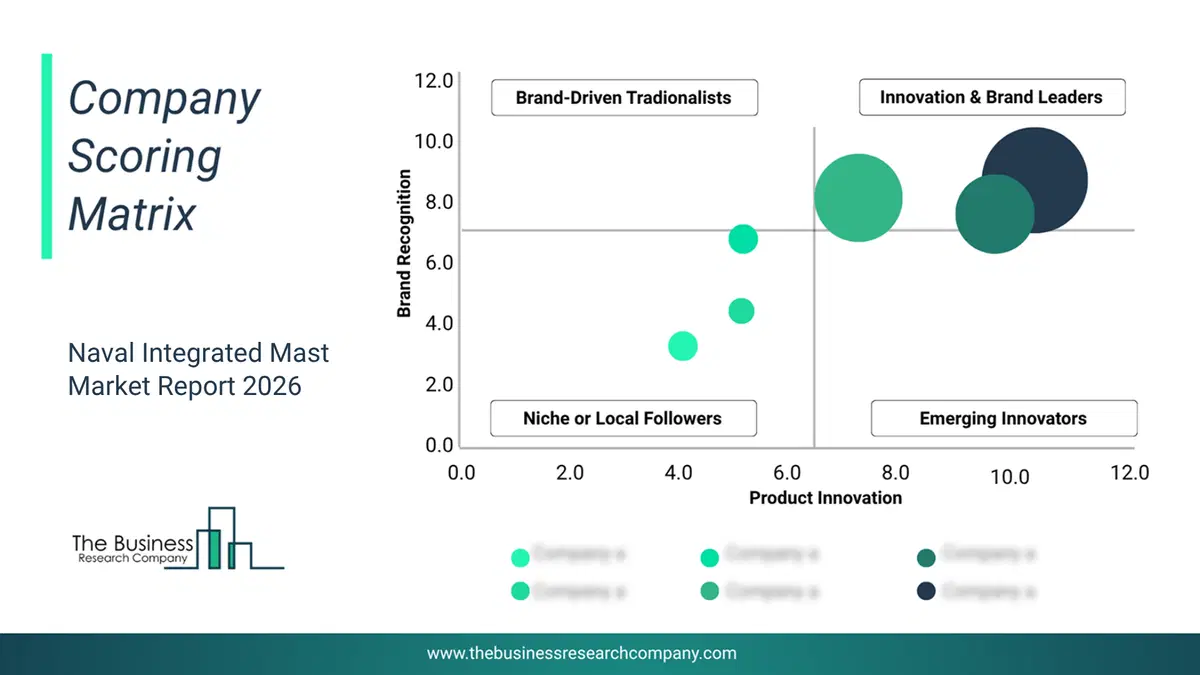
This chart maps companies by product innovation and brand strength, with bubble size indicating relative revenue, helping identify market leaders, challengers, and niche players. This is an illustrative chart; the full report provides a complete and accurate competitive analysis.
Global Naval Integrated Mast Market Trends and Insights
Major companies operating in the naval integrated mast market are focusing on developing innovative solutions such as advanced combat management system embedding to enhance situational awareness and decision-making. Advanced combat management system embedding refers to integrating a ship’s core command, control, and sensor-processing capabilities directly into the mast structure, which helps by streamlining data flow, improving real-time threat detection, and enabling faster, more coordinated responses in naval operations. For instance, in May 2025, Naval Group SA, a France-based defense industry company, launched the third Hellenic Navy FDI frigate HS Formion and successfully installed its Panoramic Sensors and Intelligence Module (PSIM) mast. The PSIM, weighing 150 tons and standing 42 meters tall, consolidates the ship’s Command Information Center (CIC), the latest version of the SETIS Combat Management System (CMS), mission planning facilities, and one of two digital data centers, while also housing the majority of above-water sensors to provide uninterrupted 360° surveillance. The integration of so many advanced functions into a single mast structure reduces vessel weight, enhances survivability, improves space utilization, and supports faster production cycles. Embedding cutting-edge digital technologies directly into modular mast systems allows companies such as Naval Group SA to set new benchmarks in naval architecture and position themselves competitively as demand for multi-mission frigates with high-end situational awareness capabilities continues to grow.What Are Latest Mergers And Acquisitions In The Naval Integrated Mast Market? Rohde & Schwarz Australia Pty Ltd And STS Defence Ltd Partner To Supply Communications Masts For Hunter Class Frigates
In August 2025, Rohde & Schwarz Australia Pty Ltd., an Australia-based manufacturing company, partnered with STS Defence Ltd to supply the twin integrated main configurable communications masts for the Royal Australian Navy's first three Hunter class frigates under the Hunter Class Frigate Program (HCFP). With this partnership, Rohde & Schwarz Australia Pty Ltd and STS Defence Ltd aim to provide high-quality communications masts that enable the Royal Australian Navy’s Hunter class frigates to operate effectively across multiple frequency bands while meeting mission-critical operational requirements. STS Defence Ltd. is a UK-based manufacturing company that specializes in providing advanced naval communication and mast systems.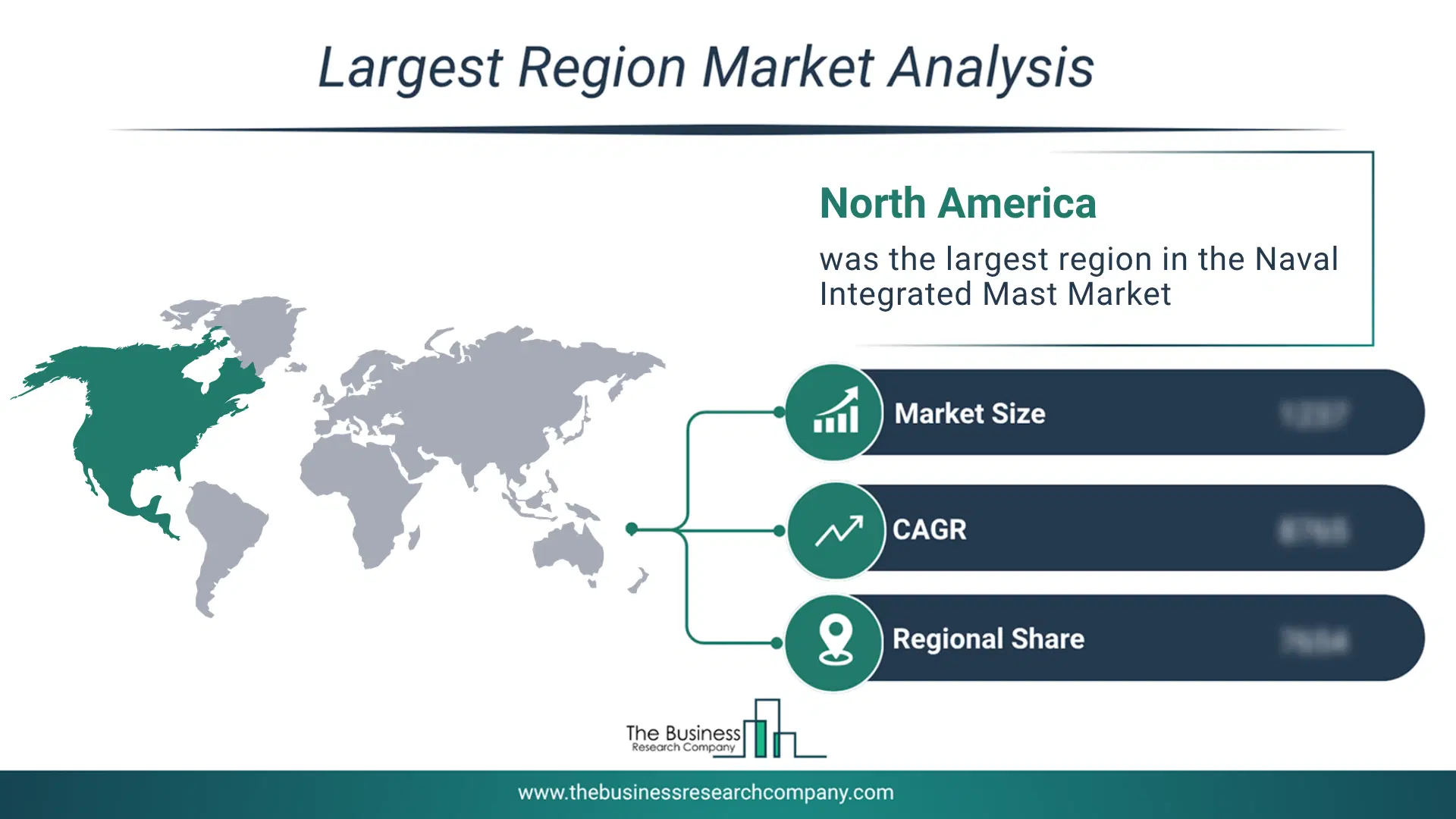
Regional Insights
North America was the largest region in the naval integrated mast market in 2025. Asia-Pacific is expected to be the fastest-growing region in the forecast period. The regions covered in this market report are Asia-Pacific, South East Asia, Western Europe, Eastern Europe, North America, South America, Middle East, Africa. The countries covered in this market report are Australia, Brazil, China, France, Germany, India, Indonesia, Japan, Taiwan, Russia, South Korea, UK, USA, Canada, Italy, SpainWhat Defines the Naval Integrated Mast Market?
The naval integrated mast market consists of sales of integrated mast systems, composite enclosed mast structures, multifunction radar and sensor modules, shipboard communications and datalink arrays, and electronic warfare and electro-optical/infrared sensor suites. Values in this market are ‘factory gate’ values, that is the value of goods sold by the manufacturers or creators of the goods, whether to other entities (including downstream manufacturers, wholesalers, distributors and retailers) or directly to end customers. The value of goods in this market includes related services sold by the creators of the goods.How is Market Value Defined and Measured?
The market value is defined as the revenues that enterprises gain from the sale of goods and/or services within the specified market and geography through sales, grants, or donations in terms of the currency (in USD unless otherwise specified). The revenues for a specified geography are consumption values that are revenues generated by organizations in the specified geography within the market, irrespective of where they are produced. It does not include revenues from resales along the supply chain, either further along the supply chain or as part of other products.
This chart presents market attractiveness based on a quantitative evaluation of growth, competition, strategic alignment, and risk, offering a clear view of opportunity areas for decision-making. This chart is for illustrative purposes; the full report contains the complete analysis.

This chart highlights the Total Addressable Market (TAM) by estimating the maximum revenue opportunity using an assumption-driven approach, supporting strategic planning and opportunity sizing across markets. The chart is illustrative; the full report provides a more comprehensive analysis.
What Key Data and Analysis Are Included in the Naval Integrated Mast Market Report 2026?
The naval integrated mast market research report is one of a series of new reports from The Business Research Company that provides market statistics, including industry global market size, regional shares, competitors with the market share, detailed market segments, market trends and opportunities, and any further data you may need to thrive in the naval integrated mast industry. The market research report delivers a complete perspective of everything you need, with an in-depth analysis of the current and future state of the industry.Naval Integrated Mast Market Report Forecast Analysis
| Report Attribute | Details |
|---|---|
| Market Size Value In 2026 | $1.63 billion |
| Revenue Forecast In 2030 | $2.32 billion |
| Growth Rate | CAGR of 9.2% from 2026 to 2030 |
| Base Year For Estimation | 2025 |
| Actual Estimates/Historical Data | 2020-2025 |
| Forecast Period | 2026 - 2030 |
| Market Representation | Revenue in USD Billion and CAGR from 2026 to 2030 |
| Segments Covered | Component, Platform, Material, Installation Type, End User |
| Regional Scope | Asia-Pacific, Western Europe, Eastern Europe, North America, South America, Middle East, Africa |
| Country Scope | The countries covered in the naval integrated mast market report are Australia, Brazil, China, France, Germany, India, Indonesia, Japan, Taiwan, Russia, South Korea, UK, USA, Canada, Italy, Spain |
| Key Companies Profiled | Lockheed Martin Corporation, General Dynamics Corporation, BAE Systems plc, L3Harris Technologies Inc., Leonardo S.p.A., ST Engineering Ltd., Elbit Systems Ltd., Indra Sistemas S.A., Israel Aerospace Industries Ltd. (IAI), Saab AB, Naval Group, Thales S.A., HENSOLDT AG, Atlas Elektronik GmbH, Terma A/S, Navantia S.A., Will-Burt Company Inc., MILMAST S.p.A., GABLER Naval Technology GmbH, Mastsystem AB |
| Customization Scope | Request for Customization |
| Pricing And Purchase Options | Explore Purchase Options |