
O-Band Coherent-Optics Market Report 2026
Global Outlook – By Component (Transceivers, Modulators, Detectors, Multiplexers Or Demultiplexers, Other Components), By Data Rate (100G, 200G, 400G, 800G, Other Data Rates), By Application (Data Centre Interconnect, Metro Networks, Long Haul, Access Networks, Other Applications), By End-User (Telecommunications, Cloud Service Providers, Enterprises, Other End-Users) – Market Size, Trends, Strategies, and Forecast to 2030
O-Band Coherent-Optics Market Overview
• O-Band Coherent-Optics market size has reached to $1.74 billion in 2025 • Expected to grow to $5.26 billion in 2030 at a compound annual growth rate (CAGR) of 24.7% • Growth Driver: Rising Demand For High-speed Bandwidth Driving The Market Due To Increasing Need For Efficient Large-volume Data Transmission • Market Trend: Technological Advancements Driving Optical Networks • North America was the largest region in 2025 and Asia-Pacific is the fastest growing region.What Is Covered Under O-Band Coherent-Optics Market?
O-band coherent-optics refers to an optical communication technology that uses coherent detection combined with O-band wavelengthsbto transmit data. It offers advantages such as extended transmission distance, higher bandwidth, reduced signal distortion due to low chromatic dispersion, and lower power consumption. This technology is particularly suited for short-to-medium-range data center interconnects and provides cost-effective, energy-efficient optical networking solutions. The main components of O-band coherent-optics are transceivers, modulators, detectors, multiplexers or demultiplexers, and other components. Transceivers refer to electronic or optical devices that both transmit and receive signals, enabling two-way communication over a network or communication channel. These systems are available in data rates of 100G, 200G, 400G, 800G, and other speeds, and are widely applied in data centers, interconnects, metro networks, long-haul networks, access networks, and others. The key end-users include telecommunications providers, cloud service providers, enterprises, and others.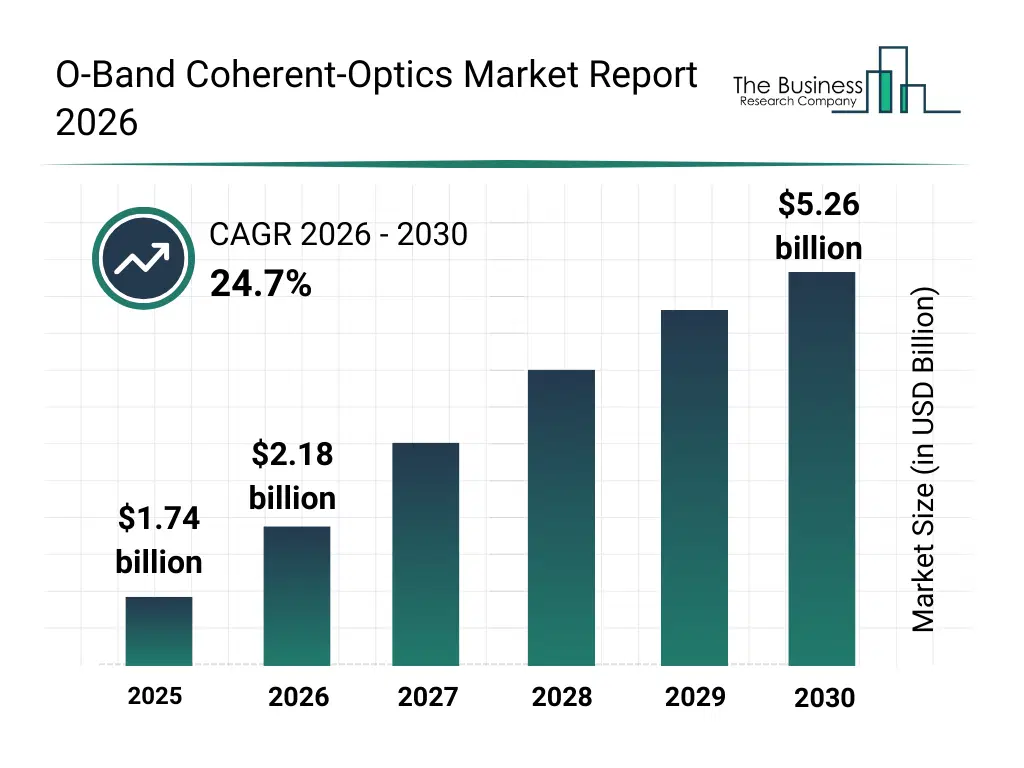
What Is The O-Band Coherent-Optics Market Size and Share 2026?
The o-band coherent-optics market size has grown exponentially in recent years. It will grow from $1.74 billion in 2025 to $2.18 billion in 2026 at a compound annual growth rate (CAGR) of 25.0%. The growth in the historic period can be attributed to growth of data center interconnects, rising demand for high-bandwidth optical networks, adoption of coherent detection technologies, expansion of metro and enterprise networks, need for low-power optical communication solutions.What Is The O-Band Coherent-Optics Market Growth Forecast?
The o-band coherent-optics market size is expected to see exponential growth in the next few years. It will grow to $5.26 billion in 2030 at a compound annual growth rate (CAGR) of 24.7%. The growth in the forecast period can be attributed to deployment of o-band coherent optics in data centers, increasing demand for energy-efficient optical networking, expansion in metro and cloud networks, development of 400g and 800g optical modules, integration with AI-based optical network management. Major trends in the forecast period include extended transmission distance, higher bandwidth optical networking, reduced signal distortion, energy-efficient optical solutions, short-to-medium range data center interconnects.
Global O-Band Coherent-Optics Market Segmentation
1) By Component: Transceivers, Modulators, Detectors, Multiplexers Or Demultiplexers, Other Components 2) By Data Rate: 100G, 200G, 400G, 800G, Other Data Rates 3) By Application: Data Centre Interconnect, Metro Networks, Long Haul, Access Networks, Other Applications 4) By End-User: Telecommunications, Cloud Service Providers, Enterprises, Other End-Users Subsegments: 1) By Transceivers: C Form-Factor Pluggable, C Form-Factor Pluggable 2, C Form-Factor Pluggable 4, Quad Small Form-Factor Pluggable Double Density, Octal Small Form-Factor Pluggable 2) By Modulators: In-Phase Quadrature Modulators, Mach-Zehnder Modulators 3) By Detectors: Positive-Intrinsic-Negative Photodiodes, Avalanche Photodiodes 4) By Multiplexers Or Demultiplexers: Wavelength Division Multiplexers, Dense Wavelength Division Multiplexers, Coarse Wavelength Division Multiplexers 5) By Other Components: Optical Amplifiers, Optical Filters, Optical SwitchesWhat Is The Driver Of The O-Band Coherent-Optics Market?
The rise in demand for high-speed bandwidth is expected to propel the growth of the O-band coherent-optics market going forward. High-speed bandwidth means the ability to transmit large volumes of data rapidly across communication networks. Demand for high-speed bandwidth is rising mainly because of the rapid growth in cloud computing, which requires substantial data transmission capacity to support services and applications hosted remotely. O-band coherent optics supports rising high-speed bandwidth demand by transmitting large data volumes efficiently with low signal distortion and reduced power consumption, thanks to its low dispersion characteristics that simplify signal processing and lower network costs. For instance, in September 2023, according to the Office of Communications (Ofcom), a UK-based regulatory authority for the communications and broadcasting sectors, in March 2023, the average UK broadband download speed reached 69.4 Mbit/s, representing a 17% year-on-year increase. Therefore, the growing appetite for faster data transfer is driving adoption of O-band coherent-optics technology.Key Players In The Global O-Band Coherent-Optics Market
Major companies operating in the o-band coherent-optics market are Huawei Technologies Co. Ltd., Cisco Systems Inc., Mitsubishi Electric Corporation, Broadcom Inc., Fujitsu Limited, NEC Corporation, Nokia Corporation, ZTE Corporation, Marvell Technology, Fujikura Ltd., Juniper Networks Inc., Ciena Corporation, Sumitomo Electric Industries Ltd., Lumentum Holdings Inc., Infinera Corporation, Eoptolink Technology Inc. Ltd., PacketLight Networks Ltd., NKT Photonics A/S, FONEX Data Systems, Quantifi Photonics
This chart is for illustrative purposes; the full report includes a detailed competitor analysis and comprehensive overview of the top 10 companies in the market.
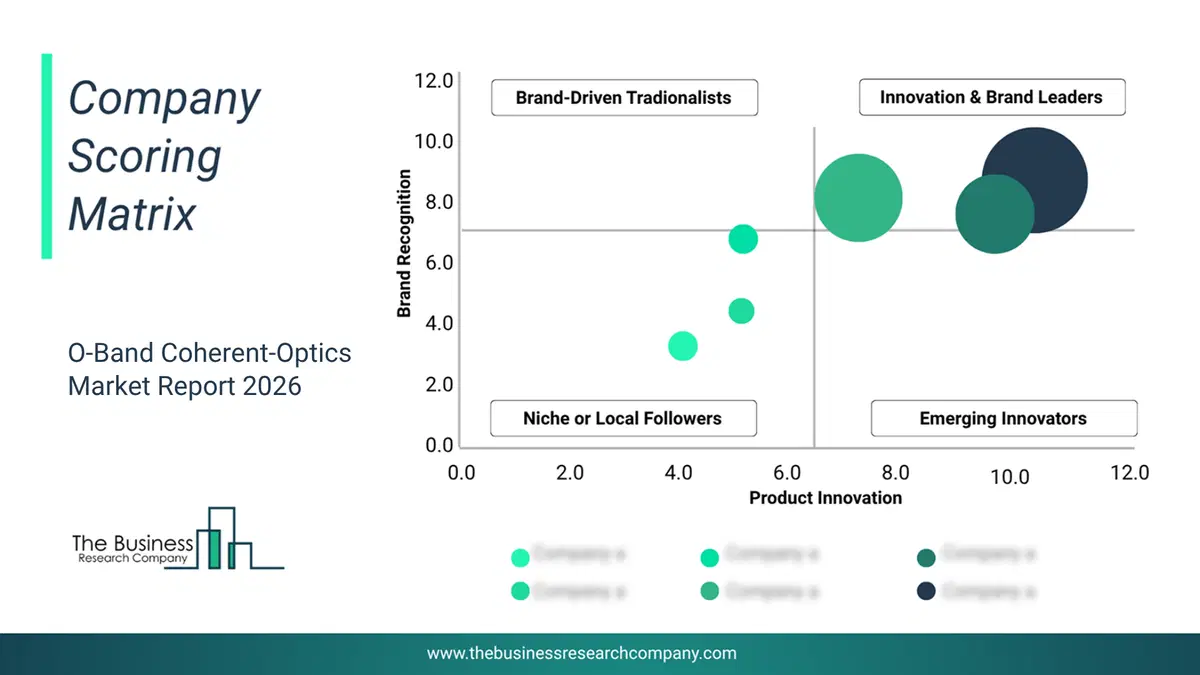
This chart maps companies by product innovation and brand strength, with bubble size indicating relative revenue, helping identify market leaders, challengers, and niche players. This is an illustrative chart; the full report provides a complete and accurate competitive analysis.
Global O-Band Coherent-Optics Market Trends and Insights
Major companies operating in the O-band coherent-optics market are focusing on technological advancements, such as optical communication networks, to gain a competitive advantage. Optical communication networks refer to systems that transmit information by sending light signals through optical fiber cables, enabling high-speed, long-distance data transfer with minimal signal loss. For instance, in December 2023, Coherent Corp., a US-based technology leader, introduced the industry-first 800G ZR/ZR+ transceiver. This product offers advanced digital signal processing for enhanced signal quality, compact pluggable form factors for easy integration, and improved power efficiency useful for data center interconnects and telecommunications. These technological improvements support expanding bandwidth needs while reducing power consumption and operational complexity, especially important in short-reach data center optical links. Such innovations are shaping the evolution of O-band coherent optics by advancing high-capacity and cost-effective networking solutions.What Are Latest Mergers And Acquisitions In The O-Band Coherent-Optics Market?
In February 2025, Nokia Corporation, a Finland-based networking company, acquired Infinera Corporation for approximately $2.3 billion. With this acquisition, Nokia aims to expand its scale and technological capabilities in coherent optical networking, strengthen its position in the fast-growing webscale and data-center interconnect segments, and accelerate innovation to meet the performance and power-efficiency demands of the AI era. Infinera Corporation is a US-based provider of advanced optical transport systems, coherent optical engines, and open optical networking solutions for metro, long-haul, and subsea applications.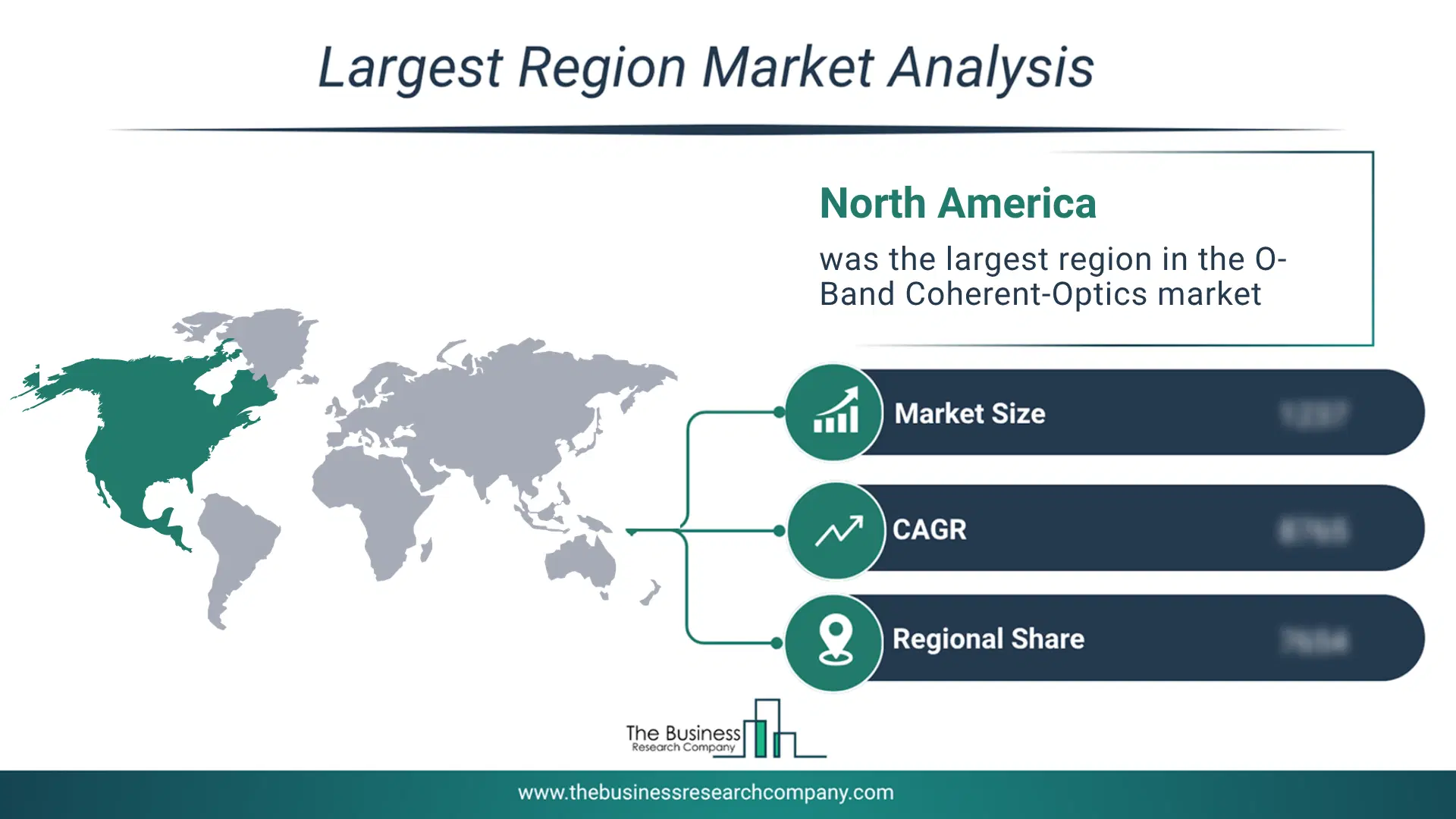
Regional Insights
North America was the largest region in the O-band coherent-optics market in 2025. Asia-Pacific is expected to be the fastest-growing region in the forecast period. The regions covered in this market report are Asia-Pacific, South East Asia, Western Europe, Eastern Europe, North America, South America, Middle East, Africa. The countries covered in this market report are Australia, Brazil, China, France, Germany, India, Indonesia, Japan, Taiwan, Russia, South Korea, UK, USA, Canada, Italy, Spain.What Defines the O-Band Coherent-Optics Market?
The O-band coherent-optics market consists of revenues earned by entities providing services such as deployment, installation, maintenance, support, testing and certification services. The market value includes the value of related goods sold by the service provider or included within the service offering. The O-band coherent-optics market includes sales of coherent optical transceivers, optical modules and chips, digital signal processors (DSPs), optical amplifiers, and wavelength-division multiplexers (WDM). Values in this market are 'factory gate' values, that is, the value of goods sold by the manufacturers or creators of the goods, whether to other entities (including downstream manufacturers, wholesalers, distributors and retailers) or directly to end customers. The value of goods in this market includes related services sold by the creators of the goods.How is Market Value Defined and Measured?
The market value is defined as the revenues that enterprises gain from the sale of goods and/or services within the specified market and geography through sales, grants, or donations in terms of the currency (in USD unless otherwise specified). The revenues for a specified geography are consumption values that are revenues generated by organizations in the specified geography within the market, irrespective of where they are produced. It does not include revenues from resales along the supply chain, either further along the supply chain or as part of other products.
This chart presents market attractiveness based on a quantitative evaluation of growth, competition, strategic alignment, and risk, offering a clear view of opportunity areas for decision-making. This chart is for illustrative purposes; the full report contains the complete analysis.

This chart highlights the Total Addressable Market (TAM) by estimating the maximum revenue opportunity using an assumption-driven approach, supporting strategic planning and opportunity sizing across markets. The chart is illustrative; the full report provides a more comprehensive analysis.
What Key Data and Analysis Are Included in the O-Band Coherent-Optics Market Report 2026?
The o-band coherent-optics market research report is one of a series of new reports from The Business Research Company that provides market statistics, including industry global market size, regional shares, competitors with the market share, detailed market segments, market trends and opportunities, and any further data you may need to thrive in the o-band coherent-optics industry. The market research report delivers a complete perspective of everything you need, with an in-depth analysis of the current and future state of the industry.O-Band Coherent-Optics Market Report Forecast Analysis
| Report Attribute | Details |
|---|---|
| Market Size Value In 2026 | $2.18 billion |
| Revenue Forecast In 2030 | $5.26 billion |
| Growth Rate | CAGR of 24.7% from 2026 to 2030 |
| Base Year For Estimation | 2025 |
| Actual Estimates/Historical Data | 2020-2025 |
| Forecast Period | 2026 - 2030 |
| Market Representation | Revenue in USD Billion and CAGR from 2026 to 2030 |
| Segments Covered | Component, Data Rate, Application, End-User |
| Regional Scope | Asia-Pacific, Western Europe, Eastern Europe, North America, South America, Middle East, Africa |
| Country Scope | The Countries Covered In This Market Report Are Australia, Brazil, China, France, Germany, India, Indonesia, Japan, Taiwan, Russia, South Korea, Uk, Usa, Canada, Italy, Spain. |
| Key Companies Profiled | Huawei Technologies Co. Ltd., Cisco Systems Inc., Mitsubishi Electric Corporation, Broadcom Inc., Fujitsu Limited, NEC Corporation, Nokia Corporation, ZTE Corporation, Marvell Technology, Fujikura Ltd., Juniper Networks Inc., Ciena Corporation, Sumitomo Electric Industries Ltd., Lumentum Holdings Inc., Infinera Corporation, Eoptolink Technology Inc. Ltd., PacketLight Networks Ltd., NKT Photonics A/S, FONEX Data Systems, Quantifi Photonics |
| Customization Scope | Request for Customization |
| Pricing And Purchase Options | Explore Purchase Options |