
Optical Orthogonal Frequency Division Multiplexing (OFDM) Communication Market Report 2026
Global Outlook – By Component (Transceivers, Modulators, Demodulators, Multiplexers, Other Components), By Technology (Direct Detection, Coherent Detection), By Application (Data Center, Long-Haul Communication, Metro Networks, Access Networks, Other Applications), By End-User (Telecommunications, Information Technology And Data Centers, Enterprises, Government, Other End-Users) – Market Size, Trends, Strategies, and Forecast to 2030
Optical Orthogonal Frequency Division Multiplexing (OFDM) Communication Market Overview
• Optical Orthogonal Frequency Division Multiplexing (OFDM) Communication market size has reached to $4.91 billion in 2025 • Expected to grow to $10.45 billion in 2030 at a compound annual growth rate (CAGR) of 16.3% • Growth Driver: Growing Expansion Of 5G Networks Driving The Market Due To Increasing Demand For High-speed, High-capacity Data Transmission • North America was the largest region in 2025 and Asia-Pacific is the fastest growing region.What Is Covered Under Optical Orthogonal Frequency Division Multiplexing (OFDM) Communication Market?
Optical orthogonal frequency division multiplexing (OFDM) communication is a high-speed optical communication technique that transmits data by dividing a single optical carrier into multiple orthogonal subcarriers, each carrying a portion of the data simultaneously. This method allows efficient utilization of the optical spectrum, improves resistance to signal distortion such as chromatic dispersion and multipath interference, and enhances data throughput in optical fiber or free-space optical links. The main components of optical orthogonal frequency division multiplexing (OFDM) communication include transceivers, modulators, demodulators, multiplexers, and other components. Transceivers refer to devices that both transmit and receive optical signals, enabling high-speed, multi-channel data transmission using OFDM techniques to improve spectral efficiency and signal robustness. These systems utilize technologies including direct detection and coherent detection, and are widely applied in data centers, long-haul communication, metro networks, access networks, and others. The key end-users include telecommunications, information technology and data centers, enterprises, government organizations, and others.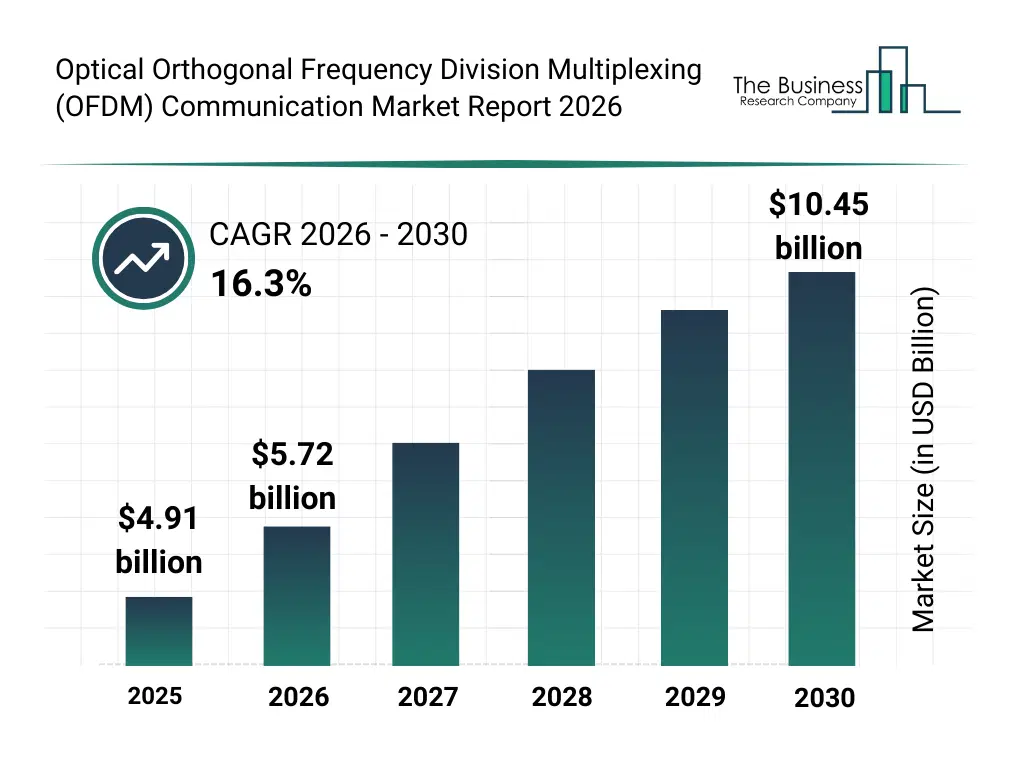
What Is The Optical Orthogonal Frequency Division Multiplexing (OFDM) Communication Market Size and Share 2026?
The optical orthogonal frequency division multiplexing (ofdm) communication market size has grown rapidly in recent years. It will grow from $4.91 billion in 2025 to $5.72 billion in 2026 at a compound annual growth rate (CAGR) of 16.5%. The growth in the historic period can be attributed to growing demand for higher data transmission rates, limitations of single-carrier optical systems, expansion of long-haul fiber networks, advancements in digital signal processing, increasing internet and video traffic.What Is The Optical Orthogonal Frequency Division Multiplexing (OFDM) Communication Market Growth Forecast?
The optical orthogonal frequency division multiplexing (ofdm) communication market size is expected to see rapid growth in the next few years. It will grow to $10.45 billion in 2030 at a compound annual growth rate (CAGR) of 16.3%. The growth in the forecast period can be attributed to deployment of ultra-high-speed metro networks, rising adoption of coherent detection technologies, demand for spectrum-efficient communication, growth of data center interconnects, increasing investments in next-generation optical networks. Major trends in the forecast period include high-spectral-efficiency optical transmission, coherent optical ofdm adoption, adaptive modulation and bandwidth allocation, dispersion-resilient optical communication, scalable high-capacity fiber networks.
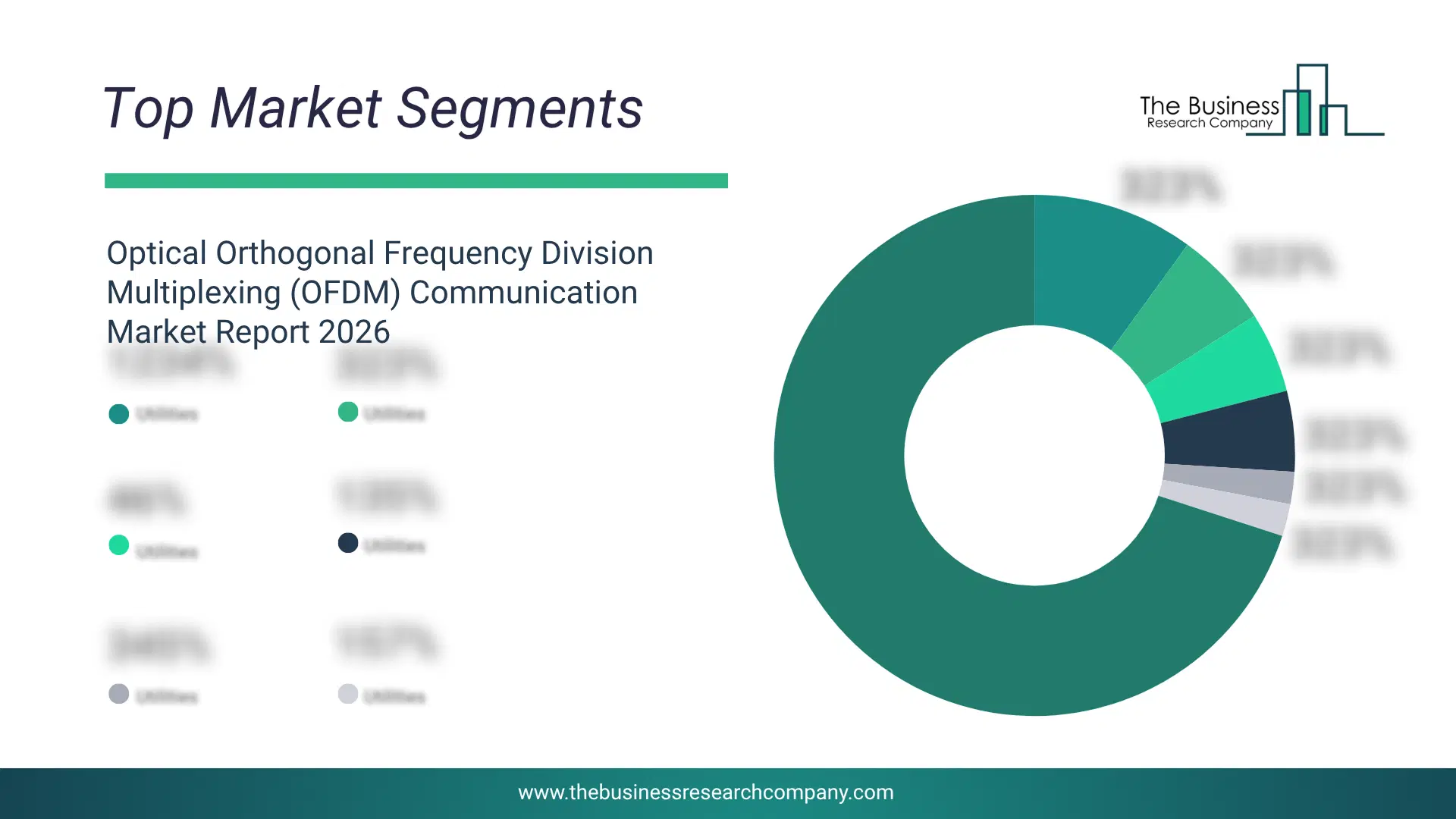
Global Optical Orthogonal Frequency Division Multiplexing (OFDM) Communication Market Segmentation
1) By Component: Transceivers, Modulators, Demodulators, Multiplexers, Other Components 2) By Technology: Direct Detection, Coherent Detection 3) By Application: Data Center, Long-Haul Communication, Metro Networks, Access Networks, Other Applications 4) By End-User: Telecommunications, Information Technology And Data Centers, Enterprises, Government, Other End-Users Subsegments: 1) By Transceivers: Coherent Transceivers, Direct Detection Transceivers, Pluggable Transceivers, Integrated Transceivers 2) By Modulators: Mach-Zehnder Modulators, Electro-Absorption Modulators, Phase Modulators, In-phase And Quadrature (IQ) Modulators 3) By Demodulators: Coherent Demodulators, Direct Detection Demodulators, Software-Defined Demodulators 4) By Multiplexers: Wavelength Division Multiplexers, Dense Wavelength Division Multiplexers, Optical Add-Drop Multiplexers, Coarse Wavelength Division Multiplexers 5) By Other Components: Optical Amplifiers, Optical Filters, Dispersion Compensation Modules, Photodetectors, Optical Connectors And CouplersWhat Are The Drivers Of The Optical Orthogonal Frequency Division Multiplexing (OFDM) Communication Market?
The growing expansion of 5G networks is expected to propel the growth of the optical orthogonal frequency division multiplexing (OFDM) communication market going forward. 5G networks refer to the fifth generation of wireless cellular technology designed to deliver significantly faster data speeds, lower latency, and enhanced connectivity for a vast number of devices simultaneously. The expansion of 5G networks is rising primarily due to the rapid increase in mobile data consumption driven by widespread use of video streaming, cloud gaming, and mobile applications demanding higher speeds and bandwidth. Optical OFDM is one of several advanced modulation techniques that can enhance fiber-optic network capacity and spectral efficiency, enabling high-speed data transmission over existing optical infrastructure. For instance, in September 2023, according to 5G Americas, a US-based industry trade organization, by the first half of 2023, 5G penetration in North America had climbed to an impressive 40%, reflecting a robust growth rate of 25.5%. Market forecasts project that 5G connections in the region will surge to approximately 669 million by 2028. Therefore, the growing expansion of 5G networks is expected to drive the growth of the optical orthogonal frequency division multiplexing (OFDM) communication industry. The growing adoption of cloud computing is expected to propel the growth of the optical orthogonal frequency division multiplexing (OFDM) communication market going forward. Cloud computing is the delivery of computing services, such as servers, storage, databases, and software, over the internet, providing on-demand access to resources without the need for physical infrastructure. The adoption of cloud computing is rising primarily due to its ability to provide scalable and cost-effective IT resources on demand. Optical OFDM offers improved spectral efficiency and resilience to dispersion in fiber, making it suitable for high-speed interconnects in cloud networks. For instance, in October 2025, according to AAG IT Services, a UK-based IT and digital transformation services company, public cloud services saw a revenue surge, exceeding $415 billion in 2022, with predictions indicating a rise to $526 billion in 2023. Therefore, the growing adoption of cloud computing is driving the growth of the optical orthogonal frequency division multiplexing (OFDM) communication industry.Key Players In The Global Optical Orthogonal Frequency Division Multiplexing (OFDM) Communication Market
Major companies operating in the optical orthogonal frequency division multiplexing (ofdm) communication market are Huawei Technologies Co. Ltd., Cisco Systems Inc., Mitsubishi Electric Corporation, Broadcom Inc., Sumitomo Electric Industries Ltd., Telefonaktiebolaget LM Ericsson (publ), Nokia Corporation, ZTE Corporation, Arista Networks Inc., Fujikura Ltd., Lumentum Holdings Inc., Accelink Technologies Co. Ltd., POET Technologies Inc., ADTRAN Inc., Viavi Solutions Inc., Tejas Networks Limited, AvicenaTech Inc., Optiwave Systems Inc., Ranovus Inc., FICER Technology Co. Ltd.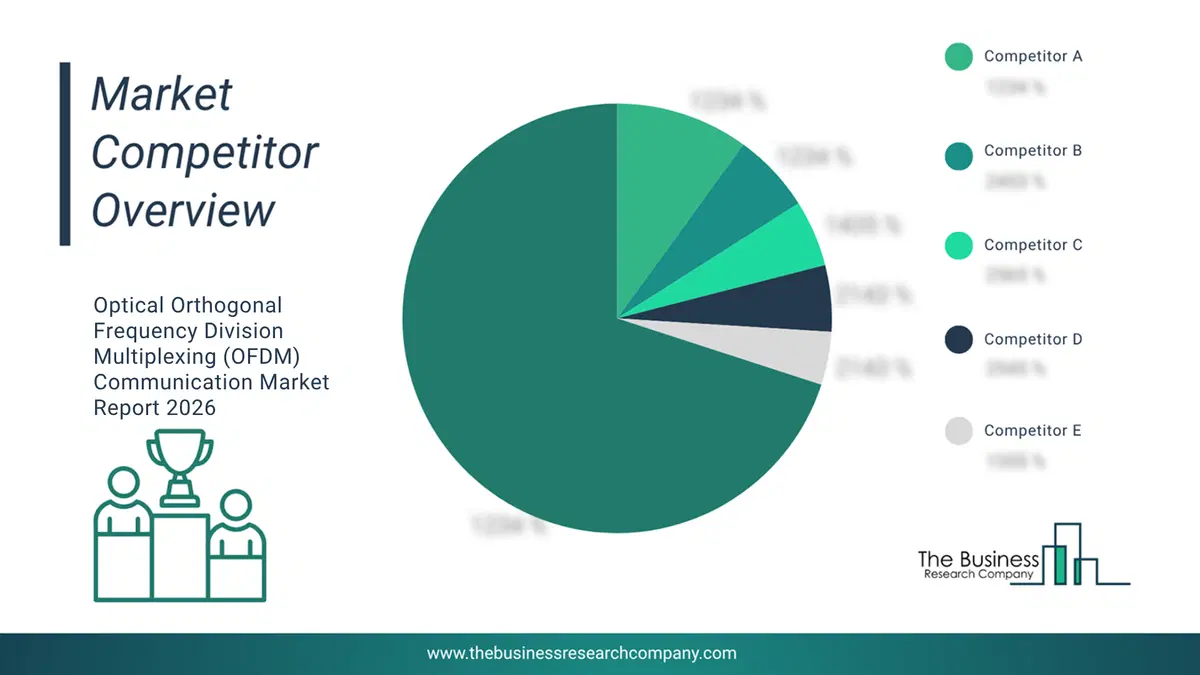
This chart is for illustrative purposes; the full report includes a detailed competitor analysis and comprehensive overview of the top 10 companies in the market.
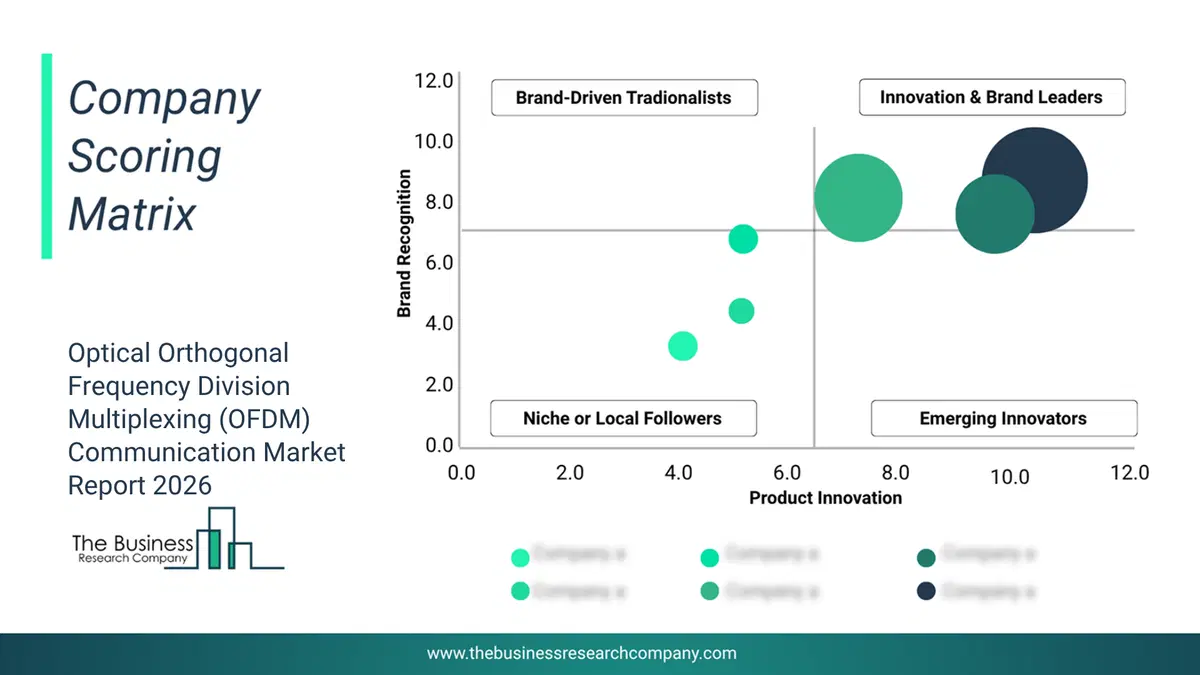
This chart maps companies by product innovation and brand strength, with bubble size indicating relative revenue, helping identify market leaders, challengers, and niche players. This is an illustrative chart; the full report provides a complete and accurate competitive analysis.
What Are Latest Mergers And Acquisitions In The Optical Orthogonal Frequency Division Multiplexing (OFDM) Communication Market?
In February 2025, Nokia Corporation, a Finland-based telecommunications, network infrastructure, and technology services provider, acquired Infinera Corporation for an undisclosed amount. With this acquisition, Nokia aims to create a leading optical networks powerhouse that accelerates product innovation and enhances its ability to support network operators in meeting the demands of the AI era. Infinera Corporation is a US-based provider of advanced optical networking equipment and software solutions for high-capacity telecommunications networks.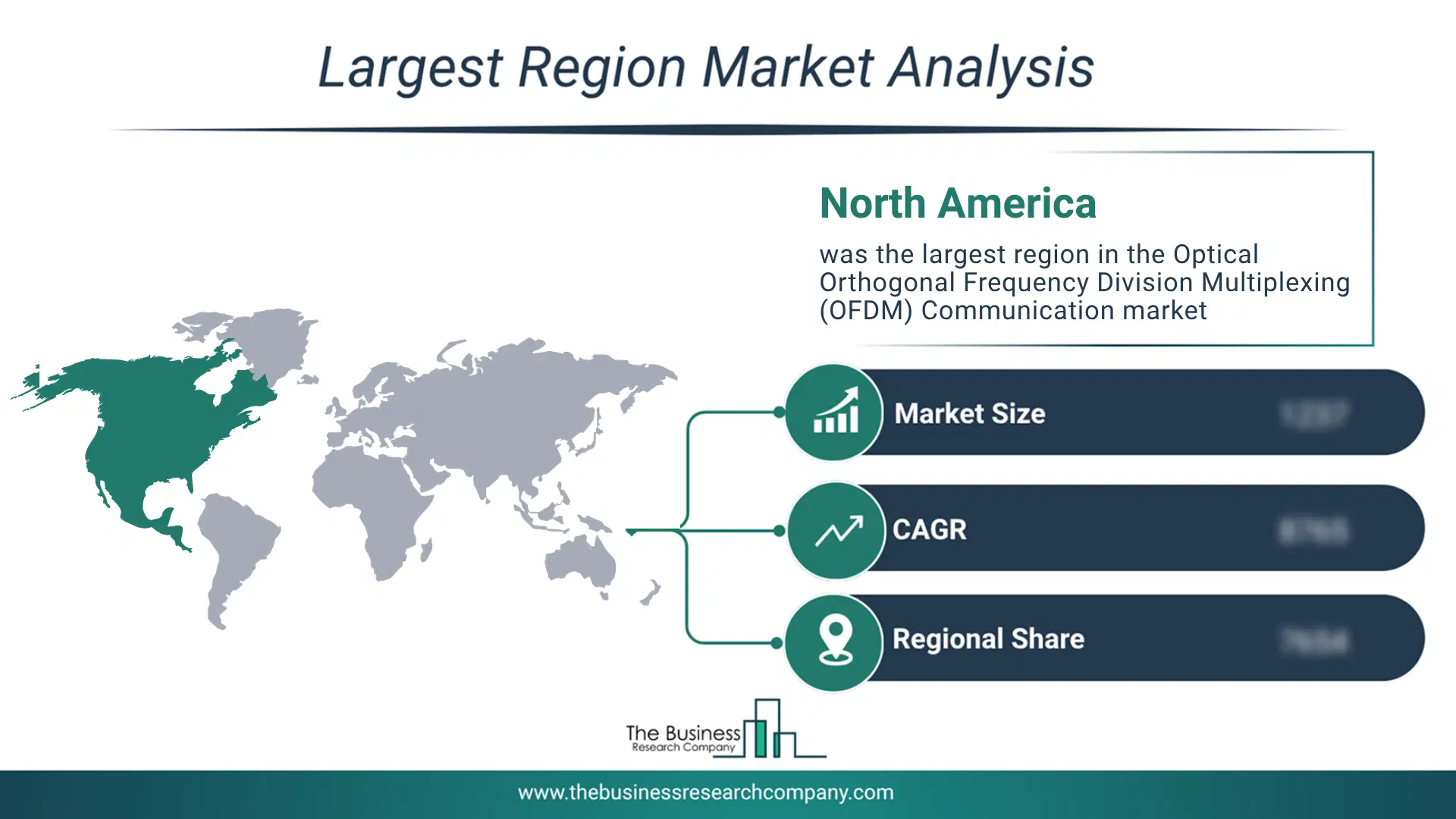
Regional Insights
North America was the largest region in the optical orthogonal frequency division multiplexing (OFDM) communication market in 2025. Asia-Pacific is expected to be the fastest-growing region in the forecast period. The regions covered in this market report are Asia-Pacific, South East Asia, Western Europe, Eastern Europe, North America, South America, Middle East, Africa. The countries covered in this market report are Australia, Brazil, China, France, Germany, India, Indonesia, Japan, Taiwan, Russia, South Korea, UK, USA, Canada, Italy, Spain.What Defines the Optical Orthogonal Frequency Division Multiplexing (OFDM) Communication Market?
The optical orthogonal frequency division multiplexing (OFDM) communication market consists of sales of optical amplifiers, optical filters, wavelength selective switches, coherent receivers and photonic integrated circuits. Values in this market are ‘factory gate’ values, that is the value of goods sold by the manufacturers or creators of the goods, whether to other entities (including downstream manufacturers, wholesalers, distributors and retailers) or directly to end customers. The value of goods in this market includes related services sold by the creators of the goods.How is Market Value Defined and Measured?
The market value is defined as the revenues that enterprises gain from the sale of goods and/or services within the specified market and geography through sales, grants, or donations in terms of the currency (in USD unless otherwise specified). The revenues for a specified geography are consumption values that are revenues generated by organizations in the specified geography within the market, irrespective of where they are produced. It does not include revenues from resales along the supply chain, either further along the supply chain or as part of other products.
This chart presents market attractiveness based on a quantitative evaluation of growth, competition, strategic alignment, and risk, offering a clear view of opportunity areas for decision-making. This chart is for illustrative purposes; the full report contains the complete analysis.

This chart highlights the Total Addressable Market (TAM) by estimating the maximum revenue opportunity using an assumption-driven approach, supporting strategic planning and opportunity sizing across markets. The chart is illustrative; the full report provides a more comprehensive analysis.
What Key Data and Analysis Are Included in the Optical Orthogonal Frequency Division Multiplexing (OFDM) Communication Market Report 2026?
The optical orthogonal frequency division multiplexing (ofdm) communication market research report is one of a series of new reports from The Business Research Company that provides market statistics, including industry global market size, regional shares, competitors with the market share, detailed market segments, market trends and opportunities, and any further data you may need to thrive in the optical orthogonal frequency division multiplexing (ofdm) communication industry. The market research report delivers a complete perspective of everything you need, with an in-depth analysis of the current and future state of the industry.Optical Orthogonal Frequency Division Multiplexing (OFDM) Communication Market Report Forecast Analysis
| Report Attribute | Details |
|---|---|
| Market Size Value In 2026 | $5.72 billion |
| Revenue Forecast In 2030 | $10.45 billion |
| Growth Rate | CAGR of 16.3% from 2026 to 2030 |
| Base Year For Estimation | 2025 |
| Actual Estimates/Historical Data | 2020-2025 |
| Forecast Period | 2026 - 2030 |
| Market Representation | Revenue in USD Billion and CAGR from 2026 to 2030 |
| Segments Covered | Component, Technology, Application, End-User |
| Regional Scope | Asia-Pacific, Western Europe, Eastern Europe, North America, South America, Middle East, Africa |
| Country Scope | The Countries Covered In This Market Report Are Australia, Brazil, China, France, Germany, India, Indonesia, Japan, Taiwan, Russia, South Korea, Uk, Usa, Canada, Italy, Spain. |
| Key Companies Profiled | Huawei Technologies Co. Ltd., Cisco Systems Inc., Mitsubishi Electric Corporation, Broadcom Inc., Sumitomo Electric Industries Ltd., Telefonaktiebolaget LM Ericsson (publ), Nokia Corporation, ZTE Corporation, Arista Networks Inc., Fujikura Ltd., Lumentum Holdings Inc., Accelink Technologies Co. Ltd., POET Technologies Inc., ADTRAN Inc., Viavi Solutions Inc., Tejas Networks Limited, AvicenaTech Inc., Optiwave Systems Inc., Ranovus Inc., FICER Technology Co. Ltd. |
| Customization Scope | Request for Customization |
| Pricing And Purchase Options | Explore Purchase Options |