
Orbital Defense Systems Market Report 2026
Global Outlook – By Component (Satellites, Ground Stations, Launch Vehicles, Other Components ), By Technology (Laser Systems, Kinetic Systems, Electronic Warfare Systems, Other Technologies ), By Application (Military, Civil, Commercial ), By End-User (Government, Defense Contractors, Commercial Enterprises) – Market Size, Trends, Strategies, and Forecast to 2030
Orbital Defense Systems Market Overview
• Orbital Defense Systems market size has reached to $18.33 billion in 2025 • Expected to grow to $25.89 billion in 2030 at a compound annual growth rate (CAGR) of 7.1% • Growth Driver: Increasing Defense Budget Fueling The Growth Of The Market Due To Rising Investment In Advanced Space-Based Military Capabilities • Market Trend: Strategic Alliances Driving Innovation And Operational Resilience I Orbital Defense • North America was the largest region in 2025.What Is Covered Under Orbital Defense Systems Market?
Orbital defense systems refer to space-based setups that safeguard against threats by using satellites, tracking tools, and defense technologies to monitor and respond to hostile activities in or from space. They work together to protect assets in space or defend against attacks targeting Earth or orbital platforms. The main components of orbital defense systems are satellites, ground stations, launch vehicles, and others. Satellites, whether natural or artificial, are key assets, with artificial satellites being purpose-built spacecraft deployed into orbit for communication, navigation, Earth observation, and scientific missions. These systems incorporate advanced technologies such as laser systems, kinetic interceptors, electronic warfare systems, and others. Orbital defense systems serve a range of applications across military, civil, and commercial domains and are utilized by governments, defense contractors, and commercial enterprises to ensure space security and operational resilience.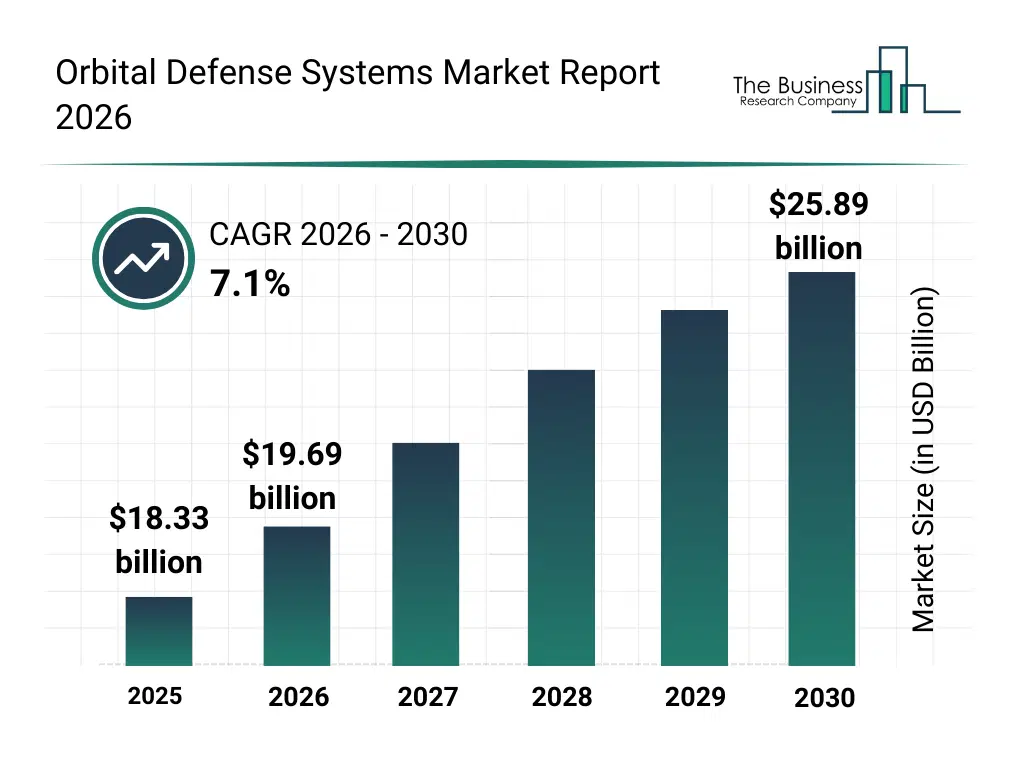
What Is The Orbital Defense Systems Market Size and Share 2026?
The orbital defense systems market size has grown strongly in recent years. It will grow from $18.33 billion in 2025 to $19.69 billion in 2026 at a compound annual growth rate (CAGR) of 7.4%. The growth in the historic period can be attributed to increasing deployment of early space-surveillance satellites for tracking orbital objects, rising need for missile detection systems supporting strategic early-warning missions, advancements in command-and-control networks enabling coordination of orbital defense assets, growth in space militarization driving investment in high-altitude defense platforms, expanding integration of orbital threat-monitoring tools derived from terrestrial defense technologies.What Is The Orbital Defense Systems Market Growth Forecast?
The orbital defense systems market size is expected to see strong growth in the next few years. It will grow to $25.89 billion in 2030 at a compound annual growth rate (CAGR) of 7.1%. The growth in the forecast period can be attributed to growing demand for unified orbital defense networks linking space and lunar facilities, increasing development of turreted weapon modules for space-based threat neutralization, rising investment in autonomous space-surveillance and interception technologies, expansion of multinational collaboration to counter emerging orbital threats, accelerating innovation in high-durability space systems engineered for long-term orbital defense operations. Major trends in the forecast period include expansion of space-based missile-warning constellations, growth in multi-orbit hybrid defense architectures, rising demand for debris-mitigation and orbital-cleanup systems, increased integration of moon-to-earth defense command networks, advancement in reusable launch systems for defense operations.
Global Orbital Defense Systems Market Segmentation
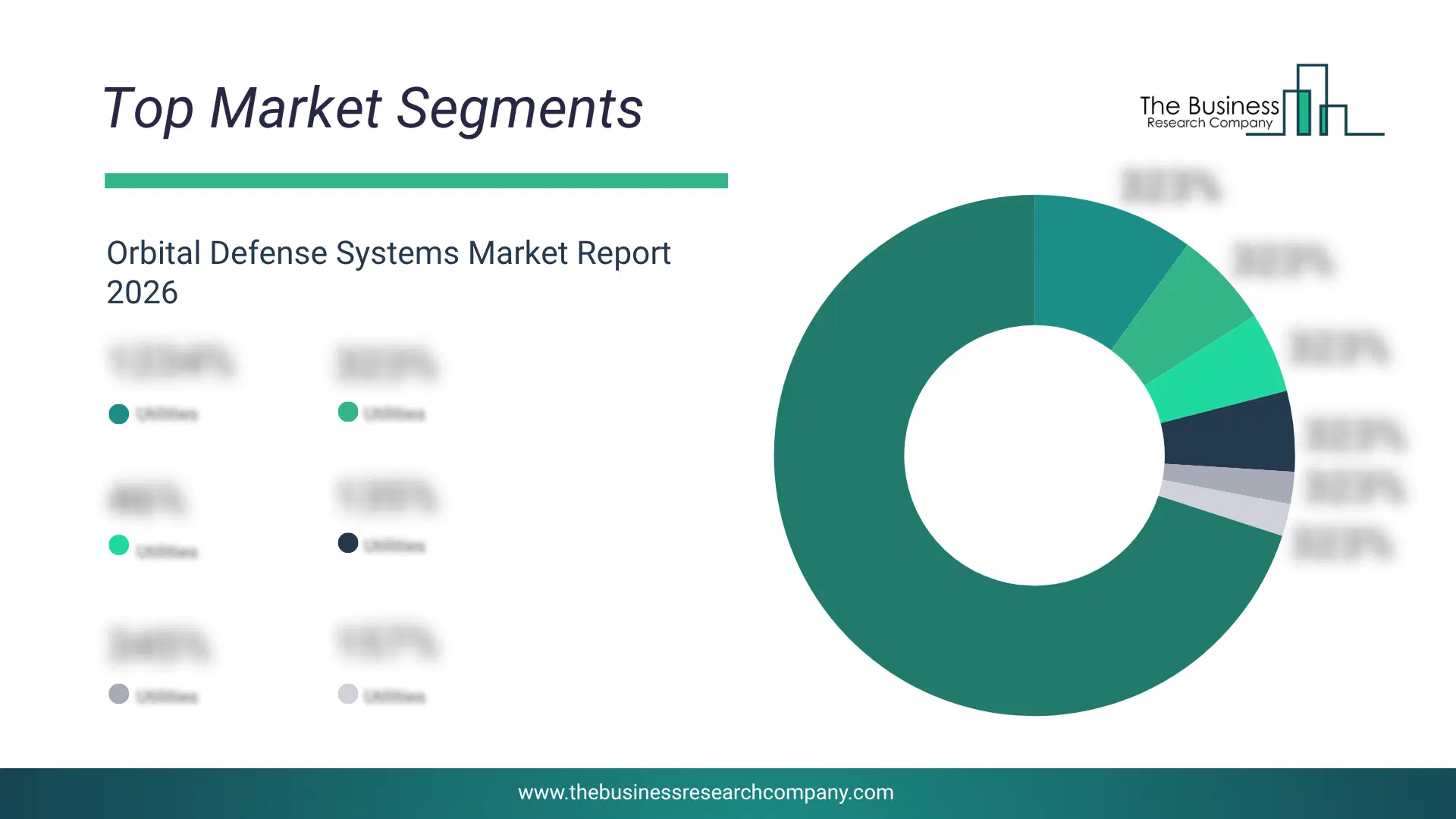
1) By Component: Satellites, Ground Stations, Launch Vehicles, Other Components 2) By Technology: Laser Systems, Kinetic Systems, Electronic Warfare Systems, Other Technologies 3) By Application: Military, Civil, Commercial 4) By End-User: Government, Defense Contractors, Commercial Enterprises Subsegments: 1) By Satellites: Communication Satellites, Surveillance Satellites, Navigation Satellites, Reconnaissance Satellites, Anti-satellite (ASAT) Weapons, Earth Observation Satellites 2) By Ground Stations: Command And Control Centers, Data Processing Units, Antenna Systems, Power Systems, Security Infrastructure 3) By Launch Vehicles: Small Launch Vehicles (SLVs), Medium Launch Vehicles (MLVs), Heavy Launch Vehicles (HLVs), Reusable Launch Systems, Ballistic Missiles-global-market-report" target="_blank">missiles 4) By Other Components: Space Debris Removal Systems, Propulsion Systems, Sensors And Detectors, Software And Artificial Intelligence Systems, Payload ModulesWhat Is Driver Of The Orbital Defense Systems Market?
The increasing defense budget is expected to propel the growth of the orbital defense systems market going forward. Defense budget refers to the funds allocated by a nation's military to purchase, replenish, and maintain its stockpile of bullets, shells, missiles, and other munitions. The defense budget is increasing due to heightened geopolitical tensions, expanded military operations, and the need to restock depleted ammunition supplies. Orbital defense systems rely heavily on defense budgets to secure funding for advanced technology development, deployment, and maintenance, ensuring effective protection against space-based threats. For instance, in December 2023, according to the House of Commons Library, a UK-based library, the UK won defense orders worth $16.04 billion (£12.0 billion) in real terms in 2022. This is a $6.15 (£4.6 billion) increase from 2021, reflecting a significant rise in defense procurement and investment in advanced military capabilities. Therefore, the increasing defense budget is driving the growth of the orbital defense systems industry.Key Players In The Global Orbital Defense Systems Market
Major companies operating in the orbital defense systems market are Raytheon Technologies Corporation, Lockheed Martin Corporation, General Dynamics Corporation, Northrop Grumman Corporation, L3Harris Technologies, Amentum Holdings Inc, General Atomics, AXIENT CORP, Rocket Lab USA Inc, Capella Space, Blue Canyon Technologies Inc, Loft Orbital Solutions Inc, LeoLabs Inc., Slingshot Aerospace Inc, SpaceWorks Enterprises Inc, Alba Orbital Limited, Voyager Technologies Inc, Kayhan Space Corp., FlyPix AI GmbH, Blackstar Orbital Technologies Corporation.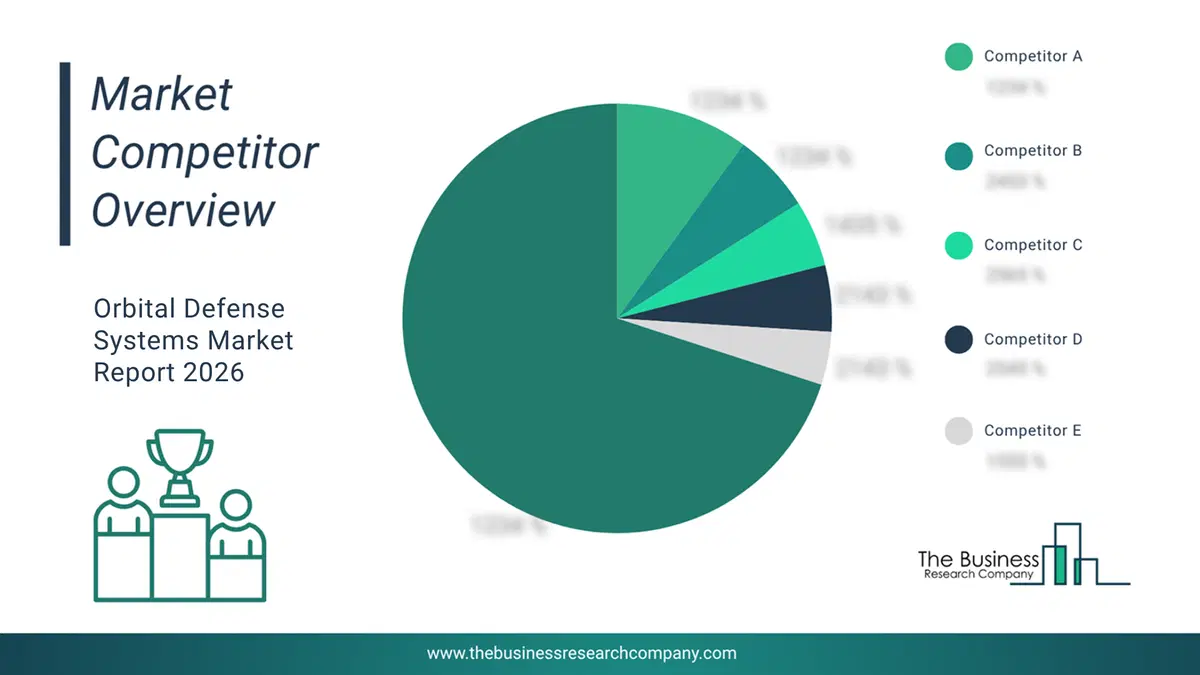
This chart is for illustrative purposes; the full report includes a detailed competitor analysis and comprehensive overview of the top 10 companies in the market.
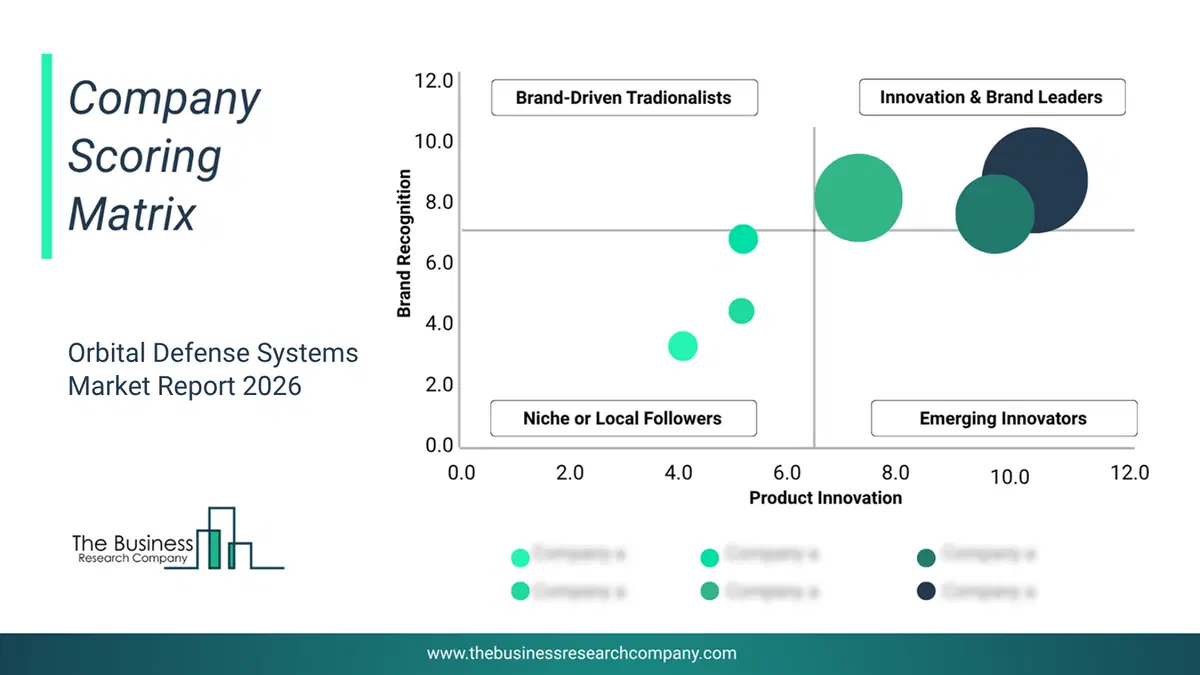
This chart maps companies by product innovation and brand strength, with bubble size indicating relative revenue, helping identify market leaders, challengers, and niche players. This is an illustrative chart; the full report provides a complete and accurate competitive analysis.
Global Orbital Defense Systems Market Trends and Insights
Major companies operating in the orbital defense systems market are focusing on strategic partnerships to accelerate technological innovation, enhance space-based surveillance and defense capabilities, and secure government contracts for large-scale deployment. Strategic partnerships refer to a process in which companies leverage each other's strengths and resources to achieve mutual benefits and success. For instance, in May 2025, Atmos Space Cargo GmbH, a Germany-based aerospace company, partnered with ARX Robotics GmbH, a Germany-based autonomous company, to launch Europe’s first orbital depot for autonomous defense systems, combining ATMOS’s re-entry capsules with ARX’s unmanned technologies. This alliance enables rapid deployment of autonomous systems for disaster response, surveillance, and defense, boosting Europe's operational resilience and expanding both companies’ strategic networks across the continent.What Are Latest Mergers And Acquisitions In The Orbital Defense Systems Market? Lockheed Martin Acquires Terran Orbital To Expand Space Systems Capabilities
In October 2024, Lockheed Martin, a US-based aerospace and defense company, acquired Terran Orbital for an undisclosed amount. Through this acquisition, it aims to strengthen its presence in the space systems sector by integrating advanced small satellite manufacturing capabilities, expanding its production agility, and enhancing its support for US Space development agency programs and other national security space missions. Terran Orbital Corporation is a US-based aerospace and defense company that manufactures orbital defense satellites and systems.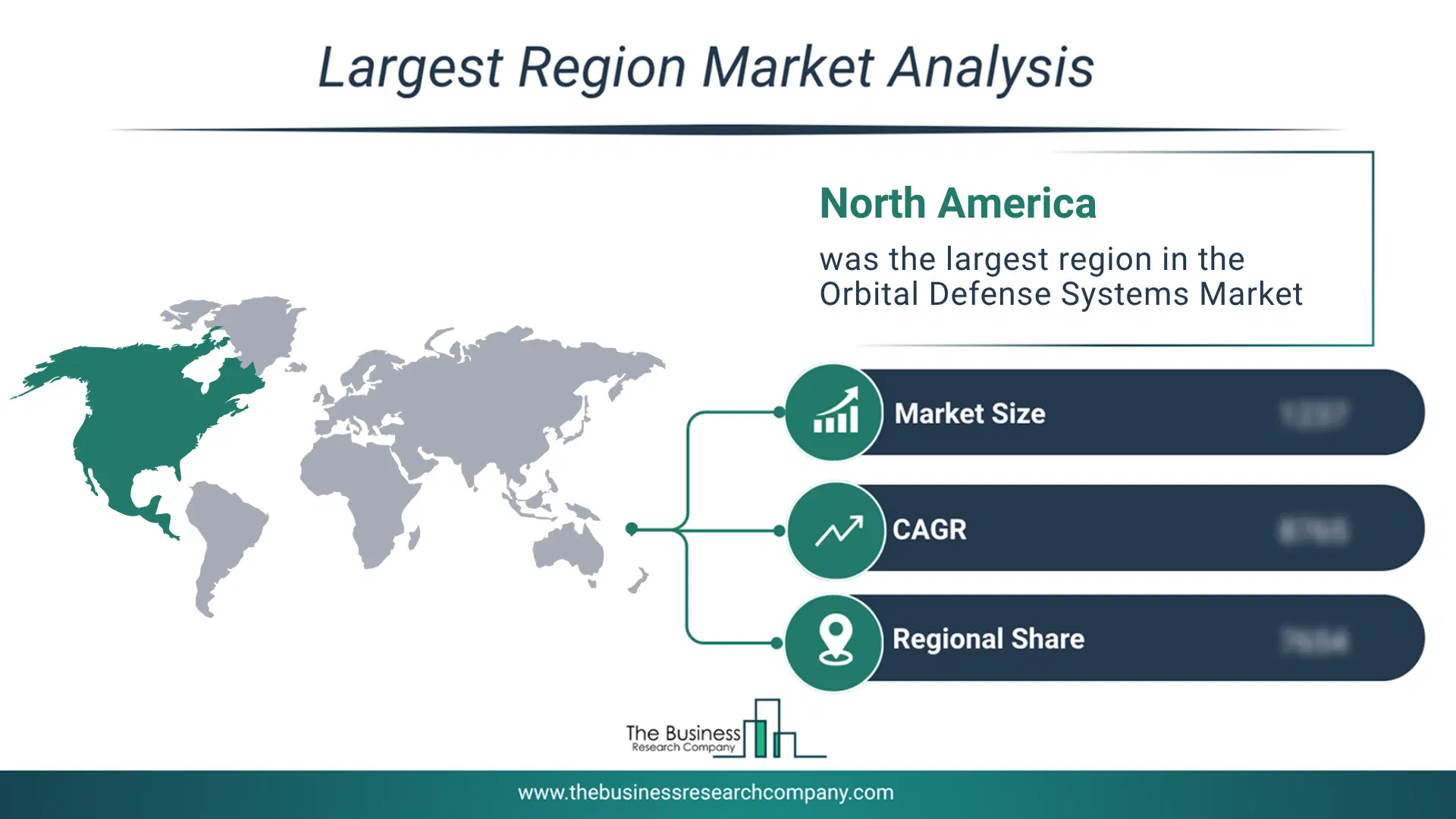
Regional Insights
North America was the largest region in the orbital defense system market in 2025. The regions covered in this market report are Asia-Pacific, South East Asia, Western Europe, Eastern Europe, North America, South America, Middle East, Africa. The countries covered in this market report are Australia, Brazil, China, France, Germany, India, Indonesia, Japan, Taiwan, Russia, South Korea, UK, USA, Canada, Italy, SpainWhat Defines the Orbital Defense Systems Market?
The orbital defense system market consists of revenues earned by entities by providing services such as space surveillance and tracking, missile detection and early warning, and orbital threat neutralization. The market value includes the value of related goods sold by the service provider or included within the service offering. The orbital defense system market also includes sales of high-altitude combat platforms, turreted weapon modules derived from advanced city destroyer armaments, and unified command and control networks linking orbital assets with the moon-based earth space defense facility. Values in this market are ‘factory gate’ values, that is the value of goods sold by the manufacturers or creators of the goods, whether to other entities (including downstream manufacturers, wholesalers, distributors and retailers) or directly to end customers. The value of goods in this market includes related services sold by the creators of the goods.How is Market Value Defined and Measured?
The market value is defined as the revenues that enterprises gain from the sale of goods and/or services within the specified market and geography through sales, grants, or donations in terms of the currency (in USD unless otherwise specified). The revenues for a specified geography are consumption values that are revenues generated by organizations in the specified geography within the market, irrespective of where they are produced. It does not include revenues from resales along the supply chain, either further along the supply chain or as part of other products.
This chart presents market attractiveness based on a quantitative evaluation of growth, competition, strategic alignment, and risk, offering a clear view of opportunity areas for decision-making. This chart is for illustrative purposes; the full report contains the complete analysis.

This chart highlights the Total Addressable Market (TAM) by estimating the maximum revenue opportunity using an assumption-driven approach, supporting strategic planning and opportunity sizing across markets. The chart is illustrative; the full report provides a more comprehensive analysis.
What Key Data and Analysis Are Included in the Orbital Defense Systems Market Report 2026?
The orbital defense systems market research report is one of a series of new reports from The Business Research Company that provides market statistics, including industry global market size, regional shares, competitors with the market share, detailed market segments, market trends and opportunities, and any further data you may need to thrive in the orbital defense systems industry. The market research report delivers a complete perspective of everything you need, with an in-depth analysis of the current and future state of the industry.Orbital Defense Systems Market Report Forecast Analysis
| Report Attribute | Details |
|---|---|
| Market Size Value In 2026 | $19.69 billion |
| Revenue Forecast In 2030 | $25.89 billion |
| Growth Rate | CAGR of 7.1% from 2026 to 2030 |
| Base Year For Estimation | 2025 |
| Actual Estimates/Historical Data | 2020-2025 |
| Forecast Period | 2026 - 2030 |
| Market Representation | Revenue in USD Billion and CAGR from 2026 to 2030 |
| Segments Covered | Component, Technology, Application, End-User |
| Regional Scope | Asia-Pacific, Western Europe, Eastern Europe, North America, South America, Middle East, Africa |
| Country Scope | The countries covered in the orbital defense systems market report are Australia, Brazil, China, France, Germany, India, Indonesia, Japan, Taiwan, Russia, South Korea, UK, USA, Canada, Italy, Spain |
| Key Companies Profiled | Raytheon Technologies Corporation, Lockheed Martin Corporation, General Dynamics Corporation, Northrop Grumman Corporation, L3Harris Technologies, Amentum Holdings Inc, General Atomics, AXIENT CORP, Rocket Lab USA Inc, Capella Space, Blue Canyon Technologies Inc, Loft Orbital Solutions Inc, LeoLabs Inc., Slingshot Aerospace Inc, SpaceWorks Enterprises Inc, Alba Orbital Limited, Voyager Technologies Inc, Kayhan Space Corp., FlyPix AI GmbH, Blackstar Orbital Technologies Corporation. |
| Customization Scope | Request for Customization |
| Pricing And Purchase Options | Explore Purchase Options |