
Orbital Transfer Vehicle Market Report 2026
Global Outlook – By Vehicle Type (Reusable Orbital Transfer Vehicles, Single-Use Orbital Transfer Vehicles), By Propulsion Type (Chemical Propulsion, Ionic Propulsion, Nuclear Thermal Propulsion, Electrical Propulsion), By Payload Capacity (Small Payload (Up To 200 Kilograms), Medium Payload (200 Kilograms To 1,000 Kilograms), Large Payload (1,000 Kilograms And Above)), By Application (Satellite Deployment, Space Exploration, In-Orbit Servicing, Space Tourism, International Space Station Resupply), By End-User (Government, Commercial, Academic And Research Institutions) – Market Size, Trends, Strategies, and Forecast to 2030
Orbital Transfer Vehicle Market Overview
• Orbital Transfer Vehicle market size has reached to $1.79 billion in 2025 • Expected to grow to $3.39 billion in 2030 at a compound annual growth rate (CAGR) of 13.7% • Growth Driver: Increasing Satellite Deployments Fueling The Market Growth Due To Rising Launch Activities And Growing Orbital Object Population • Market Trend: Autonomous And High-Power Systems Transforming Satellite Mobility • North America was the largest region in 2025 and Asia-Pacific is the fastest growing region.What Is Covered Under Orbital Transfer Vehicle Market?
An orbital transfer vehicle (OTV) is a spacecraft designed to transport payloads between different orbits after launch. It is equipped with propulsion and navigation systems that enable precise orbital maneuvers. OTVs can carry multiple satellites or other payloads and position them accurately in their designated orbits. These vehicles enhance the flexibility and efficiency of in-space operations by supporting complex mission profiles. The main vehicle types included in orbital transfer vehicles are reusable orbital transfer vehicles and single-use orbital transfer vehicles. Reusable orbital transfer vehicles refer to spacecraft designed to repeatedly transport payloads between orbits by docking, delivering, and returning for subsequent missions, offering cost-efficiency over single-use orbital transfer vehicles despite higher initial development costs. The different propulsion types include chemical propulsion, ionic propulsion, nuclear thermal propulsion, and electrical propulsion with various payload capacities such as small payload (up to 200 kilograms), medium payload (200 kilograms to 1,000 kilograms), and large payload (1,000 kilograms and above). The different applications include satellite deployment, space exploration, in-orbit servicing, space tourism, and international space station resupply, and are used by several end-users, including government, commercial, and academic and research institutions.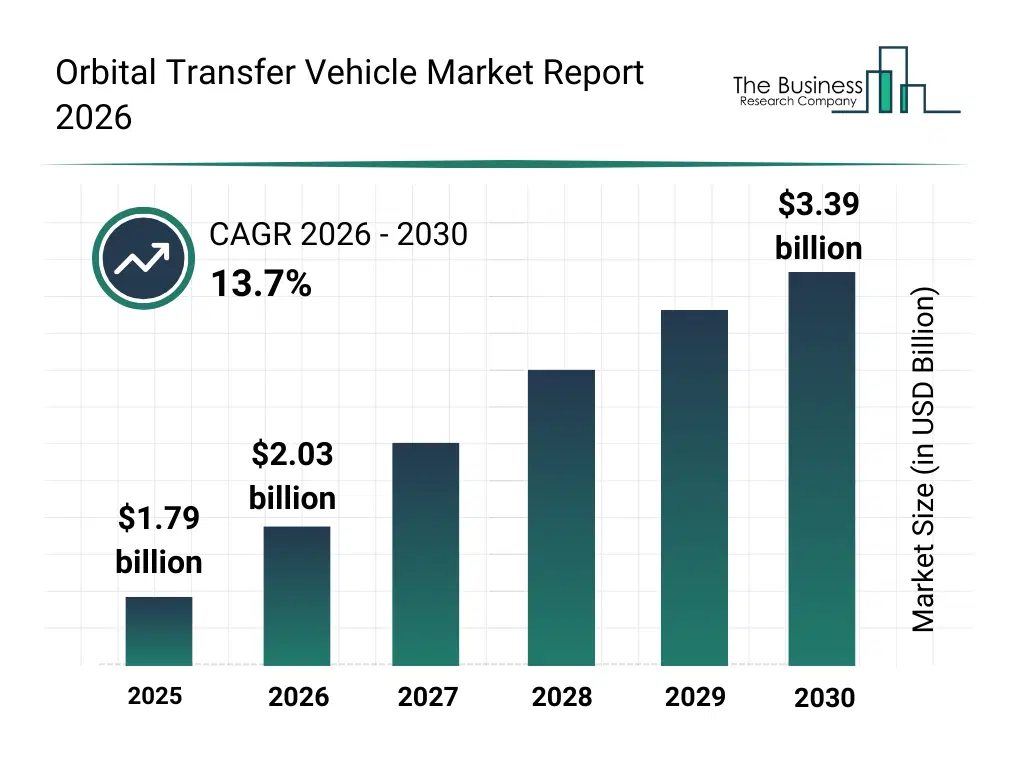
What Is The Orbital Transfer Vehicle Market Size and Share 2026?
The orbital transfer vehicle market size has grown rapidly in recent years. It will grow from $1.79 billion in 2025 to $2.03 billion in 2026 at a compound annual growth rate (CAGR) of 13.4%. The growth in the historic period can be attributed to increasing number of multi-satellite deployments, development of precision orbital maneuver technologies, adoption of onboard navigation and control systems, demand for in-space payload repositioning, growth of commercial satellite constellation programs.What Is The Orbital Transfer Vehicle Market Growth Forecast?
The orbital transfer vehicle market size is expected to see rapid growth in the next few years. It will grow to $3.39 billion in 2030 at a compound annual growth rate (CAGR) of 13.7%. The growth in the forecast period can be attributed to advancement in autonomous orbital transfer vehicles, growth in reusable otv platforms, integration with propellant depots for extended missions, expansion of multi-orbit payload delivery services, adoption of ai-based orbital navigation and collision avoidance systems. Major trends in the forecast period include multi-payload transport capability, precision orbital maneuvering systems, hybrid propulsion integration, in-orbit satellite servicing, support for space tourism and iss resupply.
Global Orbital Transfer Vehicle Market Segmentation
1) By Vehicle Type: Reusable Orbital Transfer Vehicles, Single-Use Orbital Transfer Vehicles 2) By Propulsion Type: Chemical Propulsion, Ionic Propulsion, Nuclear Thermal Propulsion, Electrical Propulsion 3) By Payload Capacity: Small Payload (Up To 200 Kilograms), Medium Payload (200 Kilograms To 1,000 Kilograms), Large Payload (1,000 Kilograms And Above) 4) By Application: Satellite Deployment, Space Exploration, In-Orbit Servicing, Space Tourism, International Space Station Resupply 5) By End-User: Government, Commercial, Academic And Research Institutions Subsegments: 1) By Reusable Orbital Transfer Vehicles: Electric Propulsion Orbital Transfer Vehicles, Chemical Propulsion Orbital Transfer Vehicles, Hybrid Propulsion Orbital Transfer Vehicles 2) By Single-Use Orbital Transfer Vehicles: Kick Stage Orbital Transfer Vehicles, Space Tug Orbital Transfer Vehicles, Upper Stage Orbital Transfer VehiclesWhat Is Driver Of The Orbital Transfer Vehicle Market?
The increasing satellite deployments are expected to propel the growth of the orbital transfer vehicle market going forward. Satellite deployment refers to the process of placing a satellite into its designated orbit and activating its systems to begin its operational mission. The rise in satellite deployment is largely fueled by the growing demand for global connectivity and high-speed internet services, prompting companies and governments to launch more satellites to expand coverage. Orbital transfer vehicles are utilized in satellite deployment to transport payloads from low Earth orbit to higher or geostationary orbits, thereby enabling precise placement and extended mission efficiency. For instance, in April 2024, according to the report by the Indian Space Research Organisation (ISRO), an India-based national space agency, 212 launches contributed to the space population in 2023, an increase from 179 launches in 2022, while 3,143 objects were added to the total space object population, up from 2,533 objects the previous year. Therefore, the increasing satellite deployments are driving the growth of the orbital transfer vehicle industry.Key Players In The Global Orbital Transfer Vehicle Market
Major companies operating in the orbital transfer vehicle market are Northrop Grumman Corporation, Moog Inc., Rocket Lab Corporation, Impulse Space Inc., Firefly Aerospace Inc., D-Orbit S.p.A., Exotrail SA, Skyrora Limited, Momentus Inc., Trans Astronautica Corporation, Space Machines Company, Quantum Space LLC, Launcher Inc., Plasmos, Atomos Space, Bellatrix Aerospace Pvt. Ltd., Epic Aerospace LLC, Exolaunch GmbH, UARX Space SL, Blue Origin Enterprises L.P.
This chart is for illustrative purposes; the full report includes a detailed competitor analysis and comprehensive overview of the top 10 companies in the market.
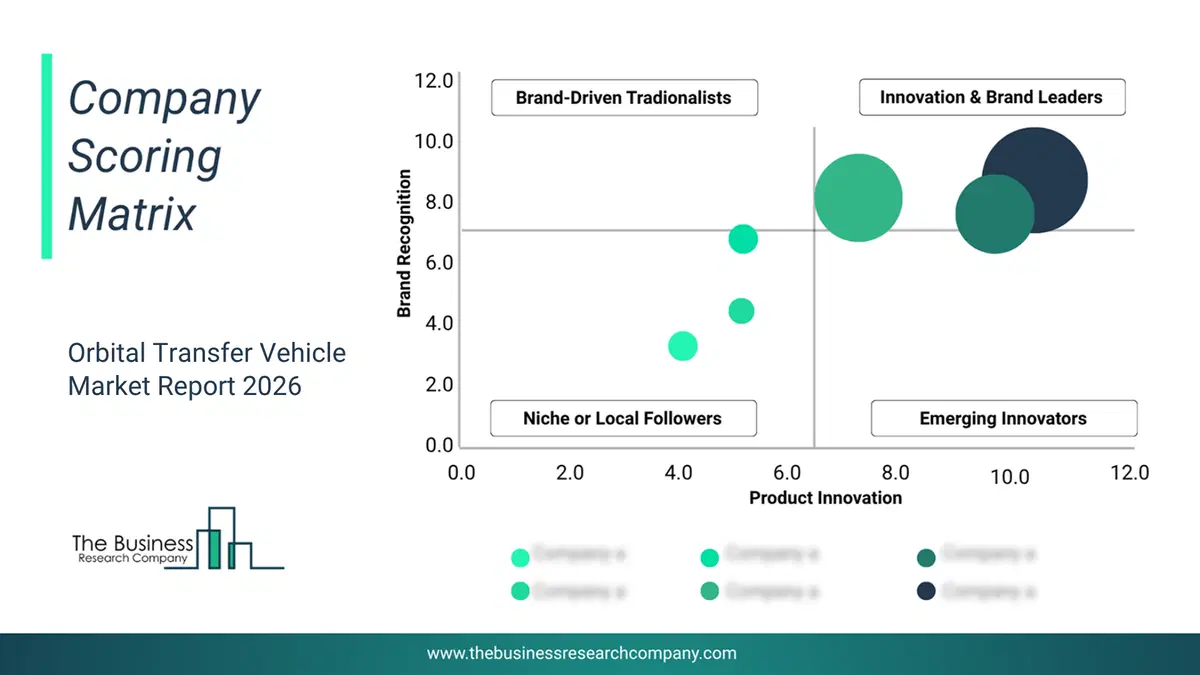
This chart maps companies by product innovation and brand strength, with bubble size indicating relative revenue, helping identify market leaders, challengers, and niche players. This is an illustrative chart; the full report provides a complete and accurate competitive analysis.
Global Orbital Transfer Vehicle Market Trends and Insights
Major companies operating in the orbital transfer vehicle market are focusing on developing advanced spacecraft, such as high-thrust, maneuverable spacecraft, to enhance in-space mobility and efficiently transport payloads across diverse orbits. High-thrust, maneuverable spacecraft refer to vehicles equipped with powerful propulsion systems and advanced control mechanisms, enabling precise orbital adjustments and efficient movement of payloads between different orbits. For instance, in August 2025, Impulse Space Inc., a US-based company specializing in developing in-space transportation technologies and services for satellites, launched its upgraded Mira vehicle, a high-thrust, highly maneuverable platform designed for payload hosting and deployment. The upgraded system features enhanced propulsion, deployable solar arrays delivering increased power for payloads, and advanced autonomous software that enables on-orbit mission reconfiguration. With these capabilities, Mira supports precise orbital maneuvers and offers enhanced pointing and control, making it suitable for complex operations such as Earth observation and space domain awareness (SDA) missions.What Are Latest Mergers And Acquisitions In The Orbital Transfer Vehicle Market? Firefly Aerospace Acquires Spaceflight Inc. To Strengthen On-Orbit Capabilities And Expand Space Services
In June 2023, Firefly Aerospace, a US-based aerospace and defense technology company, acquired Spaceflight Inc. for an undisclosed amount. With this acquisition, Firefly Aerospace strengthens its capabilities in on-orbit services, including satellite rideshare and orbital transfer operations, positioning itself to offer more responsive and integrated space solutions. It also expands Firefly’s customer base and technological expertise in satellite deployment and in-space logistics, enhancing its competitiveness in the growing space services market. Spaceflight Inc. is a US-based aerospace company specializing in satellite launch services, including rideshare missions and the development of orbital transfer vehicles (OTVs) such as the Sherpa series.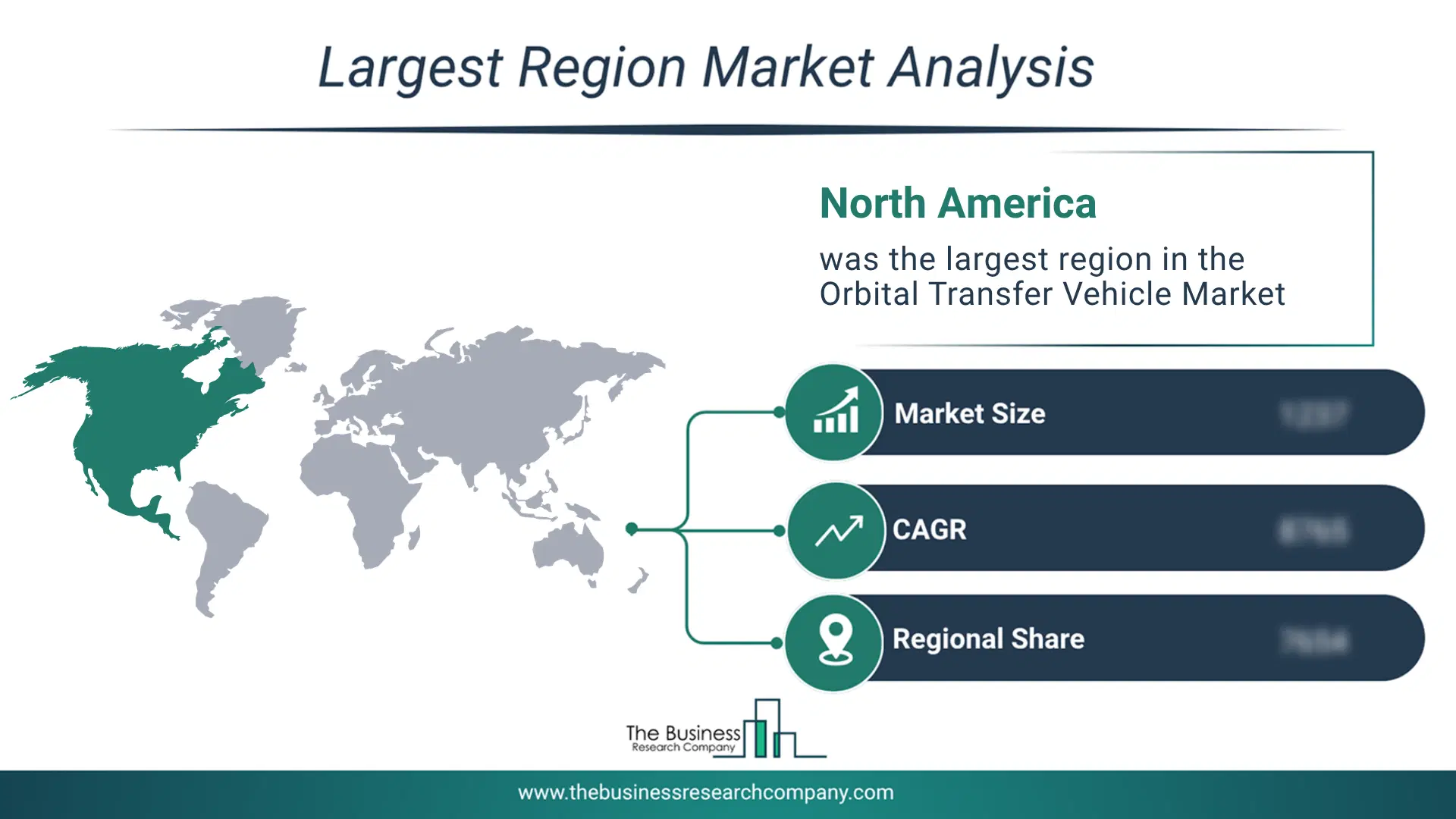
Regional Insights
North America was the largest region in the orbital transfer vehicle market in 2025. Asia-Pacific is expected to be the fastest-growing region in the forecast period. The regions covered in this market report are Asia-Pacific, South East Asia, Western Europe, Eastern Europe, North America, South America, Middle East, Africa. The countries covered in this market report are Australia, Brazil, China, France, Germany, India, Indonesia, Japan, Taiwan, Russia, South Korea, UK, USA, Canada, Italy, SpainWhat Defines the Orbital Transfer Vehicle Market?
The orbital transfer vehicle market consists of sales of spacecraft platforms, propulsion systems, and onboard navigation and control systems. Values in this market are ‘factory gate’ values; that is, the value of goods sold by the manufacturers or creators of the goods, whether to other entities (including downstream manufacturers, wholesalers, distributors, and retailers) or directly to end customers. The value of goods in this market includes related services sold by the creators of the goods.How is Market Value Defined and Measured?
The market value is defined as the revenues that enterprises gain from the sale of goods and/or services within the specified market and geography through sales, grants, or donations in terms of the currency (in USD unless otherwise specified). The revenues for a specified geography are consumption values that are revenues generated by organizations in the specified geography within the market, irrespective of where they are produced. It does not include revenues from resales along the supply chain, either further along the supply chain or as part of other products.
This chart presents market attractiveness based on a quantitative evaluation of growth, competition, strategic alignment, and risk, offering a clear view of opportunity areas for decision-making. This chart is for illustrative purposes; the full report contains the complete analysis.

This chart highlights the Total Addressable Market (TAM) by estimating the maximum revenue opportunity using an assumption-driven approach, supporting strategic planning and opportunity sizing across markets. The chart is illustrative; the full report provides a more comprehensive analysis.
What Key Data and Analysis Are Included in the Orbital Transfer Vehicle Market Report 2026?
The orbital transfer vehicle market research report is one of a series of new reports from The Business Research Company that provides market statistics, including industry global market size, regional shares, competitors with the market share, detailed market segments, market trends and opportunities, and any further data you may need to thrive in the orbital transfer vehicle industry. The market research report delivers a complete perspective of everything you need, with an in-depth analysis of the current and future state of the industry.Orbital Transfer Vehicle Market Report Forecast Analysis
| Report Attribute | Details |
|---|---|
| Market Size Value In 2026 | $2.03 billion |
| Revenue Forecast In 2030 | $3.39 billion |
| Growth Rate | CAGR of 13.7% from 2026 to 2030 |
| Base Year For Estimation | 2025 |
| Actual Estimates/Historical Data | 2020-2025 |
| Forecast Period | 2026 - 2030 |
| Market Representation | Revenue in USD Billion and CAGR from 2026 to 2030 |
| Segments Covered | Vehicle Type, Propulsion Type, Payload Capacity, Application, End-User |
| Regional Scope | Asia-Pacific, Western Europe, Eastern Europe, North America, South America, Middle East, Africa |
| Country Scope | The countries covered in the orbital transfer vehicle market report are Australia, Brazil, China, France, Germany, India, Indonesia, Japan, Taiwan, Russia, South Korea, UK, USA, Canada, Italy, Spain |
| Key Companies Profiled | Northrop Grumman Corporation, Moog Inc., Rocket Lab Corporation, Impulse Space Inc., Firefly Aerospace Inc., D-Orbit S.p.A., Exotrail SA, Skyrora Limited, Momentus Inc., Trans Astronautica Corporation, Space Machines Company, Quantum Space LLC, Launcher Inc., Plasmos, Atomos Space, Bellatrix Aerospace Pvt. Ltd., Epic Aerospace LLC, Exolaunch GmbH, UARX Space SL, Blue Origin Enterprises L.P. |
| Customization Scope | Request for Customization |
| Pricing And Purchase Options | Explore Purchase Options |