
Planetary Defense Market Report 2026
Global Outlook – By Technology (Kinetic Impact, Nuclear Detonation, Gravity Tractor, Laser Ablation, Other Technologies), By Application (Asteroid Detection, Asteroid Deflection, Space Missions, Other Applications), By End-User (Government, Space Agencies, Research Institutions, Other End-Users) – Market Size, Trends, Strategies, and Forecast to 2030
Planetary Defense Market Overview
• Planetary Defense market size has reached to $5.76 billion in 2025 • Expected to grow to $8.95 billion in 2030 at a compound annual growth rate (CAGR) of 9.1% • Growth Driver: Increase In Space Missions Fueling The Growth Of The Market Due To Advancements In Affordable And Safer Space Technologies • Market Trend: Technological Advancements In Planetary Defense And The Role Of Probes And Industry Leaders • North America was the largest region in 2025.What Is Covered Under Planetary Defense Market?
Planetary defense refers to the strategies, technologies, and coordinated efforts to detect, track, and mitigate threats posed by near-Earth objects (NEOs), such as asteroids and comets, that could potentially collide with Earth. It includes early detection through telescopes and space-based sensors, precise orbit determination, impact risk assessment, and developing methods to deflect or disrupt hazardous objects. Planetary defense is a global effort involving space agencies, governments, and scientific institutions to protect Earth from potentially catastrophic impacts. The main types of technologies in planetary defense are kinetic impact, nuclear detonation, gravity tractor, laser ablation, and others. Kinetic impact is a planetary defense strategy that involves deliberately crashing a high-speed spacecraft into an asteroid or comet. It is used for various applications, including asteroid detection, asteroid deflection, space missions, and others, and serves various end users, including government, space agencies, research institutions, and others.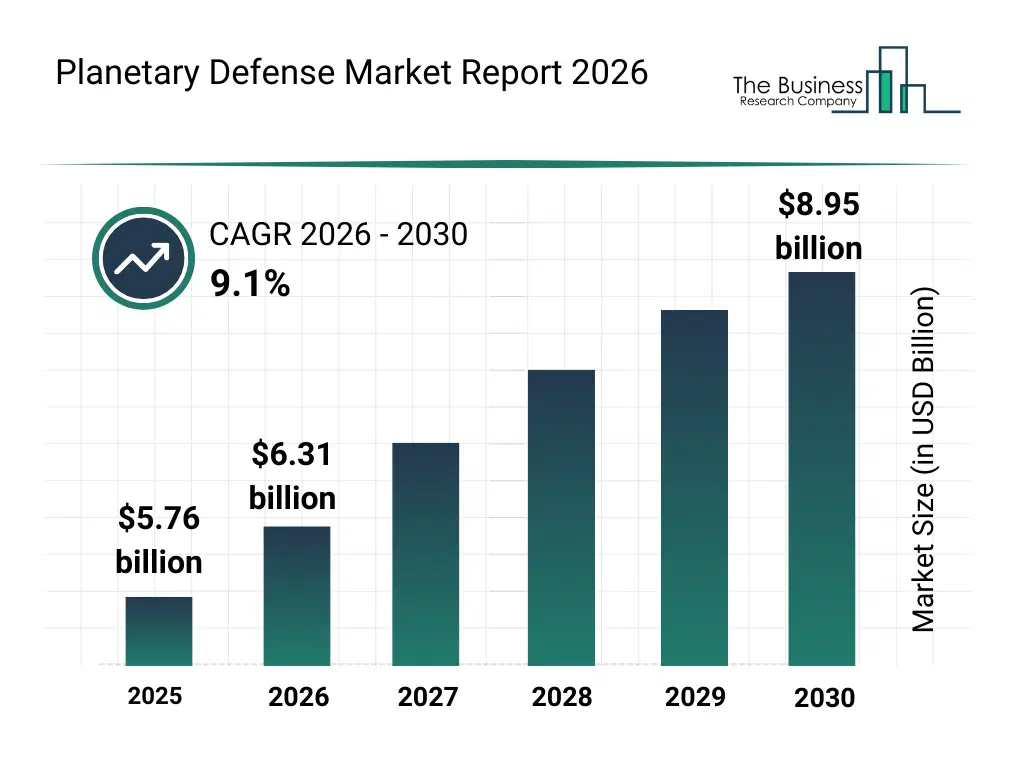
What Is The Planetary Defense Market Size and Share 2026?
The planetary defense market size has grown strongly in recent years. It will grow from $5.76 billion in 2025 to $6.31 billion in 2026 at a compound annual growth rate (CAGR) of 9.5%. The growth in the historic period can be attributed to discovery of near-earth objects, development of ground-based observation networks, early asteroid tracking missions, increased scientific research funding, establishment of planetary defense frameworks.What Is The Planetary Defense Market Growth Forecast?
The planetary defense market size is expected to see strong growth in the next few years. It will grow to $8.95 billion in 2030 at a compound annual growth rate (CAGR) of 9.1%. The growth in the forecast period can be attributed to increasing investments in space surveillance infrastructure, rising international cooperation on threat mitigation, expansion of autonomous space missions, growing use of advanced simulation models, increasing emphasis on global impact risk reduction. Major trends in the forecast period include increasing deployment of space-based neo detection systems, rising use of ai-driven orbit modeling, growing investment in deflection technology research, expansion of international planetary defense collaboration, enhanced focus on early warning capabilities.
Global Planetary Defense Market Segmentation
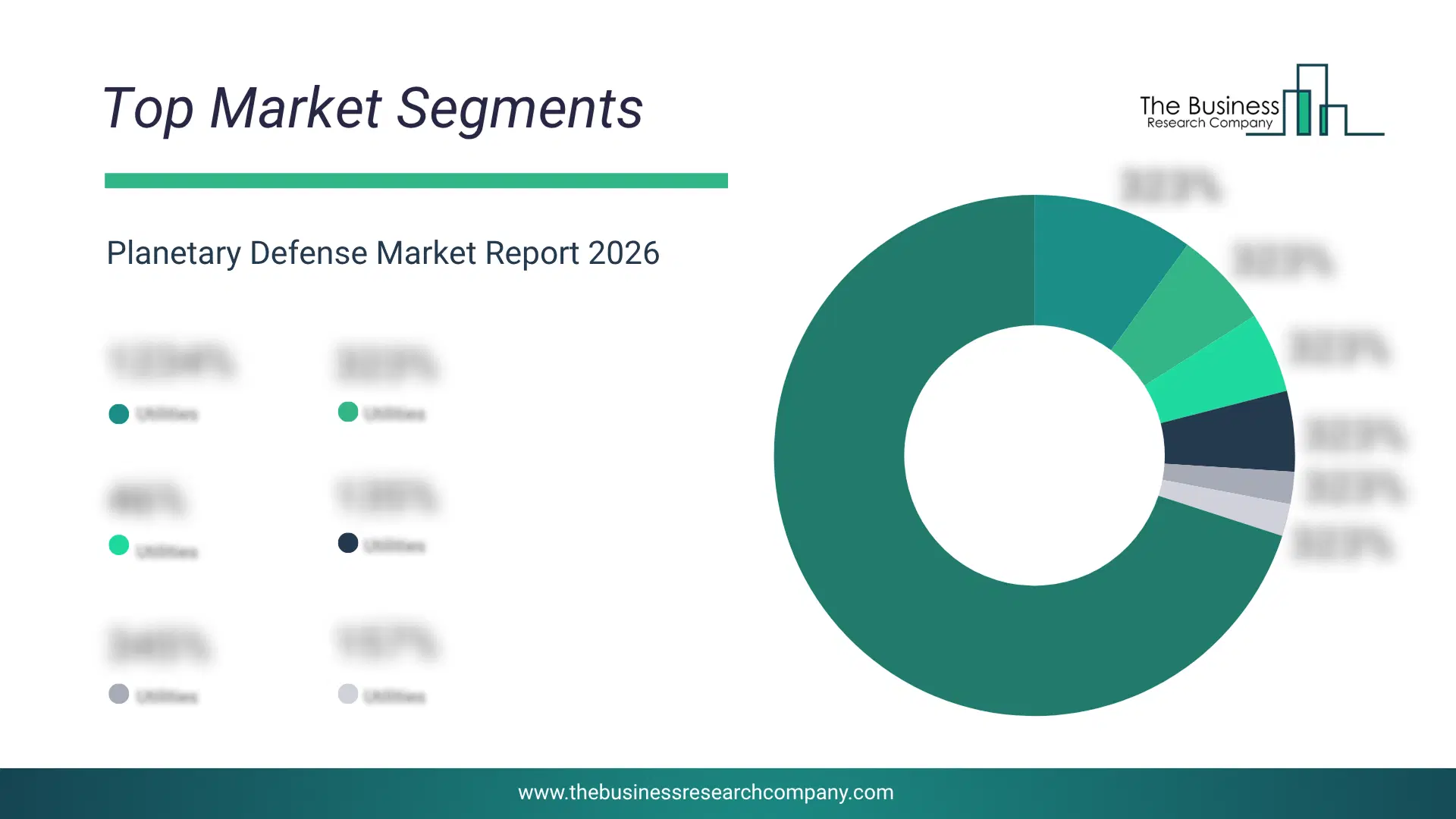
1) By Technology: Kinetic Impact, Nuclear Detonation, Gravity Tractor, Laser Ablation, Other Technologies 2) By Application: Asteroid Detection, Asteroid Deflection, Space Missions, Other Applications 3) By End-User: Government, Space Agencies, Research Institutions, Other End-Users Subsegments: 1) By Kinetic Impact: Direct Collision Mission, High-Velocity Impact Vehicle, Interceptor Spacecraft, Autonomous Guidance Systems 2) By Nuclear Detonation: Surface Nuclear Blast, Subsurface Nuclear Explosion, Standoff Nuclear Detonation, Radiation Shielding Systems 3) By Gravity Tractor: Mass Accumulation Tractor, Station-Keeping Propulsion System, Long-Duration Trajectory Alteration, Autonomous Navigation And Control 4) By Laser Ablation: Space-Based Laser Platforms, Ground-Based Laser Systems, High-Energy Laser Modules, Targeting And Thermal Tracking Systems 5) By Other Technologies: Ion Beam Deflection, Electromagnetic Rail Systems, Solar Sails For Deflection, Artificial Intelligence-Based Threat ModelingWhat Is The Driver Of The Planetary Defense Market?
The growing number of space missions is expected to propel the growth of the planetary defense market going forward. Space missions refer to organized journeys or operations conducted beyond Earth's atmosphere for scientific, commercial, defense, or exploratory purposes. The number of space missions is increasing because advancements in technology, such as reusable rockets and miniaturized satellites, have made space exploration more affordable, efficient, and accessible than ever before. Planetary defense is used in space missions to enhance the ability to detect, track, and potentially deflect hazardous near-Earth objects (NEOs), ensuring the safety of Earth and spacecraft operating in space. For instance, in 2024, according to the Space Foundation, a US-based nonprofit organization, global space launch activity hit record levels for the third consecutive year, with 223 launch attempts and 212 successes, driven by a 50% surge in commercial launches, a 33% rise in U.S. launch attempts, and over 2, 800 satellites deployed, marking a 23% increase over 2022. Therefore, the growing number of space missions is driving the growth of the planetary defense industry.Key Players In The Global Planetary Defense Market
Major companies operating in the planetary defense market are Lockheed Martin Corporation, The Boeing Company, Northrop Grumman Corporation, Space Exploration Technologies Corp., Blue Origin LLC., Maxar Technologies Inc., OHB SE, Astroscale Holdings Inc., Rocket Lab USA Inc., Planet Labs PBC, Firefly Aerospace Inc., Redwire Corporation, Terran Orbital Corporation, State Corporation for Space Activities, Orion Space Solutions LLC., Airbus S.A.S, Thales Alenia Space S.A.S, Leonardo S.p.A, L3Harris Technologies Inc., RTX Corporation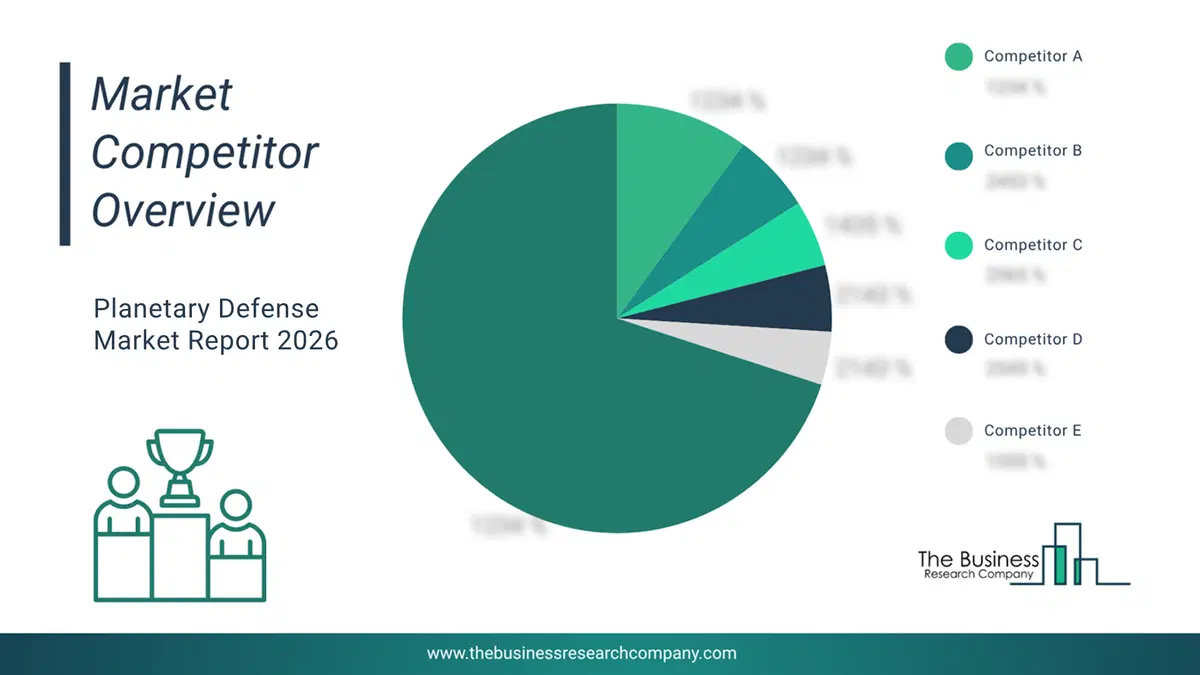
This chart is for illustrative purposes; the full report includes a detailed competitor analysis and comprehensive overview of the top 10 companies in the market.
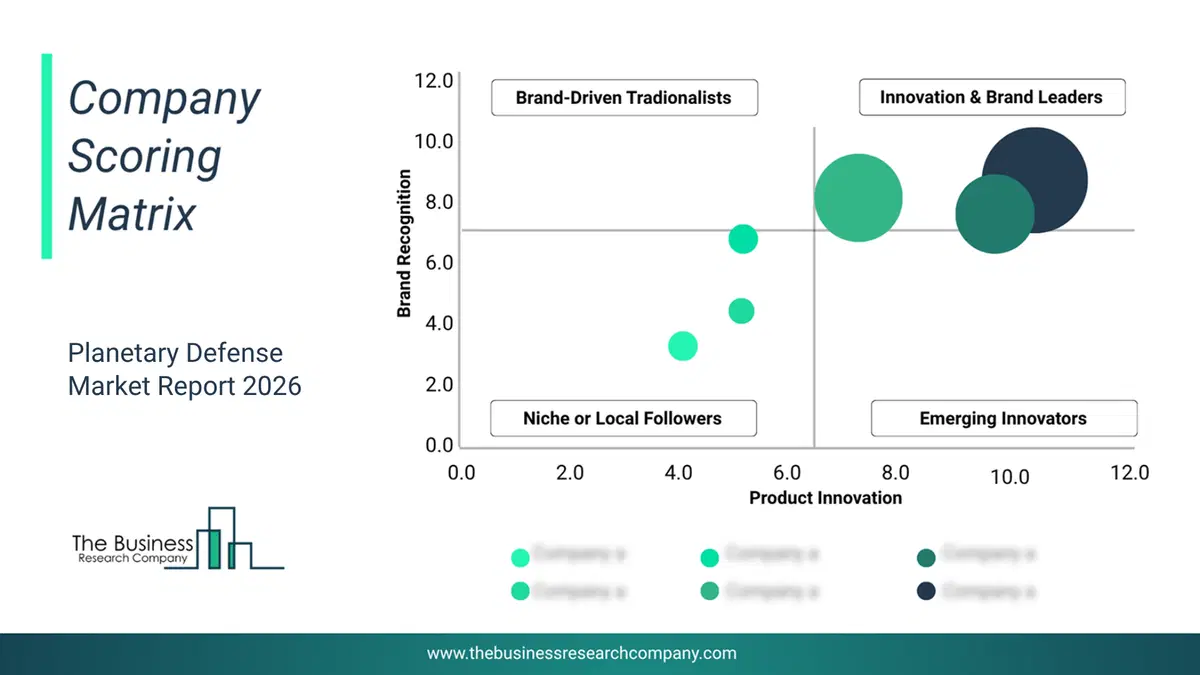
This chart maps companies by product innovation and brand strength, with bubble size indicating relative revenue, helping identify market leaders, challengers, and niche players. This is an illustrative chart; the full report provides a complete and accurate competitive analysis.
Global Planetary Defense Market Trends and Insights
Major companies operating in the planetary defense market are focusing on developing innovative solutions, such as planetary defense probes, to detect, track, and mitigate potential threats from near-Earth objects (NEOs). A planetary defense probe is a specialized spacecraft designed to study, monitor, or actively engage with potentially hazardous asteroids or comets to prevent them from colliding with Earth. For instance, in October 2024, Space Exploration Technologies Corp., a US-based space technology company, launched the European Space Agency's Hera planetary defense probe from Cape Canaveral Space Force Station in Florida. The Hera probe is accompanied by two cubesats, Milani and Juventas. These will perform close-up studies of Dimorphos, including mineralogical surveys and the first subsurface radar probe of an asteroid. Hera's primary goal is to study the aftermath of this impact in detail, measuring the crater, analyzing the momentum transfer, and assessing both surface and internal properties of Dimorphos to validate and refine the kinetic impactor method as a planetary defense strategy. This mission marks a significant step in international efforts to develop strategies for planetary defense against potentially hazardous asteroids.What Are Latest Mergers And Acquisitions In The Planetary Defense Market?
In August 2024, Lockheed Martin Corporation, a US-based aerospace manufacturer, acquired Terran Orbital for $45 million. Through this acquisition, Lockheed Martin aims to expand and enhance its advanced satellite manufacturing capabilities, strengthen its position in the space sector, and gain greater control over the supply chain for national security, commercial, and scientific satellite programs. Terran Orbital is a US-based aerospace and defense company involved in planetary defense.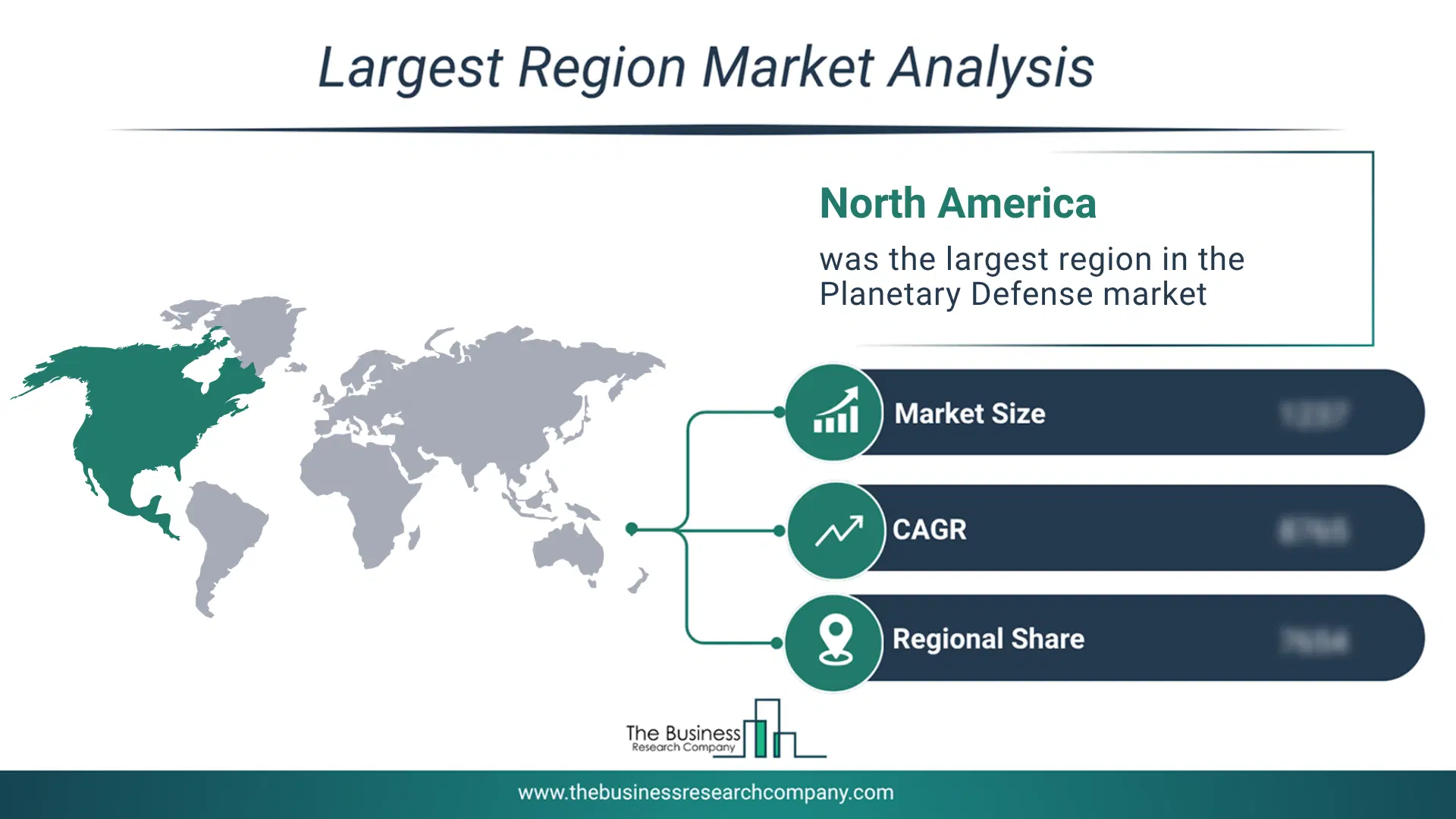
Regional Outlook
North America was the largest region in the planetary defense market in 2025. The regions covered in this market report are Asia-Pacific, South East Asia, Western Europe, Eastern Europe, North America, South America, Middle East, Africa. The countries covered in this market report are Australia, Brazil, China, France, Germany, India, Indonesia, Japan, Taiwan, Russia, South Korea, UK, USA, Canada, Italy, Spain.What Defines the Planetary Defense Market?
The planetary defense market consists of revenues earned by entities by providing services such as asteroid and comet detection, orbit tracking and monitoring, threat assessment and risk analysis, early warning systems, and impact modeling and simulation. The market value includes the value of related goods sold by the service provider or included within the service offering. The planetary defense market also includes sales of products including space-based telescopes, ground-based radar and optical systems, asteroid detection software, orbit prediction models, and impact simulation tools. Values in this market are ‘factory gate’ values, that is, the value of goods sold by the manufacturers or creators of the goods, whether to other entities (including downstream manufacturers, wholesalers, distributors, and retailers) or directly to end customers. The value of goods in this market includes related services sold by the creators of the goods.How is Market Value Defined and Measured?
The market value is defined as the revenues that enterprises gain from the sale of goods and/or services within the specified market and geography through sales, grants, or donations in terms of the currency (in USD unless otherwise specified). The revenues for a specified geography are consumption values that are revenues generated by organizations in the specified geography within the market, irrespective of where they are produced. It does not include revenues from resales along the supply chain, either further along the supply chain or as part of other products.
This chart presents market attractiveness based on a quantitative evaluation of growth, competition, strategic alignment, and risk, offering a clear view of opportunity areas for decision-making. This chart is for illustrative purposes; the full report contains the complete analysis.

This chart highlights the Total Addressable Market (TAM) by estimating the maximum revenue opportunity using an assumption-driven approach, supporting strategic planning and opportunity sizing across markets. The chart is illustrative; the full report provides a more comprehensive analysis.
What Key Data and Analysis Are Included in the Planetary Defense Market Report 2026?
The planetary defense market research report is one of a series of new reports from The Business Research Company that provides market statistics, including Market Report 2026?global market size, regional shares, competitors with the market share, detailed market segments, market trends and opportunities, and any further data you may need to thrive in the planetary defense Market Report 2026? The market research report delivers a complete perspective of everything you need, with an in-depth analysis of the current and future state of the Market Report 2026?Planetary Defense Market Report Forecast Analysis
| Report Attribute | Details |
|---|---|
| Market Size Value In 2026 | $6.31 billion |
| Revenue Forecast In 2030 | $8.95 billion |
| Growth Rate | CAGR of 9.5% from 2026 to 2030 |
| Base Year For Estimation | 2025 |
| Actual Estimates/Historical Data | 2020-2025 |
| Forecast Period | 2026 - 2030 |
| Market Representation | Revenue in USD Billion and CAGR from 2026 to 2030 |
| Segments Covered | Technology, Application, End-User |
| Regional Scope | Asia-Pacific, Western Europe, Eastern Europe, North America, South America, Middle East, Africa |
| Country Scope | The countries covered in the report are Australia, Brazil, China, France, Germany, India, Indonesia, Japan, Taiwan, Russia, South Korea, UK, USA, Canada, Italy, Spain. |
| Key Companies Profiled | Lockheed Martin Corporation, The Boeing Company, Northrop Grumman Corporation, Space Exploration Technologies Corp., Blue Origin LLC., Maxar Technologies Inc., OHB SE, Astroscale Holdings Inc., Rocket Lab USA Inc., Planet Labs PBC, Firefly Aerospace Inc., Redwire Corporation, Terran Orbital Corporation, State Corporation for Space Activities, Orion Space Solutions LLC., Airbus S.A.S, Thales Alenia Space S.A.S, Leonardo S.p.A, L3Harris Technologies Inc., RTX Corporation |
| Customization Scope | Request for Customization |
| Pricing And Purchase Options | Explore Purchase Options |