

Plasticizers Market Report 2026
Global Outlook – By Product Type (Phthalates Plasticizers, Non-Phthalates Plasticizers), By Distribution Channel (Direct Sales, Distributors & Traders, Contract Or Long-Term Supply Agreements), By Application (Flooring & Wall, Film & Sheet Coverings, Wires & Cables, Coated Fabrics, Other Applications) – Market Size, Trends, Strategies, and Forecast to 2030
Plasticizers Market Overview
• Plasticizers market size has reached to $98.62 billion in 2025 • Expected to grow to $147.5 billion in 2030 at a compound annual growth rate (CAGR) of 8.6% • Growth Driver: Elevated Demand From The Construction Industry Fueling Growth In The Plasticizer Market • Market Trend: Sustainable Non-Phthalate Plasticizer Innovations Driving Safer And Eco-Friendly Material Applications • Asia-Pacific was the largest region in 2025 and North America is the fastest growing region.What Is Covered Under Plasticizers Market?
Plasticizers are chemical additives used to increase the plasticity or fluidity of a material. Plasticizers have dominant uses in rubber, resins, and plastics, especially polyvinyl chloride (PVC). The product types of plasticizers are phthalate plasticizers, dop, dinp/didp/dphp, other non-phthalate plasticizers, dotp, adipates, trimellitates, epoxies, and benzoates. Phthalates are a group of chemicals that are used to make plastics more durable. A few of the phthalates are used to help dissolve other materials. Phthalates are in hundreds of products, like vinyl flooring, lubricating oils, and personal-care products like soaps, shampoos, and hair sprays. The distribution channels are online and offline. The various applications involved are flooring & walls, film & sheet coverings, wires & cables, coated fabrics, consumer goods, and other applications.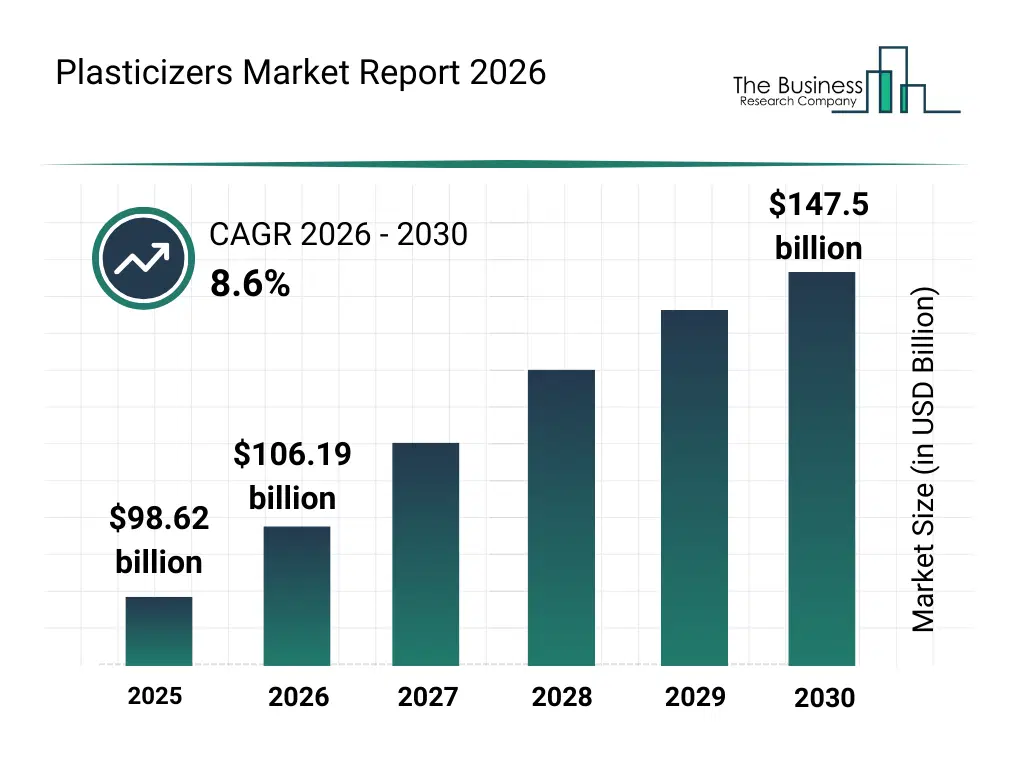
What Is The Plasticizers Market Size and Share 2026?
The plasticizers market size has grown strongly in recent years. It will grow from $98.62 billion in 2025 to $106.19 billion in 2026 at a compound annual growth rate (CAGR) of 7.7%. The growth in the historic period can be attributed to growth of pvc production, expansion of construction activities, rising demand for flexible plastics, availability of phthalate plasticizers, increasing industrial plastic consumption.What Is The Plasticizers Market Growth Forecast?
The plasticizers market size is expected to see strong growth in the next few years. It will grow to $147.5 billion in 2030 at a compound annual growth rate (CAGR) of 8.6%. The growth in the forecast period can be attributed to stringent environmental regulations, rising demand for non toxic additives, growth in cable and electronics manufacturing, expansion of infrastructure projects, advancements in bio based plasticizers. Major trends in the forecast period include growing shift toward non phthalate plasticizers, increasing use of plasticizers in flexible pvc products, rising demand from flooring and wall coverings, expansion of plasticizer use in wires and cables, increasing adoption in consumer goods manufacturing.
Global Plasticizers Market Segmentation
1) By Product Type: Phthalates Plasticizers, Non-Phthalates Plasticizers 2) By Distribution Channel: Direct Sales, Distributors & Traders, Contract Or Long-Term Supply Agreements 3) By Application: Flooring & Wall, Film & Sheet Coverings, Wires & Cables, Coated Fabrics, Other Applications Subsegments: 1) By Phthalates Plasticizers: Di(2-Ethylhexyl) Phthalate (DEHP), Diisononyl Phthalate (DINP), Di-N-Butyl Phthalate (DBP), Dicyclohexyl Phthalate (DCHP), Other Phthalates 2) By Non-Phthalates Plasticizers: Adipates, Sebacates, Trimellitates, Epoxidized Soybean Oil (ESBO), Citrate Esters, Other Non-PhthalatesWhat Is The Driver Of The Plasticizers Market?
The increasing demand from the construction industry is expected to propel the growth of the plasticizer market going forward. The construction industry, also known as the building or construction sector, encompasses a wide range of activities related to the planning, design, development, and construction of buildings, infrastructure, and other structures. Plasticizers are used in construction to improve the workability and flexibility of concrete and mortar, making them easier to mix, pour, and shape while reducing cracking and improving durability. For instance, in July 2023, according to the Australian Bureau of Statistics, an Australian-based government administration, reported that in the March quarter of 2023, the number of dwellings under construction increased to 240,813, up from 240,065 in 2022. Among these, new houses made up 103,778, compared to 101,240 in the previous year. Therefore, increasing demand from the construction industry will drive the plasticizer industry.Key Players In The Global Plasticizers Market
Major companies operating in the plasticizers market are LG Chem Ltd., Dow Chemical Company, BASF SE, UPC Group, Evonik Industries, Arkema S.A., INEOS Group, Eastman Chemical Company, Exxon Mobil Corporation, Nan Ya Plastics Corporation, Indo-Nippon Chemical Co. Ltd., KLJ Group, Amines & Plasticizers Limited, Lemon-Flex Company Limited, Bluesail Group Co. Ltd., Zhejiang Jiaao Enprotech Stock Co., Ltd., Shanghai Rongou Chemical Technology Co. Ltd., Nayakem Organics Pvt. Ltd., Gapuma UK Ltd., Alphagary, Perstorp, DOMO Chemicals, Grupa Azoty ZAK S.A., Gazprom Neft, SIBUR, GJ Chemical, Chemionics Corp., ChemCeed, Valtris, Hanwha International LLC, TRInternational Inc., Broadview Technologies Inc., Lestar Química, Innospec, Elekeiroz, BIOPOL S.A., Astra Polymers Compounding Company, Nassagi Iran Rise Alborz, Al Faisal Plastic Company, I. Plast Ltd., Nasydco, Teknor Apex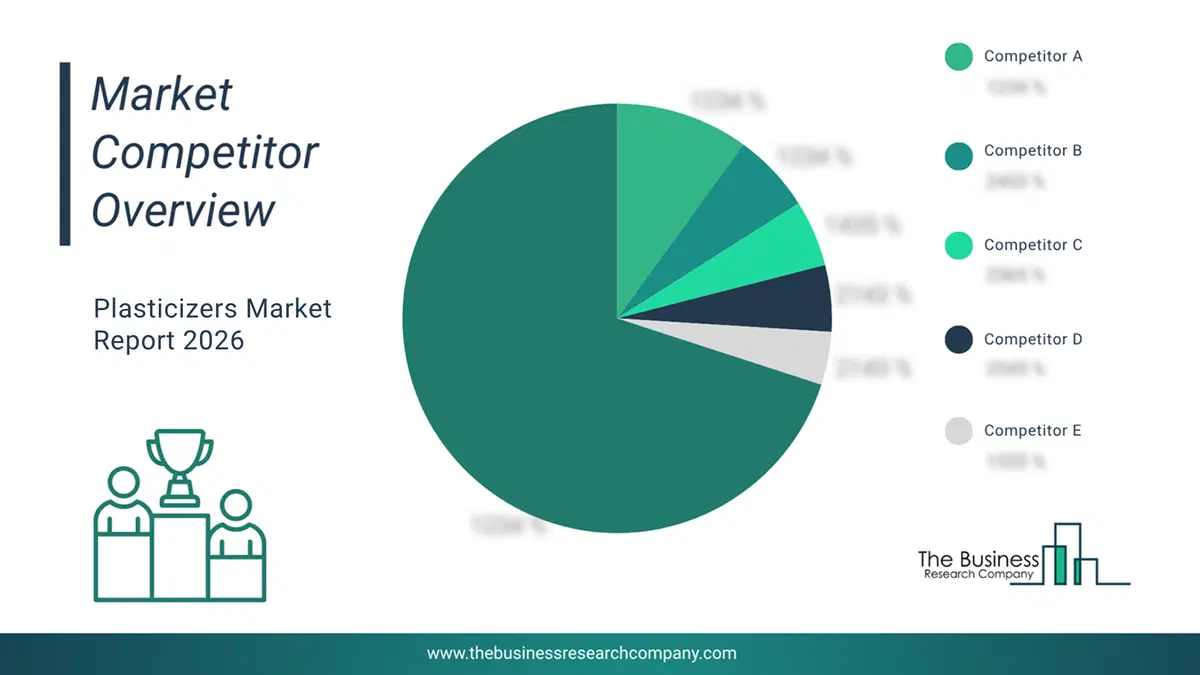
This chart is for illustrative purposes; the full report includes a detailed competitor analysis and comprehensive overview of the top 10 companies in the market.
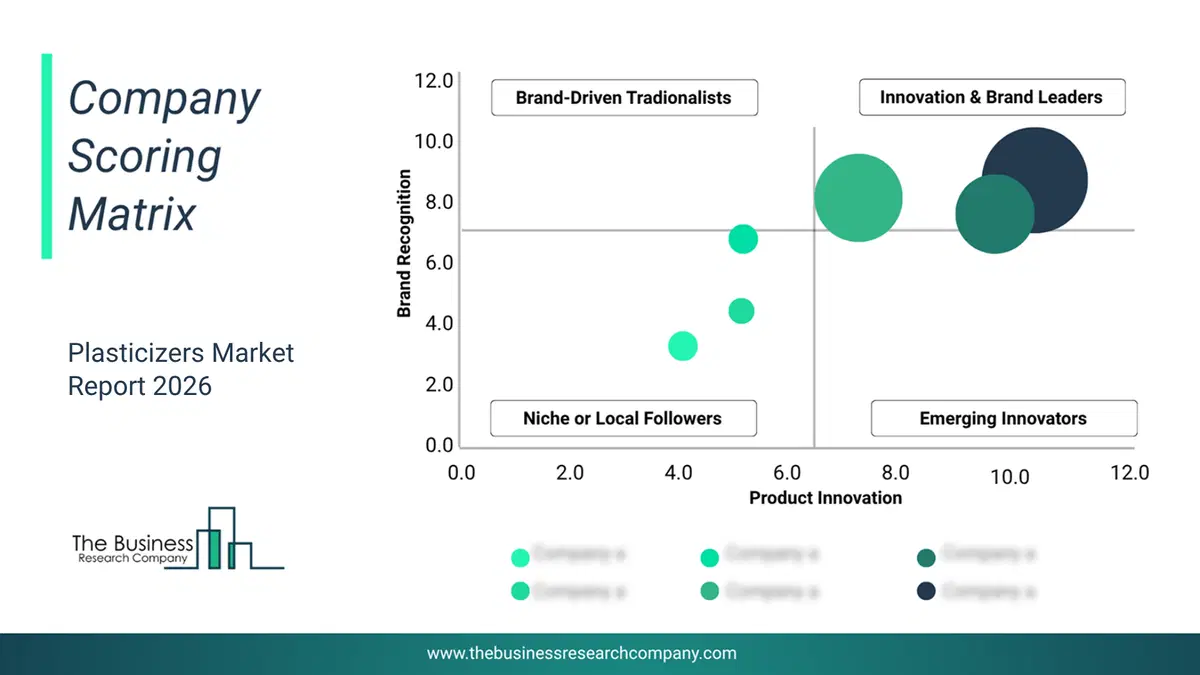
This chart maps companies by product innovation and brand strength, with bubble size indicating relative revenue, helping identify market leaders, challengers, and niche players. This is an illustrative chart; the full report provides a complete and accurate competitive analysis.
Global Plasticizers Market Trends and Insights
Major companies operating in the plasticizers market are focusing on non-phthalate and bio-based plasticizers, such as hydrogenated or sustainably sourced plasticizers, to gain a competitive advantage. Hydrogenated or sustainably sourced plasticizers are eco-friendly additives derived from renewable feedstocks or chemically treated to improve stability and reduce environmental impact, helping manufacturers produce safer, more sustainable plastics with lower carbon footprints while maintaining performance. For instance, in August 2023, LANXESS, a Germany based specialty chemicals company, introduced a more sustainable version of its phthalate free plasticizer Mesamoll, sourcing over 30 % of its inputs from sustainable feedstocks and reducing its product carbon footprint by around 20 %. This plasticizer retains high performance good gelling capacity, saponification resistance, and compatibility with PVC, PUR, and rubber, while appealing to customers increasingly focused on environmental compliance.What Are Latest Mergers And Acquisitions In The Plasticizers Market?
In December 2023, Aekyung Chemical Co., a South Korea-based consumer goods producer, acquired VINA Plasticizers Chemical Company (VPCHEM), for an undisclosed amount. This acquisition of the only plasticizer manufacturing facility in Vietnam aligns with Aekyung Chemical's growth strategy, increasing its annual plasticizer production capacity from 550,000 tons (400,000 tons in Korea and 150,000 tons in China) to 660,000 tons. VPCHEM is positioned to enhance Aekyung’s production capabilities and strengthen its market presence in Southeast Asia. VPCHEM is a Vietnam-based manufacturer of plasticizers.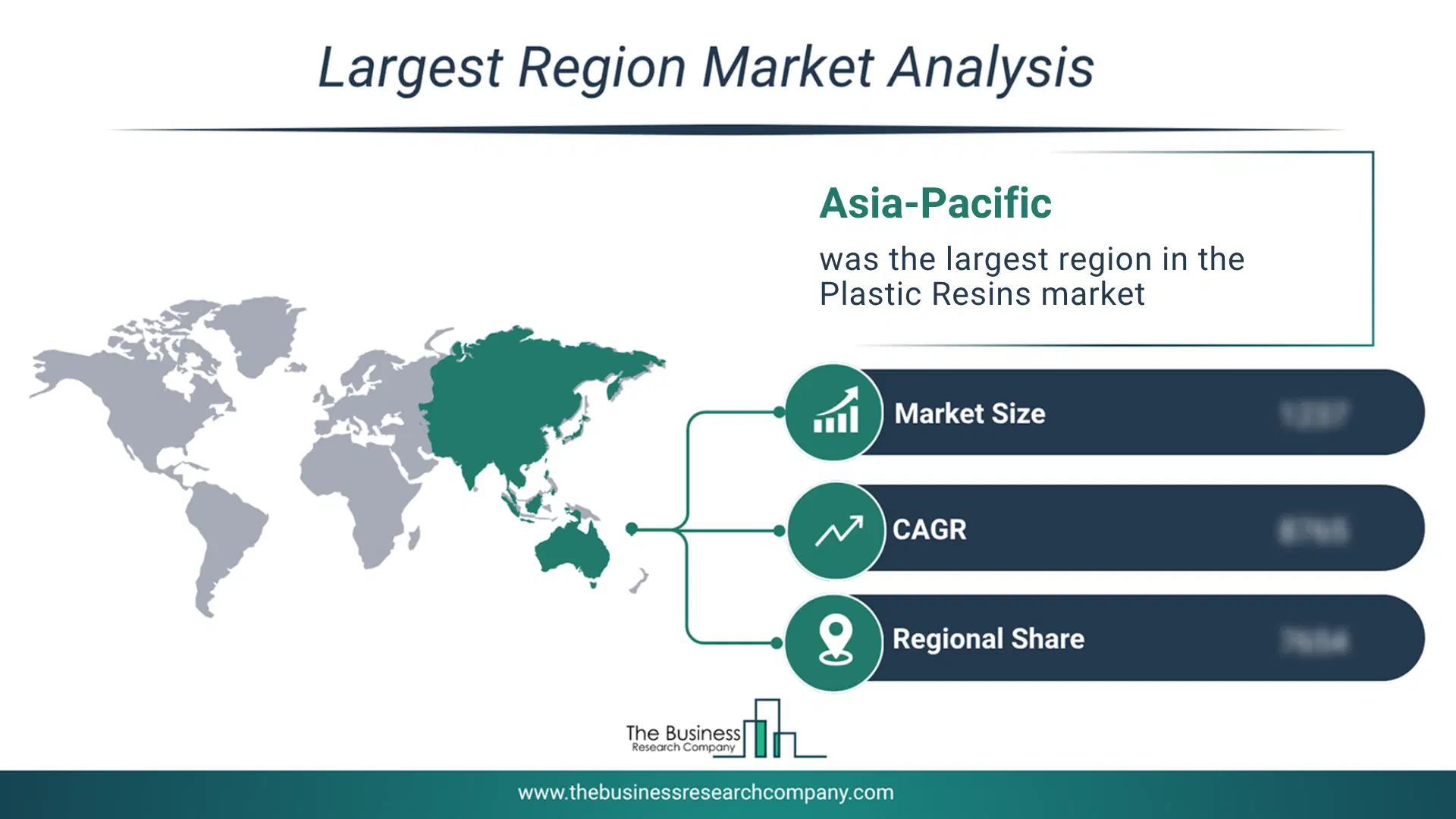
Regional Insights
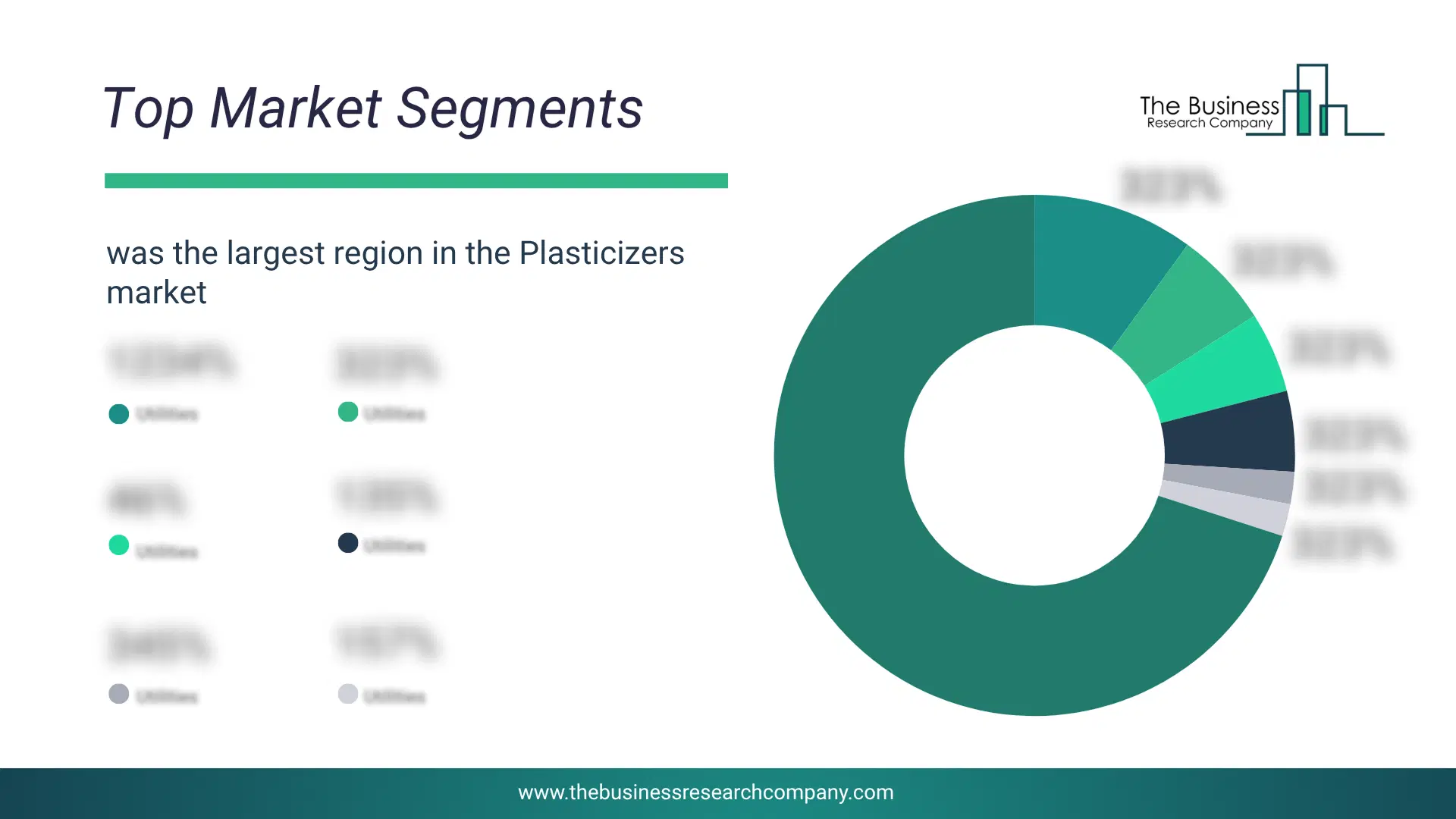
Asia-Pacific was the largest region in the plasticizers market in 2025. North America was the second-largest region in the global plasticizers market. The regions covered in this market report are Asia-Pacific, South East Asia, Western Europe, Eastern Europe, North America, South America, Middle East, Africa The countries covered in this market report are Australia, Brazil, China, France, Germany, India, Indonesia, Japan, Taiwan, Russia, South Korea, UK, USA, Canada, Italy, SpainWhat Defines the Plasticizers Market?
The plasticizers market consists of the sales of azelates, citrates, ortho-phthalates, terephthalates, and sebacates. Values in this market are factory gate values, that is the value of goods sold by the manufacturers or creators of the goods, whether to other entities (including downstream manufacturers, wholesalers, distributors, and retailers) or directly to end customers. The value of goods in this market includes related services sold by the creators of the goods.How is Market Value Defined and Measured?
The market value is defined as the revenues that enterprises gain from the sale of goods and/or services within the specified market and geography through sales, grants, or donations in terms of the currency (in USD unless otherwise specified). The revenues for a specified geography are consumption values that are revenues generated by organizations in the specified geography within the market, irrespective of where they are produced. It does not include revenues from resales along the supply chain, either further along the supply chain or as part of other products.
This chart presents market attractiveness based on a quantitative evaluation of growth, competition, strategic alignment, and risk, offering a clear view of opportunity areas for decision-making. This chart is for illustrative purposes; the full report contains the complete analysis.

This chart highlights the Total Addressable Market (TAM) by estimating the maximum revenue opportunity using an assumption-driven approach, supporting strategic planning and opportunity sizing across markets. The chart is illustrative; the full report provides a more comprehensive analysis.
What Key Data and Analysis Are Included in the Plasticizers Market Report 2026?
The plasticizers market research report is one of a series of new reports from The Business Research Company that provides market statistics, including industry global market size, regional shares, competitors with the market share, detailed market segments, market trends and opportunities, and any further data you may need to thrive in the plasticizers industry. The market research report delivers a complete perspective of everything you need, with an in-depth analysis of the current and future state of the industry.Plasticizers Market Report Forecast Analysis
| Report Attribute | Details |
|---|---|
| Market Size Value In 2026 | $106.19 billion |
| Revenue Forecast In 2030 | $147.5 billion |
| Growth Rate | CAGR of 7.7% from 2026 to 2030 |
| Base Year For Estimation | 2025 |
| Actual Estimates/Historical Data | 2020-2025 |
| Forecast Period | 2026 - 2030 |
| Market Representation | Revenue in USD Billion and CAGR from 2026 to 2030 |
| Segments Covered | Product Type, Distribution Channel, Application |
| Regional Scope | Asia-Pacific, Western Europe, Eastern Europe, North America, South America, Middle East, Africa |
| Country Scope | The countries covered in this market report are Australia, Brazil, China, France, Germany, India, Indonesia, Japan, Taiwan, Russia, South Korea, UK, USA, Canada, Italy, Spain |
| Key Companies Profiled | LG Chem Ltd., Dow Chemical Company, BASF SE, UPC Group, Evonik Industries, Arkema S.A., INEOS Group, Eastman Chemical Company, Exxon Mobil Corporation, Nan Ya Plastics Corporation, Indo-Nippon Chemical Co. Ltd., KLJ Group, Amines & Plasticizers Limited, Lemon-Flex Company Limited, Bluesail Group Co. Ltd., Zhejiang Jiaao Enprotech Stock Co., Ltd., Shanghai Rongou Chemical Technology Co. Ltd., Nayakem Organics Pvt. Ltd., Gapuma UK Ltd., Alphagary, Perstorp, DOMO Chemicals, Grupa Azoty ZAK S.A., Gazprom Neft, SIBUR, GJ Chemical, Chemionics Corp., ChemCeed, Valtris, Hanwha International LLC, TRInternational Inc., Broadview Technologies Inc., Lestar Química, Innospec, Elekeiroz, BIOPOL S.A., Astra Polymers Compounding Company, Nassagi Iran Rise Alborz, Al Faisal Plastic Company, I. Plast Ltd., Nasydco, Teknor Apex |
| Customization Scope | Request for Customization |
| Pricing And Purchase Options | Explore Purchase Options |