
Prebiotics Market Report 2026
Global Outlook – By Prebiotic Ingredient Type (Fructo-Oligosaccharides, Galacto-Oligosaccharides, Inulin, Mannan-Oligosaccharides), By Product (Capsules, Drinks, Powder), By Demography (Pediatric, Adult, Geriatric), By Distribution Channel (Hypermarkets Or Supermarkets, Pharmacies And Drug Stores, Specialty Stores, Online Sales), By End-User (Foods And Beverages, Pharmaceutical, Animal Feed, Other End-Users) - Market Size, Trends, Strategies, and Forecast to 2030
Prebiotics Market Overview
• Prebiotics market size has reached to $10.55 billion in 2025 • Expected to grow to $23.37 billion in 2030 at a compound annual growth rate (CAGR) of 17.2% • Growth Driver: Surge In Health And Wellness Fueling The Growth Of The Market Due To Rising Consumer Focus On Preventive Healthcare And Chronic Disease Management • Market Trend: Innovative Prebiotic-Infused Snacks Drive Growth In Gut Health Market • Asia-Pacific was the largest region and fastest growing region.What Is Covered Under Prebiotics Market?
Prebiotics are compounds in food, often nondigestible fibers, that pass through the upper gastrointestinal tract and selectively stimulate the growth or activity of beneficial microorganisms in the gut, such as certain bacteria and fungi. These help to maintain a healthy gut microbiome and may contribute to overall host health. The main types of prebiotics are fructo-oligosaccharides, galacto-oligosaccharides, inulin, and mannan-oligosaccharides. Fructo-oligosaccharides are short chains of fructose molecules found naturally in fruits and vegetables such as bananas, garlic, and onions. These prebiotics come in various products such as capsules, drinks, and powder, catering to various demography types, including pediatric, adult, and geriatric. They are distributed through hypermarkets or supermarkets, pharmacies and drug stores, specialty stores, and online sales, and end users span across foods and beverages, pharmaceuticals, animal feed, and others.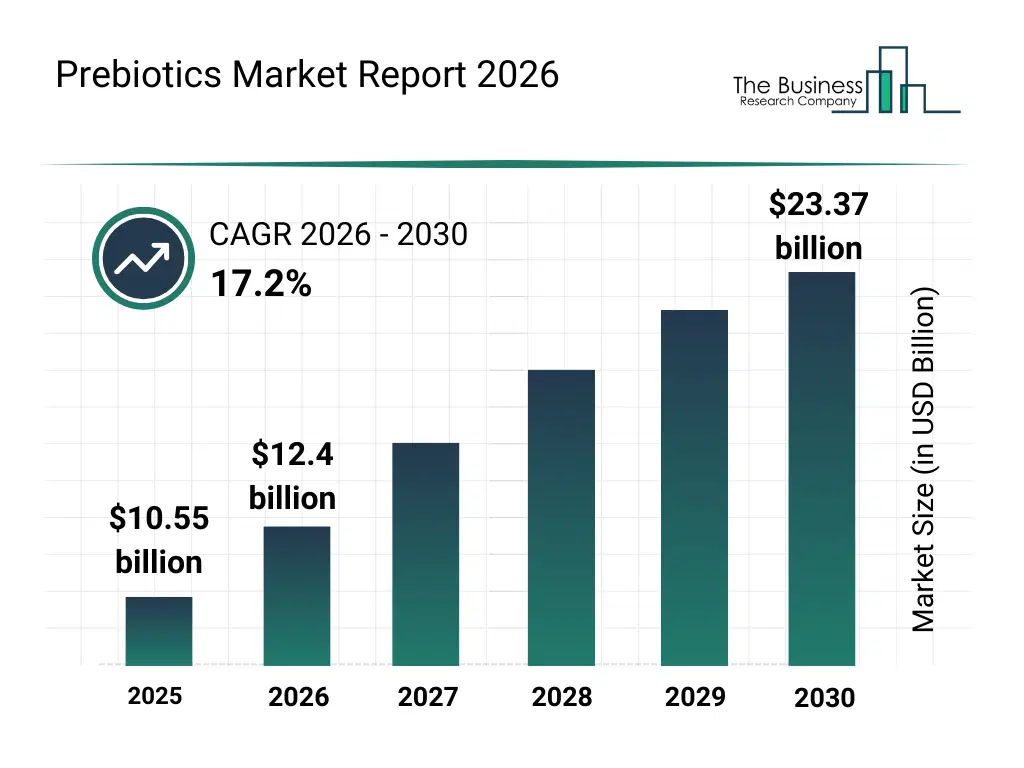
What Is The Prebiotics Market Size and Share 2026?
The prebiotics market size has grown rapidly in recent years. It will grow from $10.55 billion in 2025 to $12.4 billion in 2026 at a compound annual growth rate (CAGR) of 17.5%. The growth in the historic period can be attributed to increasing consumer awareness of digestive health, expansion of functional food products, availability of diverse oligosaccharide sources, growth in dietary supplement consumption, increased application in animal feed.What Is The Prebiotics Market Growth Forecast?
The prebiotics market size is expected to see rapid growth in the next few years. It will grow to $23.37 billion in 2030 at a compound annual growth rate (CAGR) of 17.2%. The growth in the forecast period can be attributed to increasing adoption of personalized nutrition, rising investment in microbiome-based products, expansion of prebiotics in clinical nutrition, growing demand for sustainable food ingredients, increasing integration into pharmaceutical formulations. Major trends in the forecast period include increasing incorporation of prebiotics in functional foods, rising demand for gut health supplements, growing use of prebiotics in animal nutrition, expansion of clean-label and natural ingredients, enhanced focus on microbiome research.
Global Prebiotics Market Segmentation
1) By Prebiotic Ingredient Type: Fructo-Oligosaccharides, Galacto-Oligosaccharides, Inulin, Mannan-Oligosaccharides 2) By Product: Capsules, Drinks, Powder 3) By Demography: Pediatric, Adult, Geriatric 4) By Distribution Channel: Hypermarkets Or Supermarkets, Pharmacies And Drug Stores, Specialty Stores, Online Sales 5) By End-User: Foods And Beverages, Pharmaceutical, Animal Feed, Other End-Users Subsegments: 1) By Fructo-Oligosaccharides: Short-Chain Fructo-Oligosaccharides, Long-Chain Fructo-Oligosaccharides, Enzymatically Synthesized Fructo-Oligosaccharides 2) By Galacto-Oligosaccharides: High-Purity Galacto-Oligosaccharides, Liquid Galacto-Oligosaccharides, Powder Galacto-Oligosaccharides 3) By Inulin: High Performance Inulin, Standard Inulin, Short-Chain Inulin 4) By Mannan-Oligosaccharides: Feed Grade Mannan-Oligosaccharides, Food Grade Mannan-Oligosaccharides, Functional Mannan-OligosaccharidesWhat Is The Driver Of The Prebiotics Market?
The rising consumer awareness about health and wellness is expected to propel the growth of prebiotics market going forward. Health and wellness refers to a holistic state of physical, mental, and emotional well-being achieved through balanced lifestyle choices and preventive care. The rising consumer awareness about health and wellness is due to a shift toward preventive healthcare, driven by the desire to avoid lifestyle-related diseases and reduce long-term medical costs. Prebiotics support health awareness by promoting a balanced gut microbiome, which is increasingly recognized as essential for overall well-being and informed lifestyle choices. For instance, in Jun 2024, according to the International Food Information Council (IFIC), a US‑based non‑profit organization, the proportion of Americans following a specific diet or eating pattern over the past year remains high at 54%. Most people are looking to increase their protein intake, with interest climbing from 59% in 2022 to 67% in 2023, and reaching 71% in 2024. Additionally, roughly half of consumers aim to eat more fresh foods, which are widely considered the healthiest options. Therefore, rising consumer awareness about health and wellness is driving the prebiotics industry.Key Players In The Global Prebiotics Market
Major companies operating in the prebiotics market are Cargill Inc, Archer Daniels Midland Company, Nestle SA, Bayer AG, Abbott Laboratories, Danone SA, FrieslandCampina, Haleon Group, DuPont de Nemours Inc, Amway Corp, Herbalife Nutrition Ltd, Royal Cosun, Roquette Freres, Natures Bounty, Natures Sunshine Products Inc, Good Health New Zealand, NOW Foods, Jarrow Formulas Inc, Ingredion Incorporated, Tate and Lyle PLC, BENEO GmbH, Yakult Honsha Co Ltd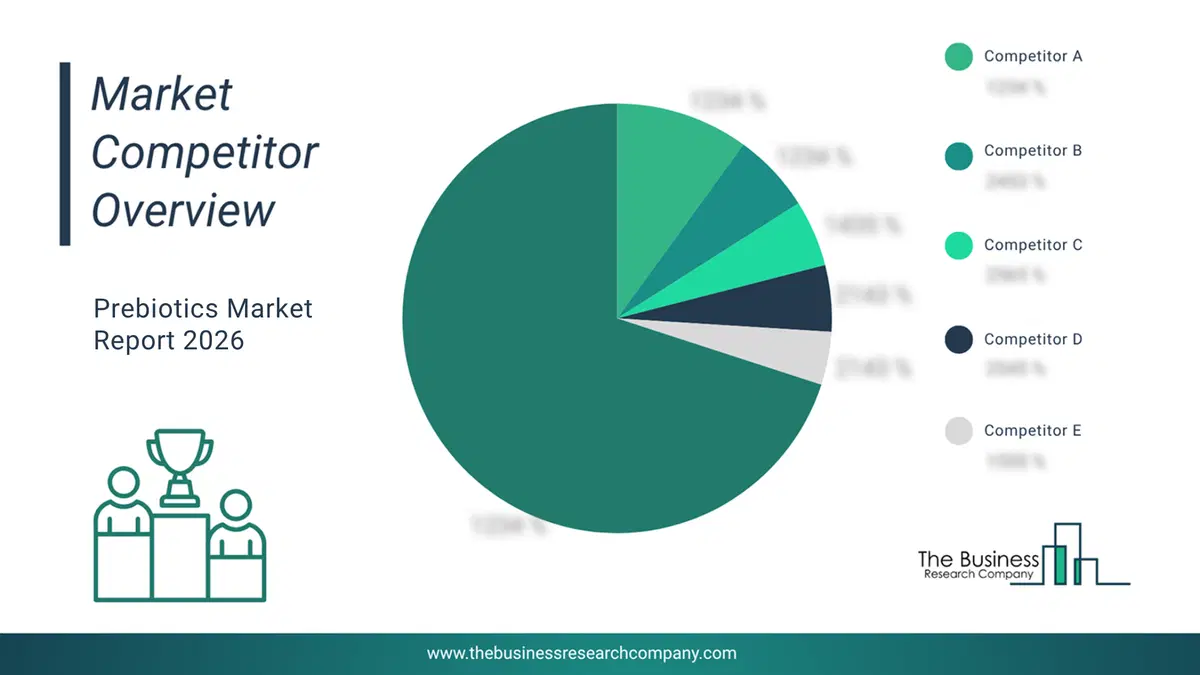
This chart is for illustrative purposes; the full report includes a detailed competitor analysis and comprehensive overview of the top 10 companies in the market.
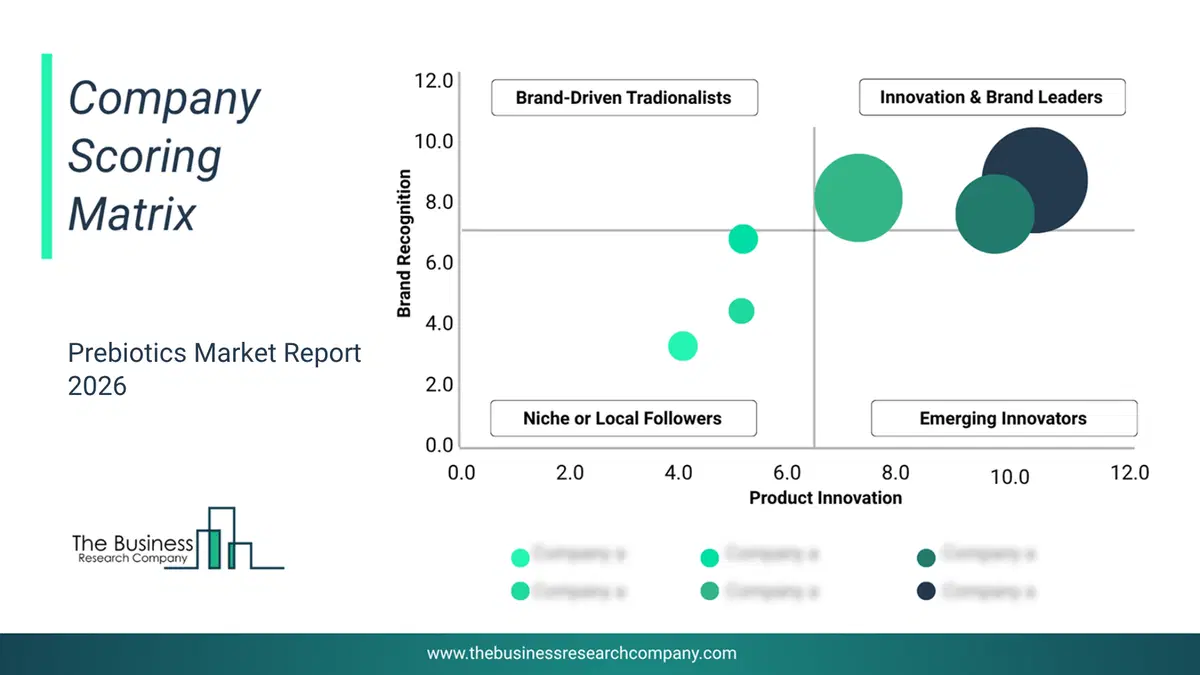
This chart maps companies by product innovation and brand strength, with bubble size indicating relative revenue, helping identify market leaders, challengers, and niche players. This is an illustrative chart; the full report provides a complete and accurate competitive analysis.
Global Prebiotics Market Trends and Insights
Major companies operating in the prebiotics market are focusing on developing innovative solutions, such as prebiotic-infused snack options, to cater to the growing consumer demand for gut health and digestive wellness. Prebiotic-infused snack options are convenient food products enhanced with ingredients that promote the growth of beneficial gut bacteria, supporting digestive health. For instance, in March 2025, Beech-Nut Nutrition Corporation, a US-based baby food company, introduced a new line of baby and toddler foods and snacks featuring prebiotics, whole milk yogurt, fruits, and vegetables, designed to support digestive health and overall nutrition. The launch includes Organic Fruit & Yogurt Jars with Prebiotics, Smoothies with Prebiotics, Jammin’ Waffles with fruit filling, and Fruti Bites with Hidden Veggies, all made with non-GMO ingredients and free from artificial additives. These products, available at major retailers such as Walmart, offer parents convenient, flavorful, and nutritious options for children ages 6 months and up.What Are Latest Mergers And Acquisitions In The Prebiotics Market?
In May 2025, PepsiCo, Inc., a US-based food, snack, and beverage company, acquired Poppi for $1.95 billion. With this acquisition, PepsiCo aims to enhance its portfolio by integrating a fast-growing prebiotic soda brand, thereby expanding its presence in the functional beverage market to meet the increasing consumer demand for healthier, wellness-oriented drink options. Poppi is a US-based beverage company specializing in flavored, low-calorie, low-sugar prebiotic sodas that manufactures and sells drinks containing prebiotics.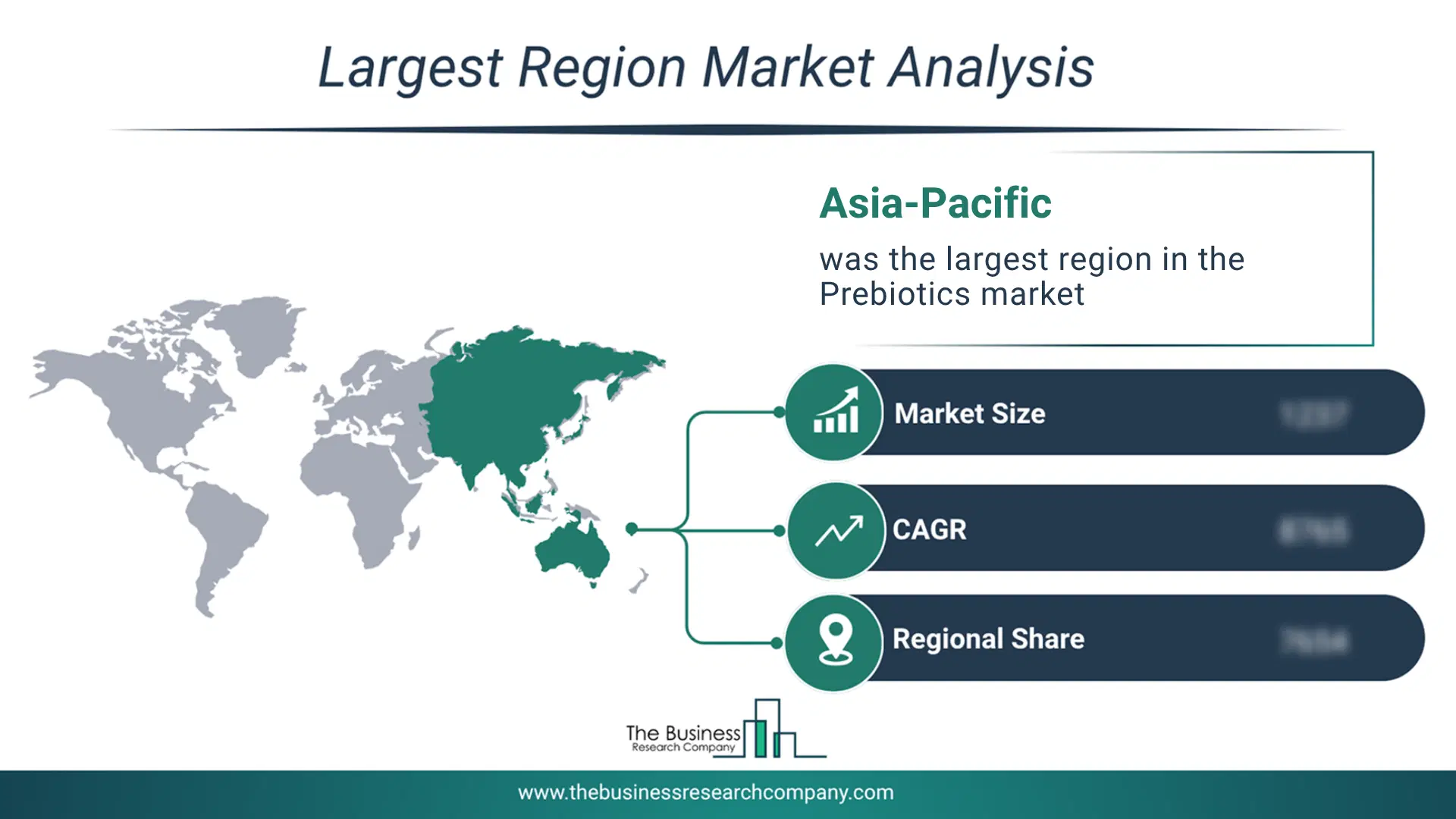
Regional Outlook
Asia-Pacific was the largest region in the prebiotics market in 2025. Asia-Pacific is expected to be the fastest-growing region in the forecast period. The regions covered in this market report are Asia-Pacific, South East Asia, Western Europe, Eastern Europe, North America, South America, Middle East, Africa. The countries covered in this market report are Australia, Brazil, China, France, Germany, India, Indonesia, Japan, Taiwan, Russia, South Korea, UK, USA, Canada, Italy, Spain.What Defines the Prebiotics Market?
The prebiotics market consists of sales of products including functional foods, dietary supplements, infant formula, beverages, and animal nutrition products. Values in this market are ‘factory gate’ values, that is, the value of goods sold by the manufacturers or creators of the goods, whether to other entities (including downstream manufacturers, wholesalers, distributors, and retailers) or directly to end customers. The value of goods in this market includes related services sold by the creators of the goods.How is Market Value Defined and Measured?
The market value is defined as the revenues that enterprises gain from the sale of goods and/or services within the specified market and geography through sales, grants, or donations in terms of the currency (in USD unless otherwise specified). The revenues for a specified geography are consumption values that are revenues generated by organizations in the specified geography within the market, irrespective of where they are produced. It does not include revenues from resales along the supply chain, either further along the supply chain or as part of other products.
This chart presents market attractiveness based on a quantitative evaluation of growth, competition, strategic alignment, and risk, offering a clear view of opportunity areas for decision-making. This chart is for illustrative purposes; the full report contains the complete analysis.

This chart highlights the Total Addressable Market (TAM) by estimating the maximum revenue opportunity using an assumption-driven approach, supporting strategic planning and opportunity sizing across markets. The chart is illustrative; the full report provides a more comprehensive analysis.
What Key Data and Analysis Are Included in the Prebiotics Market Report 2026?
The prebiotics market research report is one of a series of new reports from The Business Research Company that provides market statistics, including industry global market size, regional shares, competitors with the market share, detailed market segments, market trends and opportunities, and any further data you may need to thrive in the prebiotics industry. The market research report delivers a complete perspective of everything you need, with an in-depth analysis of the current and future state of the industry.Prebiotics Market Report Forecast Analysis
| Report Attribute | Details |
|---|---|
| Market Size Value In 2026 | $12.4 billion |
| Revenue Forecast In 2030 | $23.37 billion |
| Growth Rate | CAGR of 17.2% from 2026 to 2030 |
| Base Year For Estimation | 2025 |
| Actual Estimates/Historical Data | 2020-2025 |
| Forecast Period | 2026 - 2030 |
| Market Representation | Revenue in USD Billion and CAGR from 2026 to 2030 |
| Segments Covered | Prebiotic Ingredient Type, Product, Demography, Distribution Channel, End-User |
| Regional Scope | Asia-Pacific, Western Europe, Eastern Europe, North America, South America, Middle East, Africa |
| Country Scope | The countries covered in the report are Australia, Brazil, China, France, Germany, India, Indonesia, Japan, Taiwan, Russia, South Korea, UK, USA, Canada, Italy, Spain |
| Key Companies Profiled | Cargill Inc, Archer Daniels Midland Company, Nestle SA, Bayer AG, Abbott Laboratories, Danone SA, FrieslandCampina, Haleon Group, DuPont de Nemours Inc, Amway Corp, Herbalife Nutrition Ltd, Royal Cosun, Roquette Freres, Natures Bounty, Natures Sunshine Products Inc, Good Health New Zealand, NOW Foods, Jarrow Formulas Inc, Ingredion Incorporated, Tate and Lyle PLC, BENEO GmbH, Yakult Honsha Co Ltd |
| Customization Scope | Request for Customization |
| Pricing And Purchase Options | Explore Purchase Options |