
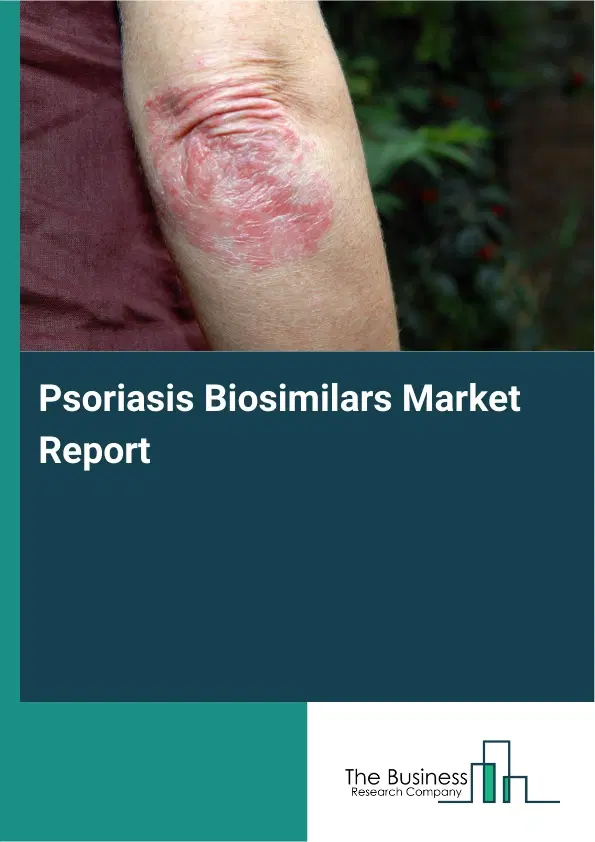
Psoriasis Biosimilars Market Report 2026
Global Outlook – By Drug Class (TNF-Alpha Inhibitors, Infliximab, Etanercept, Adalimumab, Other Biosimilars), By Disease Type (Plaque Psoriasis, Guttate Psoriasis, Inverse Psoriasis, Pustular Psoriasis), By Route Of Administration (Subcutaneous, Intravenous, Oral, Topical), By Distribution Channel (Hospital Pharmacies, Retail Pharmacies, Online Pharmacies) – Market Size, Trends, Strategies, and Forecast to 2030
Psoriasis Biosimilars Market Overview
• Psoriasis Biosimilars market size has reached to $8.16 billion in 2025 • Expected to grow to $13.79 billion in 2030 at a compound annual growth rate (CAGR) of 11% • Growth Driver: Rising Psoriatic Arthritis Diagnoses Fueling The Growth Of The Market Due To Increasing Early Detection And Cost-Effective Treatment Demand • Market Trend: Launch Of First Ustekinumab Biosimilar Autoinjector Enhances Plaque Psoriasis Treatment Options • North America was the largest region in 2025 and Asia-Pacific is the fastest growing region.What Is Covered Under Psoriasis Biosimilars Market?
Psoriasis biosimilars are biologic medications designed to closely mimic the structure, function, safety, and effectiveness of already approved reference biologics used in the treatment of moderate to severe psoriasis. These biosimilars provide a cost-effective alternative to original biologics, helping to improve patient access to advanced therapies without compromising clinical performance or quality. The main types of drug classes in psoriasis biosimilars are TNF-alpha inhibitors, infliximab, etanercept, adalimumab, and other biosimilars. TNF-alpha inhibitors are a class of biologic drugs that block tumor necrosis factor-alpha (TNF-α), a protein responsible for inflammation in psoriasis. It is used for various disease types, such as plaque psoriasis, guttate psoriasis, inverse psoriasis, and pustular psoriasis, and administered through subcutaneous, intravenous, oral, and topical routes. These drugs are distributed through hospital pharmacies, retail pharmacies, and online pharmacies.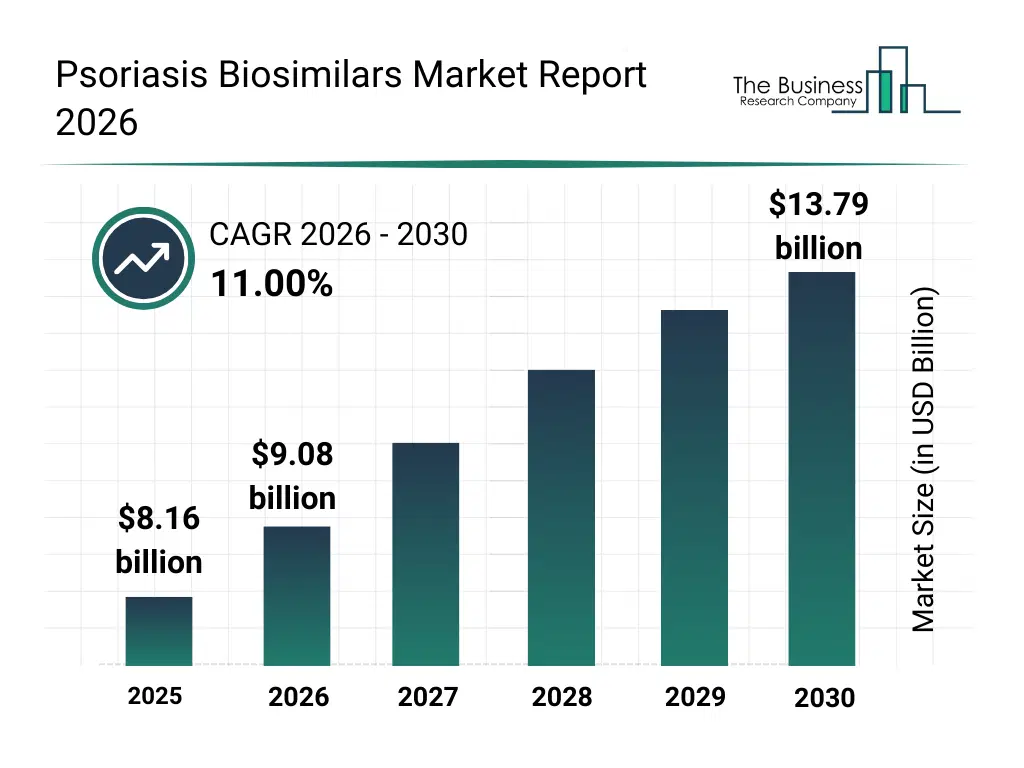
What Is The Psoriasis Biosimilars Market Size and Share 2026?
The psoriasis biosimilars market size has grown rapidly in recent years. It will grow from $8.16 billion in 2025 to $9.08 billion in 2026 at a compound annual growth rate (CAGR) of 11.3%. The growth in the historic period can be attributed to high cost of reference biologics, limited patient access to treatment, growing prevalence of moderate to severe psoriasis, increasing physician awareness and prescriptions, initial approvals of TNF-alpha inhibitors.What Is The Psoriasis Biosimilars Market Growth Forecast?
The psoriasis biosimilars market size is expected to see rapid growth in the next few years. It will grow to $13.79 billion in 2030 at a compound annual growth rate (CAGR) of 11.0%. The growth in the forecast period can be attributed to launch of new biosimilars for infliximab, etanercept, and adalimumab, expansion of hospital and online pharmacy networks, increasing healthcare expenditure on dermatology, rising adoption of patient assistance programs, growth in clinical trials for novel biosimilars. Major trends in the forecast period include rising adoption of cost-effective psoriasis biosimilars, increased focus on patient access and affordability, growth in subcutaneous and intravenous administration routes, expansion of hospital and retail pharmacy distribution channels, development of targeted therapies for different psoriasis types.
Global Psoriasis Biosimilars Market Segmentation
1) By Drug Class: TNF-Alpha Inhibitors, Infliximab, Etanercept, Adalimumab, Other Biosimilars 2) By Disease Type: Plaque Psoriasis, Guttate Psoriasis, Inverse Psoriasis, Pustular Psoriasis 3) By Route Of Administration: Subcutaneous, Intravenous, Oral, Topical 4) By Distribution Channel: Hospital Pharmacies, Retail Pharmacies, Online Pharmacies Subsegments: 1) By TNF-Alpha Inhibitors: Monoclonal Antibody Biosimilars, Fusion Protein Biosimilars 2) By Infliximab: Remicade Biosimilars, CT-P13 Biosimilars 3) By Etanercept: Enbrel Biosimilars, SB4 Biosimilars 4) By Adalimumab: Humira Biosimilars, ABP 501 Biosimilars 5) By Other Biosimilars: Ustekinumab Biosimilars, Secukinumab BiosimilarsWhat Is The Driver Of The Psoriasis Biosimilars Market?
The rising psoriatic arthritis diagnosis rates are expected to propel the growth of the psoriasis biosimilars market going forward. Psoriatic arthritis refers to a chronic autoimmune condition that causes inflammation in the joints and skin, often affecting individuals with a history of psoriasis. The psoriatic arthritis diagnosis rates are increasing, particularly due to improved screening protocols among individuals with psoriasis, which enable earlier detection and more accurate diagnosis by identifying subtle joint symptoms that might have previously gone unnoticed. Psoriasis biosimilars help manage psoriatic arthritis by providing affordable alternatives to biologic therapies, effectively reducing joint inflammation and skin symptoms. For instance, in August 2025, according to the National Psoriasis Foundation (NPF), a US-based non-profit patient advocacy organization, psoriatic arthritis affects roughly 1 in 3 people living with psoriasis, and as many as 2.4 million Americans live with psoriatic arthritis, while more than 15% of people with psoriasis may also have undiagnosed psoriatic arthritis, highlighting both increasing recognition and persistent underdiagnosis of the condition. Therefore, the rising psoriatic arthritis diagnosis rates are driving the growth of the psoriasis biosimilars industry.Key Players In The Global Psoriasis Biosimilars Market
Major companies operating in the psoriasis biosimilars market are Pfizer Inc., Amgen Inc., Sandoz Group AG, Fresenius Kabi AG, Intas Pharmaceuticals Ltd., STADA Arzneimittel AG, Aurobindo Pharma Ltd., Dr. Reddy’s Laboratories Ltd., Samsung Bioepis Co. Ltd., Zydus Lifesciences Ltd., Celltrion Inc., Bio-Thera Solutions Ltd., Coherus BioSciences Inc., mAbxience S.A., Alvotech hf.
This chart is for illustrative purposes; the full report includes a detailed competitor analysis and comprehensive overview of the top 10 companies in the market.
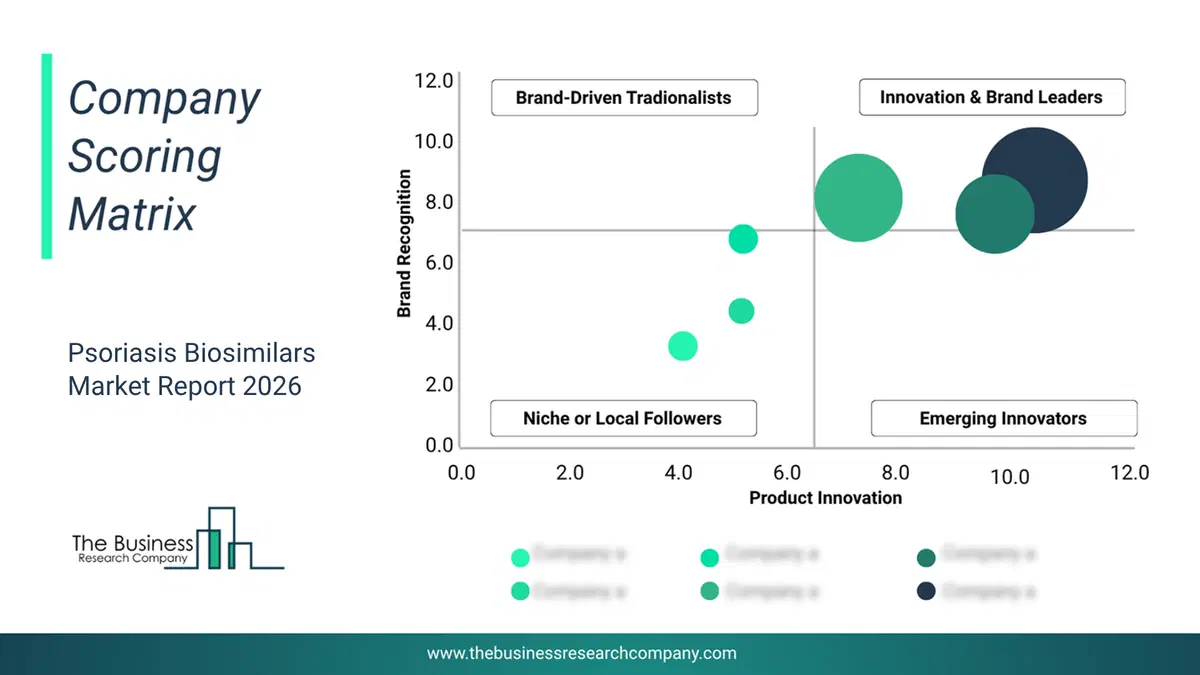
This chart maps companies by product innovation and brand strength, with bubble size indicating relative revenue, helping identify market leaders, challengers, and niche players. This is an illustrative chart; the full report provides a complete and accurate competitive analysis.
Global Psoriasis Biosimilars Market Trends and Insights
Major companies operating in the psoriasis biosimilars market are focusing on introducing innovative solutions, such as biosimilars for plaque psoriasis, to enhance treatment accessibility, reduce healthcare costs, and improve patient outcomes. Biosimilars for plaque psoriasis are lower-cost, highly similar alternatives to approved biologic drugs used to treat the chronic autoimmune skin condition characterized by red, scaly patches. For instance, in May 2025, Sandoz Group AG, a Switzerland-based company that focuses on generic pharmaceuticals and biosimilars, launched the Pyzchiva autoinjector, the first commercially available ustekinumab biosimilar autoinjector. Pyzchiva is approved for the treatment of adults with plaque psoriasis, psoriatic arthritis, and Crohn's disease, as well as pediatric patients aged six years and older (weighing over 60 kg) with plaque psoriasis. Designed to enhance patient adherence and quality of life, the autoinjector features accurate automatic dosing, reduced injection pain, a compact design, and flexible storage options for more comfortable self-administration.What Are Latest Mergers And Acquisitions In The Psoriasis Biosimilars Market?
In September 2023, Sandoz Group AG, a Switzerland-based pharmaceutical company, partnered with Samsung Bioepis to commercialize the biosimilar SB17 (ustekinumab). This collaboration leverages the strengths of both companies to bring the ustekinumab biosimilar, used to treat conditions such as plaque psoriasis, to markets in Europe and North America. The partnership aims to expand patient access to high-quality, cost-effective immunology treatments while reinforcing Sandoz’s leadership in the global biosimilars market. Samsung Bioepis is a South Korea-based biopharmaceutical company focused on developing and commercializing biosimilar drugs, including those used to treat plaque psoriasis.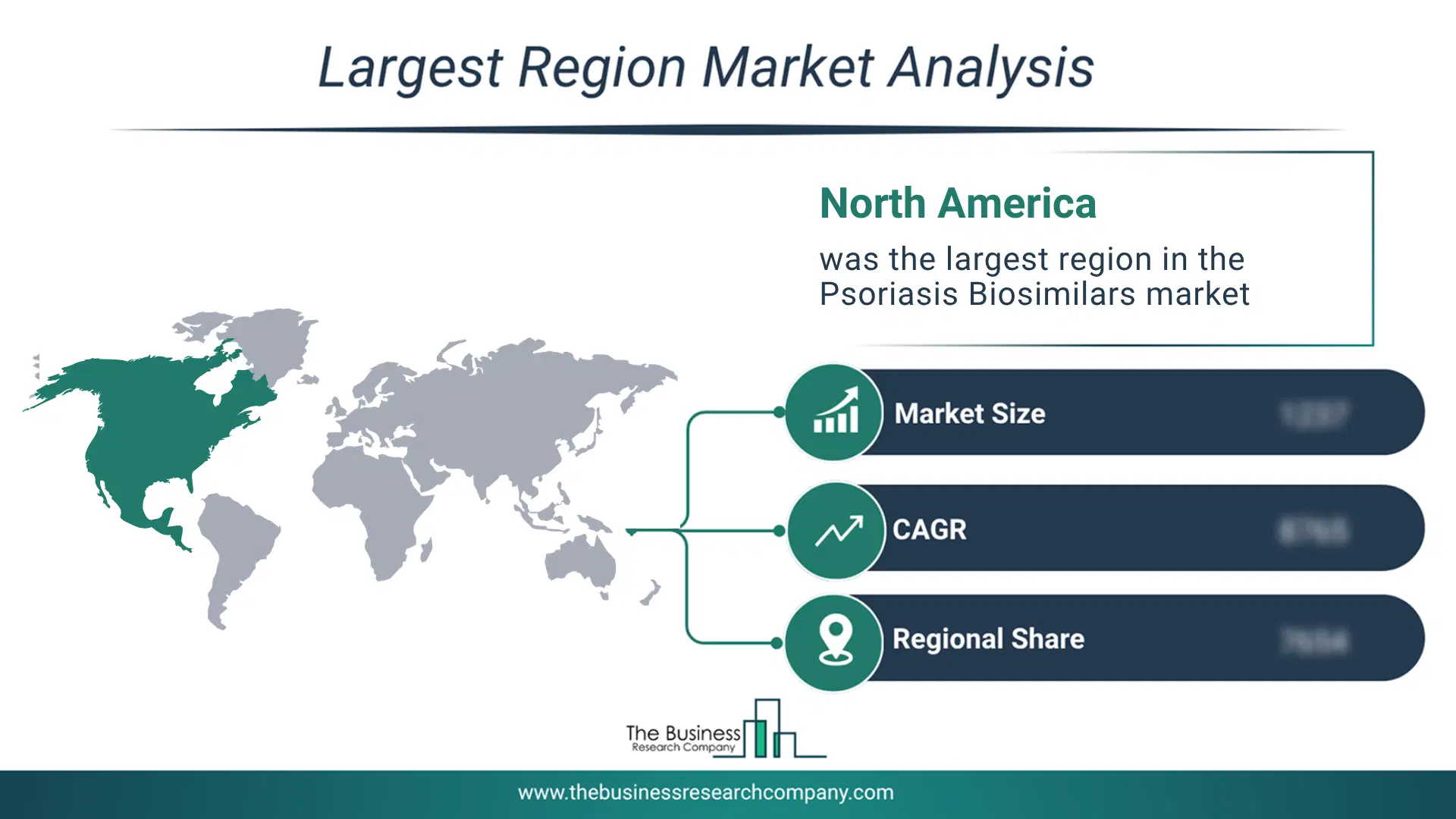
Regional Insights
North America was the largest region in the psoriasis biosimilars market in 2025. Asia-Pacific is expected to be the fastest-growing region in the forecast period. The regions covered in this market report are Asia-Pacific, South East Asia, Western Europe, Eastern Europe, North America, South America, Middle East, Africa. The countries covered in this market report are Australia, Brazil, China, France, Germany, India, Indonesia, Japan, Taiwan, Russia, South Korea, UK, USA, Canada, Italy, Spain.What Defines the Psoriasis Biosimilars Market?
The psoriasis biosimilars market consists of sales of tumor necrosis factor inhibitors, monoclonal antibodies, subcutaneous and intravenous formulations, subcutaneous injections, and interleukin inhibitors. Values in this market are ‘factory gate’ values, that is, the value of goods sold by the manufacturers or creators of the goods, whether to other entities (including downstream manufacturers, wholesalers, distributors, and retailers) or directly to end customers. The value of goods in this market includes related services sold by the creators of the goods.How is Market Value Defined and Measured?
The market value is defined as the revenues that enterprises gain from the sale of goods and/or services within the specified market and geography through sales, grants, or donations in terms of the currency (in USD unless otherwise specified). The revenues for a specified geography are consumption values that are revenues generated by organizations in the specified geography within the market, irrespective of where they are produced. It does not include revenues from resales along the supply chain, either further along the supply chain or as part of other products.
This chart presents market attractiveness based on a quantitative evaluation of growth, competition, strategic alignment, and risk, offering a clear view of opportunity areas for decision-making. This chart is for illustrative purposes; the full report contains the complete analysis.

This chart highlights the Total Addressable Market (TAM) by estimating the maximum revenue opportunity using an assumption-driven approach, supporting strategic planning and opportunity sizing across markets. The chart is illustrative; the full report provides a more comprehensive analysis.
What Key Data and Analysis Are Included in the Psoriasis Biosimilars Market Report 2026?
The psoriasis biosimilars market research report is one of a series of new reports from The Business Research Company that provides market statistics, including industry global market size, regional shares, competitors with the market share, detailed market segments, market trends and opportunities, and any further data you may need to thrive in the psoriasis biosimilars industry. The market research report delivers a complete perspective of everything you need, with an in-depth analysis of the current and future state of the industry.Psoriasis Biosimilars Market Report Forecast Analysis
| Report Attribute | Details |
|---|---|
| Market Size Value In 2026 | $9.08 billion |
| Revenue Forecast In 2030 | $13.79 billion |
| Growth Rate | CAGR of 11.3% from 2026 to 2030 |
| Base Year For Estimation | 2025 |
| Actual Estimates/Historical Data | 2020-2025 |
| Forecast Period | 2026 - 2030 |
| Market Representation | Revenue in USD Billion and CAGR from 2026 to 2030 |
| Segments Covered | Drug Class, Disease Type, Route Of Administration, Distribution Channel |
| Regional Scope | Asia-Pacific, Western Europe, Eastern Europe, North America, South America, Middle East, Africa |
| Country Scope | The countries covered in the report are Australia, Brazil, China, France, Germany, India, Indonesia, Japan, Taiwan, Russia, South Korea, UK, USA, Canada, Italy, Spain. |
| Key Companies Profiled | Pfizer Inc., Amgen Inc., Sandoz Group AG, Fresenius Kabi AG, Intas Pharmaceuticals Ltd., STADA Arzneimittel AG, Aurobindo Pharma Ltd., Dr. Reddy’s Laboratories Ltd., Samsung Bioepis Co. Ltd., Zydus Lifesciences Ltd., Celltrion Inc., Bio-Thera Solutions Ltd., Coherus BioSciences Inc., mAbxience S.A., Alvotech hf. |
| Customization Scope | Request for Customization |
| Pricing And Purchase Options | Explore Purchase Options |