
Rotational Molding Materials Market Report 2026
Global Outlook – By Type (Virgin, Recycled), By Material Type (Polyethylene, Polycarbonate, Nylon, Polyvinyl Chloride, Polypropylene, Other Material Types), By Form (Powder, Granules), By Application (Storage Tanks, Automotive Components, Containers, Toys And Leisure, Materials Handling, Industrial, Other Applications), By End-Use (Construction, Automotive, Agriculture, Consumer Goods, Chemical, Food And Beverage, Other End Users) – Market Size, Trends, Strategies, and Forecast to 2030
Rotational Molding Materials Market Overview
• Rotational Molding Materials market size has reached to $3.18 billion in 2025 • Expected to grow to $4.27 billion in 2030 at a compound annual growth rate (CAGR) of 6.1% • Growth Driver: Rise In Demand For Recycled Materials Fueling The Growth Of The Market Due To Environmental Regulations Cost Savings And Technological Advancements • Market Trend: Innovations In Polymer Materials To Improve Durability And Processing Efficiency • Europe was the largest region in 2025.What Is Covered Under Rotational Molding Materials Market?
Rotational molding materials refer to the specific types of plastics and polymers used in the rotational molding process, a manufacturing technique that creates hollow, durable plastic products. In this process, powdered plastic material is placed inside a mold, which is then heated and rotated along two axes. As the mold rotates, the material melts and evenly coats the inside to form a hollow product. These materials are carefully chosen based on the desired characteristics of the final product, such as strength, flexibility, UV resistance, and environmental durability. The main types of rotational molding materials are virgin and recycled. Virgin material refers to an unused polymer that has not been recycled or previously processed. Virgin resins are high-quality, pure polymers that are typically used in the production of rotomolded products to ensure optimal performance and durability. They are available in various material types such as polyethylene, polycarbonate, nylon, polyvinyl chloride, polyesters, polypropylene, and others. These materials are processed in different forms, such as powder and granules, and are used across applications such as storage tanks, automotive components, containers, toys and leisure, materials handling, industrial, and others and serve a broad range of end-use industries, including construction, automotive, agriculture, consumer goods, chemical, food and beverage, and others.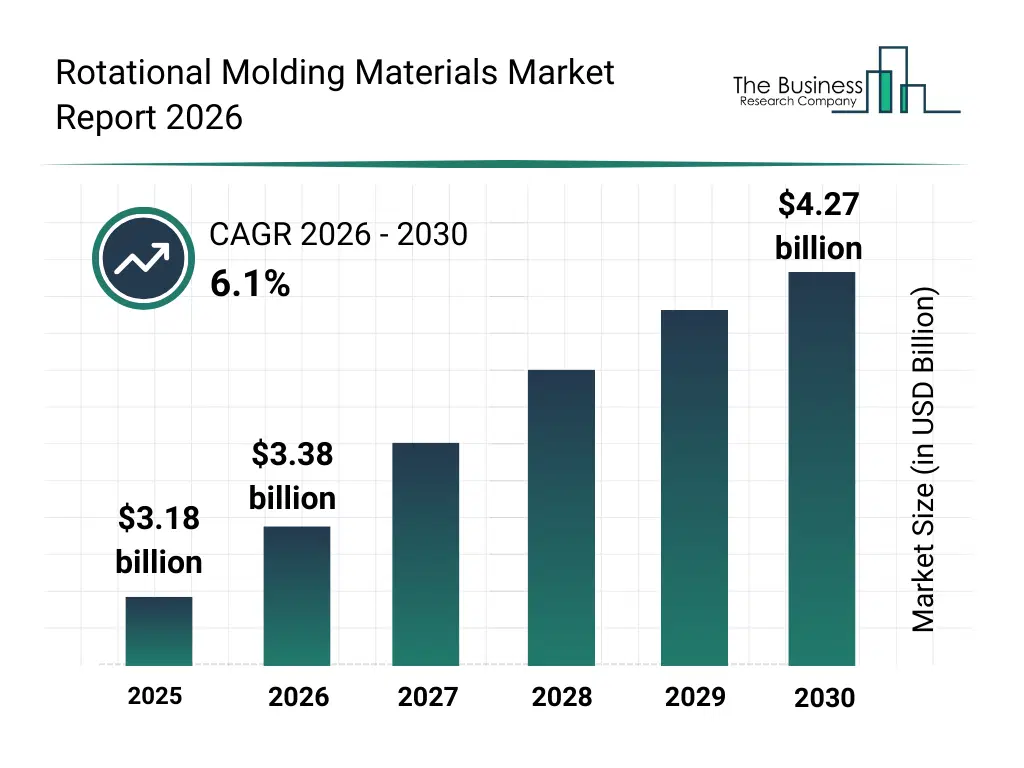
What Is The Rotational Molding Materials Market Size and Share 2026?
The rotational molding materials market size has grown strongly in recent years. It will grow from $3.18 billion in 2025 to $3.38 billion in 2026 at a compound annual growth rate (CAGR) of 6.1%. The growth in the historic period can be attributed to expansion of plastic storage tank usage, growth of agricultural water storage needs, rising demand for durable plastic containers, increasing adoption of rotomolding processes, availability of polyethylene materials.What Is The Rotational Molding Materials Market Growth Forecast?
The rotational molding materials market size is expected to see strong growth in the next few years. It will grow to $4.27 billion in 2030 at a compound annual growth rate (CAGR) of 6.1%. The growth in the forecast period can be attributed to increasing use of sustainable polymer materials, rising demand from automotive lightweighting initiatives, expansion of industrial storage applications, growing adoption of recycled polymers, increasing focus on long-life plastic products. Major trends in the forecast period include increasing adoption of recycled rotomolding materials, growing demand for high-durability polymers, expansion of uv-resistant material usage, rising use in automotive and storage applications, enhanced focus on material performance consistency.
Global Rotational Molding Materials Market Segmentation
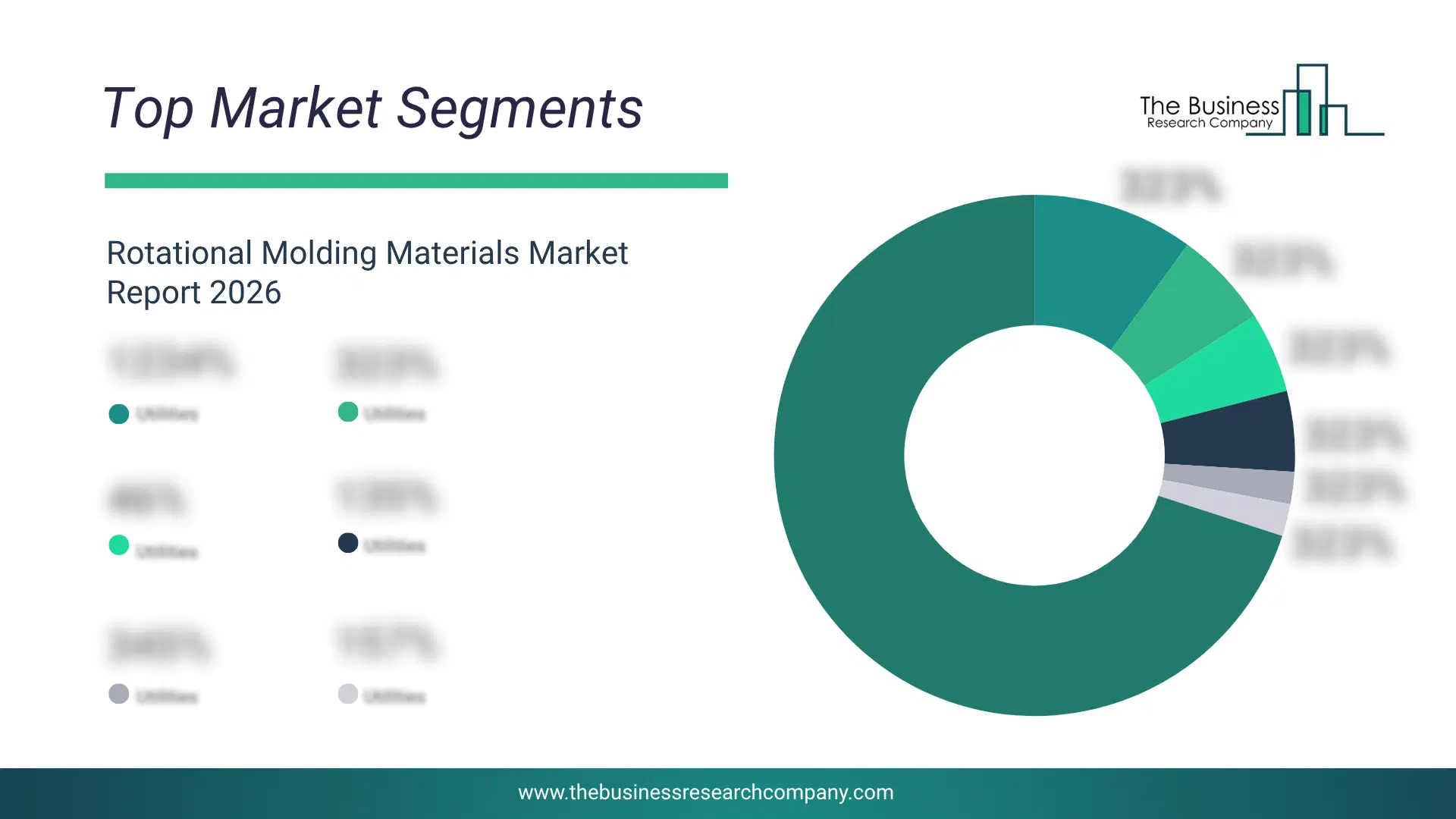
1) By Type: Virgin, Recycled 2) By Material Type: Polyethylene, Polycarbonate, Nylon, Polyvinyl Chloride, Polypropylene, Other Material Types 3) By Form: Powder, Granules 4) By Application: Storage Tanks, Automotive Components, Containers, Toys And Leisure, Materials Handling, Industrial, Other Applications 5) By End-Use: Construction, Automotive, Agriculture, Consumer Goods, Chemical, Food And Beverage, Other End Users Subsegments: 1) By Virgin: Polyethylene (PE), Polypropylene (PP), Polyvinyl Chloride (PVC), Nylon (PA), Polycarbonate (PC) 2) By Recycled: Recycled Polyethylene (rPE), Recycled Polypropylene (rPP), Recycled Polyvinyl Chloride (rPVC), Recycled High-Density Polyethylene (rHDPE), Recycled Low-Density Polyethylene (rLDPE)What Are The Drivers Of The Rotational Molding Materials Market?
The rise in demand for recycled materials is expected to propel the growth of the rotational molding materials market going forward. Recycled materials refer to substances that have been reprocessed from waste into new products, reducing reliance on virgin resources and minimizing environmental impact. Growing environmental awareness drives consumers and industries to choose sustainable options, which boosts the demand for recycled materials through conscious purchasing decisions. Rotational molding materials support recycled material demand by enabling the efficient reuse of plastics in durable and versatile molded products. For instance, in November 2024, according to Eurostat, a Luxembourg-based statistical office of the European Union, the share of materials used in the European Union that came from recycled sources reached 11.8% in 2023, increasing by 0.3 percentage points compared with the previous year, with the Netherlands recording the highest rate at 30.6%. Therefore, the rising demand for recycled materials is driving growth in the rotational molding materials industry. The growing infrastructure development is expected to propel the growth of the rotational molding materials market going forward. Infrastructure development refers to the construction and enhancement of fundamental physical systems and facilities including transportation networks, utilities, and communication systems that support economic activities. The infrastructure development is rising due to government initiatives to modernize aging systems and accommodate economic growth, as public authorities allocate significant resources to upgrade transportation networks, energy systems, and water facilities to support expanding populations and enhance national competitiveness. Rising infrastructure development increases demand for rotational molding materials as these versatile polymers provide durable, cost-effective solutions for manufacturing large hollow components used in water storage tanks, transportation barriers, and utility infrastructure installations. For instance, in July 2024, according to the Office for National Statistics (ONS), a UK-based government department, in 2023, total investment in the infrastructure sector reached £13.8 billion (around USD 17.3 billion) at constant prices, representing a 3.9% increase from 2022. Therefore, growing infrastructure development is driving the growth of the rotational molding materials industry.Key Players In The Global Rotational Molding Materials Market
Major companies operating in the rotational molding materials market are Exxon Mobil Corporation, Reliance Industries Limited, Saudi Basic Industries Corporation (SABIC), LyondellBasell Industries Holdings B.V., PTT Global Chemical Public Company Limited, DOMO Chemicals GmbH, Zhejiang Rotoun Plastic Technology Corp., Nylene Canada ULC., Prisma Colour Limited, Matrix Polymers Limited, Gregstrom Corporation, Broadway Colours Ltd, SCG Chemicals Public Company Limited, GreenAge Industries, Xiamen Keyuan Plastic Co., Ltd, OSWAL HITECH PVT. LTD., Heera Roto Compounds Pvt. Ltd., Petrotech Group, Pinaxis Polymer LLP, and Kalpataru Polymer Private Limited.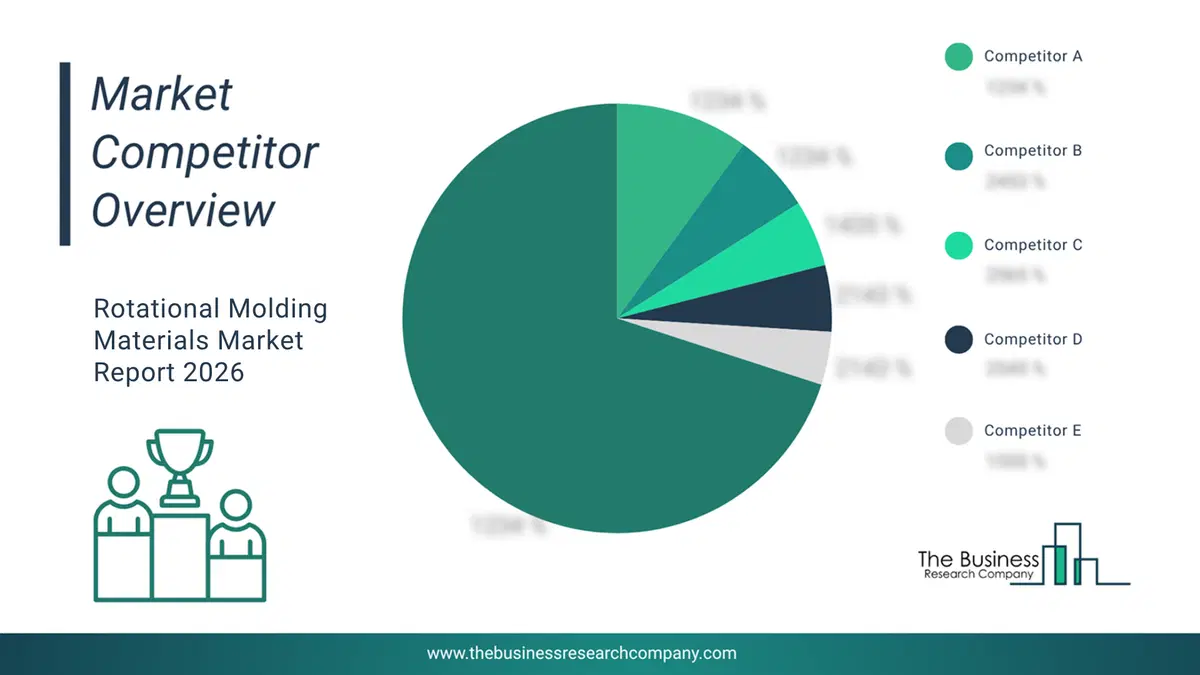
This chart is for illustrative purposes; the full report includes a detailed competitor analysis and comprehensive overview of the top 10 companies in the market.
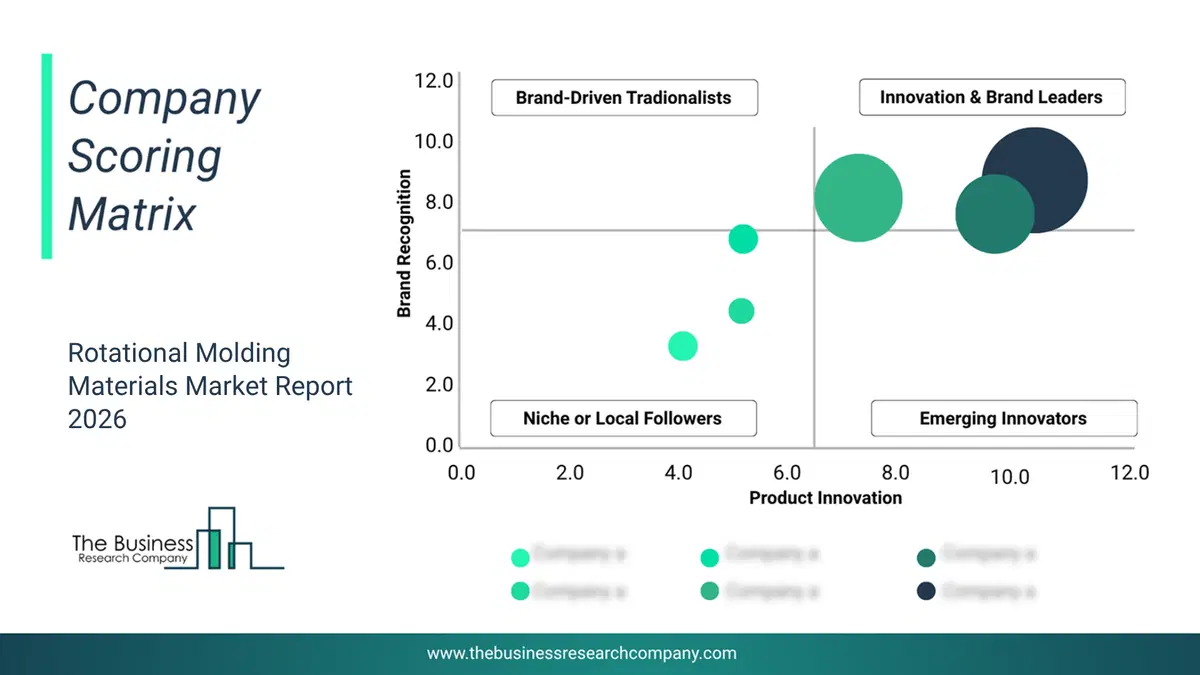
This chart maps companies by product innovation and brand strength, with bubble size indicating relative revenue, helping identify market leaders, challengers, and niche players. This is an illustrative chart; the full report provides a complete and accurate competitive analysis.
Global Rotational Molding Materials Market Trends and Insights
Major companies operating in the rotational molding materials market are focusing on developing innovative polymer grades such as advanced linear low-density polyethylene to enhance durability, sustainability, and processing efficiency. Linear low-density polyethylene is a polyethylene resin produced through copolymerization that delivers a balanced molecular structure, providing high impact strength, environmental stress crack resistance, and stable melt behavior during rotational molding, enabling capabilities such as uniform wall thickness, faster cycle times, and extended product lifespan. For instance, in December 2023, OQ SAOC, an Oman-based global integrated energy group, launched Luban LL 8446.21, an advanced linear low density polyethylene material designed to support water security applications by enabling the manufacture of durable water tanks and other rotomolded products, featuring excellent environmental stress crack resistance, enhanced weatherability, and improved processing efficiency with lower energy consumption. Luban LL 8446.21 improves long-term product reliability, manufacturing efficiency, and sustainability across critical rotational molding applications.
Regional Outlook
Europe was the largest region in the rotational molding materials market in 2025. The regions covered in this market report are Asia-Pacific, South East Asia, Western Europe, Eastern Europe, North America, South America, Middle East, Africa. The countries covered in this market report are Australia, Brazil, China, France, Germany, India, Indonesia, Japan, Taiwan, Russia, South Korea, UK, USA, Canada, Italy, Spain.What Defines the Rotational Molding Materials Market?
The rotational molding materials market consists of sales of low-density polyethylene, linear low-density polyethylene, high-density polyethylene, and crosslinked polyethylene. Values in this market are ‘factory gate’ values, that is the value of goods sold by the manufacturers or creators of the goods, whether to other entities (including downstream manufacturers, wholesalers, distributors and retailers) or directly to end customers. The value of goods in this market includes related services sold by the creators of the goods.How is Market Value Defined and Measured?
The market value is defined as the revenues that enterprises gain from the sale of goods and/or services within the specified market and geography through sales, grants, or donations in terms of the currency (in USD unless otherwise specified). The revenues for a specified geography are consumption values that are revenues generated by organizations in the specified geography within the market, irrespective of where they are produced. It does not include revenues from resales along the supply chain, either further along the supply chain or as part of other products.
This chart presents market attractiveness based on a quantitative evaluation of growth, competition, strategic alignment, and risk, offering a clear view of opportunity areas for decision-making. This chart is for illustrative purposes; the full report contains the complete analysis.

This chart highlights the Total Addressable Market (TAM) by estimating the maximum revenue opportunity using an assumption-driven approach, supporting strategic planning and opportunity sizing across markets. The chart is illustrative; the full report provides a more comprehensive analysis.
What Key Data and Analysis Are Included in the Rotational Molding Materials Market Report 2026?
The rotational molding materials market research report is one of a series of new reports from The Business Research Company that provides market statistics, including Market Report 2026?global market size, regional shares, competitors with the market share, detailed market segments, market trends and opportunities, and any further data you may need to thrive in the rotational molding materials Market Report 2026? The market research report delivers a complete perspective of everything you need, with an in-depth analysis of the current and future state of the Market Report 2026?Rotational Molding Materials Market Report Forecast Analysis
| Report Attribute | Details |
|---|---|
| Market Size Value In 2026 | $3.38 billion |
| Revenue Forecast In 2030 | $4.27 billion |
| Growth Rate | CAGR of 6.1% from 2026 to 2030 |
| Base Year For Estimation | 2025 |
| Actual Estimates/Historical Data | 2020-2025 |
| Forecast Period | 2026 - 2030 |
| Market Representation | Revenue in USD Billion and CAGR from 2026 to 2030 |
| Segments Covered | Type, Material Type, Form, Application, End-Use |
| Regional Scope | Asia-Pacific, Western Europe, Eastern Europe, North America, South America, Middle East, Africa |
| Country Scope | The countries covered in the report are Australia, Brazil, China, France, Germany, India, Indonesia, Japan, Taiwan, Russia, South Korea, UK, USA, Canada, Italy, Spain. |
| Key Companies Profiled | Exxon Mobil Corporation, Reliance Industries Limited, Saudi Basic Industries Corporation (SABIC), LyondellBasell Industries Holdings B.V., PTT Global Chemical Public Company Limited, DOMO Chemicals GmbH, Zhejiang Rotoun Plastic Technology Corp., Nylene Canada ULC., Prisma Colour Limited, Matrix Polymers Limited, Gregstrom Corporation, Broadway Colours Ltd, SCG Chemicals Public Company Limited, GreenAge Industries, Xiamen Keyuan Plastic Co., Ltd, OSWAL HITECH PVT. LTD., Heera Roto Compounds Pvt. Ltd., Petrotech Group, Pinaxis Polymer LLP, and Kalpataru Polymer Private Limited. |
| Customization Scope | Request for Customization |
| Pricing And Purchase Options | Explore Purchase Options |