
Salt Content Reduction Ingredients Market Report 2026
Global Outlook – By Product Type (Yeast Extracts, Glutamates, High Nucleotide Ingredients, Hydrolyzed Vegetable Protein, Mineral Salts, Other Product Types), By Ingredient (Mineral Blends, Amino Acid, Yeast Extract, Other Ingredients), By Application (Dairy Products, Bakery Products, Fish Derivatives, Meat And Poultry, Beverages, Sauces And Seasonings, Other Applications) – Market Size, Trends, Strategies, and Forecast to 2030
Salt Content Reduction Ingredients Market Overview
• Salt Content Reduction Ingredients market size has reached to $3.89 billion in 2025 • Expected to grow to $6.32 billion in 2030 at a compound annual growth rate (CAGR) of 10.4% • Growth Driver: Initiatives And Policies For Reduced Sodium Intake Is Anticipated To Fuel The Salt Content Reduction Ingredients Market • Market Trend: Government-Backed Initiatives And Innovations In Healthier Food Solutions • North America was the largest region in 2025 and Asia-Pacific is the fastest growing region.What Is Covered Under Salt Content Reduction Ingredients Market?
Salt content reduction ingredients are ingredients that can be used to lower the amount of sodium or salt in food products without sacrificing taste or quality. It is generally used to lower or eliminate the excessive salt content of food goods, particularly packaged meals, and improves the risk of hypertension. The main products of salt content reduction ingredients are yeast extracts, glutamates, high nucleotide ingredients, hydrolyzed vegetable protein, mineral salts, and others. Yeast extract refers to a natural origin ingredient derived from fresh yeast that is used as a flavor enhancer in savory foods such as soups, sauces, snacks, and others. Mineral blends, amino acids, yeast extract, and others are used for various applications including dairy products, bakery products, fish derivatives, meat and poultry, beverages, sauces and seasonings, and others.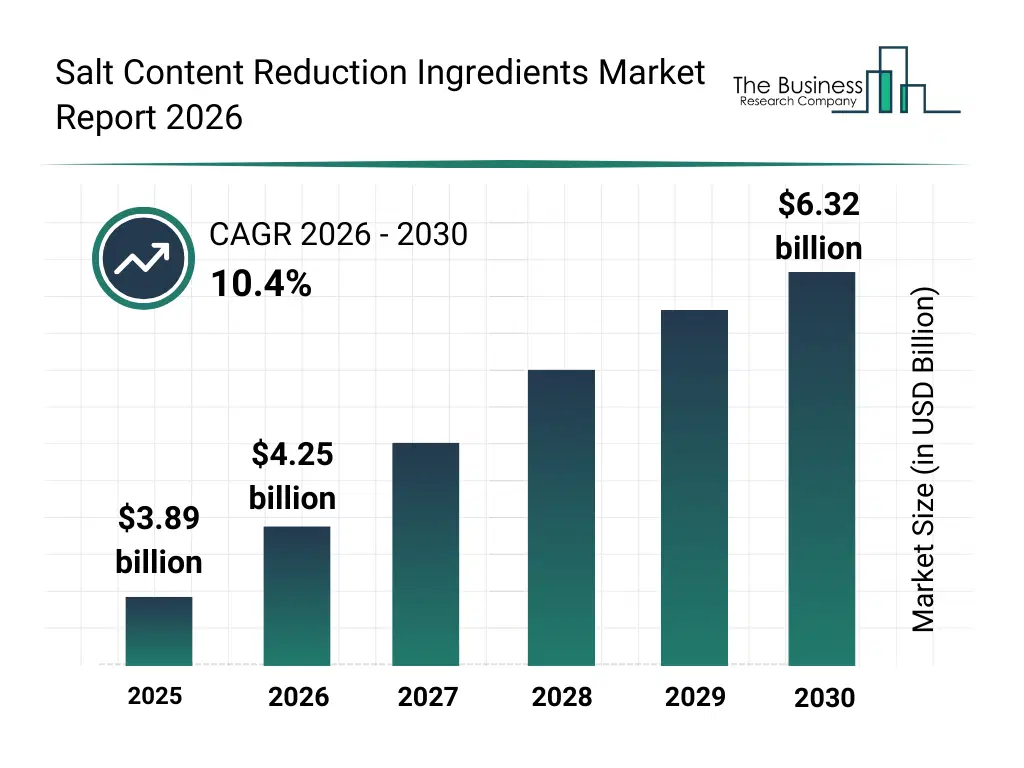
What Is The Salt Content Reduction Ingredients Market Size and Share 2026?
The salt content reduction ingredients market size has grown strongly in recent years. It will grow from $3.89 billion in 2025 to $4.25 billion in 2026 at a compound annual growth rate (CAGR) of 9.4%. The growth in the historic period can be attributed to rising consumer awareness of hypertension risks, increased regulatory scrutiny on sodium content, expansion of processed food consumption, growing use of flavor enhancers, advancements in food ingredient formulation.What Is The Salt Content Reduction Ingredients Market Growth Forecast?
The salt content reduction ingredients market size is expected to see rapid growth in the next few years. It will grow to $6.32 billion in 2030 at a compound annual growth rate (CAGR) of 10.4%. The growth in the forecast period can be attributed to increasing demand for healthier packaged foods, rising adoption of sodium reduction strategies by food manufacturers, expansion of plant-based and functional food categories, growing investments in food formulation innovation, increasing focus on preventive health nutrition. Major trends in the forecast period include increasing use of natural salt reduction solutions, rising adoption of mineral salt blends, growing demand for clean-label flavor enhancers, expansion of low-sodium food formulations, enhanced focus on taste optimization technologies.
Global Salt Content Reduction Ingredients Market Segmentation
1) By Product Type: Yeast Extracts, Glutamates, High Nucleotide Ingredients, Hydrolyzed Vegetable Protein, Mineral Salts, Other Product Types 2) By Ingredient: Mineral Blends, Amino Acid, Yeast Extract, Other Ingredients 3) By Application: Dairy Products, Bakery Products, Fish Derivatives, Meat And Poultry, Beverages, Sauces And Seasonings, Other Applications Subsegments: 1) By Yeast Extracts: Autolyzed Yeast Extracts, Hydrolyzed Yeast Extracts 2) By Glutamates: Monosodium Glutamate (MSG), Disodium Guanylate (DSG), Disodium Inosinate (DINS) 3) By High Nucleotide Ingredients: Nucleotides, Nucleosides 4) By Hydrolyzed Vegetable Protein: Soy Protein Hydrolysates, Wheat Protein Hydrolysates 5) By Mineral Salts: Potassium Chloride, Magnesium Sulfate, Calcium Chloride 6) By Other Product Types: Flavor Enhancers, Natural ExtractsWhat Is The Driver Of The Salt Content Reduction Ingredients Market?
The initiatives and policies for reduced sodium intake are expected to propel the growth of the salt content reduction ingredients market going forward. Initiatives and Policies are specific actions or formal guidelines or regulations providing a framework for decision-making and behavior within a particular context. The incorporation of salt content reduction ingredients serves as a key strategy to promote healthier food choices and mitigate the health risks associated with excessive salt-sodium consumption. For instance, in March 2023, according to the World Health Organization, a Switzerland-based intergovernmental organization, estimated that the implementation of highly cost-effective sodium reduction policies could save an estimated 7 million lives globally by 2030. Therefore, the initiatives and policies for reduced sodium intake are driving the salt content reduction ingredients industry.Key Players In The Global Salt Content Reduction Ingredients Market
Major companies operating in the salt content reduction ingredients market are Advanced Food Systems Inc., Ajinomoto Co. Inc., Angel Yeast Co. Ltd., Archer Daniels Midland Company, Associated British Foods plc, Cargill Incorporated, DuPont de Nemours Inc., Fufeng Group, Givaudan SA, Innophos Holdings Inc., Jungbunzlauer Suisse AG, Kerry Group plc, Royal DSM N.V., Savory Systems International Inc., Sensient Technologies Corporation, Tate & Lyle plc, Smart Salt, Dr. Paul Lohmann GmbH & Co. KGaA, Red Arrow Products Company LLC, Niacet Corporation, Kudos Blends Limited
This chart is for illustrative purposes; the full report includes a detailed competitor analysis and comprehensive overview of the top 10 companies in the market.
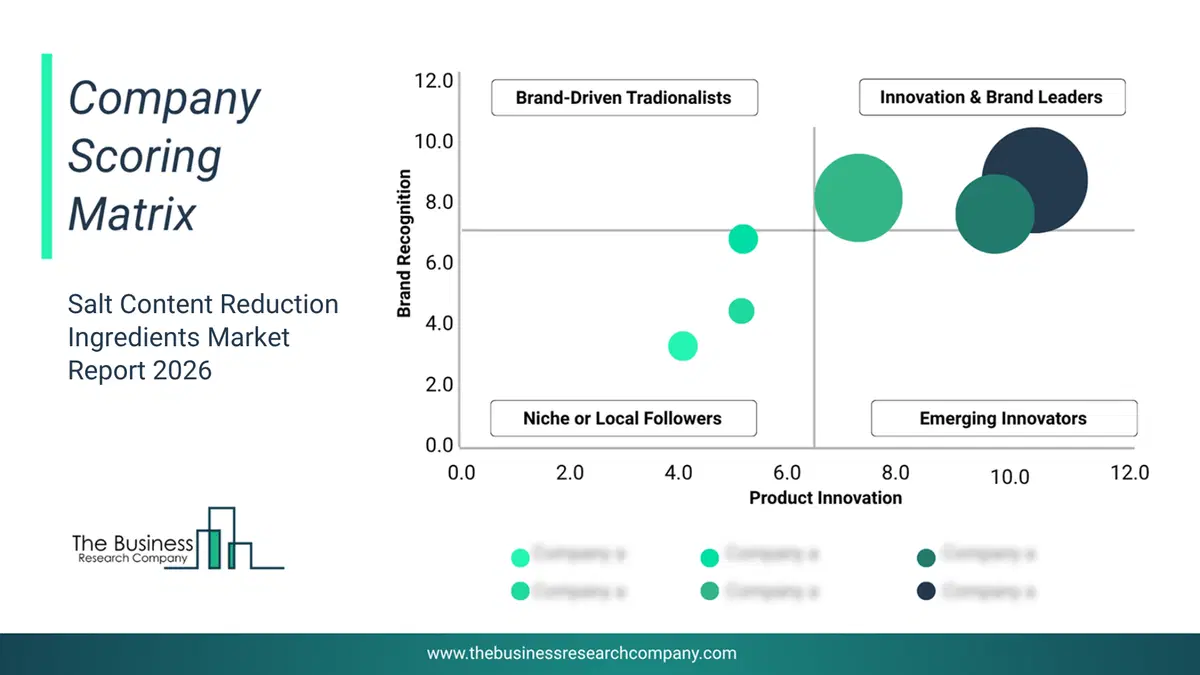
This chart maps companies by product innovation and brand strength, with bubble size indicating relative revenue, helping identify market leaders, challengers, and niche players. This is an illustrative chart; the full report provides a complete and accurate competitive analysis.
Global Salt Content Reduction Ingredients Market Trends and Insights
Major companies operating in the salt and sugar reduction ingredients market are focusing on developing innovative solutions, such as healthier food solutions such as reduced-sodium and reduced-sugar products, to meet growing consumer demand for low-sodium and low-sugar diets. Healthier food solutions are products or ingredients formulated to enhance nutritional quality, reduce harmful components such as sodium or sugar, and support overall well-being without compromising taste or convenience. For instance, in December 2024, the South Korean government launched 19 government-backed reduced-sodium and sugar products across various food categories. These products aim to promote healthier eating habits, support public health initiatives, and provide consumers with convenient alternatives without compromising taste and nutritional value, while also encouraging food manufacturers to innovate in flavor enhancement, maintain product appeal, and contribute to the overall reduction of diet-related health risks in the population.What Are Latest Mergers And Acquisitions In The Salt Content Reduction Ingredients Market?
In October 2023, Ki Chemistry S.à R.L., a Luxembourg-based chemical industry, acquired CIECH S.A. for an undisclosed amount. Through this acquisition, Ki Chemistry aims to increase its ownership stake for greater control over strategic direction, support operations, strengthen market position, and implement efficient corporate governance for improved decision making. CIECH S.A. is a Poland-based chemical company specializing in the production of chemical products, including soda ash, silicates, specialty chemicals for industries such as glass, ceramics, and agriculture, as well as salt content reduction ingredients.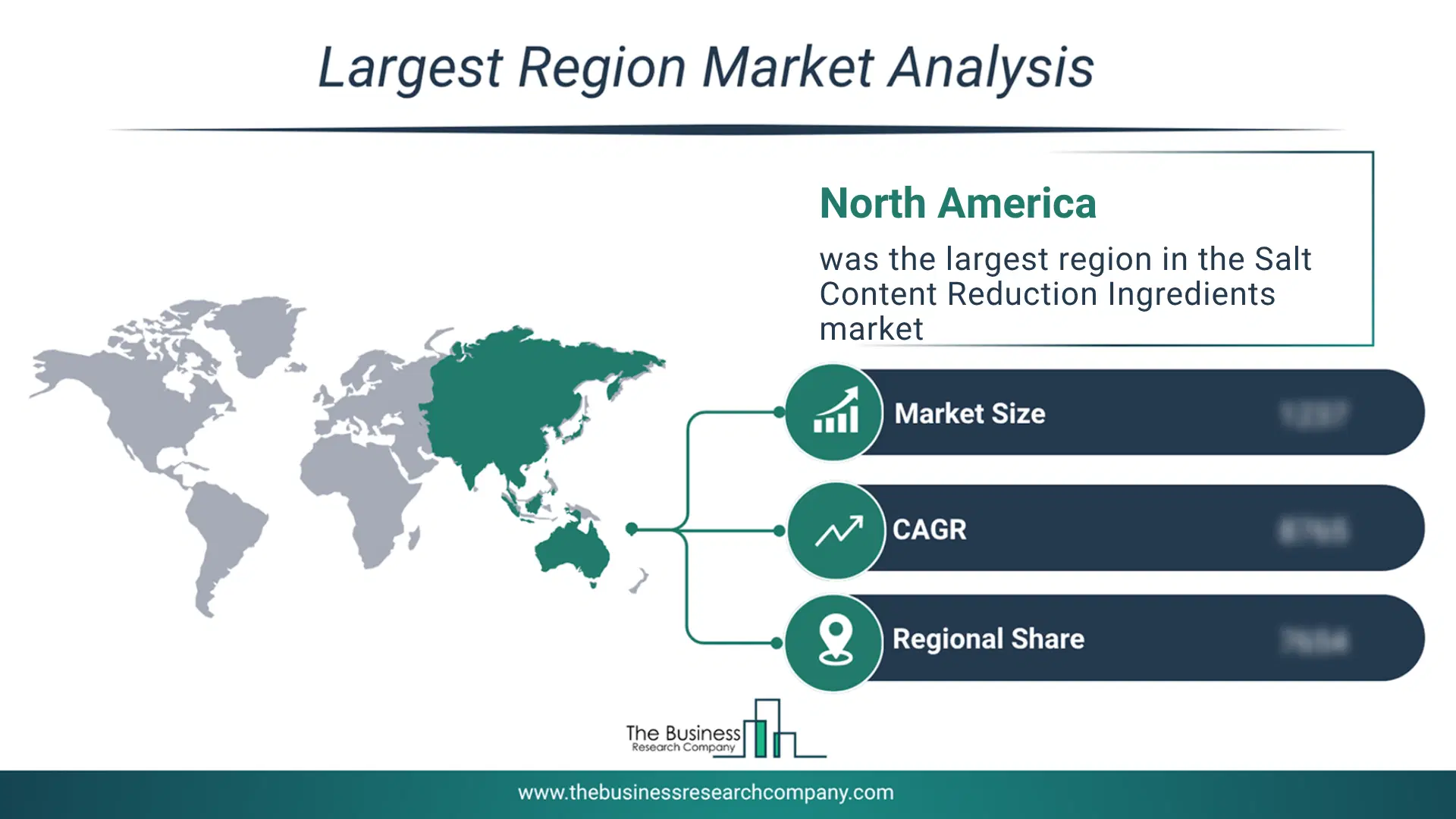
Regional Outlook
North America was the largest region in the salt content reduction ingredients market in 2025. Asia-Pacific is expected to be the fastest-growing region in the global salt content reduction ingredients market during the forecast period. The regions covered in this market report are Asia-Pacific, South East Asia, Western Europe, Eastern Europe, North America, South America, Middle East and Africa. The countries covered in this market report are Australia, Brazil, China, France, Germany, India, Indonesia, Japan, Taiwan, Russia, South Korea, UK, USA, Italy, Spain, CanadaWhat Defines the Salt Content Reduction Ingredients Market?
The salt content reduction ingredients market consists of sales of potassium sulfate, magnesium sulfate, calcium chloride, potassium lactate, and potassium chloride. Values in this market are ‘factory gate’ values, that is the value of goods sold by the manufacturers or creators of the goods, whether to other entities (including downstream manufacturers, wholesalers, distributors, and retailers) or directly to end customers. The value of goods in this market includes related services sold by the creators of the goods.How is Market Value Defined and Measured?
The market value is defined as the revenues that enterprises gain from the sale of goods and/or services within the specified market and geography through sales, grants, or donations in terms of the currency (in USD unless otherwise specified). The revenues for a specified geography are consumption values that are revenues generated by organizations in the specified geography within the market, irrespective of where they are produced. It does not include revenues from resales along the supply chain, either further along the supply chain or as part of other products.
This chart presents market attractiveness based on a quantitative evaluation of growth, competition, strategic alignment, and risk, offering a clear view of opportunity areas for decision-making. This chart is for illustrative purposes; the full report contains the complete analysis.

This chart highlights the Total Addressable Market (TAM) by estimating the maximum revenue opportunity using an assumption-driven approach, supporting strategic planning and opportunity sizing across markets. The chart is illustrative; the full report provides a more comprehensive analysis.
What Key Data and Analysis Are Included in the Salt Content Reduction Ingredients Market Report 2026?
The salt content reduction ingredients market research report is one of a series of new reports from The Business Research Company that provides market statistics, including industry global market size, regional shares, competitors with the market share, detailed market segments, market trends and opportunities, and any further data you may need to thrive in the salt content reduction ingredients industry. The market research report delivers a complete perspective of everything you need, with an in-depth analysis of the current and future state of the industry.Salt Content Reduction Ingredients Market Report Forecast Analysis
| Report Attribute | Details |
|---|---|
| Market Size Value In 2026 | $4.25 billion |
| Revenue Forecast In 2030 | $6.32 billion |
| Growth Rate | CAGR of 9.4% from 2026 to 2030 |
| Base Year For Estimation | 2025 |
| Actual Estimates/Historical Data | 2020-2025 |
| Forecast Period | 2026 - 2030 |
| Market Representation | Revenue in USD Billion and CAGR from 2026 to 2030 |
| Segments Covered | Product Type, Ingredient, Application |
| Regional Scope | Asia-Pacific, Western Europe, Eastern Europe, North America, South America, Middle East, Africa |
| Country Scope | The countries covered in the report are Australia, Brazil, China, France, Germany, India, Indonesia, Japan, Taiwan, Russia, South Korea, UK, USA, Canada, Italy, Spain. |
| Key Companies Profiled | Advanced Food Systems Inc., Ajinomoto Co. Inc., Angel Yeast Co. Ltd., Archer Daniels Midland Company, Associated British Foods plc, Cargill Incorporated, DuPont de Nemours Inc., Fufeng Group, Givaudan SA, Innophos Holdings Inc., Jungbunzlauer Suisse AG, Kerry Group plc, Royal DSM N.V., Savory Systems International Inc., Sensient Technologies Corporation, Tate & Lyle plc, Smart Salt, Dr. Paul Lohmann GmbH & Co. KGaA, Red Arrow Products Company LLC, Niacet Corporation, Kudos Blends Limited |
| Customization Scope | Request for Customization |
| Pricing And Purchase Options | Explore Purchase Options |