
Secondary Macronutrients Market Report 2026
Global Outlook – By Nutrient Type (Calcium, Magnesium, Sulfur), By Crop Type (Cereals And Grains, Oilseeds And Pulses, Fruits And Vegetables, Other Crop Types), By Application Method (Solid Application, Liquid Application) – Market Size, Trends, Strategies, and Forecast to 2030
Secondary Macronutrients Market Overview
• Secondary Macronutrients market size has reached to $42.73 billion in 2025 • Expected to grow to $55.1 billion in 2030 at a compound annual growth rate (CAGR) of 5.3% • Growth Driver: The Impact Of Increasing Climate Change On The Growth Of The Secondary Micronutrient Market • Market Trend: Innovations In Crop Nutrition Solutions For The Secondary Macronutrient Market • Asia-Pacific was the largest region in 2025 and Asia-Pacific is the fastest growing region.What Is Covered Under Secondary Macronutrients Market?
Secondary macronutrients are the compounds required for a plant in smaller amounts than N, P, and K but in greater amounts than micronutrients. These consist of the elements calcium (Ca), magnesium (Mg), and sulfur (S), and the provision of these nutrients is required for proper plant growth, development, and overall nutritional balance. The main secondary macronutrients are calcium, magnesium, and sulfur. Calcium is a silvery-white divalent metal that's found in the mineral limestone, chalk, gypsum, and other minerals and it is used in agriculture to boost crop vitality by promoting root production and development due to its capability to bind to the cell walls of tissues in plants, stabilizing them and promoting cell wall development. The various crops that use secondary macronutrients are cereals and grains, oilseeds, and pulses, fruits and vegetables, and others with different application methods such as solid application and liquid application.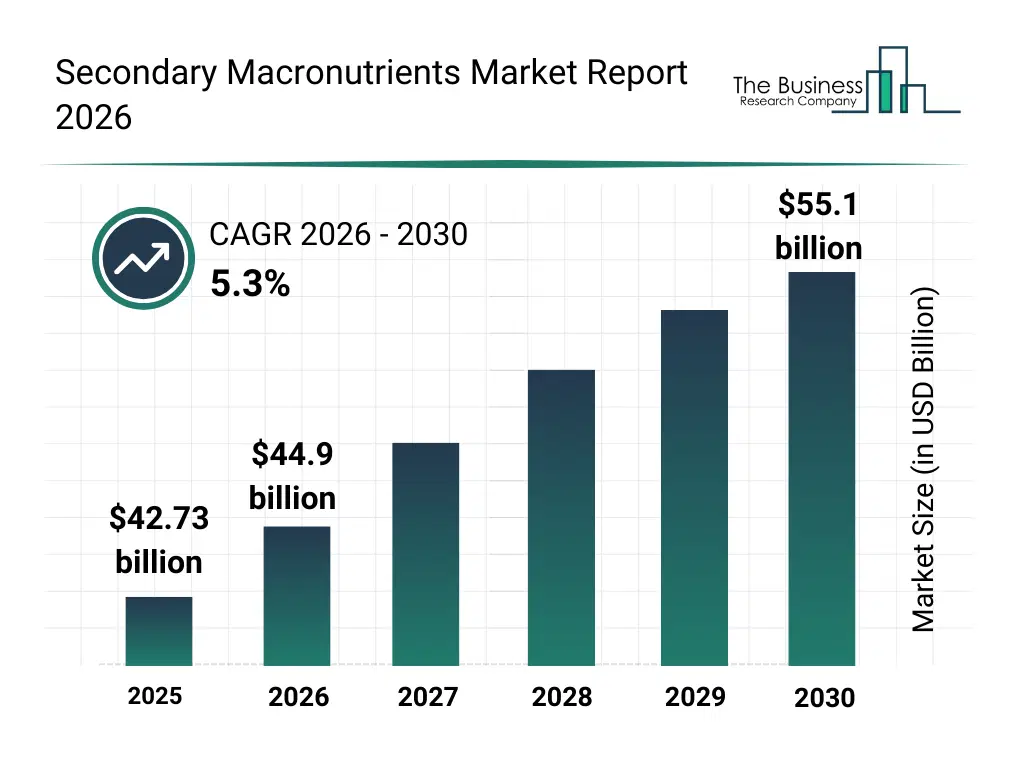
What Is The Secondary Macronutrients Market Size and Share 2026?
The secondary macronutrients market size has grown strongly in recent years. It will grow from $42.73 billion in 2025 to $44.9 billion in 2026 at a compound annual growth rate (CAGR) of 5.1%. The growth in the historic period can be attributed to increasing depletion of soil calcium and magnesium, expansion of intensive cropping systems, rising awareness of nutrient imbalance impacts, availability of compound fertilizer formulations, growth of commercial agriculture.What Is The Secondary Macronutrients Market Growth Forecast?
The secondary macronutrients market size is expected to see strong growth in the next few years. It will grow to $55.1 billion in 2030 at a compound annual growth rate (CAGR) of 5.3%. The growth in the forecast period can be attributed to increasing demand for precision fertilization, rising focus on sustainable yield improvement, expansion of micronutrient-integrated fertilizers, growing adoption of liquid nutrition solutions, increasing use in protected agriculture. Major trends in the forecast period include increasing adoption of secondary macronutrient blends, rising focus on soil nutrient balance, growing use in high-yield crop systems, expansion of liquid nutrient applications, enhanced emphasis on stress resistance in crops.
Global Secondary Macronutrients Market Segmentation
1) By Nutrient Type: Calcium, Magnesium, Sulfur 2) By Crop Type: Cereals And Grains, Oilseeds And Pulses, Fruits And Vegetables, Other Crop Types 3) By Application Method: Solid Application, Liquid Application Subsegments: 1) By Calcium: Calcium Carbonate, Calcium Nitrate, Calcium Sulfate 2) By Magnesium: Magnesium Sulfate, Magnesium Oxide, Magnesium Nitrate 3) By Sulfur: Elemental Sulfur, Sulfate CompoundsWhat Is The Driver Of The Secondary Macronutrients Market?
The increasing climate change is expected to boost the growth of the secondary macronutrient market going forward. Climate change refers to long-term alterations in global or regional climate patterns, primarily characterized by shifts in temperature, precipitation, and weather conditions. Climate change, with its unpredictable weather patterns and shifting soil conditions, heightens the need for secondary micronutrients as a crucial solution to combat nutrient deficiencies and enhance plant health amidst evolving environmental challenges. For instance, in October 2023, according to a report published by the World Health Organization (WHO), a Switzerland-based intergovernmental organization, about 3.6 billion individuals reside in regions highly vulnerable to the impacts of climate change by 2023. It is projected that from 2030 to 2050, climate change will lead to an estimated annual increase of approximately 250,000 deaths due to factors such as undernutrition, malaria, diarrhea, and heat stress. Therefore, the increasing climate change is driving the growth of the secondary macronutrient industry.Key Players In The Global Secondary Macronutrients Market
Major companies operating in the secondary macronutrients market are Nutrien Ltd., Yara International ASA, The Mosaic Company, ICL Group Ltd., EuroChem Group AG, OCP Group, Haifa Group, CF Industries Holdings, Inc., K+S Aktiengesellschaft, Coromandel International Limited, Tata Chemicals Limited, Deepak Fertilisers and Petrochemicals Corporation Limited, Gujarat State Fertilizers and Chemicals Limited, Rashtriya Chemicals and Fertilizers Limited, Koch Fertilizer, LLC, Sociedad Química y Minera de Chile S.A., Sinofert Holdings Limited, Helm AG, PhosAgro PJSC, UPL Limited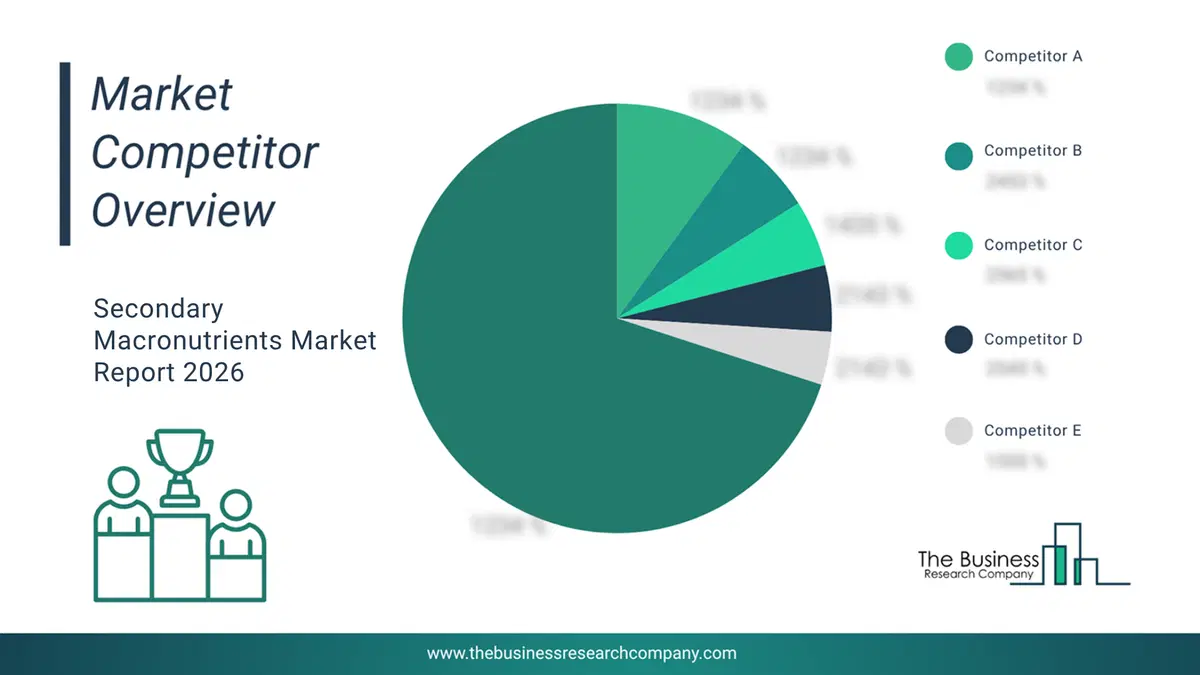
This chart is for illustrative purposes; the full report includes a detailed competitor analysis and comprehensive overview of the top 10 companies in the market.
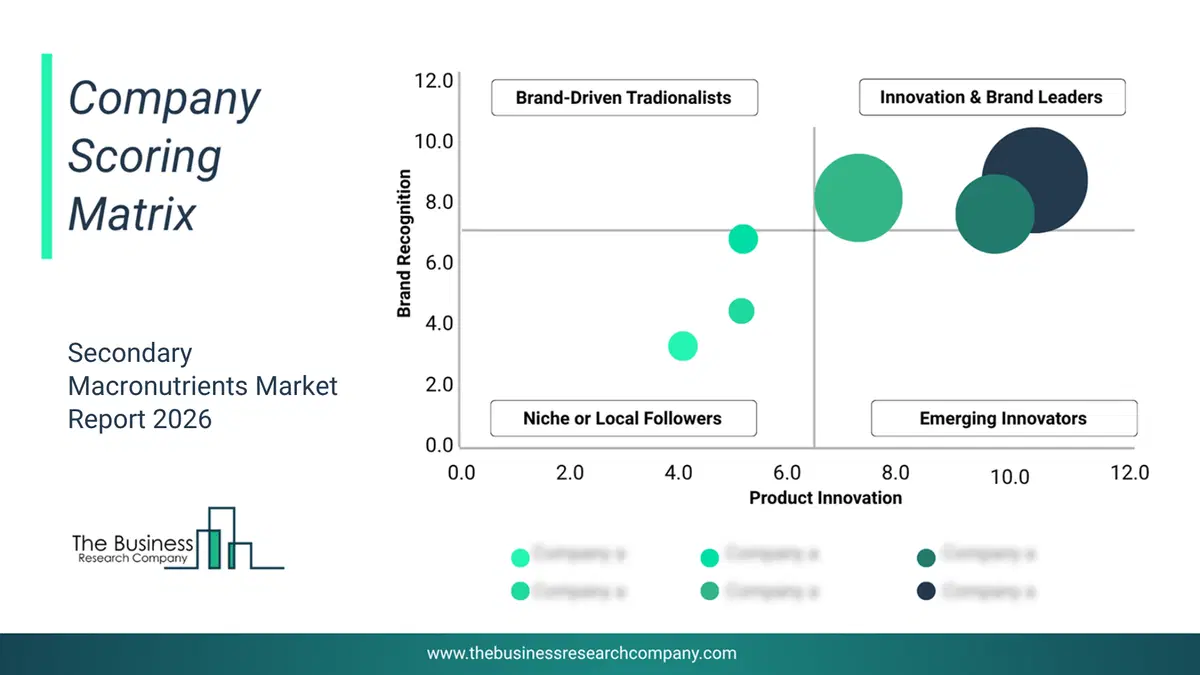
This chart maps companies by product innovation and brand strength, with bubble size indicating relative revenue, helping identify market leaders, challengers, and niche players. This is an illustrative chart; the full report provides a complete and accurate competitive analysis.
Global Secondary Macronutrients Market Trends and Insights
Major companies operating in the secondary macronutrient market are developing innovative products such as crop nutrition solutions to meet larger customer bases, more sales, and increase revenue. Crop nutrition solutions refer to a range of products and practices designed to optimize the nutrient availability and uptake for crops, ensuring their healthy growth and maximizing yield. For instance, In October 2024, SPARTA Biodiscovery, a Greece-based agribusiness company, launched Functional Crop Nutrition (FCN), specializing in providing a holistic approach to crop nutrition that encompasses nourishing, protecting, and biostimulating plants. It offers key macro- and micronutrients essential for optimal crop growth while simultaneously shielding crops from diseases, pests, and environmental stressors such as drought and heat.What Are Latest Mergers And Acquisitions In The Secondary Macronutrients Market?
In February 2024, ICL, an Israel-based minerals and chemicals company, acquired Nitro 1000 for an undisclosed amount. With this acquisition, ICL aims to bolster its presence in Brazil's biological market by enhancing its product portfolio and expanding its specialized plant nutrition offerings for important crops such as soybeans, corn, and sugarcane. Nitro 1000 is a Brazil-based Biotechnology company specializing in developing, manufacturing, and supplying biological products for agriculture including secondary micronutrients.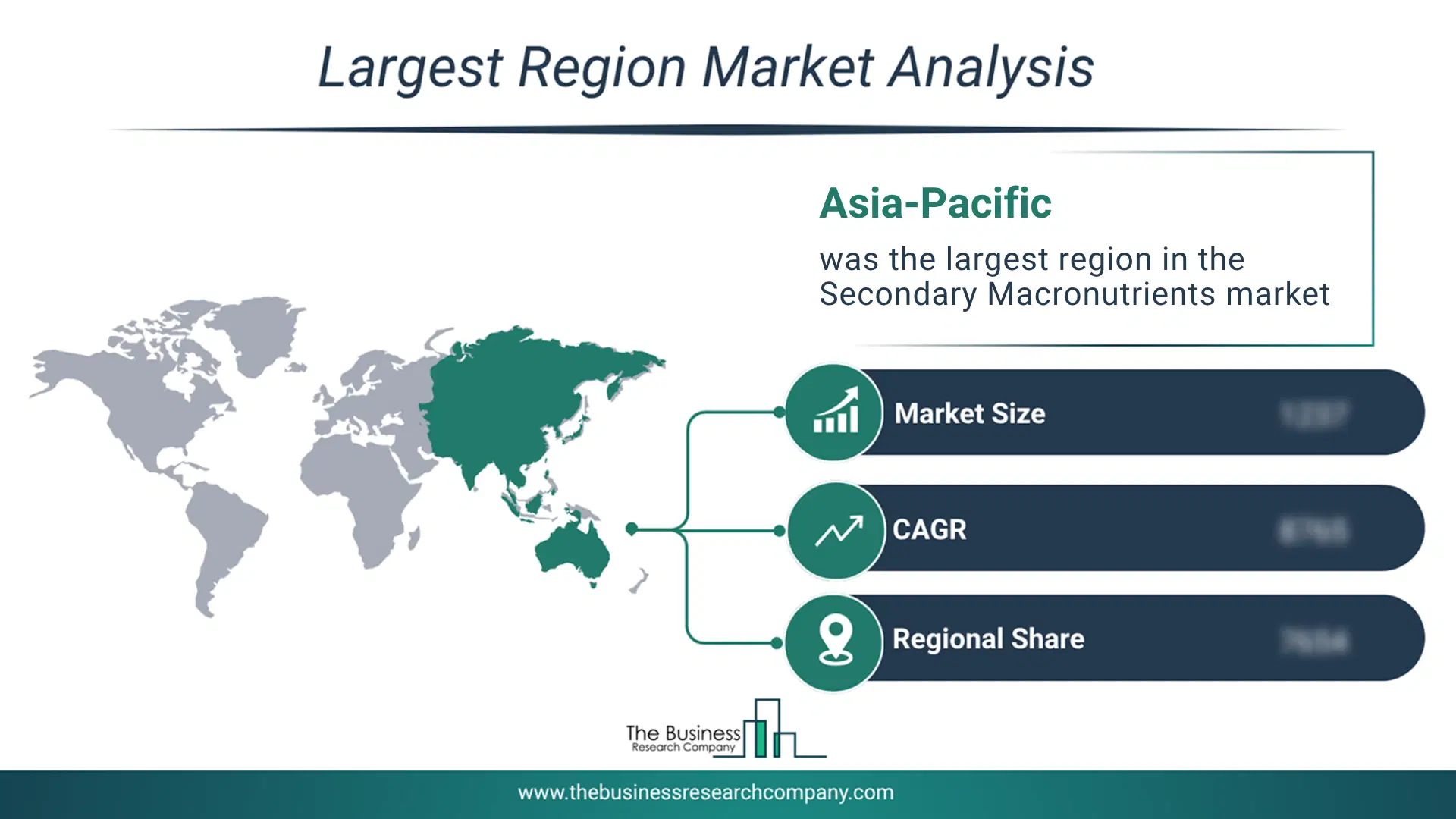
Regional Insights
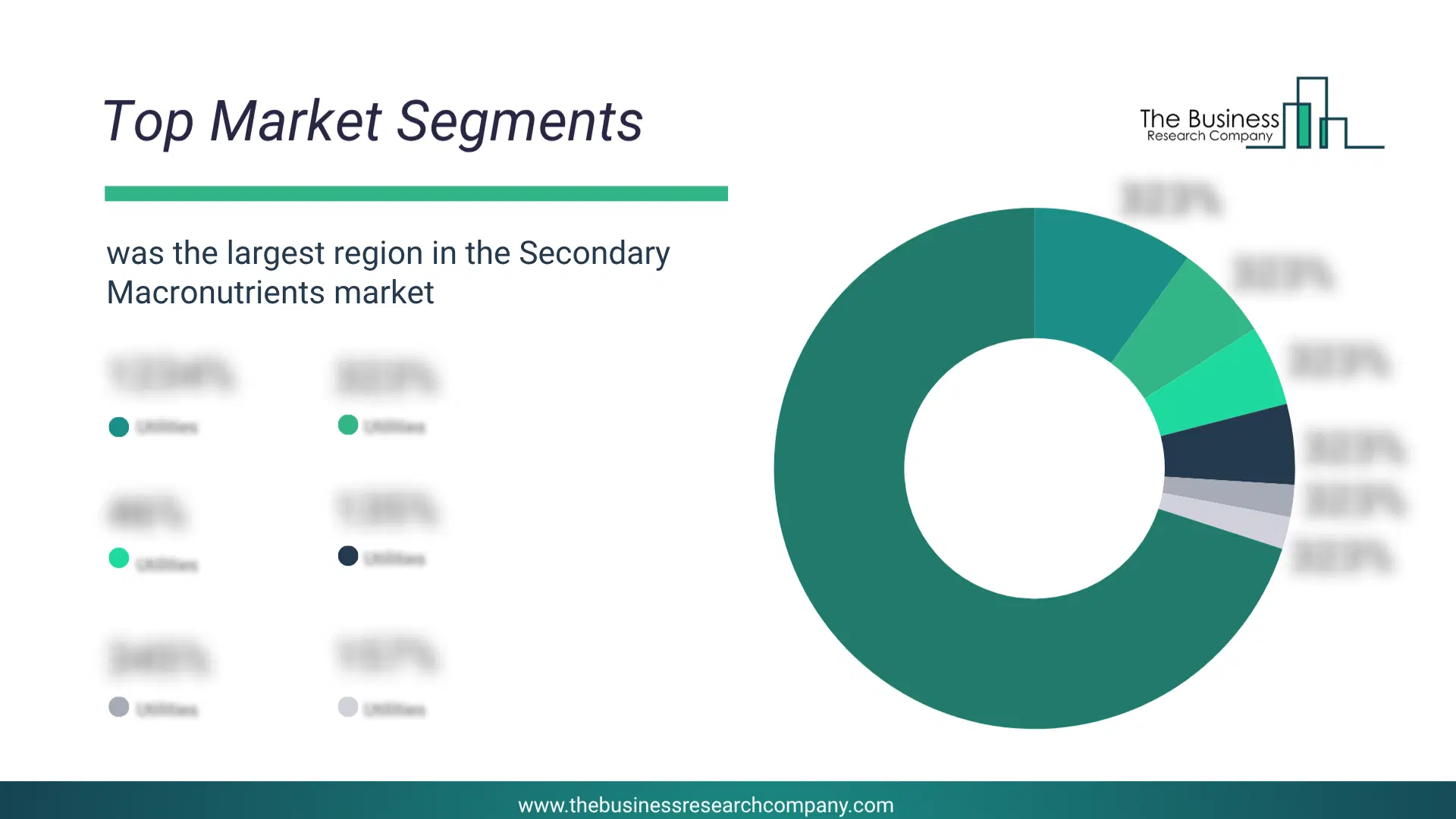
Asia-Pacific was the largest region in the secondary macronutrients market in 2025. The regions covered in this market report are Asia-Pacific, South East Asia, Western Europe, Eastern Europe, North America, South America, Middle East, Africa The countries covered in this market report are Australia, Brazil, China, France, Germany, India, Indonesia, Japan, Taiwan, Russia, South Korea, UK, USA, Canada, Italy, SpainWhat Defines the Secondary Macronutrients Market?
The secondary macronutrient market consists of sales of manganese (Mn), boron (B), copper (Cu), iron (Fe), molybdenum (Mo), chloride (Cl), and nickel (Ni). Values in this market are ‘factory gate’ values, that is the value of goods sold by the manufacturers or creators of the goods, whether to other entities (including downstream manufacturers, wholesalers, distributors, and retailers) or directly to end customers. The value of goods in this market includes related services sold by the creators of the goods.How is Market Value Defined and Measured?
The market value is defined as the revenues that enterprises gain from the sale of goods and/or services within the specified market and geography through sales, grants, or donations in terms of the currency (in USD unless otherwise specified). The revenues for a specified geography are consumption values that are revenues generated by organizations in the specified geography within the market, irrespective of where they are produced. It does not include revenues from resales along the supply chain, either further along the supply chain or as part of other products.
This chart presents market attractiveness based on a quantitative evaluation of growth, competition, strategic alignment, and risk, offering a clear view of opportunity areas for decision-making. This chart is for illustrative purposes; the full report contains the complete analysis.

This chart highlights the Total Addressable Market (TAM) by estimating the maximum revenue opportunity using an assumption-driven approach, supporting strategic planning and opportunity sizing across markets. The chart is illustrative; the full report provides a more comprehensive analysis.
What Key Data and Analysis Are Included in the Secondary Macronutrients Market Report 2026?
The secondary macronutrients market research report is one of a series of new reports from The Business Research Company that provides market statistics, including industry global market size, regional shares, competitors with the market share, detailed market segments, market trends and opportunities, and any further data you may need to thrive in the secondary macronutrients industry. The market research report delivers a complete perspective of everything you need, with an in-depth analysis of the current and future state of the industry.Secondary Macronutrients Market Report Forecast Analysis
| Report Attribute | Details |
|---|---|
| Market Size Value In 2026 | $44.9 billion |
| Revenue Forecast In 2030 | $55.1 billion |
| Growth Rate | CAGR of 5.1% from 2026 to 2030 |
| Base Year For Estimation | 2025 |
| Actual Estimates/Historical Data | 2020-2025 |
| Forecast Period | 2026 - 2030 |
| Market Representation | Revenue in USD Billion and CAGR from 2026 to 2030 |
| Segments Covered | Nutrient Type, Crop Type, Application Method |
| Regional Scope | Asia-Pacific, Western Europe, Eastern Europe, North America, South America, Middle East, Africa |
| Country Scope | The countries covered in this market report are Australia, Brazil, China, France, Germany, India, Indonesia, Japan, Taiwan, Russia, South Korea, UK, USA, Canada, Italy, Spain |
| Key Companies Profiled | Nutrien Ltd., Yara International ASA, The Mosaic Company, ICL Group Ltd., EuroChem Group AG, OCP Group, Haifa Group, CF Industries Holdings, Inc., K+S Aktiengesellschaft, Coromandel International Limited, Tata Chemicals Limited, Deepak Fertilisers and Petrochemicals Corporation Limited, Gujarat State Fertilizers and Chemicals Limited, Rashtriya Chemicals and Fertilizers Limited, Koch Fertilizer, LLC, Sociedad Química y Minera de Chile S.A., Sinofert Holdings Limited, Helm AG, PhosAgro PJSC, UPL Limited |
| Customization Scope | Request for Customization |
| Pricing And Purchase Options | Explore Purchase Options |