
Seed Treatment Market Report 2026
Global Outlook – By Type (Insecticides, Fungicides, Chemicals, Non-Chemicals), By Formulation (Liquid Solution, Powder, Emulsion, Flowable Concentrate, Water Dispersible Powder For Slurry, Other Formulations), By Crop Type (Oilseeds, Cereals And Grains, Fruits And Vegetables, Other Crop Types), By Function (Seed Protection, Seed Enhancement), By Application Technique (Seed Coating, Seed Dressing, Seed Pelleting) – Market Size, Trends, Strategies, and Forecast to 2030
Seed Treatment Market Overview
• Seed Treatment market size has reached to $13.38 billion in 2025 • Expected to grow to $23.21 billion in 2030 at a compound annual growth rate (CAGR) of 11.7% • Growth Driver: The Surge In Seed Treatment Market Amidst Rising Seed- And Soil-Borne Diseases • Market Trend: Embracing Biological Solutions For Enhanced Plant Health And Growth • North America was the largest region in 2025.What Is Covered Under Seed Treatment Market?
Seed treatment refers to the process of applying various agents to seeds before planting to protect them from diseases and pests. It is commonly used to improve the seed's germination and enhance its overall growth. The main types of chemicals in seed treatment are insecticides, fungicides, chemicals, and non-chemicals, with various types of formulations including liquid solution, powder, emulsion, flowable concentrate, water dispersible powder for slurry, and others. Insecticides refer to chemical or biological agents that are used to control or kill insects that can cause damage to crop. These are used to perform several functions, such as seed protection and seed enhancement, with several types of crops, such as oilseeds, cereals and grains, fruits and vegetables, and others. These are used for several applications, including seed coating, seed dressing, and seed pelleting.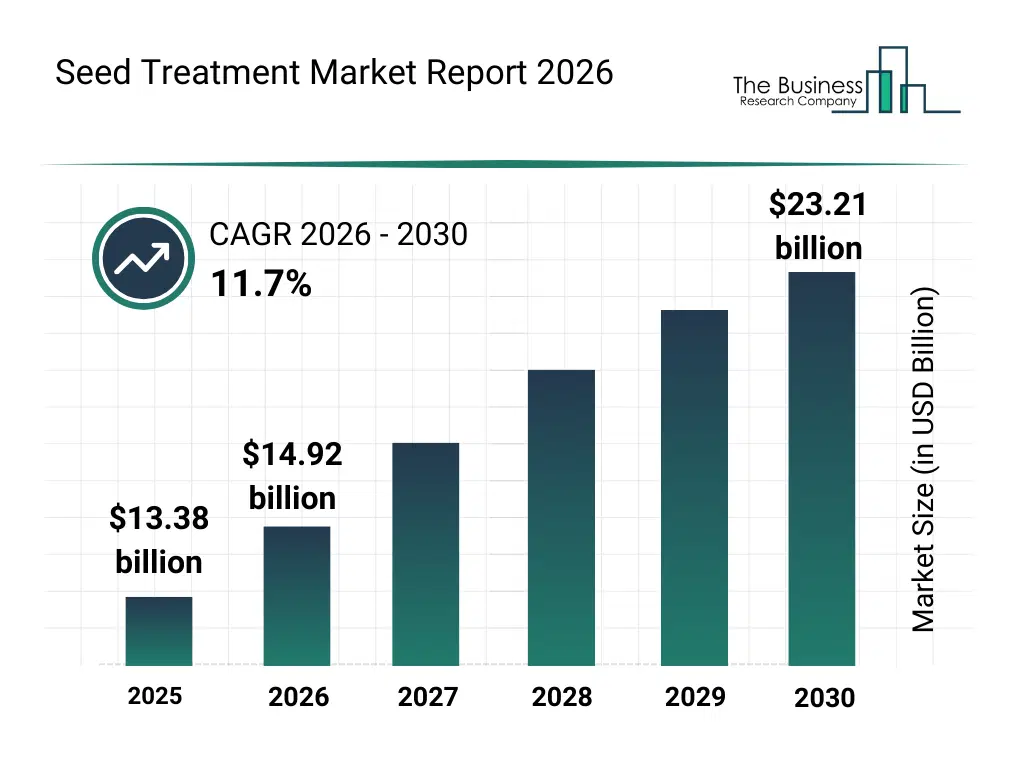
What Is The Seed Treatment Market Size and Share 2026?
The seed treatment market size has grown rapidly in recent years. It will grow from $13.38 billion in 2025 to $14.92 billion in 2026 at a compound annual growth rate (CAGR) of 11.5%. The growth in the historic period can be attributed to increasing reliance on chemical seed treatments, rise in crop disease prevalence, growing demand for high-yield crop protection, expansion of commercial farming operations, early adoption of synthetic formulations.What Is The Seed Treatment Market Growth Forecast?
The seed treatment market size is expected to see rapid growth in the next few years. It will grow to $23.21 billion in 2030 at a compound annual growth rate (CAGR) of 11.7%. The growth in the forecast period can be attributed to rising demand for biological treatment products, increasing adoption of precision agriculture, growing focus on sustainable crop protection, development of advanced coating technologies, expansion of integrated pest management adoption. Major trends in the forecast period include growing adoption of biological seed treatments, rising preference for low-toxicity and eco-friendly formulations, increasing demand for multi-functional seed enhancement products, expansion of integrated disease and pest management solutions, development of advanced seed coating and pelleting technologies.
Global Seed Treatment Market Segmentation
1) By Type: Insecticides, Fungicides, Chemicals, Non-Chemicals 2) By Formulation: Liquid Solution, Powder, Emulsion, Flowable Concentrate, Water Dispersible Powder For Slurry, Other Formulations 3) By Crop Type: Oilseeds, Cereals And Grains, Fruits And Vegetables, Other Crop Types 4) By Function: Seed Protection, Seed Enhancement 5) By Application Technique: Seed Coating, Seed Dressing, Seed Pelleting Subsegments: 1) By Insecticides: Systemic Insecticides, Contact Insecticides, Soil-Applied Insecticides 2) By Fungicides: Seed Fungicides, Soil Fungicides, Foliar Fungicides 3) By Chemicals: Synthetic Chemicals, Biochemicals 4) By Non-Chemicals: Biological Treatments, Physical TreatmentsWhat Is Driver Of The Seed Treatment Market?
The increasing number of seed- and soil-borne diseases is expected to propel the growth of the seed treatment market going forward. Seed- and soil-borne diseases refer to plant diseases that are caused by pathogens that live in the soil or on seeds. Seed- and soil-borne diseases are primarily treated through seed treatment, which can protect crops by providing a cost-effective and efficient means of controlling diseases and helping to increase crop production efficiency. For instance, in February 2023, according to a report shared by the Food and Agriculture Organization (FAO), a US-based specialized agriculture agency, annually, pests cause a significant impact on global crop production, resulting in a loss ranging from 20% to 40%. Plant diseases alone incur approximately $220 billion in costs to the global economy each year, while invasive insects contribute to an additional $70 billion. Therefore, the increasing number of seed- and soil-borne diseases is driving the growth of the seed treatment industry.Key Players In The Global Seed Treatment Market
Major companies operating in the seed treatment market are BASF SE, Syngenta AG, Bayer AG, Croda International plc, DuPont de Nemours Inc., FMC Corporation, NuFarm Ltd., Solvay S.A, ADAMA Ltd., Corteva Inc., United Phosphorus Limited, Sumitomo Chemical Co. Ltd., Bioworks Inc., Novozymes A/S, Eastman Chemical Company, Agrauxine SA, Germains Seed Technology, Incotec Group BV, Valent Biosciences Corporation, Advanced Biological Marketing Inc., Wolf Trax Inc., BrettYoung Seeds Limited, Precision Laboratories LLC, Loveland Products Inc., Plant Health Care plc, Albaugh LLC, Gowan Company LLC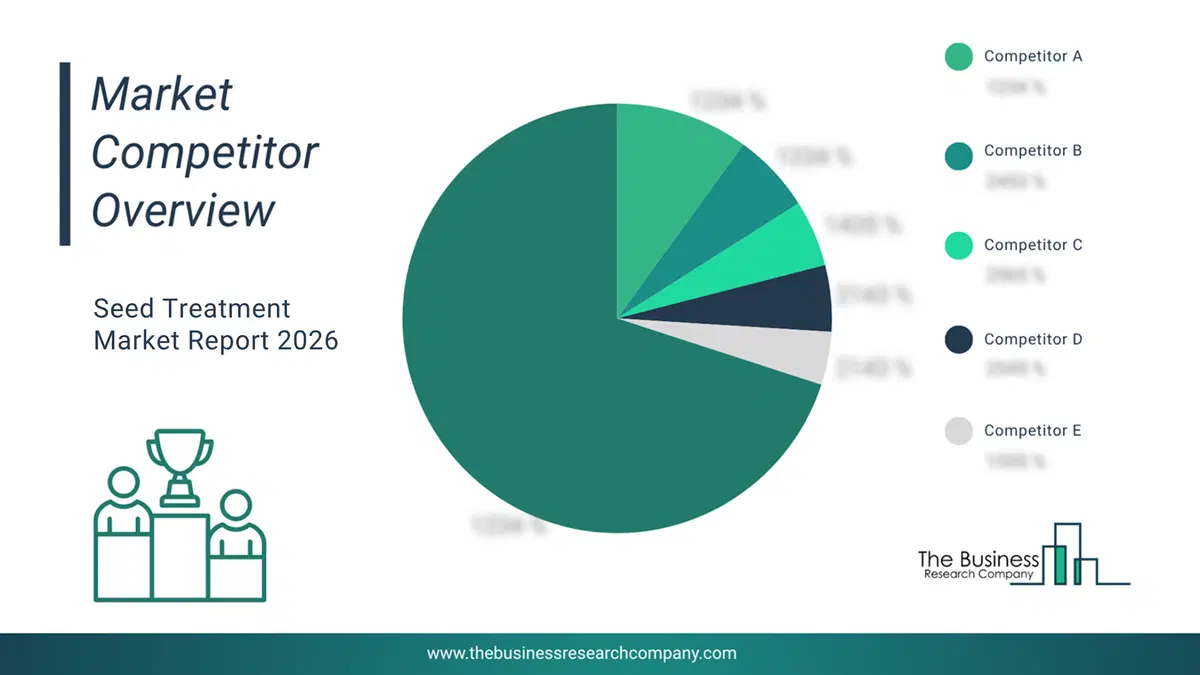
This chart is for illustrative purposes; the full report includes a detailed competitor analysis and comprehensive overview of the top 10 companies in the market.
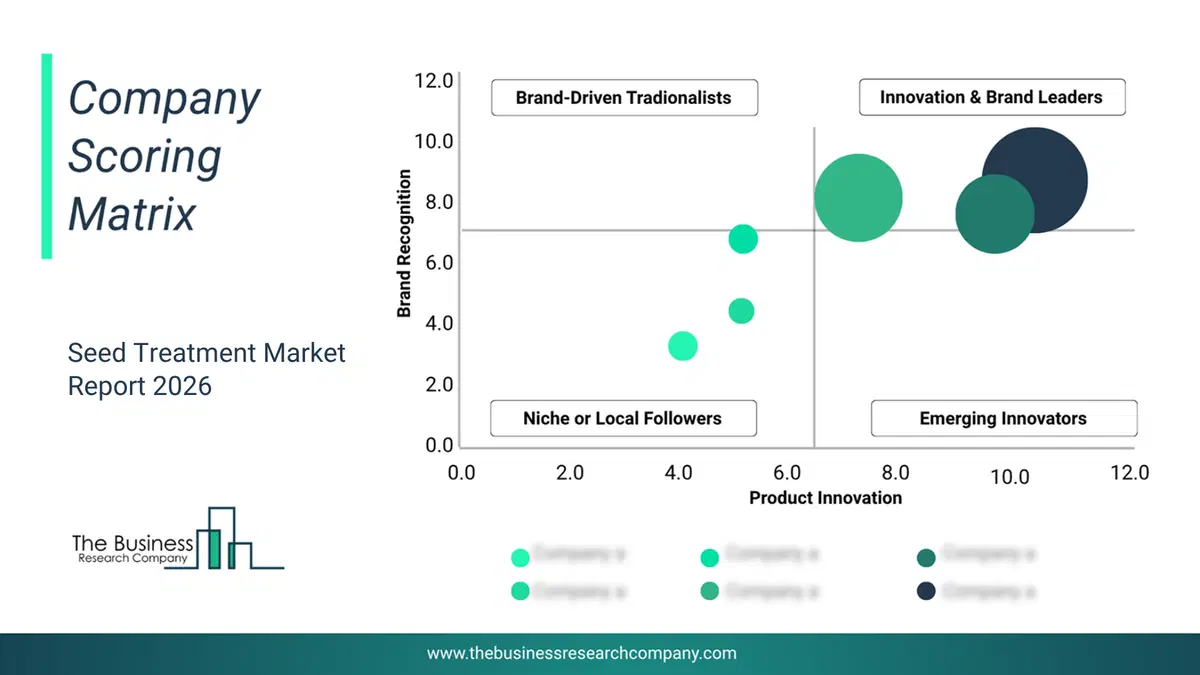
This chart maps companies by product innovation and brand strength, with bubble size indicating relative revenue, helping identify market leaders, challengers, and niche players. This is an illustrative chart; the full report provides a complete and accurate competitive analysis.
Global Seed Treatment Market Trends and Insights
Major companies operating in the seed treatment market are focused on integrating their efforts into introducing innovative biological seed treatment solutions to gain a competitive edge in the market. Biological seed treatment involves the application of naturally occurring microorganisms, such as bacteria, fungi, or other beneficial organisms, to seeds to enhance their growth, protect them from diseases, and improve overall plant health. For instance, in October 2023, Helena Agri-Enterprises, a US-based seed treatment formulator, launched its two exclusive soybean seed treatments, ‘Seed Shield Select’ and ‘Enertia.’ It is a combination of multi-fungicide and insecticide integrated with the Asset Formulation Technology that helps to optimize plant vigor and root health. Enertia is an enzyme-based, biological soybean seed treatment that is integrated with the VersaShield Formulation Technology, which helps to improve nutrient availability and enhance the soil health. The VersaShield technology helps in the stabilization of the enzymes in Enertia for long-lasting activity, consistency, and ease of use.What Are Latest Mergers And Acquisitions In The Seed Treatment Market? Growmark Inc. Expands Horizon With Strategic Acquisition Of Allied Seed LLC
In January 2023, Growmark Inc., a US-based agriculture company, acquired Allied Seed LLC for an undisclosed amount. With this acquisition, Allied Seed complements Growmark's entire supply and growth plans and places the company in a good position to address the rising demand for cover crops as part of an all-encompassing on-farm sustainability strategy. Through this acquisition, Allied Seed is expected to provide services including production, blending, packaging, and seed treatment, in addition to a broad array of forage, turf grass, and cover crop seed. Allied Seed LLC is a US-based crop seed company that provides crop seeds and seed treatment products.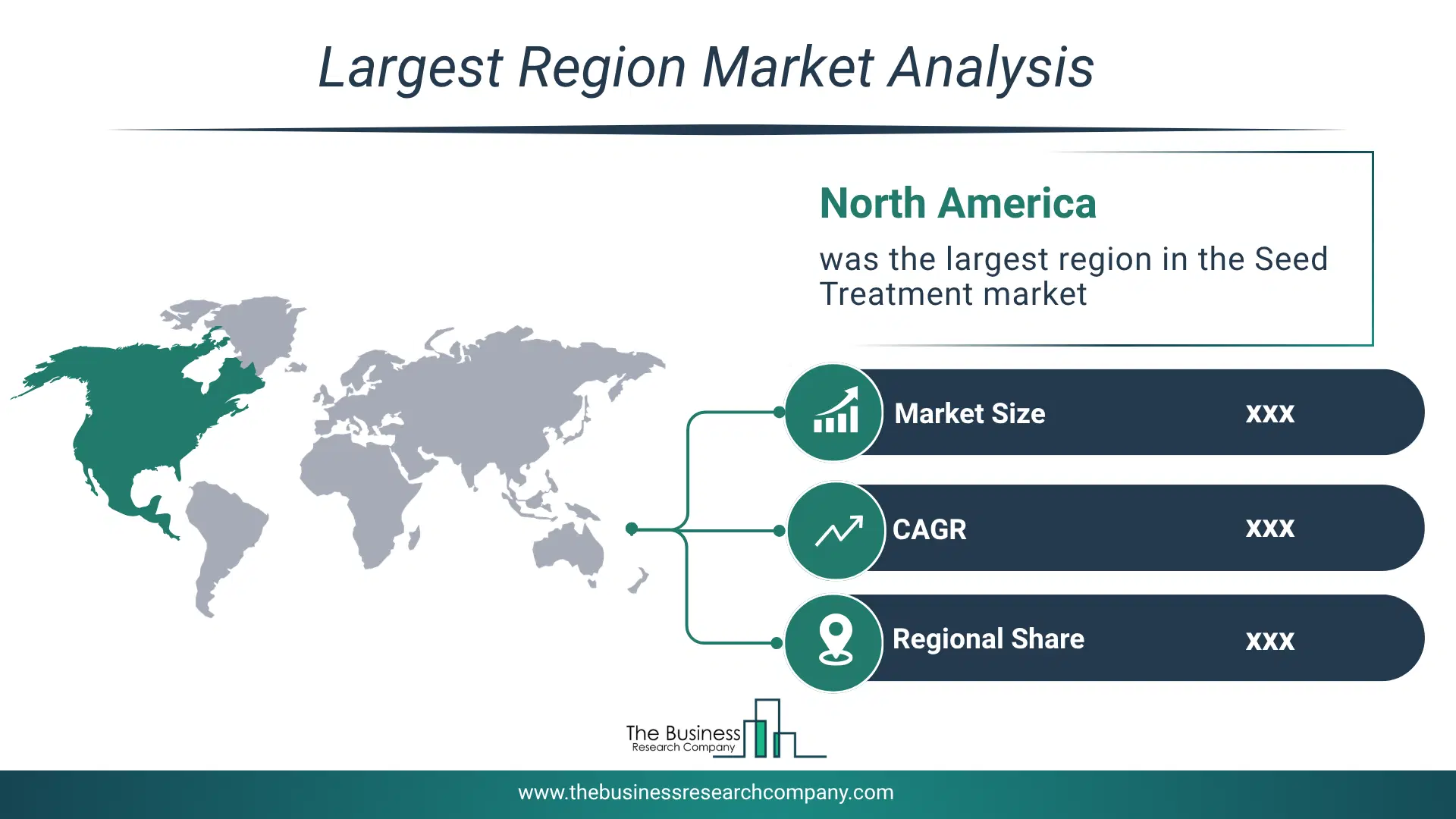
Regional Outlook
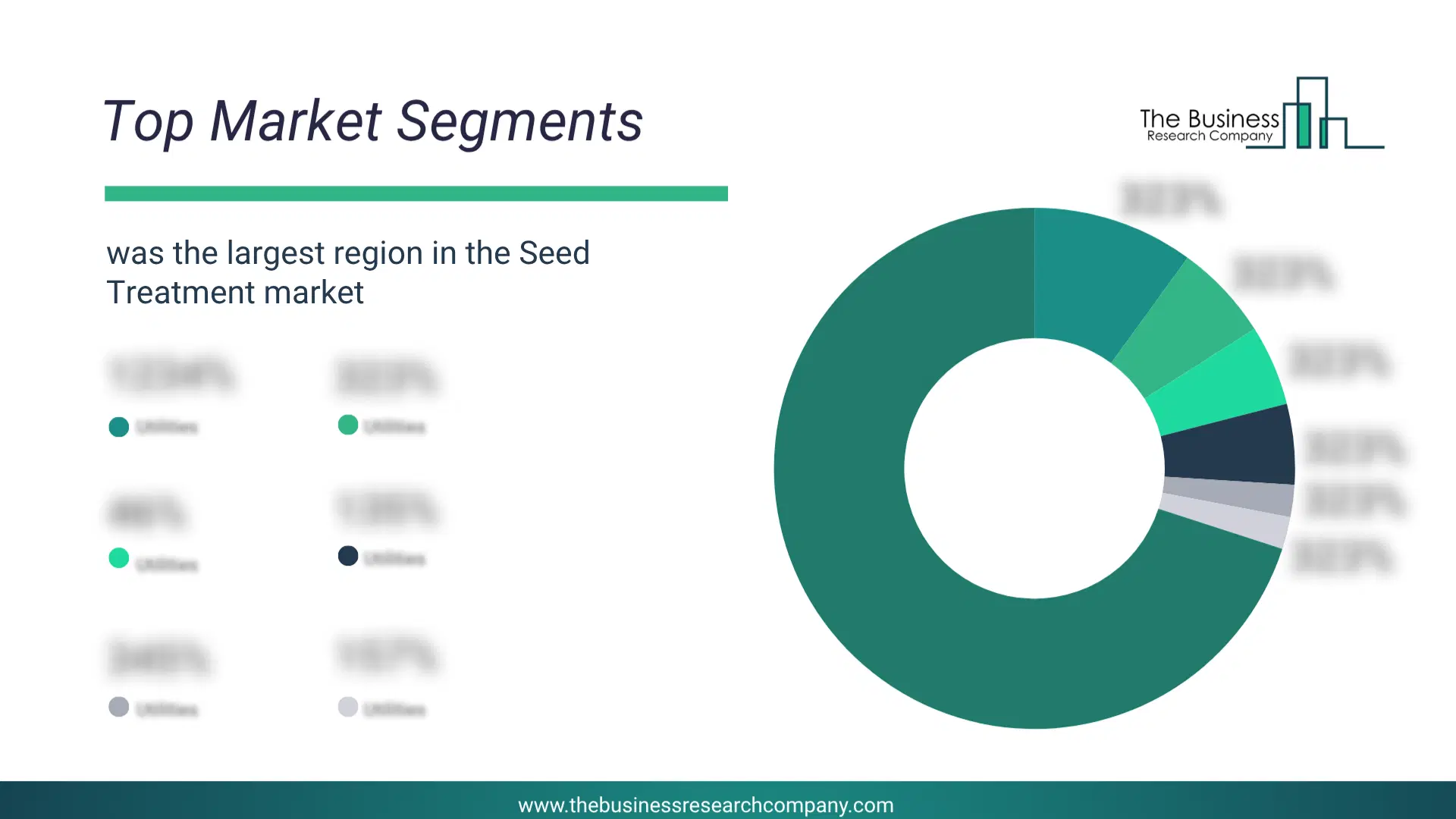
North America was the largest region in the seed treatment market in 2025. The regions covered in this market report are Asia-Pacific, South East Asia, Western Europe, Eastern Europe, North America, South America, Middle East, Africa. The countries covered in this market report are Australia, Brazil, China, France, Germany, India, Indonesia, Japan, Taiwan, Russia, South Korea, UK, USA, Canada, Italy, SpainWhat Defines the Seed Treatment Market?
The seed treatment market includes revenues earned by entities by providing services such as seed disinfection, seed disinfestation, and seed protection. The market value includes the value of related goods sold by the service provider or included within the service offering. Only goods and services traded between entities or sold to end consumers are included.How is Market Value Defined and Measured?
The market value is defined as the revenues that enterprises gain from the sale of goods and/or services within the specified market and geography through sales, grants, or donations in terms of the currency (in USD unless otherwise specified). The revenues for a specified geography are consumption values that are revenues generated by organizations in the specified geography within the market, irrespective of where they are produced. It does not include revenues from resales along the supply chain, either further along the supply chain or as part of other products.
This chart presents market attractiveness based on a quantitative evaluation of growth, competition, strategic alignment, and risk, offering a clear view of opportunity areas for decision-making. This chart is for illustrative purposes; the full report contains the complete analysis.

This chart highlights the Total Addressable Market (TAM) by estimating the maximum revenue opportunity using an assumption-driven approach, supporting strategic planning and opportunity sizing across markets. The chart is illustrative; the full report provides a more comprehensive analysis.
What Key Data and Analysis Are Included in the Seed Treatment Market Report 2026?
The seed treatment market research report is one of a series of new reports from The Business Research Company that provides market statistics, including industry global market size, regional shares, competitors with the market share, detailed market segments, market trends and opportunities, and any further data you may need to thrive in the seed treatment industry. The market research report delivers a complete perspective of everything you need, with an in-depth analysis of the current and future state of the industry.Seed Treatment Market Report Forecast Analysis
| Report Attribute | Details |
|---|---|
| Market Size Value In 2026 | $14.92 billion |
| Revenue Forecast In 2030 | $23.21 billion |
| Growth Rate | CAGR of 11.7% from 2026 to 2030 |
| Base Year For Estimation | 2025 |
| Actual Estimates/Historical Data | 2020-2025 |
| Forecast Period | 2026 - 2030 |
| Market Representation | Revenue in USD Billion and CAGR from 2026 to 2030 |
| Segments Covered | Type, Formulation, Crop Type, Function, Application Technique |
| Regional Scope | Asia-Pacific, Western Europe, Eastern Europe, North America, South America, Middle East, Africa |
| Country Scope | The countries covered in the report are Australia, Brazil, China, France, Germany, India, Indonesia, Japan, Taiwan, Russia, South Korea, UK, USA, Canada, Italy, Spain |
| Key Companies Profiled | BASF SE, Syngenta AG, Bayer AG, Croda International plc, DuPont de Nemours Inc., FMC Corporation, NuFarm Ltd., Solvay S.A, ADAMA Ltd., Corteva Inc., United Phosphorus Limited, Sumitomo Chemical Co. Ltd., Bioworks Inc., Novozymes A/S, Eastman Chemical Company, Agrauxine SA, Germains Seed Technology, Incotec Group BV, Valent Biosciences Corporation, Advanced Biological Marketing Inc., Wolf Trax Inc., BrettYoung Seeds Limited, Precision Laboratories LLC, Loveland Products Inc., Plant Health Care plc, Albaugh LLC, Gowan Company LLC |
| Customization Scope | Request for Customization |
| Pricing And Purchase Options | Explore Purchase Options |