
Self-Checkout Systems Market Report 2026
Global Outlook – By Offering (Hardware, Software, Services), By Model Type (Standalone, Countertop, Mobile), By Transaction (Cash-Based Systems, Cashless-Based Systems), By End-User Industry (Retail, Entertainment, Travel, Financial Services, Healthcare, Other End-User Industries) – Market Size, Trends, Strategies, and Forecast to 2030
Self-Checkout Systems Market Overview
• Self-Checkout Systems market size has reached to $5.83 billion in 2025 • Expected to grow to $10.82 billion in 2030 at a compound annual growth rate (CAGR) of 13.3% • Growth Driver: Retail And Tourism Industries Fueling The Growth Of The Self-Checkout Systems Market • Market Trend: Facial Recognition-Enabled Checkout Terminals For Enhanced Customer Experience • North America was the largest region in 2025.Market Gains By 2030 – Top Opportunities By Segment
Market Gain identifies the most promising market opportunities by highlighting the segments or products expected to generate the highest incremental revenue growth over the next five years.
What Is Covered Under Self-Checkout Systems Market?
Self-checkout systems refer to automated machines that allow customers to scan and pay for their purchases without the assistance of a cashier or store employee. These systems are commonly used in commercial settings and are designed to provide customers with a convenient and efficient way to complete their purchases. The main types of self-checkout system models are stand-alone, countertop, and mobile, which are used in various transaction modes, including cash-based systems and cashless-based systems. Stand-alone refers to a financial system that operates independently without relying on external connections or dependencies. These are used to offer hardware, software, and services that are used by several end-users, such as retail, entertainment, travel, financial services, healthcare, and others.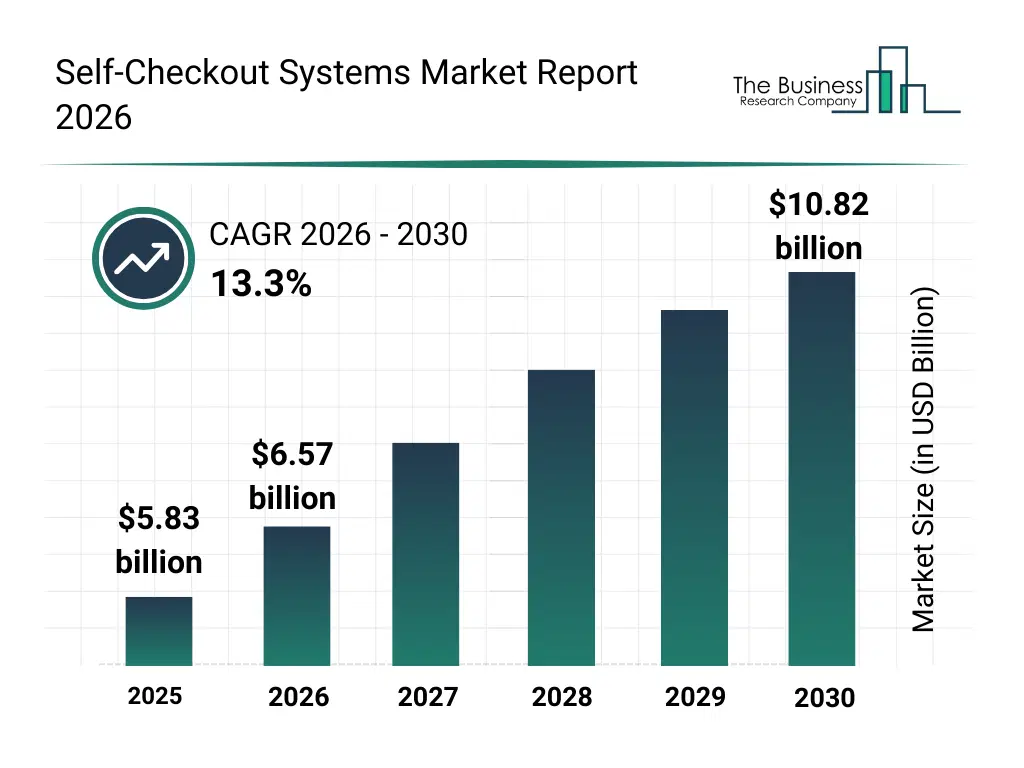
What Is The Self-Checkout Systems Market Size and Share 2026?
The self-checkout systems market size has grown rapidly in recent years. It will grow from $5.83 billion in 2025 to $6.57 billion in 2026 at a compound annual growth rate (CAGR) of 12.7%. The growth in the historic period can be attributed to growth of organized retail chains, rising labor cost pressures, increasing consumer demand for faster checkout, early adoption of barcode scanning technology, expansion of digital payment infrastructure.What Is The Self-Checkout Systems Market Growth Forecast?
The self-checkout systems market size is expected to see rapid growth in the next few years. It will grow to $10.82 billion in 2030 at a compound annual growth rate (CAGR) of 13.3%. The growth in the forecast period can be attributed to increasing adoption of contactless payments, rising focus on store automation, growth of unmanned retail formats, advancements in AI-based checkout software, expansion of self-service retail technologies. Major trends in the forecast period include rising deployment of cashless self-checkout systems, integration of computer vision for theft prevention, growing adoption of mobile and scan-and-go checkout, expansion of compact self-checkout formats for small stores, increasing focus on faster transaction and queue reduction.
Global Self-Checkout Systems Market Segmentation
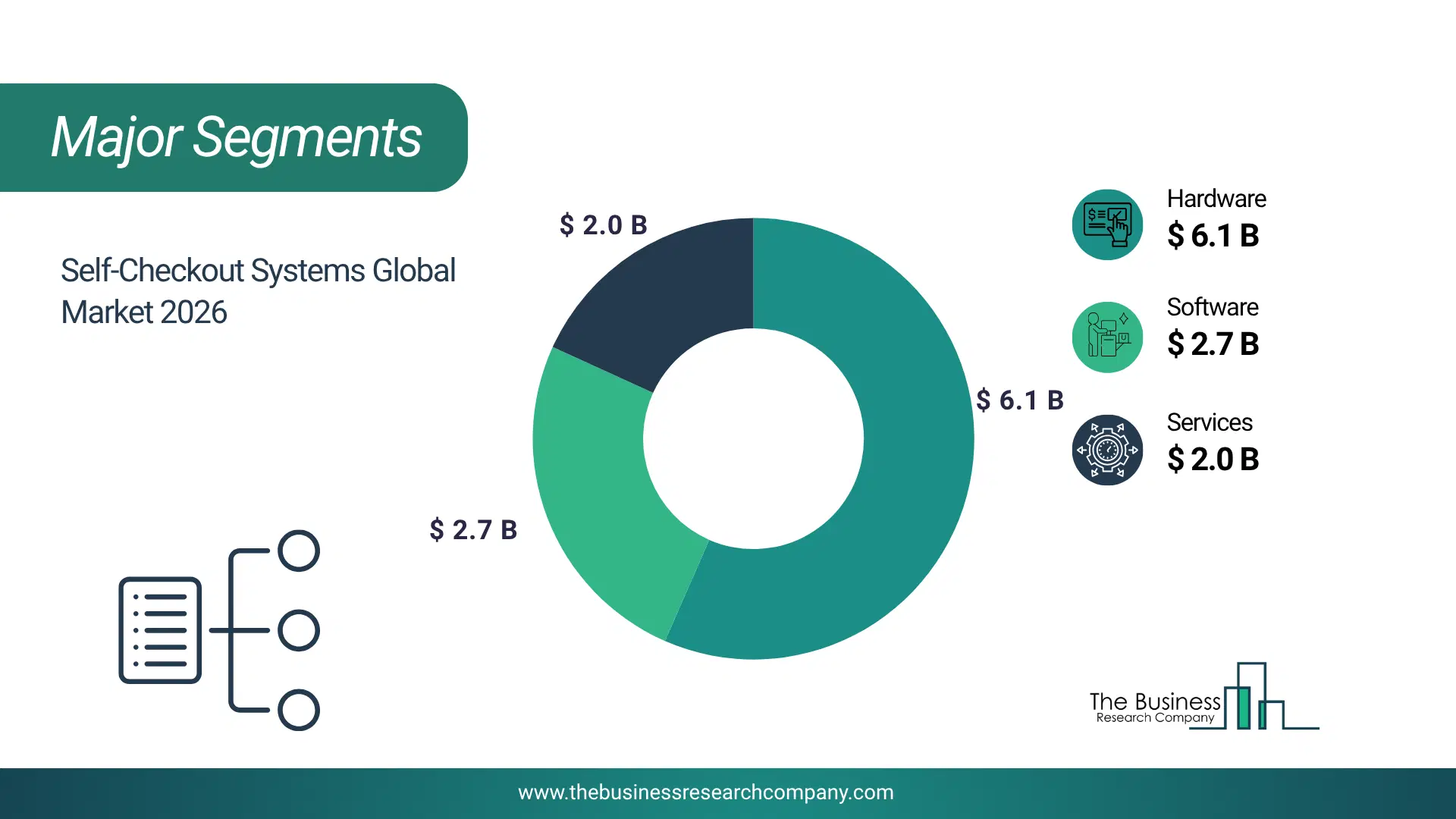
1) By Offering: Hardware, Software, Services 2) By Model Type: Standalone, Countertop, Mobile 3) By Transaction: Cash-Based Systems, Cashless-Based Systems 4) By End-User Industry: Retail, Entertainment, Travel, Financial Services, Healthcare, Other End-User Industries Subsegments: 1) By Hardware: Self-Checkout Kiosks, Payment Terminals, Scanners, Printers 2) By Software: Self-Checkout Software, Payment Processing Software, Inventory Management Software 3) By Services: Installation Services, Maintenance Services, Support Services The top segments in the self-checkout systems market will be: • Hardware will reach $6.09 billion by 2030. • Software will reach $2.75 billion by 2030. • Services will reach $1.98 billion by 2030.What Is The Driver Of The Self-Checkout Systems Market?
The growing demand for retail and tourism industries is expected to propel the growth of the self-checkout systems market going forward. Retail and tourism are the two main industries that drive the economy. The retail industry encompasses any establishments that provide goods and services to clients, while the tourist industry refers to going to other places using a variety of modes of transportation. Self-checkout systems are mostly utilized in the retail and tourist sectors to help customers finish their purchases from a merchant without the need for a conventionally staffed checkout. For instance, in February 2025, according to the United States Bureau of Economic Analysis, a US-based federal statistical agency, the travel and tourism industry’s real output, reflecting goods and services sold directly to visitors, grew by 7.0% in 2023, following a 20.8% increase in 2022. In comparison, the overall U.S. economy, measured by real GDP, expanded by 2.9% in 2023 after a 2.5% rise in 2022. Therefore, growing demand for retail and tourism industries is driving the growth of the self-checkout systems industry.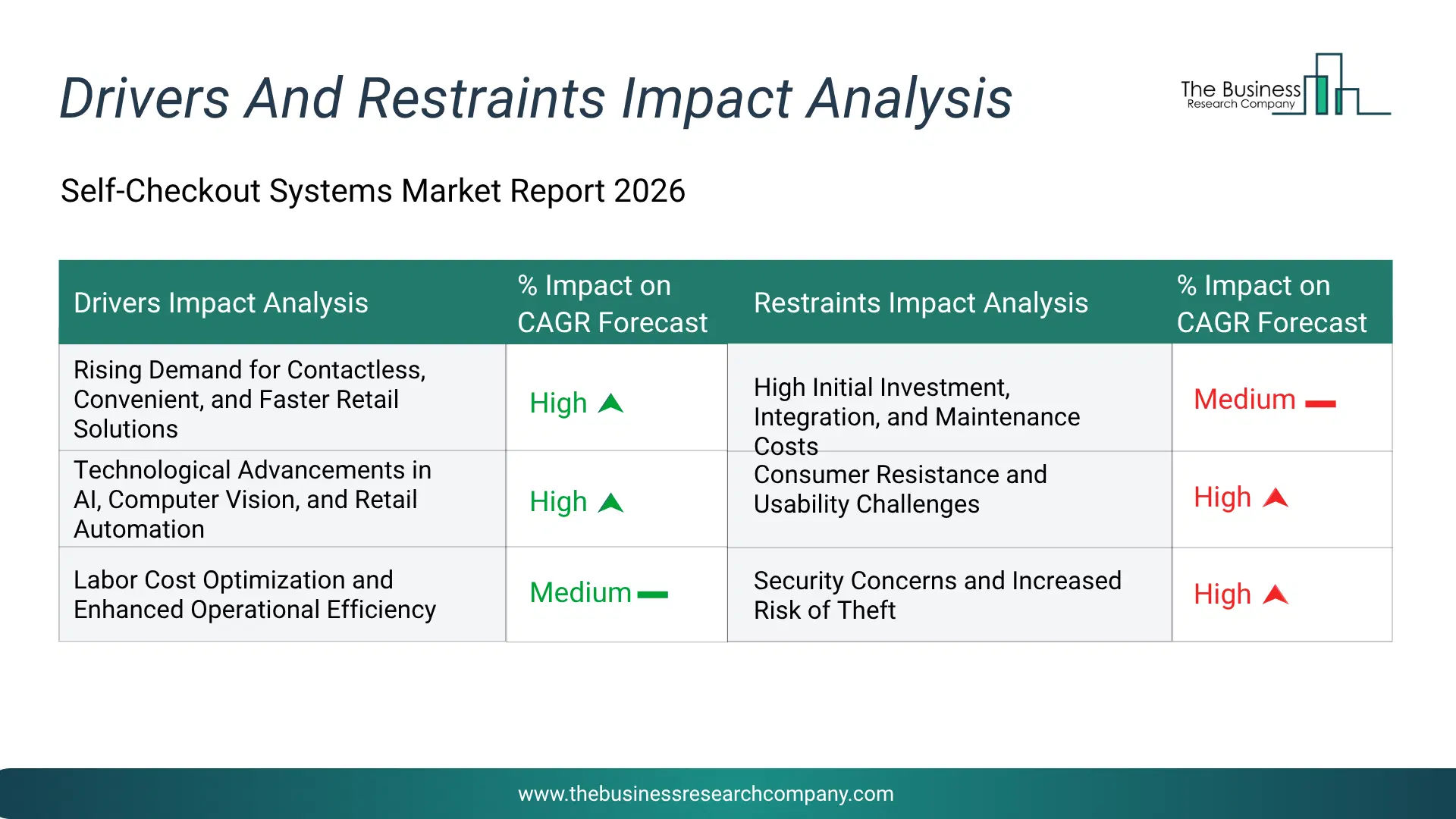
Infographic Chart Showing Key Market Drivers Analysis And Restraints For Self-Checkout Systems Market
The chart presents an impact analysis of key drivers and restraints, quantifying their relative influence on the market's growth rate and helping assess the balance between growth enablers and limiting factors. This chart offers a high-level perspective; the full report contains more detailed insights.
How Will The Drivers Impact Growth In The Global Self-Checkout Systems Market?
• Rising Demand for Contactless, Convenient, and Faster Retail Solutions (High) – During the forecast period, the rising demand for contactless, convenient, and faster retail solutions is expected to become a key growth driver for the self -checkout systems market by 2030. The modern retail landscape is witnessing a significant shift toward more convenient, frictionless, and contactless shopping experiences, which is driving the adoption of self -checkout systems. Consumers increasingly expect quick transactions, minimal wait times, and an overall seamless shopping journey, especially in supermarkets, hypermarkets, convenience stores, and specialty retail outlets. Self -checkout kiosks allow customers to scan, bag, and pay for their items independently, reducing dependency on traditional cashier -led checkouts and improving operational efficiency. • Technological Advancements in AI, Computer Vision, and Retail Automation (High) – During the forecast period, the technological advancements in ai, computer vision, and retail automation are expected to emerge as a major factor driving the expansion of the self-checkout systems market by 2030. Rapid advancements in artificial intelligence, computer vision, machine learning, and sensor technologies are significantly improving the accuracy, functionality, and security of self-checkout systems. Modern systems are now capable of automatically recognizing products, detecting mis-scans, supporting cashless transactions, and integrating seamlessly with mobile apps and loyalty programs. Retailers are increasingly deploying ai-powered features that enhance fraud prevention, optimize inventory tracking, and provide real-time analytics to improve operational decisions. These technological innovations not only improve customer experience but also reduce operational errors and improve throughput. • Labor Cost Optimization and Enhanced Operational Efficiency (Medium) – During the forecast period, the labor cost optimization and enhanced operational efficiency is expected to act as a key growth catalyst for the self-checkout systems market by 2030. Retailers worldwide are increasingly facing rising labor costs, workforce shortages, and operational inefficiencies in traditional checkout systems, making self-checkout solutions highly attractive. Automated checkout systems allow retailers to reduce dependence on manual cashier staff while reallocating employees to higher-value roles such as customer assistance, inventory management, and merchandising. This shift not only optimizes labor utilization but also enhances service quality and overall store efficiency. By reducing transaction times, self-checkout systems can handle higher customer volumes, particularly during peak shopping hours, which directly contributes to higher revenue per square foot.How Will The Restraints Impact Growth In The Global Self-Checkout Systems Market?
• High Initial Investment, Integration, and Maintenance Costs (Medium) – During the forecast period, the despite their benefits, self-checkout systems require significant upfront capital expenditure for hardware installation, software licensing, and integration with existing pos and erp systems. Small and mid-sized retailers may face budgetary constraints, making it challenging to adopt these systems across all outlets. Additionally, ongoing maintenance, software updates, and technical support add to operational costs. Integration complexities, such as aligning with legacy systems and ensuring secure payment processing, can also prolong deployment timelines and increase the total cost of ownership. • Consumer Resistance and Usability Challenges (High) – During the forecast period, the while self-checkout systems offer convenience, some consumers, particularly older adults or those unfamiliar with digital technology, may struggle to use them effectively. Issues such as scanning errors, incorrect item identification, or difficulty handling payments can lead to frustration and reluctance to adopt these systems. Retailers need to provide clear instructions, in-store assistance, and user-friendly interfaces to ensure smooth adoption. Consumer resistance, combined with occasional system glitches or technical failures, can hinder the rate of adoption, particularly in regions where digital literacy is lower. • Security Concerns and Increased Risk of Theft (High) – During the forecast period, the security concerns and increased risk of theft act as a restraint for the self-checkout systems market by making retailers cautious about widespread deployment. Self-checkout lanes are more vulnerable to scanning errors, intentional non-scanning, and shoplifting incidents compared to traditional cashier-operated systems. To mitigate these risks, retailers must invest in advanced surveillance, ai-based monitoring, and loss prevention technologies, which increases overall operational costs. These security challenges can reduce efficiency gains and discourage adoption, particularly among smaller retail chains.Key Players In The Global Self-Checkout Systems Market
Major companies operating in the self-checkout systems market are Diebold Nixdorf Inc., NCR Corporation, Toshiba Global Commerce Solutions, Fujitsu Limited, ITAB Group, Pan-Oston Corporation, StrongPoint, ECR Software Corporation, Pyramid Computer GmbH, Qingdao CCL Technology Co. Ltd., Mashgin Inc., MishiPay Ltd., 365 Retail Markets LLC, MetroClick, Scanflow AB, Slabb Inc., Pegasus Technologies, Ombori, Hisense Systems Europe, U-Scan Genesis, Zebra Technologies, Honeywell International Inc., Trigo Vision Ltd., Datalogic S.p.A.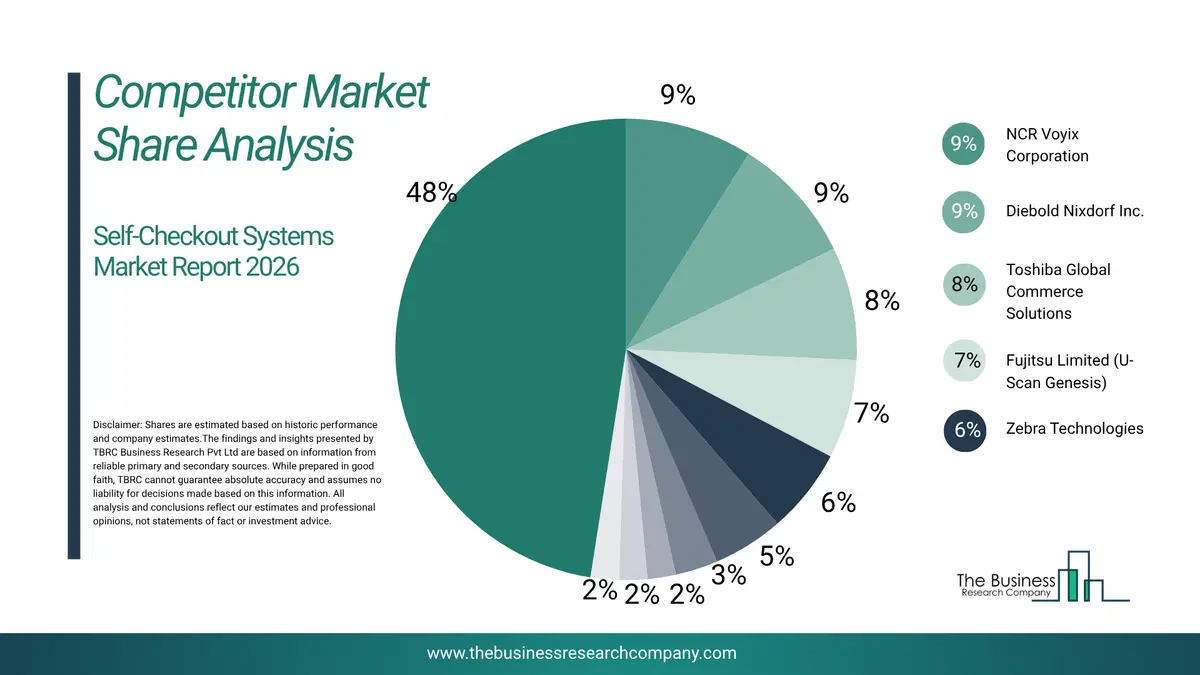
This chart is for illustrative purposes; the full report includes a detailed competitor analysis and comprehensive overview of the top 10 companies in the market.
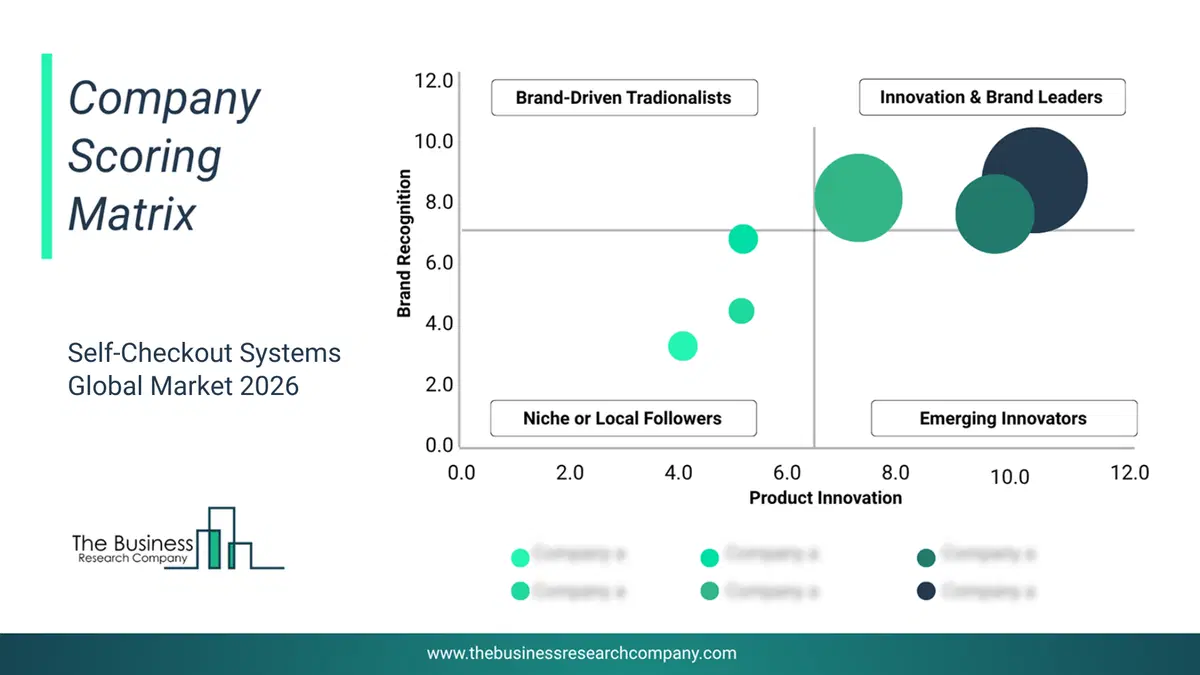
This chart maps companies by product innovation and brand strength, with bubble size indicating relative revenue, helping identify market leaders, challengers, and niche players. This is an illustrative chart; the full report provides a complete and accurate competitive analysis.
Global Self-Checkout Systems Market Trends and Insights
Major companies operating in the self-checkout systems market are focused on developing innovative products, such as facial recognition-enabled checkout terminals, to gain a competitive edge in the market. A facial recognition-enabled checkout terminal is a self-service kiosk that uses artificial intelligence (AI) and computer vision technology to identify customers, allowing them to complete purchases without interacting with a cashier or using physical cards. For instance, in September 2023, Telepower Communication Co Ltd., a China-based provider of smart terminals and solutions, launched the Telpo C50 AI Vision terminal. It is an AI-powered self-checkout system designed to improve the customer experience and reduce queue times. The C50 also features a built-in weight scale, which allows customers to weigh produce and other items without having to use a separate scale. Additionally, the C50 supports contactless payments, such as NFC and QR codes.What Are Latest Mergers And Acquisitions In The Self-Checkout Systems Market?
In February 2023, Standard AI, a US-based software development company, acquired Skip Checkout Company for an undisclosed amount. With this acquisition, Standard AI is expected to combine self-checkout with autonomous retail. Furthermore, the company is going to combine Skip's cloud-based point of sale (POS) with the intricate back-office infrastructure with the goal of streamlining operations and providing more control over things such as price, discounts, and promotions. Skip Checkout Company is a US-based self-checkout solutions provider.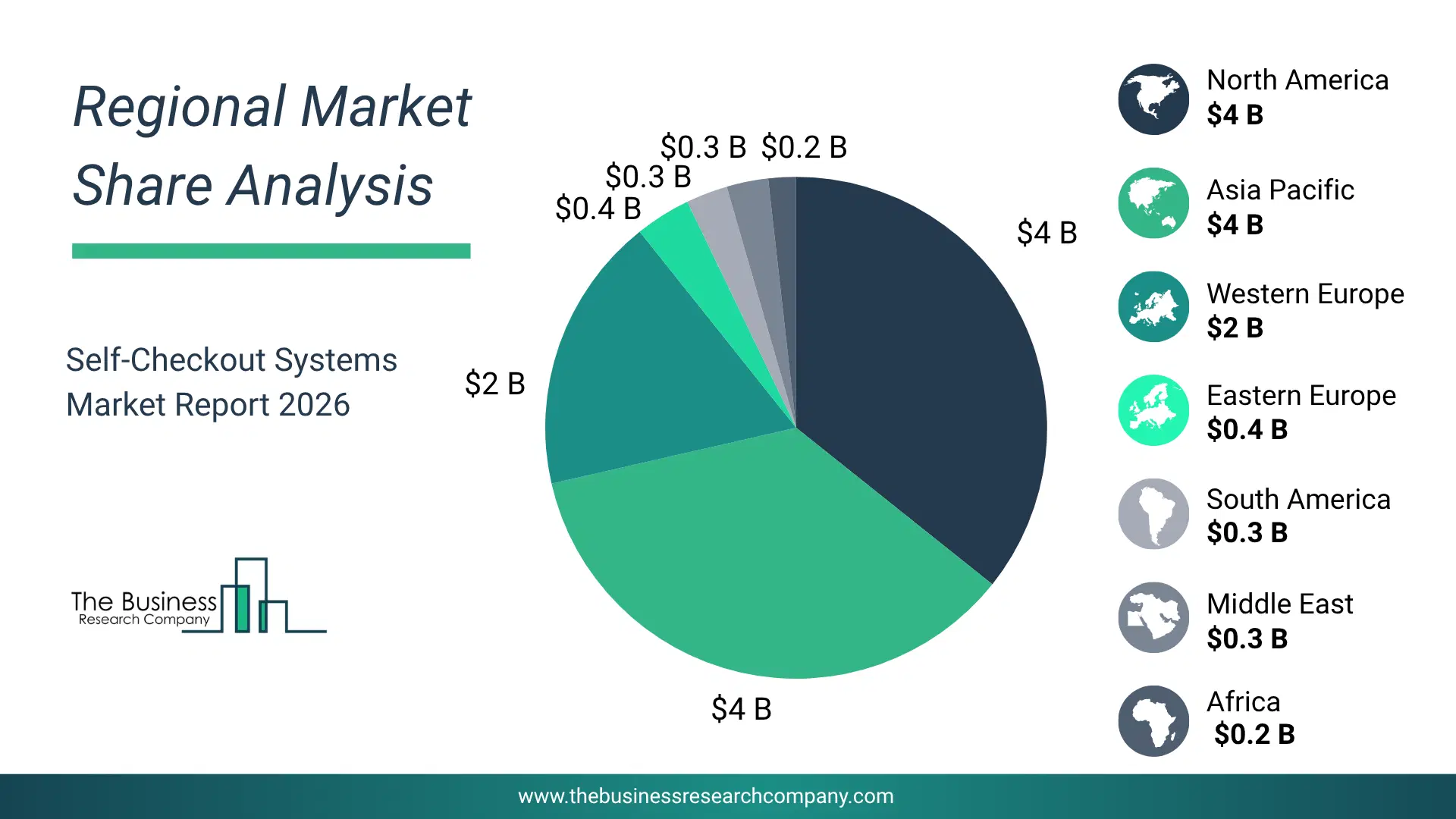
Regional Outlook
North America was the largest region in the self-checkout systems market in 2025. Asia-Pacific is expected to be the fastest-growing region in the global self-checkout systems market during the forecast period. The regions covered in this market report are Asia-Pacific, South East Asia, Western Europe, Eastern Europe, North America, South America, Middle East, Africa The countries covered in this market report are Australia, Brazil, China, France, Germany, India, Indonesia, Japan, Taiwan, Russia, South Korea, UK, USA, Canada, Italy, Spain.What Defines the Self-Checkout Systems Market?
The self-checkout systems market consists of revenues earned by entities by providing self-checkout systems services such as arch barcode scanning solutions, self-checkout software, bagging areas, and payment options services. The market value includes the value of related goods sold by the service provider or included within the service offering. The self-checkout systems market also includes sales of scan products, touch screen monitors, and hybrid systems, which are used in providing self-checkout systems services. Values in this market are ‘factory gate’ values, that is, the value of goods sold by the manufacturers or creators of the goods, whether to other entities (including downstream manufacturers, wholesalers, distributors, and retailers) or directly to end customers. The value of goods in this market includes related services sold by the creators of the goods.How is Market Value Defined and Measured?
The market value is defined as the revenues that enterprises gain from the sale of goods and/or services within the specified market and geography through sales, grants, or donations in terms of the currency (in USD unless otherwise specified). The revenues for a specified geography are consumption values that are revenues generated by organizations in the specified geography within the market, irrespective of where they are produced. It does not include revenues from resales along the supply chain, either further along the supply chain or as part of other products.
This chart presents market attractiveness based on a quantitative evaluation of growth, competition, strategic alignment, and risk, offering a clear view of opportunity areas for decision-making. This chart is for illustrative purposes; the full report contains the complete analysis.

This chart highlights the Total Addressable Market (TAM) by estimating the maximum revenue opportunity using an assumption-driven approach, supporting strategic planning and opportunity sizing across markets. The chart is illustrative; the full report provides a more comprehensive analysis.
What Key Data and Analysis Are Included in the Self-Checkout Systems Market Report 2026?
The self-checkout systems market research report is one of a series of new reports from The Business Research Company that provides market statistics, including industry global market size, regional shares, competitors with the market share, detailed market segments, market trends and opportunities, and any further data you may need to thrive in the self-checkout systems industry. The market research report delivers a complete perspective of everything you need, with an in-depth analysis of the current and future state of the industry.Self Checkout Systems Market Report Forecast Analysis
| Report Attribute | Details |
|---|---|
| Market Size Value In 2026 | $6.57 billion |
| Revenue Forecast In 2030 | $10.82 billion |
| Growth Rate | CAGR of 12.7% from 2026 to 2030 |
| Base Year For Estimation | 2025 |
| Actual Estimates/Historical Data | 2020-2025 |
| Forecast Period | 2026 - 2030 |
| Market Representation | Revenue in USD Billion and CAGR from 2026 to 2030 |
| Segments Covered | Offering, Model Type, Transaction, End-User Industry |
| Regional Scope | Asia-Pacific, Western Europe, Eastern Europe, North America, South America, Middle East, Africa |
| Country Scope | The countries covered in the report are Australia, Brazil, China, France, Germany, India, Indonesia, Japan, Taiwan, Russia, South Korea, UK, USA, Canada, Italy, Spain. |
| Key Companies Profiled | Diebold Nixdorf Inc., NCR Corporation, Toshiba Global Commerce Solutions, Fujitsu Limited, ITAB Group, Pan-Oston Corporation, StrongPoint, ECR Software Corporation, Pyramid Computer GmbH, Qingdao CCL Technology Co. Ltd., Mashgin Inc., MishiPay Ltd., 365 Retail Markets LLC, MetroClick, Scanflow AB, Slabb Inc., Pegasus Technologies, Ombori, Hisense Systems Europe, U-Scan Genesis, Zebra Technologies, Honeywell International Inc., Trigo Vision Ltd., Datalogic S.p.A. |
| Customization Scope | Request for Customization |
| Pricing And Purchase Options | Explore Purchase Options |