
Smart Bathroom Market Report 2026
Global Outlook – By Product (Hi-Tech Toilets, Soaking Tubs, Digital Faucets, Other Products), By Connectivity (Bluetooth, Wi-Fi, 3G), By Distribution (Offline, Online), By Application (Commercial, Residential) – Market Size, Trends, Strategies, and Forecast to 2030
Smart Bathroom Market Overview
• Smart Bathroom market size has reached to $5.22 billion in 2025 • Expected to grow to $8.73 billion in 2030 at a compound annual growth rate (CAGR) of 10.8% • Growth Driver: Impact Of Home Remodeling On The Smart Bathrooms Market • Market Trend: Innovative Solutions for Modern Bathrooms: Xiaomi's Smart Heater Combines Comfort with Cleanliness • North America was the largest region in 2025.Market Gains By 2030 – Top Opportunities By Segment
Market Gain identifies the most promising market opportunities by highlighting the segments or products expected to generate the highest incremental revenue growth over the next five years.
What Is Covered Under Smart Bathroom Market?
Smart bathroom refers to an area that engages and connects with users through integrated technology and data. It is intended to raise the bar for personal hygiene and cleanliness. Additionally, it improves safety, operations, and the customer experience while providing stakeholders with information into how to save labor and resources. The main product in the smart bathroom is hi-tech toilets, soaking tubs, digital faucets, and other products. Hi-tech toilets refer to the toilet having advanced features such as automatic dryers, heated seats, and many more features. The different smart bathroom connectivity options include Bluetooth, Wi-Fi, and 3G and is distributed through offline and online channels. They are used in applications for commercial and residential purposes.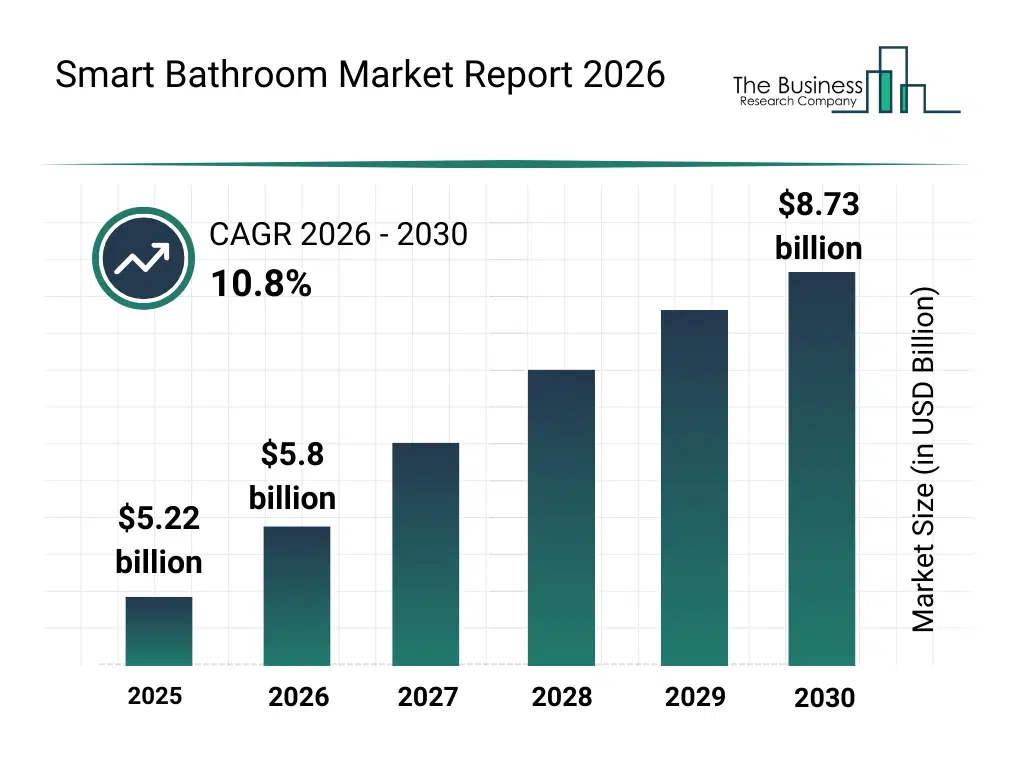
What Is The Smart Bathroom Market Size and Share 2026?
The smart bathroom market size has grown rapidly in recent years. It will grow from $5.22 billion in 2025 to $5.8 billion in 2026 at a compound annual growth rate (CAGR) of 11.1%. The growth in the historic period can be attributed to rising adoption of hi-tech toilets, increasing demand for water-saving faucets, growth in residential and commercial smart bathroom installations, increasing awareness of hygiene and cleanliness, early adoption of digital shower systems.What Is The Smart Bathroom Market Growth Forecast?
The smart bathroom market size is expected to see rapid growth in the next few years. It will grow to $8.73 billion in 2030 at a compound annual growth rate (CAGR) of 10.8%. The growth in the forecast period can be attributed to integration of AI for user personalization, expansion of bluetooth and wi-fi-enabled bathroom devices, growth of intelligent mirrors and smart bathtubs, increasing focus on energy-efficient and eco-friendly solutions, rising smart bathroom adoption in hospitality and commercial sectors. Major trends in the forecast period include touchless and sensor-enabled fixtures, water and energy efficiency solutions, integration with smart home systems, personalized user experience and settings, remote monitoring and maintenance.
Global Smart Bathroom Market Segmentation
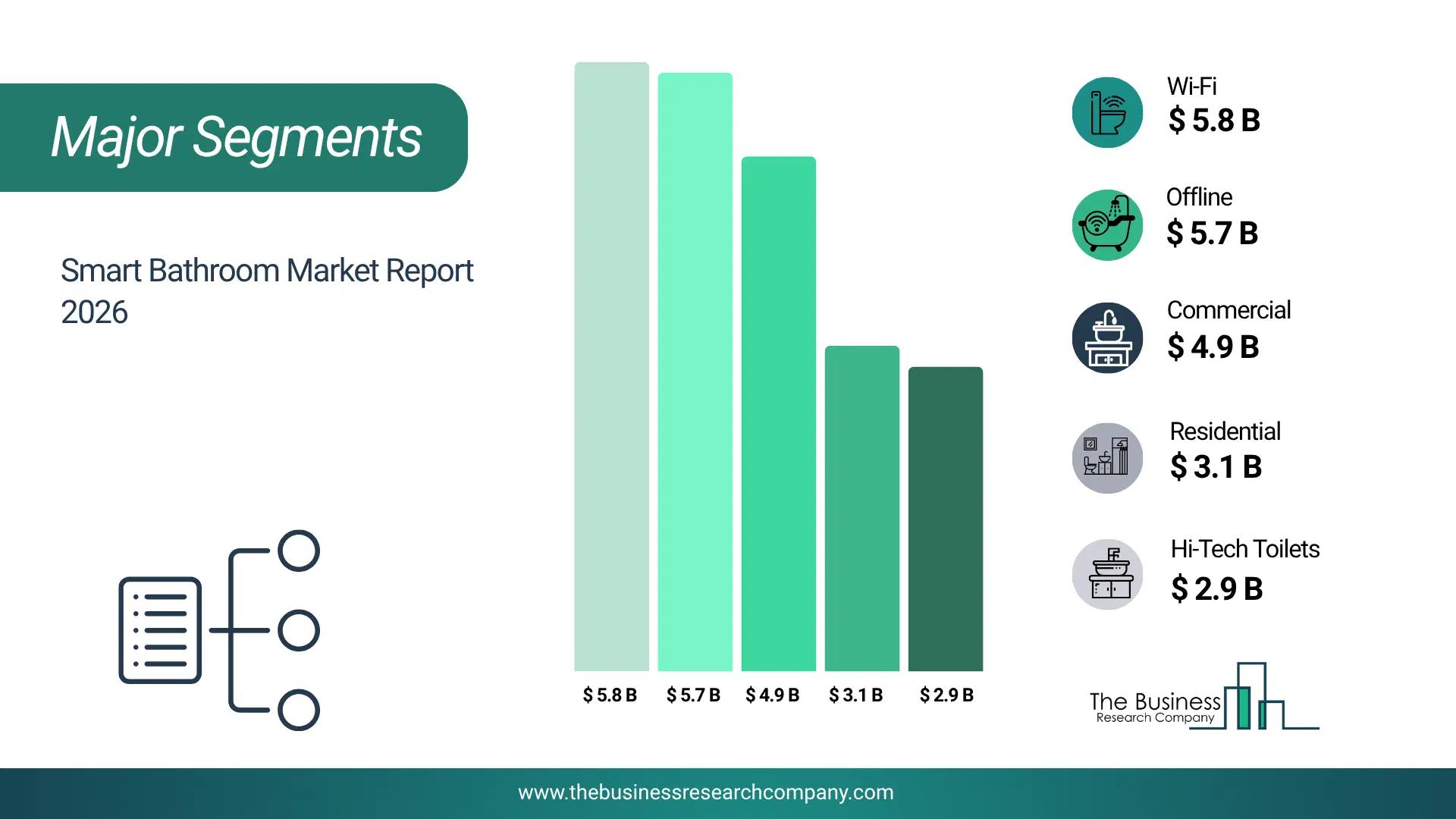
1) By Product: Hi-Tech Toilets, Soaking Tubs, Digital Faucets, Other Products 2) By Connectivity: Bluetooth, Wi-Fi, 3G 3) By Distribution: Offline, Online 4) By Application: Commercial, Residential Subsegments: 1) By Hi-Tech Toilets: Bidet Toilets, Smart Flush Toilets, Self-Cleaning Toilets 2) By Soaking Tubs: Smart Bathtubs with Jets, Heated Soaking Tubs, Bluetooth-Enabled Tubs 3) By Digital Faucets: Touchless Faucets, Digital Temperature Control Faucets, Water-Saving Faucets 4) By Other Products: Smart Shower Systems, LED Showerheads, Intelligent Mirrors The top segments in the smart bathroom market will be: • Offline will reach $5722.24 Million by 2030. • Wi-Fi will reach $5808.7 Million by 2030. • Commercial will reach $4900.21 Million by 2030. • Hi-Tech Toilets will reach $2900.92 Million by 2030. • Residential will reach $3095.13 Million by 2030.What Is The Driver Of The Smart Bathroom Market?
The increasing inclination toward home remodeling and renovations is expected to propel the growth of the smart bathrooms market going forward. Home renovations involve the restoration or improvement of a residential property to bring it back to a good or better condition. By incorporating smart technologies into bathroom remodeling and renovations modern, efficient, and personalized spaces can be created, optimize energy consumption, provides convenience and automation, customization, personalization, increased safety and security, water conservation, and can enhance the overall value of a home. For instance, in January 2023, according to the Joint Center for Housing Studies of Harvard University, a US-based research center and think tank, national spending on remodeling and repairs for owner-occupied homes is projected to reach $485 billion in 2023, marking a 2.6 % increase from the previous year, 2022. Therefore, the increasing inclination toward home remodeling and renovations is driving the growth of the smart bathrooms industry.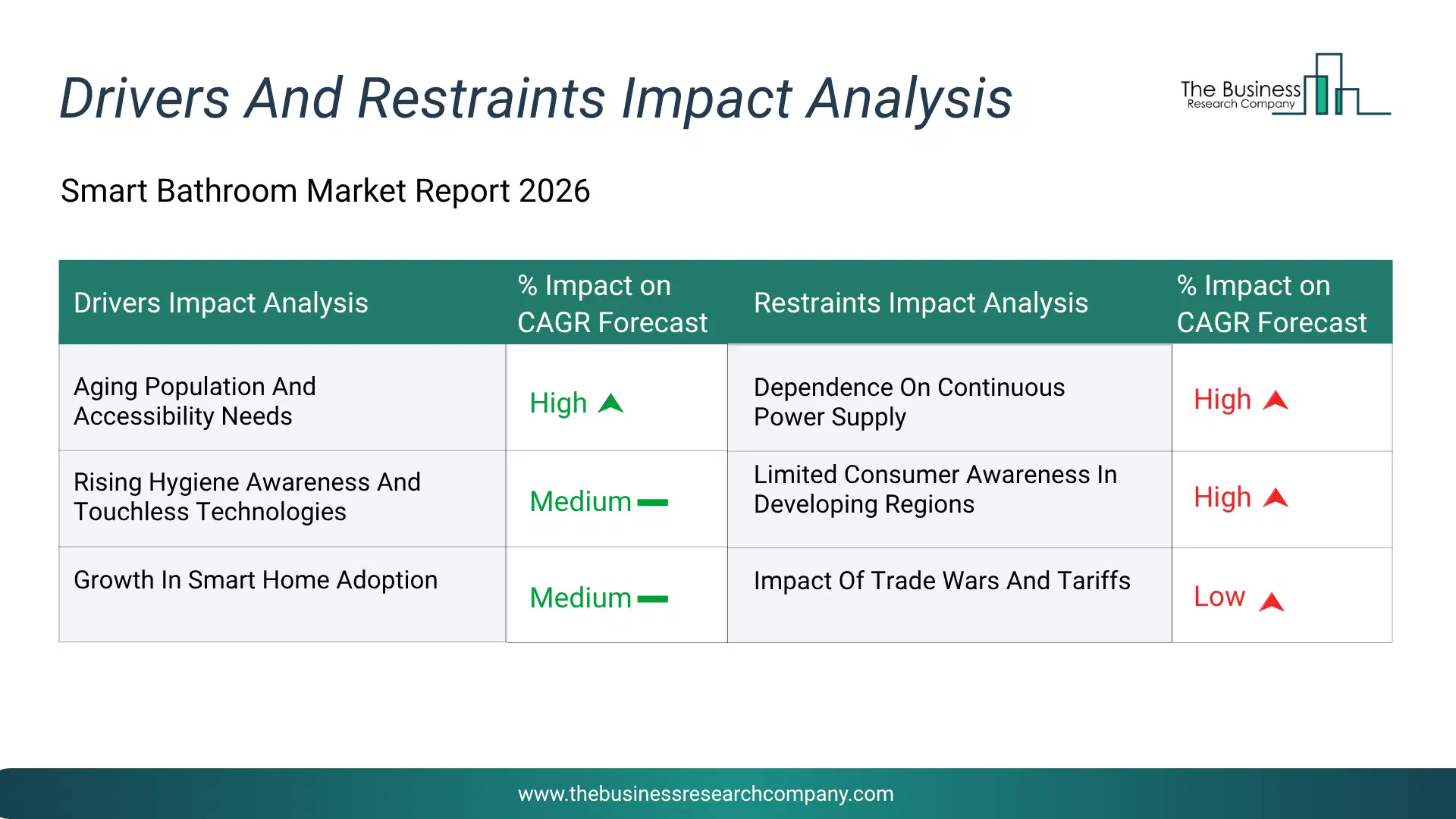
Infographic Chart Showing Key Market Drivers Analysis And Restraints For Smart Bathroom Market
The chart presents an impact analysis of key drivers and restraints, quantifying their relative influence on the market's growth rate and helping assess the balance between growth enablers and limiting factors. This chart offers a high-level perspective; the full report contains more detailed insights.
How Will The Drivers Impact Growth In The Global Smart Bathroom Market?
• Aging Population And Accessibility Needs (High) – During the forecast period, the aging population and increasing accessibility needs are expected to be key drivers propelling growth in the smart bathroom market. As the global population continues to age, a larger share of elderly individuals is expected to require living environments that support safety, independence and improved personal hygiene management. Older populations are more likely to experience mobility limitations and health conditions that make conventional bathroom fixtures difficult to use, increasing demand for accessible and user-friendly solutions such as automated toilets, touchless faucets and sensor-based lighting. The growing need for age-friendly housing and assistive home technologies is expected to accelerate the adoption of smart bathroom devices, supporting continued growth in the smart bathroom market. The aging population and increasing accessibility needs growth contribution during the forecast period in 2025 is 2.0%. • Rising Hygiene Awareness And Touchless Technologies (Medium) – During the forecast period, rising hygiene awareness and the growing adoption of touchless technologies are expected to be key drivers propelling growth in the smart bathroom market. As awareness of sanitation, infection prevention and personal health continues to increase across households, commercial facilities and public spaces, consumers and organizations are increasingly prioritizing hygienic environments that reduce physical contact with frequently used surfaces. This shift is expected to encourage the integration of advanced sanitation solutions such as touchless faucets, automatic flush systems, sensor-based soap dispensers and smart hygiene monitoring technologies within modern bathroom infrastructure. The growing emphasis on hygiene and contactless technologies is expected to accelerate the adoption of smart bathroom devices, supporting continued growth in the smart bathroom market. The rising hygiene awareness and the growing adoption of touchless technologies during the forecast period in 2025 is 1.5%. • Growth In Smart Home Adoption (Medium) – During the forecast period, the growth in smart home adoption is expected to be a key driver propelling growth in the smart bathroom market. As connected home ecosystems continue to expand, households are increasingly integrating Internet of Things (IoT) devices, automation systems and AI-enabled technologies to improve convenience, safety and energy management in residential environments. The wider deployment of smart home platforms is encouraging the integration of connected bathroom technologies such as intelligent toilets, sensor-based faucets, digital showers and automated lighting systems that enhance comfort, hygiene and operational efficiency. The expanding adoption of smart home technologies, supported by advancements in IoT and artificial intelligence, is expected to accelerate the integration of intelligent bathroom solutions, supporting continued growth in the smart bathroom market. The growth in smart home adoption growth contribution during the forecast period in 2025 is 1.0%. • Increasing Demand For Luxury Home Interiors (Low) – During the forecast period, the increasing demand for luxury home interiors is expected to be a key driver propelling growth in the smart bathroom market. As affluent consumers increasingly seek personalized living spaces that reflect their lifestyles, modern luxury homes are incorporating premium interior designs and high-end amenities that enhance comfort, aesthetics and functionality. The growing preference for customized luxury residences is encouraging homeowners to integrate advanced technologies and sophisticated fixtures, including intelligent toilets, automated faucets, digital showers and other smart bathroom solutions designed to deliver convenience and a premium user experience. The rising focus on bespoke interior design and upscale residential environments is expected to accelerate the adoption of smart bathroom technologies, supporting continued growth in the smart bathroom market. The increasing demand for luxury home interiors growth contribution during the forecast period in 2025 is 0.5%.How Will The Restraints Impact Growth In The Global Smart Bathroom Market?
• Dependence On Continuous Power Supply (High) – During the forecast period, dependence on continuous power supply is restricting the growth of the smart bathroom market. Increasing reliance on electricity to operate features such as automated flushing systems, sensor-based faucets, digital shower controls and connected monitoring technologies is creating operational constraints for smart bathroom devices in environments with unstable power infrastructure. From a functional and infrastructure perspective, maintaining consistent performance of connected bathroom systems requires uninterrupted electricity availability, stable grid connectivity and reliable backup systems to support advanced electronic components. These operational dependencies, combined with rising concerns about grid reliability, power outages and energy infrastructure limitations, are increasing hesitation among consumers and facility operators regarding the large-scale adoption of smart bathroom technologies that require continuous power support. Growth affected by dependence on continuous power supply during the forecast period in 2025 is -2.3%. • Limited Consumer Awareness In Developing Regions (Medium) – During the forecast period, limited consumer awareness in developing regions is restricting the growth of the smart bathroom market. Lower levels of digital literacy, limited exposure to smart home technologies and affordability challenges in several emerging economies are constraining consumer understanding of the benefits and functionality of advanced bathroom solutions. From a technological adoption perspective, effective utilization of smart bathroom devices requires familiarity with connected home ecosystems, mobile applications and digital infrastructure, which remain unevenly distributed across developing regions. These awareness gaps, combined with broader digital divides related to internet access, affordability and technological skills, are expected to slow the adoption of smart bathroom technologies. Growth affected by the limited consumer awareness in developing regions during the forecast period in 2025 is -2.0%. • Impact Of Trade Wars And Tariffs (Medium) – During the forecast period, the impact of trade wars and tariffs is restricting the growth of the smart bathroom market. Increasing trade tensions and the imposition of tariffs on imported consumer technology components are expected to raise manufacturing and procurement costs for smart home and connected bathroom devices that rely heavily on global supply chains. From a supply chain and production perspective, many smart bathroom technologies depend on imported electronic components, sensors, semiconductors and IoT modules, making them vulnerable to fluctuations in international trade policies and tariff structures. These trade disruptions, combined with rising import duties and cost pressures on technology products, are expected to increase device prices and reduce consumer purchasing power, thereby limiting the adoption of smart bathroom solutions in global markets during the forecast period. Growth affected by impact of trade wars and tariffs during the forecast period in 2025 is -0.3%.Key Players In The Global Smart Bathroom Market
Major companies operating in the smart bathroom market are LIXIL Group Corporation; MASCO Corporation; Kohler Co; Toto Ltd.; Bio Bidet; American Standard Brands LLC; Roca Sanitario SA; GROHE AG; Bradley Corporation; Jaquar Group Co Ltd.; Villeroy & Boch AG; RAK Ceramics P.J.S.C; Duravit AG; Moen Incorporated; Delta Faucet Company; Sloan Valve Company; Symmons Industries Inc.; Ove Decors; The Chicago Faucet Company; Jacuzzi Brands LLC; Kallista Co; Brondell Inc.; Aquatica Plumbing Group; Aquamoon LLC; Novellini Spa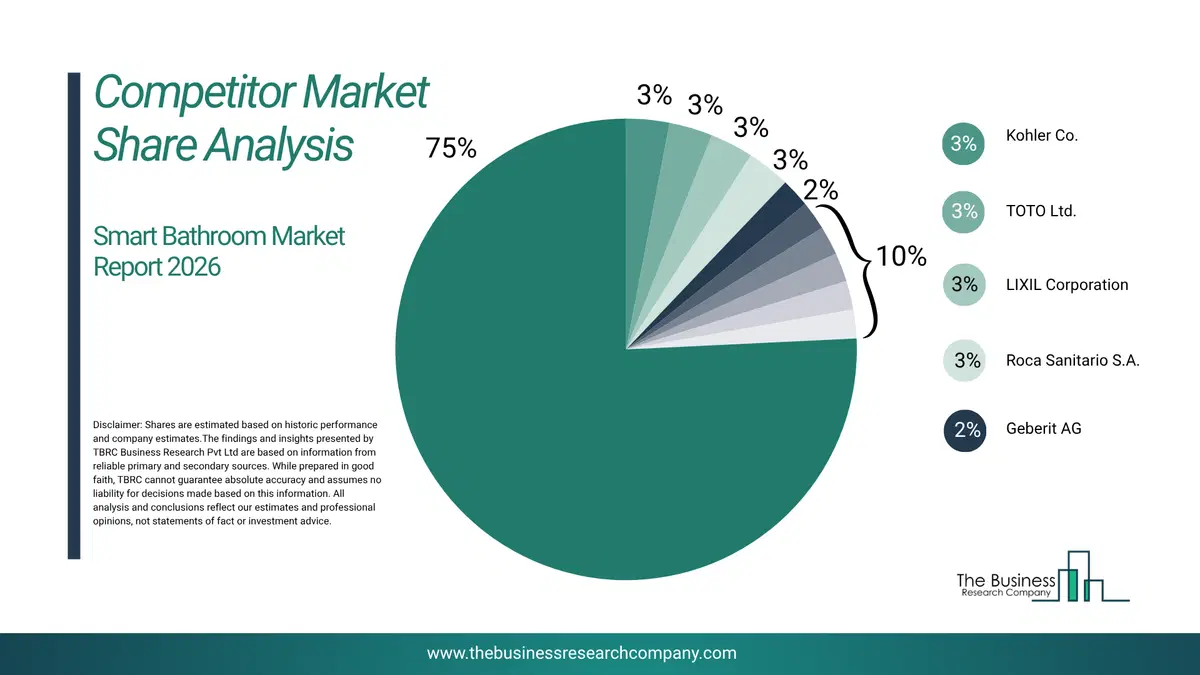
This chart is for illustrative purposes; the full report includes a detailed competitor analysis and comprehensive overview of the top 10 companies in the market.
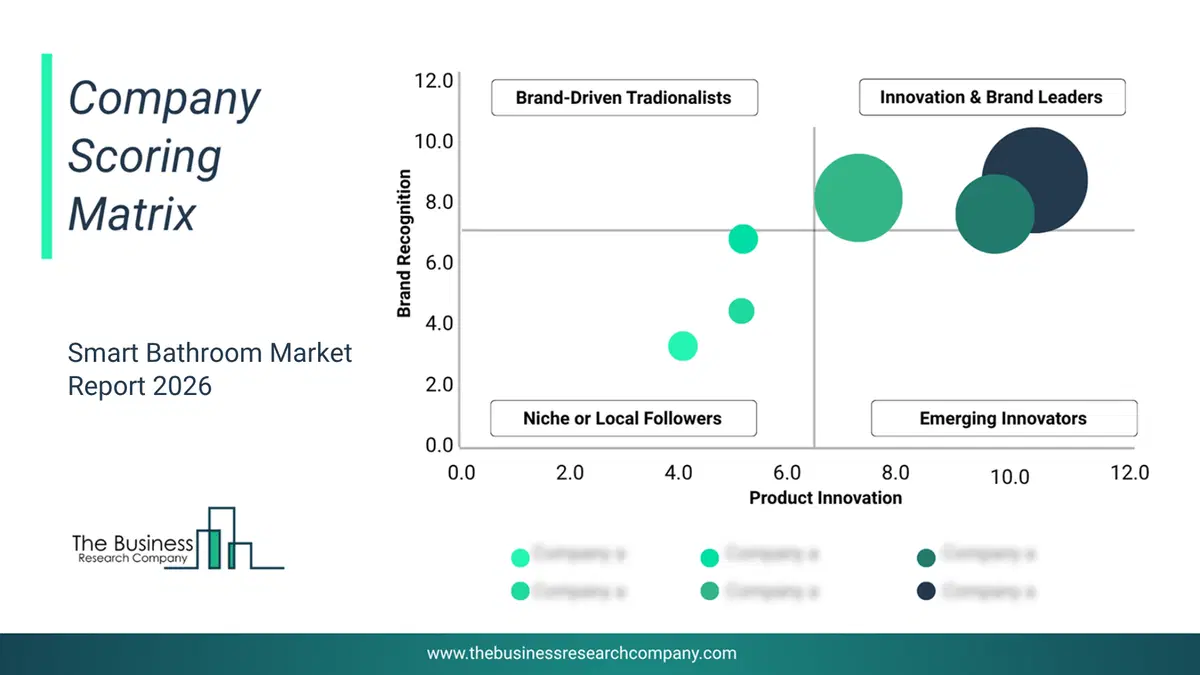
This chart maps companies by product innovation and brand strength, with bubble size indicating relative revenue, helping identify market leaders, challengers, and niche players. This is an illustrative chart; the full report provides a complete and accurate competitive analysis.
Global Smart Bathroom Market Trends and Insights
Major companies in the smart bathroom market are focused on developing smart bathrooms utilizing rapid heating technology, to enhance user convenience and improve overall bathroom experiences. Rapid heating technology in smart bathrooms typically refers to rapid or accelerated heating systems designed to quickly warm specific elements or areas of the bathroom, enhancing comfort and efficiency. For instance, in September 2024, Xiaomi Inc., a China-based consumer electronics and smart manufacturing company, launched the Mijia Smart Bathroom Heater N1, featuring rapid heating technology that raises the temperature by 15°C (~32°F) in just one minute. The device includes smart controls, a disinfection feature, and a light panel, making it a versatile addition to modern bathrooms.What Are Latest Mergers And Acquisitions In The Smart Bathroom Market?
In July 2024, Roca Corporación Empresarial, a Spain-based company that designs, manufactures, and markets bathroom products, acquired Idral Spa for an undisclosed amount. With this acquisition, Roca Group aims to strengthen its taps division, enhance its product offerings in the public and communal bathroom markets, and leverage Idral's expertise in smart tap technologies to improve user experience and hygiene. Idral S.p.A. is an Italy-based company that designs and manufactures sanitary ware, taps, and accessories for public and commercial spaces.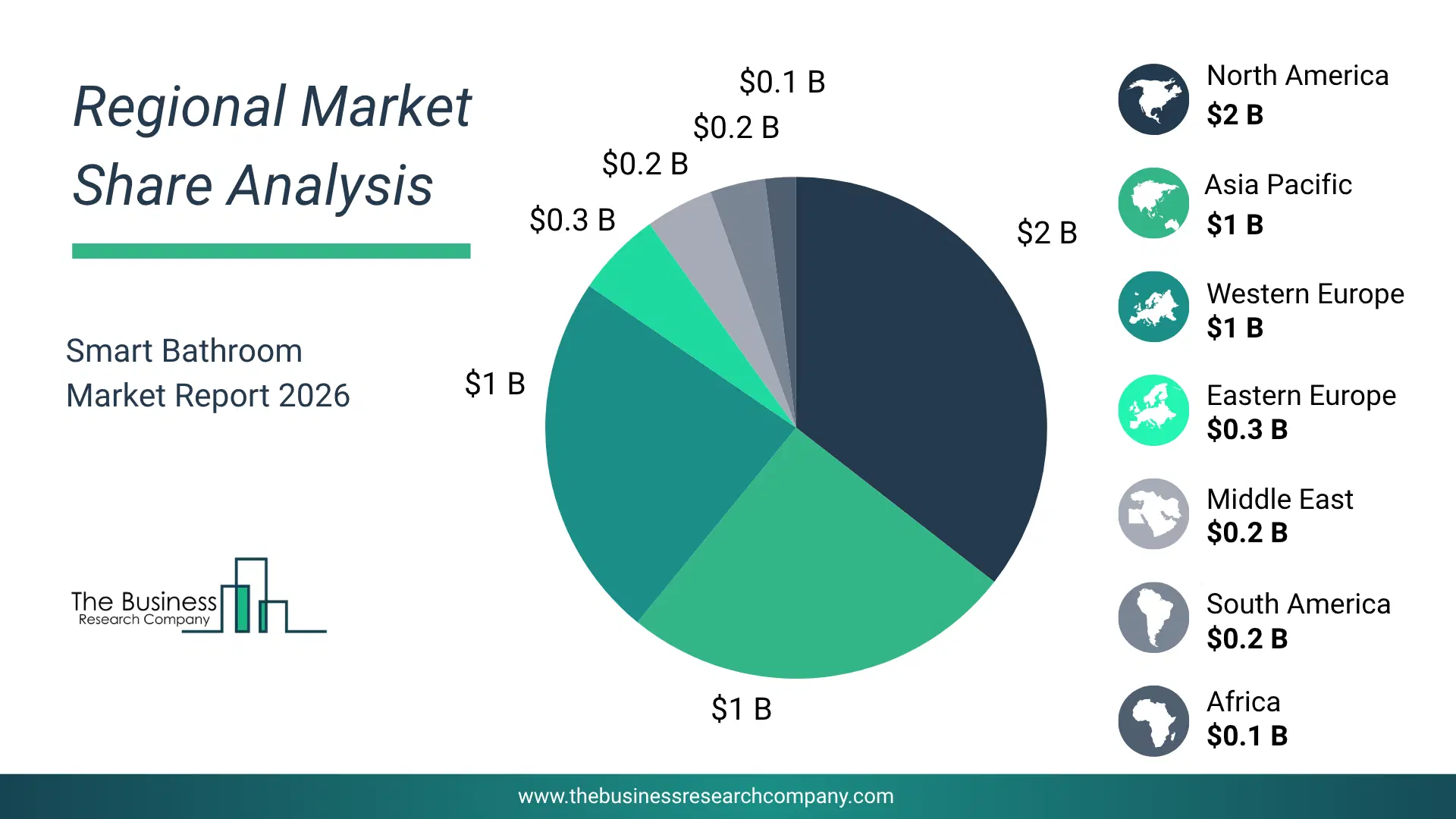
Regional Insights
North America was the largest region in the smart bathroom market in 2025 and is expected to be the fastest-growing region in the forecast period. The regions covered in this market report are Asia-Pacific, South East Asia, Western Europe, Eastern Europe, North America, South America, Middle East, Africa. The countries covered in this market report are Australia, Brazil, China, France, Germany, India, Indonesia, Japan, Taiwan, Russia, South Korea, UK, USA, Canada, Italy, SpainWhat Defines the Smart Bathroom Market?
The smart bathroom market consists of sales of Bluetooth speakers, smart showers. Values in this market are ‘factory gate’ values, that is the value of goods sold by the manufacturers or creators of the goods, whether to other entities (including downstream manufacturers, wholesalers, distributors and retailers) or directly to end customers. The value of goods in this market includes related services sold by the creators of the goods.How is Market Value Defined and Measured?
The market value is defined as the revenues that enterprises gain from the sale of goods and/or services within the specified market and geography through sales, grants, or donations in terms of the currency (in USD unless otherwise specified). The revenues for a specified geography are consumption values that are revenues generated by organizations in the specified geography within the market, irrespective of where they are produced. It does not include revenues from resales along the supply chain, either further along the supply chain or as part of other products.
This chart presents market attractiveness based on a quantitative evaluation of growth, competition, strategic alignment, and risk, offering a clear view of opportunity areas for decision-making. This chart is for illustrative purposes; the full report contains the complete analysis.

This chart highlights the Total Addressable Market (TAM) by estimating the maximum revenue opportunity using an assumption-driven approach, supporting strategic planning and opportunity sizing across markets. The chart is illustrative; the full report provides a more comprehensive analysis.
What Key Data and Analysis Are Included in the Smart Bathroom Market Report 2026?
The smart bathroom market research report is one of a series of new reports from The Business Research Company that provides market statistics, including industry global market size, regional shares, competitors with the market share, detailed market segments, market trends and opportunities, and any further data you may need to thrive in the smart bathroom industry. The market research report delivers a complete perspective of everything you need, with an in-depth analysis of the current and future state of the industry.Smart Bathroom Market Report Forecast Analysis
| Report Attribute | Details |
|---|---|
| Market Size Value In 2026 | $5.8 billion |
| Revenue Forecast In 2030 | $8.73 billion |
| Growth Rate | CAGR of 11.1% from 2026 to 2030 |
| Base Year For Estimation | 2025 |
| Actual Estimates/Historical Data | 2020-2025 |
| Forecast Period | 2026 - 2030 - 2035 |
| Market Representation | Revenue in USD Billion and CAGR from 2026 to 2030 |
| Segments Covered | Product, Connectivity, Distribution, Application |
| Regional Scope | Asia-Pacific, Western Europe, Eastern Europe, North America, South America, Middle East, Africa |
| Country Scope | The countries covered in the report are Australia, Brazil, China, France, Germany, India, Indonesia, Japan, Taiwan, Russia, South Korea, UK, USA, Canada, Italy, Spain. |
| Key Companies Profiled | LIXIL Group Corporation; MASCO Corporation; Kohler Co; Toto Ltd.; Bio Bidet; American Standard Brands LLC; Roca Sanitario SA; GROHE AG; Bradley Corporation; Jaquar Group Co Ltd.; Villeroy & Boch AG; RAK Ceramics P.J.S.C; Duravit AG; Moen Incorporated; Delta Faucet Company; Sloan Valve Company; Symmons Industries Inc.; Ove Decors; The Chicago Faucet Company; Jacuzzi Brands LLC; Kallista Co; Brondell Inc.; Aquatica Plumbing Group; Aquamoon LLC; Novellini Spa |
| Customization Scope | Request for Customization |
| Pricing And Purchase Options | Explore Purchase Options |