
Smart Apartments Market Report 2026
Global Outlook – By Product (Building Management System (BMS), Heating, Ventilating, And Air Conditioning (HVAC), Lighting Control, Security And Access Control, Emergency Alarm And Evacuation System, Audio And Visual Effects ), By Technology (Wi-Fi, Bluetooth, GSM/GPRS, RFID, Other Technologies), By Application (Residential, Hotel, Other Applications) – Market Size, Trends, Strategies, and Forecast to 2030
Smart Apartments Market Overview
• Smart Apartments market size has reached to $4.16 billion in 2025 • Expected to grow to $7.55 billion in 2030 at a compound annual growth rate (CAGR) of 12.7% • Growth Driver: Surging Popularity Of Smart Homes Fuels The Expansion Of The Smart Apartment Market • Market Trend: Smart Apartments Of The Future With Innovative IoT Solutions Enhance Security And Comfort • Asia-Pacific was the largest region and fastest growing region.What Is Covered Under Smart Apartments Market?
Smart apartments construction is the process of building, altering, repairing, improving, or demolishing any smart apartment using a detailed design and plan. Smart apartments are multifamily properties that are futuristic buildings equipped with advanced electronics and wireless devices. The smart apartments system requires a web portal or smartphone application to interact with the automated system as a user interface. The main types of products in smart apartments are building management systems (BMS), heating, ventilating, and air conditioning (HVAC), lighting control, security and access control, emergency alarm and evacuation systems, and audio and visual effects. Lighting controls are a class of smart lighting systems that can manage the amount, quality, and characteristics of light in a specific area. These smart devices help to reduce electricity waste while also boosting energy efficiency. Smart apartments are used in residential areas, hotels, and others.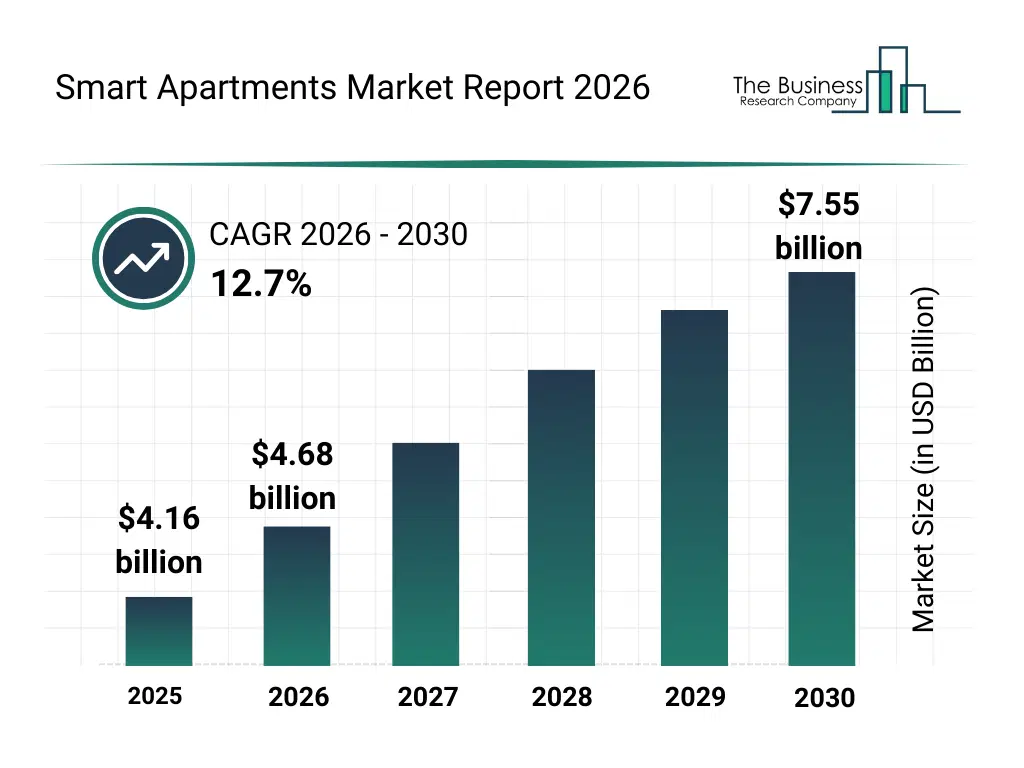
What Is The Smart Apartments Market Size and Share 2026?
The smart apartments market size has grown rapidly in recent years. It will grow from $4.16 billion in 2025 to $4.68 billion in 2026 at a compound annual growth rate (CAGR) of 12.5%. The growth in the historic period can be attributed to historical reliance on traditional apartment construction methods, initial adoption of basic automated systems, rising consumer interest in enhanced security features, gradual incorporation of energy management technologies, steady growth in multifamily housing development.What Is The Smart Apartments Market Growth Forecast?
The smart apartments market size is expected to see rapid growth in the next few years. It will grow to $7.55 billion in 2030 at a compound annual growth rate (CAGR) of 12.7%. The growth in the forecast period can be attributed to increasing demand for full smart building integration, growing regulatory pressure for energy-efficient multifamily housing, rapid adoption of cloud-based automation systems, expansion of BMS use in residential properties, rising integration of wireless and sensor-based building technologies. Major trends in the forecast period include rising demand for fully integrated smart apartment ecosystems, growth in smart hvac and automated energy management adoption, increasing use of smart security and access-control solutions, rising deployment of bms-enabled multifamily buildings, expansion of app-based and cloud-controlled residential automation.
Global Smart Apartments Market Segmentation
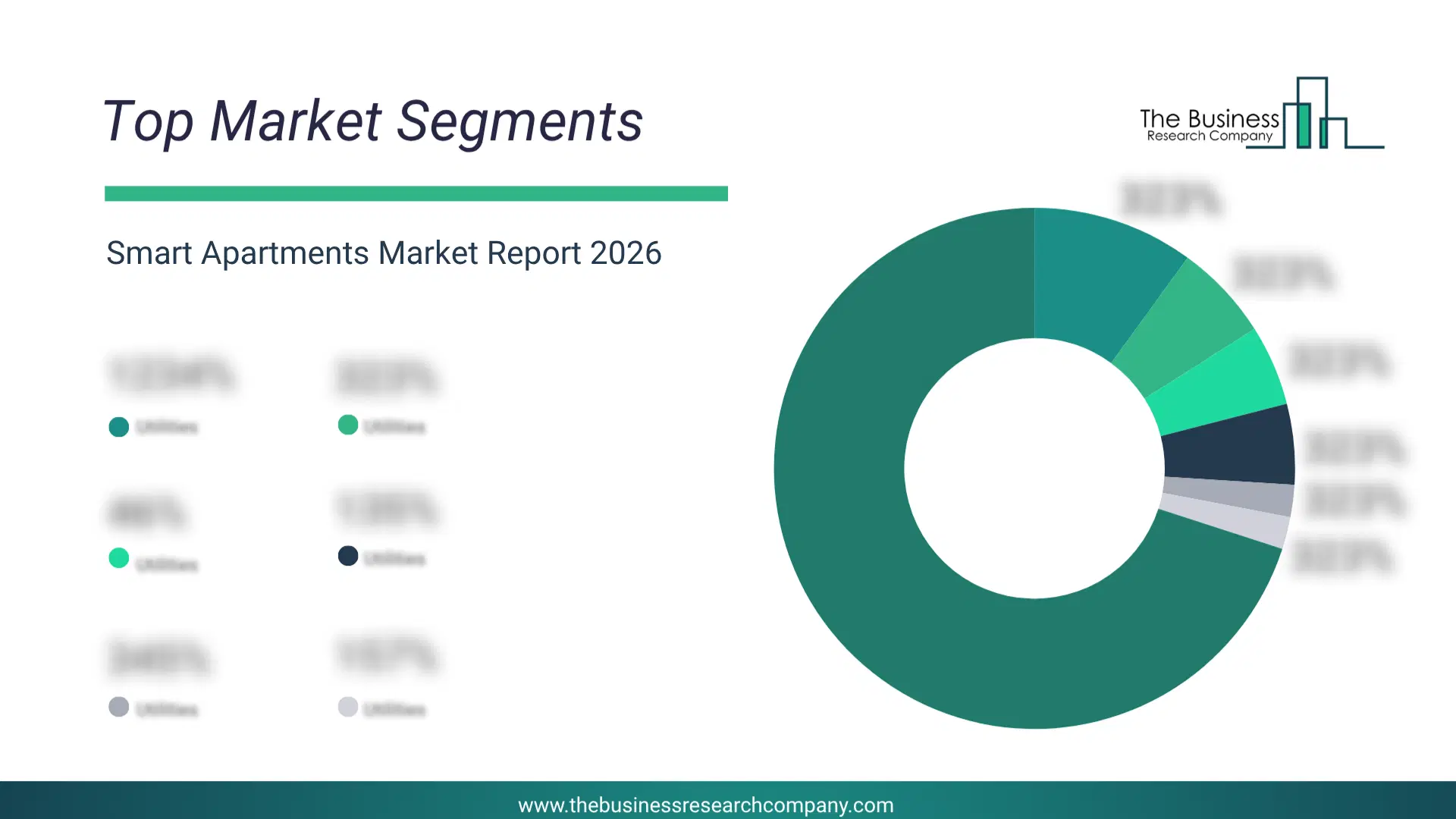
1) By Product: Building Management System (BMS), Heating, Ventilating, And Air Conditioning (HVAC), Lighting Control, Security And Access Control, Emergency Alarm And Evacuation System, Audio And Visual Effects 2) By Technology: Wi-Fi, Bluetooth, GSM/GPRS, RFID, Other Technologies 3) By Application: Residential, Hotel, Other Applications Subsegments: 1) By Building Management System (BMS): Energy Management, Water Management, Fire Safety Management, Security Management 2) By Heating, Ventilating, and Air Conditioning (HVAC): Smart Thermostats, Smart Vents, Zoning Systems 3) By Lighting Control: Smart Bulbs, Dimming Systems, Motion Sensors 4) By Security and Access Control: Smart Locks, Surveillance Cameras, Alarm Systems 5) By Emergency Alarm and Evacuation System: Fire Alarms, Emergency Lighting, Evacuation Management Systems 6) By Audio And Visual Effects: Home Theater Systems, Multi-Room Audio Systems, Smart TVsWhat Is The Driver Of The Smart Apartments Market?
The increasing popularity of smart homes is expected to propel the growth of the smart apartments market going forward. Smart homes are residences equipped with interconnected devices and systems that can be remotely controlled and automated, enhancing convenience, energy efficiency, and security for occupants. Smart homes serve as a model for smart apartment complexes, providing a structured approach to incorporating interconnected, automated, and energy-efficient systems that improve residents' quality of life. For instance, in 2023, according to TechSee Augmented Vision Ltd., an Israel-based computer software company, a smart home support survey report states that smart home adoption is on the rise, with 40% of U.S. consumers already using smart home devices, with smart speakers (49%) and smart thermostats (32%) being the most popular. Therefore, the increasing popularity of smart homes will drive the growth of the smart apartments industry.Key Players In The Global Smart Apartments Market
Major companies operating in the smart apartments market are Amazon.com Inc., Leviton Manufacturing Co. Inc., Apple Inc., Google LLC, Samsung Electronics Co. Ltd, Honeywell International Inc., Lennar Corporation, Schneider Electric SE, August Home, Asea Brown Boveri Ltd Ltd., Pulte Group Inc., Rachio Inc., Meritage Homes Corporation, Logitech International S.A., Yale, Crestron Electronics Inc., Vivint Smart Home Inc., Somfy Group, Metricon Homes LLC, Netatmo, Savant Systems LLC, Ecobee Inc., Lutron Electronics Co. Inc., Porter Davis Homes, Shea Homes, Henley Properties, Tado GmbH, Philips Hue, Control4 Corporation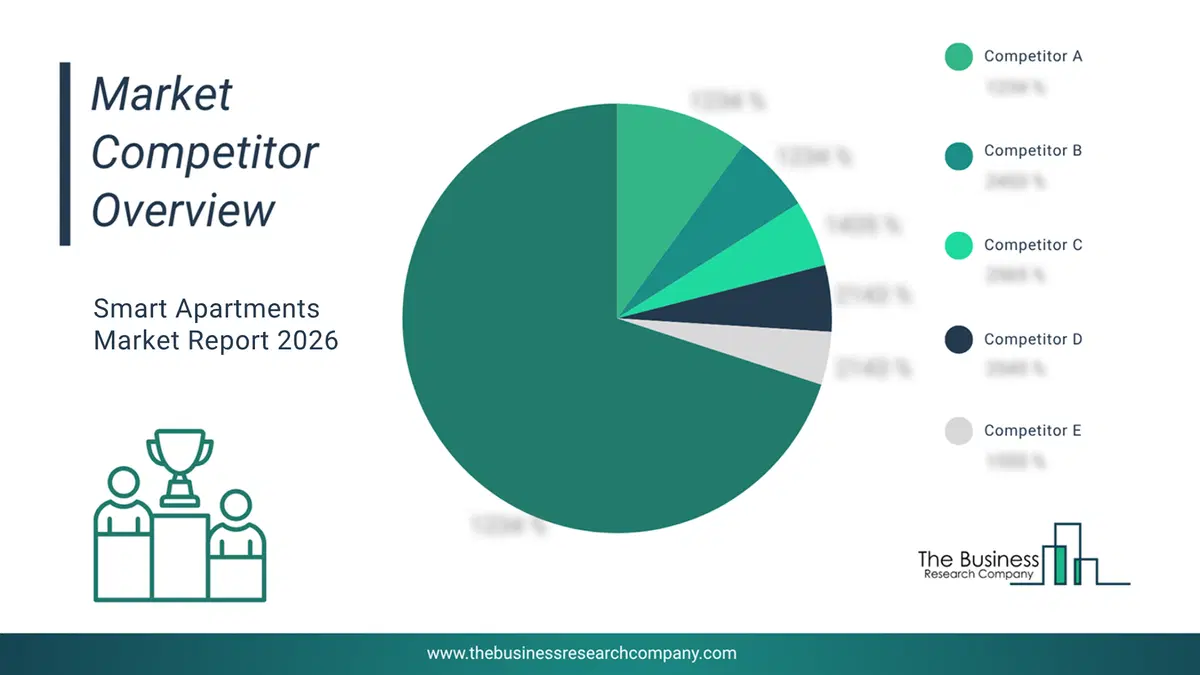
This chart is for illustrative purposes; the full report includes a detailed competitor analysis and comprehensive overview of the top 10 companies in the market.
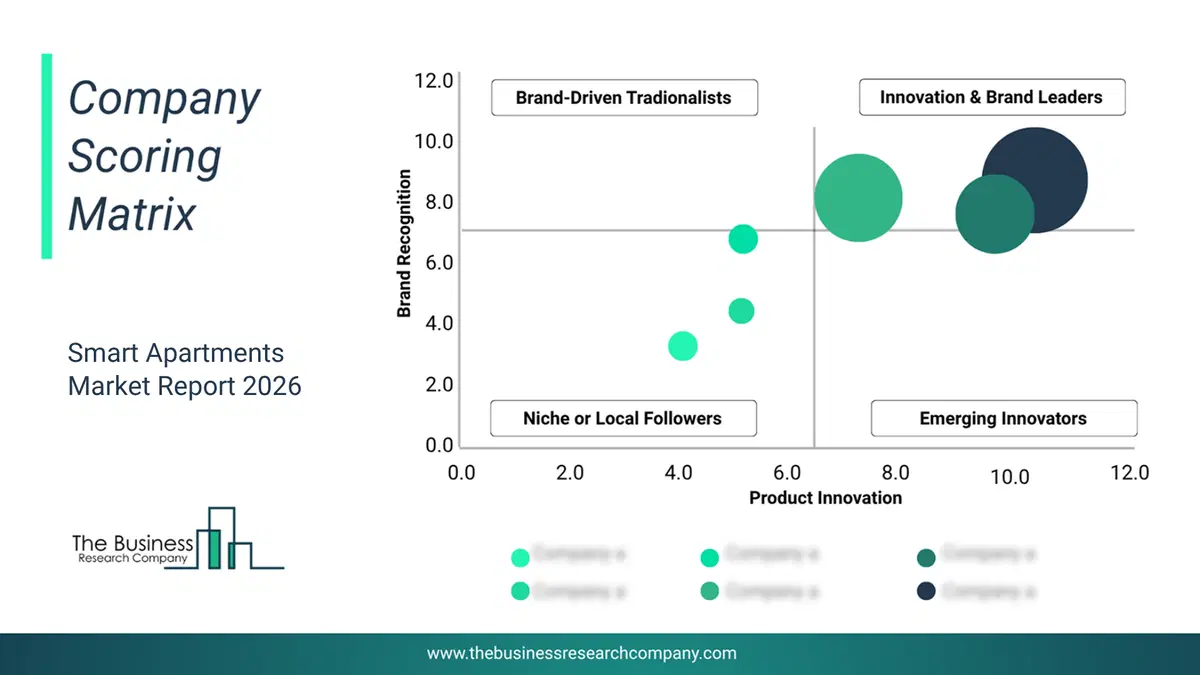
This chart maps companies by product innovation and brand strength, with bubble size indicating relative revenue, helping identify market leaders, challengers, and niche players. This is an illustrative chart; the full report provides a complete and accurate competitive analysis.
Global Smart Apartments Market Trends and Insights
Major companies operating in the Smart apartments market are focusing on advanced technologies, such as remote controlling and monitoring security, IoT-enabled systems and automation solutions, to enhance living experiences, improve energy efficiency, and provide residents with greater control over their environments. Remotely controlling and monitoring security refers to managing and overseeing security systems, such as locks, cameras, and alarms, from a distance using digital devices like smartphones or computers. For instance, in September 2024, Hitachi, Ltd. a Japan-based company that offers digital systems and solutions, launched a new BuilMirai IoT solution for small and medium-sized buildings. This subscription-based solution aims to improve building management efficiency, security, and user comfort in smart apartments. The BuilMirai solution allows users to remotely monitor and control building systems, which can lead to improved energy management and operational efficiency. The solution features an intuitive interface that simplifies the management of various building functions.What Are Latest Mergers And Acquisitions In The Smart Apartments Market?
In March 2023, NRG Energy, Inc., a U.S.-based nuclear electric power generation company, acquired Vivint Smart Home Inc. for an undisclosed amount. With this acquisition, NRG Energy aims to create an integrated essential home services platform by combining energy supply and smart home technology to enhance customer engagement and value. Vivint Smart Home Inc. is a US-based provider of integrated home security, designed for apartment homes.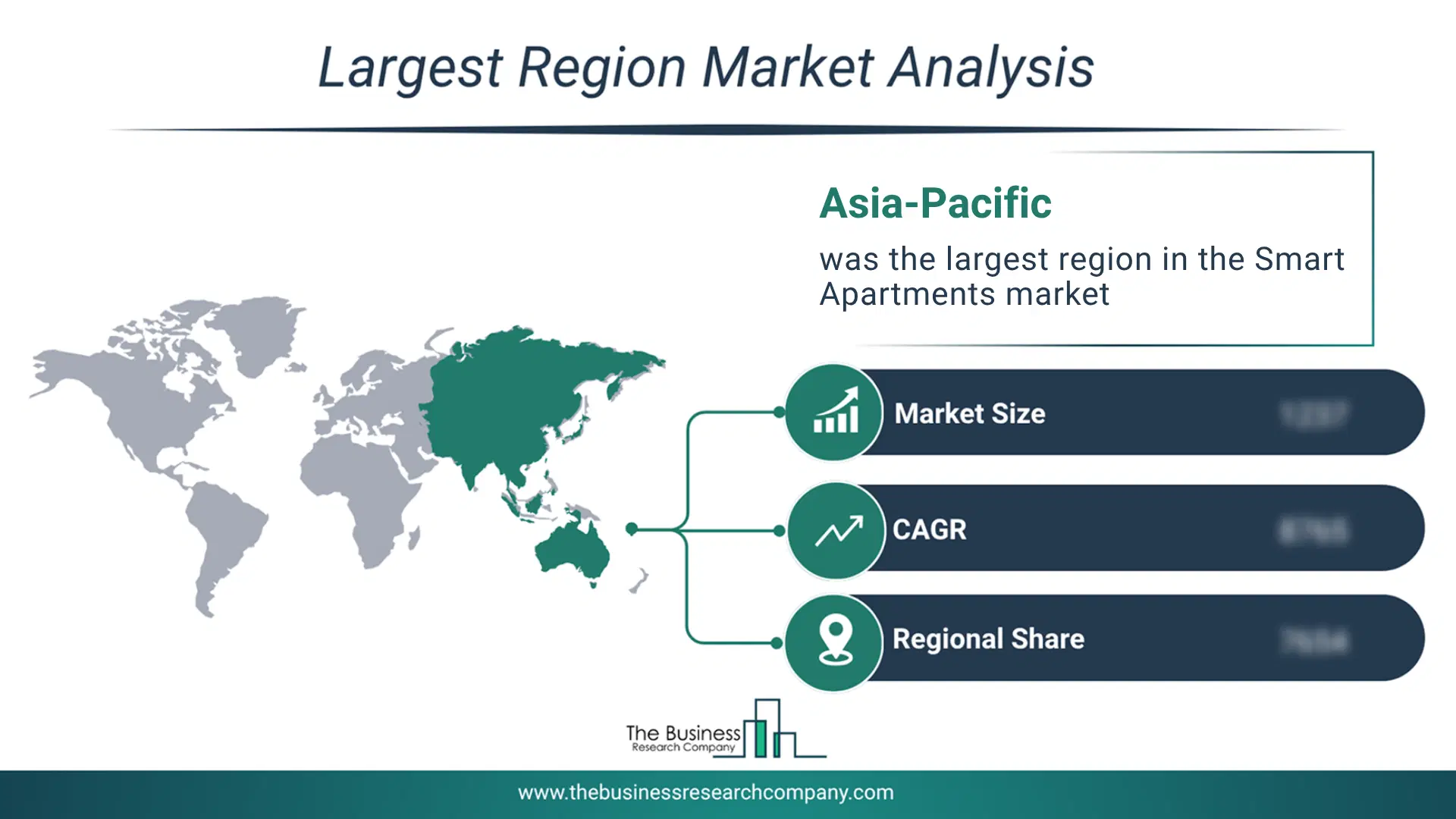
Regional Insights
Asia-Pacific was the largest region in the smart apartments market in 2025. Africa is expected to be the fastest-growing region in the global smart apartments market during the forecast period. The regions covered in this market report are Asia-Pacific, South East Asia, Western Europe, Eastern Europe, North America, South America, Middle East, Africa. The countries covered in this market report are Australia, Brazil, China, France, Germany, India, Indonesia, Japan, Taiwan, Russia, South Korea, UK, USA, Canada, Italy, Spain.What Defines the Smart Apartments Market?
The smart apartments construction market includes revenues earned by entities by constructing or remodeling and renovating smart apartments. This market includes the sales of residential housing general contractors (that is new construction, remodeling, or renovating existing residential structures), for-sale builders and remodelers of residential structures, residential project construction management firms, and residential design-build firms. The smart apartment work performed includes new work, additions, alterations, maintenance, and repairs. Smart buildings use automatic processes to control the buildings' operations, such as air conditioning, lighting, security and other systems. The market value includes the value of related goods sold by the service provider or included within the service offering. Only goods and services traded between entities or sold to end consumers are included.How is Market Value Defined and Measured?
The market value is defined as the revenues that enterprises gain from the sale of goods and/or services within the specified market and geography through sales, grants, or donations in terms of the currency (in USD unless otherwise specified). The revenues for a specified geography are consumption values that are revenues generated by organizations in the specified geography within the market, irrespective of where they are produced. It does not include revenues from resales along the supply chain, either further along the supply chain or as part of other products.
This chart presents market attractiveness based on a quantitative evaluation of growth, competition, strategic alignment, and risk, offering a clear view of opportunity areas for decision-making. This chart is for illustrative purposes; the full report contains the complete analysis.

This chart highlights the Total Addressable Market (TAM) by estimating the maximum revenue opportunity using an assumption-driven approach, supporting strategic planning and opportunity sizing across markets. The chart is illustrative; the full report provides a more comprehensive analysis.
What Key Data and Analysis Are Included in theSmart Apartments Market Report 2026?
The smart apartments market research report is one of a series of new reports from The Business Research Company that provides market statistics, including industry global market size, regional shares, competitors with the market share, detailed market segments, market trends and opportunities, and any further data you may need to thrive in the smart apartments industry. The market research report delivers a complete perspective of everything you need, with an in-depth analysis of the current and future state of the industry.Smart Apartments Market Report Forecast Analysis
| Report Attribute | Details |
|---|---|
| Market Size Value In 2026 | $4.68 billion |
| Revenue Forecast In 2030 | $7.55 billion |
| Growth Rate | CAGR of 12.5% from 2026 to 2030 |
| Base Year For Estimation | 2025 |
| Actual Estimates/Historical Data | 2020-2025 |
| Forecast Period | 2026 - 2030 |
| Market Representation | Revenue in USD Billion and CAGR from 2026 to 2030 |
| Segments Covered | Product, Technology, Application |
| Regional Scope | Asia-Pacific, Western Europe, Eastern Europe, North America, South America, Middle East, Africa |
| Country Scope | The countries covered in this market report are Australia, Brazil, China, France, Germany, India, Indonesia, Japan, Taiwan, Russia, South Korea, UK, USA, Canada, Italy, Spain |
| Key Companies Profiled | Amazon.com Inc., Leviton Manufacturing Co. Inc., Apple Inc., Google LLC, Samsung Electronics Co. Ltd, Honeywell International Inc., Lennar Corporation, Schneider Electric SE, August Home, Asea Brown Boveri Ltd Ltd., Pulte Group Inc., Rachio Inc., Meritage Homes Corporation, Logitech International S.A., Yale, Crestron Electronics Inc., Vivint Smart Home Inc., Somfy Group, Metricon Homes LLC, Netatmo, Savant Systems LLC, Ecobee Inc., Lutron Electronics Co. Inc., Porter Davis Homes, Shea Homes, Henley Properties, Tado GmbH, Philips Hue, Control4 Corporation |
| Customization Scope | Request for Customization |
| Pricing And Purchase Options | Explore Purchase Options |