
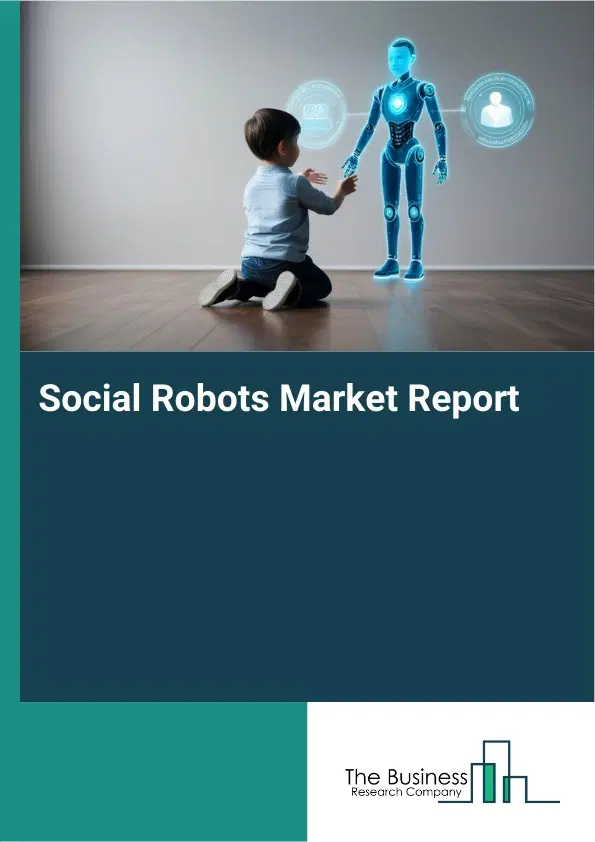
Social Robots Market Report 2026
Global Outlook – By Component (Hardware, Software, Services), By Technology (Machine Learning, Computer Vision, Context Awareness, Natural Language Processing), By Industry (Public Utility, Media And Entertainment, Education, Hospitality, Healthcare, Other Industries) – Market Size, Trends, Strategies, and Forecast to 2030
Social Robots Market Overview
• Social Robots market size has reached to $7.57 billion in 2025 • Expected to grow to $32.94 billion in 2030 at a compound annual growth rate (CAGR) of 34.5% • Growth Driver: Rise In The Adoption Of Smart Homes Demand Boosts Social Robot Market • Market Trend: Innovative Integration Of Artificial Intelligence And Machine Learning Boosts Social Robot Market • Asia-Pacific was the largest region in 2025 and North America is the fastest growing region.What Is Covered Under Social Robots Market?
Social robots refer to autonomous machines or artificial agents designed to interact and communicate with humans in a social and human-like manner. These robots are created with artificial intelligence and are outfitted with sensors, cameras, microphones and other technological devices. It is used in various applications, including companionship for older people or individuals with disabilities, educational tools, therapy and rehabilitation aids, customer service representatives and entertainment. The main types of social robots’ components are hardware, software and services. Hardware refers to the physical components of a system that can be touched or viewed. The various technologies employed are machine learning, computer vision, context awareness and natural language processing used in public utility, media and entertainment, education, hospitality, healthcare, telecommunication, banking, financial services and insurance (BFSI) and others.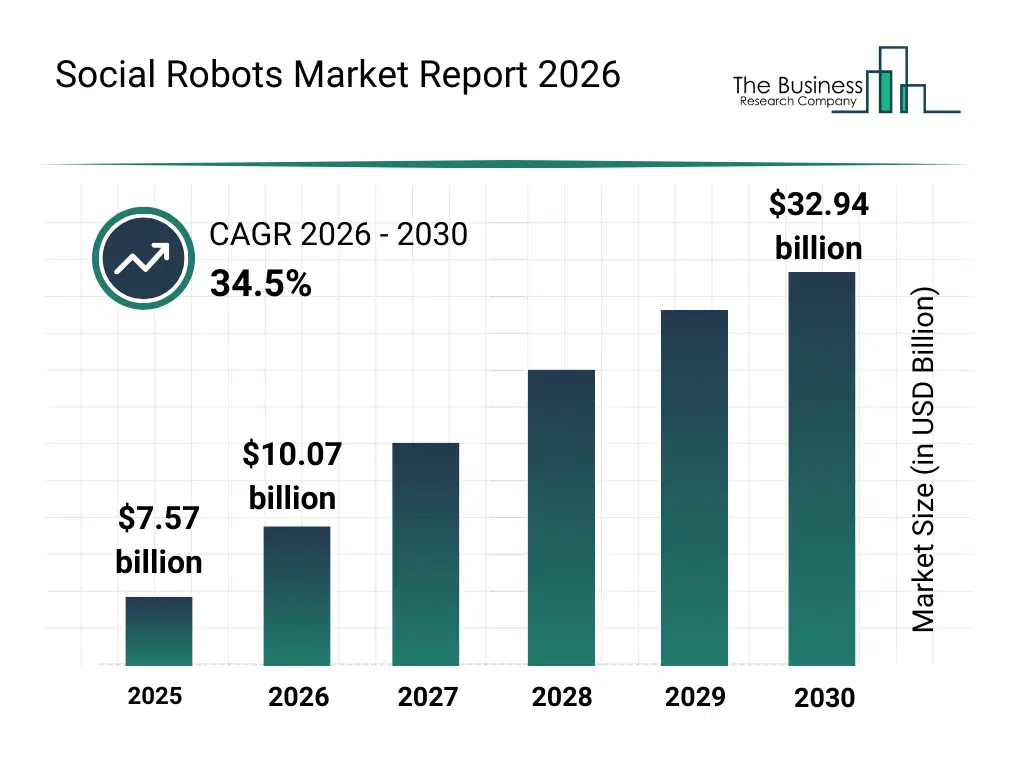
What Is The Social Robots Market Size and Share 2026?
The social robots market size has grown exponentially in recent years. It will grow from $7.57 billion in 2025 to $10.07 billion in 2026 at a compound annual growth rate (CAGR) of 33.1%. The growth in the historic period can be attributed to advancements in artificial intelligence algorithms, early adoption of service robots, growing need for assisted care solutions, expansion of educational technology tools, availability of basic human-interactive robotic platforms.What Is The Social Robots Market Growth Forecast?
The social robots market size is expected to see exponential growth in the next few years. It will grow to $32.94 billion in 2030 at a compound annual growth rate (CAGR) of 34.5%. The growth in the forecast period can be attributed to increasing aging population needs, rising demand for personalized care technologies, expansion of AI-powered customer engagement solutions, growing investments in human-centric robotics, increasing acceptance of robots in social environments. Major trends in the forecast period include increasing deployment of AI-driven social interaction robots, rising adoption of robots in healthcare and elderly care, growing use of social robots in education settings, expansion of emotion and context-aware robotics, enhanced focus on human-robot interaction design.
Global Social Robots Market Segmentation
1) By Component: Hardware, Software, Services 2) By Technology: Machine Learning, Computer Vision, Context Awareness, Natural Language Processing 3) By Industry: Public Utility, Media And Entertainment, Education, Hospitality, Healthcare, Other Industries Subsegments: 1) By Hardware: Sensors, Actuators, Processors, Power Supply, Communication Modules 2) By Software: Operating Systems, Application Software, Development Software 3) By Services: Integration Services, Maintenance and Support Services, Training And Consulting ServicesWhat Is The Driver Of The Social Robots Market?
The rise in the adoption of smart homes is expected to propel the growth of the social robot market. A smart home is a residence equipped with connected devices and automation systems that enable remote control and efficient management of various functions, such as lighting, security, heating, and entertainment. Social robots in smart homes act as intelligent companions and control hubs, facilitating voice-activated device management and personalized assistance, enhancing convenience, security, and the overall quality of life for residents. For instance, in November 2023, according to a study by Secure Data Recovery, a US-based expert data recovery company, the adoption of smart home devices among Americans has significantly increased, with the percentage of U.S. households using such technology rising from 6.9% to 22.3% in 2023. States including Connecticut, Utah, and Maryland lead in smart home adoption, with 28.2%, 27.8%, and 27.6% of their populations using smart technology, respectively. Therefore, the rise in the adoption of smart homes is driving the growth of the social robot industry.Key Players In The Global Social Robots Market
Major companies operating in the social robots market are UBTECH Robotics Inc., Hanson Robotics Ltd., Furhat Robotics AB, Blue Frog Robotics SAS, Embodied Inc., Wonder Workshop Inc., Cyberdyne Inc., Toyota Motor Corporation, Honda Motor Co. Ltd., Sony Corporation, Samsung Electronics Co. Ltd., Hasbro Inc., WowWee Group Limited, Double Robotics Inc., Unaliwear Inc., Diligent Robotics Inc., KOMPAI Robotics, Agility Robotics Inc., Apptronik Inc., Moley Robotics Ltd.
This chart is for illustrative purposes; the full report includes a detailed competitor analysis and comprehensive overview of the top 10 companies in the market.
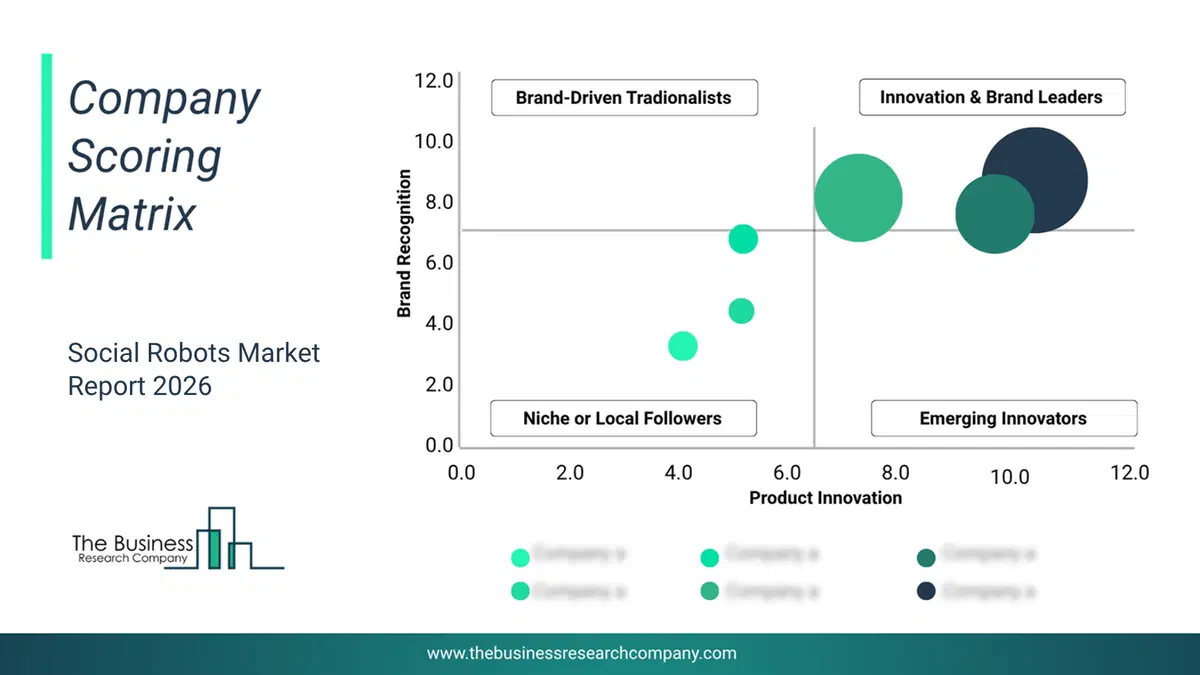
This chart maps companies by product innovation and brand strength, with bubble size indicating relative revenue, helping identify market leaders, challengers, and niche players. This is an illustrative chart; the full report provides a complete and accurate competitive analysis.
Global Social Robots Market Trends and Insights
Major companies in the social robot market are integrating innovative technologies such as artificial intelligence and machine learning into their solutions to sustain their position in the market. Artificial intelligence is the modeling of human intelligence processes by computers, particularly computer systems, whereas machine learning is how a computer system develops its intelligence. For instance, in November 2024, Honda Research Institute Japan (HRI JP), a subsidiary of Honda Motor Co., Ltd., a Japan-based mobility and technology company, launched the social robot Haru at the Virgen del Rocío University Hospital (HUVR) in Seville, Spain. The robot is designed to enhance the emotional well-being of children undergoing long-term hospital care. Haru uses built-in cameras and microphones to obtain biometric information (such as facial expressions and voice tones), analyzes the data using AI to gauge the user’s current state, and interacts through empathetic expressions and emotionally supportive responses. In addition, Haru can link with a wristwatch-type wearable sensor for more profound condition analysis. The compact 30 cm tall robot can be placed on a table and is designed to communicate in a neutral perspective (avoiding human attributes such as gender, race, or nationality) to facilitate group interactions across generational and cultural differences.What Are Latest Mergers And Acquisitions In The Social Robots Market?
In April 2025, Hugging Face, a France-based provider of open‑source AI models and developer tools, acquired Pollen Robotics for an undisclosed amount. With this acquisition, Hugging Face aims to expand from software into hardware by integrating Pollen’s humanoid robot Reachy 2 into its open-source ecosystem, thereby strengthening its position in the burgeoning social‑robotics market. Pollen Robotics, a France-based company that develops open‑source humanoid robots (such as Reachy 2) designed for educational, research, and home‑assistant applications.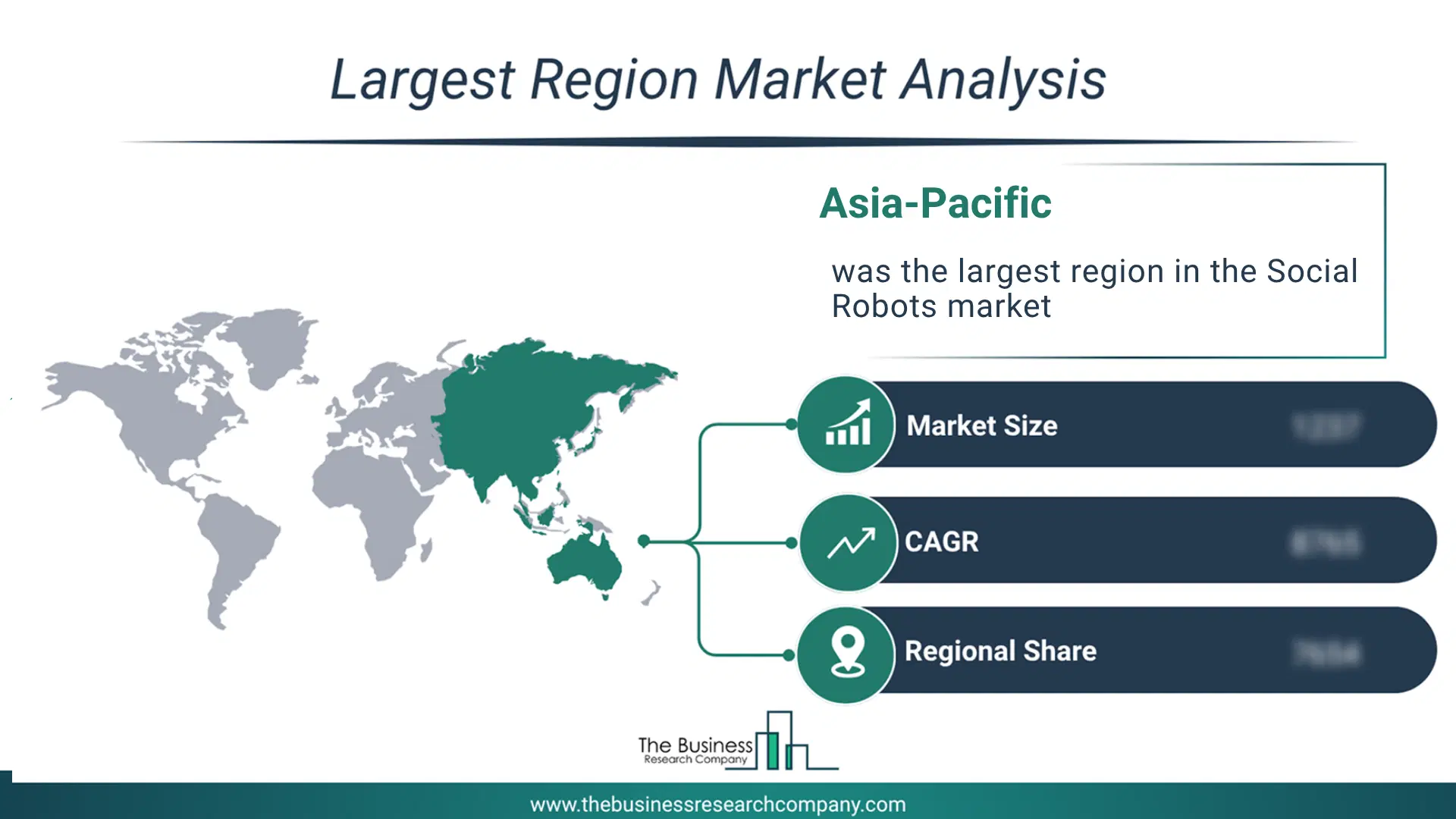
Regional Insights
Asia-Pacific was the largest region in the social robot’s market in 2025. North America is expected to be the fastest-growing region in the forecast period. The regions covered in this market report are Asia-Pacific, South East Asia, Western Europe, Eastern Europe, North America, South America, Middle East, Africa. The countries covered in this market report are Australia, Brazil, China, France, Germany, India, Indonesia, Japan, Taiwan, Russia, South Korea, UK, USA, Canada, Italy, Spain.What Defines the Social Robots Market?
The social robots market consists of revenues earned by entities by providing such as companionship and emotional support, customer service, tutoring, healthcare and well-being coaching. The market value includes the value of related goods sold by the service provider or included within the service offering. The social robots market also includes sales of anthropomorphic, zoomorphic, caricatured and functional robots. Values in this market are ‘factory gate’ values, that is the value of goods sold by the manufacturers or creators of the goods, whether to other entities (including downstream manufacturers, wholesalers, distributors and retailers) or directly to end customers. The value of goods in this market includes related services sold by the creators of the goods.How is Market Value Defined and Measured?
The market value is defined as the revenues that enterprises gain from the sale of goods and/or services within the specified market and geography through sales, grants, or donations in terms of the currency (in USD unless otherwise specified). The revenues for a specified geography are consumption values that are revenues generated by organizations in the specified geography within the market, irrespective of where they are produced. It does not include revenues from resales along the supply chain, either further along the supply chain or as part of other products.
This chart presents market attractiveness based on a quantitative evaluation of growth, competition, strategic alignment, and risk, offering a clear view of opportunity areas for decision-making. This chart is for illustrative purposes; the full report contains the complete analysis.

This chart highlights the Total Addressable Market (TAM) by estimating the maximum revenue opportunity using an assumption-driven approach, supporting strategic planning and opportunity sizing across markets. The chart is illustrative; the full report provides a more comprehensive analysis.
What Key Data and Analysis Are Included in the Social Robots Market Report 2026?
The social robots market research report is one of a series of new reports from The Business Research Company that provides market statistics, including industry global market size, regional shares, competitors with the market share, detailed market segments, market trends and opportunities, and any further data you may need to thrive in the social robots industry. The market research report delivers a complete perspective of everything you need, with an in-depth analysis of the current and future state of the industry.Social Robots Market Report Forecast Analysis
| Report Attribute | Details |
|---|---|
| Market Size Value In 2026 | $10.07 billion |
| Revenue Forecast In 2030 | $32.94 billion |
| Growth Rate | CAGR of 34.5% from 2026 to 2030 |
| Base Year For Estimation | 2025 |
| Actual Estimates/Historical Data | 2020-2025 |
| Forecast Period | 2026 - 2030 |
| Market Representation | Revenue in USD Billion and CAGR from 2026 to 2030 |
| Segments Covered | Component, Technology, Industry |
| Regional Scope | Asia-Pacific, Western Europe, Eastern Europe, North America, South America, Middle East, Africa |
| Country Scope | The Countries Covered In This Market Report Are Australia, Brazil, China, France, Germany, India, Indonesia, Japan, Taiwan, Russia, South Korea, Uk, Usa, Canada, Italy, Spain. |
| Key Companies Profiled | UBTECH Robotics Inc., Hanson Robotics Ltd., Furhat Robotics AB, Blue Frog Robotics SAS, Embodied Inc., Wonder Workshop Inc., Cyberdyne Inc., Toyota Motor Corporation, Honda Motor Co. Ltd., Sony Corporation, Samsung Electronics Co. Ltd., Hasbro Inc., WowWee Group Limited, Double Robotics Inc., Unaliwear Inc., Diligent Robotics Inc., KOMPAI Robotics, Agility Robotics Inc., Apptronik Inc., Moley Robotics Ltd. |
| Customization Scope | Request for Customization |
| Pricing And Purchase Options | Explore Purchase Options |