
Space Elevator Infrastructure Market Report 2026
Global Outlook – By Component (Tether, Climbers, Power Systems, Ground Station, Other Components), By Material Type (Carbon Nanotubes, Graphene, Diamond Nanothreads, Other Material Types), By Application (Commercial, Military, Scientific Research, Other Applications), By End-User (Space Agencies, Private Enterprises, Research Institutions, Other End-Users) – Market Size, Trends, Strategies, and Forecast to 2030
Space Elevator Infrastructure Market Overview
• Space Elevator Infrastructure market size has reached to $0.57 billion in 2025 • Expected to grow to $2.43 billion in 2030 at a compound annual growth rate (CAGR) of 33.3% • Growth Driver: The Increasing Space Exploration Activities Are Fueling The Growth Of The Market Due To Innovations In Materials, Robotics, And Orbital Systems • Market Trend: Advancement Of Carbon Nanotube Tether Systems For Scalable Space Elevator Infrastructure • North America was the largest region in 2025.What Is Covered Under Space Elevator Infrastructure Market?
Space elevator infrastructure refers to the system of physical structures and technologies required to build and operate a space elevator, a theoretical transportation system designed to move materials and people from Earth’s surface directly into space. This infrastructure aims to provide a more efficient, cost-effective, and sustainable way of accessing space compared to conventional rocket launches. The main component types of the space elevator infrastructure are tether, climbers, power systems, ground station, and others. Tether refers to the ultra-strong cable that extends from the Earth's surface into space, enabling climbers to travel along it and transport cargo or passengers. It is made up of several material types, such as carbon nanotubes, graphene, diamond nanothreads, and others. for various applications, including commercial, military, scientific research, and others, and is used by several end users, such as space agencies, private enterprises, research institutions, and others.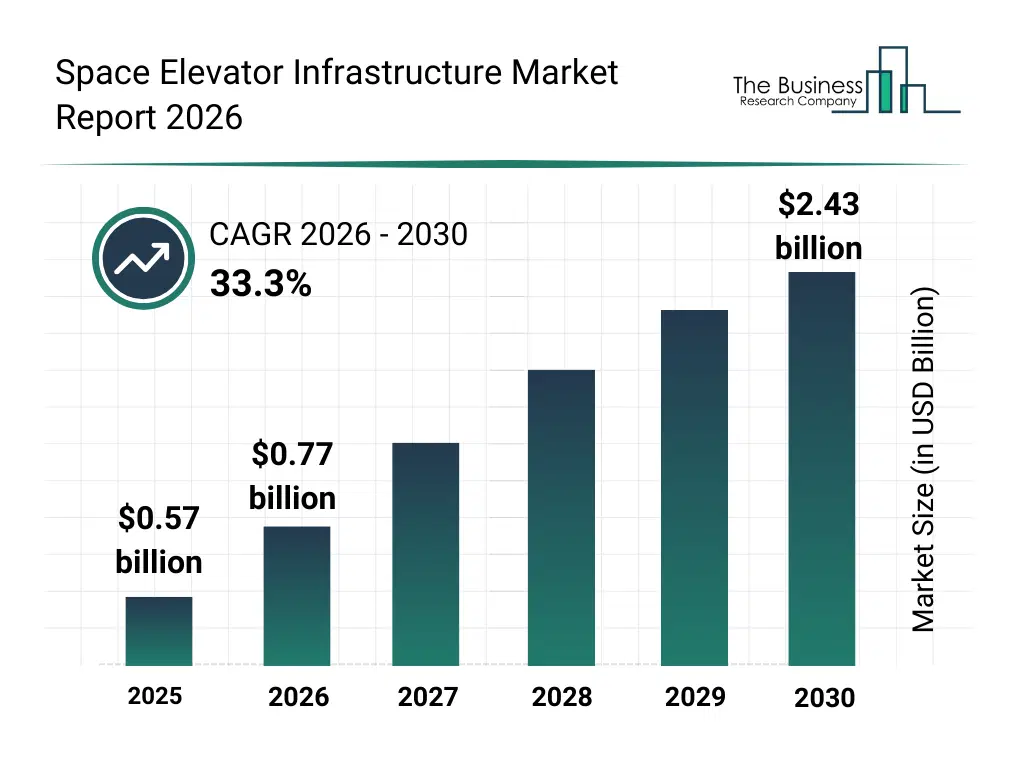
What Is The Space Elevator Infrastructure Market Size and Share 2026?
The space elevator infrastructure market size has grown exponentially in recent years. It will grow from $0.57 billion in 2025 to $0.77 billion in 2026 at a compound annual growth rate (CAGR) of 35.1%. The growth in the historic period can be attributed to early experimentation with robotic maintenance concepts for large-scale space structures, foundational development of ground control station architectures for continuous space-to-earth coordination, initial research into sensor systems for real-time structural health monitoring of long-span tethers, pioneering studies on laser-beam propulsion and microwave power transmission for climber energy supply, growing interest in alternative space access infrastructure to reduce reliance on rockets.What Is The Space Elevator Infrastructure Market Growth Forecast?
The space elevator infrastructure market size is expected to see exponential growth in the next few years. It will grow to $2.43 billion in 2030 at a compound annual growth rate (CAGR) of 33.3%. The growth in the forecast period can be attributed to advancements in autonomous robotic maintenance units for continuous tether inspection and repair, increasing adoption of next-generation sensor networks enabling precision monitoring of space elevator systems, development of high-efficiency laser and microwave power beaming platforms for large-scale operational deployment, rising investment in ground control and communication infrastructure to support space elevator operations, growing collaboration between government and private entities to accelerate megastructure infrastructure readiness. Major trends in the forecast period include advancements in high-strength nanomaterial engineering, increased adoption of power-beaming technologies, rising investment in space infrastructure prototyping, standardization of orbital safety and regulatory frameworks, development of multi-purpose climbers for cargo, research, and emergency use.
Global Space Elevator Infrastructure Market Segmentation
1) By Component: Tether, Climbers, Power Systems, Ground Station, Other Components 2) By Material Type: Carbon Nanotubes, Graphene, Diamond Nanothreads, Other Material Types 3) By Application: Commercial, Military, Scientific Research, Other Applications 4) By End-User: Space Agencies, Private Enterprises, Research Institutions, Other End-Users Subsegments: 1) By Tether: Carbon Nanotube-Based Tether, Graphene-Based Tether, Diamond Nanothread-Based Tether, Hybrid Composite Tether, Polymer Nanofiber Tether 2) By Climbers: Cargo Climbers, Passenger Climbers, Robotic Maintenance Climbers, High-Speed Climbers, Emergency Evacuation Climbers 3) By Power Systems: Laser Power Beaming Systems, Microwave Power Transmission Systems, Solar Power Systems, Battery-Powered Systems, Hybrid Energy Systems 4) By Ground Station: Anchor Foundation Systems, Climber Control Centers, Communication Hubs, Power Transmission Modules, Weather And Environmental Monitoring Units 5) By Other Components: Tether Tension Management Systems, Climber Docking And Launch Mechanisms, Orbital Counterweight Modules, Safety And Fail-Safe Systems, Monitoring And Diagnostic SystemsWhat Is Driver Of The Space Elevator Infrastructure Market?
The growing investment in the space industry is expected to propel the growth of the space elevator infrastructure market going forward. The space industry investment involves public and private sector funding to advance and commercialize space technologies, infrastructure, and services. The rise of investment in the space industry is due to increasing interest in space commercialization, as companies seek to develop profitable ventures in satellite services, space tourism, and in-orbit manufacturing. Investments in the space industry aid space elevator development by financing cutting-edge material innovations and essential infrastructure. They also boost advancements in robotics, propulsion, and orbital systems needed for construction and maintenance. For instance, in December 2024, according to the European Space Agency, a France-based intergovernmental organization, in 2024, space budgets reached €121 billion ($138.75 billion), reflecting a 7% increase from 2023, with 47% allocated to civil spending, a 5% rise compared to the previous year. Therefore, the growing investment in the space industry drives growth in the space elevator infrastructure industry.Key Players In The Global Space Elevator Infrastructure Market
Major companies operating in the space elevator infrastructure market are Lockheed Martin Corporation, National Aeronautics and Space Administration, Obayashi Corporation, Shimizu Corporation, Space Exploration Technologies Corp., Redwire (LoadPath), Tethers Unlimited Incorporated, Thoth Technology Incorporated, LiftPort Group, PowerLight Technologies, Emrod Limited, Libre Space Foundation, AstraBeam Incorporated, Etheria, The Space Elevator Company, Astrostrom, International Space Elevator Consortium, Spaceward Foundation, Carbon Designs Inc., Shizuoka University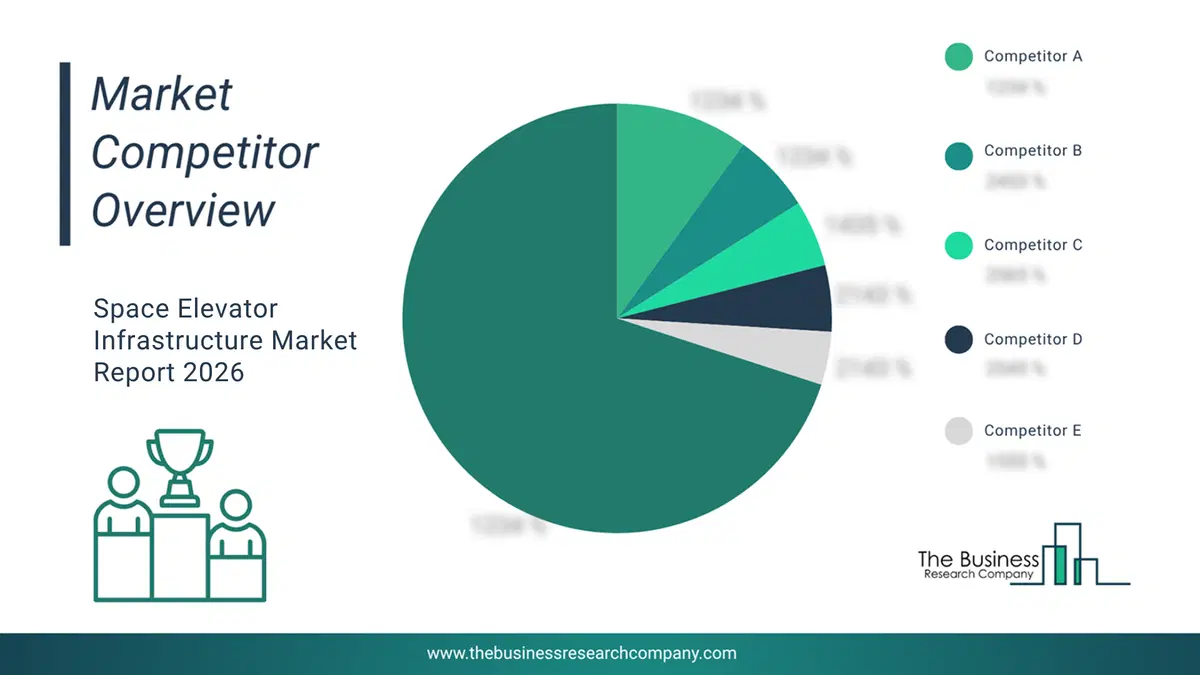
This chart is for illustrative purposes; the full report includes a detailed competitor analysis and comprehensive overview of the top 10 companies in the market.
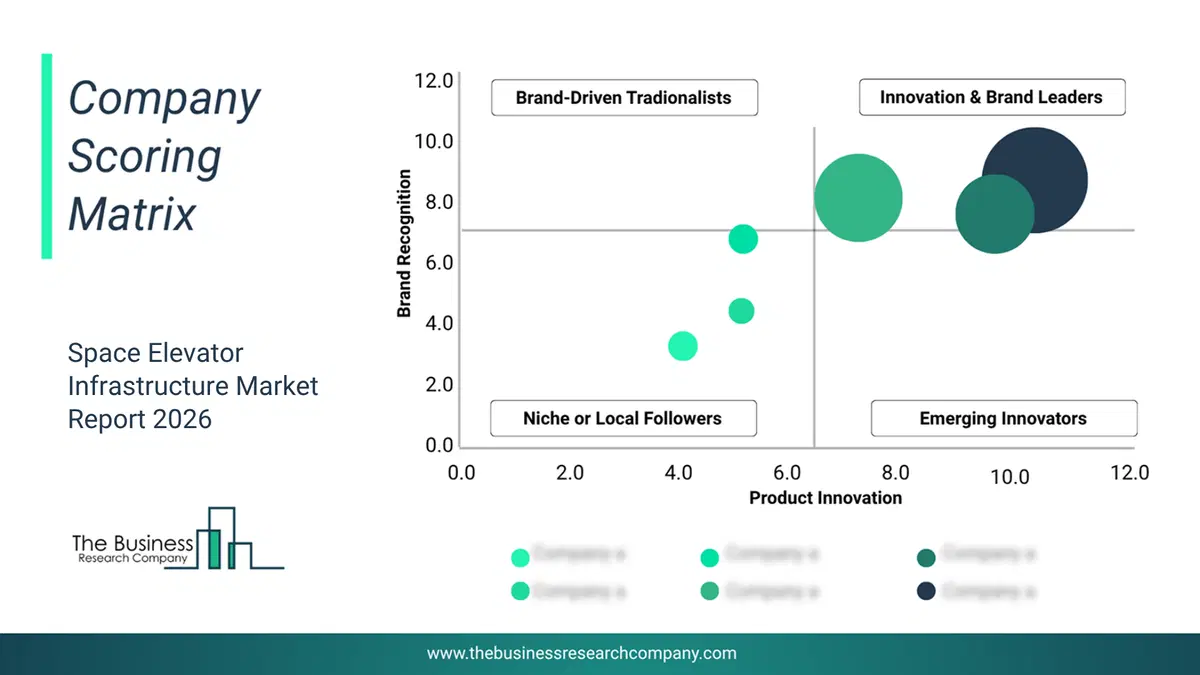
This chart maps companies by product innovation and brand strength, with bubble size indicating relative revenue, helping identify market leaders, challengers, and niche players. This is an illustrative chart; the full report provides a complete and accurate competitive analysis.
Global Space Elevator Infrastructure Market Trends and Insights
Major companies operating in the space elevator infrastructure market are focusing on developing advanced products, such as carbon nanotube-based tether systems, to enable strong, lightweight, and scalable space elevator structures. Carbon nanotube-based tether systems refer to ultra-strong and flexible materials engineered at the nanoscale, capable of supporting the immense tensile strength required to connect Earth to geostationary orbit for elevator transport. For instance, in June 2024, Obayashi Corporation, a Japan-based construction company, announced its plan to build a full-scale space elevator by 2050. The proposed system uses carbon nanotube materials to create a 96,000 km tether linking Earth to a space station in geostationary orbit. This elevator aims to reduce space transport costs drastically, enhance safety over traditional rockets, and support sustainable, long-term space infrastructure. It also envisions future cargo delivery, space tourism, and satellite deployment applications.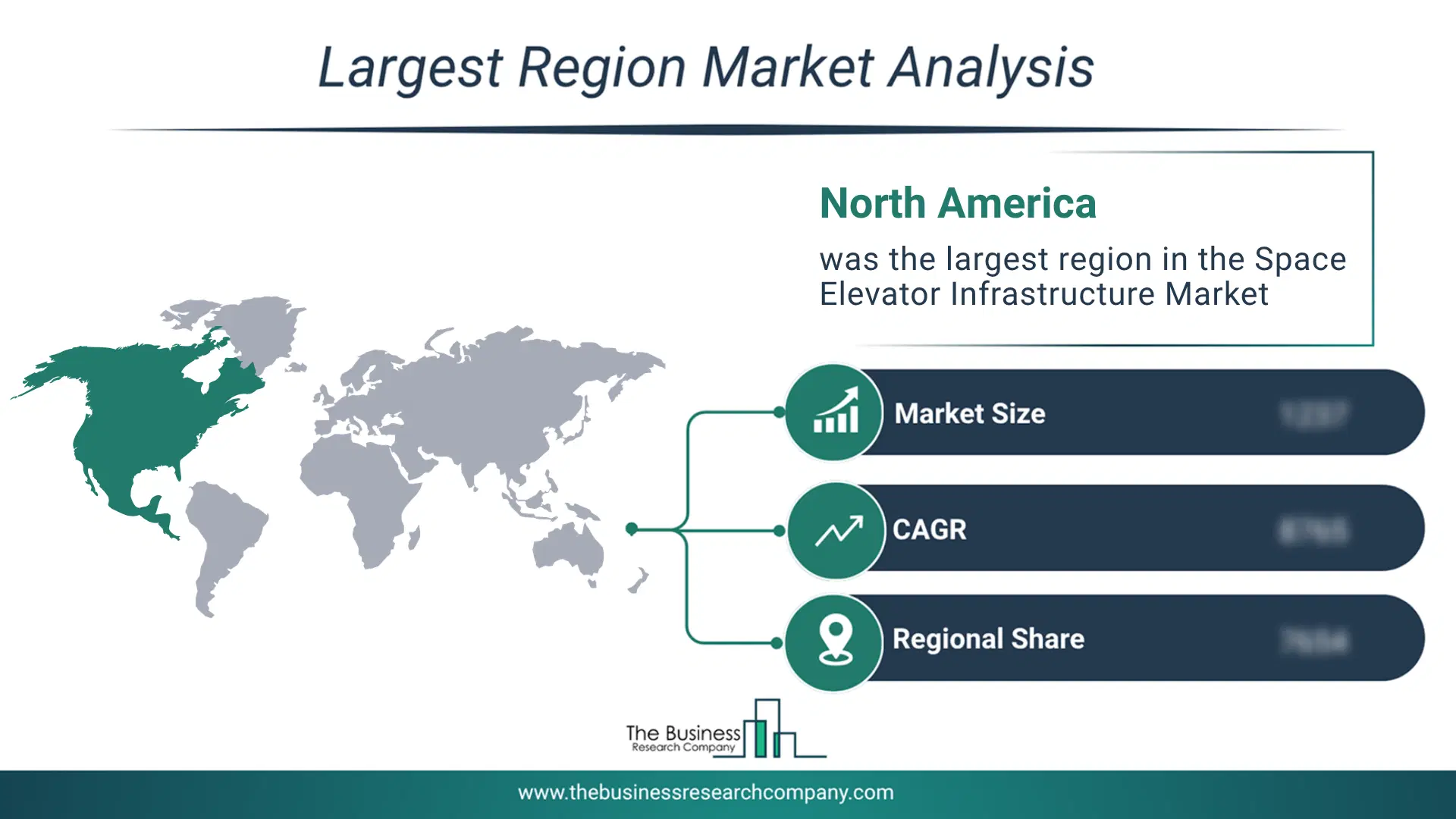
Regional Insights
North America was the largest region in the space elevator infrastructure market in 2025. The regions covered in this market report are Asia-Pacific, South East Asia, Western Europe, Eastern Europe, North America, South America, Middle East, Africa. The countries covered in this market report are Australia, Brazil, China, France, Germany, India, Indonesia, Japan, Taiwan, Russia, South Korea, UK, USA, Canada, Italy, SpainWhat Defines the Space Elevator Infrastructure Market?
The space elevator infrastructure market consists of sales of robotic maintenance units, ground control stations, sensor systems, laser-beam propelled, and microwave power beaming. Values in this market are ‘factory gate’ values, that is, the value of goods sold by the manufacturers or creators of the goods, whether to other entities (including downstream manufacturers, wholesalers, distributors, and retailers) or directly to end customers. The value of goods in this market includes related services sold by the creators of the goods.How is Market Value Defined and Measured?
The market value is defined as the revenues that enterprises gain from the sale of goods and/or services within the specified market and geography through sales, grants, or donations in terms of the currency (in USD unless otherwise specified). The revenues for a specified geography are consumption values that are revenues generated by organizations in the specified geography within the market, irrespective of where they are produced. It does not include revenues from resales along the supply chain, either further along the supply chain or as part of other products.
This chart presents market attractiveness based on a quantitative evaluation of growth, competition, strategic alignment, and risk, offering a clear view of opportunity areas for decision-making. This chart is for illustrative purposes; the full report contains the complete analysis.

This chart highlights the Total Addressable Market (TAM) by estimating the maximum revenue opportunity using an assumption-driven approach, supporting strategic planning and opportunity sizing across markets. The chart is illustrative; the full report provides a more comprehensive analysis.
What Key Data and Analysis Are Included in the Space Elevator Infrastructure Market Report 2026?
The space elevator infrastructure market research report is one of a series of new reports from The Business Research Company that provides market statistics, including industry global market size, regional shares, competitors with the market share, detailed market segments, market trends and opportunities, and any further data you may need to thrive in the space elevator infrastructure industry. The market research report delivers a complete perspective of everything you need, with an in-depth analysis of the current and future state of the industry.Space Elevator Infrastructure Market Report Forecast Analysis
| Report Attribute | Details |
|---|---|
| Market Size Value In 2026 | $0.77 billion |
| Revenue Forecast In 2030 | $2.43 billion |
| Growth Rate | CAGR of 33.3% from 2026 to 2030 |
| Base Year For Estimation | 2025 |
| Actual Estimates/Historical Data | 2020-2025 |
| Forecast Period | 2026 - 2030 |
| Market Representation | Revenue in USD Billion and CAGR from 2026 to 2030 |
| Segments Covered | Component, Material Type, Application, End-User |
| Regional Scope | Asia-Pacific, Western Europe, Eastern Europe, North America, South America, Middle East, Africa |
| Country Scope | The countries covered in the space elevator infrastructure market report are Australia, Brazil, China, France, Germany, India, Indonesia, Japan, Taiwan, Russia, South Korea, UK, USA, Canada, Italy, Spain |
| Key Companies Profiled | Lockheed Martin Corporation, National Aeronautics and Space Administration, Obayashi Corporation, Shimizu Corporation, Space Exploration Technologies Corp., Redwire (LoadPath), Tethers Unlimited Incorporated, Thoth Technology Incorporated, LiftPort Group, PowerLight Technologies, Emrod Limited, Libre Space Foundation, AstraBeam Incorporated, Etheria, The Space Elevator Company, Astrostrom, International Space Elevator Consortium, Spaceward Foundation, Carbon Designs Inc., Shizuoka University |
| Customization Scope | Request for Customization |
| Pricing And Purchase Options | Explore Purchase Options |