
Space Surveillance Market Report 2026
Global Outlook – By Component (Software, Hardware, Services), By Orbit Type (Low Earth Orbit, Medium Earth Orbit, Geostationary Orbit, Other Orbit Types), By Application (Military, Commercial, Government, Other Applications), By End-User (Defense, Space Agencies, Satellite Operators, Other End-Users) – Market Size, Trends, Strategies, and Forecast to 2030
Space Surveillance Market Overview
• Space Surveillance market size has reached to $2.02 billion in 2025 • Expected to grow to $3.58 billion in 2030 at a compound annual growth rate (CAGR) of 12.1% • Growth Driver: The Rising Volume Of Satellite Launches Is Fueling The Market Growth Due To The Demand For Improving Space Asset Security And Tracking • Market Trend: Benefits Of Space-Based Tracking Satellites For Space Situational Awareness • North America was the largest region in 2025 and Asia-Pacific is the fastest growing region.What Is Covered Under Space Surveillance Market?
Space surveillance refers to continuously monitoring, tracking, and analyzing objects in Earth's orbit, such as satellites, space debris, and other spacecraft. It uses ground-based or space-based sensors, radar, and optical systems to detect and catalog these objects to prevent collisions, support satellite operations, and ensure national and space security. The main components of space surveillance include software, hardware, and services. Space surveillance software refers to specialized programs and algorithms that analyze data from satellites and ground sensors to detect, track, and predict the behavior of objects in space. Space surveillance systems operate across various orbit types, including low earth orbit (LEO), medium earth orbit (MEO), geostationary orbit (GEO), and other orbits. These systems are used in multiple applications, such as military, commercial, government, and other sectors, and serve various end-users, including defense organizations, space agencies, satellite operators, and others.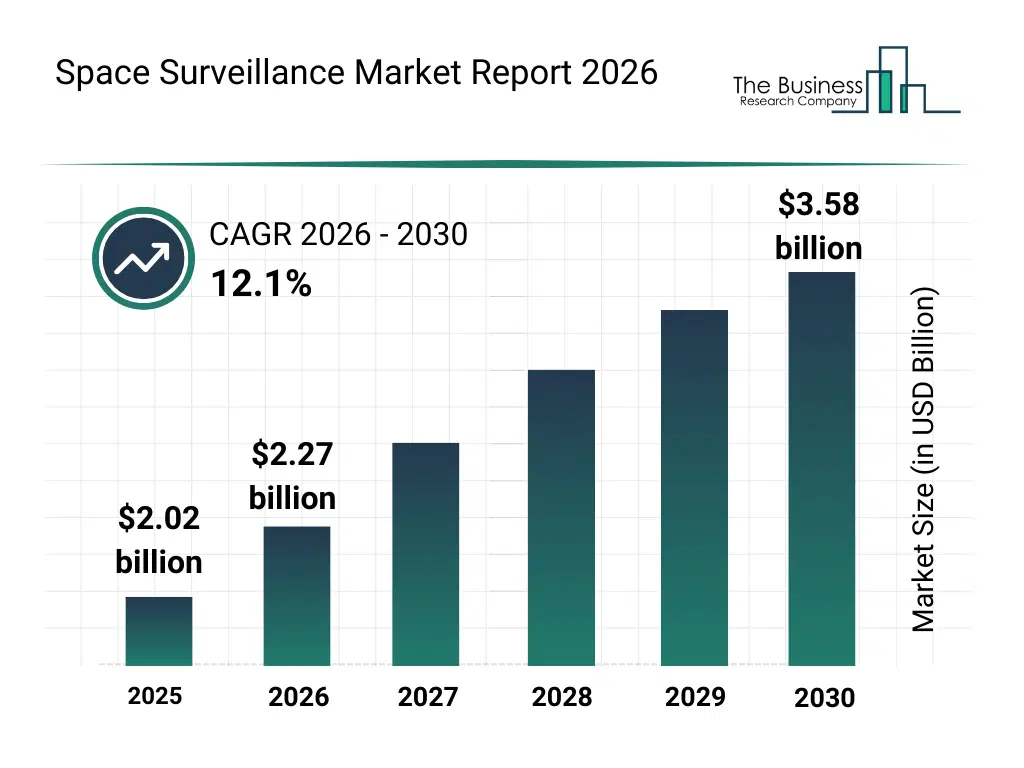
What Is The Space Surveillance Market Size and Share 2026?
The space surveillance market size has grown rapidly in recent years. It will grow from $2.02 billion in 2025 to $2.27 billion in 2026 at a compound annual growth rate (CAGR) of 12.4%. The growth in the historic period can be attributed to early development of ground-based radar systems for tracking satellites and debris, initial deployment of space-based optical telescopes for orbital observation, growth of satellite tracking and identification services, foundational implementation of collision avoidance services for operational spacecraft, early adoption of space situational awareness (ssa) software for data analysis and monitoring.What Is The Space Surveillance Market Growth Forecast?
The space surveillance market size is expected to see rapid growth in the next few years. It will grow to $3.58 billion in 2030 at a compound annual growth rate (CAGR) of 12.1%. The growth in the forecast period can be attributed to expansion of integrated orbital debris tracking and management systems, increasing use of phased array antennas for real-time surveillance, development of advanced electro-optical sensors for high-precision monitoring, rising demand for data sharing and analysis platforms supporting commercial and governmental space operations, growth in space weather monitoring services to enhance operational safety and asset protection. Major trends in the forecast period include enhanced space debris management, integration of space weather monitoring with surveillance, growth in commercial satellite traffic, expansion of space situational awareness (ssa) software, increasing demand for real-time collision avoidance.
Global Space Surveillance Market Segmentation
1) By Component: Software, Hardware, Services 2) By Orbit Type: Low Earth Orbit, Medium Earth Orbit, Geostationary Orbit, Other Orbit Types 3) By Application: Military, Commercial, Government, Other Applications 4) By End-User: Defense, Space Agencies, Satellite Operators, Other End-Users Subsegments: 1) By Software: Orbit Determination Software, Collision Avoidance Software, Space Object Cataloging Software, Visualization Tools, Artificial Intelligence-Based Tracking Software 2) By Hardware: Ground-Based Radars, Optical Telescopes, Space-Based Sensors, Tracking Antennas, Signal Processors 3) By Services: Orbital Analysis Services, Space Object Tracking Services, Data Processing Services, Maintenance And Support Services, Advisory And Consulting ServicesWhat Is Driver Of The Space Surveillance Market?
The increasing number of satellite launches is expected to propel the growth of the space surveillance market going forward. Satellite launches refer to sending artificial satellites into space using launch vehicles (rockets). The increasing number of satellite launches is due to the growing demand for global connectivity, as more satellites are needed to support broadband internet, communication networks, and data services across remote and underserved regions. Satellite launches enable the deployment of advanced surveillance systems into orbit, enhancing the ability to monitor space objects, track orbital debris, and ensure the security and functionality of space assets. For instance, in November 2023, The United States International Trade Commission, a US-based Government agency, reported that in 2023, global space launches were estimated to reach 197, up from 186 recorded in 2022. Therefore, the increasing number of satellite launches is driving the growth of the space surveillance industry.Key Players In The Global Space Surveillance Market
Major companies operating in the space surveillance market are The Boeing Company, Raytheon Technologies Corporation, Lockheed Martin Corporation, Northrop Grumman Corporation, L3Harris Technologies Inc., Thales Alenia Space S.A.S., Kratos Defense & Security Solutions Inc., Airbus Defence and Space S.A., Israel Aerospace Industries Ltd, Electro Optic Systems Pty Ltd, Swedish Space Corporation, Spire Global Inc., Astroscale Holdings Inc., Tekever S.A., Capella Space Inc., Millennium Space Systems Inc., HawkEye 360 Inc., Slingshot Aerospace Inc., Albedo Space, Turion Space
This chart is for illustrative purposes; the full report includes a detailed competitor analysis and comprehensive overview of the top 10 companies in the market.
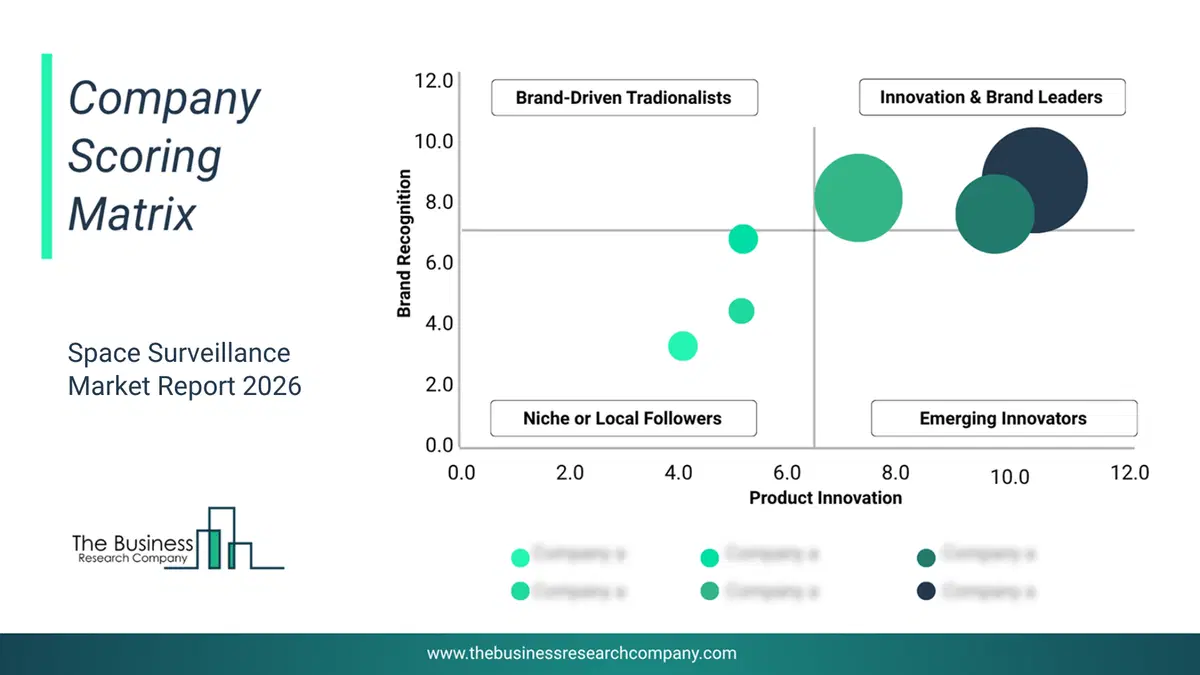
This chart maps companies by product innovation and brand strength, with bubble size indicating relative revenue, helping identify market leaders, challengers, and niche players. This is an illustrative chart; the full report provides a complete and accurate competitive analysis.
Global Space Surveillance Market Trends and Insights
Major companies operating in the space surveillance market are focusing on developing innovative solutions, such as space-based tracking satellites, to enhance real-time monitoring and improve orbital debris detection. Space-based tracking satellites are satellites placed in orbit to monitor and track objects in space, such as debris, satellites, and spacecraft, using onboard sensors and imaging systems. These satellites help improve space situational awareness by providing real-time data on the position, movement, and potential collisions of objects in orbit, ensuring safer navigation and reducing the risk of space debris accidents. For instance, in January 2025, Digantara Research and Technologies Private Limited, an India-based aerospace company, launched SCOT (Space Camera for Object Tracking) aboard SpaceX’s Transporter-12 mission. SCOT is the world’s first commercial space-based space surveillance satellite and marks a significant step forward in global space situational awareness capabilities. This satellite detects and tracks objects as small as five centimeters, allowing frequent revisits and high observation accuracy of low earth orbit (LEO). This capability is critical for avoiding potential collisions, improving orbital traffic management, and supporting satellite operators with more timely and actionable data.What Are Latest Mergers And Acquisitions In The Space Surveillance Market? Firefly Aerospace Acquires Scitec To Strengthen National Security And Space Intelligence Capabilities
In October 2025, Firefly Aerospace, a US-based aerospace and defense technology company, acquired national security technology firm SciTec for an undisclosed amount. With this acquisition, Firefly Aerospace’s aim is to enhance and diversify Firefly's national security and space capabilities by integrating SciTec's mission-proven defense software analytics, remote sensing, and multi-phenomenology data expertise. National security technology firm SciTec is a US-based company that provides space surveillance, along with expertise in missile warning, tracking, and intelligence.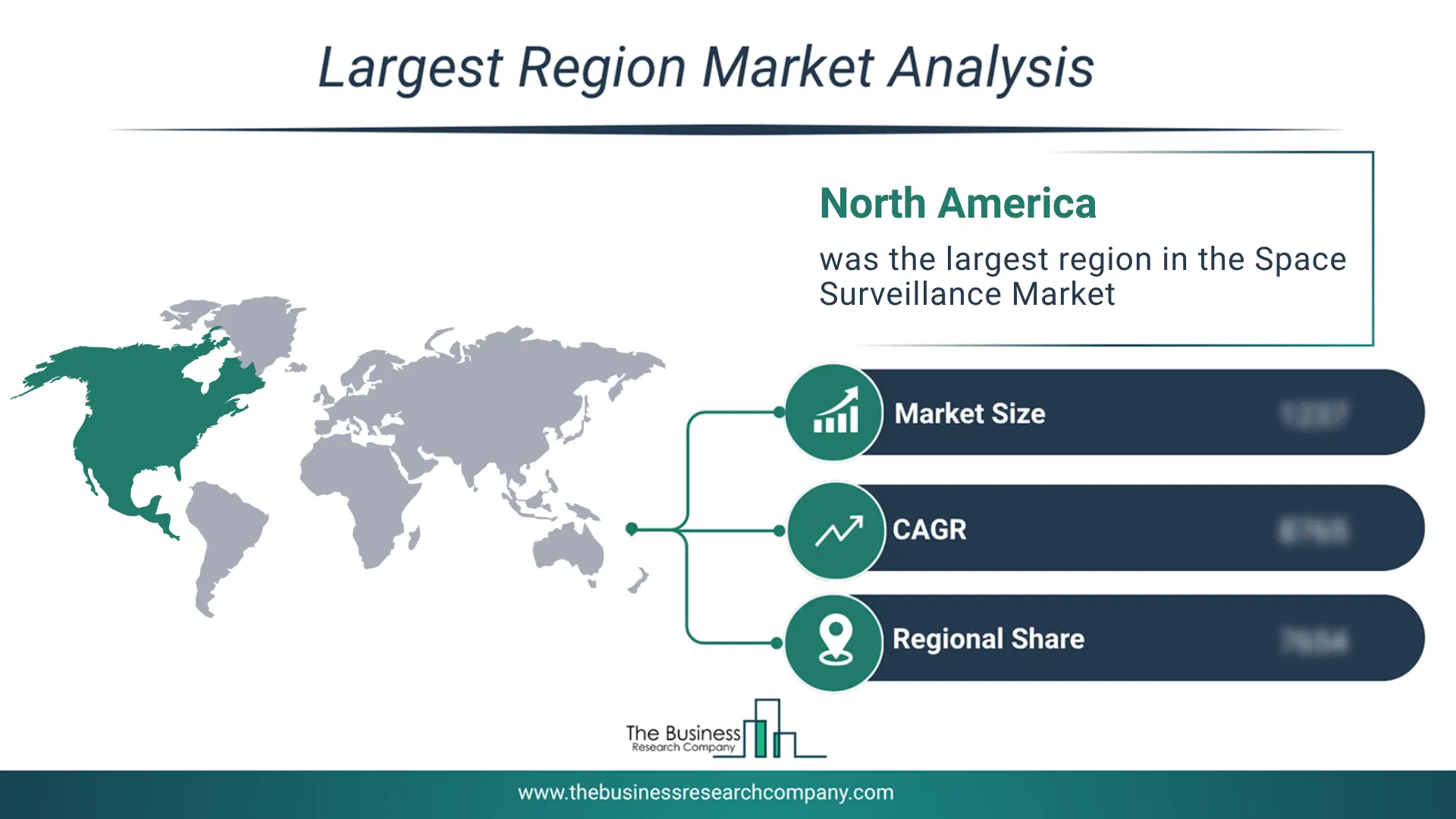
Regional Insights
North America was the largest region in the space surveillance market in 2025. Asia-Pacific is expected to be the fastest-growing region in the forecast period. The regions covered in this market report are Asia-Pacific, South East Asia, Western Europe, Eastern Europe, North America, South America, Middle East, Africa. The countries covered in this market report are Australia, Brazil, China, France, Germany, India, Indonesia, Japan, Taiwan, Russia, South Korea, UK, USA, Canada, Italy, SpainWhat Defines the Space Surveillance Market?
The space surveillance market consists of revenues earned by entities by providing services such as collision avoidance services, data sharing and analysis platform services, orbital debris tracking services, satellite tracking and identification services, and space weather monitoring services. The market value includes the value of related goods sold by the service provider or included within the service offering. The space surveillance market also includes sales of electro-optical sensors, ground-based radar systems, space-based optical telescopes, phased array antennas, and space situational awareness (SSA) software. Values in this market are ‘factory gate’ values, that is, the value of goods sold by the manufacturers or creators of the goods, whether to other entities (including downstream manufacturers, wholesalers, distributors, and retailers) or directly to end customers. The value of goods in this market includes related services sold by the creators of the goods.How is Market Value Defined and Measured?
The market value is defined as the revenues that enterprises gain from the sale of goods and/or services within the specified market and geography through sales, grants, or donations in terms of the currency (in USD unless otherwise specified). The revenues for a specified geography are consumption values that are revenues generated by organizations in the specified geography within the market, irrespective of where they are produced. It does not include revenues from resales along the supply chain, either further along the supply chain or as part of other products.
This chart presents market attractiveness based on a quantitative evaluation of growth, competition, strategic alignment, and risk, offering a clear view of opportunity areas for decision-making. This chart is for illustrative purposes; the full report contains the complete analysis.

This chart highlights the Total Addressable Market (TAM) by estimating the maximum revenue opportunity using an assumption-driven approach, supporting strategic planning and opportunity sizing across markets. The chart is illustrative; the full report provides a more comprehensive analysis.
What Key Data and Analysis Are Included in the Space Surveillance Market Report 2026?
The space surveillance market research report is one of a series of new reports from The Business Research Company that provides market statistics, including industry global market size, regional shares, competitors with the market share, detailed market segments, market trends and opportunities, and any further data you may need to thrive in the space surveillance industry. The market research report delivers a complete perspective of everything you need, with an in-depth analysis of the current and future state of the industry.Space Surveillance Market Report Forecast Analysis
| Report Attribute | Details |
|---|---|
| Market Size Value In 2026 | $2.27 billion |
| Revenue Forecast In 2030 | $3.58 billion |
| Growth Rate | CAGR of 12.1% from 2026 to 2030 |
| Base Year For Estimation | 2025 |
| Actual Estimates/Historical Data | 2020-2025 |
| Forecast Period | 2026 - 2030 |
| Market Representation | Revenue in USD Billion and CAGR from 2026 to 2030 |
| Segments Covered | Component, Orbit Type, Application, End-User |
| Regional Scope | Asia-Pacific, Western Europe, Eastern Europe, North America, South America, Middle East, Africa |
| Country Scope | The countries covered in the space surveillance market report are Australia, Brazil, China, France, Germany, India, Indonesia, Japan, Taiwan, Russia, South Korea, UK, USA, Canada, Italy, Spain |
| Key Companies Profiled | The Boeing Company, Raytheon Technologies Corporation, Lockheed Martin Corporation, Northrop Grumman Corporation, L3Harris Technologies Inc., Thales Alenia Space S.A.S., Kratos Defense & Security Solutions Inc., Airbus Defence and Space S.A., Israel Aerospace Industries Ltd, Electro Optic Systems Pty Ltd, Swedish Space Corporation, Spire Global Inc., Astroscale Holdings Inc., Tekever S.A., Capella Space Inc., Millennium Space Systems Inc., HawkEye 360 Inc., Slingshot Aerospace Inc., Albedo Space, Turion Space |
| Customization Scope | Request for Customization |
| Pricing And Purchase Options | Explore Purchase Options |