
Sustainable Seafood Market Report 2026
Global Outlook – By Product Type (Bivalves And Other Molluscs And Aquatic Invertebrates, Cephalopods, Crustaceans, Flatfish, Freshwater Fish, Groundfish, Salmonids, Small Pelagics, Tuna And Tuna-Like Species, Other Product Types), By Form (Chilled, Frozen, Canned, Other Forms), By Certification Standards (Marine Stewardship Council (MSC), Aquaculture Stewardship Council (Asc), Globalgap, Other Certification Standards), By Distribution Channel (Hypermarkets, Supermarkets, Convenience Stores, Specialty Stores, Online, Other Distribution Channels) – Market Size, Trends, Strategies, and Forecast to 2030
Sustainable Seafood Market Overview
• Sustainable Seafood market size has reached to $16.94 billion in 2025 • Expected to grow to $22.94 billion in 2030 at a compound annual growth rate (CAGR) of 6.2% • Growth Driver: The Rising Demand For High-Protein And Healthy Diets Fueling The Growth Of The Market Due To Increasing Preference For Nutrient-Rich Lean Protein Alternatives • Market Trend: Advancement In Plant-Based Seafood To Address Ethical And Eco-Friendly Consumer Demands • North America was the largest region in 2025 and Europe is the fastest growing region.What Is Covered Under Sustainable Seafood Market?
Sustainable seafood is fish and shellfish sourced through methods that prioritize environmental preservation, economic sustainability, and social responsibility. It focuses on maintaining healthy fish stocks, minimizing harm to marine habitats, and reducing unintended catches. The goal is to secure seafood supplies for the future while protecting ocean ecosystems and supporting local fishing communities. The main product types of sustainable seafood are bivalves and other molluscs and aquatic invertebrates, cephalopods, crustaceans, flatfish, freshwater fish, groundfish, salmonids, small pelagics, tuna and tuna-like species, and others. Bivalves and other molluscs and aquatic invertebrates are soft-bodied, often shelled filter feeders such as clams and oysters, known for their sustainability and low environmental impact. It is available in various forms, such as chilled, frozen, canned, and others, with several certification standards including marine stewardship council (MSC), aquaculture stewardship council (ASC), globalgap, and others, and is distributed through various distribution channels, such as hypermarkets, supermarkets, convenience stores, specialty stores, online, and others.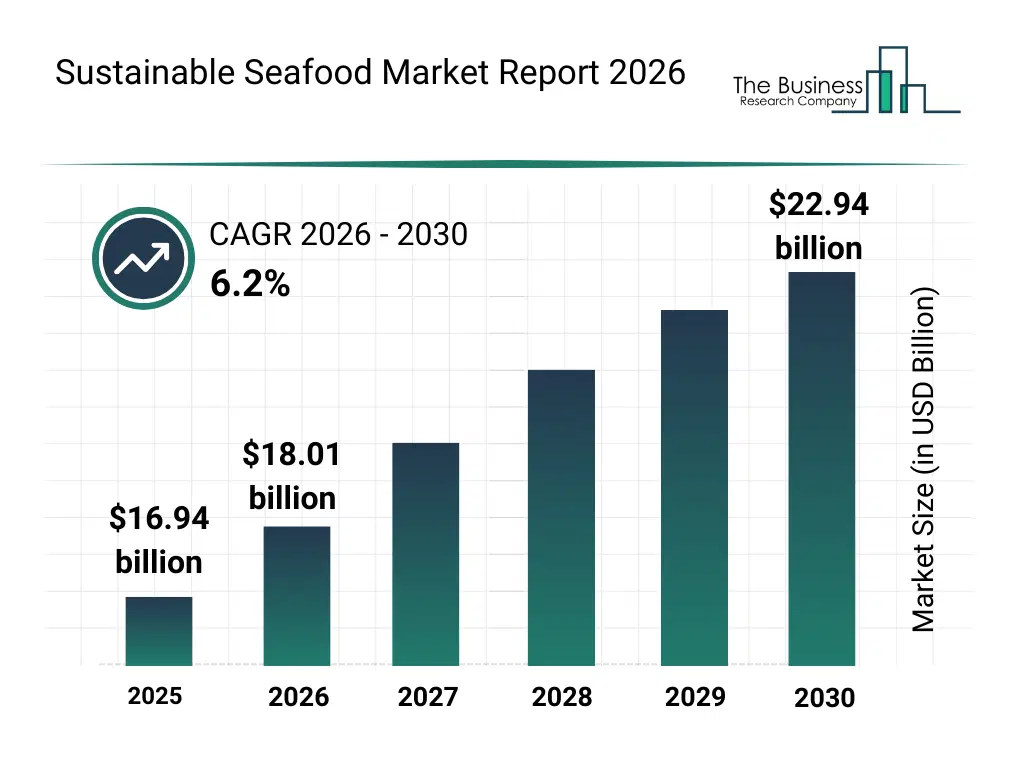
What Is The Sustainable Seafood Market Size and Share 2026?
The sustainable seafood market size has grown strongly in recent years. It will grow from $16.94 billion in 2025 to $18.01 billion in 2026 at a compound annual growth rate (CAGR) of 6.3%. The growth in the historic period can be attributed to increasing consumer awareness of overfishing, expansion of certification programs, growth of global seafood trade, rising regulatory oversight of fisheries, development of aquaculture systems.What Is The Sustainable Seafood Market Growth Forecast?
The sustainable seafood market size is expected to see strong growth in the next few years. It will grow to $22.94 billion in 2030 at a compound annual growth rate (CAGR) of 6.2%. The growth in the forecast period can be attributed to increasing demand for ethically sourced protein, rising use of digital traceability platforms, expansion of sustainable aquaculture investments, growing preference for certified seafood products, increasing retailer sustainability commitments. Major trends in the forecast period include increasing adoption of certified sustainable seafood, rising demand for traceable fish products, growing use of eco-labeling and transparency tools, expansion of responsible aquaculture practices, enhanced focus on supply chain accountability.
Global Sustainable Seafood Market Segmentation
1) By Product Type: Bivalves And Other Molluscs And Aquatic Invertebrates, Cephalopods, Crustaceans, Flatfish, Freshwater Fish, Groundfish, Salmonids, Small Pelagics, Tuna And Tuna-Like Species, Other Product Types 2) By Form: Chilled, Frozen, Canned, Other Forms 3) By Certification Standards: Marine Stewardship Council (MSC), Aquaculture Stewardship Council (Asc), Globalgap, Other Certification Standards 4) By Distribution Channel: Hypermarkets, Supermarkets, Convenience Stores, Specialty Stores, Online, Other Distribution Channels Subsegments: 1) By Bivalves And Other Molluscs And Aquatic Invertebrates: Mussels, Oysters, Clams, Scallops, Sea Cucumbers, Sea Urchins 2) By Cephalopods: Squid, Cuttlefish, Octopus 3) By Crustaceans: Shrimp, Prawns, Lobster, Crab 4) By Flatfish: Halibut, Flounder, Sole 5) By Freshwater Fish: Tilapia, Carp, Catfish, Trout 6) By Groundfish: Cod, Whiting, Pollock, Haddock 7) By Salmonids: Atlantic Salmon, Trout, Pacific Salmon 8) By Small Pelagics: Sardines, Mackerel, Herring, Anchovies 9) By Tuna And Tuna-Like Species: Bluefin Tuna, Skipjack Tuna, Yellowfin Tuna, Albacore Tuna 10) By Other Product Types: Eels, Jellyfish, Seaweed (For Integrated Aquaculture), Mixed Species PacksWhat Is The Driver Of The Sustainable Seafood Market?
The rising demand for high-protein and healthy diets is expected to propel the growth of the sustainable seafood market going forward. High-protein and healthy diets focus on protein-rich, nutrient-packed foods that promote muscle strength, sustained energy, and overall health. High-protein and healthy diets are increasing due to their effectiveness in supporting weight management by promoting fullness and preserving muscle mass. Sustainable seafood supports high-protein and healthy diets by providing a lean, nutrient-rich protein source that's low in saturated fat and rich in omega-3 fatty acids as an alternative to red meat. For instance, in Jun 2024, according to the International Food Information Council (IFIC), a US‑based non‑profit organization, the proportion of Americans who followed a specific diet or eating pattern over the past year remains high at 54%. Most individuals are aiming to increase their protein intake, with interest rising from 59% in 2022 to 67% in 2023, and reaching 71% in 2024. Additionally, about half of consumers are seeking to consume more fresh foods, which are widely regarded as the healthiest food options. Therefore, the rising demand for high-protein and healthy diets is driving the growth of the sustainable seafood industry.Key Players In The Global Sustainable Seafood Market
Major companies operating in the sustainable seafood market are Maruha Nichiro Corporation, Mowi, Thai Union Group Public Company Limited, Trident Seafoods Corporation, High Liner Foods Incorporated, Pacific Seafood Group, Ocean Beauty Seafoods LLC, Silver Bay Seafoods LLC, Espersen A/S, Blue Circle Foods, Acme Smoked Fish Corporation, Clear Springs Foods Inc., Joseph Robertson (Aberdeen) Limited, Vital Choice Wild Seafood & Organics, American Tuna Inc, Peter Pan Seafood Company LLC, Wild Planet Foods Inc., Regal Springs AG, Sea to Table LLC, Tri Marine Group Inc., Fishpeople Seafood Inc.
This chart is for illustrative purposes; the full report includes a detailed competitor analysis and comprehensive overview of the top 10 companies in the market.
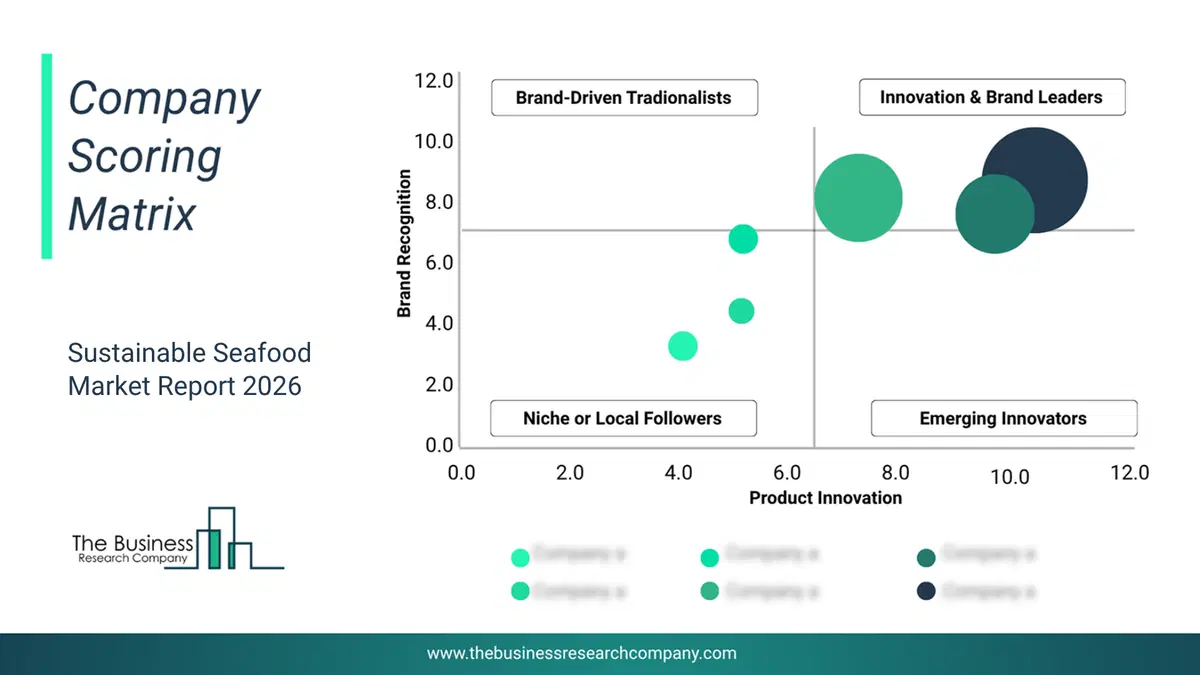
This chart maps companies by product innovation and brand strength, with bubble size indicating relative revenue, helping identify market leaders, challengers, and niche players. This is an illustrative chart; the full report provides a complete and accurate competitive analysis.
Global Sustainable Seafood Market Trends and Insights
Major companies operating in the sustainable seafood market are focused on developing advanced products such as plant-based seafood to meet rising consumer demand for ethical and eco-friendly alternatives. Plant-based seafood refers to seafood alternatives made from plant-based ingredients that mimic the taste, texture, and nutrition of traditional seafood while promoting environmental sustainability. For instance, in November 2023, Ordinary Seafood, a Germany-based provider of next-generation seafood, launched Ordinary Tuna and Ordinary Smoky Salmon, new plant-based salmon and tuna products. These products were initially available in METRO stores across Germany, marking a significant milestone for the company. Ordinary Seafood aims to provide sustainable seafood alternatives that are scientifically based, environmentally sustainable, and offer quality taste and texture, thereby reshaping the way people think about seafood.What Are Latest Mergers And Acquisitions In The Sustainable Seafood Market?
In March 2023, Cooke Inc., a Canada-based aquaculture company, acquired Slade Gorton for an undisclosed amount. The acquisition aims to strengthen Cooke’s position in the U.S. seafood importing and distribution sector. The deal aligns with Cooke's strategy to leverage Slade Gorton's extensive supply chain, diverse seafood offerings, and established customer base to increase seafood consumption across North America while advancing sustainable practices. Slade Gorton is a US-based seafood company that manufactures wholesome, nutritious, and sustainable seafood.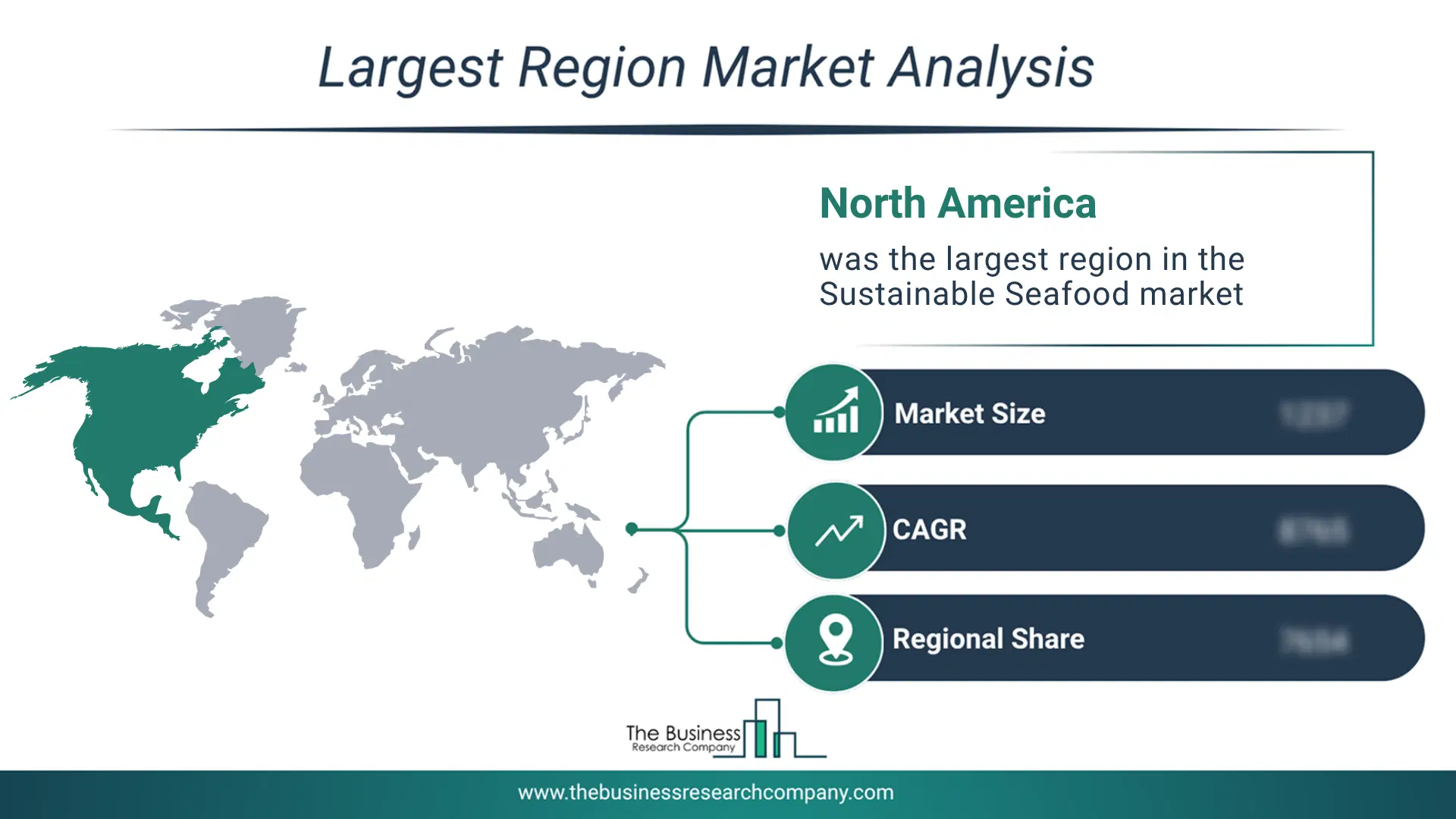
Regional Outlook
North America was the largest region in the sustainable seafood market in 2025. Europe is expected to be the fastest-growing region in the forecast period. The regions covered in this market report are Asia-Pacific, South East Asia, Western Europe, Eastern Europe, North America, South America, Middle East and Africa. The countries covered in this market report are Australia, Brazil, China, France, Germany, India, Indonesia, Japan, Taiwan, Russia, South Korea, UK, USA, Italy, Spain, CanadaWhat Defines the Sustainable Seafood Market?
The sustainable seafood market consists of sales of wild salmon, mackerel, seaweed, and algae-based products. Values in this market are ‘factory gate’ values, that is, the value of goods sold by the manufacturers or creators of the goods, whether to other entities (including downstream manufacturers, wholesalers, distributors, and retailers) or directly to end customers. The value of goods in this market includes related services sold by the creators of the goods.How is Market Value Defined and Measured?
The market value is defined as the revenues that enterprises gain from the sale of goods and/or services within the specified market and geography through sales, grants, or donations in terms of the currency (in USD unless otherwise specified). The revenues for a specified geography are consumption values that are revenues generated by organizations in the specified geography within the market, irrespective of where they are produced. It does not include revenues from resales along the supply chain, either further along the supply chain or as part of other products.
This chart presents market attractiveness based on a quantitative evaluation of growth, competition, strategic alignment, and risk, offering a clear view of opportunity areas for decision-making. This chart is for illustrative purposes; the full report contains the complete analysis.

This chart highlights the Total Addressable Market (TAM) by estimating the maximum revenue opportunity using an assumption-driven approach, supporting strategic planning and opportunity sizing across markets. The chart is illustrative; the full report provides a more comprehensive analysis.
What Key Data and Analysis Are Included in the Sustainable Seafood Market Report 2026?
The sustainable seafood market research report is one of a series of new reports from The Business Research Company that provides market statistics, including industry global market size, regional shares, competitors with the market share, detailed market segments, market trends and opportunities, and any further data you may need to thrive in the sustainable seafood industry. The market research report delivers a complete perspective of everything you need, with an in-depth analysis of the current and future state of the industry.Sustainable Seafood Market Report Forecast Analysis
| Report Attribute | Details |
|---|---|
| Market Size Value In 2026 | $18.01 billion |
| Revenue Forecast In 2030 | $22.94 billion |
| Growth Rate | CAGR of 6.3% from 2026 to 2030 |
| Base Year For Estimation | 2025 |
| Actual Estimates/Historical Data | 2020-2025 |
| Forecast Period | 2026 - 2030 |
| Market Representation | Revenue in USD Billion and CAGR from 2026 to 2030 |
| Segments Covered | Product Type, Form, Certification Standards, Distribution Channel |
| Regional Scope | Asia-Pacific, Western Europe, Eastern Europe, North America, South America, Middle East, Africa |
| Country Scope | The countries covered in the report are Australia, Brazil, China, France, Germany, India, Indonesia, Japan, Taiwan, Russia, South Korea, UK, USA, Canada, Italy, Spain. |
| Key Companies Profiled | Maruha Nichiro Corporation, Mowi, Thai Union Group Public Company Limited, Trident Seafoods Corporation, High Liner Foods Incorporated, Pacific Seafood Group, Ocean Beauty Seafoods LLC, Silver Bay Seafoods LLC, Espersen A/S, Blue Circle Foods, Acme Smoked Fish Corporation, Clear Springs Foods Inc., Joseph Robertson (Aberdeen) Limited, Vital Choice Wild Seafood & Organics, American Tuna Inc, Peter Pan Seafood Company LLC, Wild Planet Foods Inc., Regal Springs AG, Sea to Table LLC, Tri Marine Group Inc., Fishpeople Seafood Inc. |
| Customization Scope | Request for Customization |
| Pricing And Purchase Options | Explore Purchase Options |