
Synchronizing Systems Market Report 2026
Global Outlook – By Component (Hardware, Software, Services), By Synchronization Type (Time Synchronization, Frequency Synchronization, Phase Synchronization), By Deployment Mode (On-Premises, Cloud), By Application (Generator Synchronization, Grid Synchronization, Busbar Synchronization, Microgrid Synchronization, Renewable Energy Integration), By End Use Industry (Power Generation Industry, Oil And Gas Industry, Manufacturing Industry, Data Center Industry, Marine And Shipbuilding Industry, Commercial Buildings, Industrial Facilities) – Market Size, Trends, Strategies, and Forecast to 2030
Synchronizing Systems Market Overview
• Synchronizing Systems market size has reached to $6.07 billion in 2025 • Expected to grow to $9.37 billion in 2030 at a compound annual growth rate (CAGR) of 9% • Growth Driver: Surge In Demand For Precise Time Synchronization Driving Growth Of The Market Due To Increasing Need For Accurate, Low-Latency, And Coordinated Industrial And Communication Networks • Market Trend: Deploying Ruggedized GNSS Master Clocks And Network Time Servers For Resilient System Synchronization • North America was the largest region in 2025 and Asia-Pacific is the fastest growing region.What Is Covered Under Synchronizing Systems Market?
The synchronizing systems refers to technologies and equipment designed to match the frequency, voltage, phase angle, and waveform of multiple power sources or electrical systems before they are connected to operate in parallel. Its primary purpose is to ensure safe, reliable, and stable integration of generators, grids, and power networks. It also enables improved operational efficiency, reduced downtime, and enhanced protection of electrical infrastructure. The main components of synchronizing systems include hardware, software, and services. Hardware refers to the physical components of a computer or electronic system, such as processors, memory devices, and peripheral equipment. Different synchronization types include time synchronization, frequency synchronization, and phase synchronization. Multiple deployment modes are on-premises and cloud. Various applications include generator synchronization, grid synchronization, busbar synchronization, microgrid synchronization, and renewable energy integration, and they are used by several end-use industries such as power generation, oil and gas, manufacturing, data centers, marine and shipbuilding, commercial buildings, industrial facilities, and others.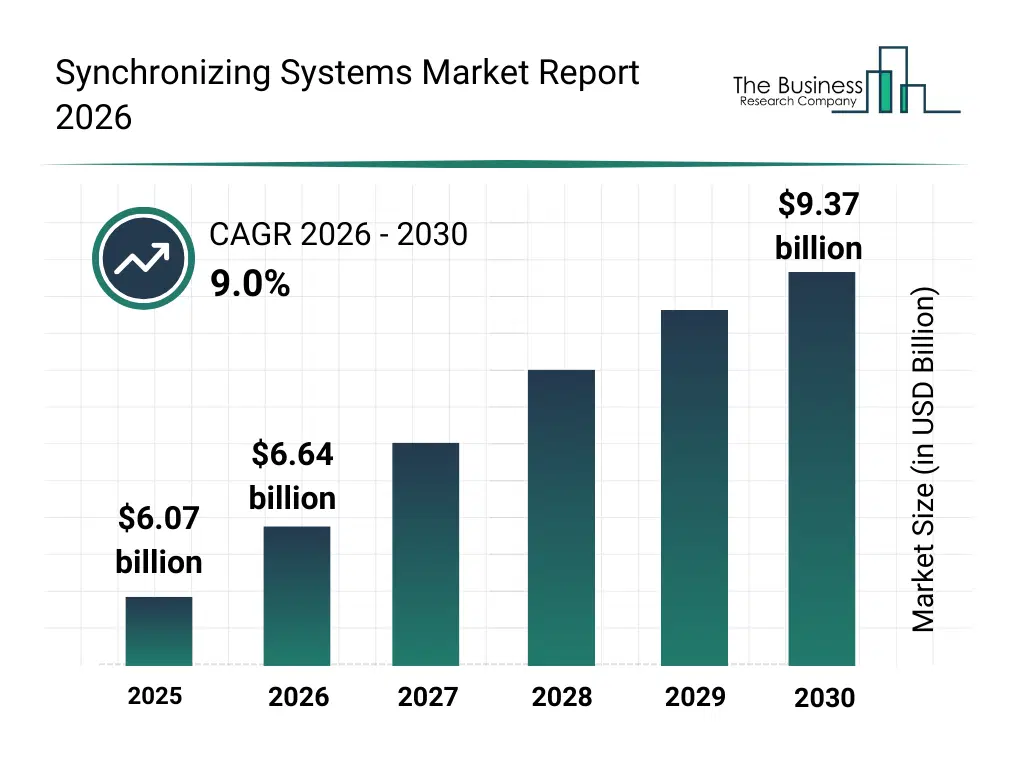
What Is The Synchronizing Systems Market Size and Share 2026?
The synchronizing systems market size has grown strongly in recent years. It will grow from $6.07 billion in 2025 to $6.64 billion in 2026 at a compound annual growth rate (CAGR) of 9.3%. The growth in the historic period can be attributed to growing adoption of industrial automation, increasing demand for precise time coordination, rising use in telecommunications networks, expansion of smart grid and power systems, growing focus on reducing operational errors.What Is The Synchronizing Systems Market Growth Forecast?
The synchronizing systems market size is expected to see strong growth in the next few years. It will grow to $9.37 billion in 2030 at a compound annual growth rate (CAGR) of 9.0%. The growth in the forecast period can be attributed to increasing integration with industrial internet of things, rising adoption of connected and autonomous systems, growing demand for high accuracy synchronization, expansion of digital infrastructure in manufacturing, rise in investment for real-time monitoring solutions. Major trends in the forecast period include technology driven innovations in timing systems, advancements in network synchronization protocols, developments in hardware and software based synchronization, rising research and development in precision timing solutions, innovation in automated and intelligent synchronization systems.
Global Synchronizing Systems Market Segmentation
1) By Component: Hardware, Software, Services 2) By Synchronization Type: Time Synchronization, Frequency Synchronization, Phase Synchronization 3) By Deployment Mode: On-Premises, Cloud 4) By Application: Generator Synchronization, Grid Synchronization, Busbar Synchronization, Microgrid Synchronization, Renewable Energy Integration 5) By End Use Industry: Power Generation Industry, Oil And Gas Industry, Manufacturing Industry, Data Center Industry, Marine And Shipbuilding Industry, Commercial Buildings, Industrial Facilities Subsegments: 1) By Hardware: Synchronization Controllers, Network Interface Devices, Timing Modules 2) By Software: System Management Software, Monitoring And Analytics Software, Configuration And Control Software 3) By Services: Installation And Integration Services, Maintenance And Support Services, Consulting And Training ServicesWhat Is The Driver Of The Synchronizing Systems Market?
The rising demand for precise time synchronization across industrial and communication networks is expected to propel the growth of the synchronizing systems market going forward. Precise time synchronization is the alignment of clocks and timing signals across devices and networks to ensure accurate data exchange and coordinated operations, which is critical for industrial automation, telecommunications, smart grids, and time sensitive networking applications. The rising demand is due to accelerating deployment of 5G networks and network infrastructure that require stricter timing accuracy and enhanced synchronization equipment to meet evolving operational standards. Synchronizing systems supports precise time alignment by enabling technologies and standards that ensure deterministic communication, low latency performance, and dependable coordination across distributed network elements. For instance, in July?2025, according to the International Telecommunication Union (ITU T), a United Nations affiliated global standards body, the updated ITU T G.8272.1 recommendation defined enhanced primary reference time clocks (ePRTCs) with precise time and phase synchronization requirements, enabling timing accuracy specifications that support sub 100 nanosecond alignment in packet networks. TSN, was valued at approximately 1.42?billion in 2024 and is expected to grow to about 4.15?billion by 2033. Therefore, the rising demand for precise time synchronization across industrial and communication networks is driving the growth of the synchronizing systems industry.Key Players In The Global Synchronizing Systems Market
Major companies operating in the synchronizing systems market are Google LLC, Microsoft Corporation, Dropbox Inc., Siemens AG, Cisco Systems Inc., Schneider Electric SE, Microchip Technology Inc, OpenText Corporation, Citrix Systems Inc., EndRun Technologies Inc., Box Inc., Safran Electronics & Defense, Egnyte Inc., Huawei Technologies Co. Ltd., Nextcloud GmbH, Syncplicity LLC, CTERA Networks Ltd., Acronis International GmbH, Oscilloquartz SA, Meinberg Funkuhren GmbH & Co. KG, SugarSync Inc., National Instruments Corporation
This chart is for illustrative purposes; the full report includes a detailed competitor analysis and comprehensive overview of the top 10 companies in the market.
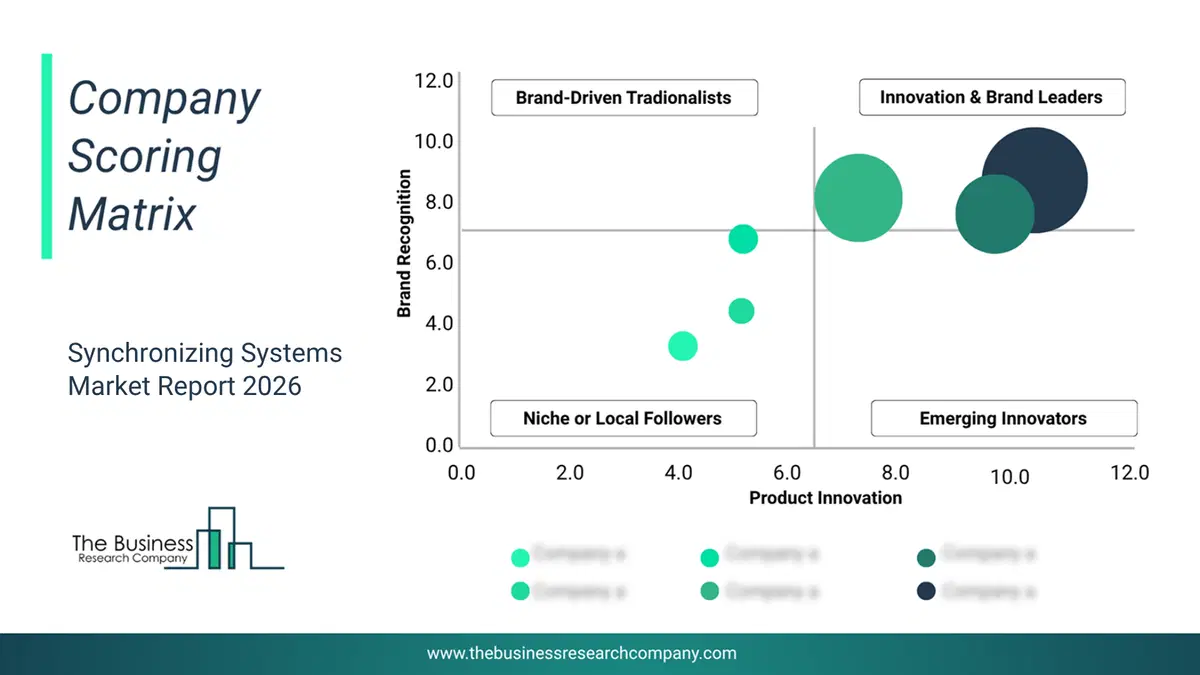
This chart maps companies by product innovation and brand strength, with bubble size indicating relative revenue, helping identify market leaders, challengers, and niche players. This is an illustrative chart; the full report provides a complete and accurate competitive analysis.
Global Synchronizing Systems Market Trends and Insights
Major companies operating in the synchronizing systems market are focusing on releasing advanced resilient timing solutions, such as ruggedized GNSS master clocks and network time servers, to ensure precise time coordination across complex systems, maintain accurate timing signals under adverse environmental conditions, and provide continuous synchronization even in GNSS-denied scenarios. Ruggedized GNSS master clocks and network time servers are hardware devices that provide stable and accurate global navigation satellite system time references, deliver synchronized time and frequency signals to connected systems, support standard timing protocols like Network Time Protocol (NTP) and Precision Time Protocol (PTP), and maintain synchronization continuity during satellite signal disruptions. For instance, in September 2025, Safran Electronics & Defense, a France-based defense electronics company, launched VersaSync, its upgraded GNSS master clock and network time server, featuring improved frequency stability under extreme temperatures, shock, and vibration; enhanced holdover performance for long-term operation without GNSS signals; and increased resistance to power supply transients to maintain timing continuity during disruptions, making it suitable for defense communications and mission-critical systems.What Are Latest Mergers And Acquisitions In The Synchronizing Systems Market?
In November 2023, Lumine Group Inc., a Canada-based communications and media software acquirer, acquired the Messaging and NetworkX business units from Synchronoss Technologies Inc. for an undisclosed amount. Through this acquisition, Lumine Group expanded its portfolio of system coordination and network orchestration technologies, incorporating Messaging and NetworkX capabilities that enable synchronized network planning, ordering and service delivery workflows. Synchronoss Technologies Inc. is a US-based provider of software solutions that streamline network operations, subscriber engagement, and coordinated cloud services for global operators.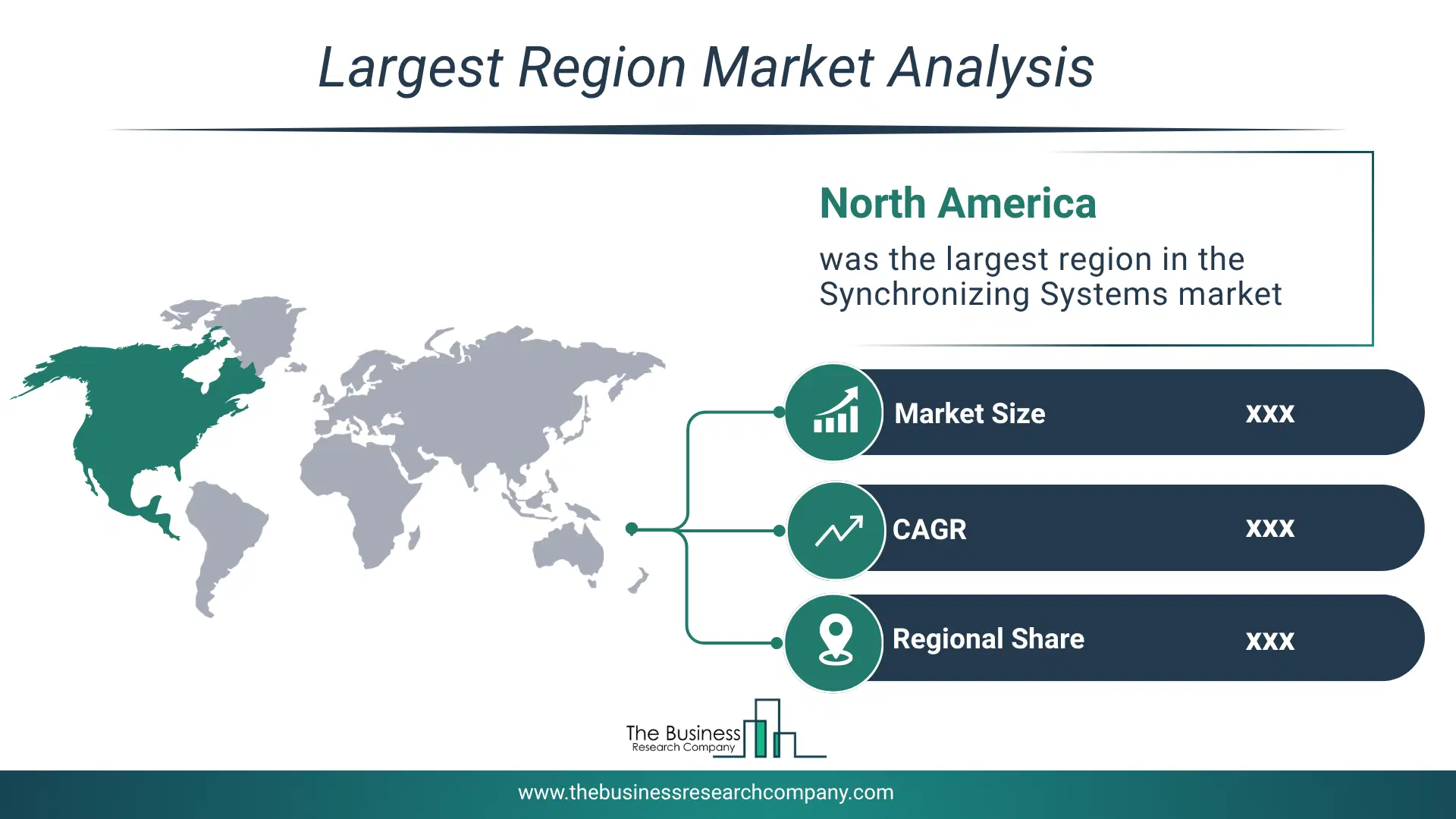
Regional Insights
North America was the largest region in the synchronizing systems market in 2025. Asia-Pacific is expected to be the fastest-growing region in the forecast period. The regions covered in this market report are Asia-Pacific, South East Asia, Western Europe, Eastern Europe, North America, South America, Middle East, Africa. The countries covered in this market report are Australia, Brazil, China, France, Germany, India, Indonesia, Japan, Taiwan, Russia, South Korea, UK, USA, Canada, Italy, Spain.What Defines the Synchronizing Systems Market?
The synchronizing systems consists of revenues earned by entities by providing products such as synchronizing relays, automatic synchronizers, generator control units, synchronizing panels, and digital synchronization modules. The market value includes the value of related goods sold by the service provider or included within the service offering. The synchronizing systems market includes sales of system monitoring components, frequency-matching devices, voltage-regulation units, and synchronization testing tools. Values in this market are ‘factory gate’ values, that is, the value of goods sold by the manufacturers or creators of the goods, whether to other entities (including downstream manufacturers, wholesalers, distributors, and retailers) or directly to end customers. The value of goods in this market includes related services sold by the creators of the goods.How is Market Value Defined and Measured?
The market value is defined as the revenues that enterprises gain from the sale of goods and/or services within the specified market and geography through sales, grants, or donations in terms of the currency (in USD unless otherwise specified). The revenues for a specified geography are consumption values that are revenues generated by organizations in the specified geography within the market, irrespective of where they are produced. It does not include revenues from resales along the supply chain, either further along the supply chain or as part of other products.
This chart presents market attractiveness based on a quantitative evaluation of growth, competition, strategic alignment, and risk, offering a clear view of opportunity areas for decision-making. This chart is for illustrative purposes; the full report contains the complete analysis.

This chart highlights the Total Addressable Market (TAM) by estimating the maximum revenue opportunity using an assumption-driven approach, supporting strategic planning and opportunity sizing across markets. The chart is illustrative; the full report provides a more comprehensive analysis.
What Key Data and Analysis Are Included in the Synchronizing Systems Market Report 2026?
The synchronizing systems market research report is one of a series of new reports from The Business Research Company that provides market statistics, including industry global market size, regional shares, competitors with the market share, detailed market segments, market trends and opportunities, and any further data you may need to thrive in the synchronizing systems industry. The market research report delivers a complete perspective of everything you need, with an in-depth analysis of the current and future state of the industry.Synchronizing Systems Market Report Forecast Analysis
| Report Attribute | Details |
|---|---|
| Market Size Value In 2026 | $6.64 billion |
| Revenue Forecast In 2030 | $9.37 billion |
| Growth Rate | CAGR of 9.3% from 2026 to 2030 |
| Base Year For Estimation | 2025 |
| Actual Estimates/Historical Data | 2020-2025 |
| Forecast Period | 2026 - 2030 |
| Market Representation | Revenue in USD Billion and CAGR from 2026 to 2030 |
| Segments Covered | Component, Synchronization Type, Deployment Mode, Application, End Use Industry |
| Regional Scope | Asia-Pacific, Western Europe, Eastern Europe, North America, South America, Middle East, Africa |
| Country Scope | The countries covered in the report are Australia, Brazil, China, France, Germany, India, Indonesia, Japan, Taiwan, Russia, South Korea, UK, USA, Canada, Italy, Spain. |
| Key Companies Profiled | Google LLC, Microsoft Corporation, Dropbox Inc., Siemens AG, Cisco Systems Inc., Schneider Electric SE, Microchip Technology Inc, OpenText Corporation, Citrix Systems Inc., EndRun Technologies Inc., Box Inc., Safran Electronics & Defense, Egnyte Inc., Huawei Technologies Co. Ltd., Nextcloud GmbH, Syncplicity LLC, CTERA Networks Ltd., Acronis International GmbH, Oscilloquartz SA, Meinberg Funkuhren GmbH & Co. KG, SugarSync Inc., National Instruments Corporation |
| Customization Scope | Request for Customization |
| Pricing And Purchase Options | Explore Purchase Options |