

Synchronous Condenser Market Report 2026
Global Outlook – By Type (New Synchronous Condenser, Refurbished Synchronous Condenser), By Starting Method (Static Frequency Convertor, Pony Motor, Other Starting Methods), By Cooling Type (Hydrogen-Cooled, Air-Cooled, Water-Cooled), By Reactive Power Rating (Up To 100 Mega Volt-Ampere Reactive (MVAR), 100-200 Mega Volt-Ampere Reactive (MVAR), Above 200 Mega Volt-Ampere Reactive (MVAR)), By End-User (Utilities, Industrial, Renewable Energy, Other End-Users) – Market Size, Trends, Strategies, and Forecast to 2030
Synchronous Condenser Market Overview
• Synchronous Condenser market size has reached to $1.13 billion in 2025 • Expected to grow to $1.45 billion in 2030 at a compound annual growth rate (CAGR) of 5% • Growth Driver: The Increasing Demand For Renewable Energy Sources Is Fueling The Market Growth Due To The Need For Enhance Grid Stability And Integration Support • Market Trend: Advancing Grid Stability Through Innovative Solutions For Renewable Energy Integration • North America was the largest region in 2025 and Asia-Pacific is the fastest growing region.Market Gains By 2030 – Top Opportunities By Segment
Market Gain identifies the most promising market opportunities by highlighting the segments or products expected to generate the highest incremental revenue growth over the next five years.
What Is Covered Under Synchronous Condenser Market?
Synchronous condenser refers to a rotating electrical machine that provides reactive power support and voltage regulation in power transmission networks. It helps stabilize the grid by improving power factor and managing fluctuations in load demand. The main types of synchronous condensers are new synchronous condensers and refurbished synchronous condensers. A new synchronous condenser is a modern electrical machine that provides reactive power support to stabilize voltage and improve power quality in advanced power grids. The starting methods include static frequency converters, pony motors, and other methods. The various cooling types include hydrogen-cooled, air-cooled, and water-cooled systems. Reactive power ratings are classified as up to 100 mega volt-amperes reactive (MVAR), 100–200 mega volt-ampere reactive (MVAR), and above 200 mega volt-amperes reactive (MVAR). These are used by various end-users such as utilities, industrial sectors, renewable energy companies, and others.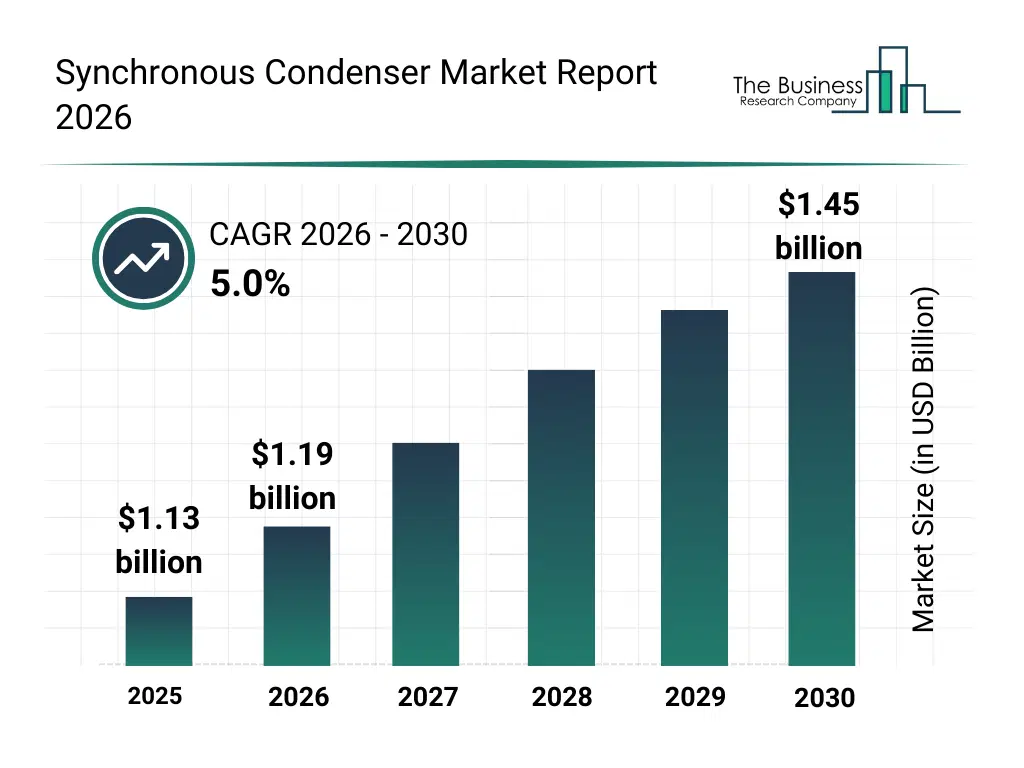
What Is The Synchronous Condenser Market Size and Share 2026?
The synchronous condenser market size has grown strongly in recent years. It will grow from $1.13 billion in 2025 to $1.19 billion in 2026 at a compound annual growth rate (CAGR) of 5.2%. The growth in the historic period can be attributed to expansion of conventional power plants, reliance on rotating machines for grid stability, early deployment of synchronous condensers, growth of transmission networks, increasing industrial electricity demand.What Is The Synchronous Condenser Market Growth Forecast?
The synchronous condenser market size is expected to see steady growth in the next few years. It will grow to $1.45 billion in 2030 at a compound annual growth rate (CAGR) of 5.0%. The growth in the forecast period can be attributed to increasing renewable energy penetration, rising need for synthetic inertia solutions, expansion of transmission grid upgrades, growing investments in grid stability solutions, increasing replacement of retiring thermal generators. Major trends in the forecast period include increasing deployment of grid stabilization equipment, rising use in renewable energy integration, growing adoption of refurbished synchronous condensers, expansion of high-capacity reactive power installations, enhanced focus on grid inertia support.
Global Synchronous Condenser Market Segmentation
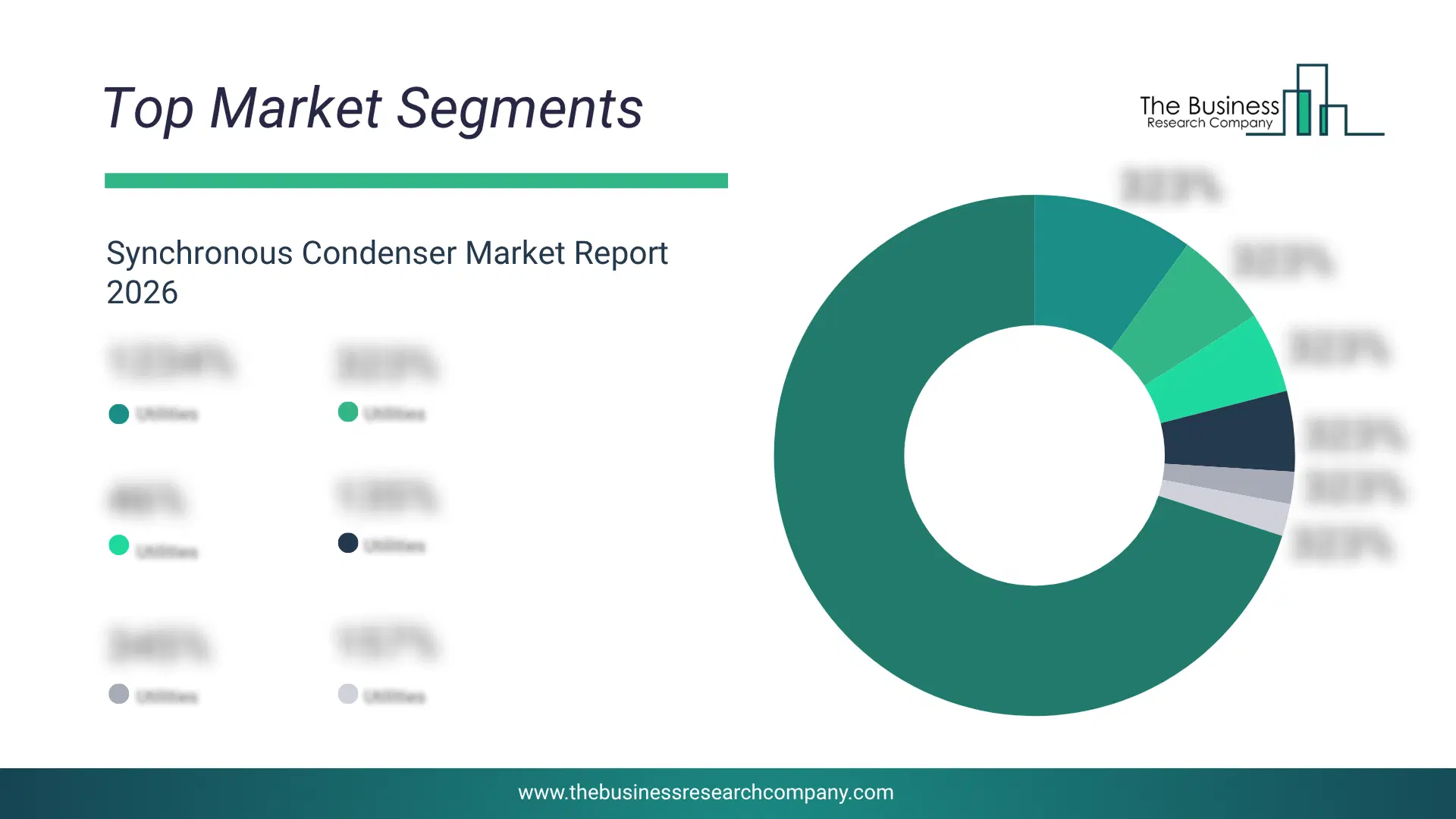
1) By Type: New Synchronous Condenser, Refurbished Synchronous Condenser 2) By Starting Method: Static Frequency Convertor, Pony Motor, Other Starting Methods 3) By Cooling Type: Hydrogen-Cooled, Air-Cooled, Water-Cooled 4) By Reactive Power Rating: Up To 100 Mega Volt-Ampere Reactive (MVAR), 100-200 Mega Volt-Ampere Reactive (MVAR), Above 200 Mega Volt-Ampere Reactive (MVAR) 5) By End-User: Utilities, Industrial, Renewable Energy, Other End-Users Subsegments: 1) By New Synchronous Condenser: Air-Cooled Synchronous Condenser, Water-Cooled Synchronous Condenser, Hydrogen-Cooled Synchronous Condenser 2) By Refurbished Synchronous Condenser: Retrofitted Synchronous Condenser, Reconditioned Synchronous Condenser, Upgraded Synchronous Condenser The top segments in the synchronous condenser market will be: • New Synchronous Condenser will reach $792.03 Million by 2025. • Static Frequency Convertor will reach $701.92 Million by 2025. • Utilities will reach $663.52 Million by 2025. • Hydrogen-Cooled will reach $526.88 Million by 2025. • Up To 100 Mega Volt-Ampere Reactive (MVAR) will reach $497.41 Million by 2025.What Is The Driver Of The Synchronous Condenser Market?
The increasing demand for renewable energy sources is expected to propel the growth of the synchronous condenser market going forward. Renewable energy sources refer to natural resources that are replenished constantly and can be used to generate energy sustainably, such as solar, wind, hydro, geothermal, and biomass. The rise in the use of renewable energy sources is primarily driven by the growing need to reduce greenhouse gas emissions and decrease dependence on fossil fuels, as these efforts aim to combat climate change, enhance energy security, and promote sustainable development. Synchronous condenser enhances grid stability by providing reactive power support and voltage regulation, making it easier to integrate intermittent renewable energy sources such as wind and solar into the power system. For instance, in December 2024, according to the Eurostat, a Luxembourg-based government agency, in 2023, renewable energy made up 24.5% of the energy consumed in the EU, rising from 23.0% in 2022. Therefore, the increasing demand for renewable energy sources is driving the growth of the synchronous condenser industry.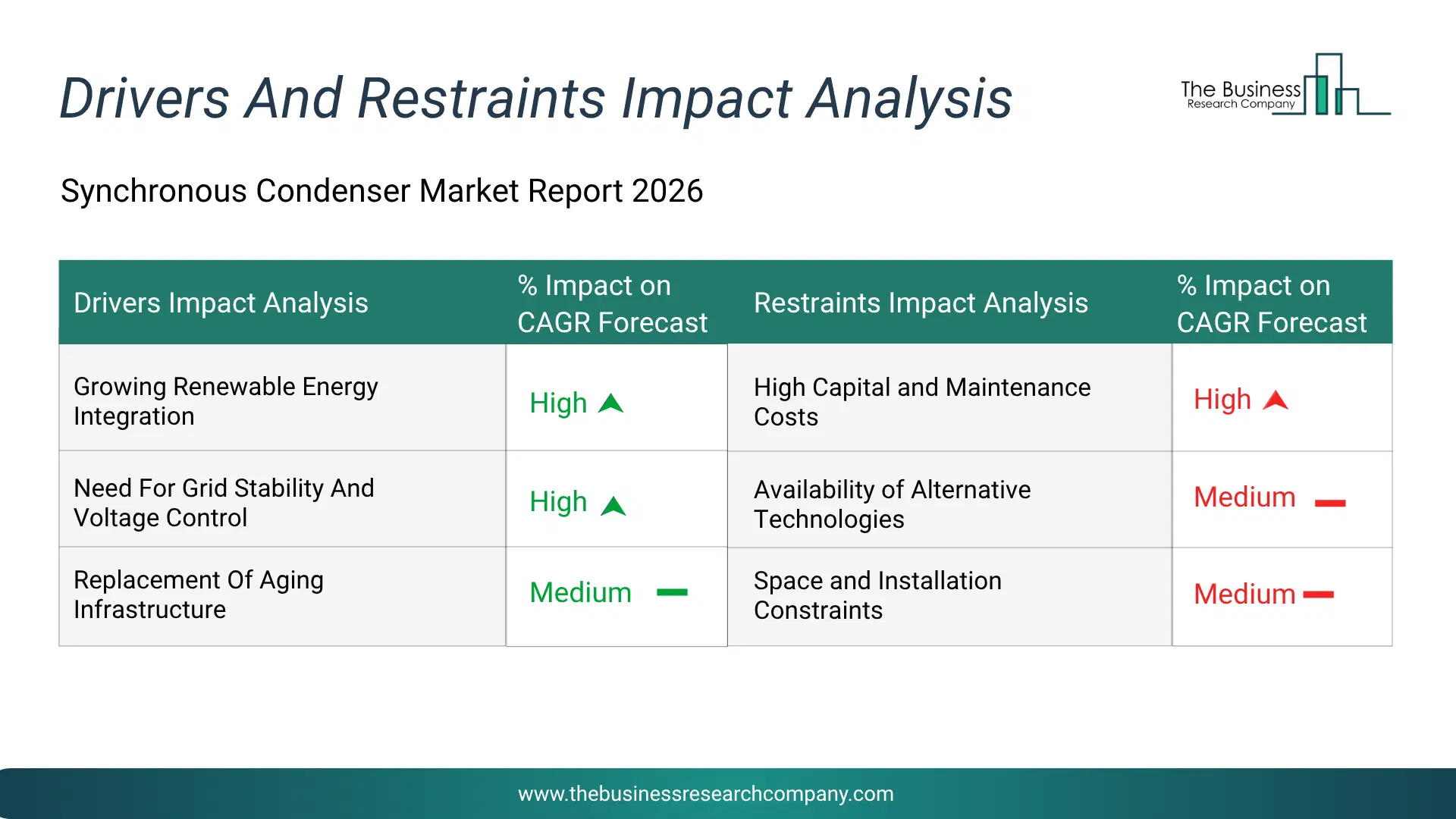
Infographic Chart Showing Key Market Drivers Analysis And Restraints For Synchronous Condenser Market
The chart presents an impact analysis of key drivers and restraints, quantifying their relative influence on the market's growth rate and helping assess the balance between growth enablers and limiting factors. This chart offers a high-level perspective; the full report contains more detailed insights.
How Will The Drivers Impact Growth In The Global Synchronous Condenser Market?
• Increasing Integration Of Renewable Energy Sources (Medium) – The increasing integration of renewable energy sources will become a key driver of growth in the synchronous condenser market by 2030. As grids increasingly incorporate inverter-based renewable generation, such as solar and wind, there is a reduction in system inertia and short-circuit strength, which are critical for maintaining grid stability. Wind and solar farms are inverter-based resources (IBRs) that do not provide inherent inertia and short-circuit strength to the grid—qualities that traditional synchronous generators provide. Synchronous condensers are being deployed to solve this exact problem, making them essential for grid stability in a renewables-heavy system. Government-backed energy bodies, such as Australia’s AEMO (Australian Energy Market Operator), emphasize that synchronous condensers are vital in such contexts. As a result, the increasing integration of renewable energy sources is anticipated to contributing to a 1.5% annual growth in the market. • Smart Grid Expansion And Digitalization Of Electricity Networks (Medium) – The smart grid expansion and digitalization of electricity networks will emerge as a major factor driving the expansion of the market by 2030. As electricity networks evolve into smarter, digital systems, they increasingly rely on advanced monitoring and automation technologies. Government energy bodies and technical studies, such as Australia’s AEMO (Australian Energy Market Operator) and research on smart grid evolution, highlight that this digital transformation improves system awareness and responsiveness but also raises the need for stable, secure grid-support infrastructure. Synchronous condensers complement smart grid capabilities by providing reactive power and inertia support, ensuring voltage stability and resilience against frequency disturbances, especially in grids with high inverter-based renewable penetration. Consequently, the expansion of smart grids and digitalization of electricity networks is projected to contributing to a 1.1% annual growth in the market. • Rise In Grid Stability And Voltage Control Requirements (Medium) – The rise in grid stability and voltage control requirements will serve as a key growth catalyst for the market by 2030. As inverter-based renewable generation penetrates deeper into power systems, traditional mechanisms for ensuring grid strength and voltage regulation diminish, leading to weaker system resilience. Government-funded research, such as the Australian renewable energy agency (ARENA) study, recognizes synchronous condensers as vital grid-strengthening assets. They contribute to enhancing short-circuit ratio (SCR), damping voltage sensitivity, improving fault ride-through and supporting system stability during contingencies, especially in weak grid zones with high renewable deployment. Therefore, this rise in grid stability and voltage control requirements is projected to supporting to a 1.0% annual growth in the market. • Replacement Of Aging Grid Infrastructure (Low) – The replacement of aging grid infrastructure will become a significant driver contributing to the growth of the market by 2030. As power grids worldwide confront aging transmission and generation assets, regulators and utilities are prioritizing modernization to uphold grid reliability and efficiency. Synchronous condensers are highlighted as effective, low-maintenance components to replace or supplement obsolete infrastructure, capable of delivering inertia, voltage support and reactive power compensation without requiring major new generation facilities. Consequently, the replacement of aging grid infrastructure is projected to contributing to a 0.8% annual growth in the market.How Will The Restraints Impact Growth In The Global Synchronous Condenser Market?
• Long Lead Times For Manufacturing And Commissioning (Medium) – Long Lead Times For Manufacturing And Commissioning will restrict the growth of the Synchronous Condenser market during the forecast period. Synchronous condenser manufacturing and commissioning involve long lead times due to complex engineering and customization requirements. Extended project timelines can affect project planning and grid integration schedules. Long lead times can create challenges for utilities and grid operators, potentially limiting market growth. • Skilled Workforce Shortage (Medium) – Skilled Workforce Shortage will restrict the growth of the Synchronous Condenser market during the forecast period. Synchronous condenser installation, operation, and maintenance require skilled engineers and technicians with specialized expertise. The shortage of qualified workforce in the power sector affects project execution and service quality. Labor gaps can lead to project delays and increased costs, limiting market growth. • Trade War And Tariffs Impacting Equipment Costs And Supply Chains (Low) – Trade War And Tariffs Impacting Equipment Costs And Supply Chains will restrict the growth of the Synchronous Condenser market during the forecast period. Trade tariffs on electrical equipment and components affect synchronous condenser costs and supply chain reliability. Trade barriers can increase project costs and affect equipment availability. Trade tensions may also impact grid infrastructure investment and market growth.Key Players In The Global Synchronous Condenser Market
Major companies operating in the synchronous condenser market are Siemens Energy AG, General Electric Company, ABB Ltd, WEG S.A, Ansaldo Energia S.p.A, Shanghai Electric Group Company Limited, Voith GmbH & Co KGaA, Mitsubishi Electric Corporation, Fuji Electric Co Ltd, Eaton Corporation plc, ANDRITZ AG, Hitachi Energy Ltd, Dongfang Electric Corporation, Harbin Electric Corporation, BRUSH Electrical Machines Ltd, Toshiba Corporation, Bharat Heavy Electricals Limited (BHEL), Hyosung Heavy Industries Corporation, Doosan Škoda Power, Nidec Corporation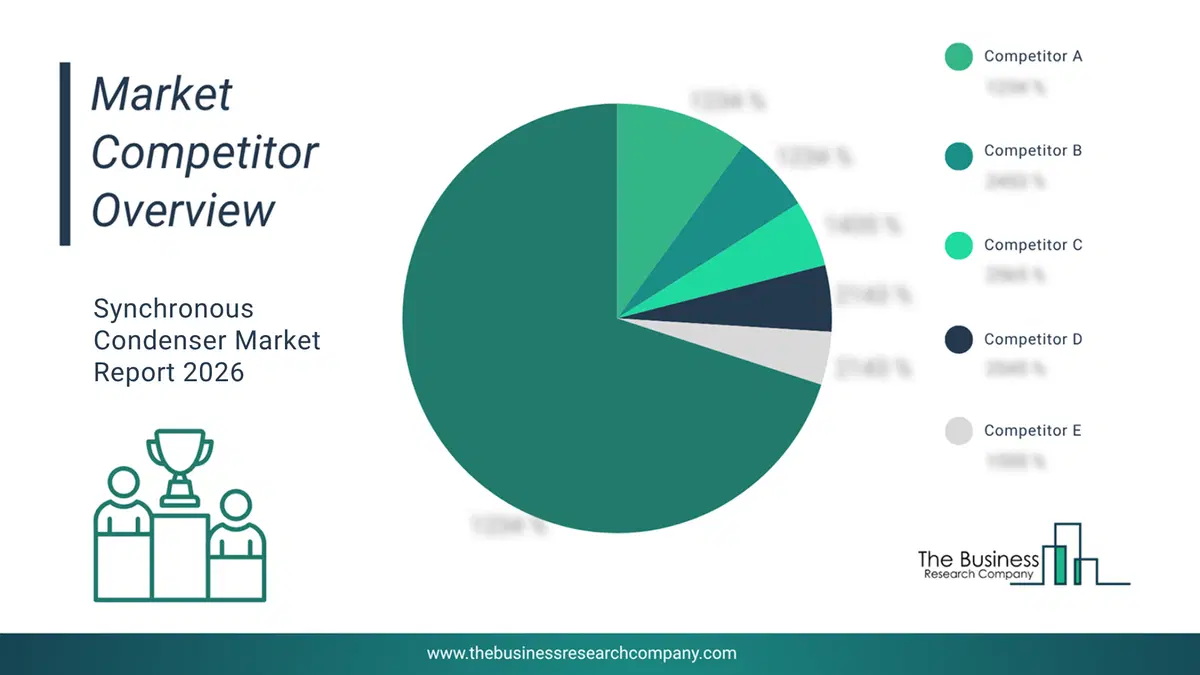
This chart is for illustrative purposes; the full report includes a detailed competitor analysis and comprehensive overview of the top 10 companies in the market.
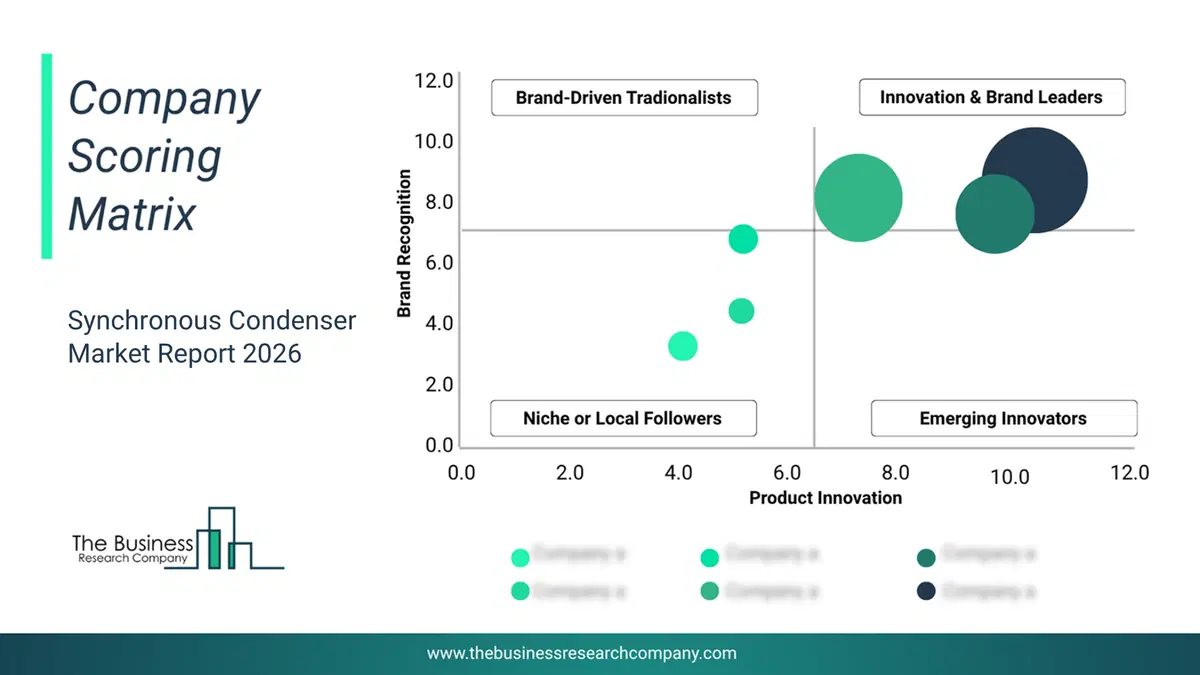
This chart maps companies by product innovation and brand strength, with bubble size indicating relative revenue, helping identify market leaders, challengers, and niche players. This is an illustrative chart; the full report provides a complete and accurate competitive analysis.
Global Synchronous Condenser Market Trends and Insights
Major companies operating in the synchronous condenser market are focusing on developing innovative products such as high-efficiency, compact designs with enhanced grid stabilization capabilities to support renewable energy integration and improve grid reliability. High-efficiency, compact designs with enhanced grid stabilization capabilities are advanced energy storage and power conversion systems. These systems help by improving energy utilization, reducing space requirements, and supporting stable and reliable grid operations amid variable renewable energy inputs. For instance, in June 2024, ANDRITZ AG, an Austria-based machinery industry company, launched synchronous condensers in India, marking a significant step toward enhancing grid stability and supporting the country’s green energy transition efforts. The launch event, themed “Synchronous Condensers – Enabling Green Energy Transition,” was attended by senior officials from key Indian power sector organizations, including the central electricity authority (CEA), Grid India, and the northern regional power committee (NRPC). ANDRITZ highlighted the increasing global demand for synchronous condenser technology, which plays a critical role in stabilizing power grids by managing voltage and reactive power, especially as India integrates more renewable energy sources such as wind and solar.What Are Latest Mergers And Acquisitions In The Synchronous Condenser Market?
In April 2024, Hitachi Energy Ltd, a Switzerland-based power technology company, partnered with SP Energy Networks, to boost the flow of renewable energy across the Great Britain power grid. This partnership aims to enhance grid stability, strength, and power quality, enabling increased transfer of renewable electricity particularly wind power from Scotland to England by deploying advanced grid solutions such as STATCOMs and synchronous condensers. Scottish Power Energy Networks Holdings Limited is a UK-based energy company responsible for operating and maintaining electricity transmission and distribution networks across central and southern Scotland, Merseyside, Cheshire, and North Wales.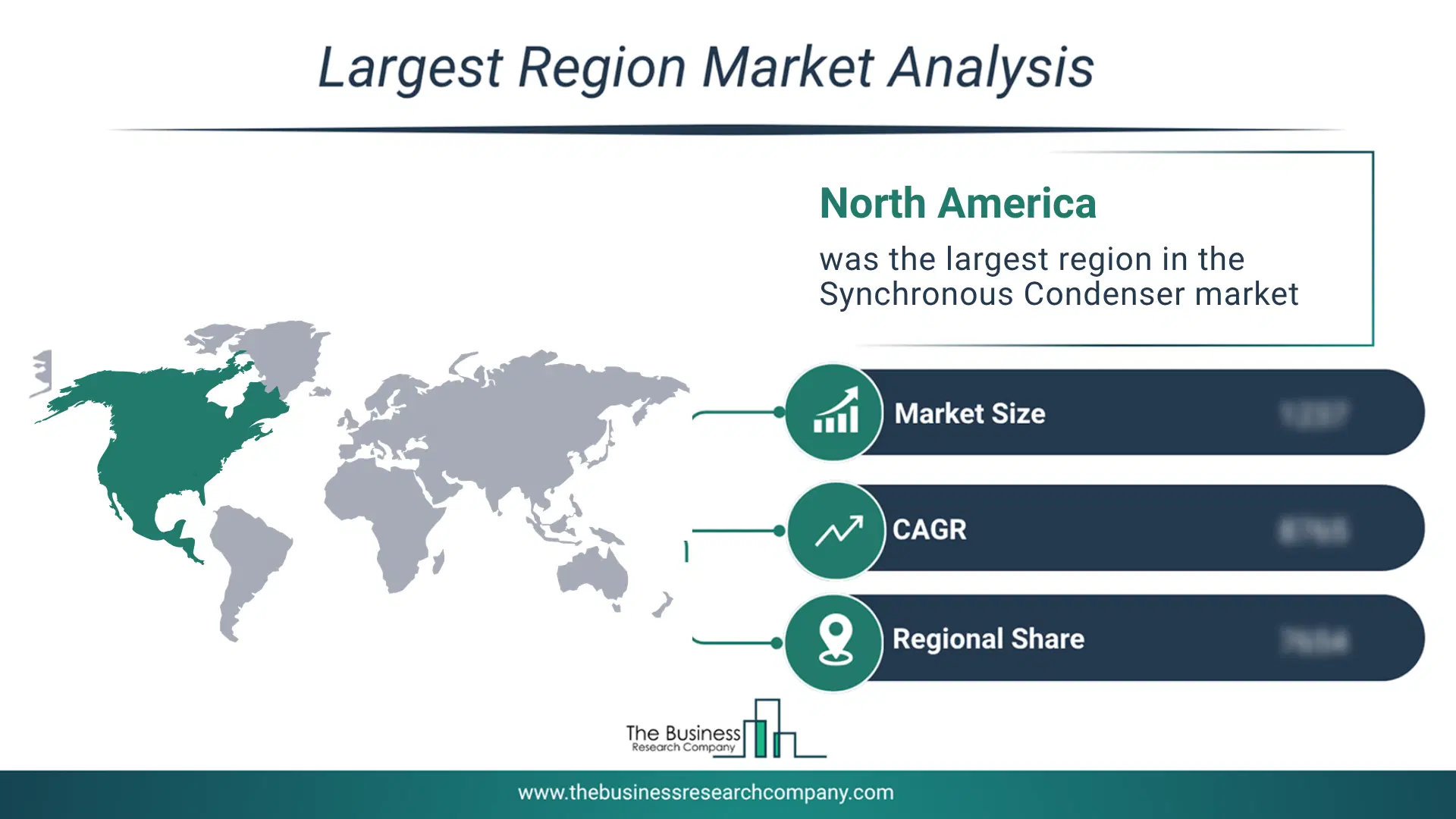
Regional Outlook
North America was the largest region in the synchronous condenser market in 2025. Asia-Pacific is expected to be the fastest-growing region in the forecast period. The regions covered in this market report are Asia-Pacific, South East Asia, Western Europe, Eastern Europe, North America, South America, Middle East, Africa. The countries covered in this market report are Australia, Brazil, China, France, Germany, India, Indonesia, Japan, Taiwan, Russia, South Korea, UK, USA, Canada, Italy, SpainWhat Defines the Synchronous Condenser Market?
The synchronous condenser market consists of sales of brushless excitation systems, hydraulic static starters, high voltage circuit breakers, protection relays and monitoring systems, automatic voltage regulators, rotor and stator assemblies. Values in this market are ‘factory gate’ values, that is, the value of goods sold by the manufacturers or creators of the goods, whether to other entities (including downstream manufacturers, wholesalers, distributors, and retailers) or directly to end customers. The value of goods in this market includes related services sold by the creators of the goods.How is Market Value Defined and Measured?
The market value is defined as the revenues that enterprises gain from the sale of goods and/or services within the specified market and geography through sales, grants, or donations in terms of the currency (in USD unless otherwise specified). The revenues for a specified geography are consumption values that are revenues generated by organizations in the specified geography within the market, irrespective of where they are produced. It does not include revenues from resales along the supply chain, either further along the supply chain or as part of other products.
This chart presents market attractiveness based on a quantitative evaluation of growth, competition, strategic alignment, and risk, offering a clear view of opportunity areas for decision-making. This chart is for illustrative purposes; the full report contains the complete analysis.

This chart highlights the Total Addressable Market (TAM) by estimating the maximum revenue opportunity using an assumption-driven approach, supporting strategic planning and opportunity sizing across markets. The chart is illustrative; the full report provides a more comprehensive analysis.
What Key Data and Analysis Are Included in the Synchronous Condenser Market Report 2026?
The synchronous condenser market research report is one of a series of new reports from The Business Research Company that provides market statistics, including Market Report 2026?global market size, regional shares, competitors with the market share, detailed market segments, market trends and opportunities, and any further data you may need to thrive in the synchronous condenser Market Report 2026? The market research report delivers a complete perspective of everything you need, with an in-depth analysis of the current and future state of the Market Report 2026?Synchronous Condenser Market Report Forecast Analysis
| Report Attribute | Details |
|---|---|
| Market Size Value In 2026 | $1.19 billion |
| Revenue Forecast In 2030 | $1.45 billion |
| Growth Rate | CAGR of 5.2% from 2026 to 2030 |
| Base Year For Estimation | 2025 |
| Actual Estimates/Historical Data | 2020-2025 |
| Forecast Period | 2026 - 2030 |
| Market Representation | Revenue in USD Billion and CAGR from 2026 to 2030 |
| Segments Covered | Type, Starting Method, Cooling Type, Reactive Power Rating, End-User |
| Regional Scope | Asia-Pacific, Western Europe, Eastern Europe, North America, South America, Middle East, Africa |
| Country Scope | The countries covered in the report are Australia, Brazil, China, France, Germany, India, Indonesia, Japan, Taiwan, Russia, South Korea, UK, USA, Canada, Italy, Spain. |
| Key Companies Profiled | Siemens Energy AG, General Electric Company, ABB Ltd, WEG S.A, Ansaldo Energia S.p.A, Shanghai Electric Group Company Limited, Voith GmbH & Co KGaA, Mitsubishi Electric Corporation, Fuji Electric Co Ltd, Eaton Corporation plc, ANDRITZ AG, Hitachi Energy Ltd, Dongfang Electric Corporation, Harbin Electric Corporation, BRUSH Electrical Machines Ltd, Toshiba Corporation, Bharat Heavy Electricals Limited (BHEL), Hyosung Heavy Industries Corporation, Doosan Škoda Power, Nidec Corporation |
| Customization Scope | Request for Customization |
| Pricing And Purchase Options | Explore Purchase Options |