
Technical Textiles Market Report 2026
Global Outlook – By Material (Natural Fiber, Synthetic Polymer, Regenerated Fiber, Mineral, Metal), By Process (Woven, Knitted, Non-woven), By Application (Transport Textiles, Medical And Hygiene Textiles, Industrial Products And Components, Agriculture, Horticulture, And Fishing, Home Textiles, Clothing Components, Packaging And Containment) – Market Size, Trends, Strategies, and Forecast to 2030
Technical Textiles Market Overview
• Technical Textiles market size has reached to $251.02 billion in 2025 • Expected to grow to $329.23 billion in 2030 at a compound annual growth rate (CAGR) of 5.6% • Growth Driver: Booming Automobile Sales Fueling Surge In The Technical Textiles Market • Market Trend: Launch Of Sustainable Product Portfolio In The Technical Textiles Market • Asia-Pacific was the largest region and fastest growing region.Market Gains By 2030 – Top Opportunities By Segment
Market Gain identifies the most promising market opportunities by highlighting the segments or products expected to generate the highest incremental revenue growth over the next five years.
What Is Covered Under Technical Textiles Market?
The technical textiles refer to engineered products with a definite functionality. Technical textiles are the type of semi-finished or finished textiles or fabric designed especially for the non-decorated purpose. Technical textiles are manufactured using non-woven or woven natural as well as synthetic fibers, which are used due to their excellent technical and functional properties. The main types of materials in technical textiles are natural fiber, synthetic polymer, regenerated fiber, mineral, and metal. Natural fibers are directly obtainable from an animal, vegetable, or mineral source. The different processes include woven, knitted, and non-woven which are used for a variety of applications including transport textiles, medical and hygiene textiles, industrial products and components, agriculture, horticulture, and fishing, home textiles, clothing components, and packaging and containment.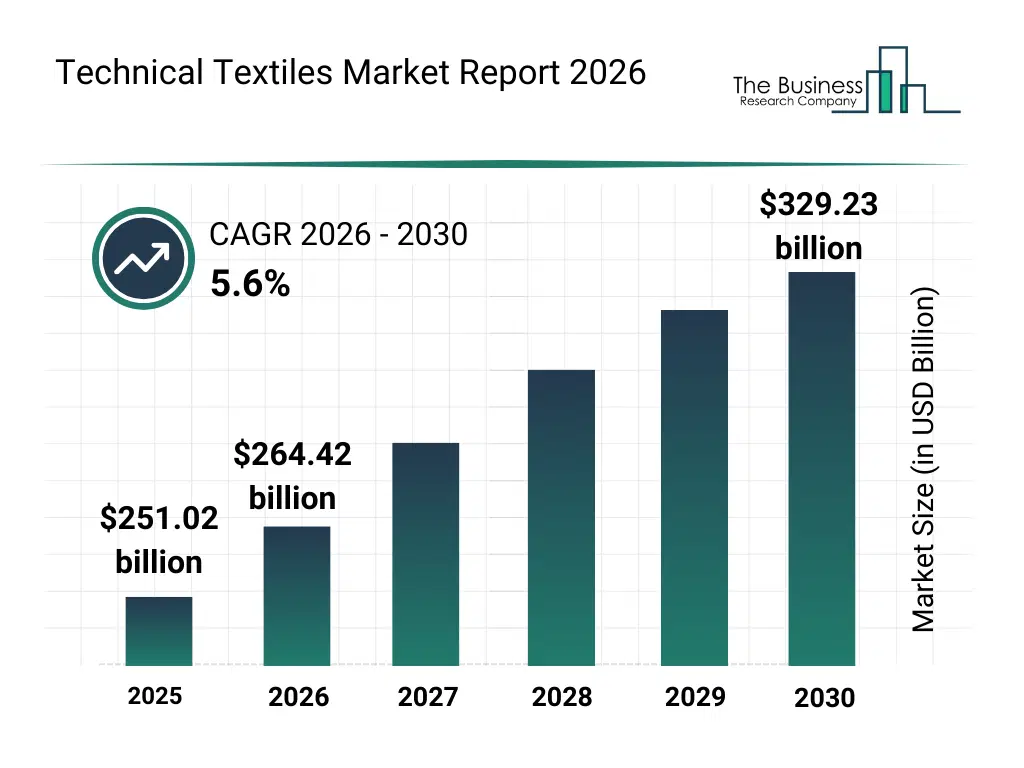
What Is The Technical Textiles Market Size and Share 2026?
The technical textiles market size has grown strongly in recent years. It will grow from $251.02 billion in 2025 to $264.42 billion in 2026 at a compound annual growth rate (CAGR) of 5.3%. The growth in the historic period can be attributed to expansion of industrial manufacturing activities, growth of automotive textile usage, increasing demand for medical textiles, rising infrastructure development, availability of advanced synthetic fibers.What Is The Technical Textiles Market Growth Forecast?
The technical textiles market size is expected to see strong growth in the next few years. It will grow to $329.23 billion in 2030 at a compound annual growth rate (CAGR) of 5.6%. The growth in the forecast period can be attributed to increasing investments in smart textile technologies, rising demand for sustainable technical fibers, expansion of healthcare textile applications, growing use in protective clothing, increasing integration of advanced materials. Major trends in the forecast period include increasing demand for high-performance functional textiles, rising adoption of non-woven technical fabrics, growing use in medical and hygiene applications, expansion of lightweight transport textiles, enhanced focus on durability and strength.
Global Technical Textiles Market Segmentation
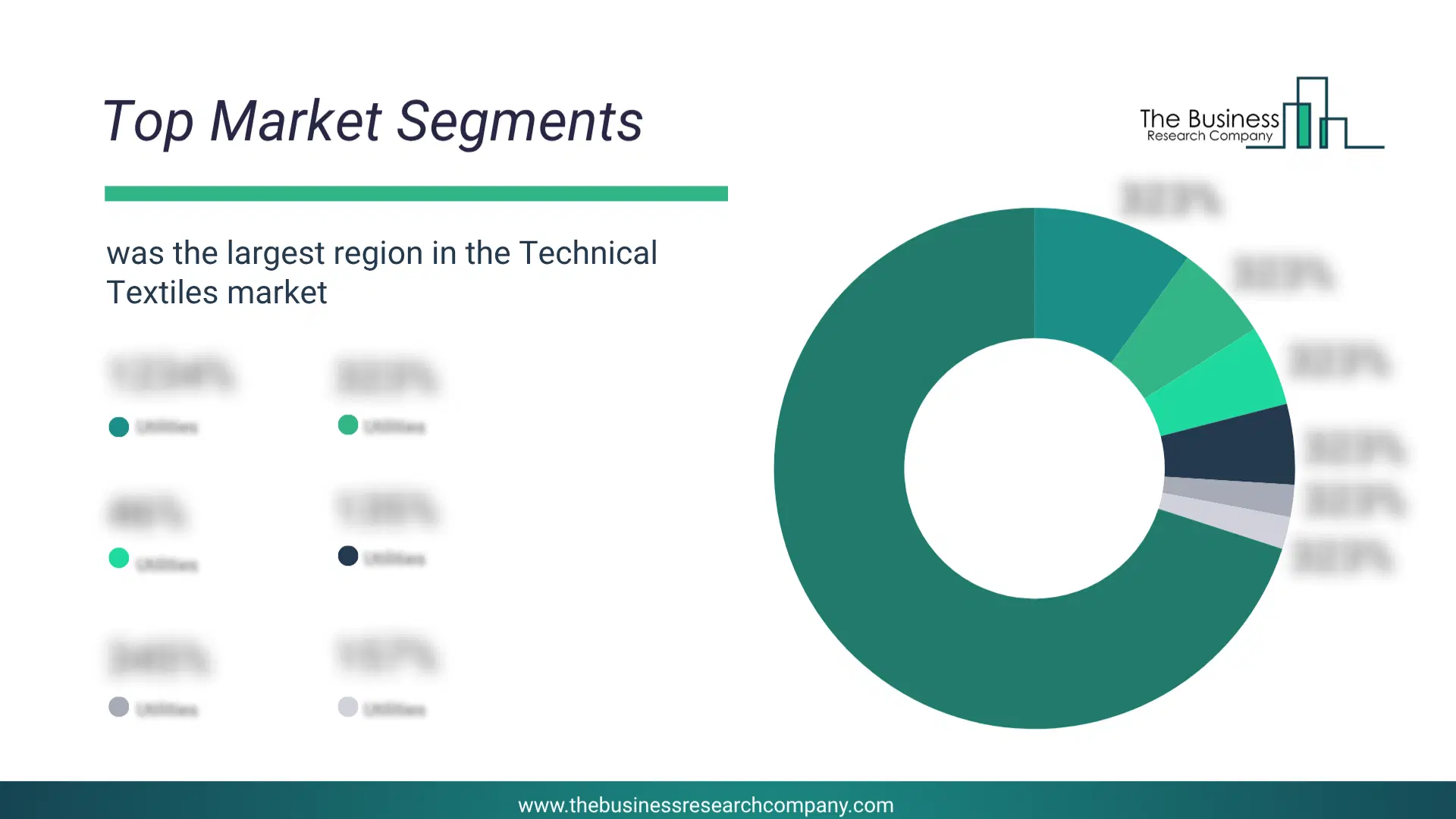
1) By Material: Natural Fiber, Synthetic Polymer, Regenerated Fiber, Mineral, Metal 2) By Process: Woven, Knitted, Non-woven 3) By Application: Transport Textiles, Medical And Hygiene Textiles, Industrial Products And Components, Agriculture, Horticulture, And Fishing, Home Textiles, Clothing Components, Packaging And Containment Subsegments: 1) By Natural Fiber: Cotton, Wool, Silk, Jute, Hemp, Other Natural Fibers 2) By Synthetic Polymer: Polyester, Nylon, Polypropylene, Polyethylene, Aramid, Other Synthetic Polymers 3) By Regenerated Fiber: Viscose, Lyocell, Modal, Acetate, Other Regenerated Fibers 4) By Mineral: Glass Fiber, Carbon Fiber, Asbestos, Other Mineral-Based Textiles 5) By Metal: Stainless Steel Fiber, Aluminum Fiber, Copper Fiber, Other Metal Fibers The top segments in the technical textiles market will be: • Woven will reach $159400 Million by 2025. • Synthetic Polymer will reach $129111.71 Million by 2025. • Non-woven will reach $53112.92 Million by 2025. • Home Textiles will reach $53091.44 Million by 2025. • Natural Fiber will reach $46938.16 Million by 2025.What Is The Driver Of The Technical Textiles Market?
Rise in sales of automobiles is expected to propel the growth of the technical textiles market going forward. Automobile, usually four-wheeled vehicle designed primarily for passenger transportation and commonly propelled by an internal-combustion engine using a volatile fuel. Technical textiles are used extensively in the automotive industry for interior components such as seats, headliners, carpets, and door panels. An increase in automobile sales often leads to higher demand for these textiles. For instance, in March 2024, according to the European Automobile Manufacturers Association (ACEA), an Italy-based organization that represents major European motor vehicle manufacturers, driven by a 10.2% rise in global car output to 76 million units, alongside production increases across major regions including the European Union exceeding 12.1 million units with over 11% growth, China surpassing 25.3 million units with more than 9% expansion, the United States reaching 7.6 million units with an 8.5% gain, and Japan producing over 7.7 million units with a 17.4% surge the automotive industry is showing strong manufacturing momentum. Therefore, rise in sales of automobiles is driving the growth of the technical textiles industry.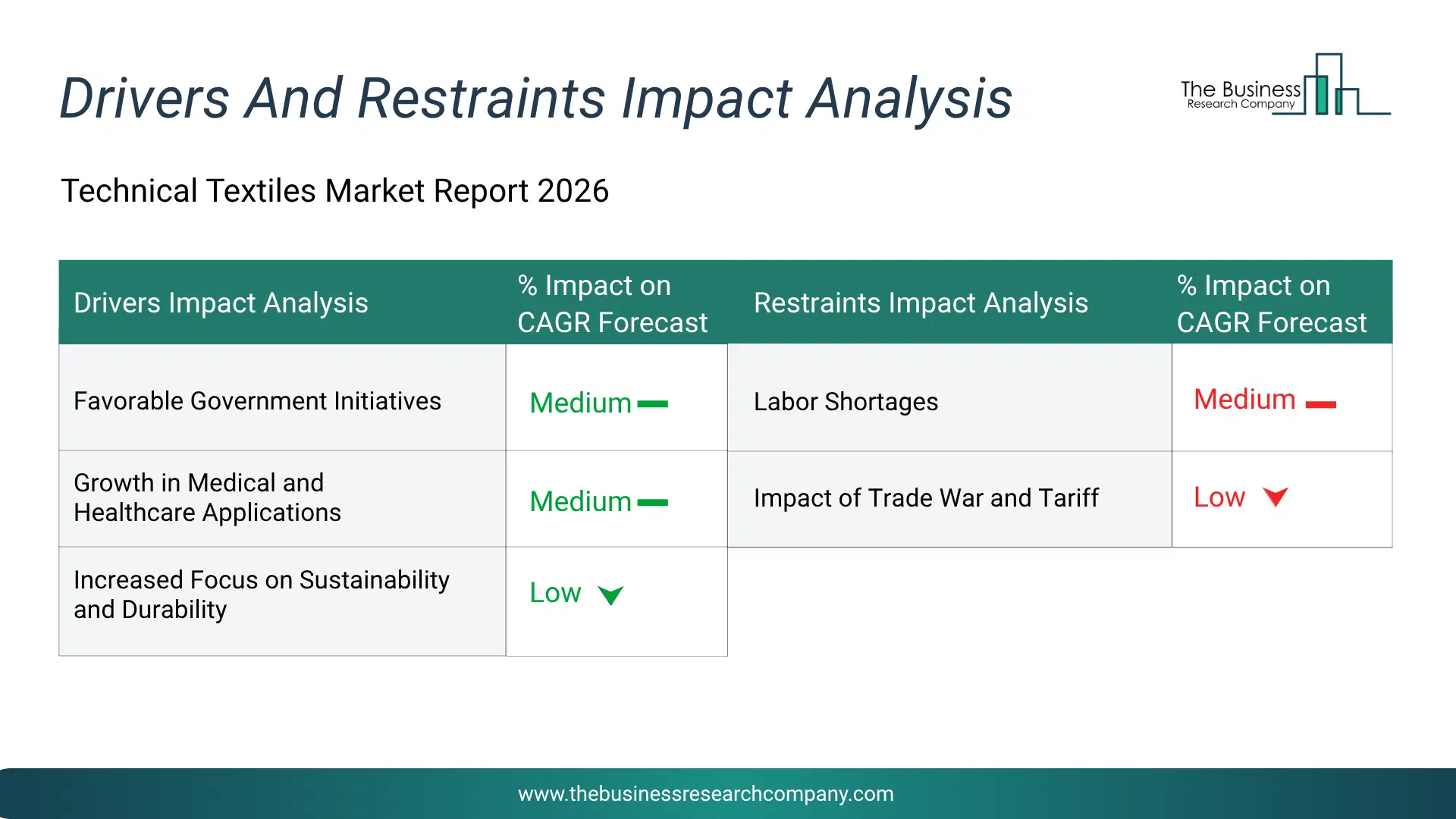
Infographic Chart Showing Key Market Drivers Analysis And Restraints For Technical Textiles Market
The chart presents an impact analysis of key drivers and restraints, quantifying their relative influence on the market's growth rate and helping assess the balance between growth enablers and limiting factors. This chart offers a high-level perspective; the full report contains more detailed insights.
How Will The Drivers Impact Growth In The Global Technical Textiles Market?
• Favorable Government Initiatives (Medium) – The favorable government initiatives will become a key driver of growth in the technical textiles market by 2030. Governments worldwide are actively promoting the expansion of the technical textiles sector through strategic industrial policies. These efforts typically involve financial incentives such as subsidies; tax relief and grants designed to lower manufacturing costs and attract investment in domestic production. Additionally, substantial funding is allocated to research and development, fostering innovation in advanced technical textiles with improved features like enhanced durability, fire resistance and environmental sustainability. Moreover, government infrastructure initiatives often incorporate mandates requiring the use of technical textiles to enhance the longevity and sustainability of projects. The integration of materials like geotextiles in roadways and specialized fabrics in public housing establishes a consistent demand, further supporting sector expansion. As a result, the favorable government initiatives is anticipated to contributing to a 1.5% annual growth in the market. • Growth in Medical and Healthcare Applications (Medium) – The growth in medical and healthcare applications will emerge as a major factor driving the expansion of the technical textiles market by 2030. The healthcare industry is actively pursuing advanced materials that ensure hygiene, durability, comfort and safety. Technical textiles fulfill these demands by supplying specialized fabrics integral to medical devices, wound care solutions and protective apparel. As global healthcare needs expand, so does the reliance on these innovative textiles. Rising needs for infection control and personal protective equipment, especially post-pandemic, have boosted their usage in disposable and reusable products. Advances in implantable and smart textiles are also creating new growth opportunities by enhancing biocompatibility and enabling health monitoring. Consequently, the growth in medical and healthcare applications capabilities is projected to contributing to a 1.0% annual growth in the market. • Increased Focus on Sustainability and Durability (Low) – The increased focus on sustainability and durability within digital manufacturing processes will serve as a key growth catalyst for the technical textiles market by 2030. Growing environmental awareness among industries and consumers is driving demand for technical textiles made from sustainable and eco-friendly materials. The sector is increasingly incorporating fibers and fabrics sourced from renewable or recycled resources, aligning with global initiatives to cut carbon emissions, reduce waste and decrease dependence on finite resources. Technical textiles are valued for their enhanced durability, which ensures resistance to harsh conditions and extended service life. This longevity minimizes the need for frequent replacements, thereby reducing waste and lowering operational costs. Advances in recycling and biodegradable materials further boost the market by reducing the overall environmental footprint across the product lifecycle. Therefore, this increased focus on sustainability and durability across digital manufacturing operations is projected to supporting to a 0.7% annual growth in the market. • Increasing Popularity of Sportswear (Low) – The increasing popularity of sportswear will become a significant driver contributing to the growth of the technical textiles market by 2030. As participation in sports and fitness activities rises, the demand for performance-enhancing sportswear is expanding rapidly. Technical textiles, engineered for moisture management, breathability, elasticity and quick-drying properties, have become crucial in delivering comfort and optimizing athletic performance. Modern consumers prioritize a blend of comfort and advanced functionality in their sports apparel. These textiles offer lightweight, durable and flexible solutions that facilitate unrestricted movement while providing UV protection and temperature control. Additionally, the increasing number of sports events and active lifestyles is fueling the need for versatile, high-performance sportswear across different climates and activities. Consequently, the increasing popularity of sportswear strategies is projected to contributing to a 0.5% annual growth in the market.How Will The Restraints Impact Growth In The Global Technical Textiles Market?
• Rising Competition from Low-Cost Manufacturers (Medium) – Rising Competition from Low-Cost Manufacturers will restrict the growth of the Technical Textiles market during the forecast period. Technical textile manufacturers face increasing competition from low-cost producers in developing regions. Price competition can affect profit margins and market share for established producers. Competitive pressures from low-cost alternatives may limit growth opportunities and affect investment in innovation. • Labor Shortages (Low) – Labor Shortages will restrict the growth of the Technical Textiles market during the forecast period. Technical textile manufacturing requires skilled workers with expertise in specialized production processes. The shortage of qualified textile engineers and technicians affects production capacity and innovation. Labor shortages can lead to production delays and increased costs, limiting market growth. • Impact of Trade War and Tariff (Low) – Impact of Trade War and Tariff will restrict the growth of the Technical Textiles market during the forecast period. Technical textile trade is affected by tariffs and trade restrictions on fibers, fabrics, and finished products. Trade barriers can increase costs and affect export competitiveness. Trade tensions may also impact international textile supply chains and market access.Key Players In The Global Technical Textiles Market
Major companies operating in the technical textiles market are Asahi Kasei, Kimberly-Clark Corporation, Berry Global Group Inc., DuPont de Nemours Inc., Mitsui Chemicals Inc., Freudenberg & Co KG, Low & Bonar Group plc., Toyobo Co Ltd., Milliken & Company, SRF Limited, Koninklijke Ten Cate B.V., 3M Company, Ahlstrom-Munksjö Oyj, SKAPS Industries, Johns Manville Corporation, Companhia Providência Indústria e Comércio, Fiberweb PLC, Strata Geosystems Pvt. Ltd., The TWE Group GmbH, Ibena Textilewerke GmbH, Officine Maccaferri S.p.A., Duvaltex Inc., Hindoostan Mills Company Limited, GSE Environmental Inc., Polymer Group Inc.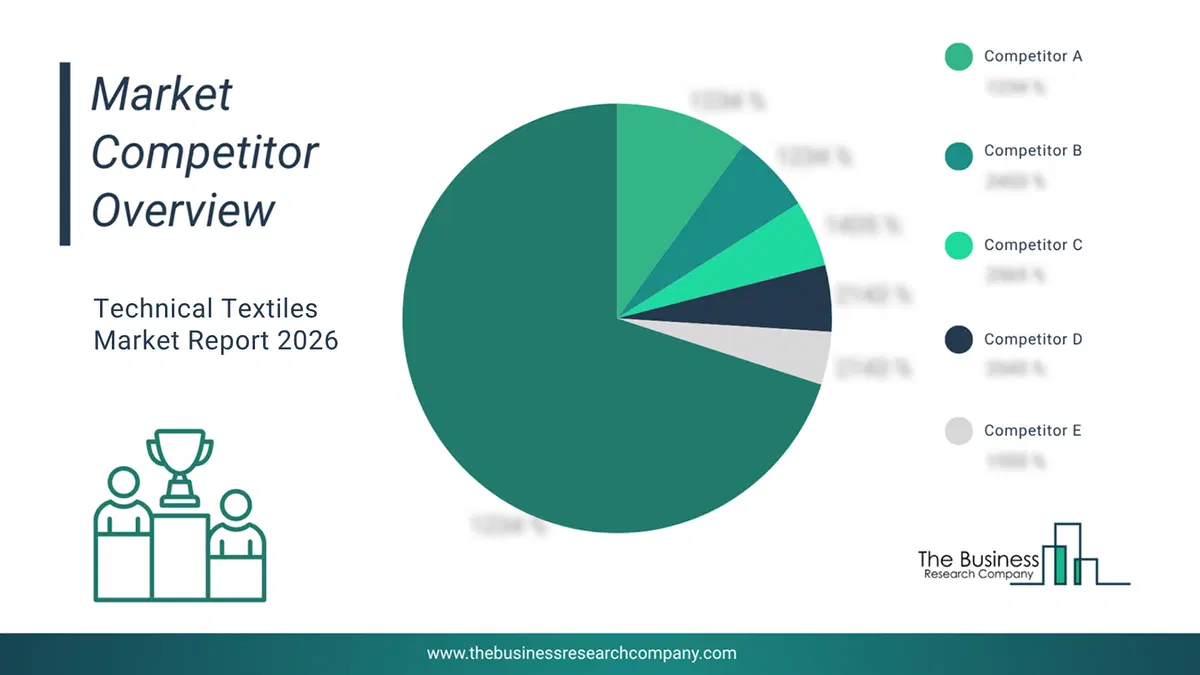
This chart is for illustrative purposes; the full report includes a detailed competitor analysis and comprehensive overview of the top 10 companies in the market.
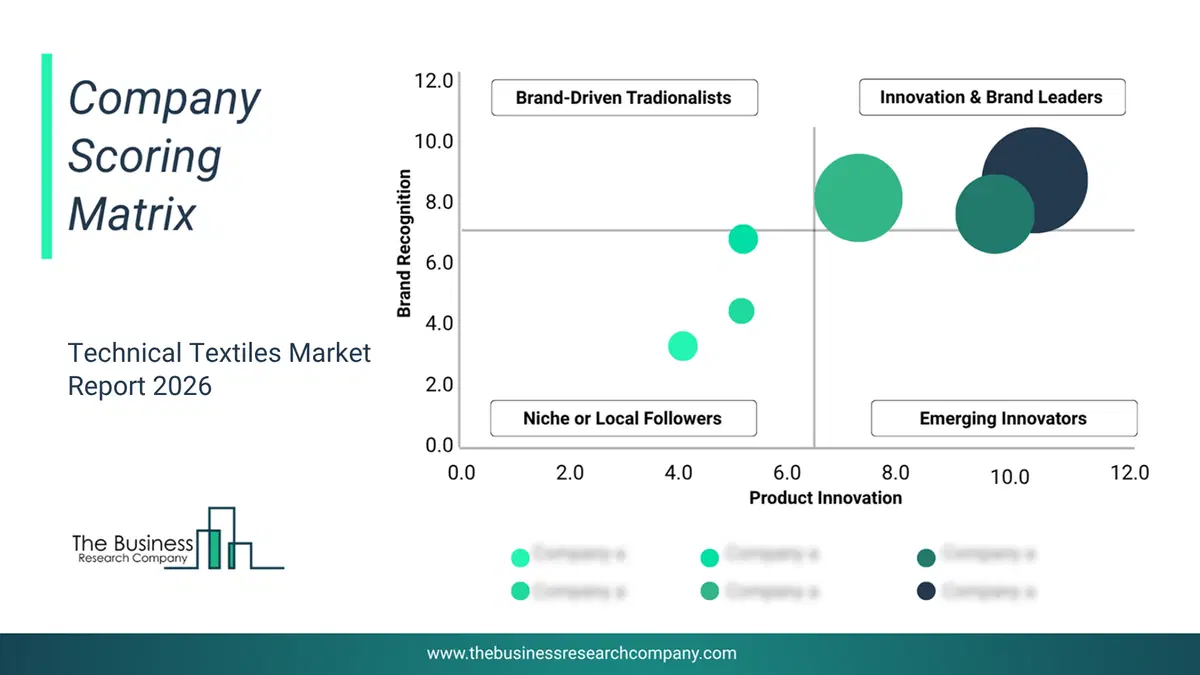
This chart maps companies by product innovation and brand strength, with bubble size indicating relative revenue, helping identify market leaders, challengers, and niche players. This is an illustrative chart; the full report provides a complete and accurate competitive analysis.
Global Technical Textiles Market Trends and Insights
Major companies in the technical textiles market are focusing on product innovation such as sustainable products to strengthen their product portfolio. Sustainable products are goods or services that are designed, produced, and used in a way that minimizes their negative impact on the environment, society, and the economy throughout their entire lifecycle. Sustainable technical textiles often utilize eco-friendly materials, such as recycled fibers, organic fibers, or bio-based materials. These materials reduce the demand for new resources and decrease the environmental impact of production. For instance, in July 2024, Freudenberg Performance Materials Apparel, a US-based supplier of innovative technical textiles, has announce a state-of-the-art thermal insulation factory. This facility specializes in the production of comfortemp, Freudenberg’s renowned high-performance thermal insulation material, designed to elevate fashion and sportswear apparel.What Are Latest Mergers And Acquisitions In The Technical Textiles Market?
In October 2023, COISNE et LAMBERT, a France-based leader in the production and marketing of technical textiles for the professional clothing and PPE sectors, acquired Infinity Group for an undisclosed amount. This acquisition of Infinity Group illustrates will build a leading group in the field of technical textiles in the European and global markets and to bring more services and solutions to the customers to support their growth. Infinity Group is a France-based player in the technical knitted fabrics sector.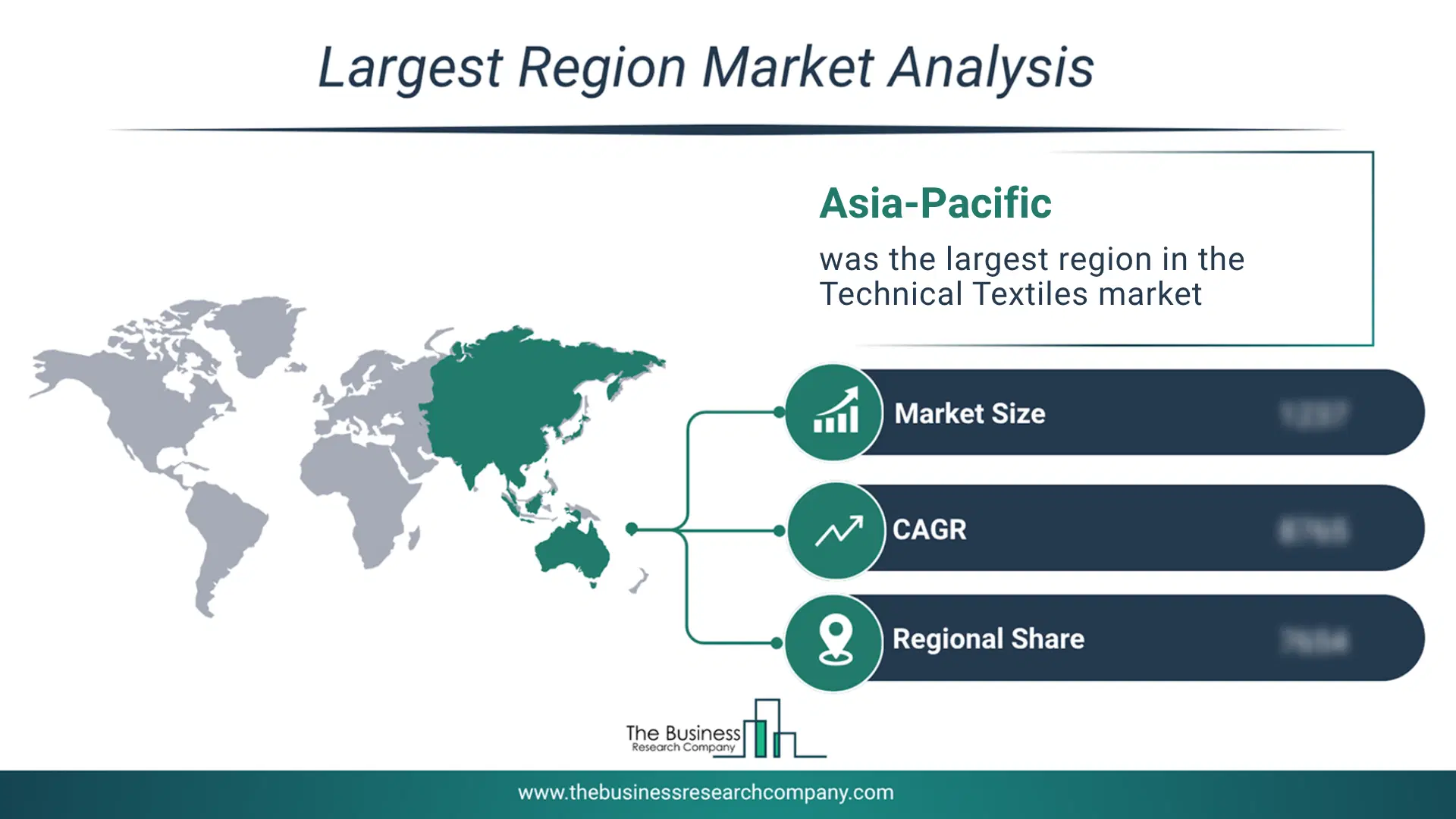
Regional Insights
Asia-Pacific was the largest region in the technical textiles market in 2025. Asia-Pacific is expected to be the fastest-growing region in the forecast period. The regions covered in this market report are Asia-Pacific, South East Asia, Western Europe, Eastern Europe, North America, South America, Middle East, Africa The countries covered in this market report are Australia, Brazil, China, France, Germany, India, Indonesia, Japan, Taiwan, Russia, South Korea, UK, USA, Canada, Italy, SpainWhat Defines the Technical Textiles Market?
The technical textiles market consists of sales of raw materials for technical textiles such as natural fibers, regerated fibers and synthetic fibers. Values in this market are ‘factory gate’ values, that is the value of goods sold by the manufacturers or creators of the goods, whether to other entities (including downstream manufacturers, wholesalers, distributors, and retailers) or directly to end customers. The value of goods in this market includes related services sold by the creators of the goods.How is Market Value Defined and Measured?
The market value is defined as the revenues that enterprises gain from the sale of goods and/or services within the specified market and geography through sales, grants, or donations in terms of the currency (in USD unless otherwise specified). The revenues for a specified geography are consumption values that are revenues generated by organizations in the specified geography within the market, irrespective of where they are produced. It does not include revenues from resales along the supply chain, either further along the supply chain or as part of other products.
This chart presents market attractiveness based on a quantitative evaluation of growth, competition, strategic alignment, and risk, offering a clear view of opportunity areas for decision-making. This chart is for illustrative purposes; the full report contains the complete analysis.

This chart highlights the Total Addressable Market (TAM) by estimating the maximum revenue opportunity using an assumption-driven approach, supporting strategic planning and opportunity sizing across markets. The chart is illustrative; the full report provides a more comprehensive analysis.
What Key Data and Analysis Are Included in the Technical Textiles Market Report 2026?
The technical textiles market research report is one of a series of new reports from The Business Research Company that provides market statistics, including industry global market size, regional shares, competitors with the market share, detailed market segments, market trends and opportunities, and any further data you may need to thrive in the technical textiles industry. The market research report delivers a complete perspective of everything you need, with an in-depth analysis of the current and future state of the industry.Technical Textiles Market Report Forecast Analysis
| Report Attribute | Details |
|---|---|
| Market Size Value In 2026 | $264.42 billion |
| Revenue Forecast In 2030 | $329.23 billion |
| Growth Rate | CAGR of 5.3% from 2026 to 2030 |
| Base Year For Estimation | 2025 |
| Actual Estimates/Historical Data | 2020-2025 |
| Forecast Period | 2026 - 2030 |
| Market Representation | Revenue in USD Billion and CAGR from 2026 to 2030 |
| Segments Covered | Material, Process, Application |
| Regional Scope | Asia-Pacific, Western Europe, Eastern Europe, North America, South America, Middle East, Africa |
| Country Scope | The countries covered in the report are Australia, Brazil, China, France, Germany, India, Indonesia, Japan, Taiwan, Russia, South Korea, UK, USA, Canada, Italy, Spain. |
| Key Companies Profiled | Asahi Kasei, Kimberly-Clark Corporation, Berry Global Group Inc., DuPont de Nemours Inc., Mitsui Chemicals Inc., Freudenberg & Co KG, Low & Bonar Group plc., Toyobo Co Ltd., Milliken & Company, SRF Limited, Koninklijke Ten Cate B.V., 3M Company, Ahlstrom-Munksjö Oyj, SKAPS Industries, Johns Manville Corporation, Companhia Providência Indústria e Comércio, Fiberweb PLC, Strata Geosystems Pvt. Ltd., The TWE Group GmbH, Ibena Textilewerke GmbH, Officine Maccaferri S.p.A., Duvaltex Inc., Hindoostan Mills Company Limited, GSE Environmental Inc., Polymer Group Inc. |
| Customization Scope | Request for Customization |
| Pricing And Purchase Options | Explore Purchase Options |