
Virtual Reality In Tourism Market Report 2026
Global Outlook – By Type (3 Dimension (3D), 4 Dimension (4D), Other Types), By Device (Head-Mounted Displays (HMDs), Smartphones, Consoles, Personal Computers (PCs)), By Platform (Android, iPhone Operating System (IOS), Windows, Macintosh Operating System (Mac OS)), By Application (Travel Agency, Hotel, Tourist Attractions, Entertainment, Education) – Market Size, Trends, Strategies, and Forecast to 2030
Virtual Reality In Tourism Market Overview
• Virtual Reality In Tourism market size has reached to $7.48 billion in 2025 • Expected to grow to $37.44 billion in 2030 at a compound annual growth rate (CAGR) of 38% • Growth Driver: Enhancing Travel Experiences Virtual Reality In Tourism Market Set To Thrive Amid Rising Global Travel Demand • Market Trend: Innovative Virtual Interactive Portals Boost Experiences Tourism • Asia-Pacific was the largest region in 2025.What Is Covered Under Virtual Reality In Tourism Market?
Virtual reality (VR) in tourism involves using immersive technology to create virtual experiences of destinations, allowing travelers to explore places before visiting. It offers interactive tours, previews of accommodations, and simulated activities, enhancing trip planning and decision-making. Virtual reality can also provide remote access to attractions, broadening the reach of tourism experiences. The main types of virtual reality in tourism are 3 Dimension (3D), 4 Dimension (4D), and others. 3D virtual reality in tourism refers to immersive digital experiences that replicate real-world destinations, allowing users to explore and interact with virtual environments as if they were physically present. This is facilitated by devices such as head-mounted displays (HMDs), smartphones, consoles, and personal computers (PCs), and is available on various platforms including android, iPhone operating system (IOS), windows, macintosh operating system (Mac OS). Applications include travel agencies, hotels, tourist attractions, entertainment, education, retail, and healthcare.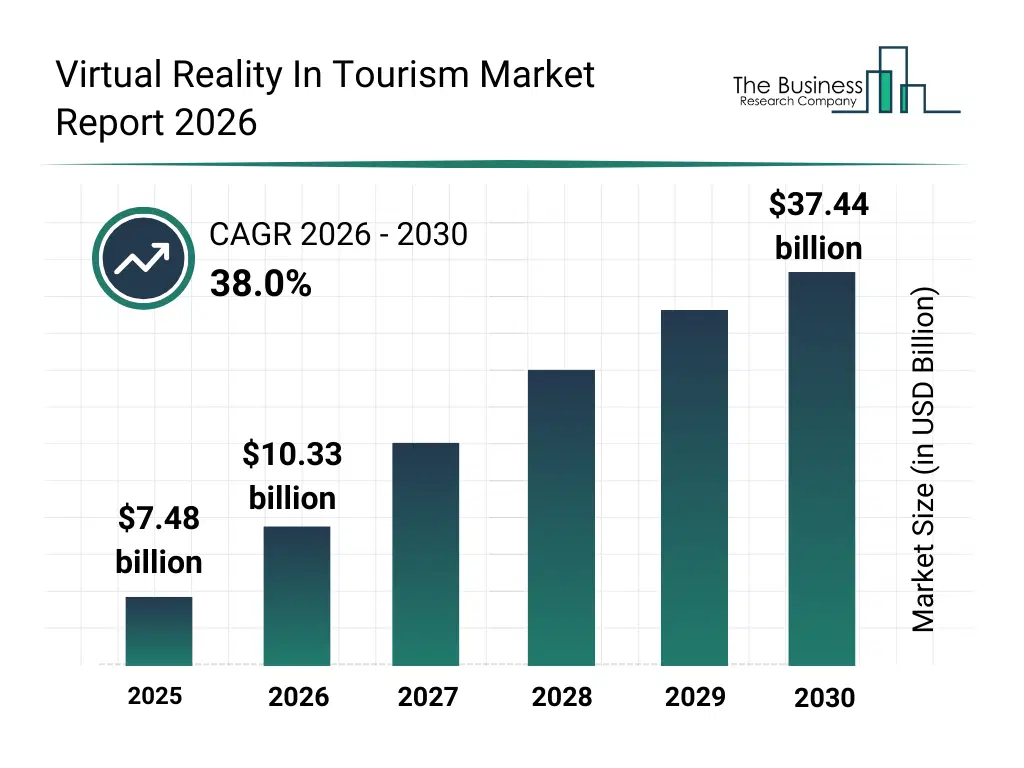
What Is The Virtual Reality In Tourism Market Size and Share 2026?
The virtual reality in tourism market size has grown exponentially in recent years. It will grow from $7.48 billion in 2025 to $10.33 billion in 2026 at a compound annual growth rate (CAGR) of 38.1%. The growth in the historic period can be attributed to growth of global tourism marketing initiatives, increasing use of digital media in travel promotion, rising demand for experiential travel planning, expansion of internet accessibility, availability of consumer vr devices.What Is The Virtual Reality In Tourism Market Growth Forecast?
The virtual reality in tourism market size is expected to see exponential growth in the next few years. It will grow to $37.44 billion in 2030 at a compound annual growth rate (CAGR) of 38.0%. The growth in the forecast period can be attributed to increasing adoption of vr-based tourism platforms, rising demand for sustainable travel alternatives, expansion of virtual heritage preservation, growing integration of ar and mr experiences, increasing investment in immersive tourism content. Major trends in the forecast period include increasing adoption of virtual destination previews, rising use of immersive travel marketing tools, growing integration of vr in trip planning, expansion of interactive cultural experiences, enhanced focus on remote tourism access.
Global Virtual Reality In Tourism Market Segmentation
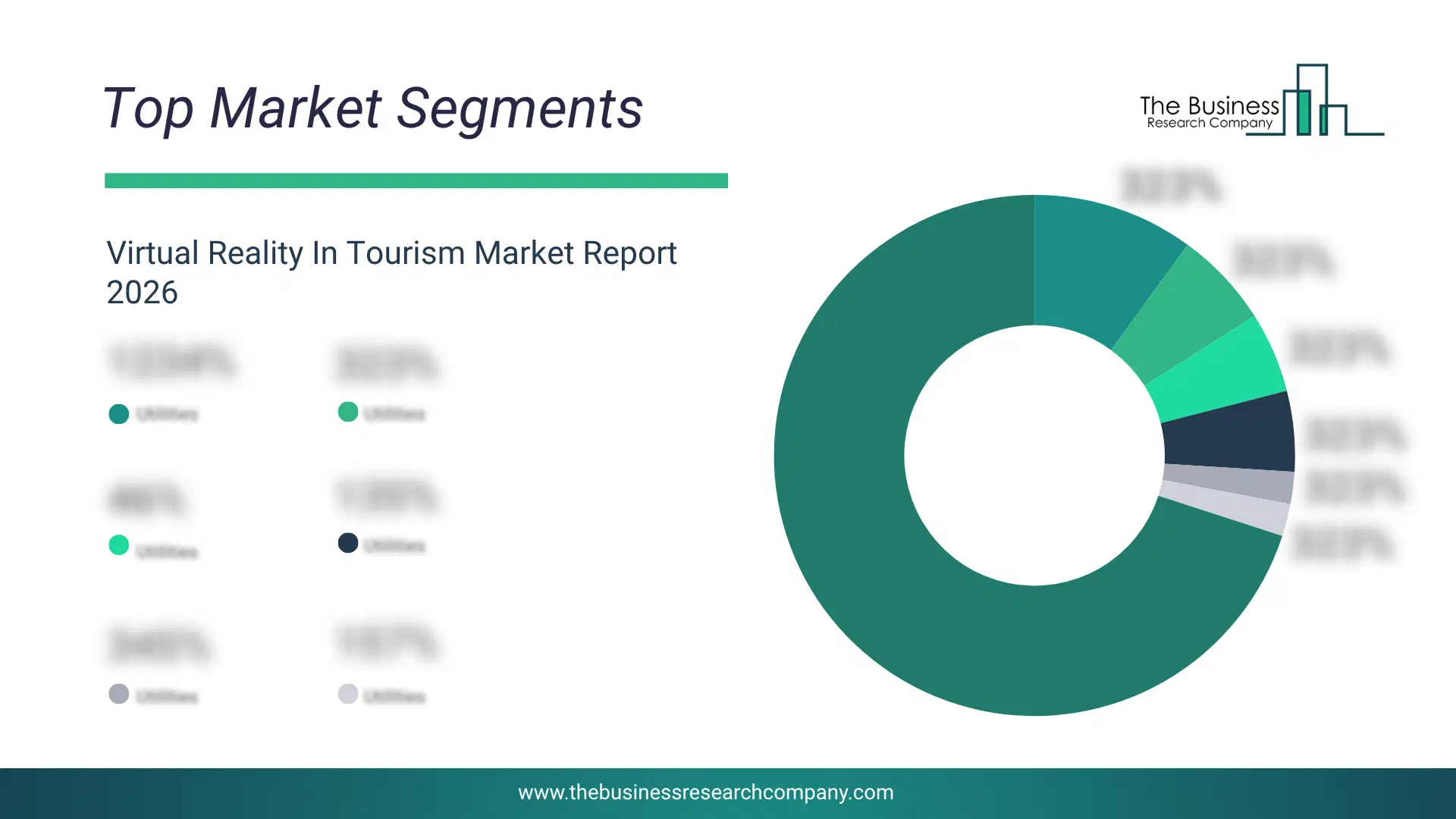
1) By Type: 3 Dimension (3D), 4 Dimension (4D), Other Types 2) By Device: Head-Mounted Displays (HMDs), Smartphones, Consoles, Personal Computers (PCs) 3) By Platform: Android, iPhone Operating System (IOS), Windows, Macintosh Operating System (Mac OS) 4) By Application: Travel Agency, Hotel, Tourist Attractions, Entertainment, Education Subsegments: 1) By 3 Dimension (3D): 3D Virtual Tours, 3D Interactive Destinations, 3D Hotel Room Previews 2) By 4 Dimension (4D): 4D Themed Experiences, 4D Virtual Tours With Sensory Enhancements 3) By Other Types: Augmented Reality (AR) Experiences, Mixed Reality (MR) Experiences, Haptic Feedback VR ExperiencesWhat Is The Driver Of The Virtual Reality In Tourism Market?
The increasing demand for travel and tourism is expected to propel the growth of the virtual reality in tourism market going forward. The demand for travel and tourism is rising due to increased disposable income, the relaxation of travel restrictions, and a growing desire for unique experiences. Virtual reality in travel and tourism services enables potential travelers to experience virtual tours of destinations, hotels, and attractions before making a booking, helping them make more informed decisions and increasing their confidence in their choices. For instance, in December 2023, according to the United Nations World Tourism Organization, a Spain-based international organization, an estimated 975 million tourists travelled internationally between January and September 2023, representing a 38 percent increase compared with the same period in 2022. Therefore, the increasing demand for travel and tourism is driving the growth of the virtual reality in tourism industry.Key Players In The Global Virtual Reality In Tourism Market
Major companies operating in the virtual reality in tourism market are Alphabet Inc., Samsung Electronics, Microsoft Corporation, Sony Group Corporation, Lufthansa Group, Nokia Corporation, Marriott International, TUI Group, National Geographic, Thomas Cook, HTC Corporation, EON Reality Inc, YouVisit, VironIT, 3D Walkabout, VeeR VR, AirPano, Travel World VR LLC, VR IMMERSION LTD, VR Gorilla, Cyber Tours Ltd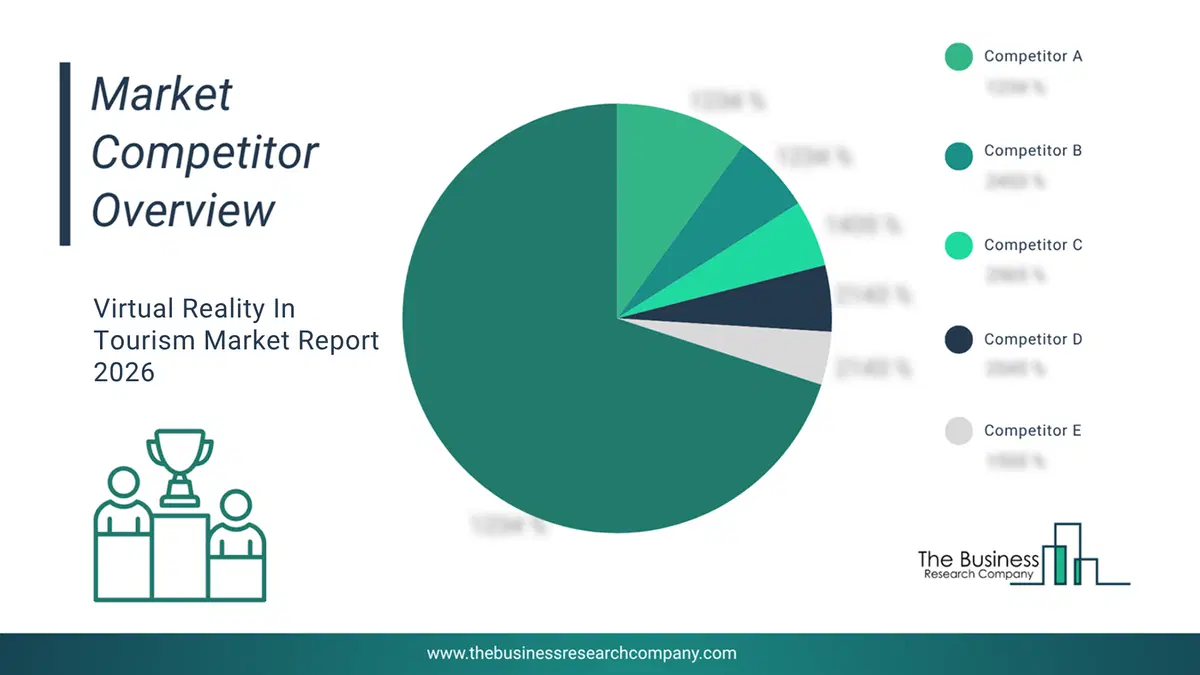
This chart is for illustrative purposes; the full report includes a detailed competitor analysis and comprehensive overview of the top 10 companies in the market.
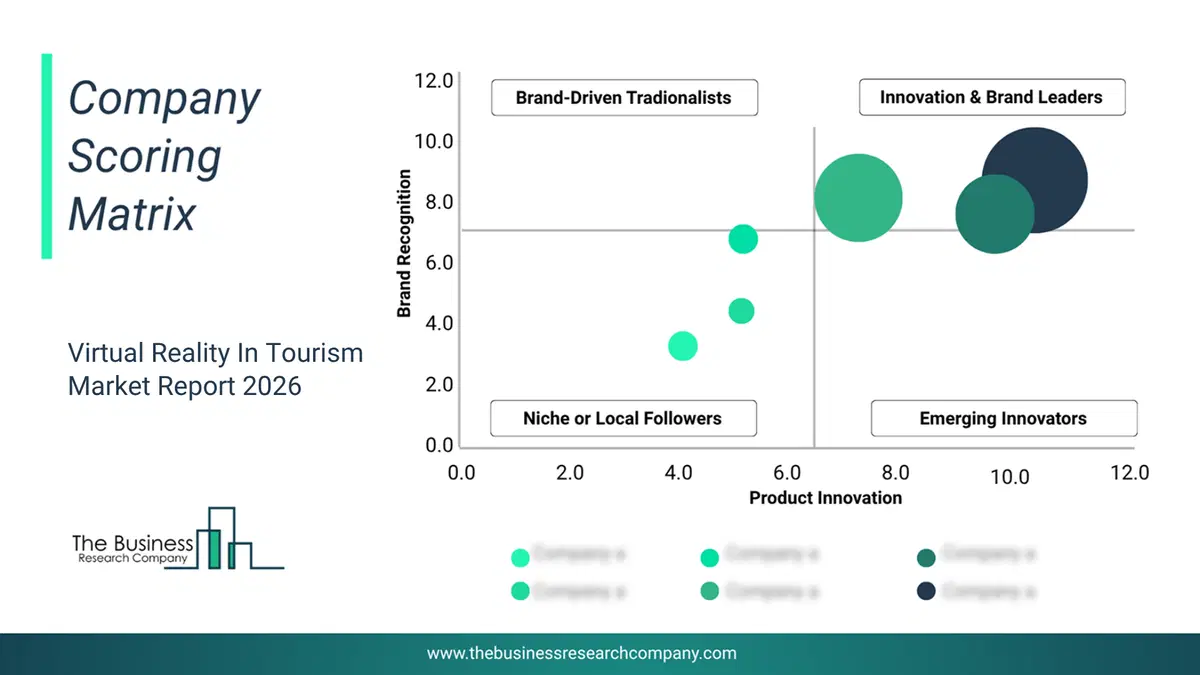
This chart maps companies by product innovation and brand strength, with bubble size indicating relative revenue, helping identify market leaders, challengers, and niche players. This is an illustrative chart; the full report provides a complete and accurate competitive analysis.
Global Virtual Reality In Tourism Market Trends and Insights
Major companies operating in the virtual reality in tourism market are focusing on innovative solutions such as a virtual interactive portal to enhance immersive travel experiences. A virtual interactive portal refers to an online platform that offers immersive, interactive experiences, allowing users to explore and engage with virtual environments or content. For instance, in February 2024, the Tokyo Metropolitan Government (TMG) and the Tokyo Convention and Visitors Bureau, a Japan-based official destination marketing and management organization, launched the Hello! Tokyo Friends platform on Roblox, which offers a virtual reality experience that immerses users in Tokyo's cultural and historical landmarks. Users explore modern icons such as Tokyo Tower and Shibuya Scramble Crossing through activities such as treasure hunts and games, with plans to include historical Edo period settings. Meanwhile, the Tokyo Hunt App blends augmented reality with real-world exploration, allowing users to capture AR photos with virtual characters at landmarks such as the Hachiko Statue and Asakusa Kaminarimon Gate. The app encourages visits to specific city checkpoints to collect emblems for redemption in the virtual world.What Are Latest Mergers And Acquisitions In The Virtual Reality In Tourism Market?
In February 2025, CoStar Group, Inc., a US-based real estate information, analytics, and online marketplaces company, acquired Matterport Inc. for an undisclosed amount. With this acquisition, CoStar aims to accelerate the deployment of AI-driven digital twin technology across its property data platforms and online marketplaces, deepening its capabilities in computer vision and spatial analytics. Matterport Inc. is a US-based spatial-data company that provides 3D capture solutions, immersive digital twins, and AI-powered property insights for commercial and residential real estate.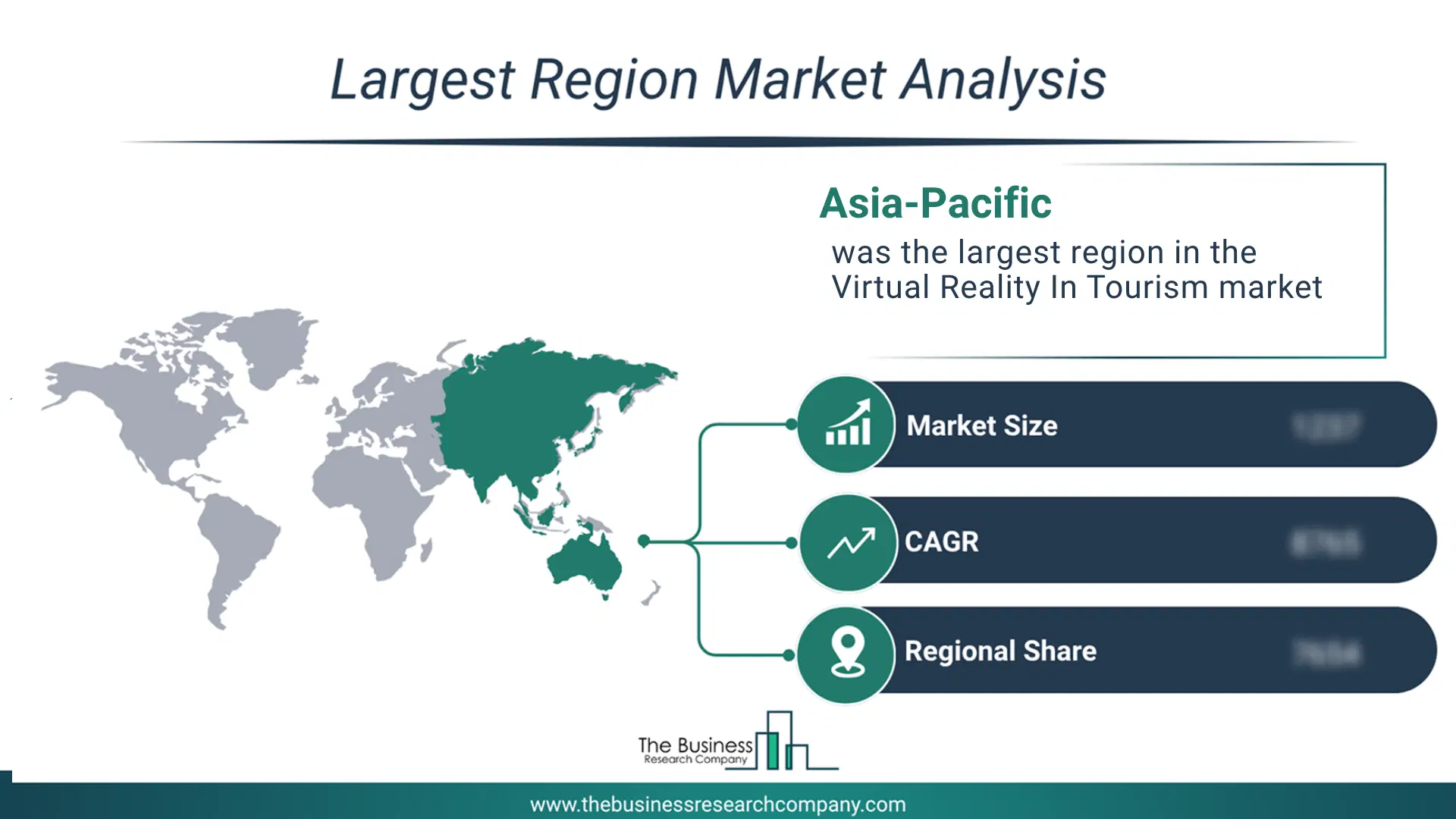
Regional Insights
Asia-Pacific was the largest region in the virtual reality in tourism market in 2025. The regions covered in this market report are Asia-Pacific, South East Asia, Western Europe, Eastern Europe, North America, South America, Middle East, Africa. The countries covered in this market report are Australia, Brazil, China, France, Germany, India, Indonesia, Japan, Taiwan, Russia, South Korea, UK, USA, Canada, Italy, Spain.What Defines the Virtual Reality In Tourism Market?
The virtual reality in tourism market consists of revenues earned by entities by providing services such as virtual reality (VR)-based destination marketing services, virtual heritage site explorations, and virtual reality (VR)-enhanced travel planning consultations. The market value includes the value of related goods sold by the service provider or included within the service offering. The virtual reality in tourism market also includes sales of virtual reality headsets and specialized virtual reality controllers. Values in this market are ‘factory gate’ values, that is the value of goods sold by the manufacturers or creators of the goods, whether to other entities (including downstream manufacturers, wholesalers, distributors and retailers) or directly to end customers. The value of goods in this market includes related services sold by the creators of the goods.How is Market Value Defined and Measured?
The market value is defined as the revenues that enterprises gain from the sale of goods and/or services within the specified market and geography through sales, grants, or donations in terms of the currency (in USD unless otherwise specified). The revenues for a specified geography are consumption values that are revenues generated by organizations in the specified geography within the market, irrespective of where they are produced. It does not include revenues from resales along the supply chain, either further along the supply chain or as part of other products.
This chart presents market attractiveness based on a quantitative evaluation of growth, competition, strategic alignment, and risk, offering a clear view of opportunity areas for decision-making. This chart is for illustrative purposes; the full report contains the complete analysis.

This chart highlights the Total Addressable Market (TAM) by estimating the maximum revenue opportunity using an assumption-driven approach, supporting strategic planning and opportunity sizing across markets. The chart is illustrative; the full report provides a more comprehensive analysis.
What Key Data and Analysis Are Included in the Virtual Reality In Tourism Market Report 2026?
The virtual reality in tourism market research report is one of a series of new reports from The Business Research Company that provides market statistics, including industry global market size, regional shares, competitors with the market share, detailed market segments, market trends and opportunities, and any further data you may need to thrive in the virtual reality in tourism industry. The market research report delivers a complete perspective of everything you need, with an in-depth analysis of the current and future state of the industry.Virtual Reality In Tourism Market Report Forecast Analysis
| Report Attribute | Details |
|---|---|
| Market Size Value In 2026 | $10.33 billion |
| Revenue Forecast In 2030 | $37.44 billion |
| Growth Rate | CAGR of 38% from 2026 to 2030 |
| Base Year For Estimation | 2025 |
| Actual Estimates/Historical Data | 2020-2025 |
| Forecast Period | 2026 - 2030 |
| Market Representation | Revenue in USD Billion and CAGR from 2026 to 2030 |
| Segments Covered | Type, Device, Platform, Application |
| Regional Scope | Asia-Pacific, Western Europe, Eastern Europe, North America, South America, Middle East, Africa |
| Country Scope | The Countries Covered In This Market Report Are Australia, Brazil, China, France, Germany, India, Indonesia, Japan, Taiwan, Russia, South Korea, Uk, Usa, Canada, Italy, Spain. |
| Key Companies Profiled | Alphabet Inc., Samsung Electronics, Microsoft Corporation, Sony Group Corporation, Lufthansa Group, Nokia Corporation, Marriott International, TUI Group, National Geographic, Thomas Cook, HTC Corporation, EON Reality Inc, YouVisit, VironIT, 3D Walkabout, VeeR VR, AirPano, Travel World VR LLC, VR IMMERSION LTD, VR Gorilla, Cyber Tours Ltd |
| Customization Scope | Request for Customization |
| Pricing And Purchase Options | Explore Purchase Options |