

Wind Turbine Nacelle Market Report 2026
Global Outlook – By Location Of Deployment (Onshore, Offshore), By Turbine Capacity (Less Than 1.5 MW, 1.5 To 2 MW, 2 To 2.5 MW, Greater Than 2.5 MW), By Application (Utility-Scale Wind Power, Distributed Or Community Wind Power, Industrial Captive Wind Power) – Market Size, Trends, Strategies, and Forecast to 2030
Wind Turbine Nacelle Market Overview
• Wind Turbine Nacelle market size has reached to $7.75 billion in 2025 • Expected to grow to $11.46 billion in 2030 at a compound annual growth rate (CAGR) of 8.3% • Growth Driver: Rise In Usage Of Renewable Energy • Market Trend: Product Innovations With New Generation Technology • Asia-Pacific was the largest region and fastest growing region.What Is Covered Under Wind Turbine Nacelle Market?
A wind turbine nacelle refers to the enclosure or housing structure at the top of a wind turbine tower that contains various components vital for the turbine's operation. It is typically a large, box-like structure that sits atop the tower and houses critical components, including the generator, gearbox, and control systems. The main wind turbine nacelle location of deployment types is onshore, and offshore. Onshore wind energy refers to the deployment of wind turbines on land, typically in areas such as open plains, hills, or coastal regions. The various turbine capacities are less than 1.5 MW, 1.5 to 2 MW, 2 to 2.5 MW, and greater than 2.5 MW applied in residential, utility, industrial, and commercial.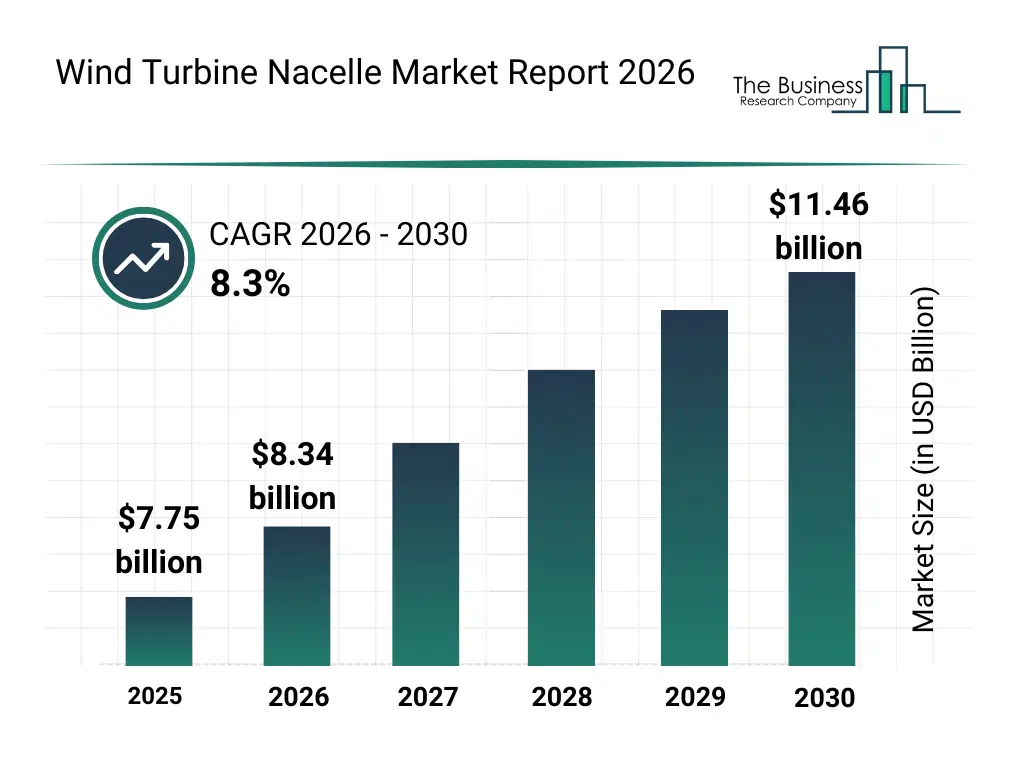
What Is The Wind Turbine Nacelle Market Size and Share 2026?
The wind turbine nacelle market size has grown strongly in recent years. It will grow from $7.75 billion in 2025 to $8.34 billion in 2026 at a compound annual growth rate (CAGR) of 7.7%. The growth in the historic period can be attributed to growth in wind turbine installations, offshore wind expansion, demand for higher efficiency turbines, technological improvements, renewable capacity additions.What Is The Wind Turbine Nacelle Market Growth Forecast?
The wind turbine nacelle market size is expected to see strong growth in the next few years. It will grow to $11.46 billion in 2030 at a compound annual growth rate (CAGR) of 8.3%. The growth in the forecast period can be attributed to offshore wind investments, demand for larger turbines, predictive maintenance adoption, smart nacelle design innovation, renewable energy capacity targets. Major trends in the forecast period include increasing demand for high capacity nacelles, integration of advanced control systems, rising adoption in offshore wind projects, focus on lightweight nacelle structures, growth of condition monitoring technologies.Tariff Impact On Wind Turbine Nacelle Market
Tariffs have influenced the wind turbine nacelle market by increasing costs of imported gearboxes, generators, cooling systems, and electronic controls. Offshore nacelle systems are most affected, particularly in europe and asia pacific. Higher component costs have increased project capital expenditure. However, tariffs are supporting regional nacelle assembly and component localization strategies.
Global Wind Turbine Nacelle Market Segmentation
1) By Location Of Deployment: Onshore, Offshore 2) By Turbine Capacity: Less Than 1.5 MW, 1.5 To 2 MW, 2 To 2.5 MW, Greater Than 2.5 MW 3) By Application: Utility-Scale Wind Power, Distributed Or Community Wind Power, Industrial Captive Wind Power Subsegments: 1) By Onshore: Utility-Scale Onshore Wind Farms, Commercial And Industrial Onshore Wind Installations, Community Wind Projects, Distributed Onshore Wind Systems 2) By Offshore: Fixed-Bottom Offshore Wind Farms, Floating Offshore Wind Farms, Near-Shore Offshore Wind Projects, Deep-Water Offshore Wind InstallationsWhat Are The Drivers Of The Wind Turbine Nacelle Market?
The usage of renewable energy sources is expected to propel the growth of the wind turbine nacelle market going forward. Renewable energy sources are sustainable and environmentally friendly forms of energy derived from naturally replenishing resources. Renewable energy sources offer sustainability, reduced greenhouse gas emissions, and decreased reliance on finite fossil fuels, making them vital for a cleaner and more sustainable energy future. Wind power is becoming more popular as a renewable energy solution that strives to minimize greenhouse gas emissions and shift to cleaner and more sustainable energy systems. Wind turbines, which use nacelles to house crucial components like the generator, gearbox, and control systems, are critical for harvesting wind energy and transforming it into electricity. For instance, in February 2025, according to the World Resources Institute, a US-based non-profit organization, reported that in 2024, solar energy set a new record by adding an estimated 39.6 gigawatts (GW) of capacity, surpassing the 27.4 GW installed in 2023. Therefore, the usage of renewable energy sources is driving the growth of the wind turbine nacelle industry. Strong government support is expected to drive the growth of the wind turbine nacelle market going forward. The governments of various countries are supporting the energy sector to produce new solutions to better serve the industry. For example, in March 2023, the UK government announced it will quadruple offshore wind capacity to 50 GW (gigawatt) by 2030, and reach net zero power generation by 2035. Meanwhile, EU countries are ramping up offshore wind activity and the EU’s Green Deal plan temporarily relaxes state aid rules, allowing member states to subsidize supply chains. Further, in February 2023, the US government committed $369 billion to catalyze investments in renewable energy. Also, in August 2022, the governments of Germany and Denmark announced an investment of 9,000 million ($9,723.3 million) in a 3 GW wind power plant, out of which €6,000 million ($6,453.12 million) will be added for the offshore wind farm. Therefore, strong government support will increase the demand for the energy industry, driving the wind turbine nacelle industry.Key Players In The Global Wind Turbine Nacelle Market
Major companies operating in the wind turbine nacelle market are Vestas Wind Systems A/S, Siemens Gamesa Renewable Energy S.A., General Electric Company, Shanghai Electric Group Company Limited, Xinjiang Goldwind Science & Technology Co. Ltd., Envision Energy Ltd., Ming Yang Smart Energy Group Co. Ltd., Enercon GmbH, Nordex SE, Suzlon Energy Limited, WEG S.A., Senvion S.A., ReGen Powertech Private Limited, Inox Wind Limited, Wind World Limited, Vensys Energy AG, CSIC Haizhuang Windpower Co., Ltd., Dongfang Electric Corporation, United Power Technology Co., Ltd., Doosan Enerbility Co., Ltd.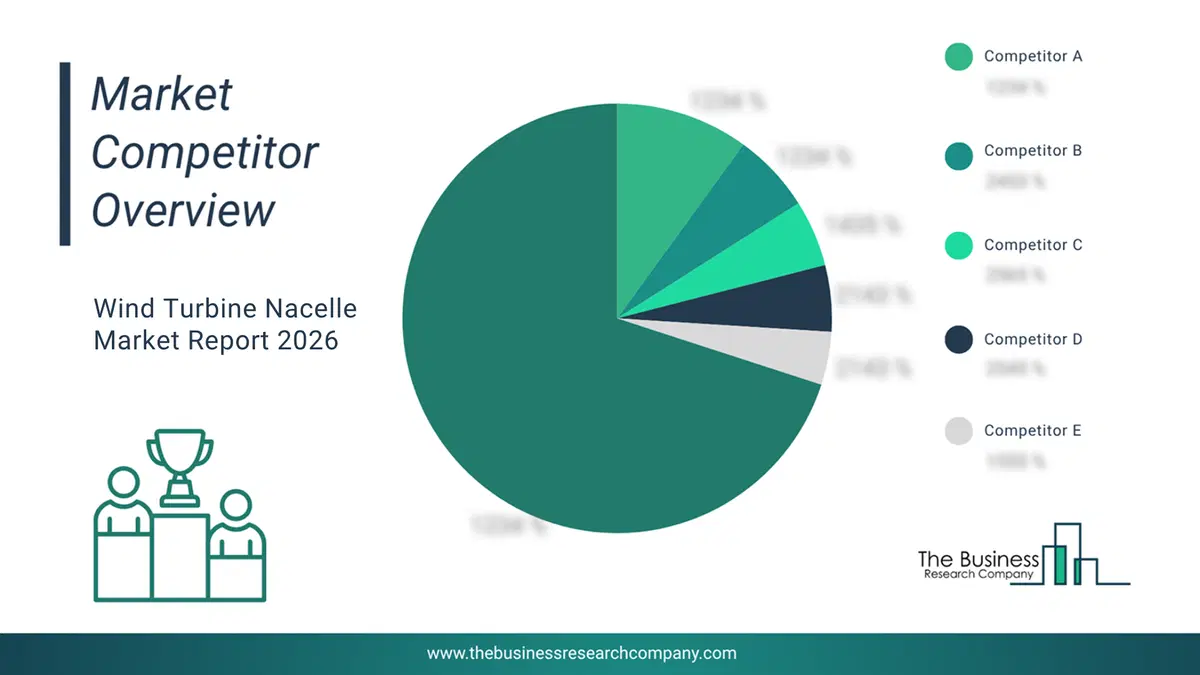
This chart is for illustrative purposes; the full report includes a detailed competitor analysis and comprehensive overview of the top 10 companies in the market.
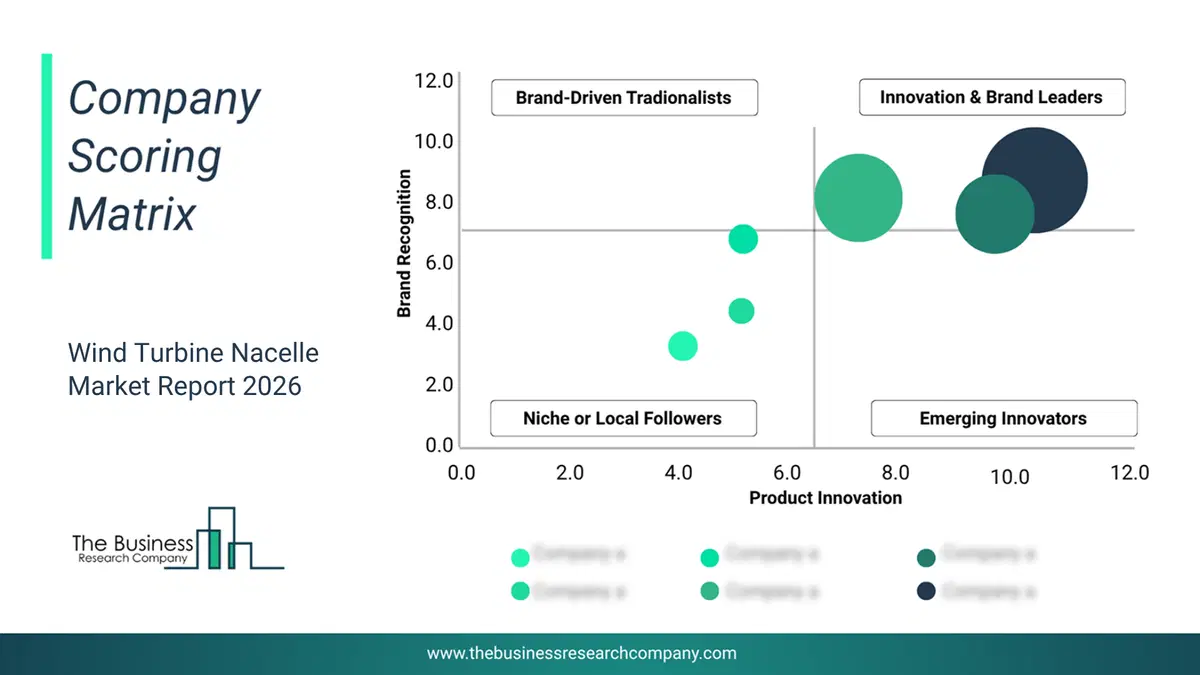
This chart maps companies by product innovation and brand strength, with bubble size indicating relative revenue, helping identify market leaders, challengers, and niche players. This is an illustrative chart; the full report provides a complete and accurate competitive analysis.
Global Wind Turbine Nacelle Market Trends and Insights
Major companies operating in the wind turbine nacelle market are innovating new products to sustain their position in the market. For instance, in November 2023, Suzlon, an Indian-based renewable energy company, introduced the S144 wind turbine generator, one of the largest in India, with a capacity extendable up to 3.15 MW based on site wind conditions. This turbine is available at hub heights of 140 meters, with plans to extend up to 160 meters, making it India's tallest wind turbine at that height. The S144 is designed to unlock previously unviable wind sites and improve energy yield across various wind regimes, boasting a 40-43% increase in generation compared to Suzlon's previous model, the S120 – 2.1 MW turbine. This advancement highlights its capability to optimize wind resources at higher altitudes, thus making low-wind sites more viable for energy production.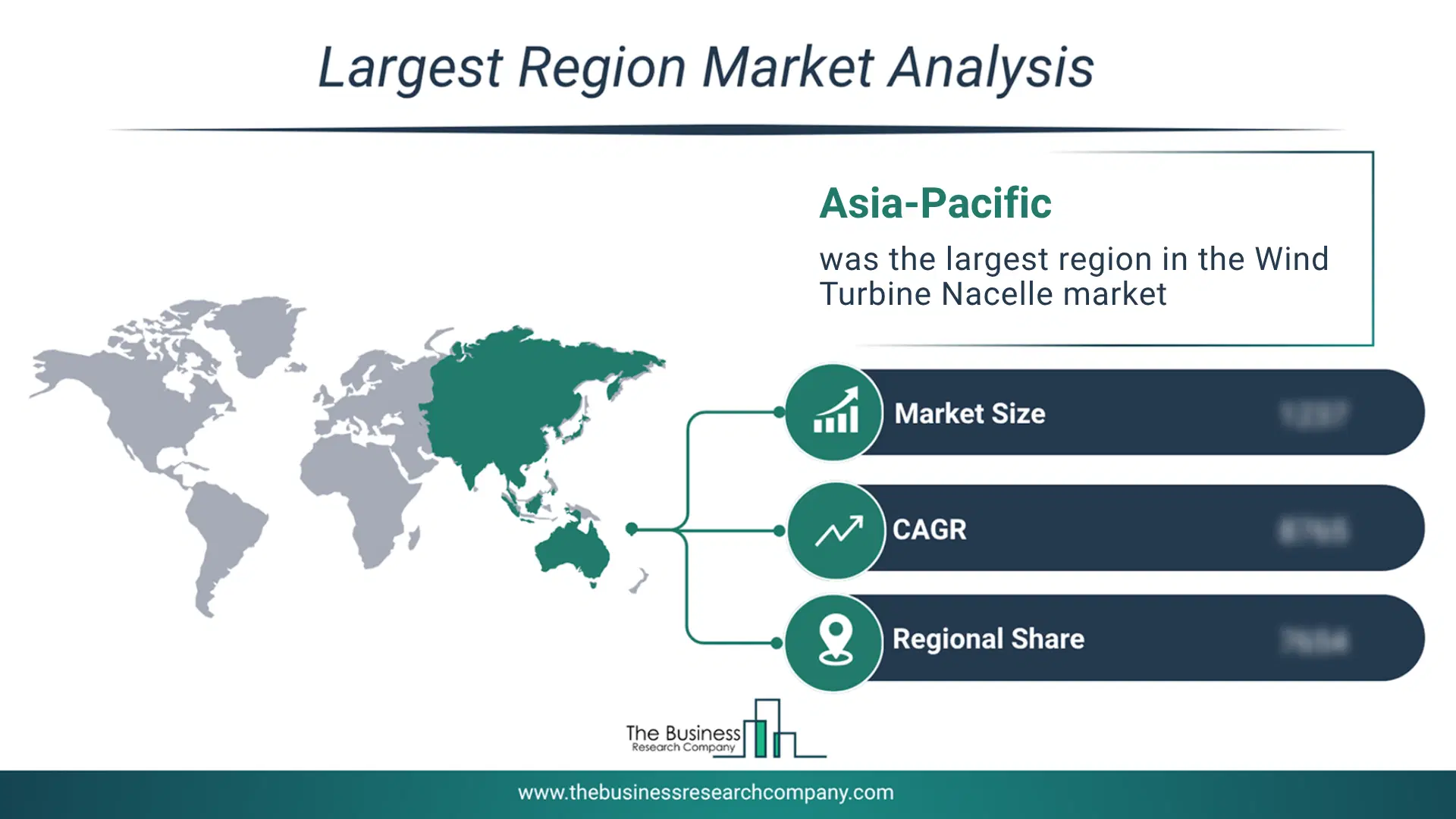
Regional Outlook
Asia-Pacific was the largest region in the wind turbine nacelle market in 2025. Asia-Pacific is expected to be the fastest-growing region in the forecast period. The regions covered in this market report are Asia-Pacific, South East Asia, Western Europe, Eastern Europe, North America, South America, Middle East, Africa The countries covered in this market report are Australia, Brazil, China, France, Germany, India, Indonesia, Japan, Taiwan, Russia, South Korea, UK, USA, Canada, Italy, Spain.What Defines the Wind Turbine Nacelle Market?
The wind turbine nacelle market consists of sales of generator systems, gearbox systems, control systems, cooling systems, and Yaw systems. Values in this market are ‘factory gate’ values, that is the value of goods sold by the manufacturers or creators of the goods, whether to other entities (including downstream manufacturers, wholesalers, distributors and retailers) or directly to end customers. The value of goods in this market includes related services sold by the creators of the goods.How is Market Value Defined and Measured?
The market value is defined as the revenues that enterprises gain from the sale of goods and/or services within the specified market and geography through sales, grants, or donations in terms of the currency (in USD unless otherwise specified). The revenues for a specified geography are consumption values that are revenues generated by organizations in the specified geography within the market, irrespective of where they are produced. It does not include revenues from resales along the supply chain, either further along the supply chain or as part of other products.
This chart presents market attractiveness based on a quantitative evaluation of growth, competition, strategic alignment, and risk, offering a clear view of opportunity areas for decision-making. This chart is for illustrative purposes; the full report contains the complete analysis.

This chart highlights the Total Addressable Market (TAM) by estimating the maximum revenue opportunity using an assumption-driven approach, supporting strategic planning and opportunity sizing across markets. The chart is illustrative; the full report provides a more comprehensive analysis.
What Key Data and Analysis Are Included in the Wind Turbine Nacelle Market Report 2026?
The wind turbine nacelle market research report is one of a series of new reports from The Business Research Company that provides market statistics, including industry global market size, regional shares, competitors with the market share, detailed market segments, market trends and opportunities, and any further data you may need to thrive in the wind turbine nacelle industry. The market research report delivers a complete perspective of everything you need, with an in-depth analysis of the current and future state of the industry.Wind Turbine Nacelle Market Report Forecast Analysis
| Report Attribute | Details |
|---|---|
| Market Size Value In 2026 | $8.34 billion |
| Revenue Forecast In 2030 | $11.46 billion |
| Growth Rate | CAGR of 8.3% from 2026 to 2030 |
| Base Year For Estimation | 2025 |
| Actual Estimates/Historical Data | 2020-2025 |
| Forecast Period | 2026 - 2030 |
| Market Representation | Revenue in USD Billion and CAGR from 2026 to 2030 |
| Segments Covered | Location Of Deployment, Turbine Capacity, Application |
| Regional Scope | Asia-Pacific, Western Europe, Eastern Europe, North America, South America, Middle East, Africa |
| Key Companies Profiled | Vestas Wind Systems A/S, Siemens Gamesa Renewable Energy S.A., General Electric Company, Shanghai Electric Group Company Limited, Xinjiang Goldwind Science & Technology Co. Ltd., Envision Energy Ltd., Ming Yang Smart Energy Group Co. Ltd., Enercon GmbH, Nordex SE, Suzlon Energy Limited, WEG S.A., Senvion S.A., ReGen Powertech Private Limited, Inox Wind Limited, Wind World Limited, Vensys Energy AG, CSIC Haizhuang Windpower Co., Ltd., Dongfang Electric Corporation, United Power Technology Co., Ltd., Doosan Enerbility Co., Ltd. |
| Customization Scope | Request for Customization |
| Pricing And Purchase Options | Explore Purchase Options |