
Alternative Fuel Vehicles Market Report 2026
Global Outlook – By Fuel Type (CNG, Hydrogen, Electric, Other Fuel Types), By Vehicle Type (Passenger Cars, Commercial Vehicle), By Application (Transportation, Agricultural, Industrial, Other Applications) – Market Size, Trends, Strategies, and Forecast to 2030
Alternative Fuel Vehicles Market Overview
• Alternative Fuel Vehicles market size has reached to $726.28 billion in 2025 • Expected to grow to $1675.36 billion in 2030 at a compound annual growth rate (CAGR) of 18.3% • Growth Driver: Escalating Fossil Fuel Prices Drive Adoption Of Alternative Fuel Vehicles • Market Trend: Emerging Innovations Accelerate Adoption Of Next-Generation Clean Mobility Solutions • Asia-Pacific was the largest region in 2025.What Is Covered Under Alternative Fuel Vehicles Market?
Alternative fuel vehicles refer to a motor vehicle that runs on alternative fuel instead of traditional petroleum fuels. Alternative fuel vehicles are less expensive, eliminate dependence on oil, and yield lower vehicle performance. The alternative fuel vehicles are used to conserve fuel and lower vehicle emissions. The main types of alternative fuel vehicles are CNG, hydrogen, electric, and other fuel types. CNG refers to compressed natural gas as an eco-friendly alternative to gasoline, made by compressing natural gas down to less than 1% of its volume. The types of vehicles include passenger cars and commercial vehicles. The various applications include transportation, chemical, agricultural, industrial, and other applications.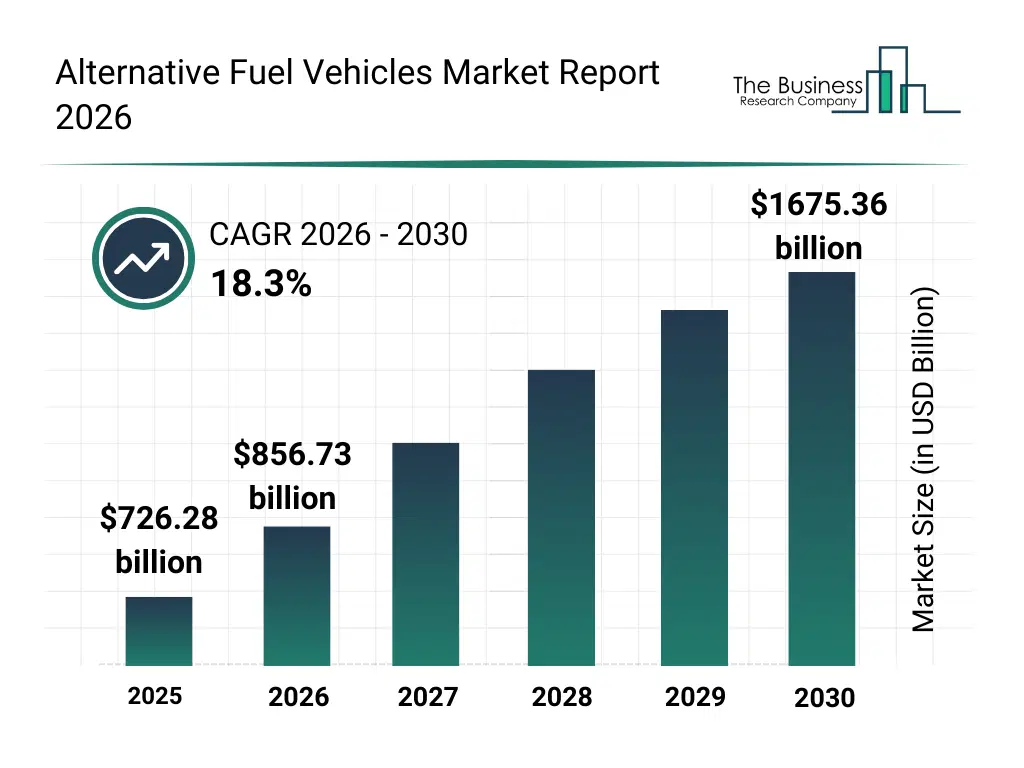
What Is The Alternative Fuel Vehicles Market Size and Share 2026?
The alternative fuel vehicles market size has grown rapidly in recent years. It will grow from $726.28 billion in 2025 to $856.73 billion in 2026 at a compound annual growth rate (CAGR) of 18.0%. The growth in the historic period can be attributed to fuel price volatility, emission regulations, urban air quality concerns, alternative fuel availability, early ev adoption.What Is The Alternative Fuel Vehicles Market Growth Forecast?
The alternative fuel vehicles market size is expected to see rapid growth in the next few years. It will grow to $1675.36 billion in 2030 at a compound annual growth rate (CAGR) of 18.3%. The growth in the forecast period can be attributed to decarbonization targets, battery cost reduction, hydrogen ecosystem development, charging infrastructure expansion, fleet electrification. Major trends in the forecast period include growing adoption of electric vehicles, expansion of hydrogen fuel cell vehicles, increased use of cng vehicles, government incentives for clean transport, development of charging and fueling infrastructure.
Global Alternative Fuel Vehicles Market Segmentation
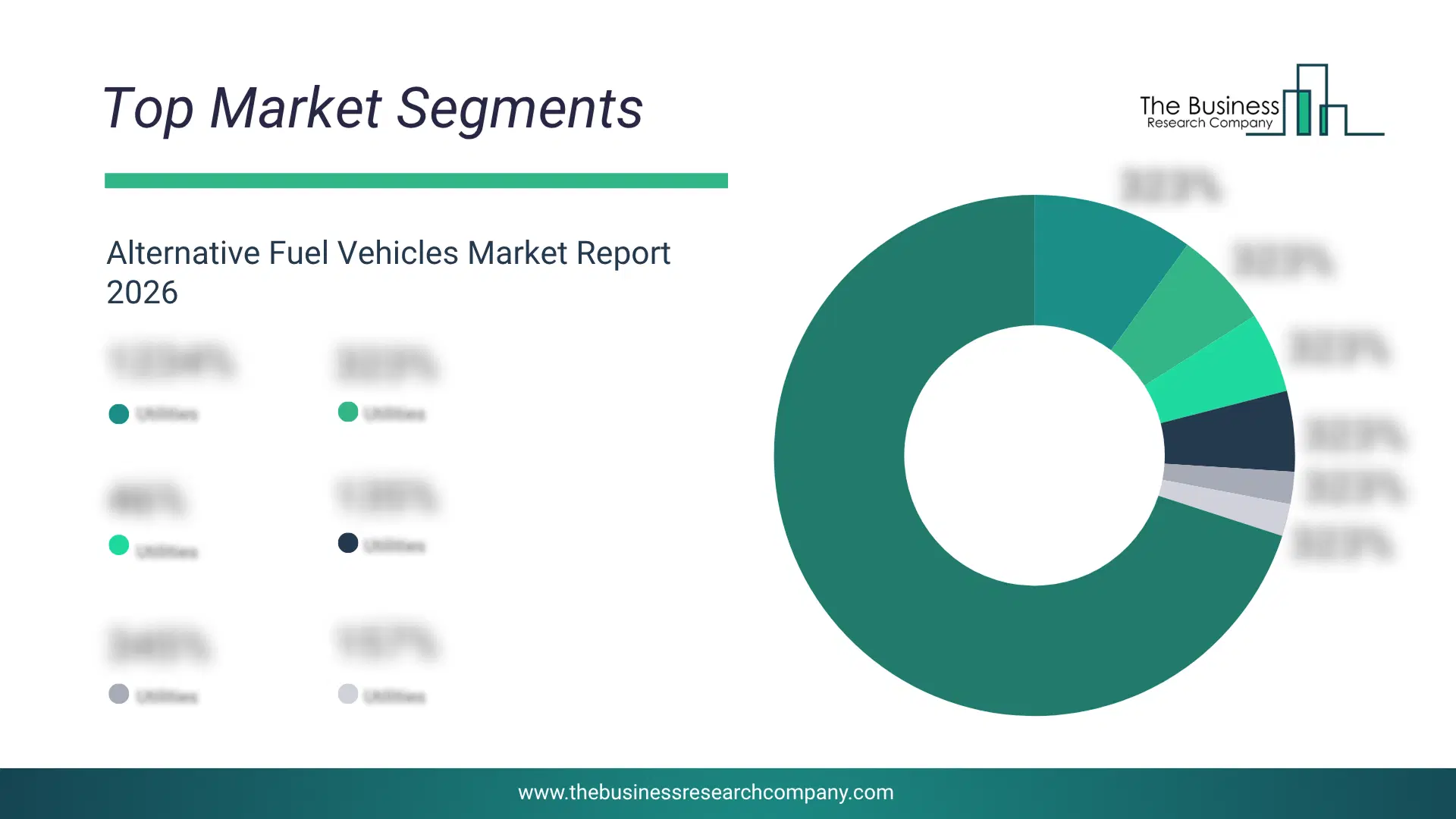
1) By Fuel Type: CNG, Hydrogen, Electric, Other Fuel Types 2) By Vehicle Type: Passenger Cars, Commercial Vehicle 3) By Application: Transportation, Agricultural, Industrial, Other Applications Subsegments: 1) By CNG: Light-Duty CNG Vehicles, Heavy-Duty CNG Vehicles, CNG Buses, CNG Trucks 2) By Hydrogen: Hydrogen Fuel Cell Vehicles (FCVs), Hydrogen Buses, Hydrogen Trucks, Hydrogen Forklifts 3) By Electric: Battery Electric Vehicles (BEVs), Plug-in Hybrid Electric Vehicles (PHEVs), Electric Buses, Electric Trucks 4) By Other Fuel Types: Biodiesel Vehicles, Ethanol Vehicles, Propane (LPG) Vehicles, Renewable Diesel VehiclesWhat Is The Driver Of The Alternative Fuel Vehicles Market?
The rising prices of fossil fuels are expected to propel the growth of the alternative fuel vehicles market going forward. Fossil fuel refers to hydrocarbon-containing materials of biological origin occurring within the earth's crust that can be used as a source of energy. Owing to the rising fuel prices the developing and underdeveloped countries are depending on foreign countries to import fossil fuels significantly which will increase the pressure on emerging economies leading to a boost in the demand for the alternative fuel vehicles market. This results in the increasing adoption of vehicles that run on alternative fuels such as CNG, hydrogen, electric vehicles, and others. For instance, in March 2024, according to the NASA, a US-based Government agency Preliminary analysis of 2023 data shows a 1.1 percent rise in fossil fuel emissions compared to 2022, resulting in total emissions reaching 36.8 billion metric tons of carbon dioxide. Therefore, the rising prices of fossil fuels are driving the alternative fuel vehicles industry.Key Players In The Global Alternative Fuel Vehicles Market
Major companies operating in the alternative fuel vehicles market report include Volkswagen AG, Toyota Motor Corporation, Ford Motor Company, General Motors Company, Mitsubishi Motors Corporation, Bayerische Motoren Werke AG, Honda Motor Co. Ltd., Hyundai Motor Company, Tesla Inc., Nissan Motor Co. Ltd., BYD Auto Co. Ltd., Zhejiang Geely Holding Group Co. Ltd., NIO Inc., Arrival Ltd., XPeng Inc., Rivian Automotive Inc., Lucid Motors Inc., Faraday Future Inc., Proterra Inc., Mahindra Electric Mobility Limited, Workhorse Group Inc., Canoo Inc., Bollinger Motors LLC, Lightning eMotors Inc., Arcimoto Inc., Fisker Inc., Lion Electric Company, Nikola Corporation, Hino Motors Ltd., Tata Motors Limited, SAIC Motor Corporation Limited, Zhongtong Bus Holding Co. Ltd., Volta Trucks Limited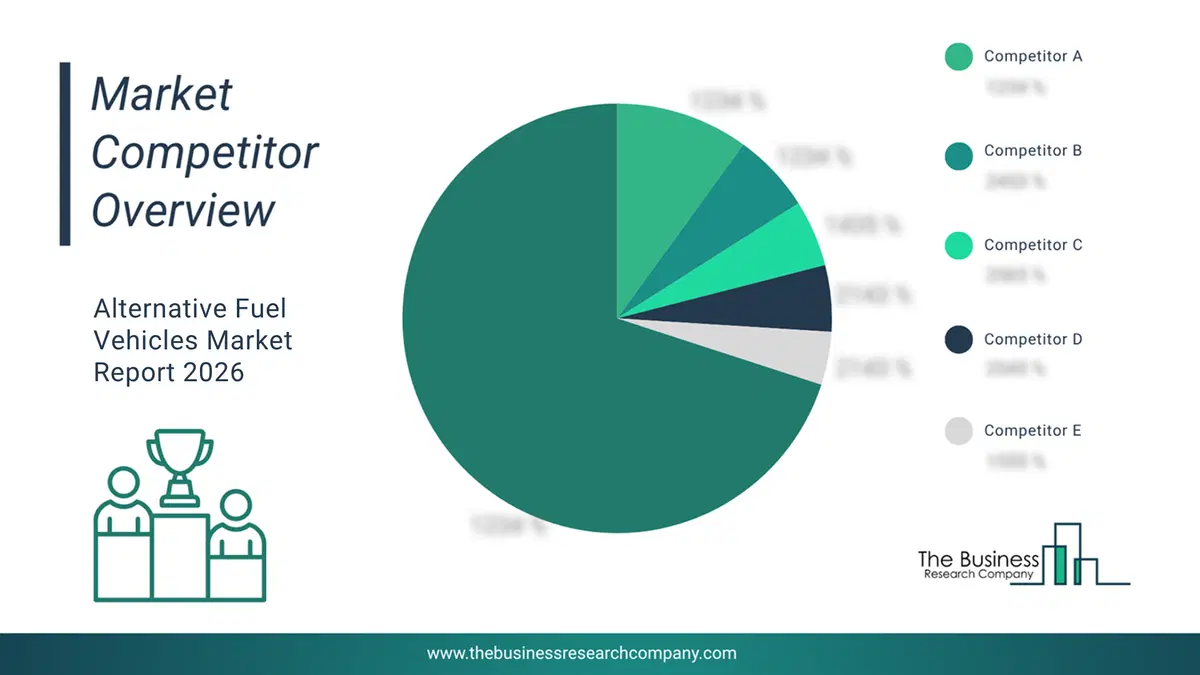
This chart is for illustrative purposes; the full report includes a detailed competitor analysis and comprehensive overview of the top 10 companies in the market.
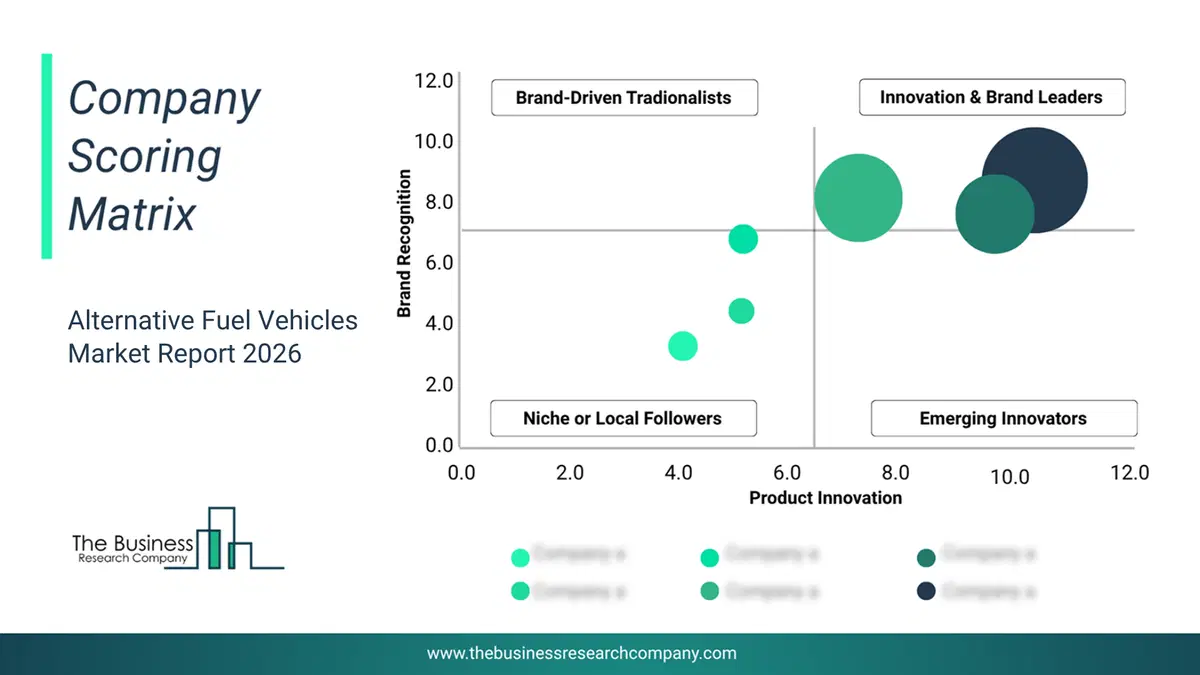
This chart maps companies by product innovation and brand strength, with bubble size indicating relative revenue, helping identify market leaders, challengers, and niche players. This is an illustrative chart; the full report provides a complete and accurate competitive analysis.
Global Alternative Fuel Vehicles Market Trends and Insights
Major companies operating in the alternative fuel vehicles market are focusing on developing innovative solutions, such as hydrogen-powered heavy-duty trucks and fuel-cell powertrains, to meet the rising demand for stringent emissions reduction, long-range freight electrification, and faster refuelling compared with battery electric options. Hydrogen fuel-cell trucks use an electrochemical fuel cell stack to convert hydrogen gas into electricity on board, storing hydrogen in high-pressure tanks and using that electricity to drive electric motors. For instance, in April 2025, Hyundai Motor Company, a South Korea–based automaker, unveiled the XCIENT Fuel Cell Class-8 heavy-duty truck, an advanced fuel-cell truck designed for North American long-haul markets. The XCIENT Fuel Cell integrates a modular H₂O fuel cell system with high-pressure hydrogen tanks and electric drive components to deliver Class-8 performance. It is engineered for long-distance freight with fast hydrogen refuelling times versus battery charging. Unique features include multiple fuel-cell stacks for scalable power, heavy-duty chassis integration for typical North American payloads, and software for fleet telematics and energy management. Typical applications target long-haul and regional distribution fleets seeking zero tailpipe emissions without sacrificing range or uptime. The main benefits are near-instant refuelling, reduced operational downtime compared with battery charging, and elimination of tailpipe greenhouse gas and particulate emissions when run on green hydrogen.What Are Latest Mergers And Acquisitions In The Alternative Fuel Vehicles Market?
In September 2024, TransTech Group, a US-based pavement engineering firm that provides custom engineered products and services, acquired Cryogenic Technology Resources for an undisclosed amount. This acquisition of TransTech Group’s aim is to strengthen its position in the cryogenic and high-pressure gas storage and transfer markets. Cryogenic Technology Resources is a US-based manufacturer company that provides engineered solutions and services for the industrial gas market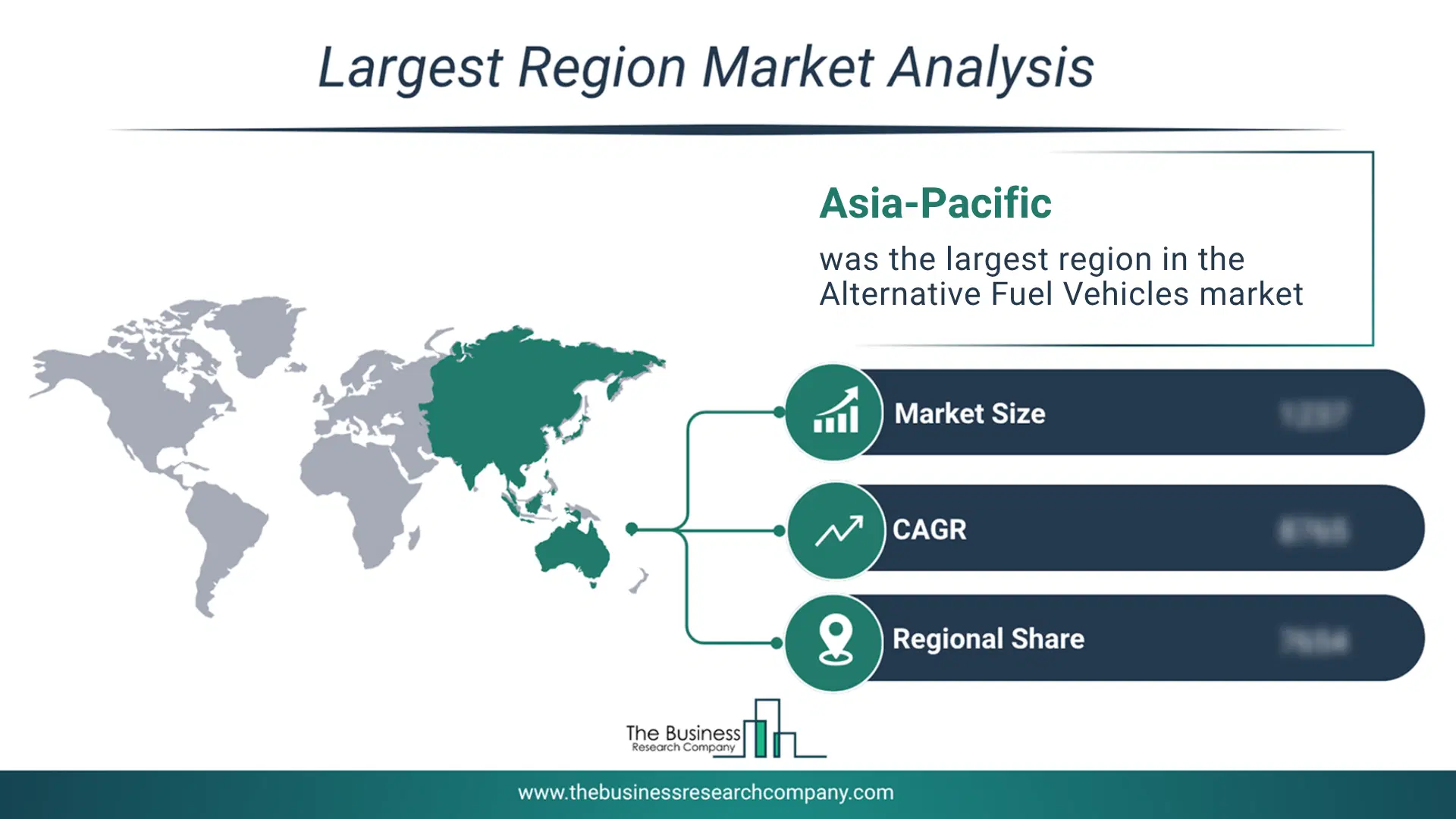
Regional Outlook
Asia-Pacific was the largest region in the alternative fuel vehicle market in 2025. The regions covered in this market report include Asia-Pacific, South East Asia, Western Europe, Eastern Europe, North America, South America, Middle East, Africa. The countries covered in this market report include Australia, Brazil, China, France, Germany, India, Indonesia, Japan, Taiwan, Russia, South Korea, UK, USA, Canada, Italy, SpainWhat Defines the Alternative Fuel Vehicles Market?
The alternative fuel vehicles market consists of sales of natural gas vehicles, fuel cell electric vehicles and flexible fuel vehicles. Values in this market are ‘factory gate’ values, that is the value of goods sold by the manufacturers or creators of the goods, whether to other entities (including downstream manufacturers, wholesalers, distributors and retailers) or directly to end customers. The value of goods in this market includes related services sold by the creators of the goods.How is Market Value Defined and Measured?
The market value is defined as the revenues that enterprises gain from the sale of goods and/or services within the specified market and geography through sales, grants, or donations in terms of the currency (in USD unless otherwise specified). The revenues for a specified geography are consumption values that are revenues generated by organizations in the specified geography within the market, irrespective of where they are produced. It does not include revenues from resales along the supply chain, either further along the supply chain or as part of other products.
This chart presents market attractiveness based on a quantitative evaluation of growth, competition, strategic alignment, and risk, offering a clear view of opportunity areas for decision-making. This chart is for illustrative purposes; the full report contains the complete analysis.

This chart highlights the Total Addressable Market (TAM) by estimating the maximum revenue opportunity using an assumption-driven approach, supporting strategic planning and opportunity sizing across markets. The chart is illustrative; the full report provides a more comprehensive analysis.
What Key Data and Analysis Are Included in the Alternative Fuel Vehicles Market Report 2026?
The alternative fuel vehicles market research report is one of a series of new reports from The Business Research Company that provides market statistics, including industry global market size, regional shares, competitors with the market share, detailed market segments, market trends and opportunities, and any further data you may need to thrive in the alternative fuel vehicles industry. The market research report delivers a complete perspective of everything you need, with an in-depth analysis of the current and future state of the industry.Alternative Fuel Vehicles Market Report Forecast Analysis
| Report Attribute | Details |
|---|---|
| Market Size Value In 2026 | $856.73 billion |
| Revenue Forecast In 2030 | $1675.36 billion |
| Growth Rate | CAGR of 18.0% from 2026 to 2030 |
| Base Year For Estimation | 2025 |
| Actual Estimates/Historical Data | 2020-2025 |
| Forecast Period | 2026 - 2030 - 2030 |
| Market Representation | Revenue in USD Billion and CAGR from 2026 to 2030 |
| Segments Covered | Fuel Type, Vehicle Type, Application |
| Regional Scope | Asia-Pacific, Western Europe, Eastern Europe, North America, South America, Middle East, Africa |
| Country Scope | The countries covered in the report are Australia, Brazil, China, France, Germany, India, Indonesia, Japan, Taiwan, Russia, South Korea, UK, USA, Canada, Italy, Spain. |
| Key Companies Profiled | Volkswagen AG, Toyota Motor Corporation, Ford Motor Company, General Motors Company, Mitsubishi Motors Corporation, Bayerische Motoren Werke AG, Honda Motor Co. Ltd., Hyundai Motor Company, Tesla Inc., Nissan Motor Co. Ltd., BYD Auto Co. Ltd., Zhejiang Geely Holding Group Co. Ltd., NIO Inc., Arrival Ltd., XPeng Inc., Rivian Automotive Inc., Lucid Motors Inc., Faraday Future Inc., Proterra Inc., Mahindra Electric Mobility Limited, Workhorse Group Inc., Canoo Inc., Bollinger Motors LLC, Lightning eMotors Inc., Arcimoto Inc., Fisker Inc., Lion Electric Company, Nikola Corporation, Hino Motors Ltd., Tata Motors Limited, SAIC Motor Corporation Limited, Zhongtong Bus Holding Co. Ltd., Volta Trucks Limited |
| Customization Scope | Request for Customization |
| Pricing And Purchase Options | Explore Purchase Options |