
Artificial Gravity Systems Market Report 2026
Global Outlook – By Component (Rotating Habitats, Tether Systems, Control Systems, Power Systems), By Technology (Centrifugal Force, Linear Acceleration, Electromagnetic Force), By Application (Space Stations, Spacecraft, Space Tourism, Military And Defense), By End-User (Government, Commercial, Research Institution) – Market Size, Trends, Strategies, and Forecast to 2030
Artificial Gravity Systems Market Overview
• Artificial Gravity Systems market size has reached to $1.44 billion in 2025 • Expected to grow to $3.28 billion in 2030 at a compound annual growth rate (CAGR) of 17.9% • Growth Driver: Increasing Investments In Space Exploration Driving The Space Wheel Market Growth Due To Advancements In Satellite Technology • Market Trend: Rotational Artificial Gravity Habitats Enhance Human Health And Productivity In Long-Duration Space Missions • North America was the largest region in 2025 and Asia-Pacific is the fastest growing region.What Is Covered Under Artificial Gravity Systems Market?
Artificial gravity systems are technologies designed to simulate the effects of gravity in environments where natural gravity is weak or absent, such as space. They typically achieve this through rotation or linear acceleration, creating a force that mimics gravitational pull. These systems help maintain physical health and spatial orientation by reducing the adverse effects of prolonged weightlessness. The main components of the artificial gravity systems include rotating habitats, tether systems, control systems, and power systems. Rotating habitats refer to enclosed structures designed to spin in order to generate artificial gravity through centrifugal force, enabling a more Earth-like environment for occupants in space. Different technologies include centrifugal force, linear acceleration, and electromagnetic force. The various applications involved are space stations, spacecraft, space tourism, and military and defense, and they are used by several end-users such as government agencies, commercial entities, and research institutions.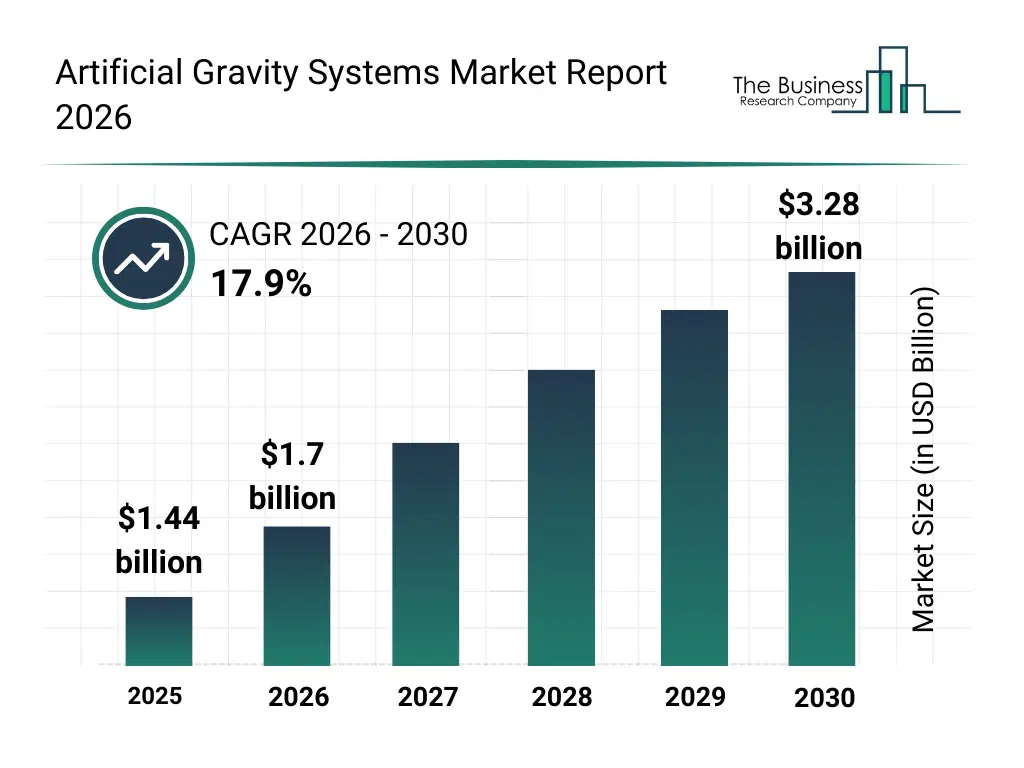
What Is The Artificial Gravity Systems Market Size and Share 2026?
The artificial gravity systems market size has grown rapidly in recent years. It will grow from $1.44 billion in 2025 to $1.7 billion in 2026 at a compound annual growth rate (CAGR) of 18.1%. The growth in the historic period can be attributed to increasing interest in long-duration space missions, advancements in centrifugal and rotational habitat technologies, rising investment in astronaut health and safety solutions, early adoption by space agencies for microgravity research, collaborations between aerospace manufacturers and research institutions.What Is The Artificial Gravity Systems Market Growth Forecast?
The artificial gravity systems market size is expected to see rapid growth in the next few years. It will grow to $3.28 billion in 2030 at a compound annual growth rate (CAGR) of 17.9%. The growth in the forecast period can be attributed to development of compact and modular artificial gravity systems for spacecraft, integration with life-support and exercise modules, rising demand from commercial space tourism and private space missions, emphasis on human physiology optimization for deep-space travel, expansion of engineering and design services for long-duration mission support. Major trends in the forecast period include expansion of modular rotating habitat architectures, advancements in compact centrifugal exercise systems, integration of multi-force hybrid gravity simulation modules, increased demand for long-duration mission human physiology simulation, development of lightweight, radiation-shielded gravity-enabled cabins.
Global Artificial Gravity Systems Market Segmentation
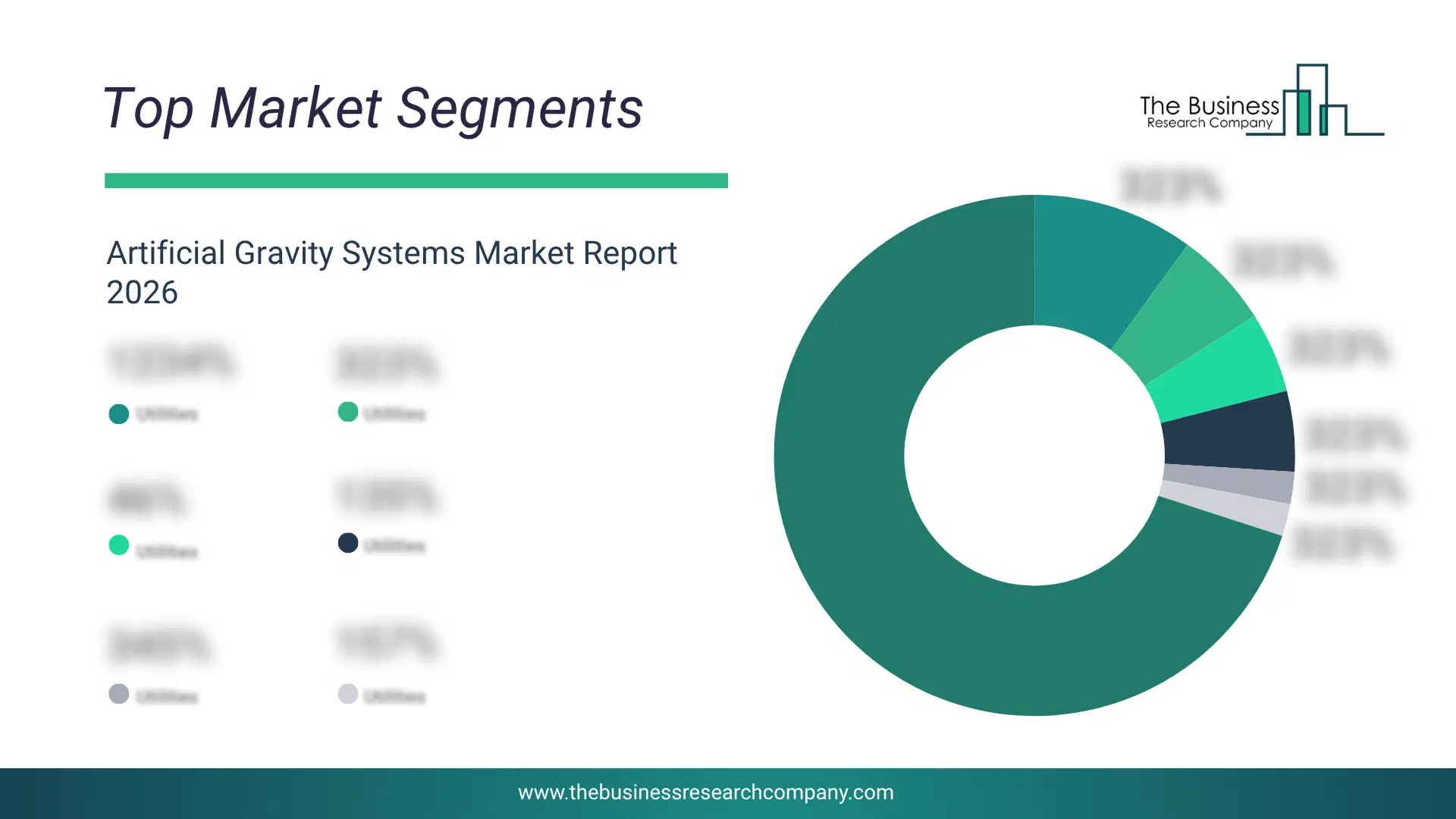
1) By Component: Rotating Habitats, Tether Systems, Control Systems, Power Systems 2) By Technology: Centrifugal Force, Linear Acceleration, Electromagnetic Force 3) By Application: Space Stations, Spacecraft, Space Tourism, Military And Defense 4) By End-User: Government, Commercial, Research Institution Subsegments: 1) By Rotating Habitats: Ring-Shaped Structures, Cylindrical Modules, Toroidal Stations, Spherical Modules 2) By Tether Systems: Momentum Exchange Tethers, Hybrid Tether Systems 3) By Control Systems: Automated Navigation Systems, Attitude Control Systems, Stabilization Mechanisms, Artificial Gravity Adjustment Systems 4) By Power Systems: Solar Power Systems, Nuclear Power Systems, Fuel Cell Systems, Hybrid Power SystemsWhat Is Driver Of The Artificial Gravity Systems Market?
The increasing investments in space exploration are expected to propel the growth of the artificial gravity systems market going forward. Space exploration refers to the scientific and technical investigation of outer space through the development and deployment of spacecraft, both crewed and uncrewed, to discover, study, and understand celestial bodies and phenomena beyond earth’s atmosphere. Rising investments in space exploration are driven by national security interests because countries seek to strengthen space-based defense systems, protect critical satellites, and maintain strategic advantages over rivals. Increasing investments in space exploration accelerate the research, development, and deployment of artificial gravity systems by providing the necessary funding and technological advancements to create viable solutions for long-duration human space missions. For instance, in June 2024, according to the Ministry of Foreign Affairs and Trade, a New Zealand-based government department, the UK has committed to investing approximately USD 12.5 billion (£10 billion) in space programs over the ten-year period beginning in 2023, of which around USD 3.75 billion(£3 billion) was earmarked in the 2023 spending review. Therefore, increasing investments in space exploration are driving the growth of the artificial gravity systems industry.Key Players In The Global Artificial Gravity Systems Market
Major companies operating in the artificial gravity systems market are Airbus SE, Lockheed Martin Corporation, Northrop Grumman Corporation, Thales S.A., L3Harris Technologies Inc., Leidos Holdings Inc., Blue Origin L.P., Sierra Space Corporation, Axiom Space Inc., The Charles Stark Draper Laboratory Inc., Maxar Technologies Inc., Gateway Spaceport LLC, gravityLab Inc., Joules Space Technology LLC, Orbital Assembly Corporation, Conglomera Astrogravitics Inc., Exodus Star Inc., DigitalBlast Inc., Vast Space LLC, GravityLab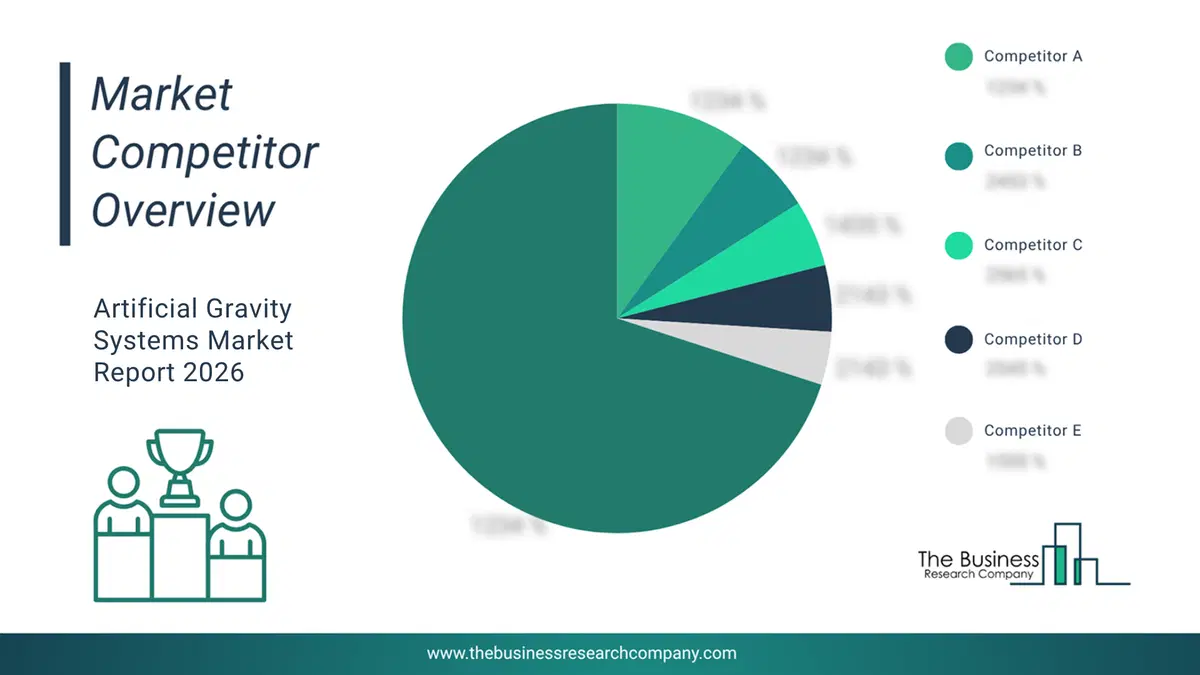
This chart is for illustrative purposes; the full report includes a detailed competitor analysis and comprehensive overview of the top 10 companies in the market.
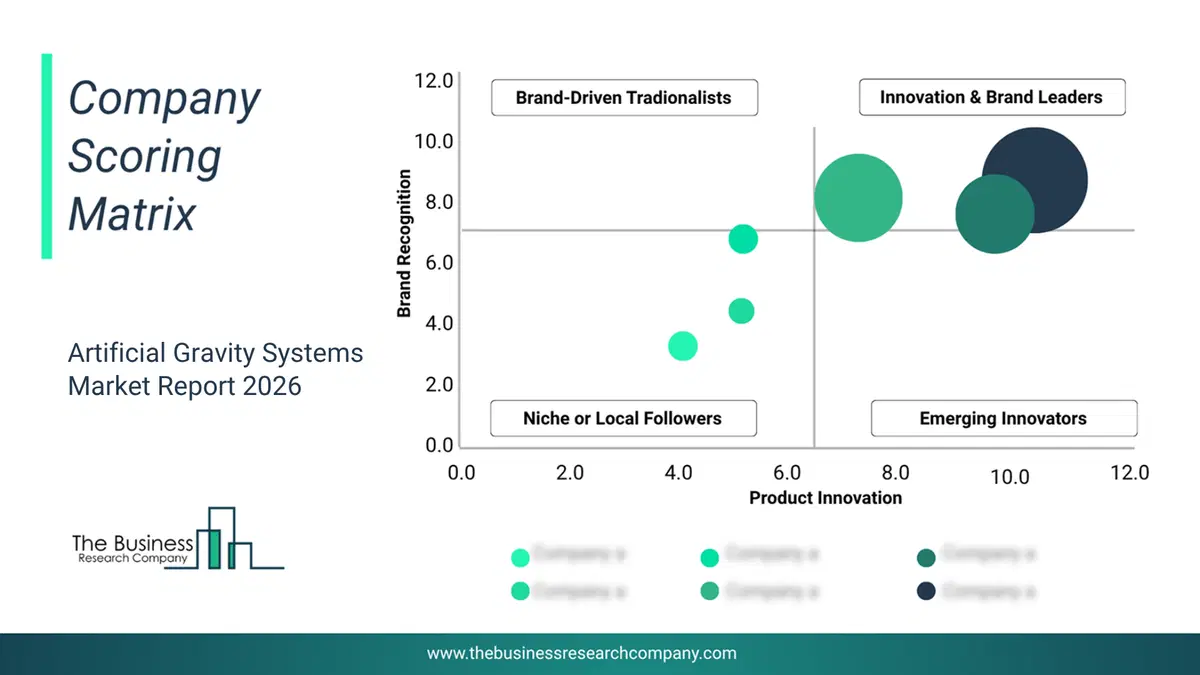
This chart maps companies by product innovation and brand strength, with bubble size indicating relative revenue, helping identify market leaders, challengers, and niche players. This is an illustrative chart; the full report provides a complete and accurate competitive analysis.
Global Artificial Gravity Systems Market Trends and Insights
Major companies in the artificial gravity systems market are developing advanced rotational artificial-gravity habitats to support longer-duration human space missions, commercial LEO platforms, and private astronaut operations. These habitats generate centrifugal force by rotating part or all of the structure, simulating gravity to counteract the muscle and bone loss seen in traditional zero-gravity environments thereby improving crew health, comfort, and productivity. For instance, in October 2025, Vast Space, a US-based space infrastructure company, unveiled its Haven-1 private space station, scheduled for launch no earlier than May 2026 aboard a Falcon 9 rocket. Designed with an advanced propulsion and rotational subsystem for artificial gravity experiments, the station offers a habitable volume of about 45 m³, supports up to four crew members, and features docking capability, life-support systems, a large domed Earth-viewing window, and modular lab space for in-orbit research.What Are Latest Mergers And Acquisitions In The Artificial Gravity Systems Market? NASA And Vast Partner To Advance Artificial Gravity Space Station Technology
In June 2023, the National Aeronautics and Space Administration (NASA), a US-based governmental agency, partnered with Vast Space LLC to accelerate the development and deployment of advanced space station technologies. With this partnership, Vast and NASA aim to collaborate on developing key technologies and operations for commercial microgravity and artificial gravity space stations, including Haven-1 and future crewed missions, by leveraging NASA’s expertise, data products, and facilities to accelerate innovation, enhance safety and efficiency, and support the long-term vision of sustainable human habitation in space. Vast Space LLC is a US-based aerospace component manufacturing company that specializes in providing artificial gravity station.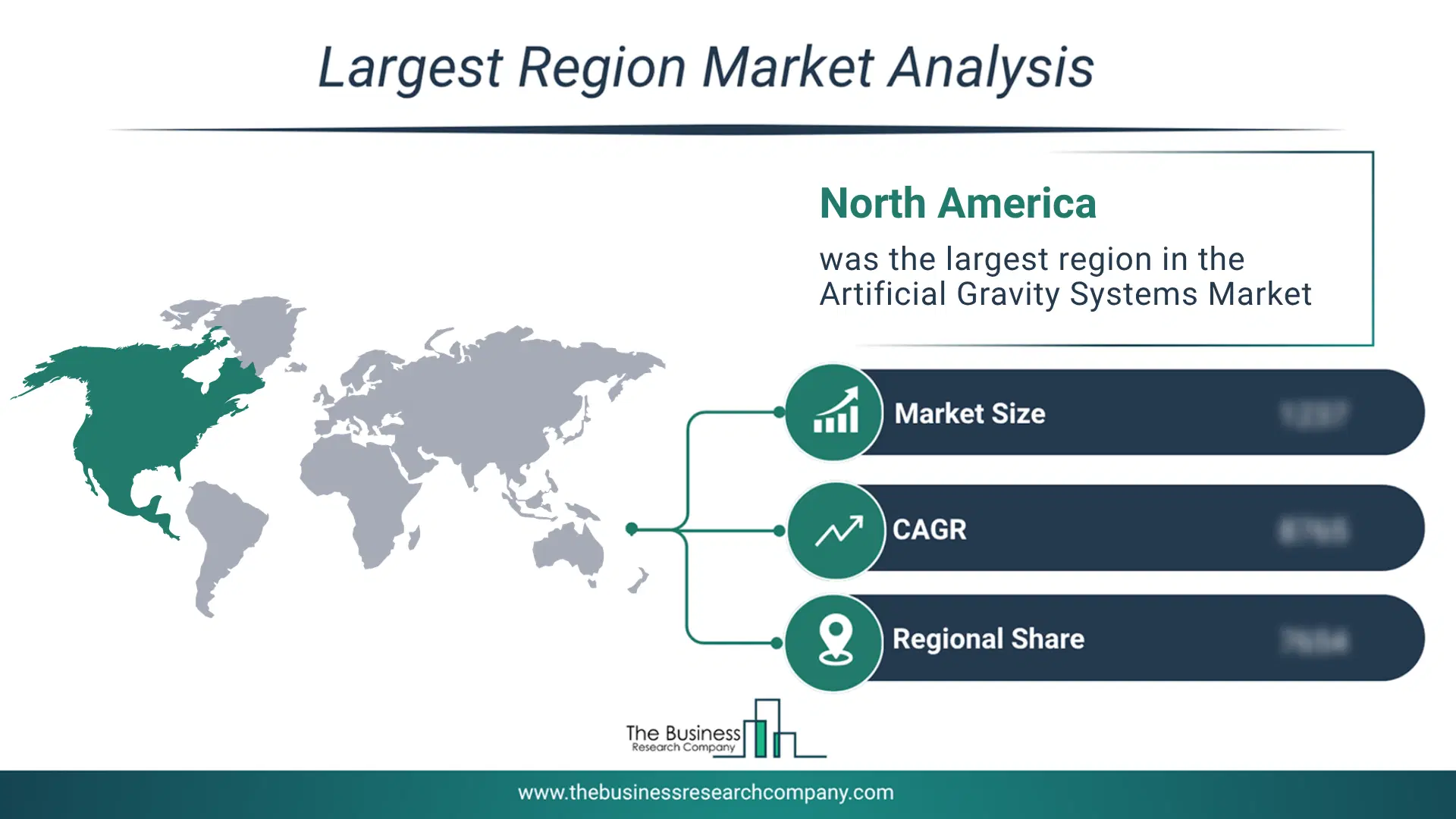
Regional Insights
North America was the largest region in the artificial gravity systems market in 2025. Asia-Pacific is expected to be the fastest-growing region in the forecast period. The regions covered in this market report are Asia-Pacific, South East Asia, Western Europe, Eastern Europe, North America, South America, Middle East, Africa. The countries covered in this market report are Australia, Brazil, China, France, Germany, India, Indonesia, Japan, Taiwan, Russia, South Korea, UK, USA, Canada, Italy, SpainWhat Defines the Artificial Gravity Systems Market?
The artificial gravity systems market consists of revenues earned by entities by providing services such as spacecraft centrifugal module design, human physiology simulation, rotational habitat engineering, and long-duration mission support. The market value includes the value of related goods sold by the service provider or included within the service offering. The artificial gravity systems market also includes sales of centrifugal habitats, rotating exercise devices, gravity simulation modules, torque control systems, and life-support integrated cabins. Values in this market are ‘factory gate’ values, that is, the value of goods sold by the manufacturers or creators of the goods, whether to other entities (including downstream manufacturers, wholesalers, distributors, and retailers) or directly to end customers. The value of goods in this market includes related services sold by the creators of the goods.How is Market Value Defined and Measured?
The market value is defined as the revenues that enterprises gain from the sale of goods and/or services within the specified market and geography through sales, grants, or donations in terms of the currency (in USD unless otherwise specified). The revenues for a specified geography are consumption values that are revenues generated by organizations in the specified geography within the market, irrespective of where they are produced. It does not include revenues from resales along the supply chain, either further along the supply chain or as part of other products.
This chart presents market attractiveness based on a quantitative evaluation of growth, competition, strategic alignment, and risk, offering a clear view of opportunity areas for decision-making. This chart is for illustrative purposes; the full report contains the complete analysis.

This chart highlights the Total Addressable Market (TAM) by estimating the maximum revenue opportunity using an assumption-driven approach, supporting strategic planning and opportunity sizing across markets. The chart is illustrative; the full report provides a more comprehensive analysis.
What Key Data and Analysis Are Included in the Artificial Gravity Systems Market Report 2026?
The artificial gravity systems market research report is one of a series of new reports from The Business Research Company that provides market statistics, including industry global market size, regional shares, competitors with the market share, detailed market segments, market trends and opportunities, and any further data you may need to thrive in the artificial gravity systems industry. The market research report delivers a complete perspective of everything you need, with an in-depth analysis of the current and future state of the industry.Artificial Gravity Systems Market Report Forecast Analysis
| Report Attribute | Details |
|---|---|
| Market Size Value In 2026 | $1.7 billion |
| Revenue Forecast In 2030 | $3.28 billion |
| Growth Rate | CAGR of 17.9% from 2026 to 2030 |
| Base Year For Estimation | 2025 |
| Actual Estimates/Historical Data | 2020-2025 |
| Forecast Period | 2026 - 2030 |
| Market Representation | Revenue in USD Billion and CAGR from 2026 to 2030 |
| Segments Covered | Component, Technology, Application, End-User |
| Regional Scope | Asia-Pacific, Western Europe, Eastern Europe, North America, South America, Middle East, Africa |
| Country Scope | The countries covered in the artificial gravity systems market report are Australia, Brazil, China, France, Germany, India, Indonesia, Japan, Taiwan, Russia, South Korea, UK, USA, Canada, Italy, Spain |
| Key Companies Profiled | Airbus SE, Lockheed Martin Corporation, Northrop Grumman Corporation, Thales S.A., L3Harris Technologies Inc., Leidos Holdings Inc., Blue Origin L.P., Sierra Space Corporation, Axiom Space Inc., The Charles Stark Draper Laboratory Inc., Maxar Technologies Inc., Gateway Spaceport LLC, gravityLab Inc., Joules Space Technology LLC, Orbital Assembly Corporation, Conglomera Astrogravitics Inc., Exodus Star Inc., DigitalBlast Inc., Vast Space LLC, GravityLab |
| Customization Scope | Request for Customization |
| Pricing And Purchase Options | Explore Purchase Options |