
Atomic Spectroscopy Market Report 2026
Global Outlook – By Type (Atomic Absorption Spectroscopy (AAS) Instruments, Atomic Emission Spectroscopy (AES) Instruments, Inductively Coupled Plasma (ICP) Spectrometers (ICP-OES and ICP-MS), X-Ray Fluorescence (XRF) Spectrometers, Laser-Induced Breakdown Spectroscopy (LIBS) Instruments, Other Atomic Spectroscopy Instruments), By Technology (Atomic Absorption Spectroscopy (AAS), X-ray Fluorescence (XRF), Inductively Coupled Plasma-Optical Emission Spectroscopy (ICP-OES), Inductively Coupled Plasma-Mass Spectrometry (ICP-MS), Elemental Analyzers, Other Technologies), By Application (Food And Beverage Testing, Pharmaceutical, Other Applications), By Distribution Channel (Authorized Distributors), By End-User (Laboratories, Universities) – Market Size, Trends, Strategies, and Forecast to 2030
Atomic Spectroscopy Market Overview
• Atomic Spectroscopy market size has reached to $8.2 billion in 2025 • Expected to grow to $12.7 billion in 2030 at a compound annual growth rate (CAGR) of 9.3% • Growth Driver: Surging Oil And Gas Production Drives Momentum In The Atomic Spectroscopy Market • Market Trend: Advanced Atomic Absorption Spectrometers Revolutionizing The Atomic Spectroscopy Market • North America was the largest region in 2025 and Asia-Pacific is the fastest growing region.What Is Covered Under Atomic Spectroscopy Market?
Atomic spectroscopy is a branch of analytical chemistry that studies the interaction of atoms with electromagnetic radiation. It determines trace elements in drug products, active pharmaceutical ingredients (APIs), raw materials, and intermediates. The main types of atomic spectroscopy are instruments, inductively coupled plasma (ICP) spectrometers, and others. Instruments refer to the various tools and devices used in scientific research, analysis, and measurement. In the context of atomic spectroscopy, instruments are specifically designed for the analysis of elemental composition using spectroscopic techniques. The technology includes atomic absorption spectroscopy (AAS), X-ray fluorescence (XRF), X-ray diffraction (XRD), inductively coupled plasma-optical emission spectroscopy (ICP-OES), inductively coupled plasma-mass spectrometry (ICP-MS), elemental analyzers, and others. These are used for food and beverage testing, pharmaceutical, industrial, environmental testing, geological sciences, petrochemical, academics, and other applications distributed by direct tenders and retail channels for various end-users including laboratories, universities, manufacturing facilities, and government agencies.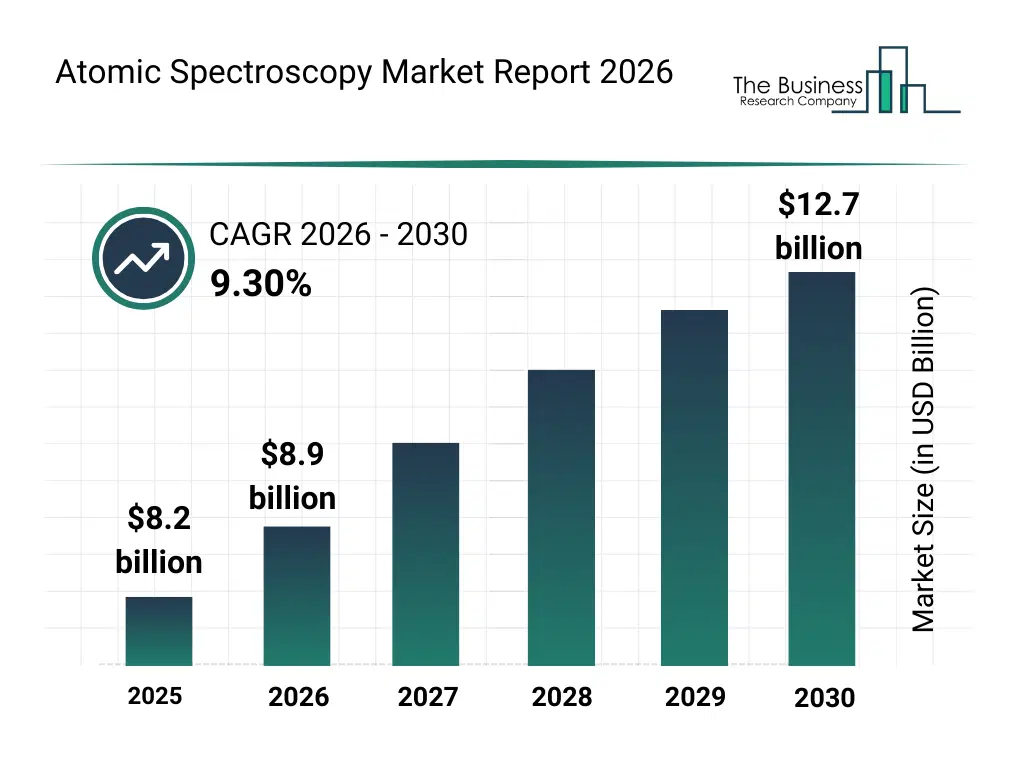
What Is The Atomic Spectroscopy Market Size and Share 2026?
The atomic spectroscopy market size has grown strongly in recent years. It will grow from $8.2 billion in 2025 to $8.9 billion in 2026 at a compound annual growth rate (CAGR) of 8.6%. The growth in the historic period can be attributed to increasing regulatory requirements for elemental impurity testing, expansion of pharmaceutical manufacturing activities, rising use of spectroscopy in environmental monitoring, growth of academic research laboratories, increased adoption of xrf and aas techniques.What Is The Atomic Spectroscopy Market Growth Forecast?
The atomic spectroscopy market size is expected to see strong growth in the next few years. It will grow to $12.7 billion in 2030 at a compound annual growth rate (CAGR) of 9.3%. The growth in the forecast period can be attributed to increasing demand for high-throughput analytical testing, rising investments in advanced laboratory instrumentation, expansion of food and beverage safety testing, growing focus on real-time elemental analysis, continuous innovation in spectroscopy software and automation. Major trends in the forecast period include increasing adoption of high-sensitivity elemental analysis systems, rising use of icp-ms in pharmaceutical testing, growing demand for automated spectroscopy platforms, expansion of multi-element detection capabilities, enhanced focus on trace-level accuracy.
Global Atomic Spectroscopy Market Segmentation
1) By Type: Atomic Absorption Spectroscopy (AAS) Instruments, Atomic Emission Spectroscopy (AES) Instruments, Inductively Coupled Plasma (ICP) Spectrometers (ICP-OES and ICP-MS), X-Ray Fluorescence (XRF) Spectrometers, Laser-Induced Breakdown Spectroscopy (LIBS) Instruments, Other Atomic Spectroscopy Instruments 2) By Technology: Atomic Absorption Spectroscopy (AAS), X-ray Fluorescence (XRF), Inductively Coupled Plasma-Optical Emission Spectroscopy (ICP-OES), Inductively Coupled Plasma-Mass Spectrometry (ICP-MS), Elemental Analyzers, Other Technologies 3) By Application: Food And Beverage Testing, Pharmaceutical, Industrial, Environmental Testing, Geological Sciences, Petrochemical, Academics, Other Applications 4) By Distribution Channel: Direct Tenders, Authorized Distributors / Channel Partners, Government & Institutional Tenders 5) By End-User: Laboratories, Universities, Manufacturing Facilities, Government Agencies Subsegments: 1) By Atomic Absorption Spectroscopy (AAS) Instruments: Flame Atomic Absorption Spectrometers (FAAS), Graphite Furnace Atomic Absorption Spectrometers (GFAAS), Hydride Generation AAS, Cold Vapor AAS 2) By Atomic Emission Spectroscopy (AES) Instruments: Flame Emission Spectrometers, Arc Spark Atomic Emission Spectrometers 3) By Inductively Coupled Plasma (ICP) Spectrometers: Inductively Coupled Plasma And Optical Emission Spectroscopy (ICP-OES And ICP-AES), Inductively Coupled Plasma And Mass Spectrometry (ICP-MS) 4) By X-Ray Fluorescence (XRF) Spectrometers: Energy-Dispersive X-Ray Fluorescence (EDXRF), Wavelength-Dispersive X-Ray Fluorescence (WDXRF), Handheld And Portable XRF Spectrometers 5) By Laser-Induced Breakdown Spectroscopy (LIBS) Instruments: Laboratory-Based LIBS Systems, Portable And Handheld LIBS Systems, Inline And Process LIBS Systems 6) By Other Atomic Spectroscopy Instruments: Glow Discharge Optical Emission Spectroscopy (GD-OES), Atomic Fluorescence Spectroscopy (AFS), Microwave-Induced Plasma Spectroscopy (MIP)What Is The Driver Of The Atomic Spectroscopy Market?
The increasing demand for oil and gas production is expected to propel the atomic spectroscopy market going forward. Oil and gas production refers to the basic process of converting crude oil and natural gas from wells into finished petroleum products that may be used by consumers. The oil and gas industry uses atomic spectroscopy to provide accurate and reliable analytical data for exploration, production, refining, and environmental compliance that helps optimize processes, ensure product quality, and maintain the integrity of equipment. For instance, in March 2023, according to the US Energy Information Administration, a US-based government agency, crude oil output was 12.4 million b/d in 2023, up from 11.7 million b/d in 2022 in the US. Therefore, the increasing demand for oil and gas production is driving the growth of the atomic spectroscopy industry.Key Players In The Global Atomic Spectroscopy Market
Major companies operating in the atomic spectroscopy market are Thermo Fisher Scientific Inc., Agilent Technologies Inc., Shimadzu Corporation, PerkinElmer Inc., Bruker Corporation, JEOL Ltd., Rigaku Corporation, Hitachi High-Tech Corporation, Analytik Jena AG, GBC Scientific Equipment Pty Ltd., Lumex Instruments, AMETEK Inc., Buck Scientific Instruments LLC, PG Instruments Limited, Teledyne Leeman Labs, Horiba Ltd., Skyray Instrument Co. Ltd., Focused Photonics Inc., Aurora Instruments Ltd., Beijing Beifen-Ruili Analytical Instrument (Group) Co. Ltd.
This chart is for illustrative purposes; the full report includes a detailed competitor analysis and comprehensive overview of the top 10 companies in the market.
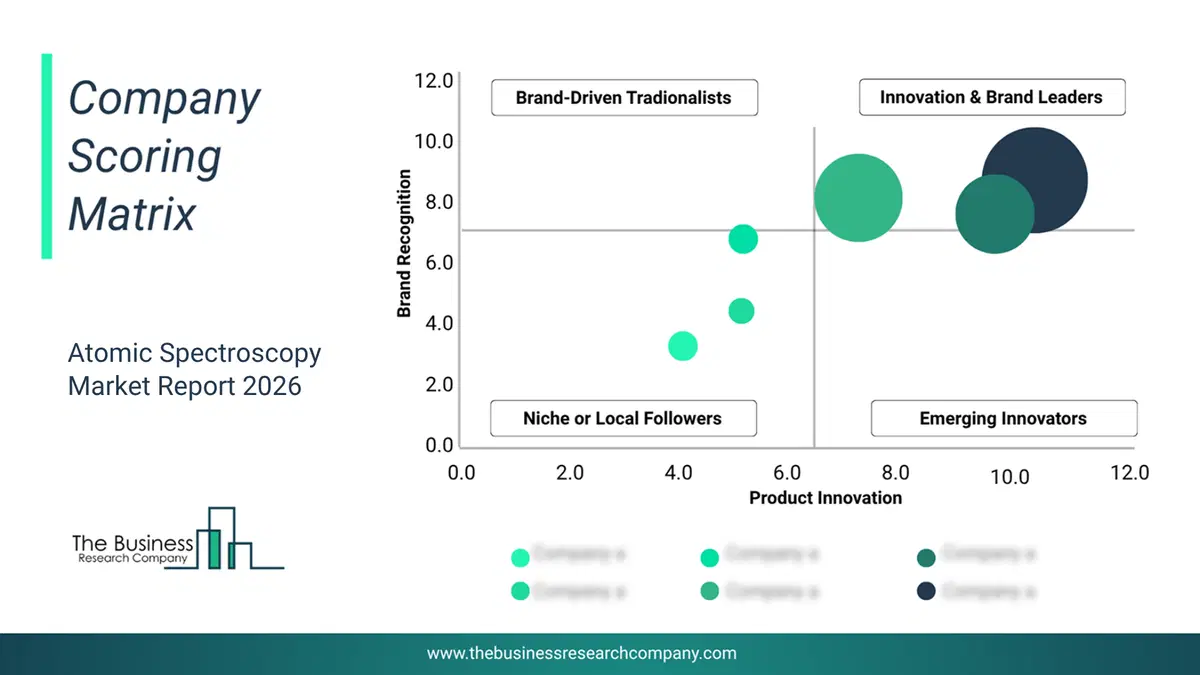
This chart maps companies by product innovation and brand strength, with bubble size indicating relative revenue, helping identify market leaders, challengers, and niche players. This is an illustrative chart; the full report provides a complete and accurate competitive analysis.
Global Atomic Spectroscopy Market Trends and Insights
Major companies operating in the atomic spectroscopy market are focused on introducing advanced solutions, such as atomic absorption (AA) spectrometers, to gain a competitive edge in the market. An atomic absorption (AA) spectrometer is an analytical instrument used to determine the concentration of specific elements in a sample by measuring the absorption of light, typically from a flame or graphite furnace, by free atoms in the sample. For instance, in September 2024, Thermo Fisher Scientific Inc., a US-based life science and clinical research company, launched the atomic absorption (AA) spectrometer iCE 3300GF. The iCE 3300GF AA spectrometer is ideal for cost-conscious laboratories, offering guaranteed deuterium background correction and automatic optical setup for optimal sensitivity, reliability, and accuracy. Designed for a wide range of analytical applications in environmental, academic, clinical, and food safety laboratories, this spectrometer excels in trace elemental analysis. Its integrated furnace autosampler simplifies standard preparation and intelligent dilution of over-range samples, while the Ebert optical system enhances productivity by allowing automatic and unattended operation. A standout feature is its innovative graphite furnace vision system (GFTV), which provides a real-time view inside the graphite cuvette, enabling observation of sample deposition and drying, thereby improving method development.What Are Latest Mergers And Acquisitions In The Atomic Spectroscopy Market?
In October 2023, Calibre Scientific, a US-based manufacturing company, acquired C.P.S. Analitica S.r.l. for an undisclosed amount. Through this acquisition, Calibre Scientific aims to expand its presence in Italy and Europe, strengthen its analytical and chromatography product portfolio, and enhance its support for laboratories using spectroscopy and chromatography instruments. C.P.S. Analitica S.r.l. is an Italy-based company providing consumables, spare parts, and laboratory equipment for chromatography, atomic absorption spectroscopy (AAS), UV spectroscopy, and ICP/MS instruments.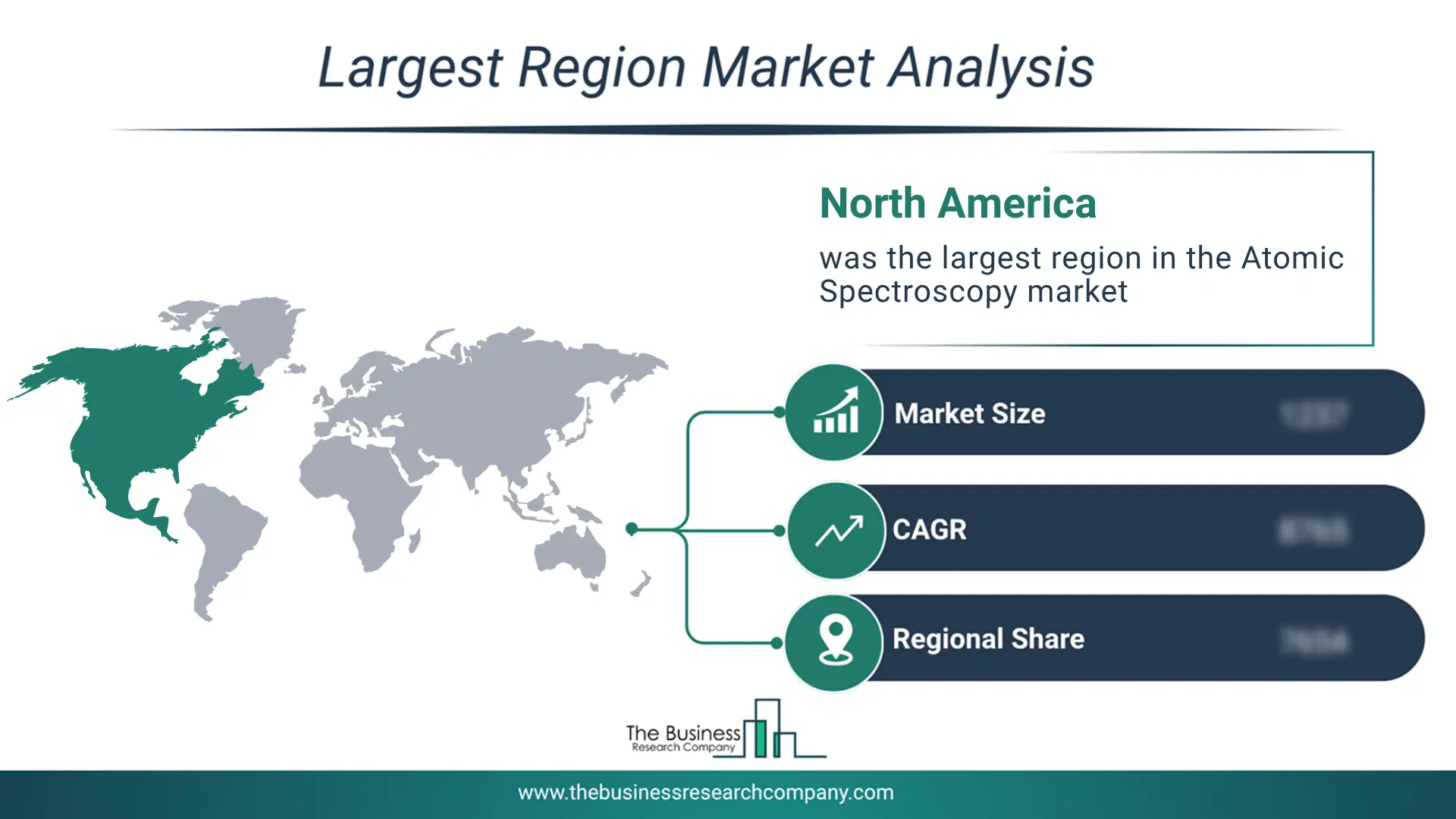
Regional Outlook
North America was the largest region in the atomic spectroscopy market in 2025. Asia-Pacific is expected to be the fastest-growing region in the forecast period. The regions covered in this market report are Asia-Pacific, South East Asia, Western Europe, Eastern Europe, North America, South America, Middle East, Africa. The countries covered in this market report are Australia, Brazil, China, France, Germany, India, Indonesia, Japan, Taiwan, Russia, South Korea, UK, USA, Canada, Italy, SpainWhat Defines the Atomic Spectroscopy Market?
The atomic spectroscopy market consists of revenues earned by entities by providing services such as the determination of trace elements, assisting in drug safety procedures, and analysis of illicit drug powder samples. The market value includes the value of related goods sold by the service provider or included within the service offering. The atomic spectroscopy market also includes sales of atomic absorption spectrometers, atomic emission spectrometers, and atomic fluorescence spectrometers, which are used in providing atomic spectroscopy services. Values in this market are ‘factory gate’ values, that is the value of goods sold by the manufacturers or creators of the goods, whether to other entities (including downstream manufacturers, wholesalers, distributors and retailers) or directly to end customers. The value of goods in this market includes related services sold by the creators of the goods.How is Market Value Defined and Measured?
The market value is defined as the revenues that enterprises gain from the sale of goods and/or services within the specified market and geography through sales, grants, or donations in terms of the currency (in USD unless otherwise specified). The revenues for a specified geography are consumption values that are revenues generated by organizations in the specified geography within the market, irrespective of where they are produced. It does not include revenues from resales along the supply chain, either further along the supply chain or as part of other products.
This chart presents market attractiveness based on a quantitative evaluation of growth, competition, strategic alignment, and risk, offering a clear view of opportunity areas for decision-making. This chart is for illustrative purposes; the full report contains the complete analysis.

This chart highlights the Total Addressable Market (TAM) by estimating the maximum revenue opportunity using an assumption-driven approach, supporting strategic planning and opportunity sizing across markets. The chart is illustrative; the full report provides a more comprehensive analysis.
What Key Data and Analysis Are Included in the Atomic Spectroscopy Market Report 2026?
The atomic spectroscopy market research report is one of a series of new reports from The Business Research Company that provides market statistics, including industry global market size, regional shares, competitors with the market share, detailed market segments, market trends and opportunities, and any further data you may need to thrive in the atomic spectroscopy industry. The market research report delivers a complete perspective of everything you need, with an in-depth analysis of the current and future state of the industry.Atomic Spectroscopy Market Report Forecast Analysis
| Report Attribute | Details |
|---|---|
| Market Size Value In 2026 | $8.9 billion |
| Revenue Forecast In 2030 | $12.7 billion |
| Growth Rate | CAGR of 9.3% from 2026 to 2030 |
| Base Year For Estimation | 2025 |
| Actual Estimates/Historical Data | 2020-2025 |
| Forecast Period | 2026 - 2030 |
| Market Representation | Revenue in USD Billion and CAGR from 2026 to 2030 |
| Segments Covered | Type, Technology, Application, Distribution Channel, End-User |
| Regional Scope | Asia-Pacific, Western Europe, Eastern Europe, North America, South America, Middle East, Africa |
| Country Scope | The countries covered in the report are Australia, Brazil, China, France, Germany, India, Indonesia, Japan, Taiwan, Russia, South Korea, UK, USA, Canada, Italy, Spain. |
| Key Companies Profiled | Thermo Fisher Scientific Inc., Agilent Technologies Inc., Shimadzu Corporation, PerkinElmer Inc., Bruker Corporation, JEOL Ltd., Rigaku Corporation, Hitachi High-Tech Corporation, Analytik Jena AG, GBC Scientific Equipment Pty Ltd., Lumex Instruments, AMETEK Inc., Buck Scientific Instruments LLC, PG Instruments Limited, Teledyne Leeman Labs, Horiba Ltd., Skyray Instrument Co. Ltd., Focused Photonics Inc., Aurora Instruments Ltd., Beijing Beifen-Ruili Analytical Instrument (Group) Co. Ltd. |
| Customization Scope | Request for Customization |
| Pricing And Purchase Options | Explore Purchase Options |