
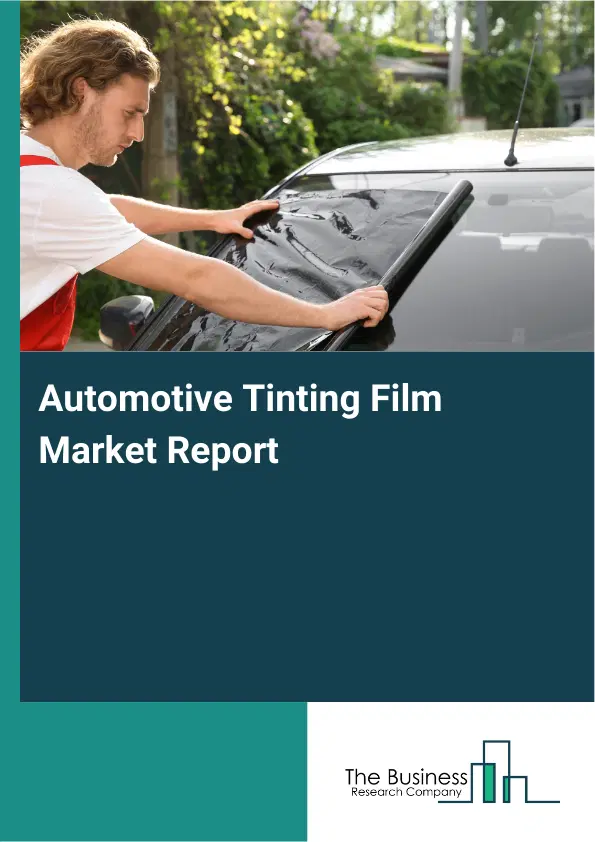
Automotive Tinting Film Market Report 2026
Global Outlook – By Film Type (Window Film, Paint protection Film, Wrap Film, Other Types), By Material Type (Dyed, Metalized, Ceramic, Other Materials), By Vehicle type (Passenger Cars, LCV, HCV) – Market Size, Trends, Strategies, and Forecast to 2030
Automotive Tinting Film Market Overview
• Automotive Tinting Film market size has reached to $4.36 billion in 2025 • Expected to grow to $6.42 billion in 2030 at a compound annual growth rate (CAGR) of 8% • Growth Driver: Rising Global Temperatures Fuel The Demand For Automotive Tinting Films Market • Market Trend: Innovative Technologies Drive Evolution In The Automotive Tinting Film Market • North America was the largest region in 2025 and Asia-Pacific is the fastest growing region.What Is Covered Under Automotive Tinting Film Market?
The automotive tinting film refers to thin laminate films applied to vehicles to reduce the heat and radiation from the sun that enters the vehicle's interior, which helps control the temperature inside the vehicle. These tinting films can differ from one location to another due to a specific region's climate or heat level. The main types of automotive tinting film are window film, paint protection film, wrap film, and other types. The window film refers to a unique film or coating applied to windows on an automobile to prevent a specific spectrum or amount of sunlight from passing through the glass. Window tint can also reduce sun glare and keep harmful UV rays away from reaching the car occupant. The various types of materials used in automotive tinting film include dyed, metalized, ceramic, and other materials that are suitable for passenger cars, LCVs, and HCVs.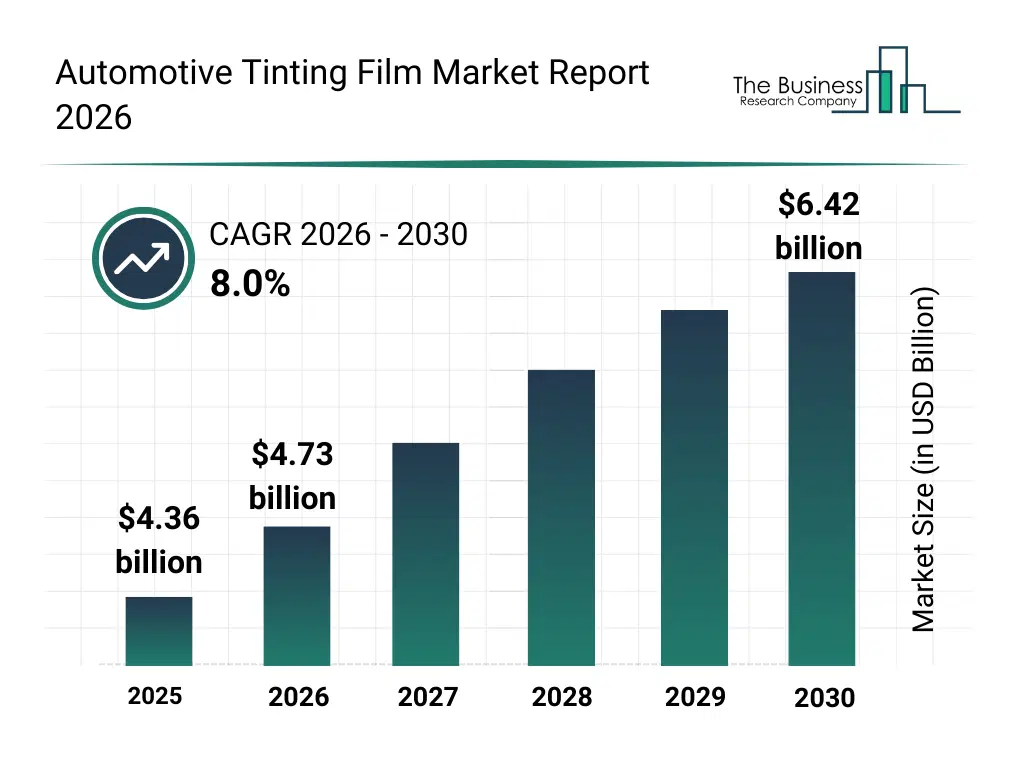
What Is The Automotive Tinting Film Market Size and Share 2026?
The automotive tinting film market size has grown strongly in recent years. It will grow from $4.36 billion in 2025 to $4.73 billion in 2026 at a compound annual growth rate (CAGR) of 8.3%. The growth in the historic period can be attributed to rising vehicle ownership rates, increasing demand for passenger comfort solutions, growth of aftermarket automotive customization, expansion of urban mobility, availability of dyed and metalized film technologies.What Is The Automotive Tinting Film Market Growth Forecast?
The automotive tinting film market size is expected to see strong growth in the next few years. It will grow to $6.42 billion in 2030 at a compound annual growth rate (CAGR) of 8.0%. The growth in the forecast period can be attributed to increasing electric vehicle adoption, rising focus on thermal efficiency in vehicles, expansion of premium vehicle customization, growing awareness of uv protection benefits, increasing demand for advanced ceramic films. Major trends in the forecast period include increasing adoption of ceramic and ir-blocking films, rising demand for heat and uv protection solutions, growing use of paint protection and wrap films, expansion of custom aesthetic vehicle films, enhanced focus on regulatory-compliant tint levels.
Global Automotive Tinting Film Market Segmentation
1) By Film Type: Window Film, Paint protection Film, Wrap Film, Other Types 2) By Material Type: Dyed, Metalized, Ceramic, Other Materials 3) By Vehicle type: Passenger Cars, LCV, HCV Subsegments: 1) By Window Film: Dyed Window Film, Metalized Window Film, Ceramic Window Film 2) By Paint Protection Film: Self-Healing Paint Protection Film, Clear Bra Film 3) By Wrap Film: Gloss Wrap Film, Matte Wrap Film, Textured Wrap Film 4) By Other Types: Security Film, Decorative Film, UV Protection FilmWhat Is The Driver Of The Automotive Tinting Film Market?
The increasing global temperatures is driving the growth of the automotive tinting film market. A vehicle is a machine used for transporting people or goods. Global temperatures represent the average temperature of the Earth's surface, indicating variations in climate patterns and affecting environmental conditions around the world. Increasing global temperatures can be attributed to several factors, including greenhouse gas emissions, deforestation, and industrial activities, which collectively enhance the greenhouse effect and contribute to climate change. Automotive tinting films reflect a significant percentage of solar heat, which helps keep vehicle interiors cooler, reduces reliance on air conditioning, and ultimately lowers fuel consumption and greenhouse gas emissions. For instance, in January 2024, according to the Berkeley Earth, US-based, non-profit organization 2023 emerged as the warmest year on record at 1.54 °C, reflecting a notable increase from 1.25 °C in 2022. Therefore, the increasing global temperatures is expected to boost demand for the automotive tinting films industry during the forecast period.Key Players In The Global Automotive Tinting Film Market
Major companies operating in the automotive tinting film market are 3M, Eastman Chemical Company, Saint-Gobain Group, Avery Dennison Corporation, Johnson Window Films Inc., Madico Inc., Toray Industries Inc., TintFit Window Films Ltd., Global Window Films, Solar Screen International SA, Huper Optik USA, Armolan Performance Films Pvt Ltd., Nexfil Co Ltd., Hanita Coatings, Garware Hi-Tech Films Ltd., Llumar, SunTek Industries, Rayno Window Film Inc., XPEL Inc., Flexfilm Ltd., Geoshield Ltd., American Standard Window Films, LINTEC Corporation, Compagnie de Saint-Gobain S.A., V-KOOL Inc., Apex Window Films, Raytech USA Inc.
This chart is for illustrative purposes; the full report includes a detailed competitor analysis and comprehensive overview of the top 10 companies in the market.
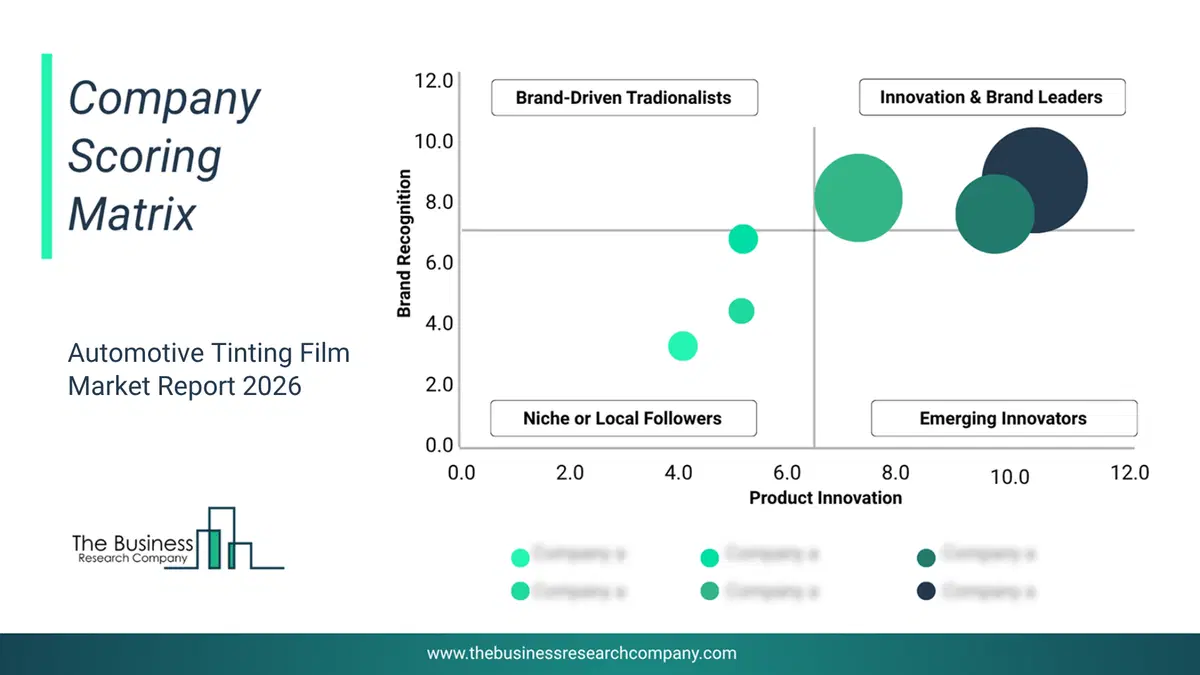
This chart maps companies by product innovation and brand strength, with bubble size indicating relative revenue, helping identify market leaders, challengers, and niche players. This is an illustrative chart; the full report provides a complete and accurate competitive analysis.
Global Automotive Tinting Film Market Trends and Insights
Major companies operating in the automotive tinting film market are focused on providing technologically advanced solutions to strengthen their market position. These companies are implementing enhanced automotive tinting film technologies into their products, such as nano tinting technology, electro-chromatic technology, liquid-crystal technologies, multilayered sputtering, photovoltaic (PV) technology, and others, to block harmful UV rays and make vehicles significantly more relaxed and more comfortable from the inside. For instance, in April 2024, Hyundai Motor Company, a South Korea-based automotive company, launched Nano Cooling Film., a vehicle window tint that employs cutting-edge nanostructure technology to improve interior cooling efficiency. This innovative film effectively blocks external heat energy and emits internal radiant heat to the outside, leading to a substantial decrease in a vehicle's interior temperature without sacrificing visibility. Specifically engineered for maximum performance in hot and dry environments, Nano Cooling Film consists of a distinctive three-layer composition that selectively reflects and radiates particular wavelengths of solar heat.What Are Latest Mergers And Acquisitions In The Automotive Tinting Film Market?
In August 2023, AP Corp., a US-based not-for-profit cooperative news agency, acquired Solar Tint, Inc. for an undisclosed amount. The aim of the acquisition is to expand AP Corp.'s presence in Florida and enhance its operations across Maryland and North Carolina. Solar Tint, Inc., a US-based window tinting company that specializes in providing high-quality window film solutions for automotive, residential, and commercial applications.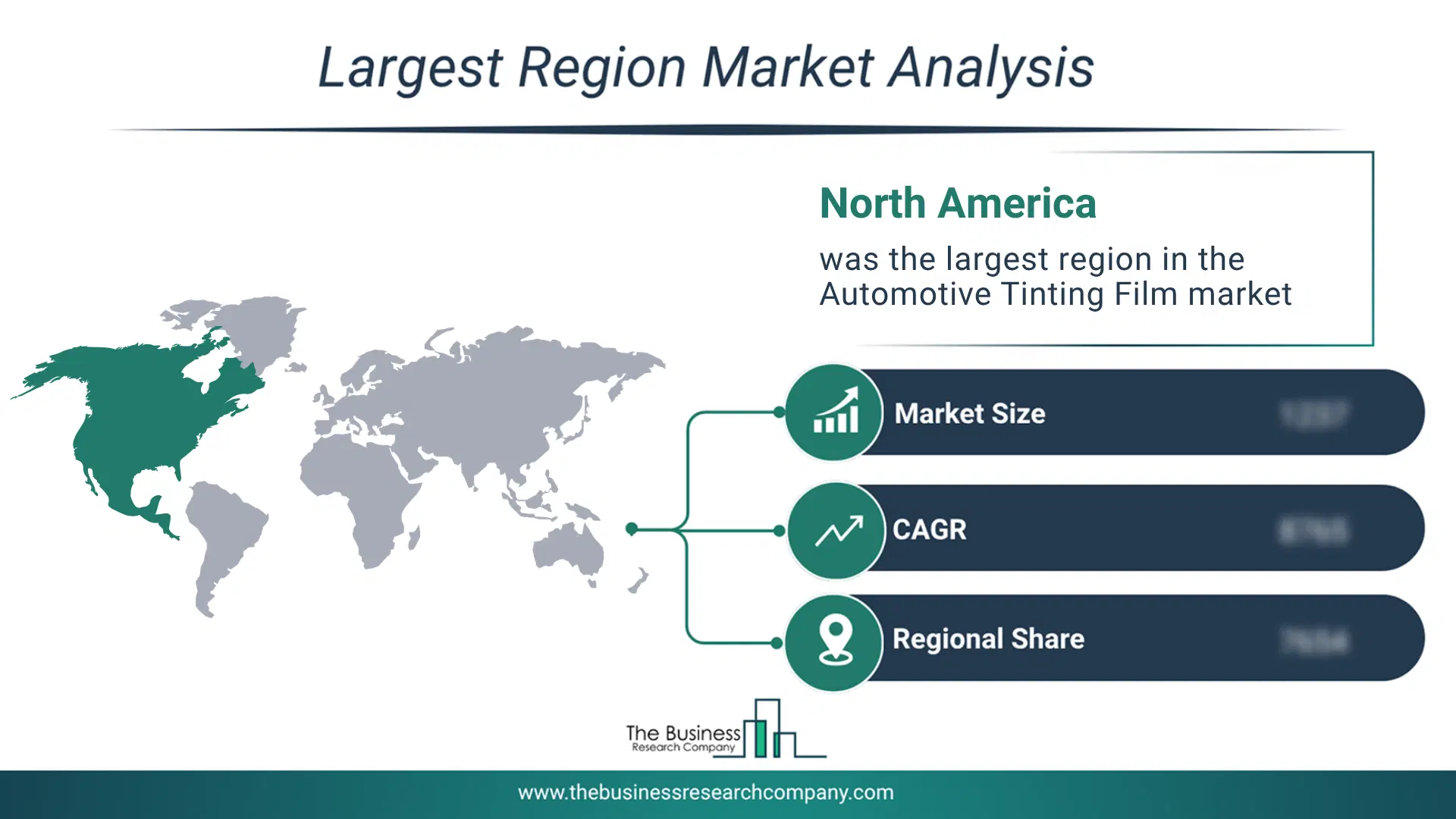
Regional Insights
North America was the largest region in the automotive tinting film market in 2025. Asia-Pacific is expected to be the fastest-growing region in the forecast period. The regions covered in this market report are Asia-Pacific, South East Asia, Western Europe, Eastern Europe, North America, South America, Middle East, Africa The countries covered in this market report are Australia, Brazil, China, France, Germany, India, Indonesia, Japan, Taiwan, Russia, South Korea, UK, USA, Canada, Italy, SpainWhat Defines the Automotive Tinting Film Market?
The automotive tinting film market consists of sales of crystalline glass tints, ceramic tints, and carbon tints. Values in this market are ‘factory gate’ values, that is the value of goods sold by the manufacturers or creators of the goods, whether to other entities (including downstream manufacturers, wholesalers, distributors, and retailers) or directly to end customers. The value of goods in this market includes related services sold by the creators of the goods.How is Market Value Defined and Measured?
The market value is defined as the revenues that enterprises gain from the sale of goods and/or services within the specified market and geography through sales, grants, or donations in terms of the currency (in USD unless otherwise specified). The revenues for a specified geography are consumption values that are revenues generated by organizations in the specified geography within the market, irrespective of where they are produced. It does not include revenues from resales along the supply chain, either further along the supply chain or as part of other products.
This chart presents market attractiveness based on a quantitative evaluation of growth, competition, strategic alignment, and risk, offering a clear view of opportunity areas for decision-making. This chart is for illustrative purposes; the full report contains the complete analysis.

This chart highlights the Total Addressable Market (TAM) by estimating the maximum revenue opportunity using an assumption-driven approach, supporting strategic planning and opportunity sizing across markets. The chart is illustrative; the full report provides a more comprehensive analysis.
What Key Data and Analysis Are Included in the Automotive Tinting Film Market Report 2026?
The automotive tinting film market research report is one of a series of new reports from The Business Research Company that provides market statistics, including industry global market size, regional shares, competitors with the market share, detailed market segments, market trends and opportunities, and any further data you may need to thrive in the automotive tinting film industry. The market research report delivers a complete perspective of everything you need, with an in-depth analysis of the current and future state of the industry.Automotive Tinting Film Market Report Forecast Analysis
| Report Attribute | Details |
|---|---|
| Market Size Value In 2026 | $4.73 billion |
| Revenue Forecast In 2030 | $6.42 billion |
| Growth Rate | CAGR of 8.3% from 2026 to 2030 |
| Base Year For Estimation | 2025 |
| Actual Estimates/Historical Data | 2020-2025 |
| Forecast Period | 2026 - 2030 |
| Market Representation | Revenue in USD Billion and CAGR from 2026 to 2030 |
| Segments Covered | Film Type, Material Type, Vehicle type |
| Regional Scope | Asia-Pacific, Western Europe, Eastern Europe, North America, South America, Middle East, Africa |
| Country Scope | The countries covered in this market report are Australia, Brazil, China, France, Germany, India, Indonesia, Japan, Taiwan, Russia, South Korea, UK, USA, Canada, Italy, Spain |
| Key Companies Profiled | 3M, Eastman Chemical Company, Saint-Gobain Group, Avery Dennison Corporation, Johnson Window Films Inc., Madico Inc., Toray Industries Inc., TintFit Window Films Ltd., Global Window Films, Solar Screen International SA, Huper Optik USA, Armolan Performance Films Pvt Ltd., Nexfil Co Ltd., Hanita Coatings, Garware Hi-Tech Films Ltd., Llumar, SunTek Industries, Rayno Window Film Inc., XPEL Inc., Flexfilm Ltd., Geoshield Ltd., American Standard Window Films, LINTEC Corporation, Compagnie de Saint-Gobain S.A., V-KOOL Inc., Apex Window Films, Raytech USA Inc. |
| Customization Scope | Request for Customization |
| Pricing And Purchase Options | Explore Purchase Options |