
Battle Force Ships Market Report 2026
Global Outlook – By Vessel Type (Frigates, Corvettes, Destroyers, Aircraft Carriers, Torpedo Boats, Support Crafts, Others), By Technology (Conventional Powered, Nuclear Powered), By Application (Search And Rescue, Combat Operations, Mcm Operations, Coastal Surveillance, Others) – Market Size, Trends, Strategies, and Forecast to 2030
Battle Force Ships Market Overview
• Battle Force Ships market size has reached to $26.01 billion in 2025 • Expected to grow to $41.76 billion in 2030 at a compound annual growth rate (CAGR) of 10.1% • Growth Driver: Elevated Geopolitical Tensions Fuel Expansion In The Battle Force Ship Market • Market Trend: Innovative Warship Development Strengthens India's Position As A Warship Builder • Asia-Pacific was the largest region in 2025 and Western Europe is the fastest growing region.What Is Covered Under Battle Force Ships Market?
Battle force ship refers to warships capable of aiding combat operations, such as aircraft carriers, and support crafts. The battle force ship components include an anchor, rudder, bow, keel, accommodation, propeller, mast, bridge, hatch coves, and bow thrusters. The main types of vessels in battle force ships are frigates, corvettes, destroyers, aircraft carriers, torpedo boats, support crafts, and others. A frigate is a navy ship that can travel at high speeds and is relatively small. Frigates are frequently deployed to defend other ships. The different applications include search and rescue, combat operations, mcm operations, coastal surveillance, and others and involve various technologies such as conventional power or nuclear power.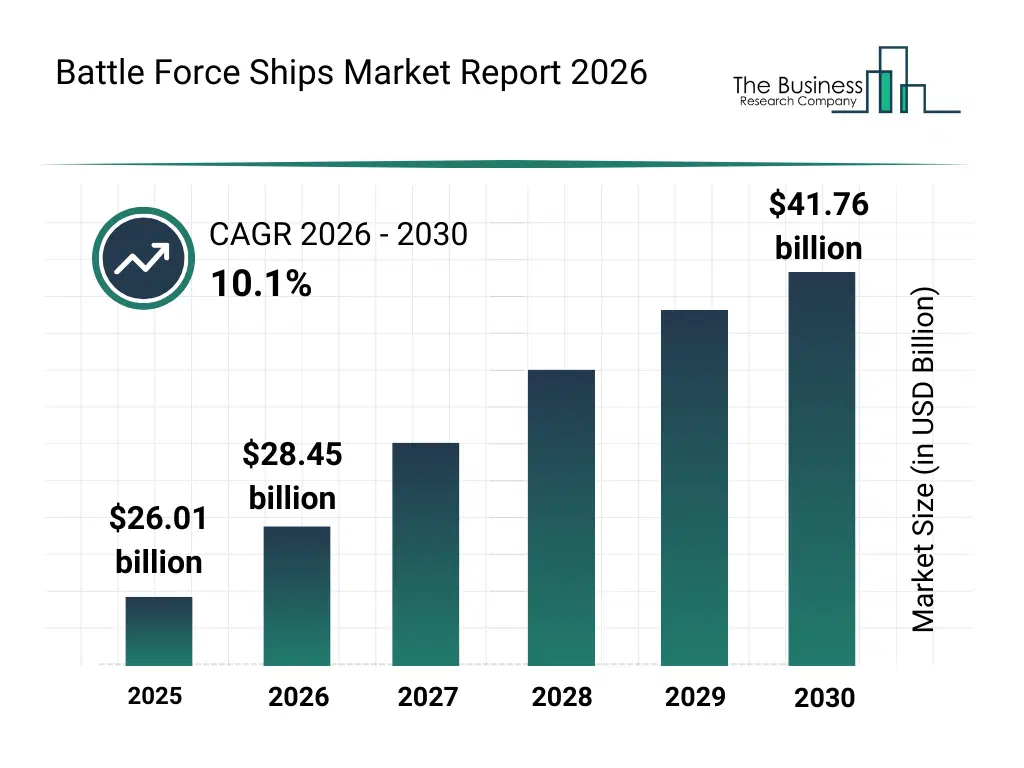
What Is The Battle Force Ships Market Size and Share 2026?
The battle force ships market size has grown strongly in recent years. It will grow from $26.01 billion in 2025 to $28.45 billion in 2026 at a compound annual growth rate (CAGR) of 9.4%. The growth in the historic period can be attributed to expansion of global naval fleets during defense modernization programs, technological advancements in propulsion and weapon systems, increased production of aircraft carriers and destroyers, government defense contracts driving shipbuilding orders, growth in support watercraft and auxiliary naval vessels.What Is The Battle Force Ships Market Growth Forecast?
The battle force ships market size is expected to see rapid growth in the next few years. It will grow to $41.76 billion in 2030 at a compound annual growth rate (CAGR) of 10.1%. The growth in the forecast period can be attributed to rising investment in next-generation stealth and autonomous warships, growth in naval modernization programs for emerging economies, advancements in integrated weapon and defense systems on ships, increasing demand for multi-role combat and support vessels, adoption of AI and automated systems for ship navigation and combat operations. Major trends in the forecast period include integration of advanced naval propulsion and power systems, adoption of modular warship design for flexibility in combat, implementation of advanced radar and sonar systems, expansion of retrofit and upgrade services for legacy ships, increased focus on multi-mission and multi-role capabilities.
Global Battle Force Ships Market Segmentation
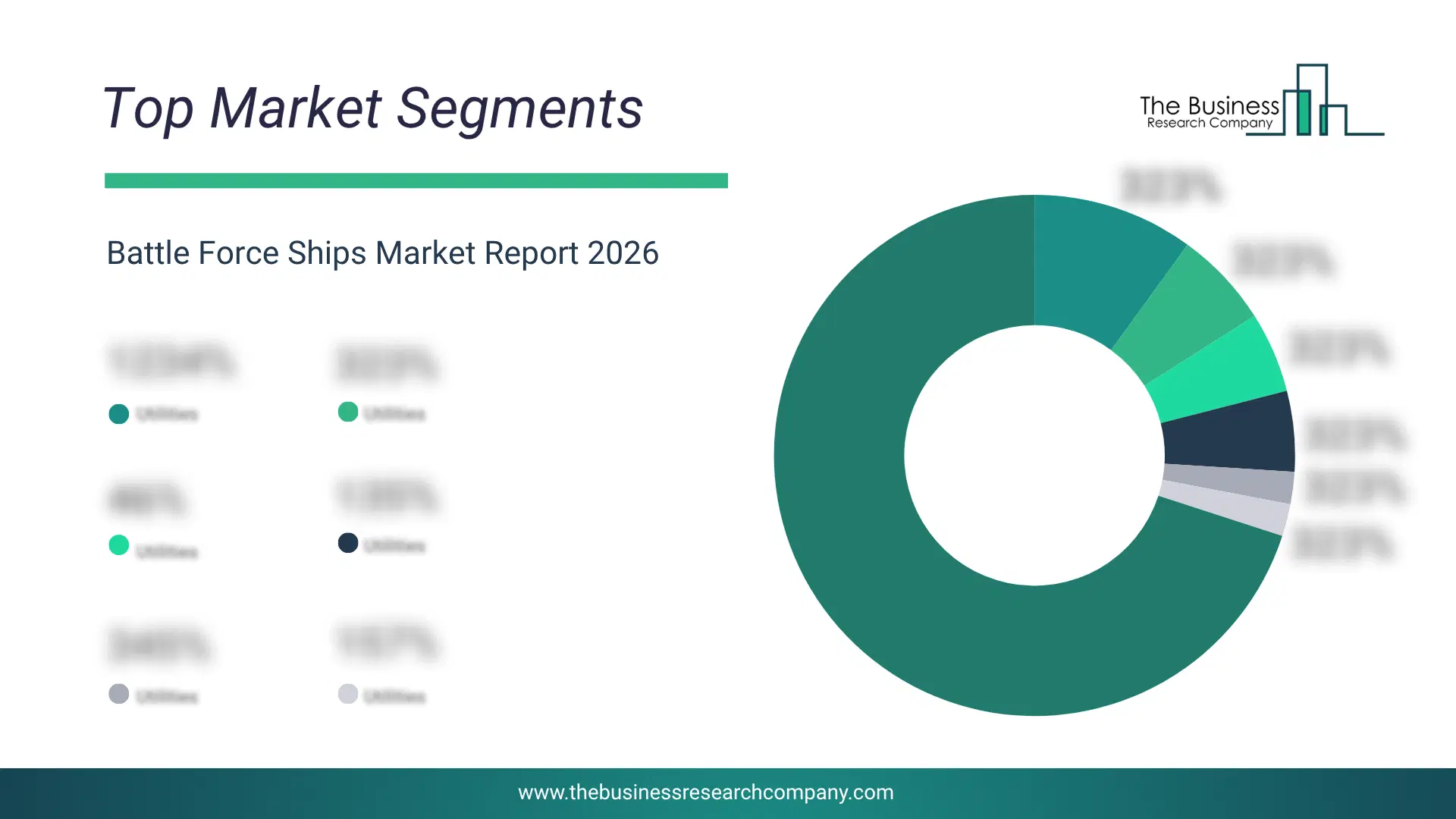
1) By Vessel Type: Frigates, Corvettes, Destroyers, Aircraft Carriers, Torpedo Boats, Support Crafts, Others 2) By Technology: Conventional Powered, Nuclear Powered 3) By Application: Search And Rescue, Combat Operations, Mcm Operations, Coastal Surveillance, Others Subsegments: 1) By Frigates: Multi-Role Frigates, Anti-Submarine Warfare Frigates, Air Defense Frigates 2) By Corvettes: Coastal Defense Corvettes, Multi-Role Corvettes, Missile Corvettes 3) By Destroyers: Guided Missile Destroyers, Anti-Aircraft Destroyers, Anti-Submarine Destroyers 4) By Aircraft Carriers: Nuclear-Powered Aircraft Carriers, Conventionally-Powered Aircraft Carriers 5) By Torpedo Boats: Fast Attack Torpedo Boats, Multi-Role Torpedo Boats 6) By Support Crafts: Amphibious Assault Ships, Auxiliary Ships, Supply Ships 7) By Others: Landing Ship Tanks (LST), Minesweepers, SubmarinesWhat Is Driver Of The Battle Force Ships Market?
The rising geopolitical tensions are expected to propel the growth of the battle force ship market going forward. The geopolitical tensions refer to conflicts, rivalries, or strained relations between different countries or regions, often arising from disputes over territory, resources, political ideology, military power, or other geopolitical factors. Battle-force ships play a significant role in both exacerbating and mitigating rising geopolitical tensions. They can deter aggression, reassure allies and partners, and conduct combat operations if necessary to protect a country's interests or those of its allies. For instance, in January 2023, according to reports published by the National Library of Medicine, a US-based medical library, in the assessment of geopolitical risk, Syria and Yemen experienced substantial increases, with Syria's geopolitical risk rising by a factor of 1.442 and Yemen's by 1.467, and currently, Russia and Ukraine's geopolitical tensions have risen. Therefore, rising geopolitical tensions are driving the growth of the battle force ship industry.Key Players In The Global Battle Force Ships Market
Major companies operating in the battle force ships market are BAE Systems, Lockheed Martin Corp, General Dynamics Corporation, Huntington Ingalls Industries, Abu Dhabi Ship Building, Austal Limited, Damen Schelde Naval Shipbuilding (DSNS), Daewoo Shipbuilding & Marine Engineering (DSME), Hyundai Heavy Industries, Mazagon Dock Shipbuilders Limited, Naval Group SA, PO Sevmash, Thales Group, ThyssenKrupp Marine Systems AG, Fincantieri S.p.A., ASC PTY LTD., Raytheon Technologies Corp., SaaB AB, Mitsubishi Heavy Industries Ltd., Kawasaki Shipbuilding Corporation, Kockums AB, United Shipbuilding Corporation, Navantia, Samsung Heavy Industries, China Shipbuilding Industry Corporation, STX Offshore & Shipbuilding, Boustead Naval Shipyard, Garden Reach Shipbuilders & Engineers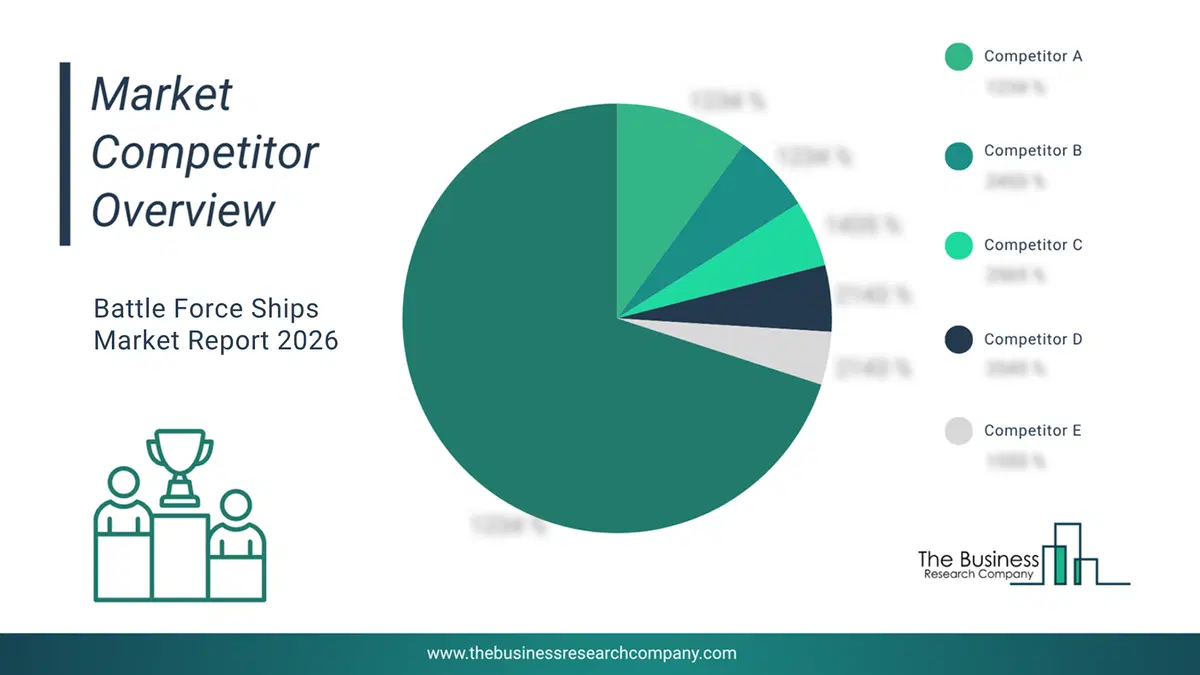
This chart is for illustrative purposes; the full report includes a detailed competitor analysis and comprehensive overview of the top 10 companies in the market.
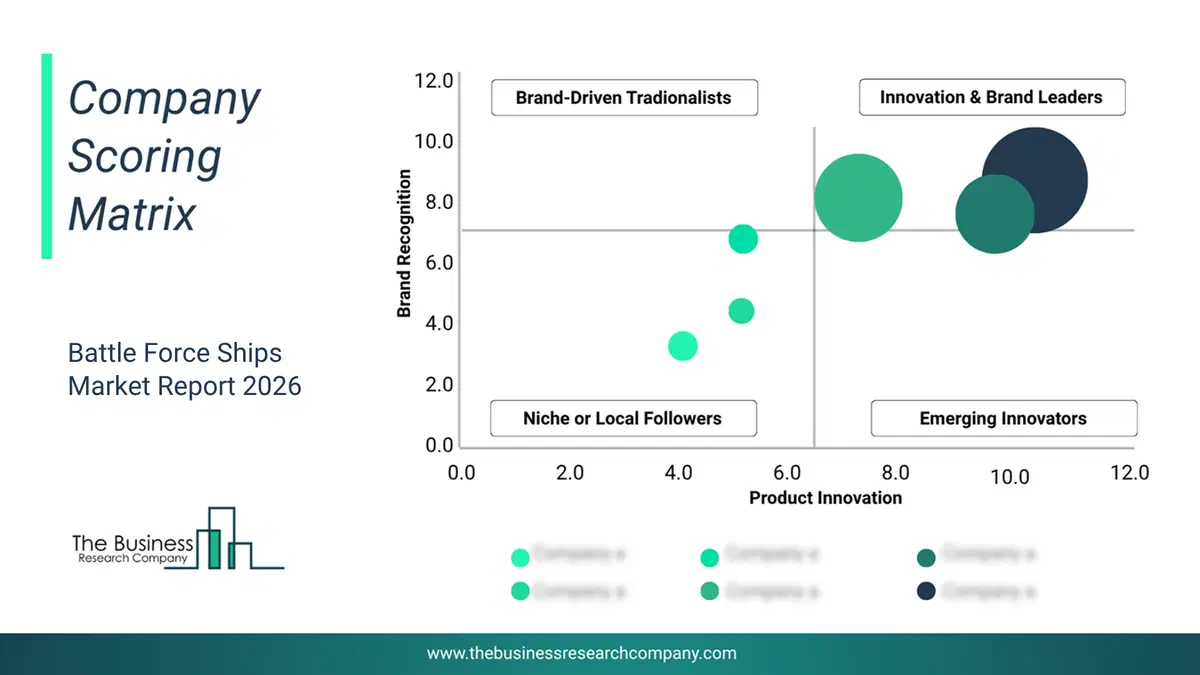
This chart maps companies by product innovation and brand strength, with bubble size indicating relative revenue, helping identify market leaders, challengers, and niche players. This is an illustrative chart; the full report provides a complete and accurate competitive analysis.
Global Battle Force Ships Market Trends and Insights
Major companies operating in the battle force ship market are developing innovative battleships such as INS Anjadip and INS Sanshodhak to meet the growing demand for warships from the Indian Navy and demonstrate its capabilities as a warship builder. INS Anjadip is a fast and agile warship that is designed to detect and destroy submarines in shallow waters. And INS Sanshodhak is a multi-purpose warship that is used for a variety of tasks, including hydrographic surveying, oceanographic research, and search and rescue operations. For instance, in June 2023, Garden Reach Shipbuilders & Engineers Ltd., an India-based shipbuilding and repairing company, launched two warships called INS Anjadip and INS Sanshodhak, both of these warships are significant additions to the Indian Navy's fleet. The INS Anjadip will enhance the Indian Navy's anti-submarine warfare capabilities in shallow waters, while the INS Sanshodhak will enhance the Indian Navy's maritime surveillance and research capabilities. This helps the country's growing capabilities as a warship builder and the Indian Navy's commitment to modernizing its fleet.What Are Latest Mergers And Acquisitions In The Battle Force Ships Market? Hanwha Group Acquires Controlling Stake In Daewoo Shipbuilding & Marine Engineering
In May 2023, Hanwha Group Co. Ltd., a South Korea-based conglomerate, acquired a 49.3% controlling stake in Daewoo Shipbuilding & Marine Engineering Co., Ltd. (DSME) for 2 trillion won (US$1.49 billion). With this acquisition, Hanwha Group Co., Ltd. aims to strengthen its position in South Korea’s offshore and marine industry, support a leading national sector, and contribute to the local economy while overseeing DSME’s operations and growth, expanding its technological capabilities, enhancing global competitiveness, and driving long-term sustainable development in shipbuilding and related maritime industries. Daewoo Shipbuilding & Marine Engineering Co. Ltd. is a South Korea-based shipbuilding company that specializes in constructing naval vessels, offshore platforms, and large-scale marine ships.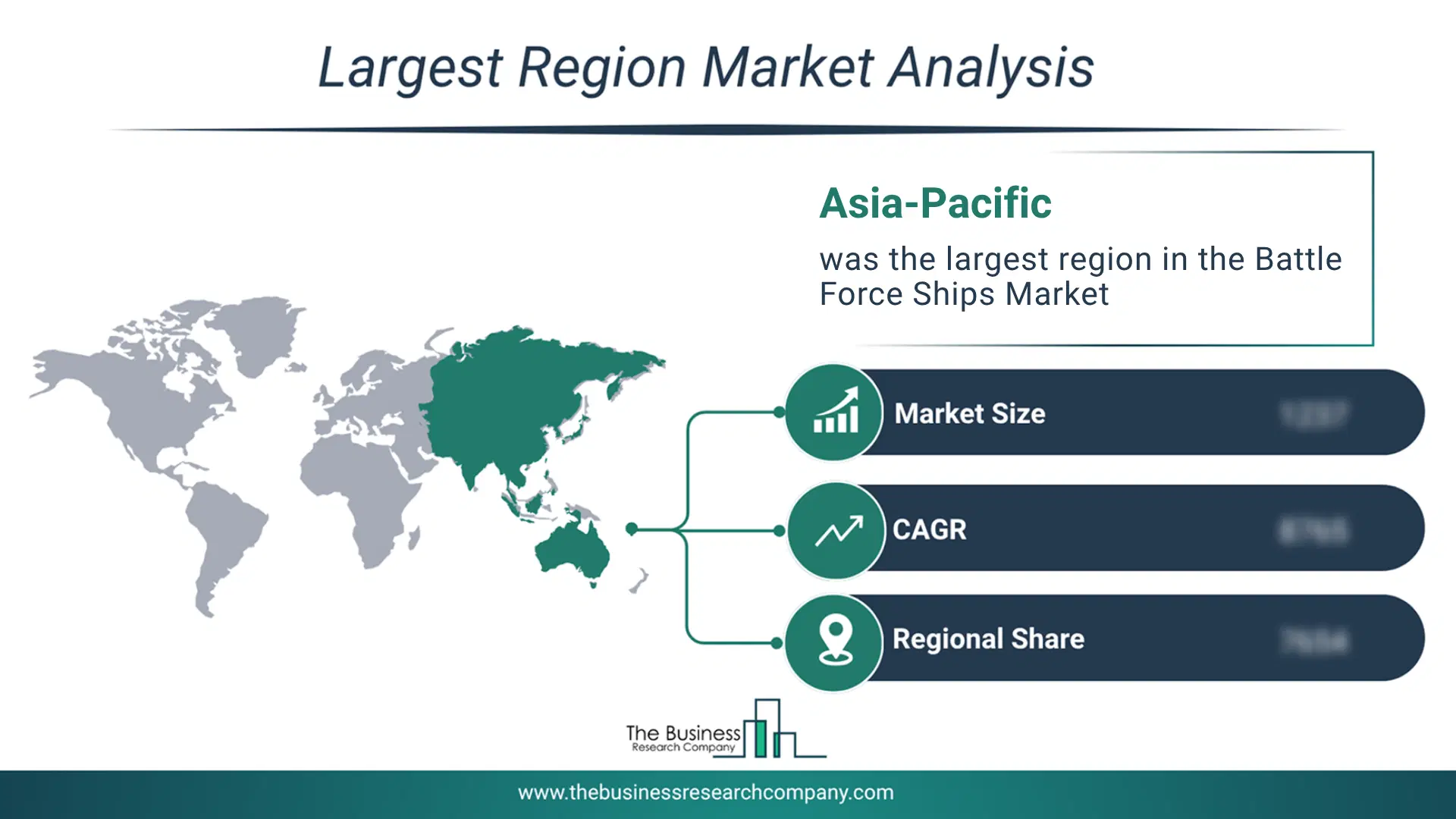
Regional Insights
Asia-Pacific was the largest region in the battle force ships market in 2025. Western Europe is expected to be the fastest-growing region in the battle force ships market during the forecast period. The regions covered in this market report are Asia-Pacific, South East Asia, Western Europe, Eastern Europe, North America, South America, Middle East, Africa. The countries covered in this market report are Australia, Brazil, China, France, Germany, India, Indonesia, Japan, Taiwan, Russia, South Korea, UK, USA, Canada, Italy, SpainWhat Defines the Battle Force Ships Market?
The battle force ship market consists of sales of battle force ships, such as combat warships, and support watercraft. Values in this market are factory gate values, that is, the value of goods sold by the manufacturers or creators of the goods, whether to other entities (including downstream manufacturers, wholesalers, distributors, and retailers) or directly to end customers. The value of goods in this market includes related services sold by the creators of the goods.How is Market Value Defined and Measured?
The market value is defined as the revenues that enterprises gain from the sale of goods and/or services within the specified market and geography through sales, grants, or donations in terms of the currency (in USD unless otherwise specified). The revenues for a specified geography are consumption values that are revenues generated by organizations in the specified geography within the market, irrespective of where they are produced. It does not include revenues from resales along the supply chain, either further along the supply chain or as part of other products.
This chart presents market attractiveness based on a quantitative evaluation of growth, competition, strategic alignment, and risk, offering a clear view of opportunity areas for decision-making. This chart is for illustrative purposes; the full report contains the complete analysis.

This chart highlights the Total Addressable Market (TAM) by estimating the maximum revenue opportunity using an assumption-driven approach, supporting strategic planning and opportunity sizing across markets. The chart is illustrative; the full report provides a more comprehensive analysis.
What Key Data and Analysis Are Included in the Battle Force Ships Market Report 2026?
The battle force ships market research report is one of a series of new reports from The Business Research Company that provides market statistics, including industry global market size, regional shares, competitors with the market share, detailed market segments, market trends and opportunities, and any further data you may need to thrive in the battle force ships industry. The market research report delivers a complete perspective of everything you need, with an in-depth analysis of the current and future state of the industry.Battle Force Ships Market Report Forecast Analysis
| Report Attribute | Details |
|---|---|
| Market Size Value In 2026 | $28.45 billion |
| Revenue Forecast In 2030 | $41.76 billion |
| Growth Rate | CAGR of 10.1% from 2026 to 2030 |
| Base Year For Estimation | 2025 |
| Actual Estimates/Historical Data | 2020-2025 |
| Forecast Period | 2026 - 2030 |
| Market Representation | Revenue in USD Billion and CAGR from 2026 to 2030 |
| Segments Covered | Vessel Type, Technology, Application |
| Regional Scope | Asia-Pacific, Western Europe, Eastern Europe, North America, South America, Middle East, Africa |
| Country Scope | The countries covered in the battle force ships market report are Australia, Brazil, China, France, Germany, India, Indonesia, Japan, Taiwan, Russia, South Korea, UK, USA, Canada, Italy, Spain |
| Key Companies Profiled | BAE Systems, Lockheed Martin Corp, General Dynamics Corporation, Huntington Ingalls Industries, Abu Dhabi Ship Building, Austal Limited, Damen Schelde Naval Shipbuilding (DSNS), Daewoo Shipbuilding & Marine Engineering (DSME), Hyundai Heavy Industries, Mazagon Dock Shipbuilders Limited, Naval Group SA, PO Sevmash, Thales Group, ThyssenKrupp Marine Systems AG, Fincantieri S.p.A., ASC PTY LTD., Raytheon Technologies Corp., SaaB AB, Mitsubishi Heavy Industries Ltd., Kawasaki Shipbuilding Corporation, Kockums AB, United Shipbuilding Corporation, Navantia, Samsung Heavy Industries, China Shipbuilding Industry Corporation, STX Offshore & Shipbuilding, Boustead Naval Shipyard, Garden Reach Shipbuilders & Engineers |
| Customization Scope | Request for Customization |
| Pricing And Purchase Options | Explore Purchase Options |