
Commercial Building Insulation Market Report 2026
Global Outlook – By Material Type (Fiberglass, Mineral Wool, Cellulose, Polyurethane Foam, Polystyrene, Other Material Types), By Application (Walls, Roofs, Floors, Other Application), By End-Use (Offices, Retail, Hospitality, Healthcare, Other End-Uses) – Market Size, Trends, Strategies, and Forecast to 2030
Commercial Building Insulation Market Overview
• Commercial Building Insulation market size has reached to $15.1 billion in 2025 • Expected to grow to $19.74 billion in 2030 at a compound annual growth rate (CAGR) of 5.4% • Growth Driver: Expansion Of The Construction Sector Fueling The Growth Of The Market Due To Rising Urbanization And Infrastructure Demand • Market Trend: Sustainable Insulation Solution Reduces Carbon Footprint And Enhances Performance • Asia-Pacific was the largest region in 2025.What Is Covered Under Commercial Building Insulation Market?
Commercial building insulation refers to materials and systems installed in the walls, roofs, and floors of commercial structures such as offices, malls, and warehouses to reduce heat transfer. This insulation enhances energy efficiency by maintaining indoor temperature, which helps lower heating and cooling costs. It also improves occupant comfort and can aid in soundproofing and moisture control. The main types of materials in commercial building insulation are fiberglass, mineral wool, cellulose, polyurethane foam, polystyrene, and others. Fiberglass insulation refers to a thermal insulating material made from fine glass fibers, designed to reduce heat transfer and improve energy efficiency in buildings. It finds applications in walls, roofs, floors, and others, serving end users, including offices, retail, hospitality, healthcare, and others.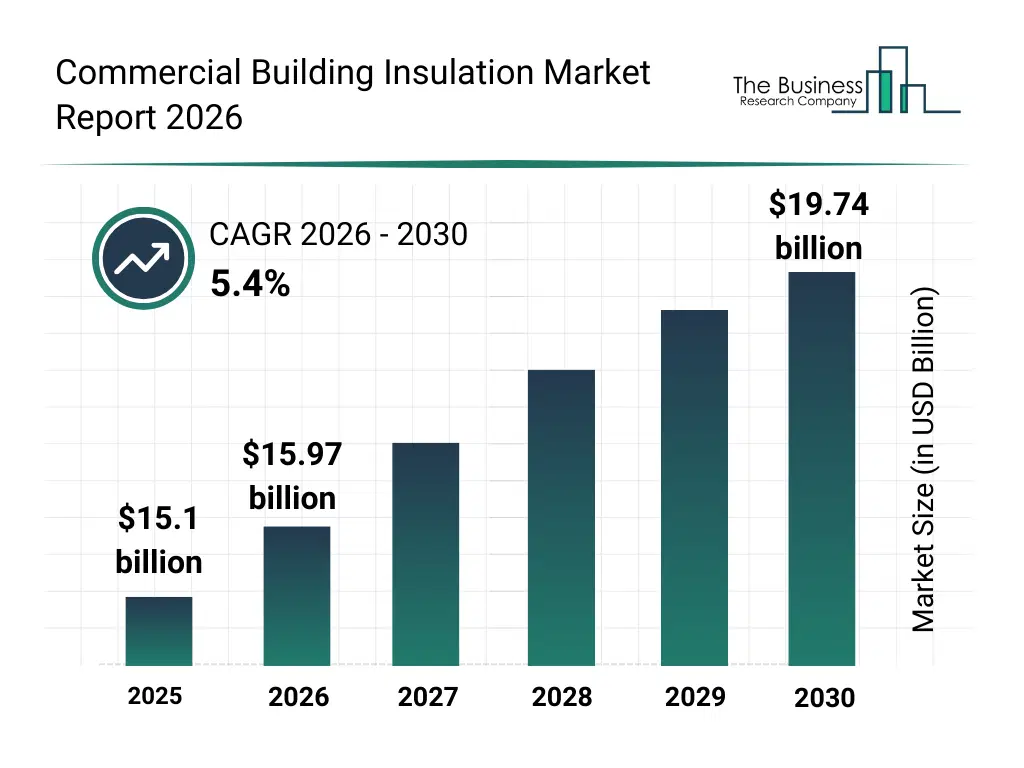
What Is The Commercial Building Insulation Market Size and Share 2026?
The commercial building insulation market size has grown strongly in recent years. It will grow from $15.1 billion in 2025 to $15.97 billion in 2026 at a compound annual growth rate (CAGR) of 5.8%. The growth in the historic period can be attributed to rising use of insulation for commercial energy efficiency, increasing adoption of thermal and acoustic control systems, reliance on polymer- and mineral-based insulation materials, expansion of commercial construction activities, growing need for moisture and fire-resistant insulation solutions.What Is The Commercial Building Insulation Market Growth Forecast?
The commercial building insulation market size is expected to see strong growth in the next few years. It will grow to $19.74 billion in 2030 at a compound annual growth rate (CAGR) of 5.4%. The growth in the forecast period can be attributed to increasing demand for sustainable insulation materials, rising use of smart energy management systems, expansion of high-performance insulation technologies, development of advanced reflective and vacuum insulation panels, growing adoption of stricter building energy regulations. Major trends in the forecast period include integration of AI-based building energy optimization, development of low-carbon insulation materials, advancement of automated insulation manufacturing lines, use of connected sensors for insulation performance monitoring, expansion of digital modeling and thermal simulation tools.
Global Commercial Building Insulation Market Segmentation
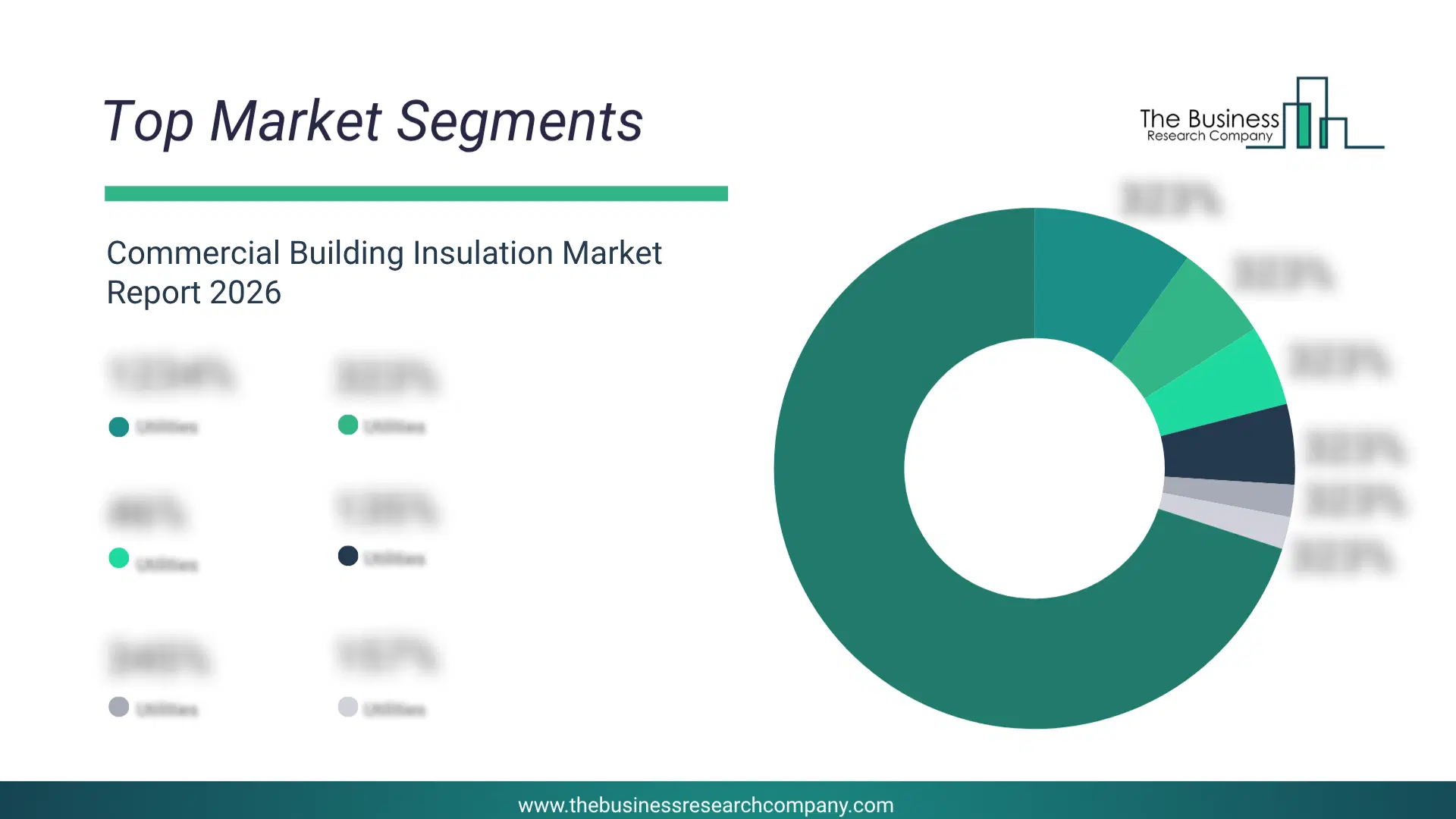
1) By Material Type: Fiberglass, Mineral Wool, Cellulose, Polyurethane Foam, Polystyrene, Other Material Types 2) By Application: Walls, Roofs, Floors, Other Application 3) By End-Use: Offices, Retail, Hospitality, Healthcare, Other End-Uses Subsegments: 1) By Fiberglass: Blanket Insulation, Board Insulation, Loose Fill Insulation 2) By Mineral Wool: Rock Wool, Slag Wool, Loose Fill, Boards And Batts 3) By Cellulose: Dry Cellulose, Spray Applied Cellulose, Stabilized Cellulose 4) By Polyurethane Foam: Open Cell Foam, Closed Cell Foam, Spray Foam 5) By Polystyrene: Expanded Polystyrene, Extruded Polystyrene 6) By Other Material Type: Cotton Insulation, Aerogel Insulation, Hemp Insulation, Vermiculite InsulationWhat Is The Driver Of The Commercial Building Insulation Market?
The expansion of the construction sector is expected to propel the growth of the commercial building insulation market going forward. The construction sector refers to the industry that focuses on building, renovating, and maintaining infrastructure, residential, commercial, and industrial projects. The construction sector is expanding due to rapid urbanization, as more people move to cities, increasing the demand for housing, transportation networks, and public infrastructure. Commercial building insulation supports the construction sector by enhancing energy efficiency, making it essential for sustainable and high-performance buildings. It reduces heating and cooling demands, lowering operational costs and improving occupant comfort. For instance, in April 2025, according to the United States Census Bureau, a US-based government agency, construction spending reached $2,156,495 million in 2024, an increase from $2,023,662 million in 2023. Therefore, the expansion of the construction sector is driving the growth of the commercial building insulation industry.Key Players In The Global Commercial Building Insulation Market
Major companies operating in the commercial building insulation market are BASF SE, Dow Inc., Saint-Gobain S.A., Covestro AG, Knauf Insulation, Sika AG, Owens Corning, Kingspan Group plc, Huntsman Corporation, Etex Group, Rockwool International A/S, Alkegen, GAF Materials Corporation, CertainTeed Corporation, Johns Manville Corporation, Armacell International S.A, Atlas Roofing Corporation, Aspen Aerogels Inc., URSA Insulation S.A., Lloyd Insulations Limited, Brucha d.o.o., Bradford Insulation, Compagnie de Saint-Gobain S.A., Thermotec GmbH, Neo Thermal Insulation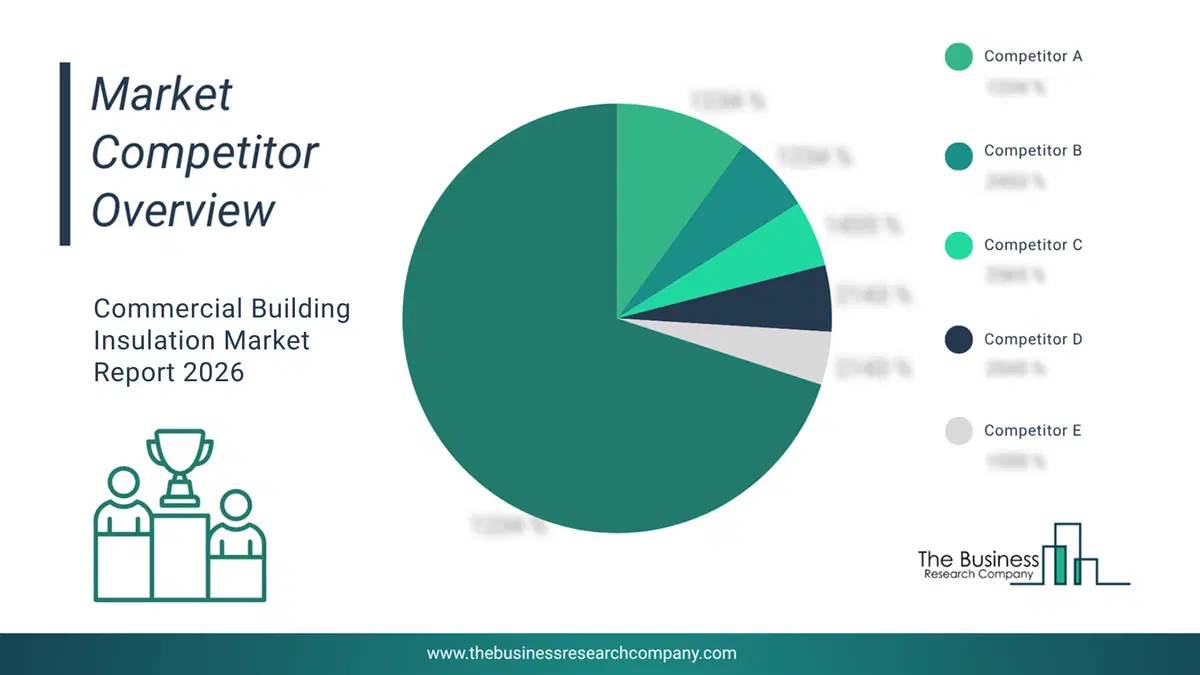
This chart is for illustrative purposes; the full report includes a detailed competitor analysis and comprehensive overview of the top 10 companies in the market.
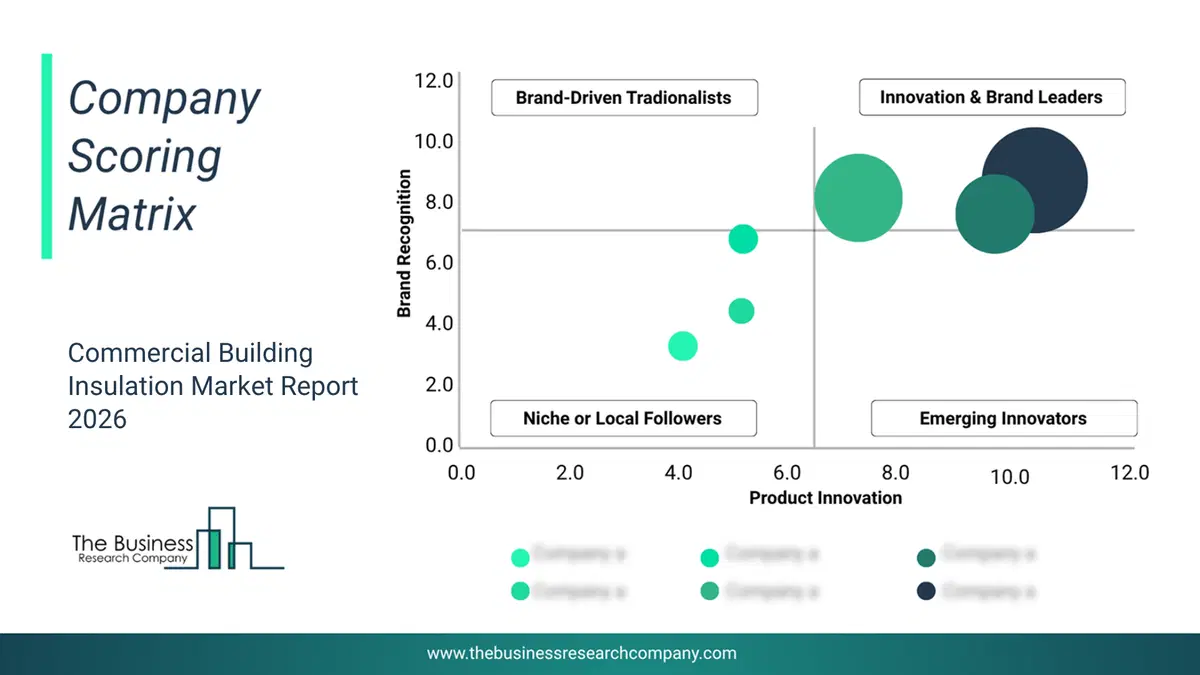
This chart maps companies by product innovation and brand strength, with bubble size indicating relative revenue, helping identify market leaders, challengers, and niche players. This is an illustrative chart; the full report provides a complete and accurate competitive analysis.
Global Commercial Building Insulation Market Trends and Insights
Major companies operating in the commercial building insulation market are focusing on developing sustainable products, such as bio-based insulation materials, to improve energy efficiency, reduce environmental impact, and meet stringent regulatory standards. Bio-based insulation materials refer to eco-friendly alternatives made from renewable resources such as plant fibers, recycled materials, or other natural components, offering superior thermal performance while minimizing carbon footprint. For instance, in November 2023, Kingspan Group, an Ireland-based building materials company, launched Hemkor, a bio-based insulation product. Hemkor is a groundbreaking rigid insulation board made from responsibly sourced bio-based materials, offering excellent thermal efficiency and fire resistance. This innovative product aligns with circular economy principles, reducing reliance on fossil fuel-derived materials while maintaining high performance in commercial building applications. Hemkor exemplifies Kingspan’s commitment to sustainability, helping construction projects achieve lower embodied carbon and enhanced energy efficiency without compromising safety or durability.What Are Latest Mergers And Acquisitions In The Commercial Building Insulation Market?
In February 2024, Compagnie de Saint-Gobain S.A., a France-based manufacturing company, acquired International Cellulose Corporation (ICC) for an undisclosed amount. With this acquisition, Saint-Gobain aims to expand its sustainable spray-on insulation offerings, enhance commercial building performance, and advance its goal of net-zero carbon emissions by 2050. International Cellulose Corporation (ICC) is a U.S.-based specialty building materials company that specializes in spray-applied insulation for commercial buildings.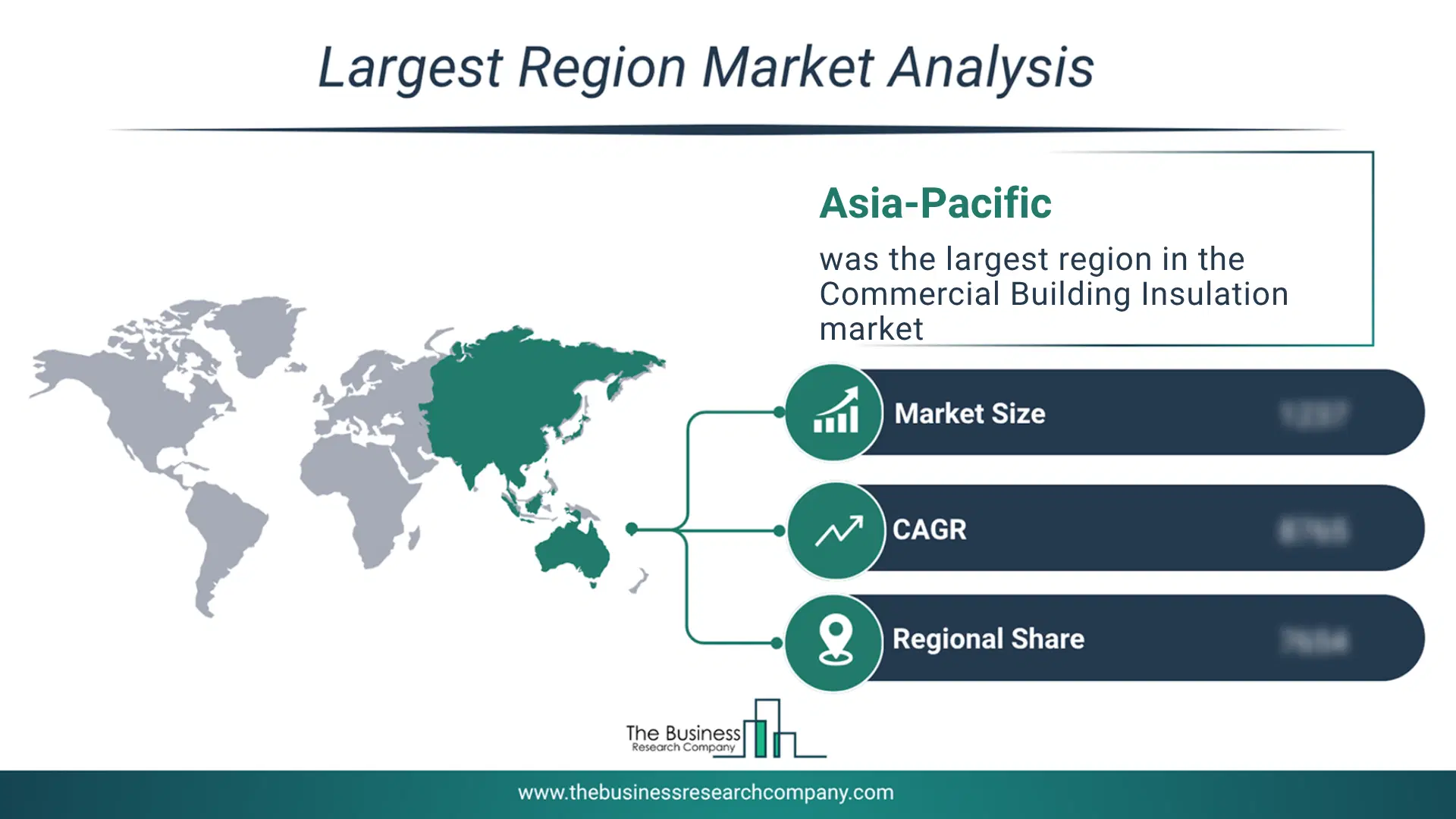
Regional Insights
Asia-Pacific was the largest region in the commercial building insulation market in 2025. The regions covered in this market report are Asia-Pacific, South East Asia, Western Europe, Eastern Europe, North America, South America, Middle East, Africa. The countries covered in this market report are Australia, Brazil, China, France, Germany, India, Indonesia, Japan, Taiwan, Russia, South Korea, UK, USA, Canada, Italy, Spain.What Defines the Commercial Building Insulation Market?
The commercial building insulation market consists of sales of structural insulated panels, spray-applied fire-resistive materials, vacuum insulated panels, vapor barriers, and reflective insulation materials. Values in this market are ‘factory gate’ values, that is, the value of goods sold by the manufacturers or creators of the goods, whether to other entities (including downstream manufacturers, wholesalers, distributors, and retailers) or directly to end customers. The value of goods in this market includes related services sold by the creators of the goods.How is Market Value Defined and Measured?
The market value is defined as the revenues that enterprises gain from the sale of goods and/or services within the specified market and geography through sales, grants, or donations in terms of the currency (in USD unless otherwise specified). The revenues for a specified geography are consumption values that are revenues generated by organizations in the specified geography within the market, irrespective of where they are produced. It does not include revenues from resales along the supply chain, either further along the supply chain or as part of other products.
This chart presents market attractiveness based on a quantitative evaluation of growth, competition, strategic alignment, and risk, offering a clear view of opportunity areas for decision-making. This chart is for illustrative purposes; the full report contains the complete analysis.

This chart highlights the Total Addressable Market (TAM) by estimating the maximum revenue opportunity using an assumption-driven approach, supporting strategic planning and opportunity sizing across markets. The chart is illustrative; the full report provides a more comprehensive analysis.
What Key Data and Analysis Are Included in theCommercial Building Insulation Market Report 2026?
The commercial building insulation market research report is one of a series of new reports from The Business Research Company that provides market statistics, including industry global market size, regional shares, competitors with the market share, detailed market segments, market trends and opportunities, and any further data you may need to thrive in the commercial building insulation industry. The market research report delivers a complete perspective of everything you need, with an in-depth analysis of the current and future state of the industry.Commercial Building Insulation Market Report Forecast Analysis
| Report Attribute | Details |
|---|---|
| Market Size Value In 2026 | $15.97 billion |
| Revenue Forecast In 2030 | $19.74 billion |
| Growth Rate | CAGR of 5.8% from 2026 to 2030 |
| Base Year For Estimation | 2025 |
| Actual Estimates/Historical Data | 2020-2025 |
| Forecast Period | 2026 - 2030 |
| Market Representation | Revenue in USD Billion and CAGR from 2026 to 2030 |
| Segments Covered | Material Type, Application, End-Use |
| Regional Scope | Asia-Pacific, Western Europe, Eastern Europe, North America, South America, Middle East, Africa |
| Country Scope | The countries covered in this market report are Australia, Brazil, China, France, Germany, India, Indonesia, Japan, Taiwan, Russia, South Korea, UK, USA, Canada, Italy, Spain |
| Key Companies Profiled | BASF SE, Dow Inc., Saint-Gobain S.A., Covestro AG, Knauf Insulation, Sika AG, Owens Corning, Kingspan Group plc, Huntsman Corporation, Etex Group, Rockwool International A/S, Alkegen, GAF Materials Corporation, CertainTeed Corporation, Johns Manville Corporation, Armacell International S.A, Atlas Roofing Corporation, Aspen Aerogels Inc., URSA Insulation S.A., Lloyd Insulations Limited, Brucha d.o.o., Bradford Insulation, Compagnie de Saint-Gobain S.A., Thermotec GmbH, Neo Thermal Insulation |
| Customization Scope | Request for Customization |
| Pricing And Purchase Options | Explore Purchase Options |