
Electric Vehicle Charger Market Report 2026
Global Outlook – By Vehicle Type ( Battery Electric Vehicle (BEV), Plug-in Hybrid Electric Vehicle (PHEV), Hybrid Electric Vehicle (HEV)), By Charging Type ( On-Board Chargers, Off-Board Chargers), By End-User ( Residential, Commercial) – Market Size, Trends, Strategies, and Forecast to 2030
Electric Vehicle Charger Market Overview
• Electric Vehicle Charger market size has reached to $14.8 billion in 2025 • Expected to grow to $47.13 billion in 2030 at a compound annual growth rate (CAGR) of 25.9% • Growth Driver: Residential Sector Expansion Fuels Growth In The Electric Vehicle Charger Market • Market Trend: Technological Advancements Shaping The Electric Vehicle Charger Market • Asia-Pacific was the largest region in 2025.Market Gains By 2030 – Top Opportunities By Segment
Market Gain identifies the most promising market opportunities by highlighting the segments or products expected to generate the highest incremental revenue growth over the next five years.
What Is Covered Under Electric Vehicle Charger Market?
An electric vehicle charger is defined as a charger that delivers energy to the vehicle battery system per unit of time. It is a part of electric vehicle supply equipment that provides electrical power to plug-in electric automobiles. The main types of vehicles in electric vehicle chargers are battery electric vehicles (BEV), plug-in hybrid electric vehicles (PHEV), and hybrid electric vehicles (HEV). Battery electric vehicles employ an electric motor instead of an internal combustion engine. Battery electric vehicles use a traction battery pack to power the electric motor that needs to be plugged into the charging outlet. The different charging types include on-board chargers, off-board chargers and are used in various end-use sectors such as residential, and commercial.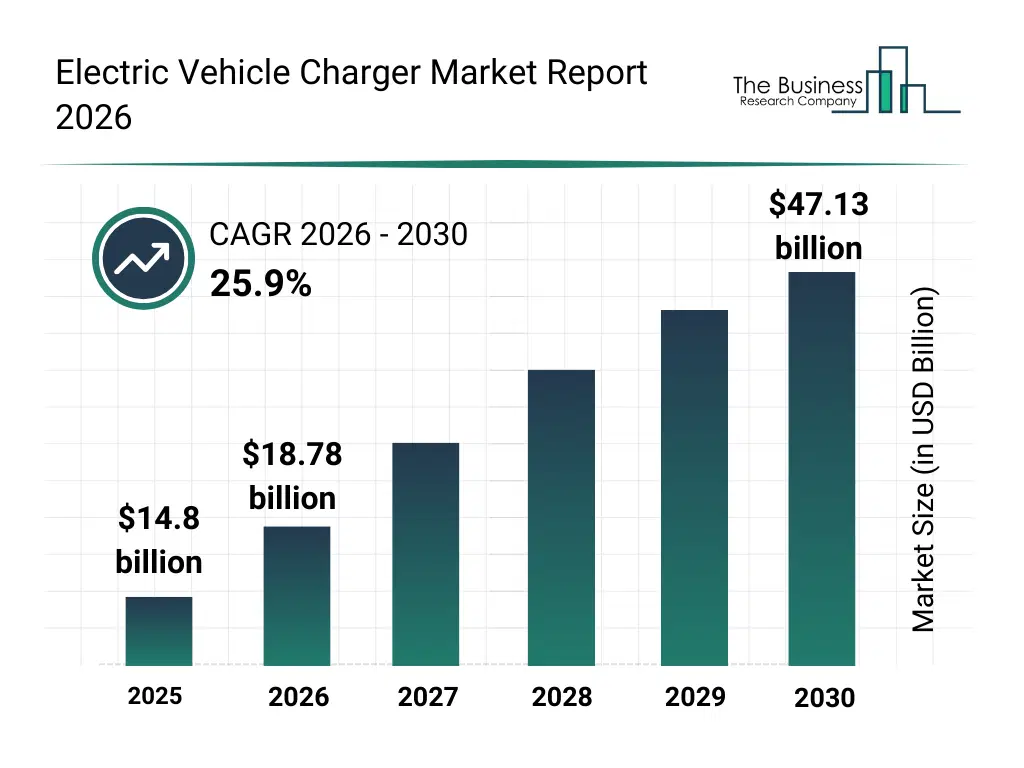
What Is The Electric Vehicle Charger Market Size 2026 And Growth Rate?
The electric vehicle charger market size has grown exponentially in recent years. It will grow from $14.8 billion in 2025 to $18.78 billion in 2026 at a compound annual growth rate (CAGR) of 27.0%. The growth in the historic period can be attributed to rise in residential EV charger installations, increase in commercial charging station deployment, adoption in public fast and ultra-fast charging networks, growth in BEV, PHEV, and HEV adoption, expansion of on-board and off-board charger utilization.What Is The Electric Vehicle Charger Market Growth Forecast?
The electric vehicle charger market size is expected to see exponential growth in the next few years. It will grow to $47.13 billion in 2030 at a compound annual growth rate (CAGR) of 25.9%. The growth in the forecast period can be attributed to increase in ultra-fast charging infrastructure, rising deployment of DC fast chargers, growth in smart network management and IoT-enabled monitoring, expansion in commercial and residential charging solutions, increase in EV fleet charging solutions. Major trends in the forecast period include integration of AI-based ev chargers, deployment of smart charging networks, adoption of fast dc and ultra-fast chargers, implementation of IoT-enabled charging management, expansion of residential and commercial ev charging solutions.
Global Electric Vehicle Charger Market Segmentation
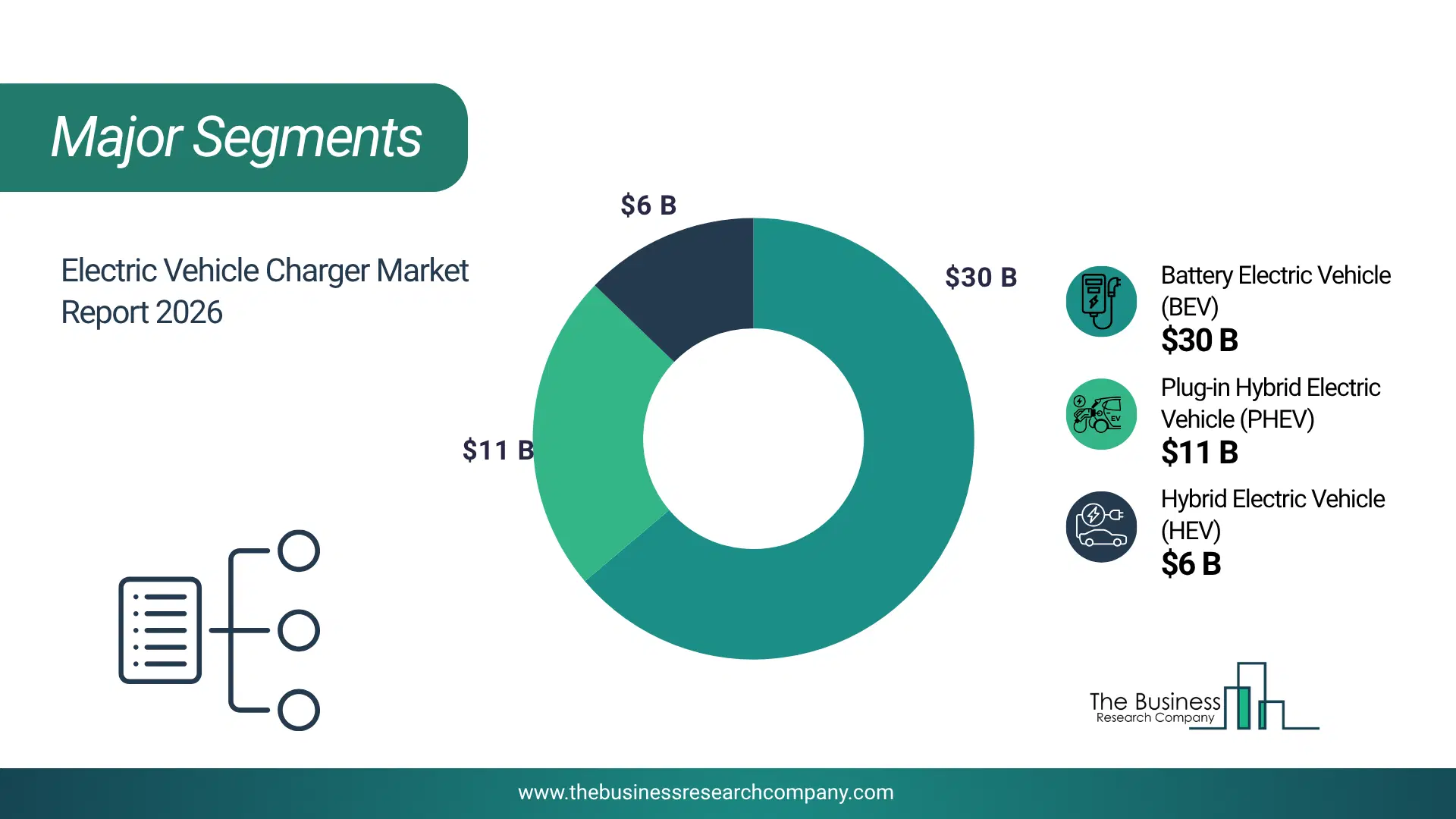
1) By Vehicle Type: Battery Electric Vehicle (BEV), Plug-in Hybrid Electric Vehicle (PHEV), Hybrid Electric Vehicle (HEV) 2) By Charging Type: On-Board Chargers, Off-Board Chargers 3) By End-User: Residential, Commercial Subsegments: 1) By Battery Electric Vehicle (BEV): Residential Charging Stations, Public Fast Charging Stations, Ultra-Fast Charging Stations 2) By Plug-in Hybrid Electric Vehicle (PHEV): Level 1 Chargers, Level 2 Chargers, Fast Chargers 3) By Hybrid Electric Vehicle (HEV): Level 1 Chargers, Specialized Charging Stations for HEVs The top segments in the electric vehicle charger market will be: • Battery Electric Vehicle (BEV) will reach $30.25 Billion by 2030. • Plug-in Hybrid Electric Vehicle (PHEV) will reach $10.54 Billion by 2030. • Hybrid Electric Vehicle (HEV) will reach $6.1 Billion by 2030.What Is The Driver Of The Electric Vehicle Charger Market?
The increasing residential sector is expected to propel the growth of the electric vehicle charger market going forward. The residential sector, often referred to as the housing sector, is a key segment of the economy and society that encompasses the housing and living arrangements of individuals, families, and households. Electric vehicle (EV) chargers in the residential sector offer convenience, cost savings, and environmental benefits, efficiency, lifespan, and safety. For instance, in October 2023, according to the United States Census Bureau, a US-based principal agency of the federal statistical system, the number of privately owned housing units approved by building permits in February was 1,524,000 on a seasonally adjusted yearly basis. This is 13.8% more than the January rate, which was corrected to 1,339,000. Therefore, the increasing residential sector is driving the growth of the electric vehicle charger industry.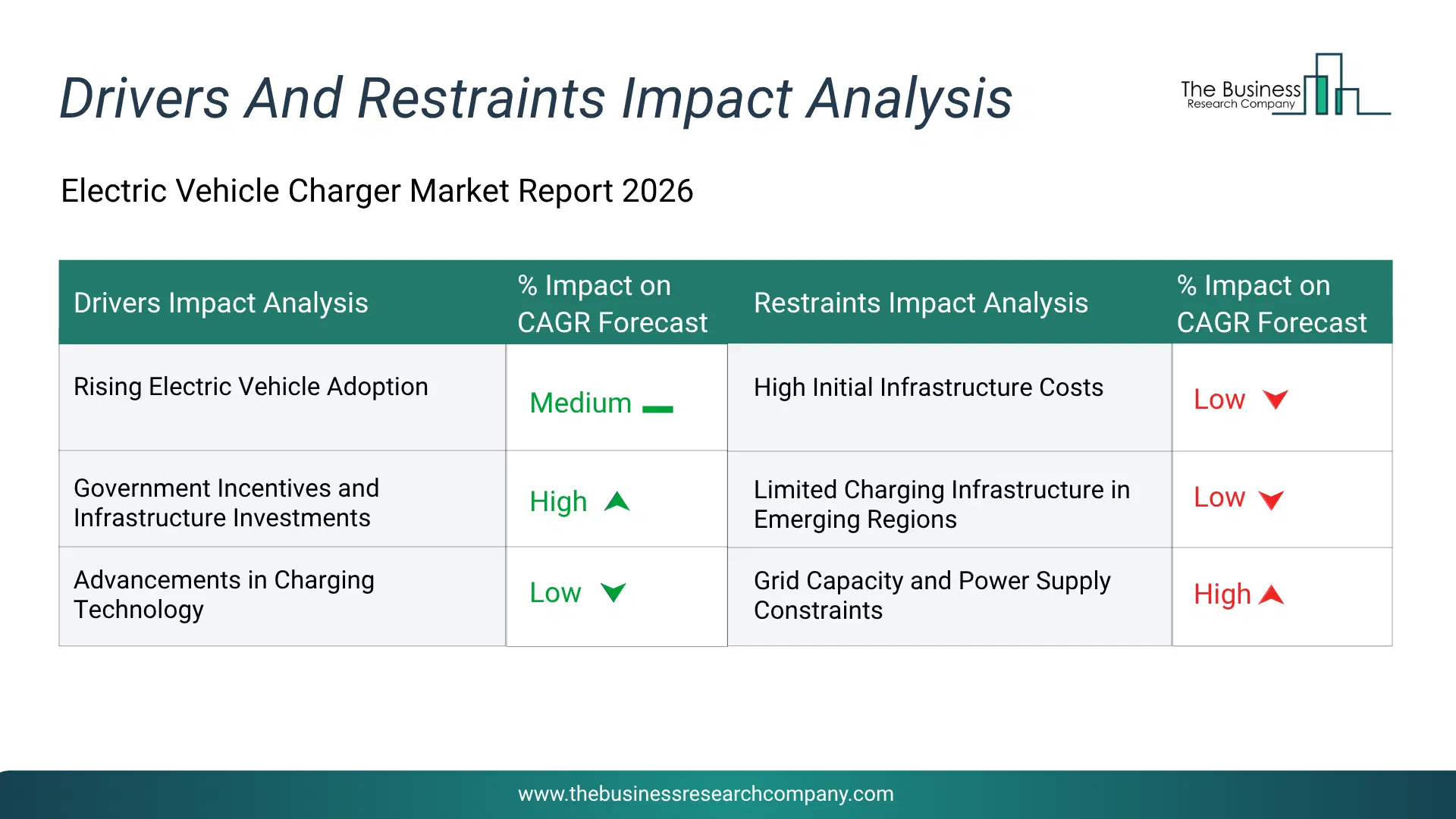
Infographic Chart Showing Key Market Drivers Analysis And Restraints For Electric Vehicle Charger Market
The chart presents an impact analysis of key drivers and restraints, quantifying their relative influence on the market's growth rate and helping assess the balance between growth enablers and limiting factors. This chart offers a high-level perspective; the full report contains more detailed insights.
How Will The Drivers Impact Growth In The Global Electric Vehicle Charger Market?
• Rising Electric Vehicle Adoption (Medium) – During the forecast period, rapid technological advancements are expected to become a key growth driver for the electric vehicle charger market by 2030. Continuous innovation in high-power charging systems, semiconductor components such as silicon carbide (SiC) and gallium nitride (GaN), and intelligent charging software is enabling faster, more efficient, and reliable charging solutions. The evolution of ultra-fast DC chargers and wireless charging technologies is reducing charging time and enhancing user convenience. Manufacturers are also focusing on modular and scalable charger designs to support future capacity expansion. This ongoing technological progress is strengthening the overall charging ecosystem and accelerating infrastructure rollout. • Government Incentives and Infrastructure Investments (High) – During the forecast period, the increasing focus on electric vehicles (EVs) is expected to emerge as a major factor driving the expansion of the electric vehicle charger market by 2030. Automakers are significantly expanding their EV portfolios across passenger and commercial vehicle segments, creating a strong parallel demand for reliable and widespread charging infrastructure. The shift toward electrified mobility is encouraging investments in both public and private charging networks, including workplace and destination charging solutions. Additionally, strategic collaborations between automakers, utilities, and charging providers are accelerating infrastructure development. • Advancements in Charging Technology (Low) – During the forecast period, the rising demand for motor vehicles is expected to act as a key growth catalyst for the electric vehicle charger market by 2030. Increasing vehicle ownership, particularly in emerging economies, is expanding the overall addressable market for electric mobility and associated charging infrastructure. As consumers transition toward electrified powertrains, the need for accessible and efficient charging solutions is increasing across urban and semi-urban areas. Automotive manufacturers are also integrating charging solutions with vehicle sales, further supporting infrastructure growth.How Will The Restraints Impact Growth In The Global Electric Vehicle Charger Market?
• High Initial Infrastructure Costs (Medium) – During the forecast period, high initial infrastructure costs are significantly restricting the growth of the electric vehicle charger market. Substantial capital requirements for installation, grid upgrades, equipment procurement, and land acquisition are limiting large-scale deployment, particularly for private operators and developing regions. • Limited Charging Infrastructure in Emerging Regions (High) – During the forecast period, limited charging infrastructure in emerging regions is significantly restricting the growth of the electric vehicle charger market. Inadequate network density, lack of public charging stations, and slow infrastructure development are hindering EV adoption and limiting market expansion in these regions. • Grid Capacity and Power Supply Constraints (Low) – During the forecast period, grid capacity and power supply constraints are significantly restricting the growth of the electric vehicle charger market. Increasing electricity demand from EV charging stations is placing pressure on existing grid infrastructure, leading to stability concerns, load management issues, and slower expansion of high-capacity charging networks.Key Players In The Global Electric Vehicle Charger Market
Major companies operating in the electric vehicle charger market are ABB Group, AeroVironment Inc., ChargePoint Inc., BP Chargemaster, Evatran Group Inc., Leviton Manufacturing Co. Inc., Webasto SE, Eaton Corporation plc, Schneider Electric SE, Siemens AG, Électricité de France S.A. (EDF), POD Point Ltd., IES Synergy, Efacec Power Solutions S.A., HyundAI Motor Company, Alfen N.V., Allego B.V., ClipperCreek Inc., Continental AG, Magna International Inc., SemaConnect Inc., TGOOD Global Ltd., ZF Friedrichshafen AG, Robert Bosch GmbH, Delta Electronics Inc., Cyber Switching Inc., Tesla Inc., EVgo Services LLC, Electrify America LLC, Blink Charging Co., Tritium Pty Ltd., Enel X, Wallbox Chargers S.L., EVBox Group, BorgWarner Inc.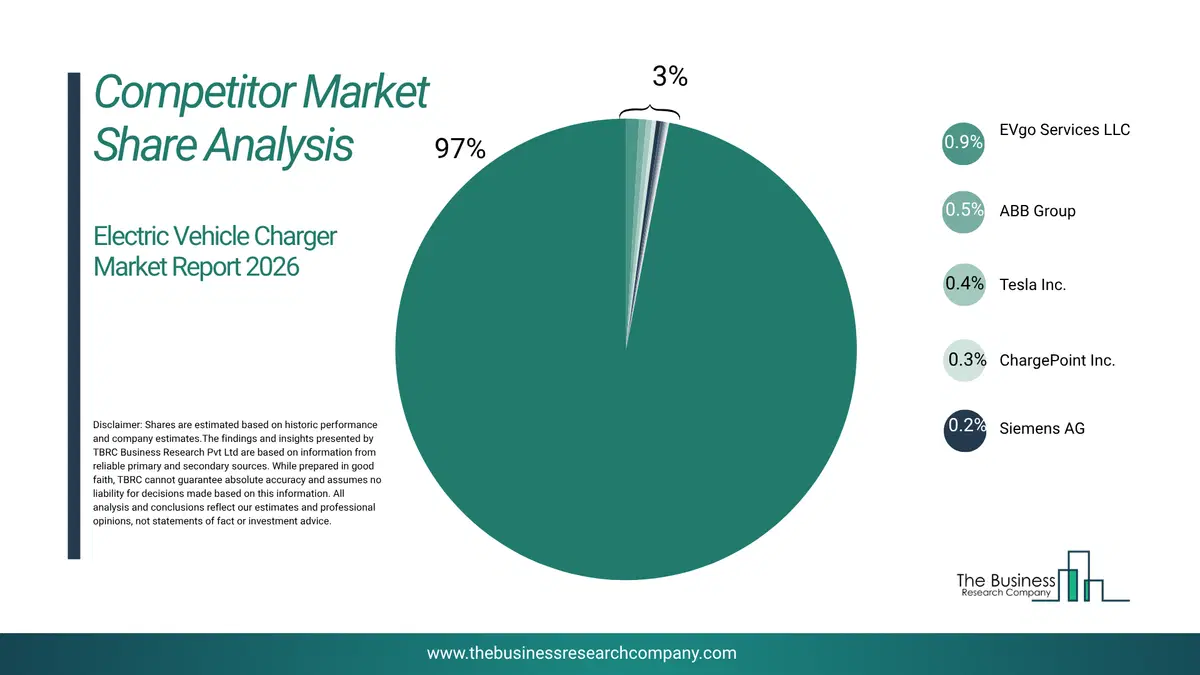
This chart is for illustrative purposes; the full report includes a detailed competitor analysis and comprehensive overview of the top 10 companies in the market.
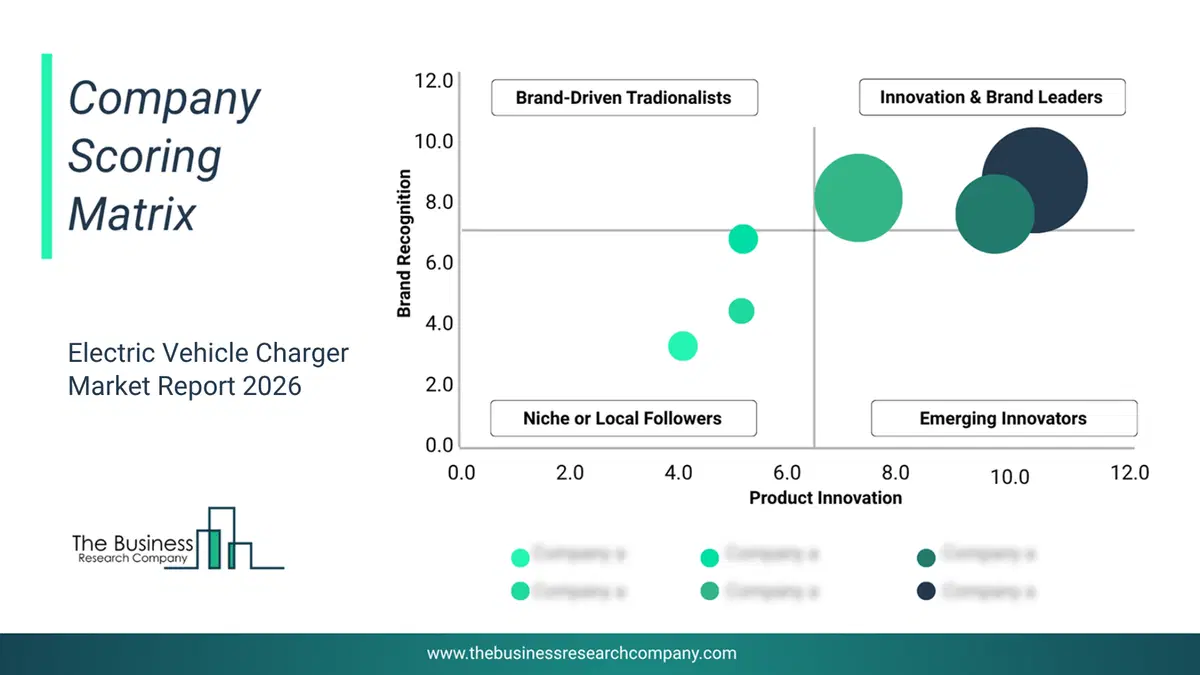
This chart maps companies by product innovation and brand strength, with bubble size indicating relative revenue, helping identify market leaders, challengers, and niche players. This is an illustrative chart; the full report provides a complete and accurate competitive analysis.
Global Electric Vehicle Charger Market Trends and Insights
Major companies operating in the electric vehicle charger market are focusing on developing technologically advanced solutions, such as the Fastest DC Charger, to enhance the electric vehicle (EV) charging experience. Fastest DC charger refers to a type of electric vehicle (EV) charging station that utilizes direct current (DC) to deliver high power levels, enabling rapid charging of electric vehicle batteries. For instance, in May 2024, Exicom Tele-Systems Ltd., an India-based EV charging provider, introduced Harmony Gen 1.5, a high-performance DC fast charger designed for electric vehicles. DC charger, to address the growing demand for efficient and user-friendly EV charging solutions. to meet the surging demand for efficient and user-friendly EV charging solutions amidst the rapid growth of the electric vehicle market. Designed with a modular construction that supports power outputs from 60 kW to 400 kW, it caters to various vehicles while boasting an efficiency rating exceeding 95%.What Are Latest Mergers And Acquisitions In The Electric Vehicle Charger Market?
In August 2024, Exicom Tele-Systems Ltd, an India-based company offering eco-friendly EV charging and critical power systems for homes and businesses, acquired Tritium for USD 37 million. This acquisition aligns with Exicom's vision of contributing to a sustainable future by enhancing EV infrastructure and charging solutions globally. Tritium is an Australian-based company that designs and manufactures patented hardware and software for creating DC fast chargers for electric vehicles.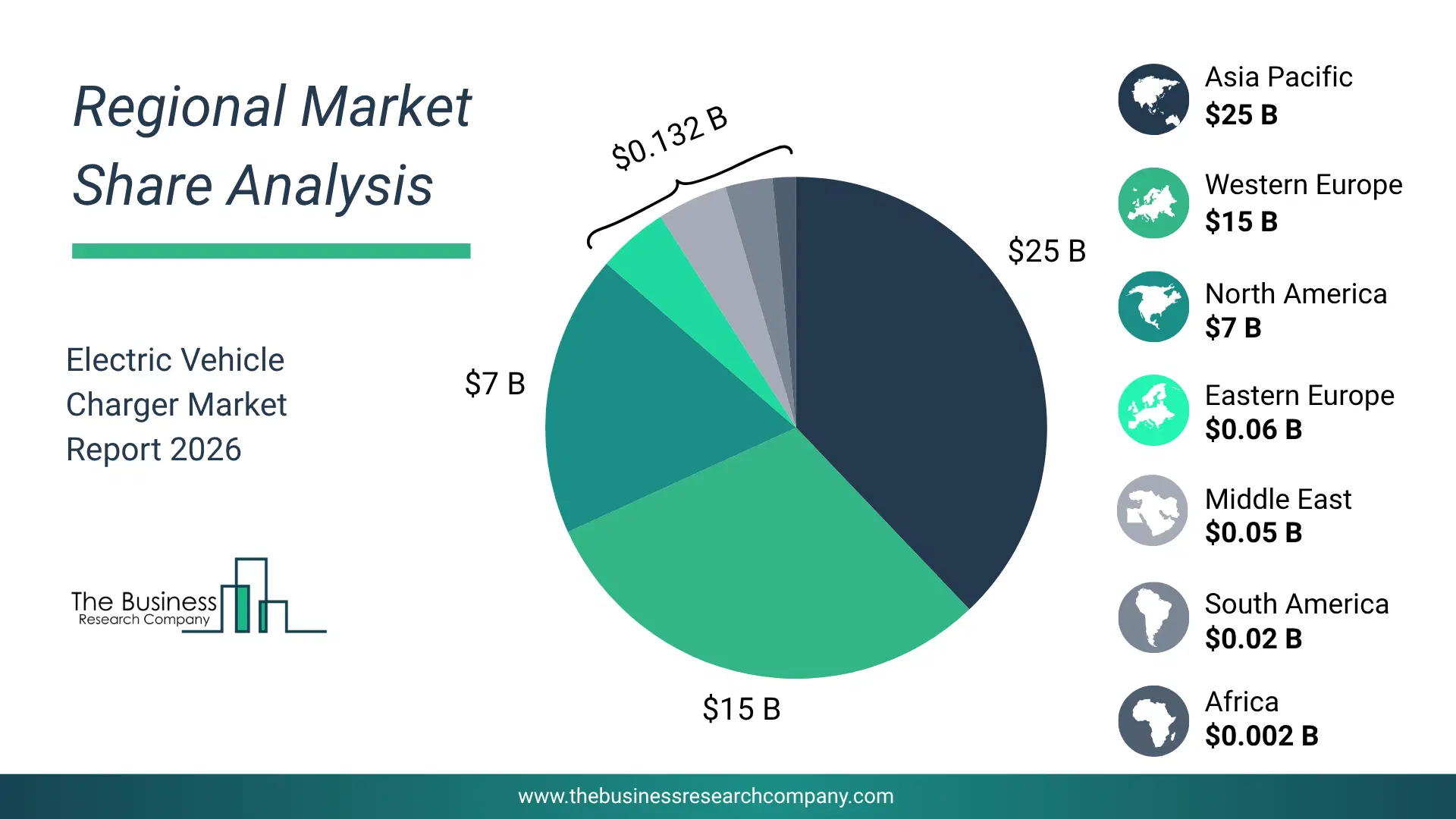
Regional Outlook
Asia-Pacific was the largest region in the electric vehicle charger market in 2025. The regions covered in this market report are Asia-Pacific, South East Asia, Western Europe, Eastern Europe, North America, South America, Middle East, Africa. The countries covered in this market report are Australia, Brazil, China, France, Germany, India, Indonesia, Japan, Taiwan, Russia, South Korea, UK, USA, Canada, Italy, Spain.What Defines the Electric Vehicle Charger Market?
The electric vehicle charger market consists of sales of on-board electric vehicle chargers and off-board electric vehicle chargers. Values in this market are ‘factory gate’ values, that is the value of goods sold by the manufacturers or creators of the goods, whether to other entities (including downstream manufacturers, wholesalers, distributors and retailers) or directly to end customers. The value of goods in this market includes related services sold by the creators of the goods.How is Market Value Defined and Measured?
The market value is defined as the revenues that enterprises gain from the sale of goods and/or services within the specified market and geography through sales, grants, or donations in terms of the currency (in USD unless otherwise specified). The revenues for a specified geography are consumption values that are revenues generated by organizations in the specified geography within the market, irrespective of where they are produced. It does not include revenues from resales along the supply chain, either further along the supply chain or as part of other products.
This chart presents market attractiveness based on a quantitative evaluation of growth, competition, strategic alignment, and risk, offering a clear view of opportunity areas for decision-making. This chart is for illustrative purposes; the full report contains the complete analysis.

This chart highlights the Total Addressable Market (TAM) by estimating the maximum revenue opportunity using an assumption-driven approach, supporting strategic planning and opportunity sizing across markets. The chart is illustrative; the full report provides a more comprehensive analysis.
What Key Data and Analysis Are Included in the Electric Vehicle Charger Market Report 2026?
The electric vehicle charger market research report is one of a series of new reports from The Business Research Company that provides market statistics, including industry global market size, regional shares, competitors with the market share, detailed market segments, market trends and opportunities, and any further data you may need to thrive in the electric vehicle charger industry. The market research report delivers a complete perspective of everything you need, with an in-depth analysis of the current and future state of the industry.Electric Vehicle Charger Market Report Forecast Analysis Market Report Forecast Analysis
| Report Attribute | Details |
|---|---|
| Market Size Value In 2026 | $18.78 billion |
| Revenue Forecast In 2030 | $47.13 billion |
| Growth Rate | CAGR of 27.0% from 2026 to 2030 |
| Base Year For Estimation | 2025 |
| Actual Estimates/Historical Data | 2020-2025 |
| Forecast Period | 2026 - 2030 |
| Market Representation | Revenue in USD Billion and CAGR from 2026 to 2030 |
| Segments Covered | Vehicle Type, Charging Type, End-User |
| Regional Scope | Asia-Pacific, Western Europe, Eastern Europe, North America, South America, Middle East, Africa |
| Country Scope | The countries covered in the report are Australia, Brazil, China, France, Germany, India, Indonesia, Japan, Taiwan, Russia, South Korea, UK, USA, Canada, Italy, Spain. |
| Key Companies Profiled | ABB Group, AeroVironment Inc., ChargePoint Inc., BP Chargemaster, Evatran Group Inc., Leviton Manufacturing Co. Inc., Webasto SE, Eaton Corporation plc, Schneider Electric SE, Siemens AG, Électricité de France S.A. (EDF), POD Point Ltd., IES Synergy, Efacec Power Solutions S.A., HyundAI Motor Company, Alfen N.V., Allego B.V., ClipperCreek Inc., Continental AG, Magna International Inc., SemaConnect Inc., TGOOD Global Ltd., ZF Friedrichshafen AG, Robert Bosch GmbH, Delta Electronics Inc., Cyber Switching Inc., Tesla Inc., EVgo Services LLC, Electrify America LLC, Blink Charging Co., Tritium Pty Ltd., Enel X, Wallbox Chargers S.L., EVBox Group, BorgWarner Inc. |
| Customization Scope | Request for Customization |
| Pricing And Purchase Options | Explore Purchase Options |