
Electric Vehicle Power Electronics Market Report 2026
Global Outlook – By Component (Microcontroller, Sensor ), By Device Type (Power Integrated Circuit (IC), Direct Component, Module), By Material (Silicon, Silicon Carbide, Gallium Nitride), By Electric Vehicle (Battery Electric Vehicle, Plug-In Hybrid Electric Vehicle, Hybrid Electric Vehicle, Fuel Cell Electric Vehicle), By Application (Advanced Driver Assistance Systems (ADAS) And Safety, Engine Management And Powertrain, Battery Management) – Market Size, Trends, Strategies, and Forecast to 2030
Electric Vehicle Power Electronics Market Overview
• Electric Vehicle Power Electronics market size has reached to $16.52 billion in 2025 • Expected to grow to $64.99 billion in 2030 at a compound annual growth rate (CAGR) of 31.4% • Growth Driver: Government Initiatives Driving Growth In The Electric Vehicle Power Electronics Market • Market Trend: Innovative Semiconductor Technology Enhances High-Power Vehicle Performance • Asia-Pacific was the largest region in 2025.What Is Covered Under Electric Vehicle Power Electronics Market?
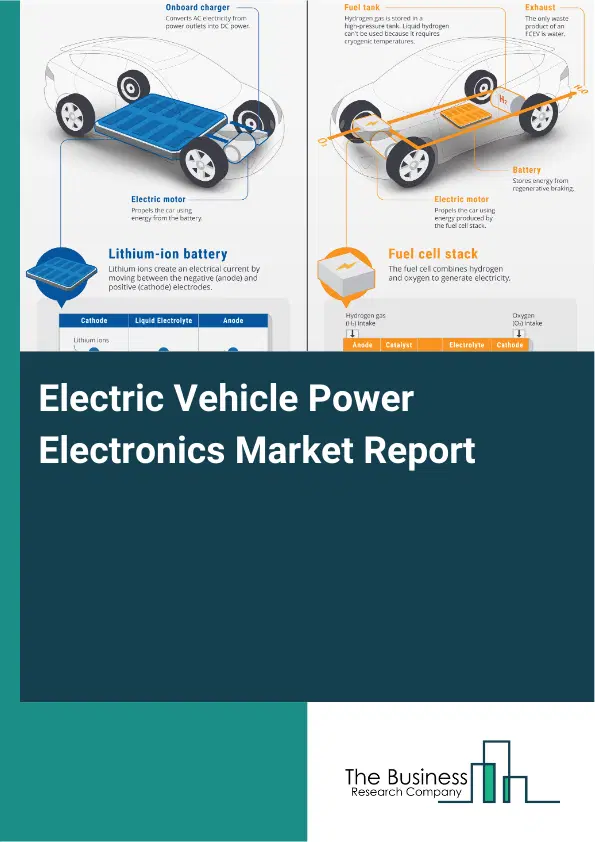
Electric vehicle power electronics refer to the components and systems responsible for controlling and managing electrical energy within an electric vehicle. Power electronics play a critical role in optimizing energy usage, enhancing vehicle performance, and supporting the overall functionality of electric vehicles. The main forms of electric vehicle power electronics are microcontrollers and sensors. A microcontroller is a compact integrated circuit that contains a processor core, memory (both volatile RAM and non-volatile ROM or Flash memory), and programmable input and output peripherals. These can be used on various devices, such as power integrated circuits (IC), direct components, and modules. Materials used are silicon, silicon carbide, gallium nitride, gallium arsenide, germanium, and others and can be used in battery electric vehicles, plug in hybrid electric vehicles, hybrid electric vehicles, and fuel cell electric vehicles. These are used for a variety of applications, such as advanced driver assistance systems (ADAS) and safety, body control and comfort, infotainment, telematics, engine management and powertrain, and battery management.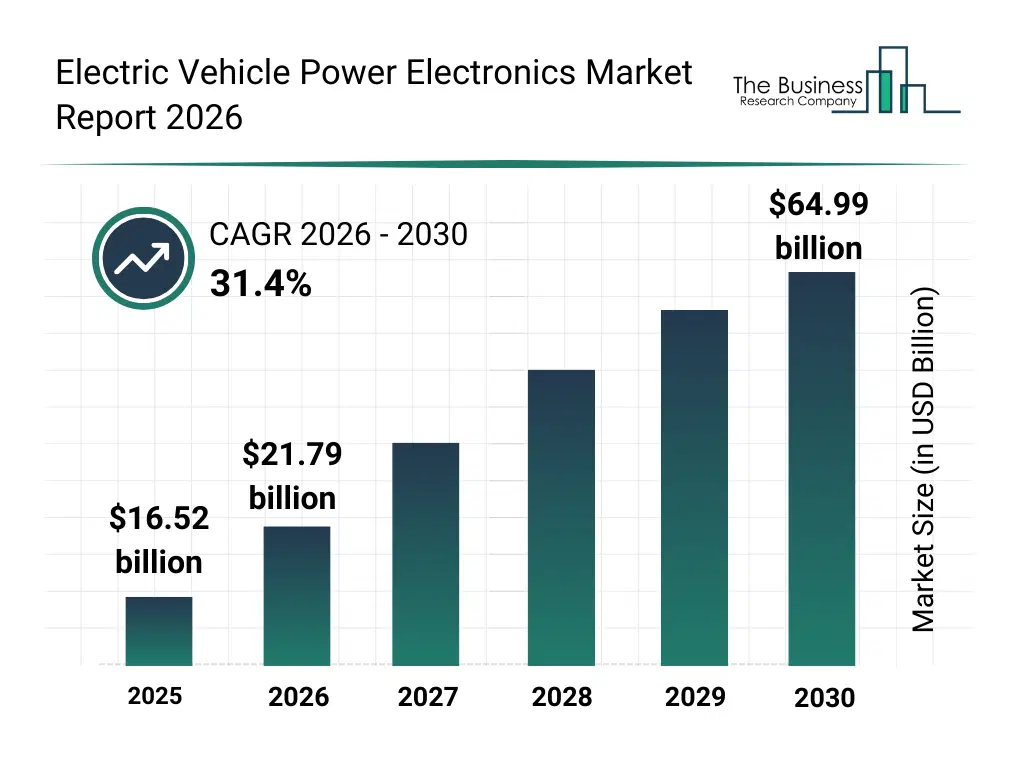
What Is The Electric Vehicle Power Electronics Market Size and Share 2026?
The electric vehicle power electronics market size has grown exponentially in recent years. It will grow from $16.52 billion in 2025 to $21.79 billion in 2026 at a compound annual growth rate (CAGR) of 31.9%. The growth in the historic period can be attributed to ev electrification growth, semiconductor advancements, need for efficient energy control, power density improvements, automotive electronics integration.What Is The Electric Vehicle Power Electronics Market Growth Forecast?
The electric vehicle power electronics market size is expected to see exponential growth in the next few years. It will grow to $64.99 billion in 2030 at a compound annual growth rate (CAGR) of 31.4%. The growth in the forecast period can be attributed to wide bandgap semiconductor adoption, higher voltage ev architectures, fast charging demand, smart power management, autonomous driving electronics. Major trends in the forecast period include adoption of silicon carbide power devices, integration of advanced battery management systems, growth of modular power electronics, demand for high-efficiency inverters, expansion of adas power electronics.
Global Electric Vehicle Power Electronics Market Segmentation
1) By Component: Microcontroller, Sensor 2) By Device Type: Power Integrated Circuit (IC), Direct Component, Module 3) By Material: Silicon, Silicon Carbide, Gallium Nitride 4) By Electric Vehicle: Battery Electric Vehicle, Plug-In Hybrid Electric Vehicle, Hybrid Electric Vehicle, Fuel Cell Electric Vehicle 5) By Application: Advanced Driver Assistance Systems (ADAS) And Safety, Engine Management And Powertrain, Battery Management Subsegments: 1) By Microcontroller: Digital Signal Processors (DSP), Application-Specific Integrated Circuits (ASIC), Embedded Microcontrollers (MCUs) 2) By Sensor: Current Sensors, Voltage Sensors, Temperature SensorsWhat Is The Driver Of The Electric Vehicle Power Electronics Market?
The government's initiative to balance environmental pollution is expected to propel the growth of the electric vehicle power electronic market going forward. The government initiative for balancing pollution refers to forces that protect environment and the conservation of natural resources with other policy goals, such as affordable energy and economic growth. Government initiatives helps in mitigating environmental pollution by promoting research and regulations aimed at enhancing the efficiency and sustainability of power electronic systems in electric vehicles. For instance, in March 2023, according to the European Union Council, a Belgium-based government body, the Fit for 55 regulation was formally adopted, setting a target that all new cars and vans sold in the EU become zero‑emission by 2035, with intermediate CO₂ emission reduction targets of 55% for cars and 50% for vans by 2030 compared with 2021 levels. Therefore, the government initiative to balance environmental pollution is driving the growth of the electric vehicle power electronic industry.Key Players In The Global Electric Vehicle Power Electronics Market
Major companies operating in the electric vehicle power electronics market report include Robert Bosch GmbH, Tesla Inc., Siemens AG, Hitachi Automotive Systems Ltd., Denso Corporation, Continental AG, Hyundai Kefico Corporation, Mitsubishi Electric Corporation, Asea Brown Boveri Groups, Toshiba Corporation, Toyota Industries Corporation, Valeo Corporation, Texas Instruments, Infineon Technologies AG, NXP Semi Conductors, Renesas Electronics, OnSemi, Microchip Technology, Vishay Intertechnology, Danfoss Corporation, Fuji Electronic Co. Ltd., Delphi Technologies, Hangzhou Tiecheng Information Technology , Electrodrive Powertrain Solution Pvt. Ltd
This chart is for illustrative purposes; the full report includes a detailed competitor analysis and comprehensive overview of the top 10 companies in the market.
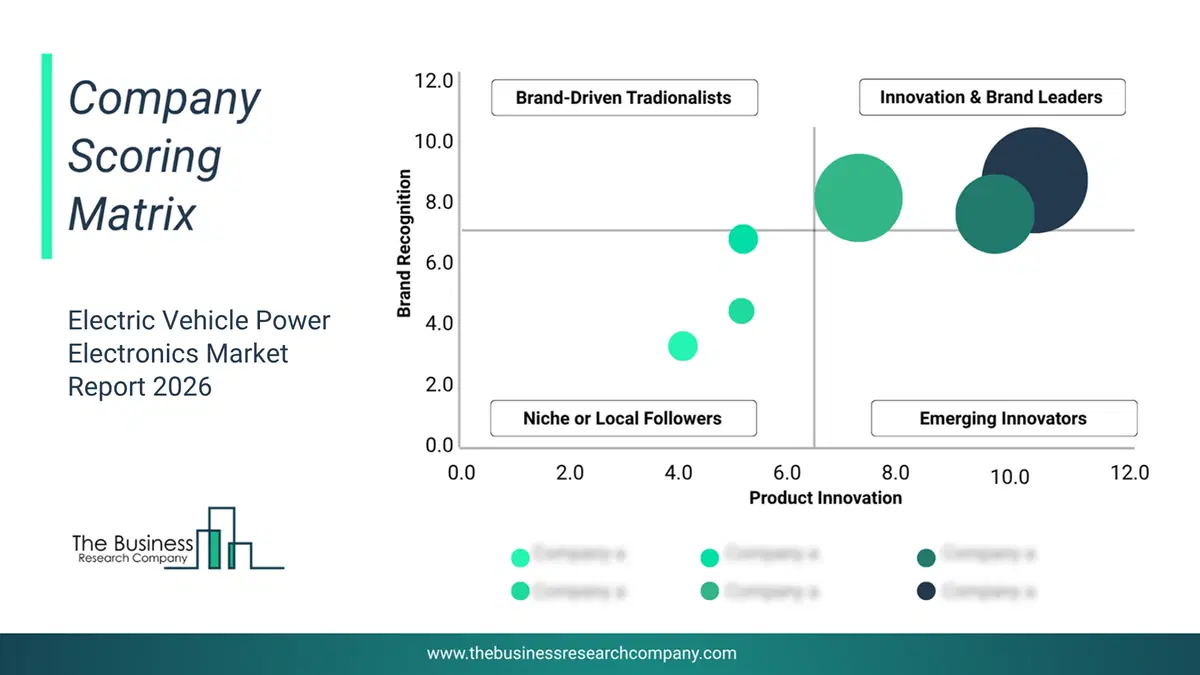
This chart maps companies by product innovation and brand strength, with bubble size indicating relative revenue, helping identify market leaders, challengers, and niche players. This is an illustrative chart; the full report provides a complete and accurate competitive analysis.
Global Electric Vehicle Power Electronics Market Trends and Insights
Major companies operating in the electric vehicle power electronic market are focusing on developing advanced power semiconductor solutions, such as high-voltage SiC modules, to enhance vehicle efficiency, reliability, and overall performance. High-voltage SiC modules integrate multiple semiconductor components into a single package, enabling improved power density, reduced energy losses, and extended component lifetime in electric drivetrains. For instance, in November 2025, Wolfspeed Inc., a US-based semiconductor company, launched its 1200 V SiC six-pack power modules. These modules combine advanced Gen 4 SiC MOSFET technology with innovative packaging, delivering three times more power cycling capability at operating temperature and 15% higher inverter current capability compared to competing solutions. Designed for high-power EV applications, including heavy-duty and industrial vehicles, the modules improve energy efficiency, extend operational life, and reduce maintenance costs for fleet operators and OEMs.What Are Latest Mergers And Acquisitions In The Electric Vehicle Power Electronics Market?
In December 2023., Hitachi Energy, a Japan-based technology company, acquired COET S.r.l. for an undisclosed amount. The acquisition enhances Hitachi Energy's global position and expands its portfolio in high-power electric vehicle charging infrastructure, power electronics, and grid-edge solutions. COET S.r.l. is an Italy-based company that specializes in the design and manufacture of power equipment for electric mobility, rail, and industry.
Regional Outlook
Asia-Pacific was the largest region in the electric vehicle power electronics market in 2025. The regions covered in this market report include Asia-Pacific, South East Asia, Western Europe, Eastern Europe, North America, South America, Middle East, Africa. The countries covered in this market report include Australia, Brazil, China, France, Germany, India, Indonesia, Japan, Taiwan, Russia, South Korea, UK, USA, Canada, Italy, SpainWhat Defines the Electric Vehicle Power Electronics Market?
The electric vehicle power electronics market consists of sales of wide-bandgap (WBG) semiconductors, automotive inverters, onboard chargers, electric motor controllers, and heat exchangers. Values in this market are ‘factory gate’ values, that is the value of goods sold by the manufacturers or creators of the goods, whether to other entities (including downstream manufacturers, wholesalers, distributors and retailers) or directly to end customers. The value of goods in this market includes related services sold by the creators of the goods.How is Market Value Defined and Measured?
The market value is defined as the revenues that enterprises gain from the sale of goods and/or services within the specified market and geography through sales, grants, or donations in terms of the currency (in USD unless otherwise specified). The revenues for a specified geography are consumption values that are revenues generated by organizations in the specified geography within the market, irrespective of where they are produced. It does not include revenues from resales along the supply chain, either further along the supply chain or as part of other products.
This chart presents market attractiveness based on a quantitative evaluation of growth, competition, strategic alignment, and risk, offering a clear view of opportunity areas for decision-making. This chart is for illustrative purposes; the full report contains the complete analysis.

This chart highlights the Total Addressable Market (TAM) by estimating the maximum revenue opportunity using an assumption-driven approach, supporting strategic planning and opportunity sizing across markets. The chart is illustrative; the full report provides a more comprehensive analysis.
What Key Data and Analysis Are Included in the Electric Vehicle Power Electronics Market Report 2026?
The electric vehicle power electronics market research report is one of a series of new reports from The Business Research Company that provides market statistics, including industry global market size, regional shares, competitors with the market share, detailed market segments, market trends and opportunities, and any further data you may need to thrive in the electric vehicle power electronics industry. The market research report delivers a complete perspective of everything you need, with an in-depth analysis of the current and future state of the industry.Electric Vehicle Power Electronics Market Report Forecast Analysis
| Report Attribute | Details |
|---|---|
| Market Size Value In 2026 | $21.79 billion |
| Revenue Forecast In 2030 | $64.99 billion |
| Growth Rate | CAGR of 31.9% from 2026 to 2030 |
| Base Year For Estimation | 2025 |
| Actual Estimates/Historical Data | 2020-2025 |
| Forecast Period | 2026 - 2030 - 2030 |
| Market Representation | Revenue in USD Billion and CAGR from 2026 to 2030 |
| Segments Covered | Component, Device Type, Material, Electric Vehicle, Application |
| Regional Scope | Asia-Pacific, Western Europe, Eastern Europe, North America, South America, Middle East, Africa |
| Country Scope | The countries covered in the report are Australia, Brazil, China, France, Germany, India, Indonesia, Japan, Taiwan, Russia, South Korea, UK, USA, Canada, Italy, Spain. |
| Key Companies Profiled | Robert Bosch GmbH, Tesla Inc., Siemens AG, Hitachi Automotive Systems Ltd., Denso Corporation, Continental AG, Hyundai Kefico Corporation, Mitsubishi Electric Corporation, Asea Brown Boveri Groups, Toshiba Corporation, Toyota Industries Corporation, Valeo Corporation, Texas Instruments, Infineon Technologies AG, NXP Semi Conductors, Renesas Electronics, OnSemi, Microchip Technology, Vishay Intertechnology, Danfoss Corporation, Fuji Electronic Co. Ltd., Delphi Technologies, Hangzhou Tiecheng Information Technology , Electrodrive Powertrain Solution Pvt. Ltd |
| Customization Scope | Request for Customization |
| Pricing And Purchase Options | Explore Purchase Options |