
Factory Simulation Software Market Report 2026
Global Outlook – By Software (Three-Dimensional (3D) Simulation Software, Two-Dimensional (2D) Simulation Software), By Deployment (On-Premises, Cloud-Based), By Application (Manufacturing, Supply Chain Management, Transportation, Robotics, Healthcare) – Market Size, Trends, Strategies, and Forecast to 2030
Factory Simulation Software Market Overview
• Factory Simulation Software market size has reached to $13.3 billion in 2025 • Expected to grow to $23.54 billion in 2030 at a compound annual growth rate (CAGR) of 12% • Growth Driver: Increasing Demand For Automation Fueling The Growth Of The Market Due To Increasing Efficiency And Cost Reduction • Market Trend: Predictive Simulation Tool Enhances Production Efficiency And Cost Reduction • North America was the largest region in 2025 and Asia-Pacific is the fastest growing region.What Is Covered Under Factory Simulation Software Market?
Factory simulation software is a digital tool that models analyzes, and optimizes manufacturing processes within a virtual factory environment. It allows users to simulate production lines, workflows, equipment performance, and resource allocation to identify inefficiencies, test changes, and improve overall productivity without disrupting real-world operations. The main deployments of factory simulation software are on-premises and cloud-based. On-premises refers to software or hardware that is installed and operated within a company's own physical location, rather than being hosted remotely or in the cloud. This includes software such as 3D simulation software and 2D simulation software, which are applicable across various industries, such as manufacturing, supply chain management, transportation, robotics, and healthcare.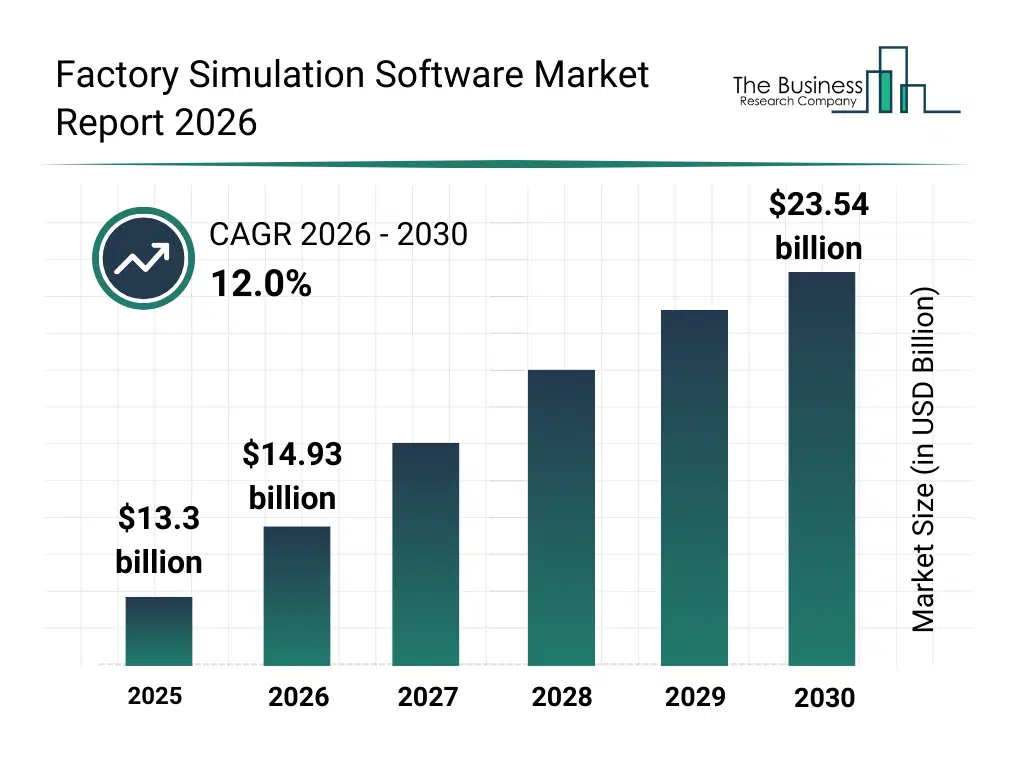
What Is The Factory Simulation Software Market Size and Share 2026?
The factory simulation software market size has grown rapidly in recent years. It will grow from $13.3 billion in 2025 to $14.93 billion in 2026 at a compound annual growth rate (CAGR) of 12.3%. The growth in the historic period can be attributed to growth in smart manufacturing adoption, expansion of automation technologies, increasing production efficiency demand, rise in industrial IoT usage, adoption of lean manufacturing practices.What Is The Factory Simulation Software Market Growth Forecast?
The factory simulation software market size is expected to see rapid growth in the next few years. It will grow to $23.54 billion in 2030 at a compound annual growth rate (CAGR) of 12.0%. The growth in the forecast period can be attributed to integration of AI-driven simulation engines, expansion of smart factory investments, adoption of cloud-based simulation platforms, growth of virtual commissioning tools, demand for predictive production. Major trends in the forecast period include virtual factory modeling, production line optimization, digital twin integration, real-time process simulation, immersive manufacturing training.
Global Factory Simulation Software Market Segmentation
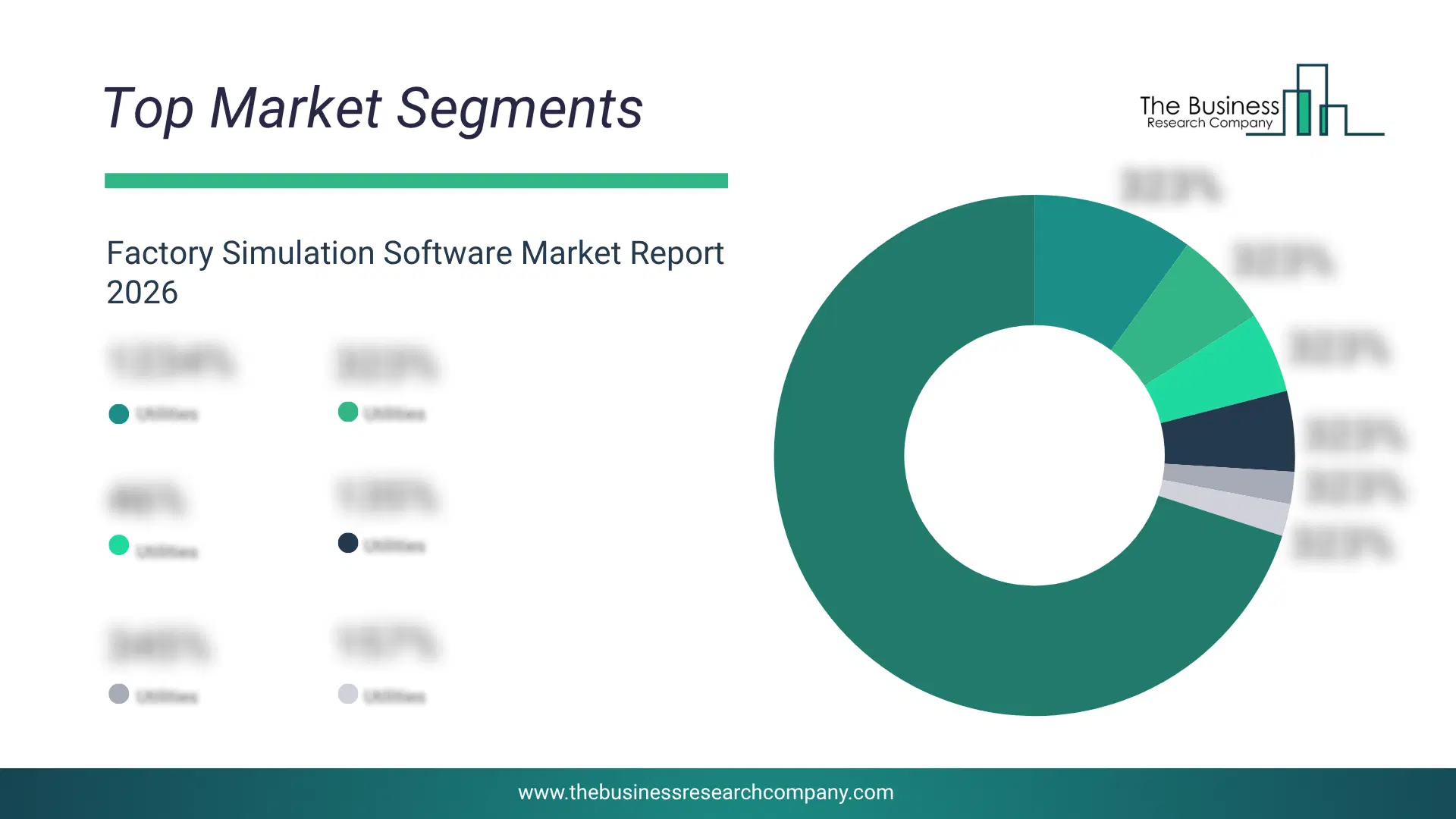
1) By Software: Three-Dimensional (3D) Simulation Software, Two-Dimensional (2D) Simulation Software 2) By Deployment: On-Premises, Cloud-Based 3) By Application: Manufacturing, Supply Chain Management, Transportation, Robotics, Healthcare Subsegments: 1) By Three-Dimensional (3D) Simulation Software: Virtual Commissioning Software, Digital Twin Platforms, Robotics And Automation Simulation, Ergonomics And Human Factors Simulation, 3D Layout And Facility Planning Tools, Immersive VR Or AR Simulation 2) By Two-Dimensional (2D) Simulation Software: Discrete Event Simulation (DES) Tools, Production And Workflow Simulation, Logistics And Supply Chain Simulation, Resource Scheduling And Utilization Tools, Process Flowcharting And Layout ToolsWhat Is The Driver Of The Factory Simulation Software Market?
The increasing demand for automation is expected to propel the growth of the factory simulation software market going forward. Automation is using technology to perform tasks with minimal human intervention, enhancing efficiency and consistency. The demand for automation is increasing due to the need for higher production efficiency and reduced operational costs, as it enables faster, error-free operations with minimal manual intervention. Factory simulation software enhances automation by enabling virtual testing of production processes, making it ideal for optimizing complex manufacturing systems. It reduces manual planning by providing accurate predictive insights and improving operational efficiency and decision-making. For instance, in September 2024, according to the International Federation of Robotics, a Germany-based non-profit organization, 4.2 million robotic units were operating in factories globally in 2023, marking a 10% increase from 3.90 million units in 2022. Therefore, the increasing demand for automation is driving the growth of the factory simulation software industry.Key Players In The Global Factory Simulation Software Market
Major companies operating in the factory simulation software market are Midea Group, Schneider Electric SE, Emerson Electric Co, Rockwell Automation Inc., Dassault Systèmes SE, Autodesk Inc., Hexagon AB, Keysight Technologies, Synopsys Inc., Cadence Design Systems, PTC Inc., MathWorks Inc., Siemens AG, Royal HaskoningDHV, Faro Technologies, Wolfram Research, Tebis, The AnyLogic Company, Tecnomatix Technologies Ltd., SAS Institute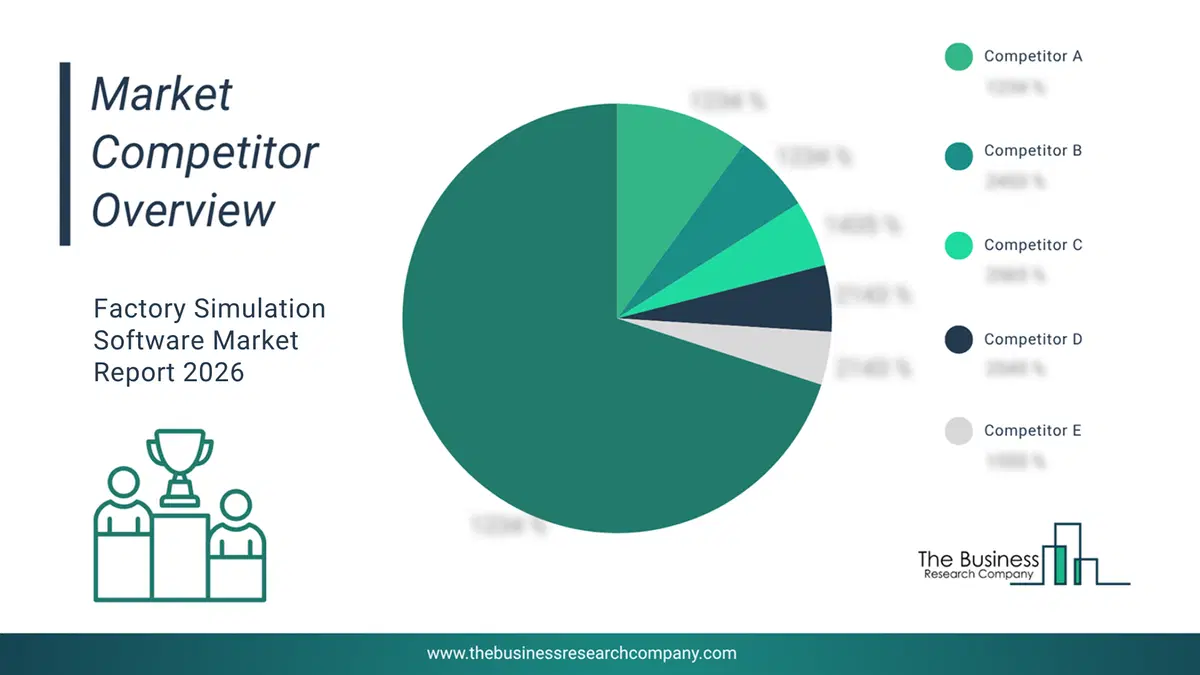
This chart is for illustrative purposes; the full report includes a detailed competitor analysis and comprehensive overview of the top 10 companies in the market.
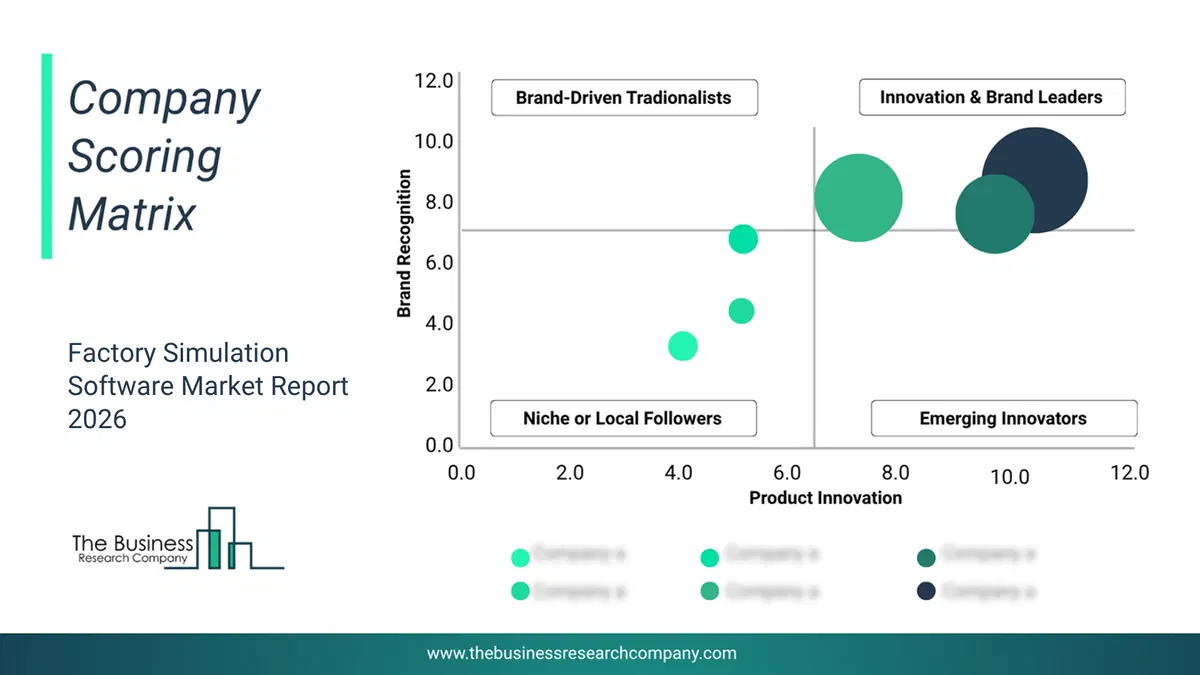
This chart maps companies by product innovation and brand strength, with bubble size indicating relative revenue, helping identify market leaders, challengers, and niche players. This is an illustrative chart; the full report provides a complete and accurate competitive analysis.
Global Factory Simulation Software Market Trends and Insights
Major companies operating in the factory simulation software market are focusing on developing technologically advanced solutions, such as predictive simulation tools, to optimize production efficiency and reduce operational costs. A predictive simulation tool is a software solution that uses historical data, real-time inputs, and advanced algorithms to forecast future scenarios and outcomes within a factory environment, enabling proactive decision-making and process optimization. For instance, in February 2025, ESI Group, a France-based software company, launched BM-Stamp, an innovative predictive stamping simulation tool designed for automotive stamping processes. This tool offers an intuitive graphical interface and a precise solver, allowing engineers of all experience levels to conduct predictive simulations for formability, dimensional accuracy, and surface quality without requiring specialized finite element method (FEM) expertise. BM-Stamp enhances automotive stamping by minimizing the need for expensive physical prototypes, speeding up production timelines, and ensuring consistent, high-quality outcomes across various automotive materials.What Are Latest Mergers And Acquisitions In The Factory Simulation Software Market?
In March 2025, Siemens AG, a Germany-based automation company, acquired Altair Engineering Inc. for $10 billion. With this acquisition, Siemens AG aims to dominate industrial AI and software by integrating Altair's expertise to create the world's most comprehensive AI-powered design portfolio, expand PLM market share, and drive digital transformation. Altair Engineering Inc. is a US-based software company that offers factory simulation software through its suite of tools designed to optimize manufacturing processes.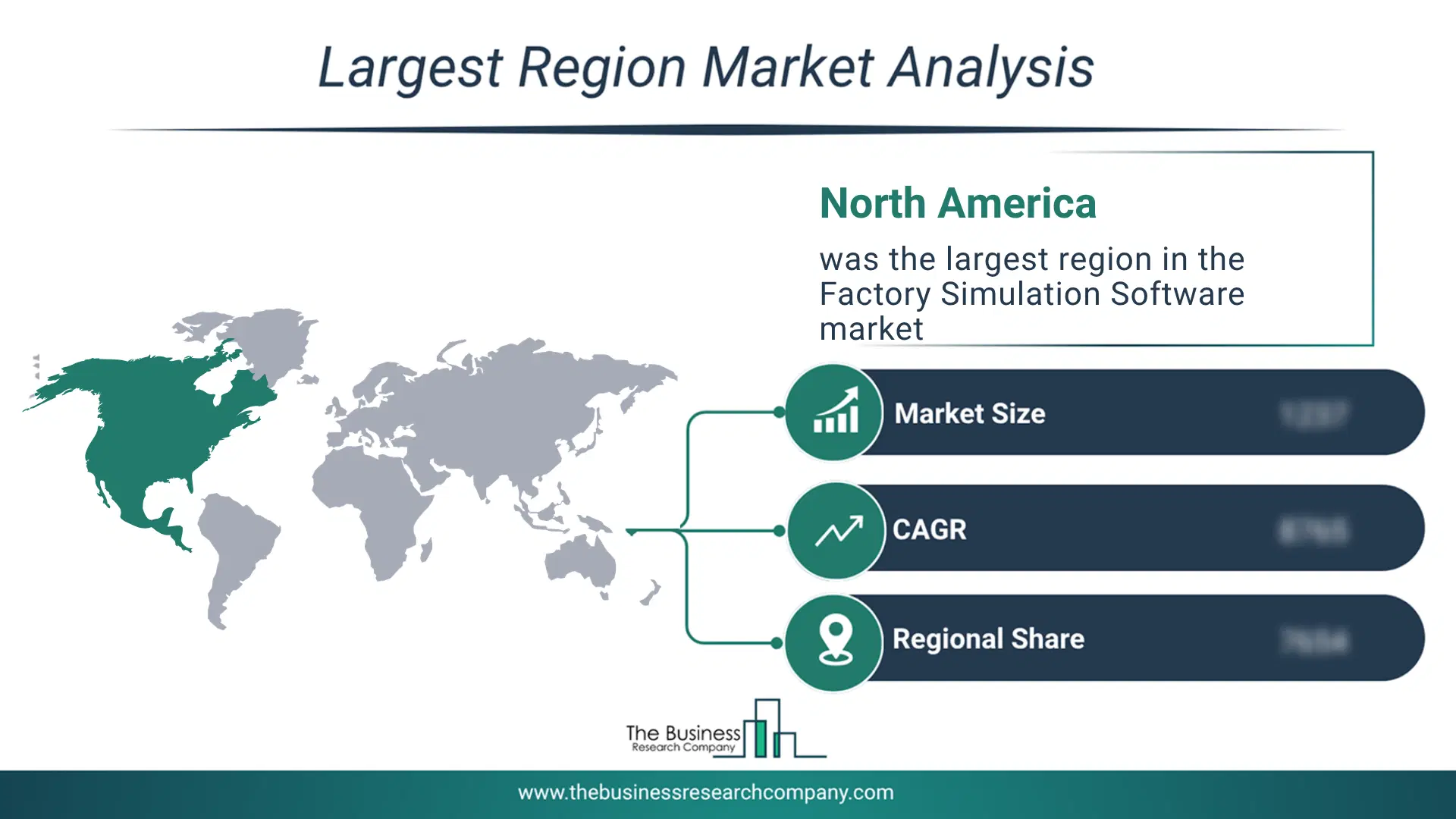
Regional Insights
North America was the largest region in the factory simulation software market in 2025. Asia-Pacific is expected to be the fastest-growing region in the forecast period. The regions covered in this market report are Asia-Pacific, South East Asia, Western Europe, Eastern Europe, North America, South America, Middle East, Africa. The countries covered in this market report are Australia, Brazil, China, France, Germany, India, Indonesia, Japan, Taiwan, Russia, South Korea, UK, USA, Canada, Italy, Spain.What Defines the Factory Simulation Software Market?
The factory simulation software market consists of revenues earned by entities by providing services such as digital twin modeling services, production line simulation, process optimization consulting, predictive maintenance simulation and virtual commissioning. The market value includes the value of related goods sold by the service provider or included within the service offering. The factory simulation software market also consists of sales of three-dimensional (3D) factory layout tools, production scheduling tools, optimization software, system dynamics software and supply chain simulation software. Values in this market are ‘factory gate’ values, that is, the value of goods sold by the manufacturers or creators of the goods, whether to other entities (including downstream manufacturers, wholesalers, distributors, and retailers) or directly to end customers. The value of goods in this market includes related services sold by the creators of the goods.How is Market Value Defined and Measured?
The market value is defined as the revenues that enterprises gain from the sale of goods and/or services within the specified market and geography through sales, grants, or donations in terms of the currency (in USD unless otherwise specified). The revenues for a specified geography are consumption values that are revenues generated by organizations in the specified geography within the market, irrespective of where they are produced. It does not include revenues from resales along the supply chain, either further along the supply chain or as part of other products.
This chart presents market attractiveness based on a quantitative evaluation of growth, competition, strategic alignment, and risk, offering a clear view of opportunity areas for decision-making. This chart is for illustrative purposes; the full report contains the complete analysis.

This chart highlights the Total Addressable Market (TAM) by estimating the maximum revenue opportunity using an assumption-driven approach, supporting strategic planning and opportunity sizing across markets. The chart is illustrative; the full report provides a more comprehensive analysis.
What Key Data and Analysis Are Included in the Factory Simulation Software Market Report 2026?
The factory simulation software market research report is one of a series of new reports from The Business Research Company that provides market statistics, including industry global market size, regional shares, competitors with the market share, detailed market segments, market trends and opportunities, and any further data you may need to thrive in the factory simulation software industry. The market research report delivers a complete perspective of everything you need, with an in-depth analysis of the current and future state of the industry.Factory Simulation Software Market Report Forecast Analysis
| Report Attribute | Details |
|---|---|
| Market Size Value In 2026 | $14.93 billion |
| Revenue Forecast In 2030 | $23.54 billion |
| Growth Rate | CAGR of 12% from 2026 to 2030 |
| Base Year For Estimation | 2025 |
| Actual Estimates/Historical Data | 2020-2025 |
| Forecast Period | 2026 - 2030 |
| Market Representation | Revenue in USD Billion and CAGR from 2026 to 2030 |
| Segments Covered | Software, Deployment, Application |
| Regional Scope | Asia-Pacific, Western Europe, Eastern Europe, North America, South America, Middle East, Africa |
| Country Scope | The Countries Covered In This Market Report Are Australia, Brazil, China, France, Germany, India, Indonesia, Japan, Taiwan, Russia, South Korea, Uk, Usa, Canada, Italy, Spain. |
| Key Companies Profiled | Midea Group, Schneider Electric SE, Emerson Electric Co, Rockwell Automation Inc., Dassault Systèmes SE, Autodesk Inc., Hexagon AB, Keysight Technologies, Synopsys Inc., Cadence Design Systems, PTC Inc., MathWorks Inc., Siemens AG, Royal HaskoningDHV, Faro Technologies, Wolfram Research, Tebis, The AnyLogic Company, Tecnomatix Technologies Ltd., SAS Institute |
| Customization Scope | Request for Customization |
| Pricing And Purchase Options | Explore Purchase Options |