
Food Anti-Caking Agents Market Report 2026
Global Outlook – By Type (Calcium Compounds, Sodium Compounds, Magnesium Compounds, Microcrystalline Cellulose, Other Types), By Source (Synthetic, Natural), By Application (Seasoning And Condiments, Bakery, Dairy Products, Soups And Sauces, Other Applications) – Market Size, Trends, Strategies, and Forecast to 2030
Food Anti-Caking Agents Market Overview
• Food Anti-Caking Agents market size has reached to $0.92 billion in 2025 • Expected to grow to $1.27 billion in 2030 at a compound annual growth rate (CAGR) of 6.7% • Growth Driver: Rising Demand For Food Anti-Caking Agents Driven By Increased Consumption Of Frozen And Convenience Foods • Market Trend: Product Innovation In The Anti-Caking Agents Market • North America was the largest region in 2025.What Is Covered Under Food Anti-Caking Agents Market?
Food anti-caking agents are finely powdered substances used as additives to prevent the formation of lumps in food and other sources. These agents are placed in granulated materials, such as table salt or confectioneries, and are mostly water-soluble, while some are also soluble in alcohol and other organic solvents. The main types of food anti-caking agents are calcium compounds, sodium compounds, magnesium compounds, microcrystalline cellulose, and others. Calcium silicate is a calcium compound that is a commonly used anti-caking agent which is added to table salt. The different sources include synthetic, natural, and is used in seasoning and condiments, bakery, dairy products, soups and sauces, others.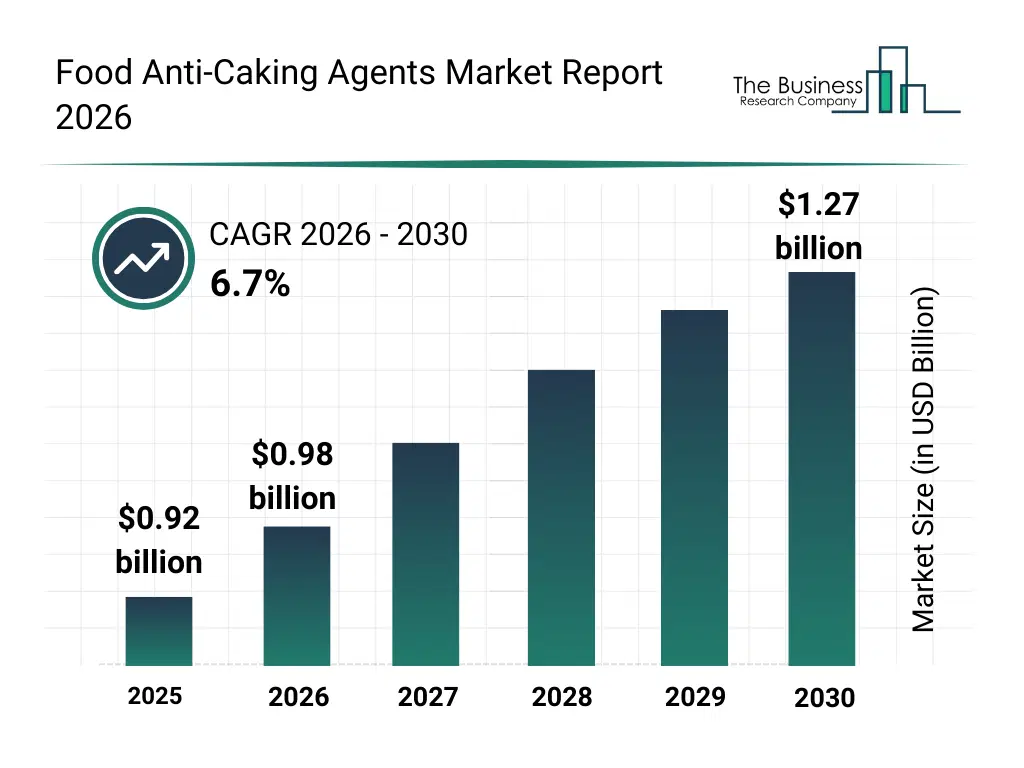
What Is The Food Anti-Caking Agents Market Size and Share 2026?
The food anti-caking agents market size has grown strongly in recent years. It will grow from $0.92 billion in 2025 to $0.98 billion in 2026 at a compound annual growth rate (CAGR) of 6.4%. The growth in the historic period can be attributed to growth in packaged food consumption, rising use of powdered food ingredients, expansion of seasoning and condiment markets, adoption of industrial food processing techniques, increased focus on product shelf stability.What Is The Food Anti-Caking Agents Market Growth Forecast?
The food anti-caking agents market size is expected to see strong growth in the next few years. It will grow to $1.27 billion in 2030 at a compound annual growth rate (CAGR) of 6.7%. The growth in the forecast period can be attributed to increasing demand for clean-label additives, rising investments in food formulation optimization, expansion of convenience food consumption, growing regulatory scrutiny on additive usage, increasing adoption of plant-based food products. Major trends in the forecast period include increasing demand for free-flowing food products, rising use of natural anti-caking agents, expansion of anti-caking applications in seasonings and dairy, growing focus on moisture control in food processing, enhanced formulation stability across packaged foods.
Global Food Anti-Caking Agents Market Segmentation
1) By Type: Calcium Compounds, Sodium Compounds, Magnesium Compounds, Microcrystalline Cellulose, Other Types 2) By Source: Synthetic, Natural 3) By Application: Seasoning And Condiments, Bakery, Dairy Products, Soups And Sauces, Other Applications Subsegments: 1) By Calcium Compounds: Calcium Silicate, Calcium Carbonate 2) By Sodium Compounds: Sodium Bicarbonate, Sodium Aluminosilicate 3) By Magnesium Compounds: Magnesium Carbonate, Magnesium Oxide 4) By Microcrystalline Cellulose: MCC Type 1, MCC Type 2 5) By Other Types: Talc, Silica Gel, Starch DerivativesWhat Is The Driver Of The Food Anti-Caking Agents Market?
The increasing consumption of frozen and convenience food is expected to propel the growth of the food anti-caking agents market going forward. Frozen and convenience food are ready to eat and complete meal that has been pre-pared commercially and require little cooking by the consumer. Frozen and convenience foods need to have a longer shelf life to remain viable in the market. Anti-caking agents help in preventing the formation of lumps or clumps in these products, which can lead to spoilage or decreased product quality. This extended shelf life is attractive to both manufacturers and consumers. For instance, in December 2023, according to International Institute of Refrigeration (IIR/IIF), France-based intergovernmental organization reported that, the global frozen food market was estimated at USD 392.4 billion in 2022 and is projected to reach USD 612.3 billion by 2032, growing at a compound annual growth rate (CAGR) of 4.6% between 2023 and 2032. Therefore, the increasing consumption of frozen and convenience food drive the growth of the food anti-caking agents industry.Key Players In The Global Food Anti-Caking Agents Market
Major companies operating in the food anti-caking agents market are BASF SE, Evonik Industries AG, Cargill Incorporated, PQ Corporation, Solvay SA, Cabot Corporation, Tate & Lyle plc, ABITEC Corporation, Ingredion Incorporated, DuPont Nutrition & Biosciences, Roquette Frères SA, Royal Cosun, Kao Corporation, Orisil Pvt Ltd., Tixolex, Spectrum Chemical Mfg Corp., Jost Chemical Co., Lorama Group Inc., Allied Blending & Ingredients Inc., NB Entrepreneurs India Pvt Ltd.
This chart is for illustrative purposes; the full report includes a detailed competitor analysis and comprehensive overview of the top 10 companies in the market.
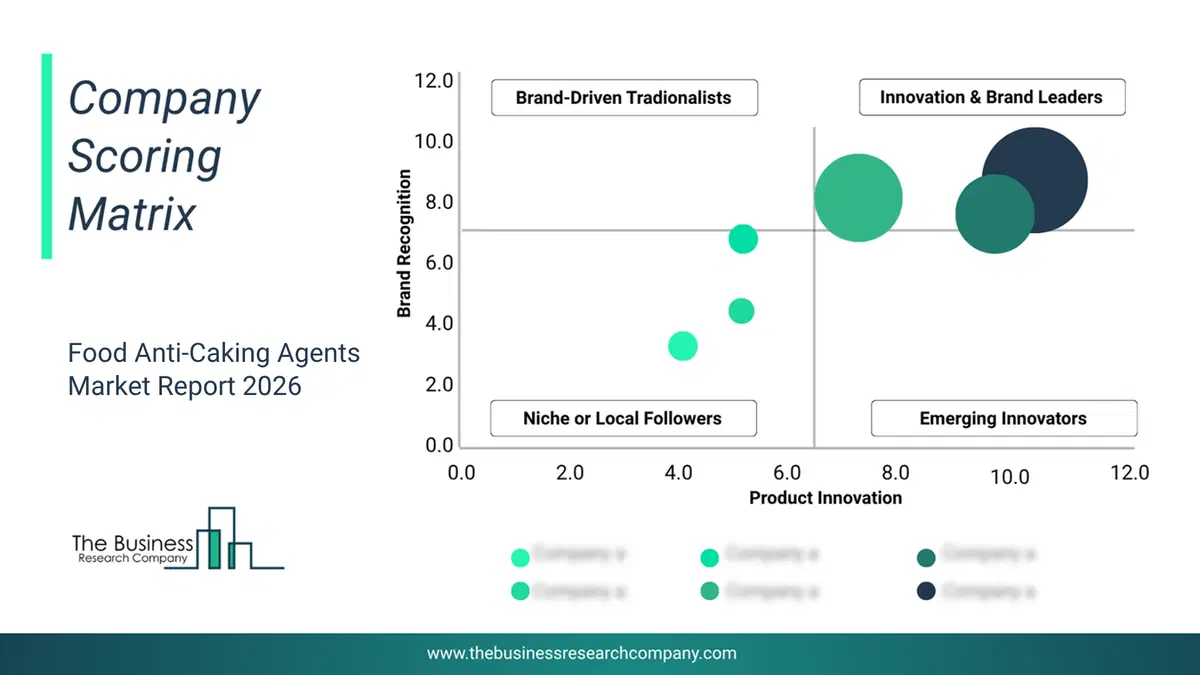
This chart maps companies by product innovation and brand strength, with bubble size indicating relative revenue, helping identify market leaders, challengers, and niche players. This is an illustrative chart; the full report provides a complete and accurate competitive analysis.
Global Food Anti-Caking Agents Market Trends and Insights
Major companies in the anti-caking agents market is focusing on product innovation such as non-nano anti-caking solution to expand product portfolio. Non-nano anti-caking agent solution provide high porosity, high moisture-binding capabilities and reduced mechanical interlocking feature. For instance, in in February 2024, Kraton Corporation, an US-based chemicals and materials company, launched SYLVASOLV, which is biobased hydrocarbon oils that provide exceptional performance and environmental benefits across multiple industries. Their product line features SYLVASOLV, starting with SYLVASOLV 1000, which is specifically designed to address the distinct functional requirements of the agriculture sector. This product is suitable for applications like fertilizer coatings and crop protection, offering advantages such as dust control and anti-caking properties that improve the handling, transportation, storage, and effectiveness of agricultural products.What Are Latest Mergers And Acquisitions In The Food Anti-Caking Agents Market?
In July 2024, Incredo, a US-based investment, partnered with Sucro, works for an undisclosed amount. The aim of the partnership is to expand the distribution of Incredo Sugar, enabling access to customers across the Americas seeking effective sugar reduction solutions. Sucro, works is a US-based food supply chain company that focuses on the sugar industry, specifically providing supply chain solutions.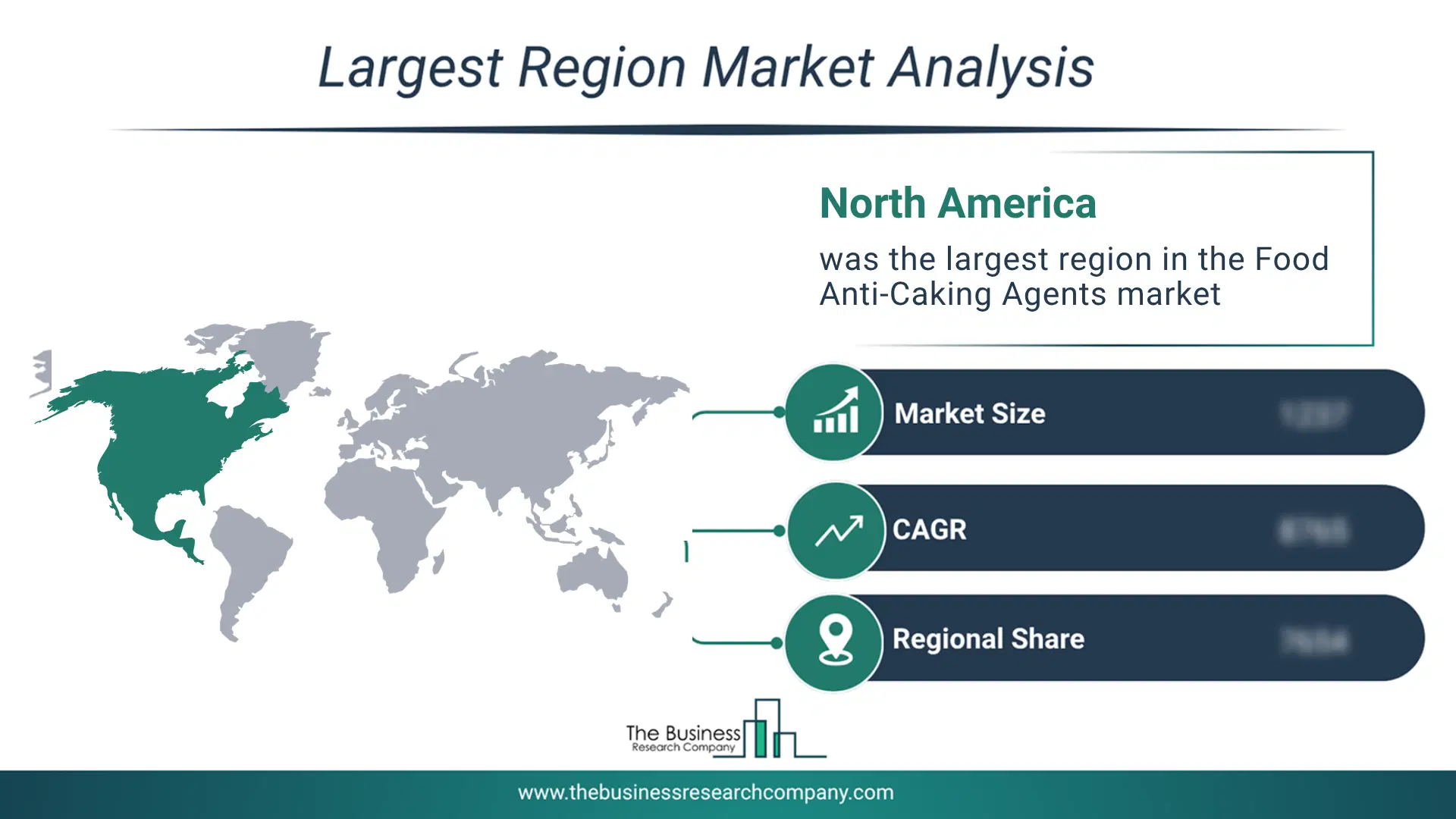
Regional Outlook
North America was the largest region in the food anti-caking agents market in 2025. The regions covered in this market report are Asia-Pacific, South East Asia, Western Europe, Eastern Europe, North America, South America, Middle East and Africa. The countries covered in this market report are Australia, Brazil, China, France, Germany, India, Indonesia, Japan, Taiwan, Russia, South Korea, UK, USA, Italy, Spain, CanadaWhat Defines the Food Anti-Caking Agents Market?
The food anti-caking agents market consists of calcium compounds, magnesium compounds, sodium compounds, microcrystalline cellulose, and other food anti-caking agents. Values in this market are ‘factory gate’ values, that is the value of goods sold by the manufacturers or creators of the goods, whether to other entities (including downstream manufacturers, wholesalers, distributors and retailers) or directly to end customers. The value of goods in this market includes related services sold by the creators of the goods.How is Market Value Defined and Measured?
The market value is defined as the revenues that enterprises gain from the sale of goods and/or services within the specified market and geography through sales, grants, or donations in terms of the currency (in USD unless otherwise specified). The revenues for a specified geography are consumption values that are revenues generated by organizations in the specified geography within the market, irrespective of where they are produced. It does not include revenues from resales along the supply chain, either further along the supply chain or as part of other products.
This chart presents market attractiveness based on a quantitative evaluation of growth, competition, strategic alignment, and risk, offering a clear view of opportunity areas for decision-making. This chart is for illustrative purposes; the full report contains the complete analysis.

This chart highlights the Total Addressable Market (TAM) by estimating the maximum revenue opportunity using an assumption-driven approach, supporting strategic planning and opportunity sizing across markets. The chart is illustrative; the full report provides a more comprehensive analysis.
What Key Data and Analysis Are Included in the Food Anti-Caking Agents Market Report 2026?
The food anti-caking agents market research report is one of a series of new reports from The Business Research Company that provides market statistics, including industry global market size, regional shares, competitors with the market share, detailed market segments, market trends and opportunities, and any further data you may need to thrive in the food anti-caking agents industry. The market research report delivers a complete perspective of everything you need, with an in-depth analysis of the current and future state of the industry.Food Anti-Caking Agents Market Report Forecast Analysis
| Report Attribute | Details |
|---|---|
| Market Size Value In 2026 | $0.98 billion |
| Revenue Forecast In 2030 | $1.27 billion |
| Growth Rate | CAGR of 6.4% from 2026 to 2030 |
| Base Year For Estimation | 2025 |
| Actual Estimates/Historical Data | 2020-2025 |
| Forecast Period | 2026 - 2030 |
| Market Representation | Revenue in USD Billion and CAGR from 2026 to 2030 |
| Segments Covered | Type, Source, Application |
| Regional Scope | Asia-Pacific, Western Europe, Eastern Europe, North America, South America, Middle East, Africa |
| Country Scope | The countries covered in the report are Australia, Brazil, China, France, Germany, India, Indonesia, Japan, Taiwan, Russia, South Korea, UK, USA, Canada, Italy, Spain. |
| Key Companies Profiled | BASF SE, Evonik Industries AG, Cargill Incorporated, PQ Corporation, Solvay SA, Cabot Corporation, Tate & Lyle plc, ABITEC Corporation, Ingredion Incorporated, DuPont Nutrition & Biosciences, Roquette Frères SA, Royal Cosun, Kao Corporation, Orisil Pvt Ltd., Tixolex, Spectrum Chemical Mfg Corp., Jost Chemical Co., Lorama Group Inc., Allied Blending & Ingredients Inc., NB Entrepreneurs India Pvt Ltd. |
| Customization Scope | Request for Customization |
| Pricing And Purchase Options | Explore Purchase Options |