
Food Certification Market Report 2026
Global Outlook – By Type (International Organization for Standardization 22000, British Retail Consortium (BRC), Safe Quality Food (SQF), International Featured Standards (IFS), HALAL, KOSHER, Free-From Certifications, Hazard Analysis and Critical Control Points (HACCP), Vegan, Others Types), By Category (Organic Food Certification, Sustainable Food Certification), By Risk (High-Risk Foods, Low-Risk Foods), By Application (Bakery Products, Confectionary Products, Baby Foods, Meat And Poultry Products, Convenience Food, Nuts And Dried Fruits, Milk And Dairy Products, Tobacco, Honey, Tea And Coffee), By End User (Growers, Manufacturers, Retailers, Food Service Organization, Others Categories) – Market Size, Trends, Strategies, and Forecast to 2030
Food Certification Market Overview
• Food Certification market size has reached to $8.41 billion in 2025 • Expected to grow to $13.91 billion in 2030 at a compound annual growth rate (CAGR) of 10.5% • Growth Driver: Growing Awareness About Food Safety And Quality Fueling The Growth Of The Market Due To Rising Consumer Concern And Regulatory Pressure • Market Trend: Advanced Certification Measures Reinforce Public Trust In Food Contact Materials • North America was the largest region in 2025 and Asia-Pacific is the fastest growing region.What Is Covered Under Food Certification Market?
Food certification refers to the formal process by which an independent, authorized body evaluates and verifies that a food product, production system, or management process complies with established safety, quality, and regulatory standards set by national or international authorities. It is widely used by food producers, suppliers, and regulatory agencies to ensure consumer protection, facilitate market access, and promote transparent food supply chains. The main types of food certification are International Organization for Standardization 22000, British Retail Consortium (BRC), Safe Quality Food (SQF), International Featured Standards (IFS), halal, kosher, free-from certifications, Hazard Analysis and Critical Control Points (HACCP), vegan, and others. International Organization for Standardization 22000 is a globally recognized food safety management standard that establishes systematic processes to identify, control, and prevent food safety hazards across the entire supply chain. It includes various categories such as organic food certification and sustainable food certification with various risks including high-risk foods and low-risk foods. It finds applications in bakery products, confectionery products, baby foods, meat and poultry products, convenience food, nuts and dried fruits, milk and dairy products, tobacco, honey, and others, catering to end users, such as growers, manufacturers, retailers, food service organizations, and others.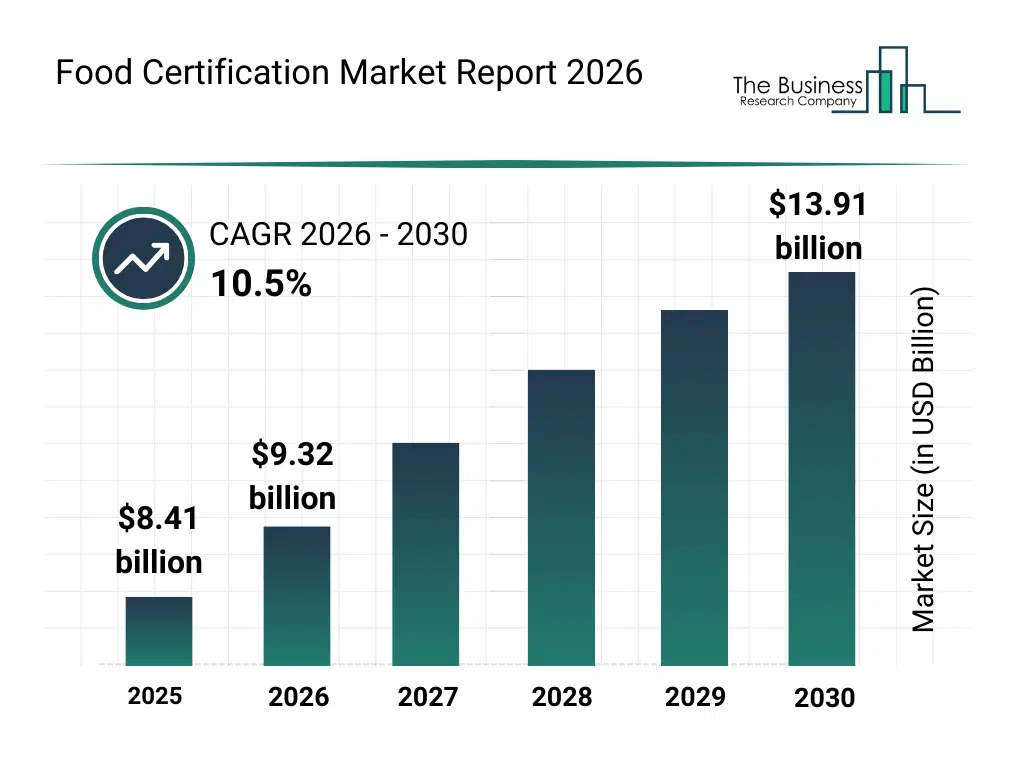
What Is The Food Certification Market Size and Share 2026?
The food certification market size has grown rapidly in recent years. It will grow from $8.41 billion in 2025 to $9.32 billion in 2026 at a compound annual growth rate (CAGR) of 10.8%. The growth in the historic period can be attributed to increasing regulatory enforcement in food safety, expansion of global food trade, rising consumer awareness of food quality, adoption of standardized food safety frameworks, growth of organized food retail.What Is The Food Certification Market Growth Forecast?
The food certification market size is expected to see rapid growth in the next few years. It will grow to $13.91 billion in 2030 at a compound annual growth rate (CAGR) of 10.5%. The growth in the forecast period can be attributed to increasing demand for sustainability certifications, rising adoption of digital audit technologies, expansion of cross-border food exports, growing focus on supply chain transparency, increasing regulatory harmonization across regions. Major trends in the forecast period include increasing adoption of digital certification platforms, rising demand for traceability and transparency services, growing focus on sustainable and ethical food certifications, expansion of multi-standard certification audits, enhanced integration of blockchain-based verification systems.
Global Food Certification Market Segmentation
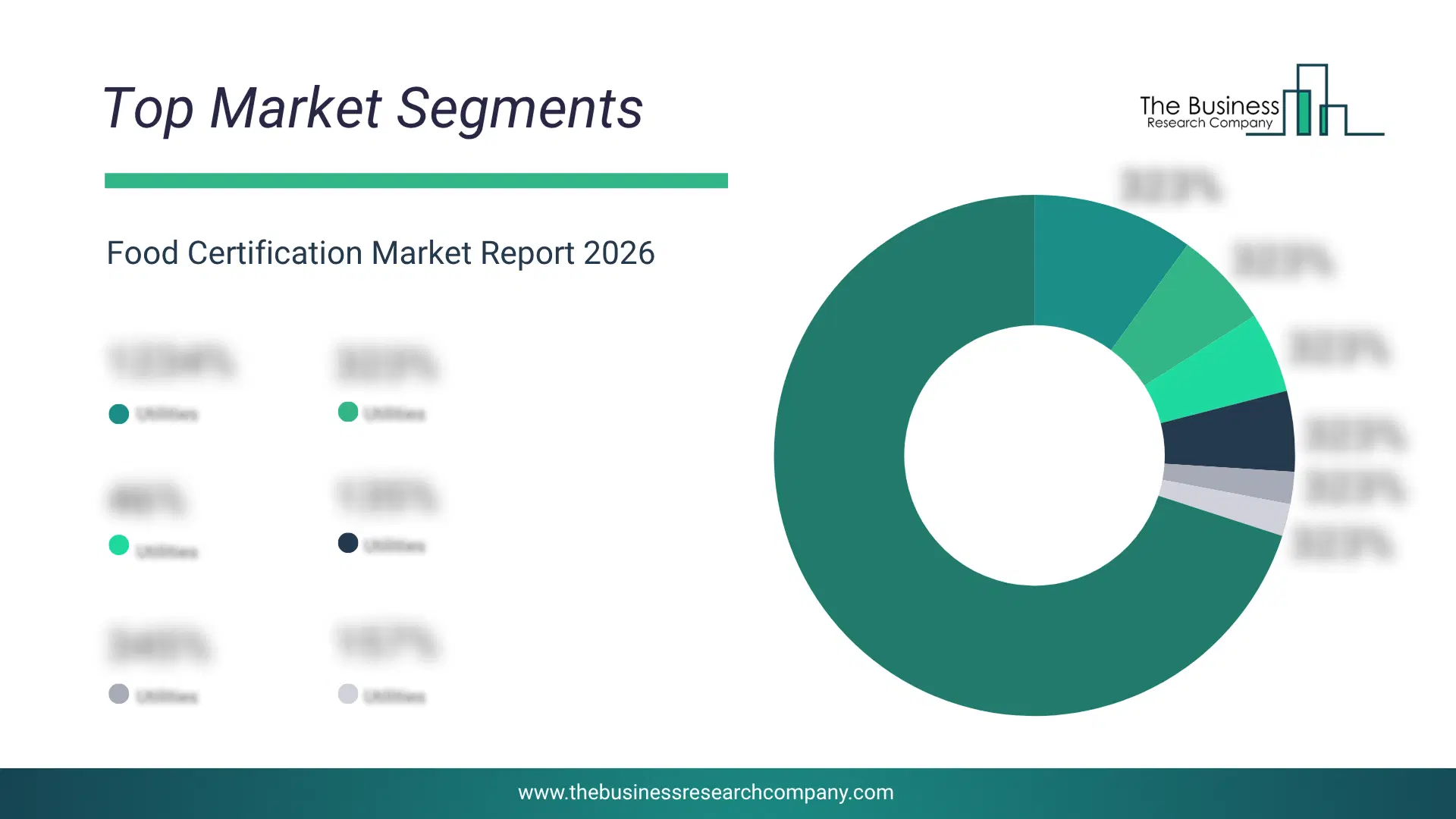
1) By Type: International Organization for Standardization 22000, British Retail Consortium (BRC), Safe Quality Food (SQF), International Featured Standards (IFS), HALAL, KOSHER, Free-From Certifications, Hazard Analysis and Critical Control Points (HACCP), Vegan, Others Types 2) By Category: Organic Food Certification, Sustainable Food Certification 3) By Risk: High-Risk Foods, Low-Risk Foods 4) By Application: Bakery Products, Confectionary Products, Baby Foods, Meat And Poultry Products, Convenience Food, Nuts And Dried Fruits, Milk And Dairy Products, Tobacco, Honey, Tea And Coffee 5) By End User: Growers, Manufacturers, Retailers, Food Service Organization, Others Categories Subsegments: 1) By International Organization For Standardization 22000: Food Safety Management Systems, Quality Management Integration, Supply Chain Certification, Risk Assessment Frameworks 2) By British Retail Consortium: Global Food Safety Standard, Packaging Material Standard, Storage And Distribution Standard, Consumer Product Standard 3) By Safe Quality Food: Primary Production Certification, Manufacturing Certification, Retail And Foodservice Certification, Storage And Distribution Certification 4) By International Featured Standards: Food Standard, Logistics Standard, Broker Standard, Packaging Standard 5) By Halal: Meat And Poultry Certification, Processed Food Certification, Beverages Certification, Ingredients Certification 6) By Kosher: Meat Certification, Dairy Certification, Pareve Certification, Passover Certification 7) By Free-From Certifications: Gluten-Free Certification, Allergen-Free Certification, Lactose-Free Certification, Additive-Free Certification 8) By Hazard Analysis And Critical Control Points: System Design Certification, Process Verification, Compliance Audit, Risk Management Training 9) By Vegan: Food And Beverage Certification, Ingredient Certification, Cosmetics And Personal Care Certification, Restaurant Certification 10) By Others Types: Organic Certification, Non-Genetically Modified Certification, Fair Trade Certification, Sustainable Sourcing CertificationWhat Is The Driver Of The Food Certification Market?
The growing awareness about food safety and quality is expected to propel the growth of the food certifications market going forward. Food safety and quality refer to the comprehensive set of practices, standards, and management systems designed to ensure that food products are free from hazards, consistently meet defined quality parameters, and remain suitable for human consumption throughout the entire supply chain. The growing awareness about food safety and quality arises from widespread media coverage of foodborne risks, prompting stricter measures by governments and businesses. Food certification assures food safety and quality by verifying that products meet established standards, making them safe for consumption. It reduces health risks, ensures regulatory compliance, and builds consumer trust, improving overall confidence in food products. For instance, in October 2024, according to the World Health Organization (WHO), a Switzerland-based specialized agency of the United Nations, approximately 600 million people early one in ten suffer from foodborne illnesses annually, resulting in around 420,000 deaths and an estimated loss of $110 billion each year in productivity and medical expenses, while children under 5 years old bear about 40% of this burden, accounting for roughly 125,000 deaths annually. Therefore, growing awareness about food safety and quality is driving the growth of the food certification industry.Key Players In The Global Food Certification Market
Major companies operating in the food certification market are Société Générale de Surveillance (SGS), Eurofins Scientific, Bureau Veritas, Dekra SE, Intertek Group plc, Mérieux NutriSciences, DNV GL, Underwriters Laboratories (UL), TÜV Nord Group, ALS Limited, Lloyd’s Register (LR), AsureQuality, NSF International, SCS Global Services, Control Union Certifications, FoodChain ID Group Inc., BRCGS, Eagle Certification Group, Groupe Ecocert, The Non‑GMO Project, Biocert, Taiwan Quality Food Association, ISOQAR (Alcumus ISOQAR), Food Alliance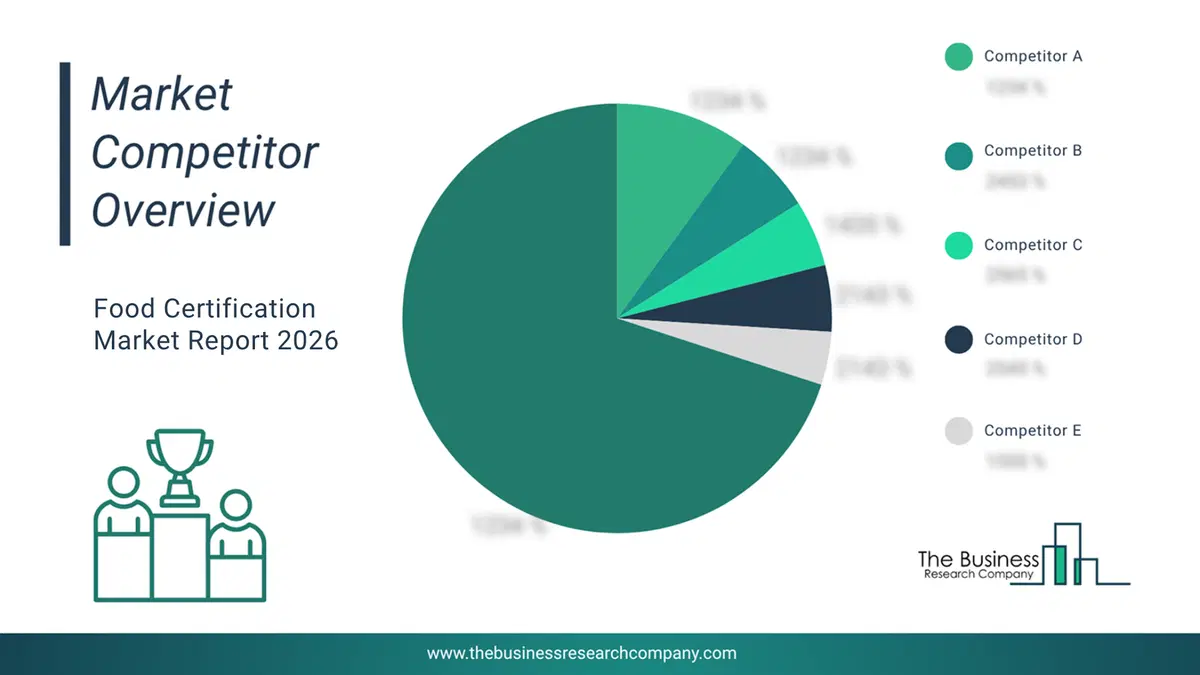
This chart is for illustrative purposes; the full report includes a detailed competitor analysis and comprehensive overview of the top 10 companies in the market.
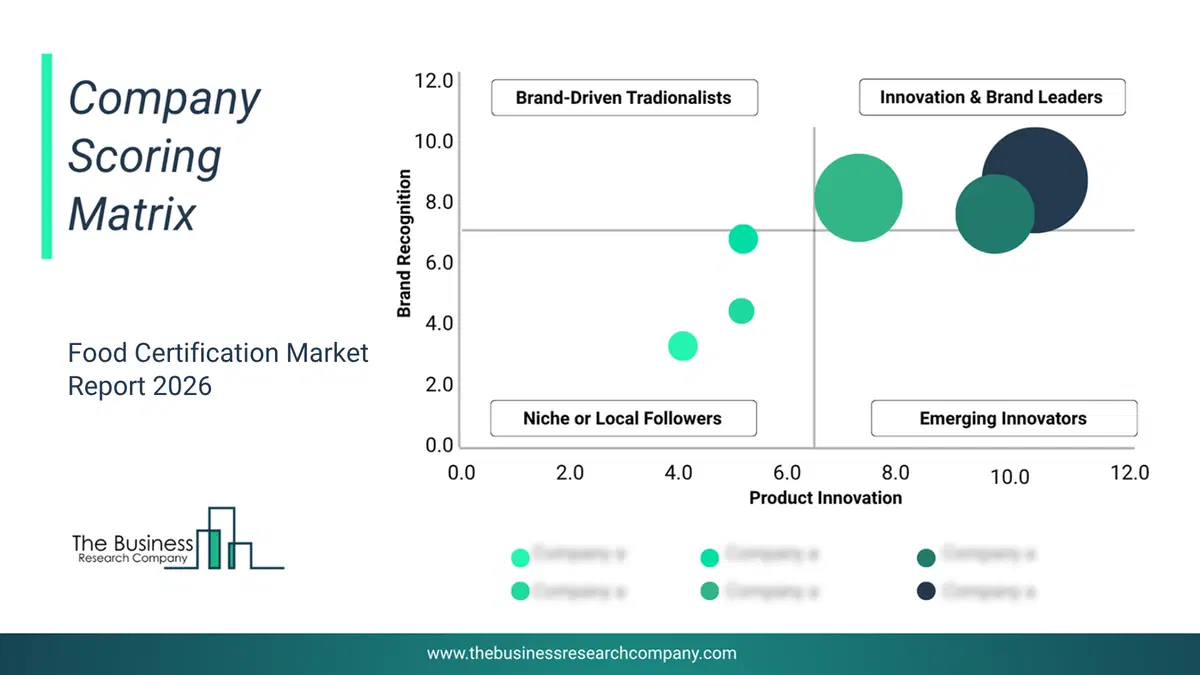
This chart maps companies by product innovation and brand strength, with bubble size indicating relative revenue, helping identify market leaders, challengers, and niche players. This is an illustrative chart; the full report provides a complete and accurate competitive analysis.
Global Food Certification Market Trends and Insights
Major companies operating in the food certification market are focusing on developing innovative solutions, such as safe food packaging certification protocols, to enhance consumer protection from chemical exposure in food contact materials. A safe food packaging certification protocol is a scientifically based assessment framework that verifies food contact packaging materials for compliance with safety standards by evaluating and eliminating harmful chemical substances that may migrate into food. For instance, in September 2025, the National Science Foundation (NSF), a US-based public health and safety organization, launched NSF Protocol 525: Safe Food Packaging Certification. The protocol establishes rigorous, science-based criteria for assessing packaging materials and validating the absence of hazardous substances such as per- and polyfluoroalkyl substances, bisphenol A, heavy metals, and phthalates. This advancement strengthens regulatory compliance, supports transparency in packaging safety, and reinforces public trust by ensuring that food contact materials meet elevated global safety standards.What Are Latest Mergers And Acquisitions In The Food Certification Market?
In September 2024, Mérieux NutriSciences, a France-based provider of food safety, quality, and sustainability services, acquired Bureau Veritas’ food testing activities in Japan, Morocco, Southeast Asia, and South Africa for an undisclosed amount. Through this acquisition, Mérieux NutriSciences aims to expand its global presence and strengthen its analytical capabilities in emerging markets to better support multinational food manufacturers and local clients. Bureau Veritas is a France-based testing, inspection, and certification company that provides food certification services.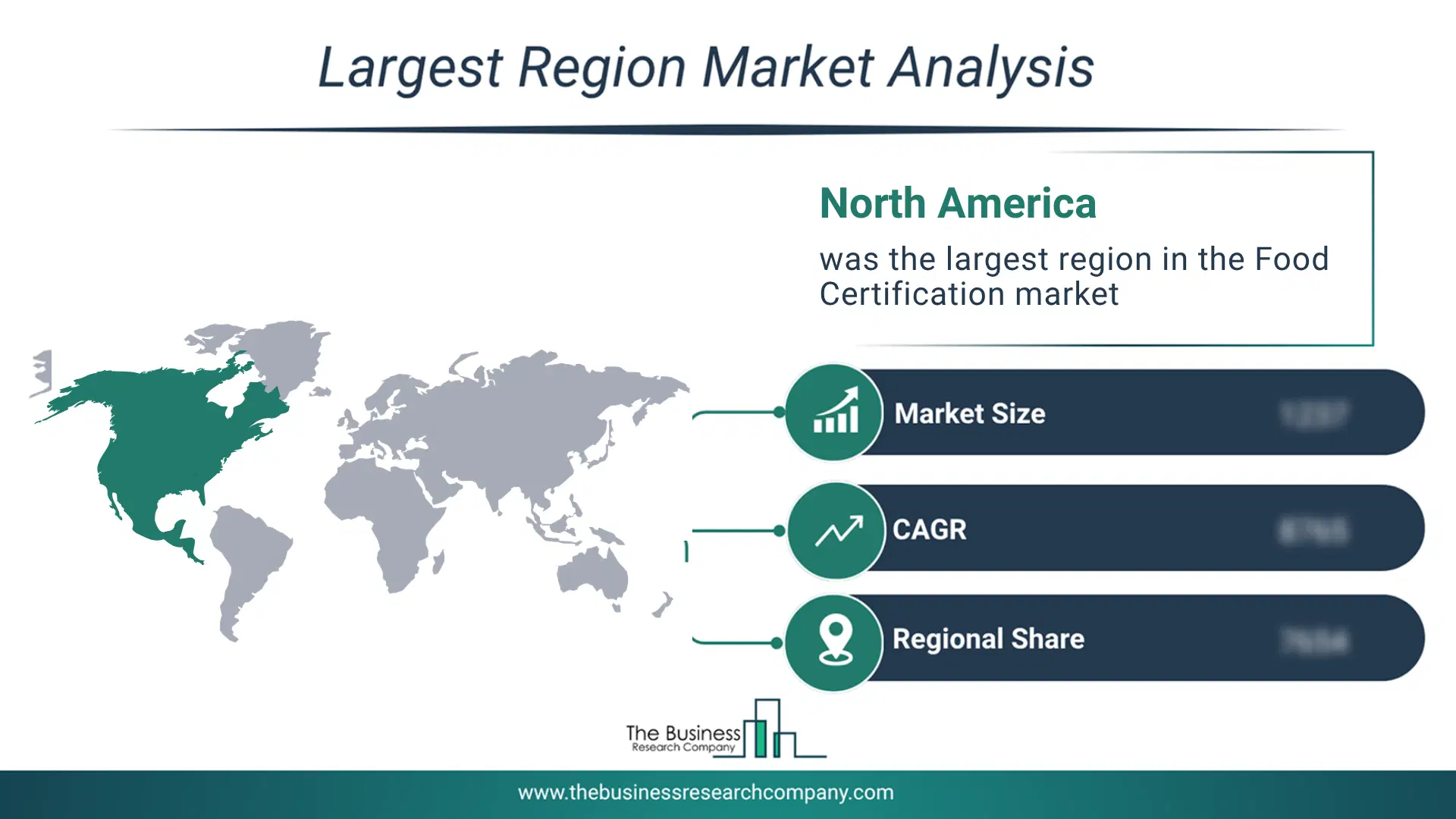
Regional Outlook
North America was the largest region in the food certification market in 2025. Asia-Pacific is expected to be the fastest-growing region in the forecast period. The regions covered in this market report are Asia-Pacific, South East Asia, Western Europe, Eastern Europe, North America, South America, Middle East and Africa. The countries covered in this market report are Australia, Brazil, China, France, Germany, India, Indonesia, Japan, Taiwan, Russia, South Korea, UK, USA, Italy, Spain, CanadaWhat Defines the Food Certification Market?
The food certification market consists of revenues earned by entities through auditing of food production processes, inspection of facilities, laboratory testing of products, certification of compliance with standards, and reporting or issuance of certificates. The market value includes the fees for assessments, audits, consulting services, and related reporting tools provided as part of the service offering.How is Market Value Defined and Measured?
The market value is defined as the revenues that enterprises gain from the sale of goods and/or services within the specified market and geography through sales, grants, or donations in terms of the currency (in USD unless otherwise specified). The revenues for a specified geography are consumption values that are revenues generated by organizations in the specified geography within the market, irrespective of where they are produced. It does not include revenues from resales along the supply chain, either further along the supply chain or as part of other products.
This chart presents market attractiveness based on a quantitative evaluation of growth, competition, strategic alignment, and risk, offering a clear view of opportunity areas for decision-making. This chart is for illustrative purposes; the full report contains the complete analysis.

This chart highlights the Total Addressable Market (TAM) by estimating the maximum revenue opportunity using an assumption-driven approach, supporting strategic planning and opportunity sizing across markets. The chart is illustrative; the full report provides a more comprehensive analysis.
What Key Data and Analysis Are Included in the Food Certification Market Report 2026?
The food certification market research report is one of a series of new reports from The Business Research Company that provides market statistics, including industry global market size, regional shares, competitors with the market share, detailed market segments, market trends and opportunities, and any further data you may need to thrive in the food certification industry. The market research report delivers a complete perspective of everything you need, with an in-depth analysis of the current and future state of the industry.Food Certification Market Report Forecast Analysis
| Report Attribute | Details |
|---|---|
| Market Size Value In 2026 | $9.32 billion |
| Revenue Forecast In 2030 | $13.91 billion |
| Growth Rate | CAGR of 10.8% from 2026 to 2030 |
| Base Year For Estimation | 2025 |
| Actual Estimates/Historical Data | 2020-2025 |
| Forecast Period | 2026 - 2030 |
| Market Representation | Revenue in USD Billion and CAGR from 2026 to 2030 |
| Segments Covered | Type, Category, Risk, Application, End User |
| Regional Scope | Asia-Pacific, Western Europe, Eastern Europe, North America, South America, Middle East, Africa |
| Country Scope | The countries covered in the report are Australia, Brazil, China, France, Germany, India, Indonesia, Japan, Taiwan, Russia, South Korea, UK, USA, Canada, Italy, Spain. |
| Key Companies Profiled | Société Générale de Surveillance (SGS), Eurofins Scientific, Bureau Veritas, Dekra SE, Intertek Group plc, Mérieux NutriSciences, DNV GL, Underwriters Laboratories (UL), TÜV Nord Group, ALS Limited, Lloyd’s Register (LR), AsureQuality, NSF International, SCS Global Services, Control Union Certifications, FoodChain ID Group Inc., BRCGS, Eagle Certification Group, Groupe Ecocert, The Non‑GMO Project, Biocert, Taiwan Quality Food Association, ISOQAR (Alcumus ISOQAR), Food Alliance |
| Customization Scope | Request for Customization |
| Pricing And Purchase Options | Explore Purchase Options |