
Food Safety Testing Market Report 2026
Global Outlook – By Contaminant (Pathogens, Pesticides, Genetically Modified Organisms (GMOs), Toxins, Other Containments), By Technology (Traditional, Rapid), By Application (Meat, Poultry, And Seafood Products, Dairy And Dairy Products, Processed Food, Beverages, Cereals And Grains) – Market Size, Trends, Strategies, and Forecast to 2030
Food Safety Testing Market Overview
• Food Safety Testing market size has reached to $27.83 billion in 2025 • Expected to grow to $46.4 billion in 2030 at a compound annual growth rate (CAGR) of 10.8% • Growth Driver: The Impact Of Growing Demand For Healthy Food Products On Food Testing Market • Market Trend: Technological Advancements Shaping The Future Of Food Safety Testing • North America was the largest region in 2025 and Asia-Pacific is the fastest growing region.What Is Covered Under Food Safety Testing Market?
Food safety testing refers to the process of scientifically describing the management, quality and storage of food to determine if it is safe for consumption. Food safety testing is usually the last course of the food production chain and is essential to guarantee that the food is liberated from physical, synthetic and natural dangers. The main food safety testing contaminants are pathogens, pesticides, genetically modified organisms (GMOs), toxins, and other contaminants. Pathogens refer to organisms in food that can cause irresistible infections in their host. Most microbes can stay away from the invulnerable reactions of the host, setting off related ailments. The different kinds of pathogens include salmonella, listeria, E. coli, Campylobacter, and others. The different food safety testing technologies include traditional and rapid for applications including meat, poultry, and seafood products, dairy and dairy products, processed food, beverages and cereals and grains.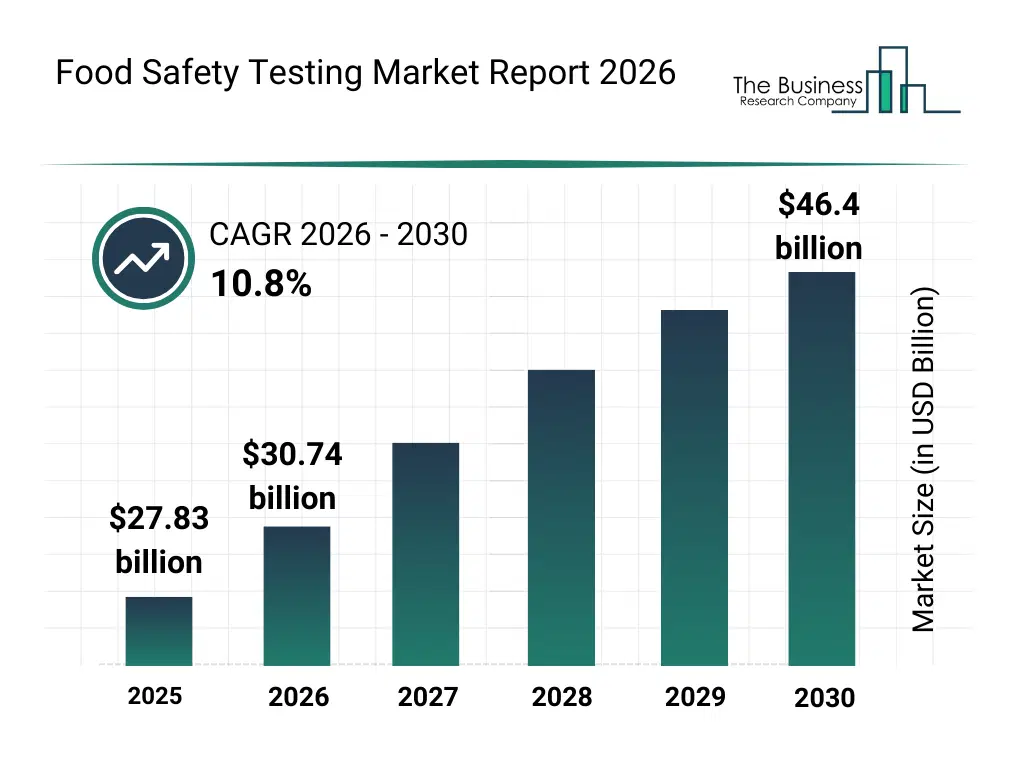
What Is The Food Safety Testing Market Size and Share 2026?
The food safety testing market size has grown rapidly in recent years. It will grow from $27.83 billion in 2025 to $30.74 billion in 2026 at a compound annual growth rate (CAGR) of 10.5%. The growth in the historic period can be attributed to rising food safety regulations, growth of global food trade, increasing incidence of foodborne illnesses, expansion of processed food production, adoption of laboratory-based testing methods.What Is The Food Safety Testing Market Growth Forecast?
The food safety testing market size is expected to see rapid growth in the next few years. It will grow to $46.4 billion in 2030 at a compound annual growth rate (CAGR) of 10.8%. The growth in the forecast period can be attributed to increasing investments in advanced diagnostic technologies, rising demand for real-time food safety monitoring, expansion of regulatory compliance requirements, growing adoption of automated testing systems, increasing focus on supply chain transparency. Major trends in the forecast period include increasing adoption of rapid food testing technologies, rising demand for pathogen detection solutions, growing use of molecular and dna-based testing, expansion of on-site and portable testing kits, enhanced focus on end-to-end food traceability.
Global Food Safety Testing Market Segmentation
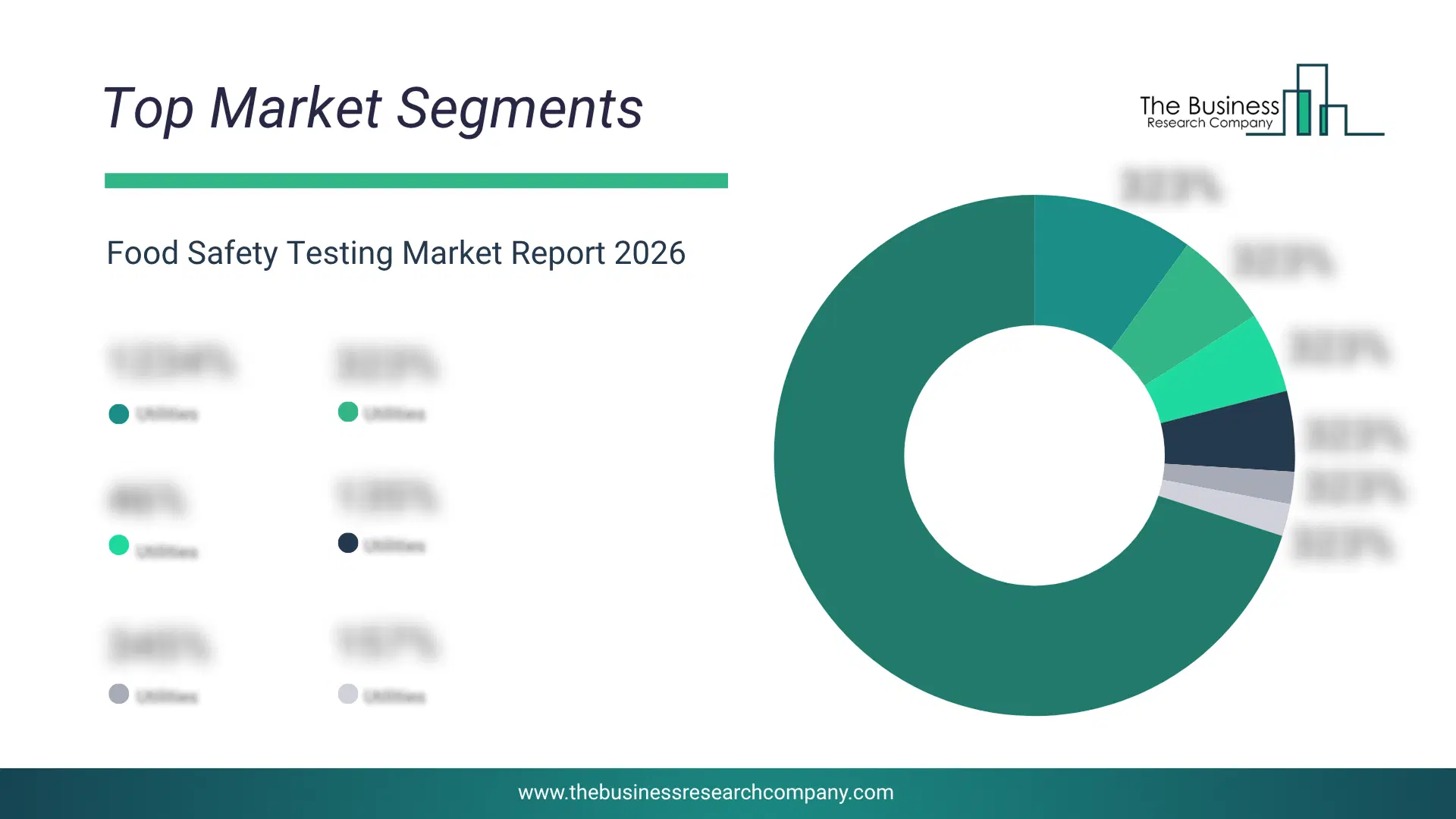
1) By Contaminant: Pathogens, Pesticides, Genetically Modified Organisms (GMOs), Toxins, Other Containments 2) By Technology: Traditional, Rapid 3) By Application: Meat, Poultry, And Seafood Products, Dairy And Dairy Products, Processed Food, Beverages, Cereals And Grains Subsegments: 1) By Pathogens: Bacteria, Viruses, Parasites, 2) By Pesticides: Herbicides, Insecticides, Fungicides 3) By Genetically Modified Organisms (GMOs): DNA Testing For GMO Presence, Protein Testing For GMO Traits 4) By Toxins: Mycotoxins, Marine Toxins, Heavy Metals 5) By Other Contaminants: Chemical Contaminants, Allergen Testing, Residuals From ProcessingWhat Is The Driver Of The Food Safety Testing Market?
Growing demand for healthy food products is expected to drive the food testing market. Healthy food products provide nutrients that promote the body's health and aid in energy retention. Food safety testing is required to verify that food products are free of food risks that can endanger public health. For instance, in 2024, according to Good Food Institute (GFI), a US-based non-profit organization reported that, global plant-based meat and seafood retail sales (excluding tofu and tempeh) were $5.9 billion in 2023 to $6.1 billion in 2024. Therefore, the growing demand for healthy food products drives the growth of the food testing market.Key Players In The Global Food Safety Testing Market
Major companies operating in the food safety testing market are SGS SA, Eurofins Scientific SE, Intertek Group plc, Bureau Veritas SA, ALS Limited, TÜV SÜD AG, AsureQuality Limited, Bio-Rad Laboratories Inc., Thermo Fisher Scientific Inc., Microbac Laboratories Inc., Symbio Laboratories, DNV GL, NSF International, Idexx Laboratories Inc., Neogen Corporation, Agilent Technologies Inc., Shimadzu Corporation, PerkinElmer Inc., Merieux NutriSciences Corporation, The SOCOTEC Group, Romer Labs Division Holding GmbH, Charm Sciences Inc., Hygiena LLC, R-Biopharm AG, MilliporeSigma, 3M Company, QIAGEN N.V.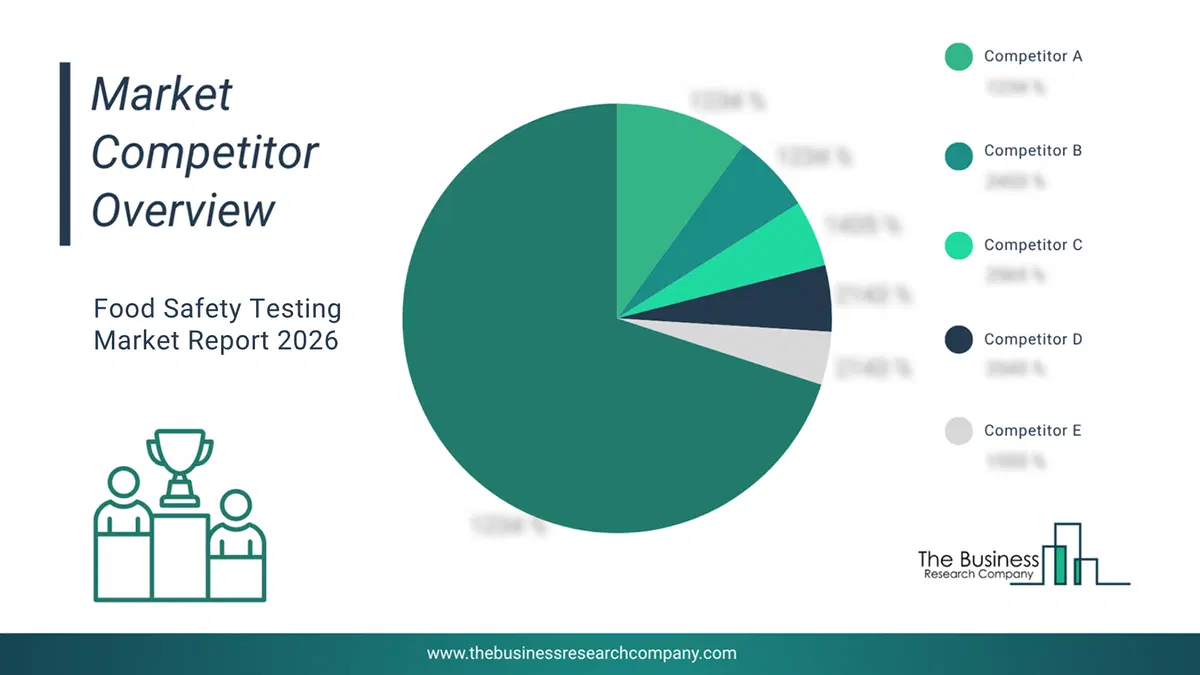
This chart is for illustrative purposes; the full report includes a detailed competitor analysis and comprehensive overview of the top 10 companies in the market.
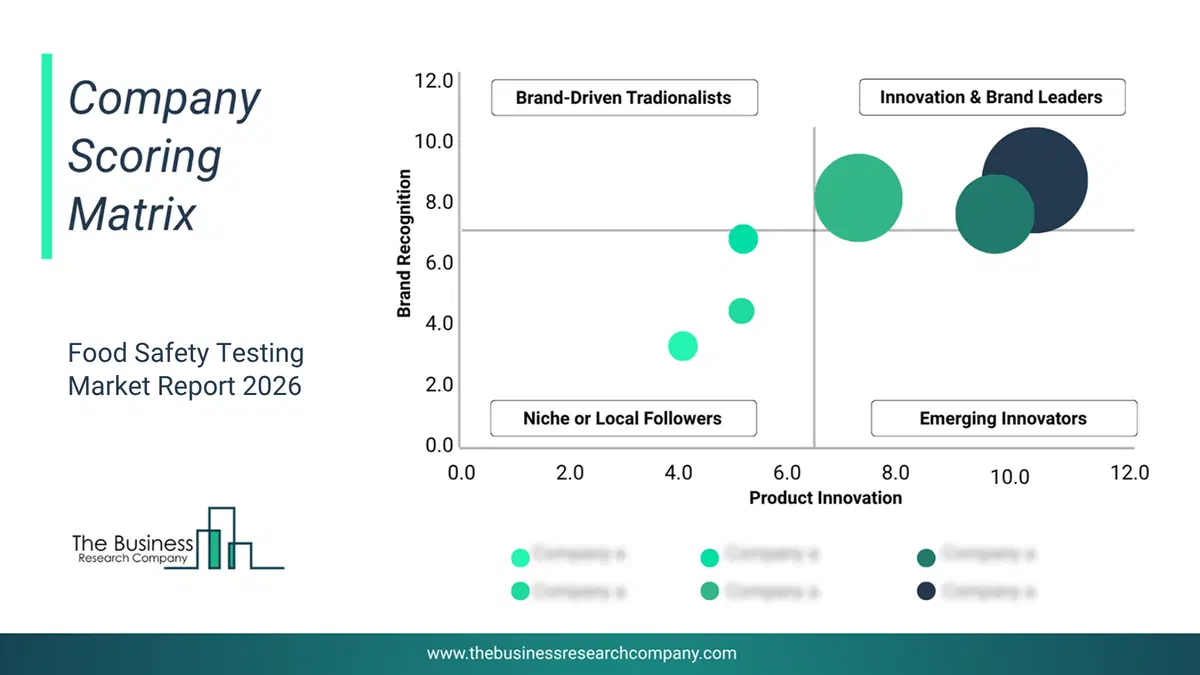
This chart maps companies by product innovation and brand strength, with bubble size indicating relative revenue, helping identify market leaders, challengers, and niche players. This is an illustrative chart; the full report provides a complete and accurate competitive analysis.
Global Food Safety Testing Market Trends and Insights
Major companies operating in the food safety testing market are focusing on developing innovative solutions, such as automated high-throughput microbiological testing systems, to meet the rising demand for faster, more accurate, and cost-effective food screening across production and processing environments. These advanced smart-testing technologies streamline traditionally labor-intensive analytical workflows, improving consistency and enabling seamless integration into routine quality monitoring compared with manual plating and counting methods. For instance, In June 2024, Neogen Corporation, a US-based biotechnology company, launched Petrifilm Automated Feeder to improve the efficiency of high-throughput food safety testing laboratories. Petrifilm Automated Feeder, The feeder automates the loading and counting of Petrifilm plates, greatly minimizing the time technicians dedicate to these activities. With the ability to process up to 300 Petrifilm plates in only 33 minutes, it is perfectly suited for high-volume laboratories that conduct over 100,000 quality indicator tests each year. Additionally, the feeder integrates smoothly with the Petrifilm Plate Reader Advanced, enabling labs to easily incorporate it into their current workflows and laboratory information management systems.What Are Latest Mergers And Acquisitions In The Food Safety Testing Market?
In June 2024, WESSLING Holding GmbH & Co. KG, a Germany-based service company, acquired the ALS Limited testing, inspection, and certification company for an undisclosed amount. Aim of the Acquisition To improve WESSLING market presence in Europe, capitalize on growth opportunities, and enhance service capabilities by integrating specialized expertise and resources. ALS Limited is a Australia -based testing, inspection, and certification company that specializes in offering analytical services across a range of industries, such as environmental, food safety, pharmaceuticals, mining, and industrial sectors. The company is dedicated to delivering high-quality testing and data-driven insights that help ensure safety, compliance, and quality for its clients.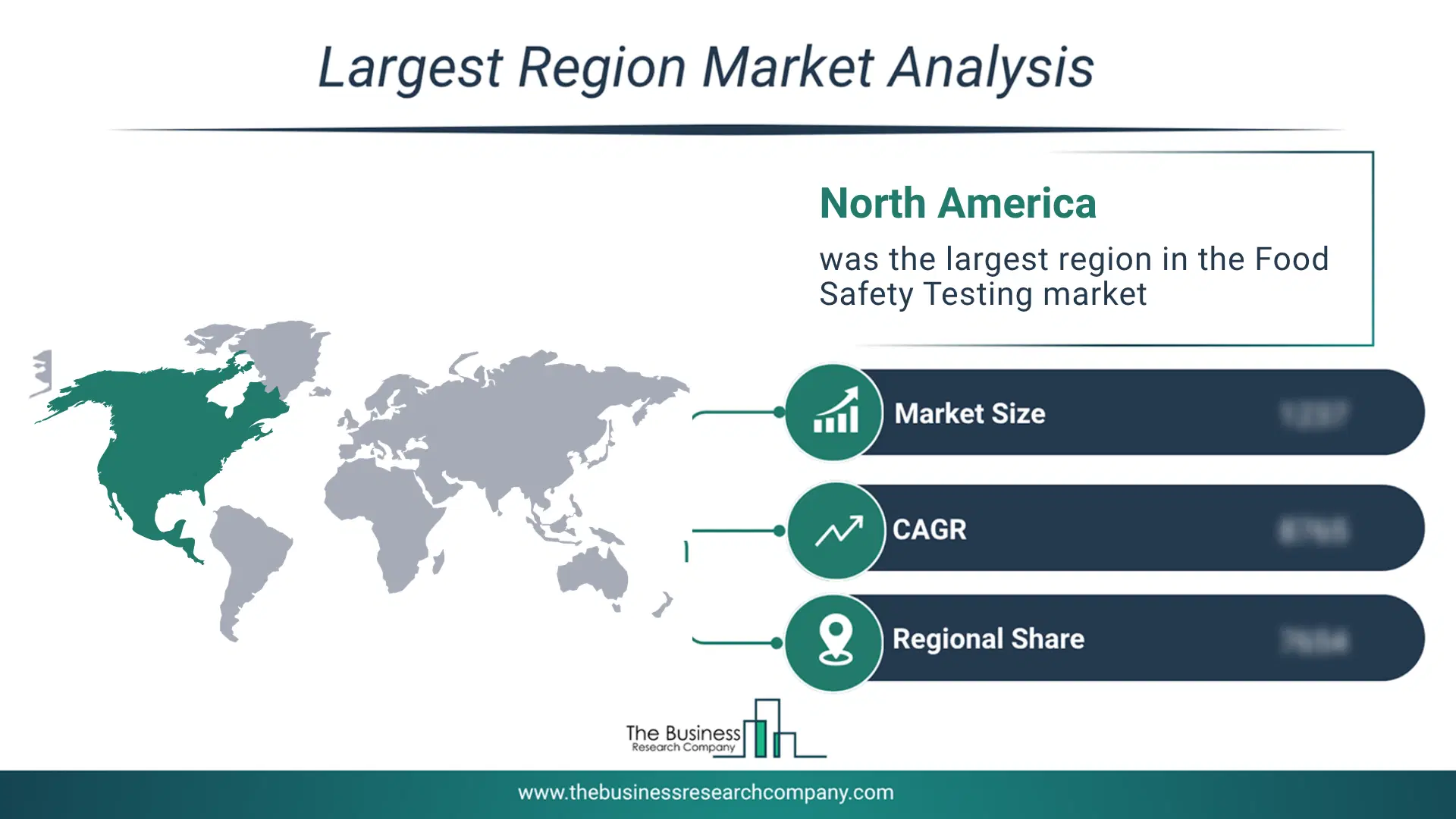
Regional Outlook
North America was the largest region in the food safety testing market in 2025. Asia-Pacific is expected to be the fastest-growing region in the forecast period. The regions covered in this market report are Asia-Pacific, South East Asia, Western Europe, Eastern Europe, North America, South America, Middle East and Africa. The countries covered in this market report are Australia, Brazil, China, France, Germany, India, Indonesia, Japan, Taiwan, Russia, South Korea, UK, USA, Italy, Spain, CanadaWhat Defines the Food Safety Testing Market?
The food safety testing market includes revenues earned by entities by providing microbiology testing, nutritional analysis, pesticide residue testing, product testing label, shelf life testing. The market value includes the value of related goods sold by the service provider or included within the service offering. Only goods and services traded between entities or sold to end consumers are included.How is Market Value Defined and Measured?
The market value is defined as the revenues that enterprises gain from the sale of goods and/or services within the specified market and geography through sales, grants, or donations in terms of the currency (in USD unless otherwise specified). The revenues for a specified geography are consumption values that are revenues generated by organizations in the specified geography within the market, irrespective of where they are produced. It does not include revenues from resales along the supply chain, either further along the supply chain or as part of other products.
This chart presents market attractiveness based on a quantitative evaluation of growth, competition, strategic alignment, and risk, offering a clear view of opportunity areas for decision-making. This chart is for illustrative purposes; the full report contains the complete analysis.

This chart highlights the Total Addressable Market (TAM) by estimating the maximum revenue opportunity using an assumption-driven approach, supporting strategic planning and opportunity sizing across markets. The chart is illustrative; the full report provides a more comprehensive analysis.
What Key Data and Analysis Are Included in the Food Safety Testing Market Report 2026?
The food safety testing market research report is one of a series of new reports from The Business Research Company that provides market statistics, including industry global market size, regional shares, competitors with the market share, detailed market segments, market trends and opportunities, and any further data you may need to thrive in the food safety testing industry. The market research report delivers a complete perspective of everything you need, with an in-depth analysis of the current and future state of the industry.Food Safety Testing Market Report Forecast Analysis
| Report Attribute | Details |
|---|---|
| Market Size Value In 2026 | $30.74 billion |
| Revenue Forecast In 2030 | $46.4 billion |
| Growth Rate | CAGR of 10.5% from 2026 to 2030 |
| Base Year For Estimation | 2025 |
| Actual Estimates/Historical Data | 2020-2025 |
| Forecast Period | 2026 - 2030 |
| Market Representation | Revenue in USD Billion and CAGR from 2026 to 2030 |
| Segments Covered | Contaminant, Technology, Application |
| Regional Scope | Asia-Pacific, Western Europe, Eastern Europe, North America, South America, Middle East, Africa |
| Country Scope | The countries covered in the report are Australia, Brazil, China, France, Germany, India, Indonesia, Japan, Taiwan, Russia, South Korea, UK, USA, Canada, Italy, Spain. |
| Key Companies Profiled | SGS SA, Eurofins Scientific SE, Intertek Group plc, Bureau Veritas SA, ALS Limited, TÜV SÜD AG, AsureQuality Limited, Bio-Rad Laboratories Inc., Thermo Fisher Scientific Inc., Microbac Laboratories Inc., Symbio Laboratories, DNV GL, NSF International, Idexx Laboratories Inc., Neogen Corporation, Agilent Technologies Inc., Shimadzu Corporation, PerkinElmer Inc., Merieux NutriSciences Corporation, The SOCOTEC Group, Romer Labs Division Holding GmbH, Charm Sciences Inc., Hygiena LLC, R-Biopharm AG, MilliporeSigma, 3M Company, QIAGEN N.V. |
| Customization Scope | Request for Customization |
| Pricing And Purchase Options | Explore Purchase Options |