
Food Manufacturing Software Market Report 2026
Global Outlook – By Component (Software, Services), By Deployment Mode (Cloud Based, On Premise, Hybrid), By Enterprise Size (Small Enterprises, Medium-sized Enterprises, Large Enterprises), By Application (Inventory Management, Production Planning, Quality Control, Compliance Management, Other Applications), By End User (Meat, Poultry, Seafood, Dairy Products, Beverages, Baked Goods, Packaged Goods) – Market Size, Trends, Strategies, and Forecast to 2030
Food Manufacturing Software Market Overview
• Food Manufacturing Software market size has reached to $5.82 billion in 2025 • Expected to grow to $8.78 billion in 2030 at a compound annual growth rate (CAGR) of 8.5% • Growth Driver: The Rise In Food Safety Concerns Driving The Growth Of The Market Due To Increasing Contamination Risks And Regulatory Demands • Market Trend: Advancing Efficiency Through Integrated Digital Platforms • North America was the largest region in 2025 and Asia-Pacific is the fastest growing region.What Is Covered Under Food Manufacturing Software Market?
Food manufacturing software is a specialized digital solution designed to manage, streamline, and optimize all processes involved in food production, from raw material sourcing and inventory management to production planning and quality control. It ensures compliance with food safety regulations, improves operational efficiency, and reduces waste across the manufacturing lifecycle. The main components of food manufacturing software are software and services. Software refers to a set of programs, instructions, and data that enable a computer or electronic device to perform specific tasks or functions. It can be deployed in cloud-based, on-premise, and hybrid environments. and serves enterprises of all sizes, including small enterprises, medium-sized enterprises, and large enterprises. This software supports a range of applications such as inventory management, production planning, quality control, compliance management, and other applications that cater to various end users such as meat, poultry, seafood, dairy products, beverages, baked goods, and packaged goods.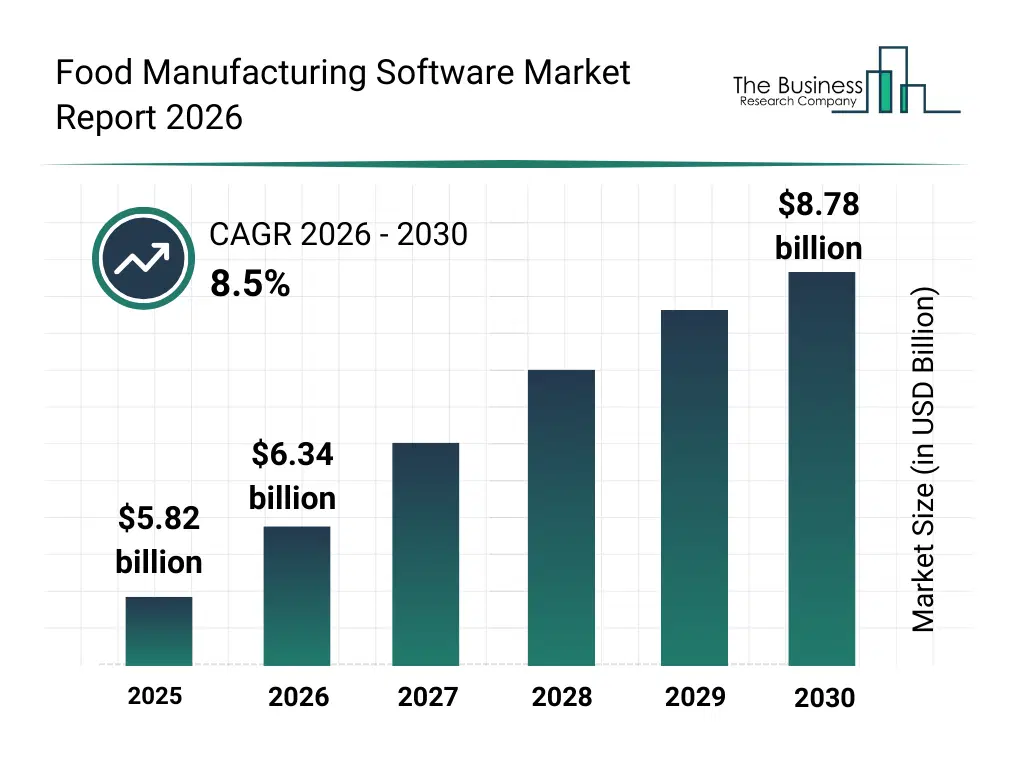
What Is The Food Manufacturing Software Market Size and Share 2026?
The food manufacturing software market size has grown strongly in recent years. It will grow from $5.82 billion in 2025 to $6.34 billion in 2026 at a compound annual growth rate (CAGR) of 8.9%. The growth in the historic period can be attributed to increasing digitization of food manufacturing operations, rising regulatory scrutiny on food safety, expansion of packaged food production, growing need for inventory optimization, adoption of enterprise resource planning systems.What Is The Food Manufacturing Software Market Growth Forecast?
The food manufacturing software market size is expected to see strong growth in the next few years. It will grow to $8.78 billion in 2030 at a compound annual growth rate (CAGR) of 8.5%. The growth in the forecast period can be attributed to increasing adoption of predictive analytics in food production, rising investments in smart food factories, growing demand for waste reduction solutions, expansion of cloud-native manufacturing software, increasing focus on data-driven decision making. Major trends in the forecast period include increasing adoption of ai-driven production planning tools, rising use of cloud-based food manufacturing platforms, growing integration of real-time quality monitoring systems, expansion of end-to-end traceability software solutions, enhanced focus on regulatory compliance automation.
Global Food Manufacturing Software Market Segmentation
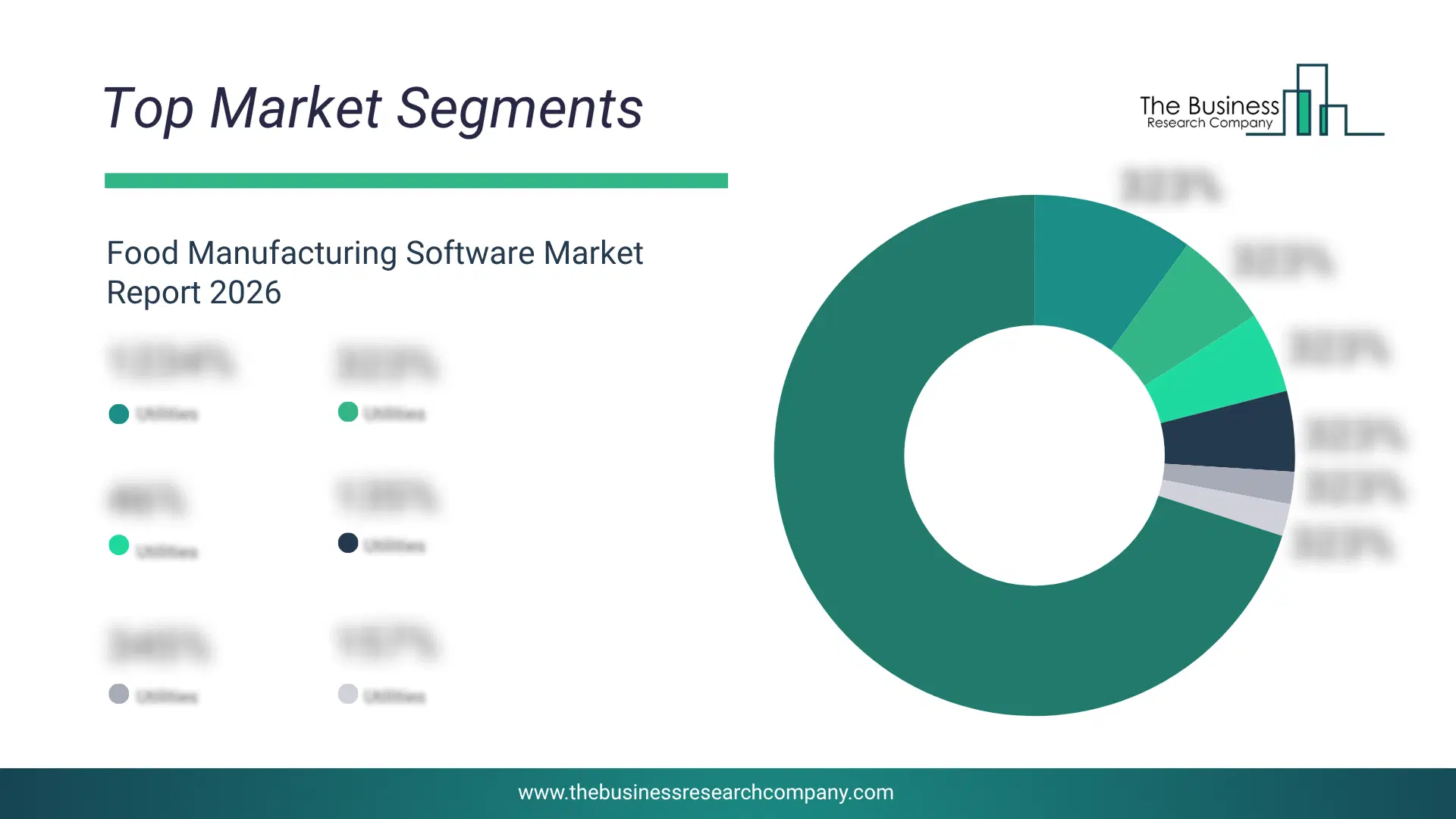
1) By Component: Software, Services 2) By Deployment Mode: Cloud Based, On Premise, Hybrid 3) By Enterprise Size: Small Enterprises, Medium-sized Enterprises, Large Enterprises 4) By Application: Inventory Management, Production Planning, Quality Control, Compliance Management, Other Applications 5) By End User: Meat, Poultry, Seafood, Dairy Products, Beverages, Baked Goods, Packaged Goods Subsegments: 1) By Software: Design And Simulation Tools, Process Control Software, Data Analysis And Monitoring Platforms, Automation And Integration Solutions 2) By Services: Installation And Commissioning, Maintenance And Support, Training And Consulting, Upgrades And RetrofittingWhat Is The Driver Of The Food Manufacturing Software Market?
The rising food safety concerns are expected to propel the growth of the food manufacturing software market going forward. Food safety concerns refer to the risks and issues related to the handling, preparation, and storage of food that could lead to contamination, foodborne illnesses, or violations of health standards. Rising food safety concerns are due to contamination of food products caused by harmful pathogens, chemicals, or improper handling throughout the supply chain. Food manufacturing software helps address food safety concerns by enabling real-time monitoring, ensuring regulatory compliance, and streamlining quality control processes across the production chain. For instance, in February 2025, according to US Public Interest Research Group (PIRG) Education Fund, a US-based consumer-advocacy group, a total of 1,392 Americans in 2024 became ill after consuming a contaminated food item, up from 1,118 in 2023, with hospitalizations more than doubling from 230 to 487 and deaths rising from 8 to 19. Therefore, rising food safety concerns are driving the growth of the food manufacturing software industry.Key Players In The Global Food Manufacturing Software Market
Major companies operating in the food manufacturing software market are SAP SE, Sage Group, The Sage Group plc, Vicinity Manufacturing ERP Solutions, MasterControl Inc., iRely India Private Limited., CSB-System AG, Datacor Enterprise Resource Planning (ERP) Software, BatchMaster Software Manufacturing ERP, SYSPRO ERP Software, Katana Manufacturing ERP by Katana Corp, YAVEON ProBatch, inecta Food ERP, Plex Systems Inc., Royal 4 Systems Inc., LYNQ Limited., Food Decision Software Inc., JustFood ERP, Mar-Kov Computer Systems Inc., FlexiBake Software Ltd.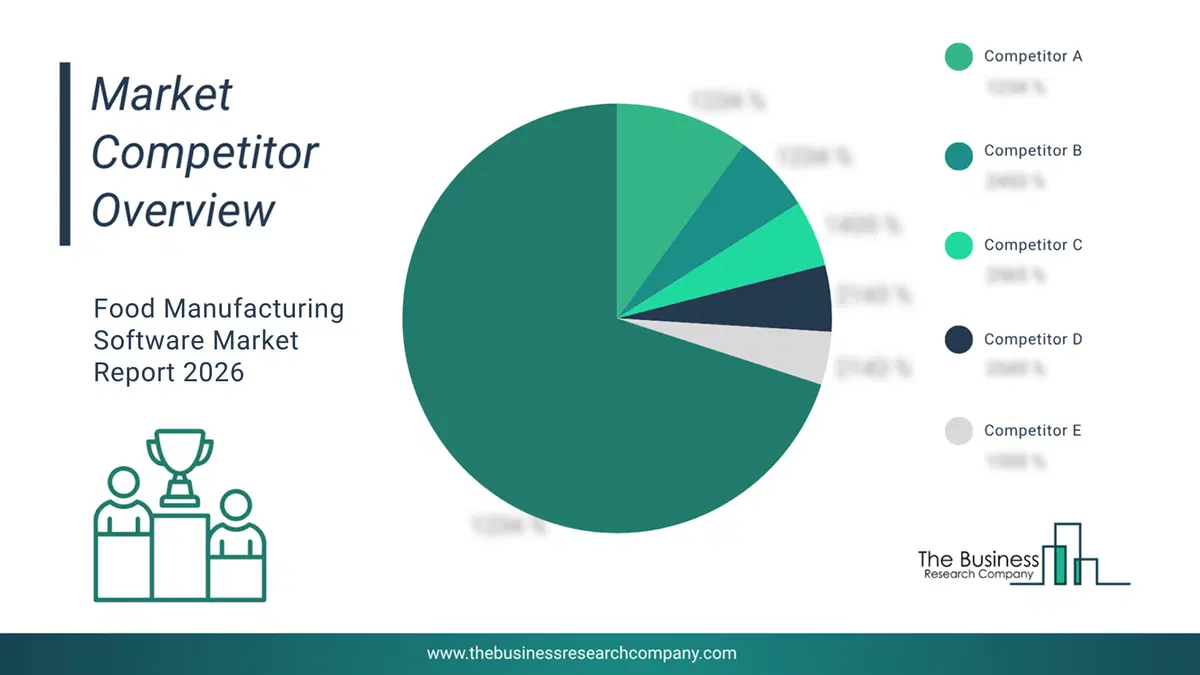
This chart is for illustrative purposes; the full report includes a detailed competitor analysis and comprehensive overview of the top 10 companies in the market.
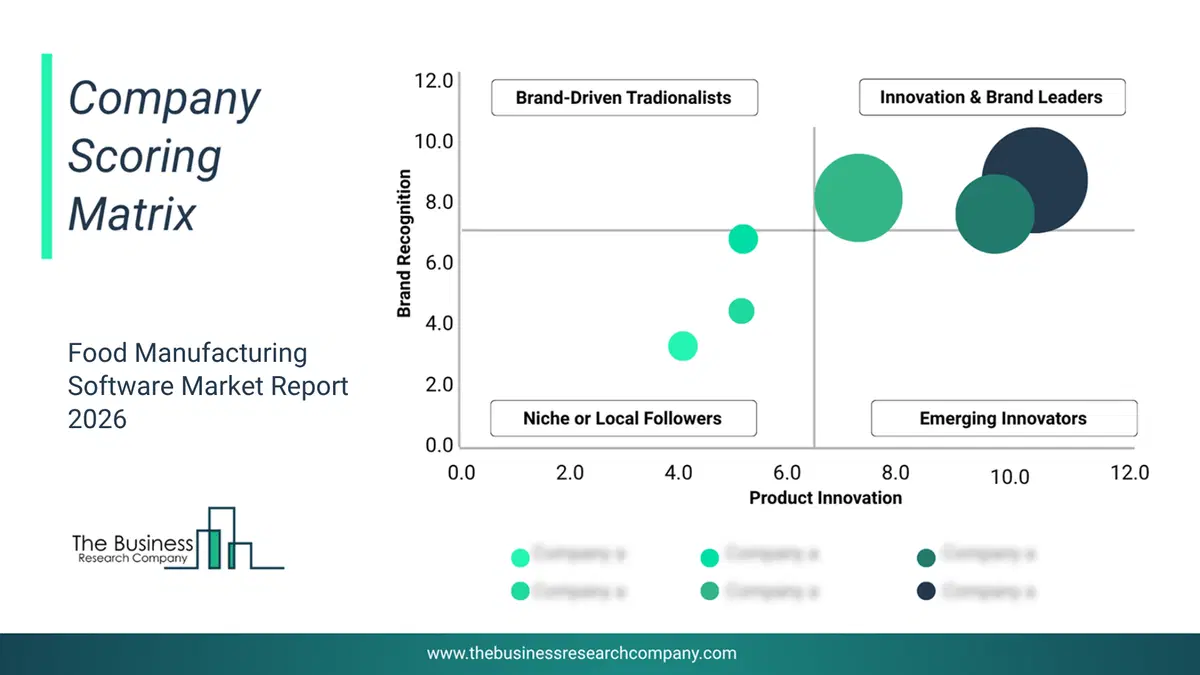
This chart maps companies by product innovation and brand strength, with bubble size indicating relative revenue, helping identify market leaders, challengers, and niche players. This is an illustrative chart; the full report provides a complete and accurate competitive analysis.
Global Food Manufacturing Software Market Trends and Insights
Major companies operating in the food manufacturing software market are focusing on leveraging innovative solutions such as integrated enterprise resource planning (ERP) platforms to enhance operational visibility and efficiency. Integrated ERP platforms are enterprise systems that unify financial, supply chain, inventory, production, and compliance functions into a single real time environment, enabling streamlined workflows, end to end traceability, and improved decision making. For instance, in January 2025, Vormittag Associates Inc. (VAI), a US-based ERP software developer, launched S2K Food Release 6.2, an integrated ERP solution designed to support food distributors in managing supply chain complexity and growth, featuring upgrades such as route and load management, rebate and billback management, and support for catchweight and broken case processing. S2K Food Release 6.2 improves automation, cost control, and real time operational insights across financial management, inventory management, warehouse management, demand planning, CRM, ecommerce, and process manufacturing.What Are Latest Mergers And Acquisitions In The Food Manufacturing Software Market?
In February 2023, QAD Inc., a US-based software company, acquired Redzone for an undisclosed amount. With this acquisition, QAD Inc. aims to enhance productivity and frontline engagement for manufacturers by seamlessly connecting and empowering the workforce, thereby fortifying its vision of the Adaptive Enterprise to optimize efficiency, agility, and resilience from the shop floor to the top floor. Redzone is a US-based company that offers specialized food manufacturing software designed to enhance productivity, ensure compliance, and foster a connected workforce on the shop floor.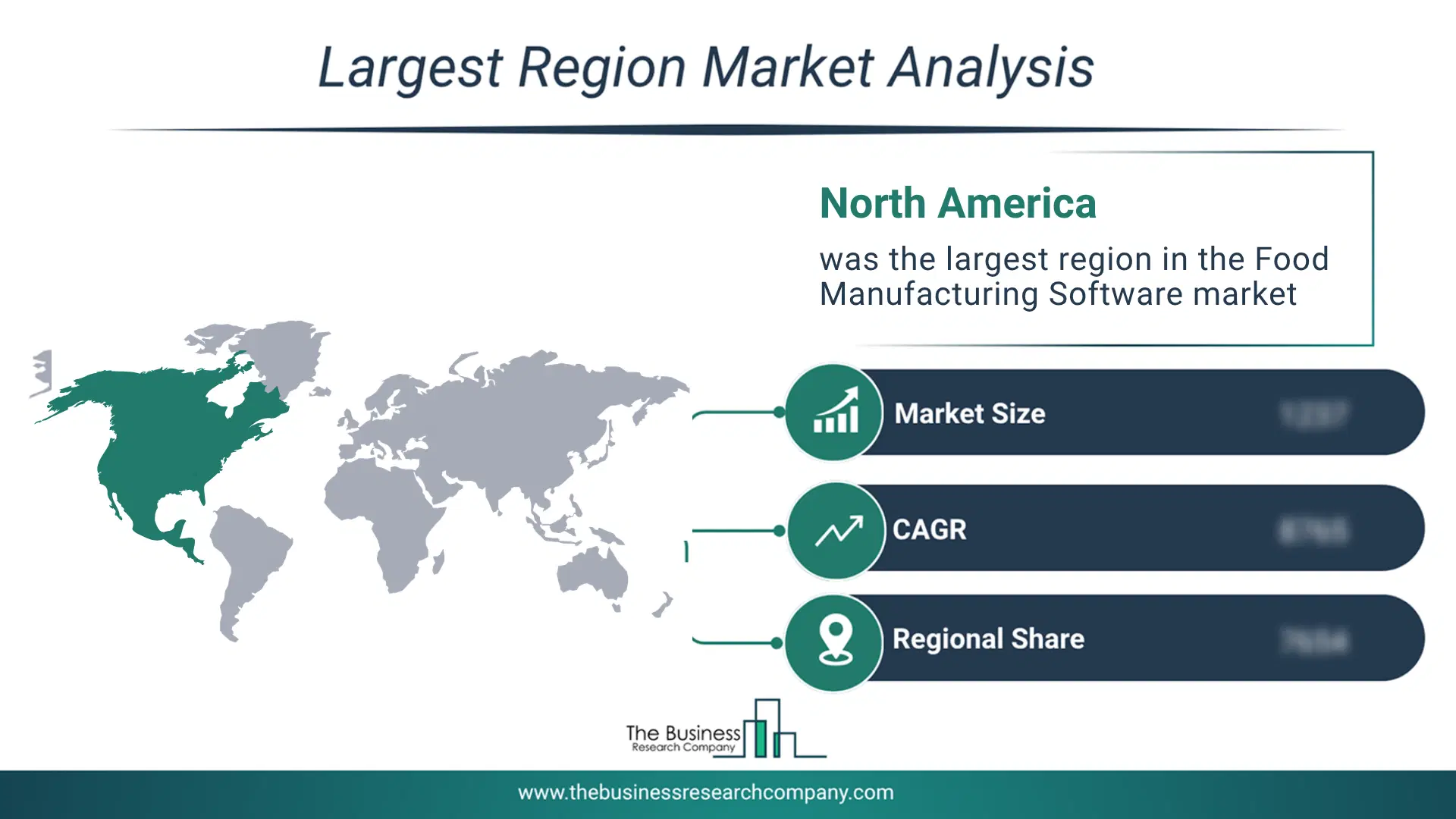
Regional Outlook
North America was the largest region in the food manufacturing software market in 2025. Asia-Pacific is expected to be the fastest-growing region in the forecast period. The regions covered in this market report are Asia-Pacific, South East Asia, Western Europe, Eastern Europe, North America, South America, Middle East and Africa. The countries covered in this market report are Australia, Brazil, China, France, Germany, India, Indonesia, Japan, Taiwan, Russia, South Korea, UK, USA, Italy, Spain, CanadaWhat Defines the Food Manufacturing Software Market?
The food manufacturing software market consists of revenues earned by entities by providing services such as production planning and scheduling, inventory and supply chain management, quality control and compliance management, recipe and formulation management, and sales and distribution management. The market value includes the value of related goods sold by the service provider or included within the service offering. The food manufacturing software market also includes sales of enterprise resource planning (ERP) systems, manufacturing execution systems, quality management systems, supply chain management (SCM) software, and food traceability software. Values in this market are ‘factory gate’ values; that is, the value of goods sold by the manufacturers or creators of the goods, whether to other entities (including downstream manufacturers, wholesalers, distributors, and retailers) or directly to end customers. The value of goods in this market includes related services sold by the creators of the goods.How is Market Value Defined and Measured?
The market value is defined as the revenues that enterprises gain from the sale of goods and/or services within the specified market and geography through sales, grants, or donations in terms of the currency (in USD unless otherwise specified). The revenues for a specified geography are consumption values that are revenues generated by organizations in the specified geography within the market, irrespective of where they are produced. It does not include revenues from resales along the supply chain, either further along the supply chain or as part of other products.
This chart presents market attractiveness based on a quantitative evaluation of growth, competition, strategic alignment, and risk, offering a clear view of opportunity areas for decision-making. This chart is for illustrative purposes; the full report contains the complete analysis.

This chart highlights the Total Addressable Market (TAM) by estimating the maximum revenue opportunity using an assumption-driven approach, supporting strategic planning and opportunity sizing across markets. The chart is illustrative; the full report provides a more comprehensive analysis.
What Key Data and Analysis Are Included in the Food Manufacturing Software Market Report 2026?
The food manufacturing software market research report is one of a series of new reports from The Business Research Company that provides market statistics, including industry global market size, regional shares, competitors with the market share, detailed market segments, market trends and opportunities, and any further data you may need to thrive in the food manufacturing software industry. The market research report delivers a complete perspective of everything you need, with an in-depth analysis of the current and future state of the industry.Food Manufacturing Software Market Report Forecast Analysis
| Report Attribute | Details |
|---|---|
| Market Size Value In 2026 | $6.34 billion |
| Revenue Forecast In 2030 | $8.78 billion |
| Growth Rate | CAGR of 8.9% from 2026 to 2030 |
| Base Year For Estimation | 2025 |
| Actual Estimates/Historical Data | 2020-2025 |
| Forecast Period | 2026 - 2030 |
| Market Representation | Revenue in USD Billion and CAGR from 2026 to 2030 |
| Segments Covered | Component, Deployment Mode, Enterprise Size, Application, End User |
| Regional Scope | Asia-Pacific, Western Europe, Eastern Europe, North America, South America, Middle East, Africa |
| Country Scope | The countries covered in the report are Australia, Brazil, China, France, Germany, India, Indonesia, Japan, Taiwan, Russia, South Korea, UK, USA, Canada, Italy, Spain. |
| Key Companies Profiled | SAP SE, Sage Group, The Sage Group plc, Vicinity Manufacturing ERP Solutions, MasterControl Inc., iRely India Private Limited., CSB-System AG, Datacor Enterprise Resource Planning (ERP) Software, BatchMaster Software Manufacturing ERP, SYSPRO ERP Software, Katana Manufacturing ERP by Katana Corp, YAVEON ProBatch, inecta Food ERP, Plex Systems Inc., Royal 4 Systems Inc., LYNQ Limited., Food Decision Software Inc., JustFood ERP, Mar-Kov Computer Systems Inc., FlexiBake Software Ltd. |
| Customization Scope | Request for Customization |
| Pricing And Purchase Options | Explore Purchase Options |