
Food Testing Services Market Report 2026
Global Outlook – By Testing Type (Microbiological Testing, Chemical Testing, Allergen Testing, Molecular Testing), By Technology (Traditional, Rapid), By Food Products Tested (Dairy Products, Meat And Seafood, Fruits And Vegetables, Cereals And Grains, Beverages, Processed And Packaged Foods, Infant And Baby Food, Animal Feed, Pet Food), By End-User (Food Manufacturers, Food Service Providers, Government Agencies, Other End-Users) – Market Size, Trends, Strategies, and Forecast to 2030
Food Testing Services Market Overview
• Food Testing Services market size has reached to $23.4 billion in 2025 • Expected to grow to $35.62 billion in 2030 at a compound annual growth rate (CAGR) of 8.7% • Growth Driver: Growing Demand For Clean-Label And Organic Food Fueling The Growth Due To Increasing Need For Verification And Certification Compliance • Market Trend: Advancing Food Safety Testing Through Next-Generation High-Resolution Mass Detection • North America was the largest region in 2025 and Asia-Pacific is the fastest growing region.Market Gains By 2030 – Top Opportunities By Segment
Market Gain identifies the most promising market opportunities by highlighting the segments or products expected to generate the highest incremental revenue growth over the next five years.
What Is Covered Under Food Testing Services Market?
Food testing services refer to laboratory and analytical procedures used to evaluate the safety, quality, and composition of food products. These services help detect contaminants, pathogens, additives, and nutritional content to ensure compliance with regulatory standards. Food testing services are used to safeguard consumer health, maintain product quality, and support food manufacturers in meeting safety regulations and market requirements. The main testing types of food testing services are microbiological testing, chemical testing, allergen testing, and molecular testing. Microbiological testing refers to the analysis of samples to detect, identify, and measure microorganisms such as bacteria, viruses, fungi, and yeasts to ensure safety, quality, and compliance. These utilize various technologies, including traditional methods and rapid testing techniques, and are applied across a wide range of food products, including dairy products, meat and seafood, fruits and vegetables, cereals and grains, beverages, processed and packaged foods, infant and baby food, animal feed, and pet food. These services support various end-users, such as food manufacturers, food service providers, government agencies, and others.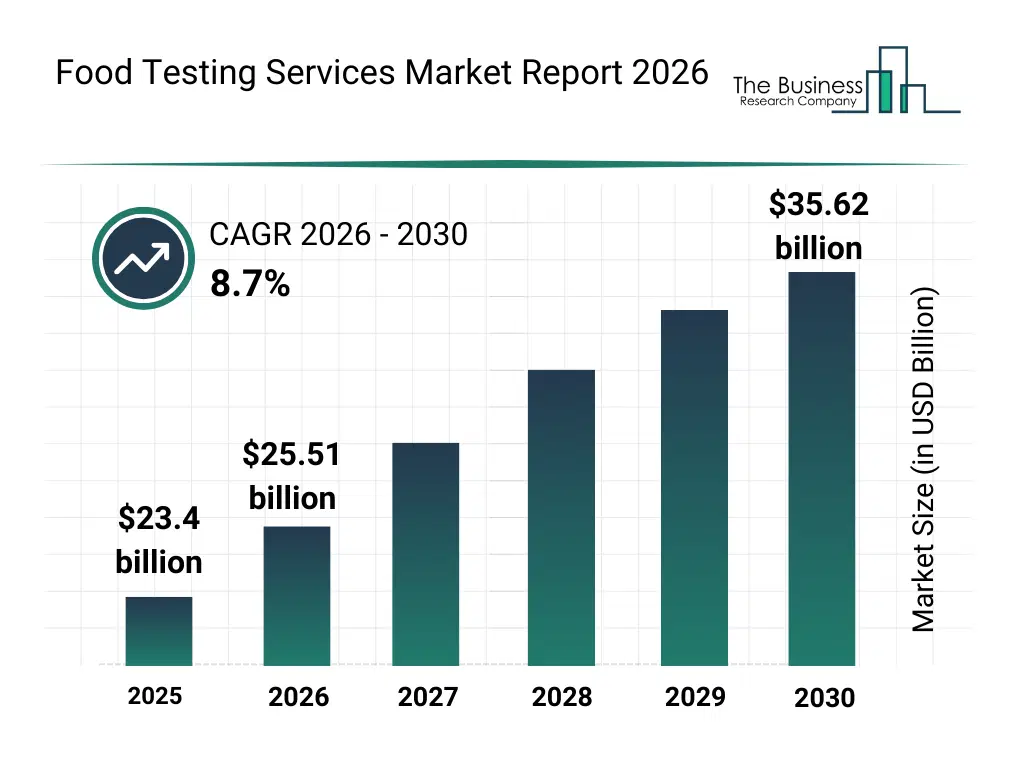
What Is The Food Testing Services Market Size and Share 2026?
The food testing services market size has grown strongly in recent years. It will grow from $23.4 billion in 2025 to $25.51 billion in 2026 at a compound annual growth rate (CAGR) of 9.0%. The growth in the historic period can be attributed to increasing food safety incidents, tightening regulatory testing requirements, expansion of packaged and processed food consumption, growth of global food supply chains, rising public health monitoring activities.What Is The Food Testing Services Market Growth Forecast?
The food testing services market size is expected to see strong growth in the next few years. It will grow to $35.62 billion in 2030 at a compound annual growth rate (CAGR) of 8.7%. The growth in the forecast period can be attributed to increasing adoption of real-time testing solutions, rising investments in advanced analytical technologies, expansion of pathogen surveillance programs, growing focus on preventive food safety management, increasing use of ai-enabled testing platforms. Major trends in the forecast period include increasing adoption of rapid testing technologies, rising use of molecular and pcr-based testing, growing integration of automated laboratory systems, expansion of multi-residue contaminant testing, enhanced focus on data-driven food safety analytics.
Global Food Testing Services Market Segmentation
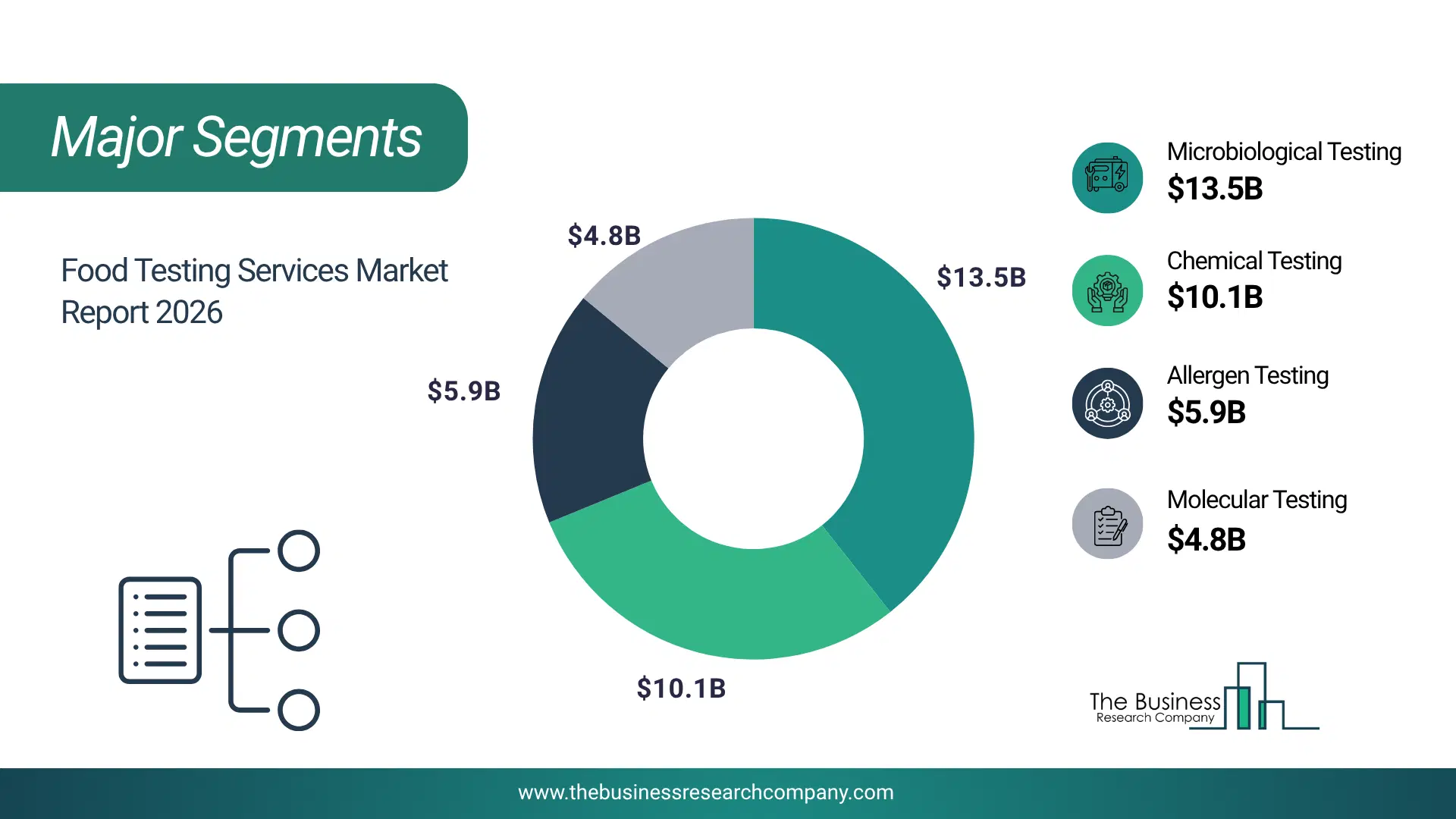
1) By Testing Type: Microbiological Testing, Chemical Testing, Allergen Testing, Molecular Testing 2) By Technology: Traditional, Rapid 3) By Food Products Tested: Dairy Products, Meat And Seafood, Fruits And Vegetables, Cereals And Grains, Beverages, Processed And Packaged Foods, Infant And Baby Food, Animal Feed, Pet Food 4) By End-User: Food Manufacturers, Food Service Providers, Government Agencies, Other End-Users Subsegments: 1) By Microbiological Testing: Pathogen Testing, Spoilage Microorganism Testing, Indicator Organism Testing, Probiotic Testing, Allergen-Related Microbial Testing, Rapid Microbial Detection, Antibiotic Residue Testing 2) By Chemical Testing: Pesticide Residue Analysis, Heavy Metal Testing, Additive And Preservative Testing, Mycotoxin Testing, Nutrient Composition Analysis, Contaminant Screening, Allergen Testing 3) By Allergen Testing: Milk, Eggs, Peanuts, Tree Nuts, Soy, Wheat, Fish, Shellfish, Sesame, Others 4) By Molecular Testing: Polymerase Chain Reaction (PCR), Real-Time Polymerase Chain Reaction, Digital Polymerase Chain Reaction, Next-Generation Sequencing (NGS), Loop-Mediated Isothermal Amplification (LAMP), Enzyme-Linked Immunosorbent Assay (ELISA), DNA Microarray, Hybridization Assays The top segments in the food testing services market will be: • Microbiological Testing will reach $13.45 billion by 2030. • Chemical Testing will reach $10.01 billion by 2030. • Allergen Testing will reach $5.88 billion by 2030. • Molecular Testing will reach $4.75 billion by 2030.What Is The Driver Of The Food Testing Services Market?
The growing demand for clean-label and organic food is expected to propel the growth of the food testing services market going forward. Clean-label and organic food refers to food products that are made with natural, minimally processed ingredients that are free from artificial additives, preservatives, colors, and genetically modified organisms and are produced in accordance with certified organic farming and processing standards. The growing demand for clean-label and organic food is primarily driven by increasing consumer emphasis on health and transparency, as individuals seek greater assurance regarding the quality, safety, and ethical sourcing of the products they consume. In response, food testing services help verify ingredient authenticity, detect contaminants, and ensure regulatory compliance, thereby reinforcing consumer trust and supporting the sustained growth of the clean-label and organic food. For instance, in April 2025, according to the Organic Trade Association (OTA), a US-based trade association, U.S. sales of certified organic products grew by 5.2% in 2024 more than twice the 2.5% growth rate of the overall market reaching a record high of $71.6 billion. Therefore, the growing demand for clean-label and organic food is driving the growth of the food testing services industry.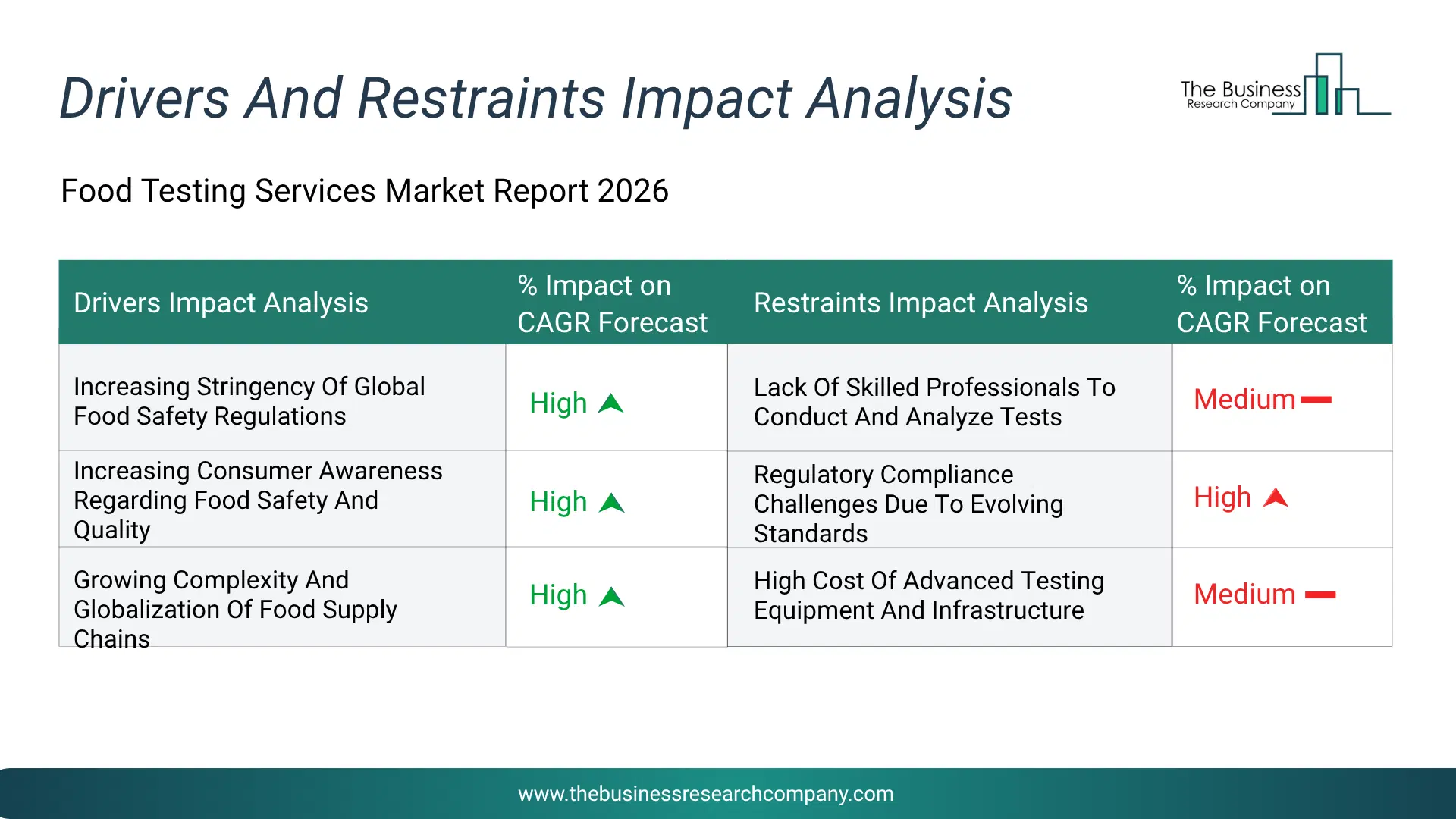
Infographic Chart Showing Key Market Drivers Analysis And Restraints For Food Testing Services Market
The chart presents an impact analysis of key drivers and restraints, quantifying their relative influence on the market's growth rate and helping assess the balance between growth enablers and limiting factors. This chart offers a high-level perspective; the full report contains more detailed insights.
How Will The Drivers Impact Growth In The Global Food Testing Services Market?
• Increasing Stringency Of Global Food Safety Regulations (High) – During the forecast period, the increasing stringency of global food safety regulations is expected to become a key growth driver for the food testing services market by 2030. The tightening of global food safety regulations is accelerating the demand for food testing services by requiring manufacturers and suppliers to comply with more rigorous safety standards. Regulatory authorities worldwide are implementing stricter testing procedures to reduce risks associated with contamination, adulteration, and foodborne diseases. This heightened regulatory oversight is increasing the need for advanced analytical testing, certification, and quality assurance services. Consequently, food producers increasingly depend on specialized laboratories to validate product safety, quality, and traceability. Ultimately, stronger regulations enhance consumer trust while expanding the global demand for food testing services. • Increasing Consumer Awareness Regarding Food Safety And Quality (High) – During the forecast period, the increasing consumer awareness regarding food safety and quality is expected to emerge as a major factor driving the expansion of the food testing services market by 2030. Growing consumer awareness regarding food safety and product quality is significantly driving the demand for food testing services, as consumers increasingly seek transparency and assurance about the food they consume. Heightened concerns about foodborne illnesses, contamination, and adulteration are encouraging manufacturers to adopt stricter testing and certification practices. This rising awareness is pushing food producers to comply with safety regulations and labelling standards more rigorously. As a result, testing laboratories are witnessing increased demand for analytical, verification, and quality assessment services. Overall, informed consumer behaviour is strengthening the global demand for reliable food testing solutions. • Growing Complexity And Globalization Of Food Supply Chains (High) – During the forecast period, the growing complexity and globalization of food supply chains are expected to act as key growth catalysts for the food testing services market by 2030. The increasing complexity and globalization of food supply chains are driving demand for food testing services by intensifying the need for safety verification, traceability, and quality assurance across international markets. As food ingredients are sourced, processed, and distributed across multiple regions, the risks of contamination, adulteration, and regulatory noncompliance increase. This evolving supply chain landscape encourages manufacturers and regulators to rely more heavily on rigorous testing to ensure product integrity and authenticity. Food testing services play a vital role in confirming that products meet diverse international regulatory standards and labelling requirements. Consequently, the expansion and interconnectivity of global food supply networks significantly strengthen the demand for advanced food testing solutions.How Will The Restraints Impact Growth In The Global Food Testing Services Market?
• Lack Of Skilled Professionals To Conduct And Analyze Tests (Medium) – During the forecast period, the the lack of skilled professionals to conduct and analyze tests acts as a major restraint for the food testing services market. Accurate food testing requires trained experts who can handle advanced instruments, interpret complex results, and ensure regulatory compliance. A shortage of qualified technicians and analysts leads to delays, errors, and reduced testing capacity. This skill gap also limits the adoption of modern analytical technologies and automation tools. Consequently, the overall efficiency, reliability, and scalability of food testing operations are adversely affected. • Regulatory Compliance Challenges Due To Evolving Standards (High) – During the forecast period, the regulatory compliance challenges due to evolving standards act as a major restraint for food testing services because frequent changes in food safety regulations require constant updates in testing methods, documentation, and certifications. Laboratories must invest in new equipment, retrain staff, and adjust procedures to meet updated regional and international requirements. This increases operational costs and slows testing turnaround times. Moreover, varying standards across countries create additional complexity for global food manufacturers. As a result, maintaining compliance becomes resource-intensive, limiting efficiency and profitability in the food testing industry. • High Cost Of Advanced Testing Equipment And Infrastructure (Medium) – During the forecast period, the the high cost of advanced testing equipment and infrastructure acts as a major restraint for the food testing services market because it increases the initial investment and ongoing operational expenses for laboratories. Sophisticated instruments such as chromatographs, spectrometers, and molecular analyzers require substantial capital, regular maintenance, and skilled operators. Smaller testing facilities and emerging market players often struggle to afford such technologies, limiting their service range and competitiveness. High infrastructure costs also slow the adoption of innovative testing methods. Consequently, this financial burden restricts market expansion and accessibility of reliable testing services.Key Players In The Global Food Testing Services Market
Major companies operating in the food testing services market are Eurofins Scientific SE, Mérieux NutriSciences Corporation, Société Générale de Surveillance S.A. (SGS SA), Intertek Group plc, Bureau Veritas S.A., Australian Laboratory Services Pty Ltd (ALS Limited / ALS Global), Element Materials Technology Ltd. (Element), Neogen Corporation, Underwriters Laboratories LLC (UL LLC / UL Solutions), Technischer Überwachungsverein Süd Aktiengesellschaft (TÜV SÜD AG), DEKRA SE, Quality Inspection Management Asia (QIMA), Environmental Microbiology Services Laboratory Inc. (EMSL Analytical Inc.), Tentamus Group GmbH, Campden BRI (Campden and Chorleywood Food Research Association Group), Food Safety Net Services Inc. (FSNS), Microbac Laboratories Inc., IEH Laboratories & Consulting Group, Romer Labs Division Holding GmbH, Symbio Laboratories, AsureQuality Limited, R J Hill Laboratories Limited, Reading Scientific Services Ltd. (RSSL), National Sanitation Foundation International (NSF International), Q Laboratories Inc., FoodChain ID Inc., Institut für Produktqualität GmbH, and Canadian Analytical Laboratories Inc.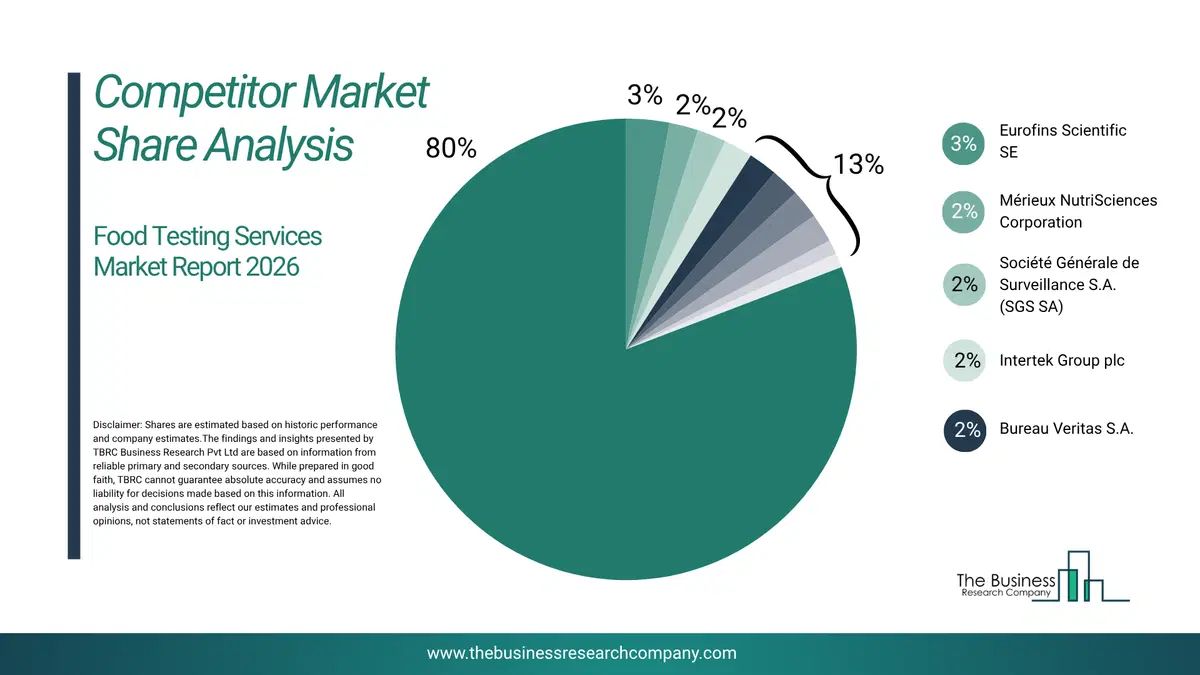
This chart is for illustrative purposes; the full report includes a detailed competitor analysis and comprehensive overview of the top 10 companies in the market.
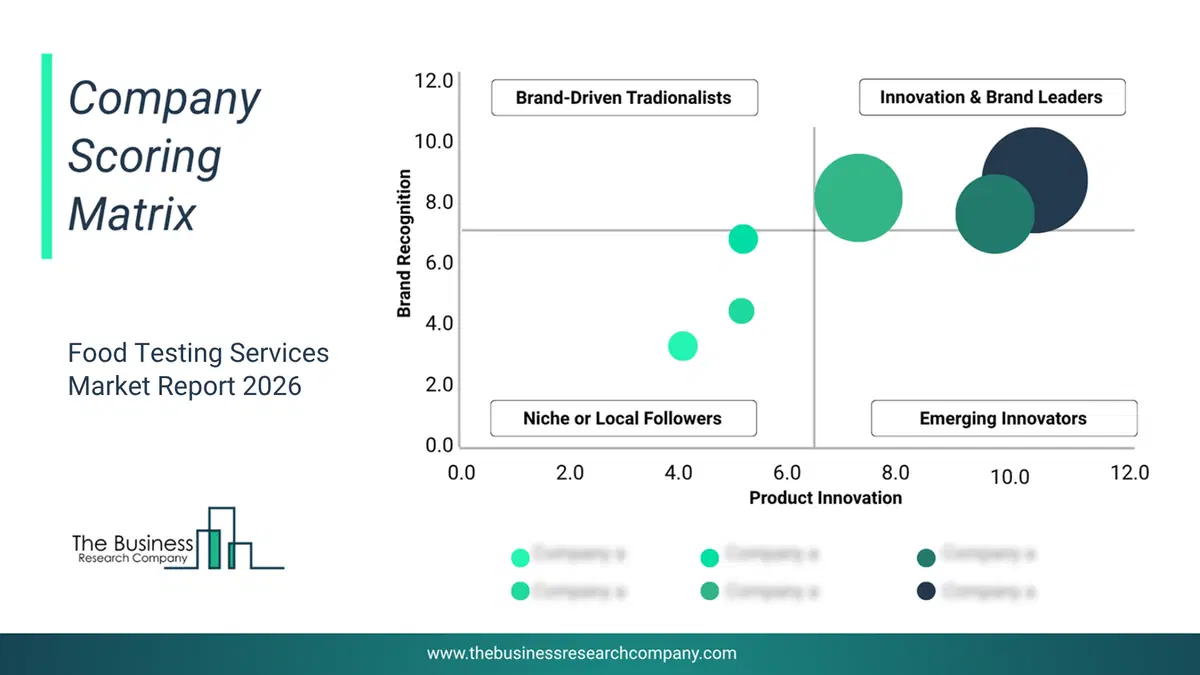
This chart maps companies by product innovation and brand strength, with bubble size indicating relative revenue, helping identify market leaders, challengers, and niche players. This is an illustrative chart; the full report provides a complete and accurate competitive analysis.
Global Food Testing Services Market Trends and Insights
Major companies operating in the food testing services market are focusing on developing innovative advancements such as high-resolution mass detectors to enhance the accuracy and efficiency of contaminant detection in food samples. A high-resolution mass detector is an analytical instrument that precisely measures the mass of chemical compounds at high resolution, enabling the identification and quantification of trace contaminants such as pesticides, per- and polyfluoroalkyl substances (PFAS), and other pollutants in complex food matrices. For instance, in October 2025, Thermo Fisher Scientific, a US-based provider of scientific instrumentation and laboratory solutions, launched the Thermo Scientific Orbitrap Exploris EFOX Mass Detector. The system is specifically designed for environmental and food safety laboratories, offering research-grade performance for routine testing with enhanced detection of PFAS and other contaminants. It enables faster, more reliable analysis through integrated workflows, full-scan data collection, and simplified operation, supporting laboratories in meeting stringent regulatory and quality requirements efficiently.What Are Latest Mergers And Acquisitions In The Food Testing Services Market?
In October 2025, the National Sanitation Foundation (NSF), a US-based provider of public health, safety, and quality assurance services, acquired Cambium Analytica for an undisclosed amount. With this acquisition, NSF aims to expand its analytical testing and product development capabilities across the natural food, beverage, and dietary supplement sectors, strengthening its position in the rapidly growing food and nutrition market. Cambium Analytica is a US-based analytical testing and development company offering in-process quality assurance, batch release testing, contract research, and product development services for natural food, beverage, and supplement manufacturers.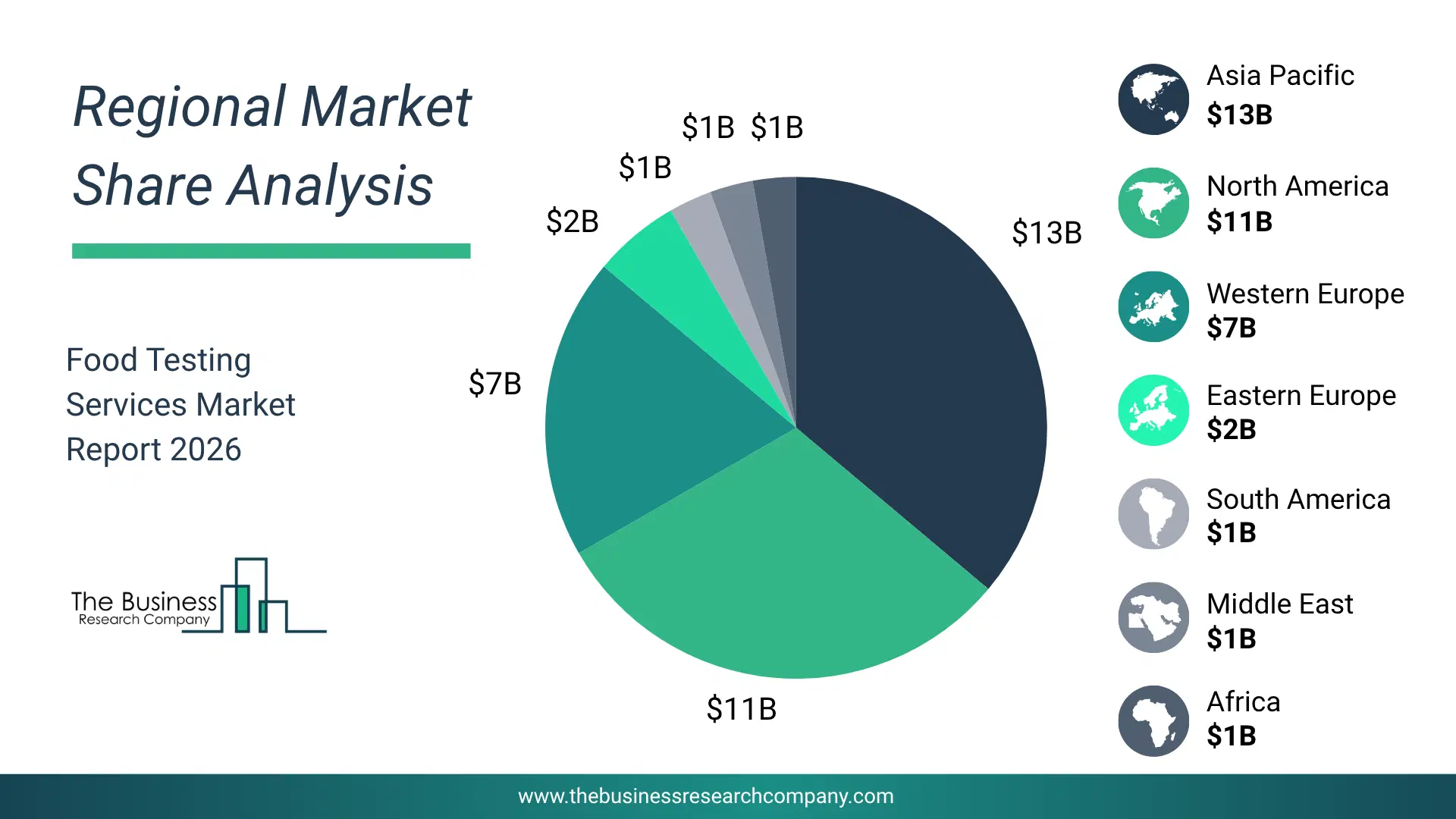
Regional Outlook
North America was the largest region in the food testing services market in 2025. Asia-Pacific is expected to be the fastest-growing region in the forecast period. The regions covered in this market report are Asia-Pacific, South East Asia, Western Europe, Eastern Europe, North America, South America, Middle East and Africa. The countries covered in this market report are Australia, Brazil, China, France, Germany, India, Indonesia, Japan, Taiwan, Russia, South Korea, UK, USA, Italy, Spain, CanadaWhat Defines the Food Testing Services Market?
The food testing services market includes revenues earned by entities through testing for contaminants and allergens, verifying nutritional content, providing certification and compliance services, and offering advisory and laboratory support. The market value includes the value of related goods sold by the service provider or included within the service offering. Only goods and services traded between entities or sold to end consumers are included.How is Market Value Defined and Measured?
The market value is defined as the revenues that enterprises gain from the sale of goods and/or services within the specified market and geography through sales, grants, or donations in terms of the currency (in USD unless otherwise specified). The revenues for a specified geography are consumption values that are revenues generated by organizations in the specified geography within the market, irrespective of where they are produced. It does not include revenues from resales along the supply chain, either further along the supply chain or as part of other products.
This chart presents market attractiveness based on a quantitative evaluation of growth, competition, strategic alignment, and risk, offering a clear view of opportunity areas for decision-making. This chart is for illustrative purposes; the full report contains the complete analysis.

This chart highlights the Total Addressable Market (TAM) by estimating the maximum revenue opportunity using an assumption-driven approach, supporting strategic planning and opportunity sizing across markets. The chart is illustrative; the full report provides a more comprehensive analysis.
What Key Data and Analysis Are Included in the Food Testing Services Market Report 2026?
The food testing services market research report is one of a series of new reports from The Business Research Company that provides market statistics, including industry global market size, regional shares, competitors with the market share, detailed market segments, market trends and opportunities, and any further data you may need to thrive in the food testing services industry. The market research report delivers a complete perspective of everything you need, with an in-depth analysis of the current and future state of the industry.Food Testing Services Market Report Forecast Analysis
| Report Attribute | Details |
|---|---|
| Market Size Value In 2026 | $25.51 billion |
| Revenue Forecast In 2030 | $35.62 billion |
| Growth Rate | CAGR of 8.7% from 2026 to 2030 |
| Base Year For Estimation | 2025 |
| Actual Estimates/Historical Data | 2020-2025 |
| Forecast Period | 2026 - 2030 |
| Market Representation | Revenue in USD Billion and CAGR from 2026 to 2030 |
| Segments Covered | Testing Type, Technology, Food Products Tested, End-User |
| Regional Scope | Asia-Pacific, Western Europe, Eastern Europe, North America, South America, Middle East, Africa |
| Country Scope | The countries covered in the report are Australia, Brazil, China, France, Germany, India, ... |
| Key Companies Profiled | Eurofins Scientific SE, Mérieux NutriSciences Corporation, Société Générale de Surveillance S.A. (SGS SA), Intertek Group plc, Bureau Veritas S.A., Australian Laboratory Services Pty Ltd (ALS Limited / ALS Global), Element Materials Technology Ltd. (Element), Neogen Corporation, Underwriters Laboratories LLC (UL LLC / UL Solutions), Technischer Überwachungsverein Süd Aktiengesellschaft (TÜV SÜD AG), DEKRA SE, Quality Inspection Management Asia (QIMA), Environmental Microbiology Services Laboratory Inc. (EMSL Analytical Inc.), Tentamus Group GmbH, Campden BRI (Campden and Chorleywood Food Research Association Group), Food Safety Net Services Inc. (FSNS), Microbac Laboratories Inc., IEH Laboratories & Consulting Group, Romer Labs Division Holding GmbH, Symbio Laboratories, AsureQuality Limited, R J Hill Laboratories Limited, Reading Scientific Services Ltd. (RSSL), National Sanitation Foundation International (NSF International), Q Laboratories Inc., FoodChain ID Inc., Institut für Produktqualität GmbH, and Canadian Analytical Laboratories Inc. </b> |
| Customization Scope | Request for Customization |
| Pricing And Purchase Options | Explore Purchase Options |