
High-Precision GNSS Receiver Market Report 2026
Global Outlook – By Product (Core Satellite Navigation Systems, Regional Satellite Navigation Systems, Satellite - Based Augmentation Systems (SABS)), By Component (Devices, Services), By Application (Survey And Mapping, Astronomy, Military And Defense, Agriculture, Other Applications) – Market Size, Trends, Strategies, and Forecast to 2030
High-Precision GNSS Receiver Market Overview
• High-Precision GNSS Receiver market size has reached to $1.53 billion in 2025 • Expected to grow to $2.19 billion in 2030 at a compound annual growth rate (CAGR) of 7.4% • Growth Driver: Growing Mining Industry Fueling Expansion Of High-Precision GNSS Receiver Market • Market Trend: Innovative GNSS Receivers With Dead Reckoning Enhance Precision And Resilience In Challenging Environments • Asia-Pacific was the largest region in 2025.What Is Covered Under High-Precision GNSS Receiver Market?
A high-precision GNSS (Global Navigation Satellite System) receiver is a device designed to receive signals from satellites. These receivers utilize advanced algorithms and technologies to achieve centimeter-level or even millimeter-level accuracy in positioning. The main types of products included in high-precision GNSS receivers are core satellite navigation systems, regional satellite navigation systems, and satellite-based augmentation systems (SABS). Core satellite navigation systems refer to the primary satellite-based positioning systems that provide global coverage and accurate positioning services to users worldwide. It includes a variety of components, such as devices and services, which are used in different applications, such as survey and mapping, astronomy, military and defense, agriculture, and others.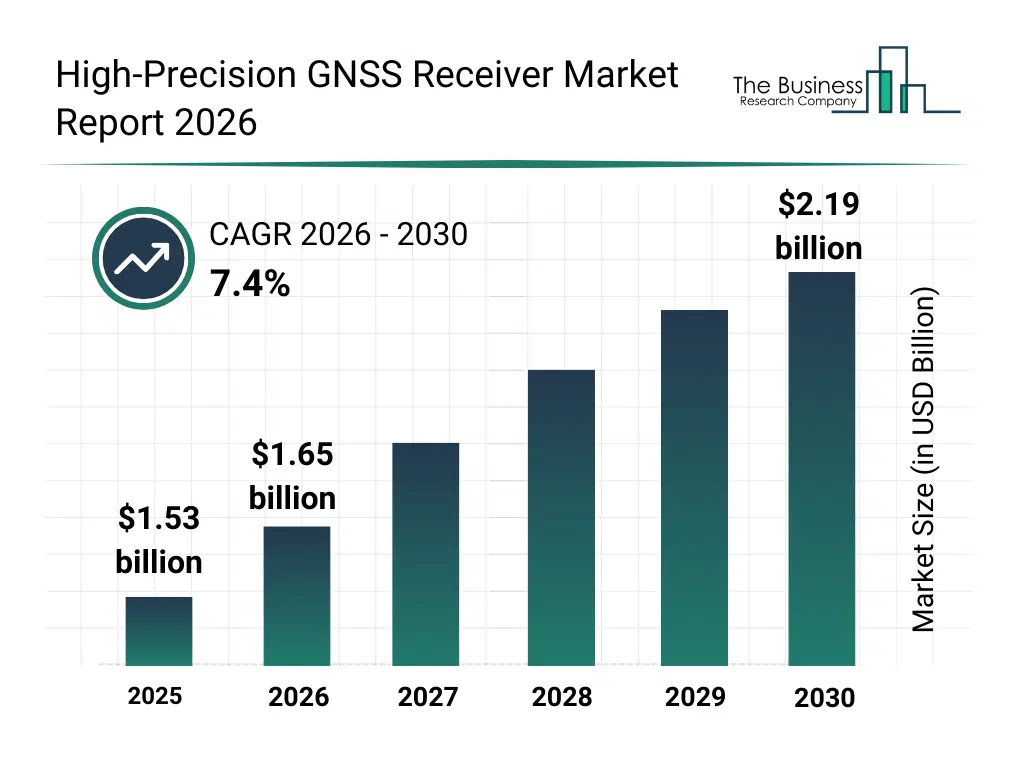
What Is The High-Precision GNSS Receiver Market Size and Share 2026?
The high-precision gnss receiver market size has grown strongly in recent years. It will grow from $1.53 billion in 2025 to $1.65 billion in 2026 at a compound annual growth rate (CAGR) of 7.5%. The growth in the historic period can be attributed to adoption in land surveying and mapping, defense and military navigation needs, growth of satellite infrastructure, demand for precision agriculture, expansion of geospatial data usage.What Is The High-Precision GNSS Receiver Market Growth Forecast?
The high-precision gnss receiver market size is expected to see strong growth in the next few years. It will grow to $2.19 billion in 2030 at a compound annual growth rate (CAGR) of 7.4%. The growth in the forecast period can be attributed to autonomous vehicle navigation requirements, smart infrastructure deployment, growth of precision farming, integration with iot platforms, demand for real-time location analytics. Major trends in the forecast period include centimeter-level positioning accuracy, multi-constellation signal processing, real-time kinematic (RTK) integration, miniaturization of gnss hardware, enhanced interference and jamming resistance.

Global High-Precision GNSS Receiver Market Segmentation
1) By Product: Core Satellite Navigation Systems, Regional Satellite Navigation Systems, Satellite - Based Augmentation Systems (SABS) 2) By Component: Devices, Services 3) By Application: Survey And Mapping, Astronomy, Military And Defense, Agriculture, Other Applications Subsegments: 1) By Core Satellite Navigation Systems: GPS (Global Positioning System), GLONASS (Global Navigation Satellite System), Galileo, BeiDou 2) By Regional Satellite Navigation Systems: WAAS (Wide Area Augmentation System), EGNOS (European Geostationary Navigation Overlay Service), MSAS (Multi-functional Satellite Augmentation System), GAGAN (GPS Aided Geo Augmented Navigation) 3) By Satellite-Based Augmentation Systems (SBAS): Local Area Augmentation Systems (LAAS), Differential GPS (DGPS), Ground-Based Augmentation Systems (GBAS)What Is The Driver Of The High-Precision GNSS Receiver Market?
The growing mining industry is expected to propel the growth of the high-precision GNSS receiver market going forward. The mining industry refers to the sector encompassing activities related to the exploration, extraction, processing, and transportation of valuable minerals, metals, and other geological materials from the earth's crust. The shift towards renewable energy sources, such as solar panels, wind turbines, and electric vehicles, requires significant amounts of minerals and metals. High-precision GNSS receivers are used in the mining sector to enhance operational efficiency, safety, and productivity by providing accurate positioning and geospatial data for various applications and enabling better decision-making. For instance, in March 2025, the United States Geological Survey, a US-based scientific government agency, reported that US metal mine production was valued at $33.5 billion in 2024, reflecting a slight increase from $33 billion in 2023. Therefore, the growing mining industry is driving the growth of the high-precision global navigation satellite system receiver market.Key Players In The Global High-Precision GNSS Receiver Market
Major companies operating in the high-precision gnss receiver market are Raytheon Technologies Corporation; Qualcomm Incorporated; Broadcom Inc.; Texas Instruments Incorporated; Thales Group; Hexagon AB; Trimble Inc.; Cobham PLC; MiTAC Holdings Corp.; Topcon Positioning Systems Inc.; Hi-Target Surveying Instrument Co. Ltd.; Raven Industries Inc.; CHC Navigation Technology Ltd.; Beijing UniStrong Science And Technology Co. Ltd.; Carlson Systems Holdings Inc.; Swift Navigation Inc.; Septentrio N.V.; Javad GNSS Inc.; Unicore Communications Inc.; NavCom Technology Inc.; Tersus GNSS Inc.; AG Leader Technology Inc.; Geneq Inc.; ComNav Technology Ltd.; Hemisphere GNSS Inc.
This chart is for illustrative purposes; the full report includes a detailed competitor analysis and comprehensive overview of the top 10 companies in the market.

This chart maps companies by product innovation and brand strength, with bubble size indicating relative revenue, helping identify market leaders, challengers, and niche players. This is an illustrative chart; the full report provides a complete and accurate competitive analysis.
Global High-Precision GNSS Receiver Market Trends and Insights
Major companies operating in the high-precision GNSS receiver market are focusing on developing innovative technological advancements, such as the dead reckoning (DR) functions, to ensure reliable positioning accuracy, improve signal resilience, and support navigation in challenging environments. DR calculates position shifts using prior location data and movement sensors, ensuring accurate tracking when GNSS signals are limited. For instance, in September 2024, Quectel Wireless Solutions Co. Ltd., a China-based IoT solutions provider, launched the QLM29H series GNSS receiver, which combines high-precision localization with easy integration. The dual-band QLM29H features an integrated antenna, supports both L1 and L5 signals, and is compatible with multiple GNSS constellations (GPS, GLONASS, Galileo, etc.). Equipped with sensitivity-enhancing filters, it seamlessly integrates with legacy systems and operates reliably in temperatures from -40°C to +85°C, making it ideal for applications in agriculture and micromobility.What Are Latest Mergers And Acquisitions In The High-Precision GNSS Receiver Market?
In October 2023, CNH Industrial N.V., a UK-based agricultural machinery company, acquired Hemisphere GNSS for $175 million. Through this acquisition, CNH will solidify its position as a leader in precision, automation, and autonomy technology for the agriculture and construction industries. It aimed to accelerate its development efforts, improve its product offerings, and gain a competitive edge in the long run. Hemisphere GNSS is a US-based provider of satellite positioning services. It offers high-precision GNSS receivers and positioning tools.
Regional Insights
Asia-Pacific was the largest region in the high-precision GNSS receiver market in 2025. The regions covered in this market report are Asia-Pacific, South East Asia, Western Europe, Eastern Europe, North America, South America, Middle East, Africa. The countries covered in this market report are Australia, Brazil, China, France, Germany, India, Indonesia, Japan, Taiwan, Russia, South Korea, UK, USA, Canada, Italy, SpainWhat Defines the High-Precision GNSS Receiver Market?
The high-precision GNSS receiver market consists of revenues earned by entities by providing services such as positioning services, navigation services, precision agriculture services, and geodetic and scientific research services. The market value includes the value of related goods sold by the service provider or included within the service offering. The high-precision GNSS receiver market also includes sales of single-frequency GNSS receivers, multi-frequency GNSS receivers, differential GNSS (DGNSS) receivers, OEM GNSS receiver modules, GNSS antennas and accessories, and real-time kinematic GNSS receivers. Values in this market are ‘factory gate’ values, that is the value of goods sold by the manufacturers or creators of the goods, whether to other entities (including downstream manufacturers, wholesalers, distributors and retailers) or directly to end customers. The value of goods in this market includes related services sold by the creators of the goods.How is Market Value Defined and Measured?
The market value is defined as the revenues that enterprises gain from the sale of goods and/or services within the specified market and geography through sales, grants, or donations in terms of the currency (in USD unless otherwise specified). The revenues for a specified geography are consumption values that are revenues generated by organizations in the specified geography within the market, irrespective of where they are produced. It does not include revenues from resales along the supply chain, either further along the supply chain or as part of other products.
This chart presents market attractiveness based on a quantitative evaluation of growth, competition, strategic alignment, and risk, offering a clear view of opportunity areas for decision-making. This chart is for illustrative purposes; the full report contains the complete analysis.

This chart highlights the Total Addressable Market (TAM) by estimating the maximum revenue opportunity using an assumption-driven approach, supporting strategic planning and opportunity sizing across markets. The chart is illustrative; the full report provides a more comprehensive analysis.
What Key Data and Analysis Are Included in the High-Precision GNSS Receiver Market Report 2026?
The high-precision gnss receiver market research report is one of a series of new reports from The Business Research Company that provides market statistics, including industry global market size, regional shares, competitors with the market share, detailed market segments, market trends and opportunities, and any further data you may need to thrive in the high-precision gnss receiver industry. The market research report delivers a complete perspective of everything you need, with an in-depth analysis of the current and future state of the industry.High-Precision GNSS Receiver Market Report Forecast Analysis
| Report Attribute | Details |
|---|---|
| Market Size Value In 2026 | $1.65 billion |
| Revenue Forecast In 2030 | $2.19 billion |
| Growth Rate | CAGR of 7.4% from 2026 to 2030 |
| Base Year For Estimation | 2025 |
| Actual Estimates/Historical Data | 2020-2025 |
| Forecast Period | 2026 - 2030 |
| Market Representation | Revenue in USD Billion and CAGR from 2026 to 2030 |
| Segments Covered | Product, Component, Application |
| Regional Scope | Asia-Pacific, Western Europe, Eastern Europe, North America, South America, Middle East, Africa |
| Country Scope | The Countries Covered In This Market Report Are Australia, Brazil, China, France, Germany, India, Indonesia, Japan, Taiwan, Russia, South Korea, Uk, Usa, Canada, Italy, Spain. |
| Key Companies Profiled | Raytheon Technologies Corporation, Qualcomm Incorporated, Broadcom Inc., Texas Instruments Incorporated, Thales Group, Hexagon AB, Trimble Inc., Cobham PLC, MiTAC Holdings Corp., Topcon Positioning Systems Inc., Hi-Target Surveying Instrument Co. Ltd., Raven Industries Inc., CHC Navigation Technology Ltd., Beijing UniStrong Science And Technology Co. Ltd., Carlson Systems Holdings Inc., Swift Navigation Inc., Septentrio N.V., Javad GNSS Inc., Unicore Communications Inc., NavCom Technology Inc., Tersus GNSS Inc., AG Leader Technology Inc., Geneq Inc., ComNav Technology Ltd., Hemisphere GNSS Inc. |
| Customization Scope | Request for Customization |
| Pricing And Purchase Options | Explore Purchase Options |