
Image Recognition In Retail Market Report 2026
Global Outlook – By Component (Hardware, Software, Services), By Type (Code Recognition, Digital Image Processing, Facial Recognition, Object Recognition, Other Types), By Deployment (On-Premises, Cloud), By Application (Scanning And Imaging, Image Search, Security And Surveillance, Augmented Reality, Marketing And Advertising, Other Applications) – Market Size, Trends, Strategies, and Forecast to 2030
Image Recognition In Retail Market Overview
• Image Recognition In Retail market size has reached to $2.85 billion in 2025 • Expected to grow to $7.07 billion in 2030 at a compound annual growth rate (CAGR) of 19.6% • Growth Driver: Online Retail Boom Fuels Demand For Image Recognition • Market Trend: Ai-Powered Image Recognition Tools Revolutionize Retail Shopping • North America was the largest region in 2025.What Is Covered Under Image Recognition In Retail Market?
Image recognition in retail is an algorithm that analyses a picture or video, decodes its information, and identifies the image as representing a certain brand, product, category, or something else entirely. Image recognition in retail is used to maintain shelf health, display compliance, competitive insight, and planogram compliance. The main types of image recognition in retail are code recognition, digital image processing, facial recognition, object recognition, and others. Code recognition is an identifying solution that can read and validate both QR codes, all conventional barcodes, and 2D data matrix codes. The various components include hardware, software, and services that are deployed through on-premises and cloud. The applications include scanning and imaging, image search, security and surveillance, augmented reality, marketing and advertising, and others.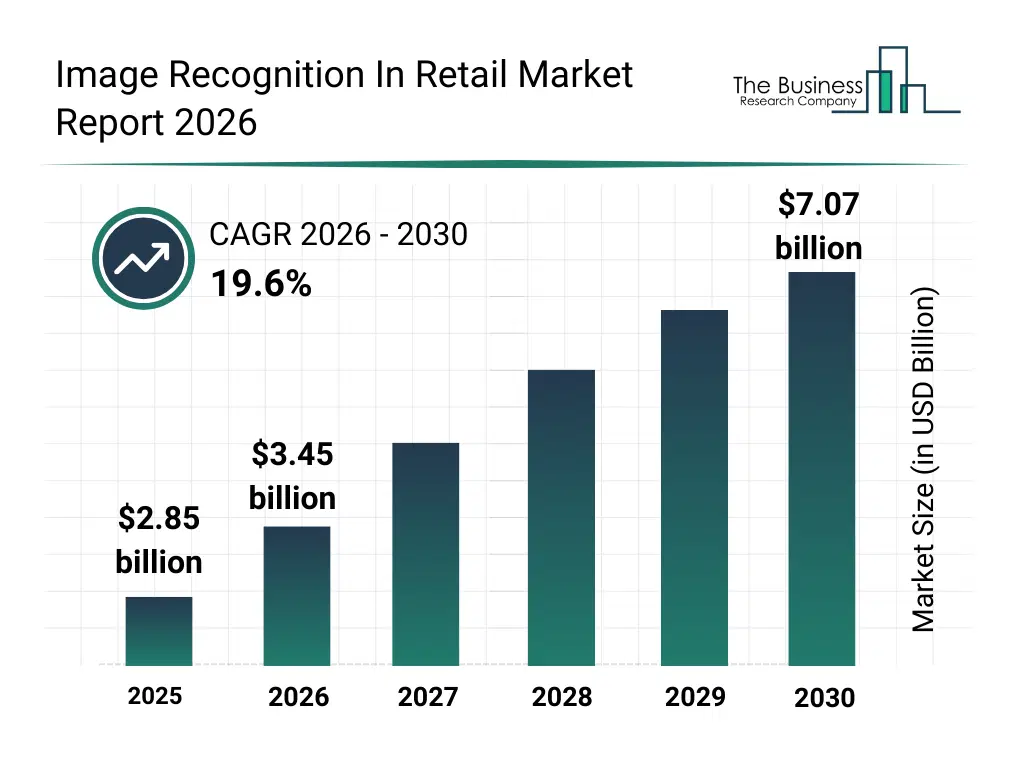
What Is The Image Recognition In Retail Market Size and Share 2026?
The image recognition in retail market size has grown exponentially in recent years. It will grow from $2.85 billion in 2025 to $3.45 billion in 2026 at a compound annual growth rate (CAGR) of 20.8%. The growth in the historic period can be attributed to increasing retail digitization initiatives, growth of organized retail formats, rising demand for in-store visibility, adoption of computer vision technologies, expansion of omnichannel retail strategies.What Is The Image Recognition In Retail Market Growth Forecast?
The image recognition in retail market size is expected to see rapid growth in the next few years. It will grow to $7.07 billion in 2030 at a compound annual growth rate (CAGR) of 19.6%. The growth in the forecast period can be attributed to growing investments in ai-powered retail analytics, rising demand for real-time merchandising insights, expansion of autonomous retail stores, increasing focus on loss prevention technologies, wider adoption of cloud-based image recognition. Major trends in the forecast period include increasing adoption of shelf analytics solutions, rising use of real-time image recognition systems, growing deployment of ai-based planogram compliance tools, expansion of automated visual auditing, enhanced integration with retail analytics platforms.
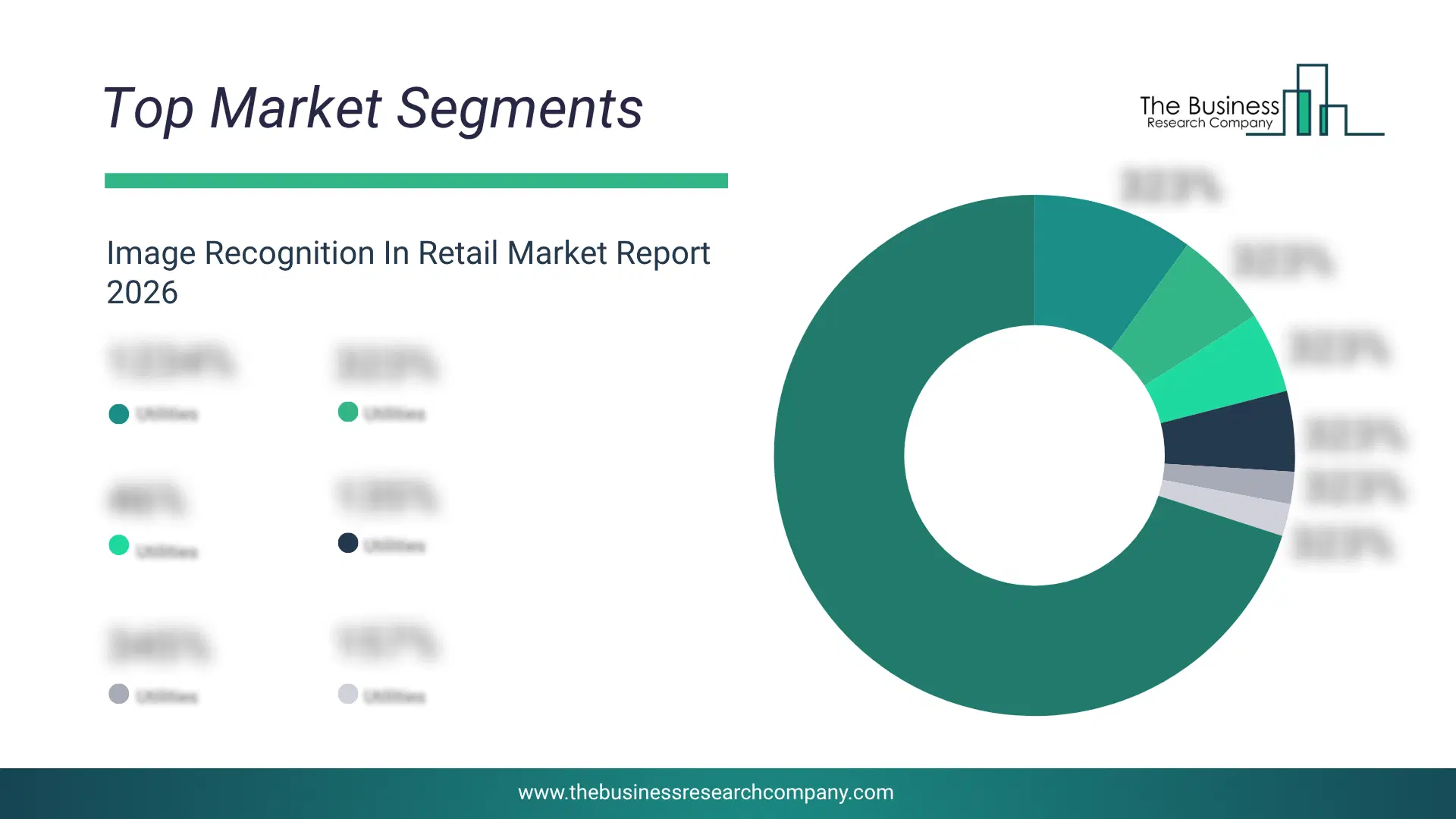
Global Image Recognition In Retail Market Segmentation
1) By Component: Hardware, Software, Services 2) By Type: Code Recognition, Digital Image Processing, Facial Recognition, Object Recognition, Other Types 3) By Deployment: On-Premises, Cloud 4) By Application: Scanning And Imaging, Image Search, Security And Surveillance, Augmented Reality, Marketing And Advertising, Other Applications Subsegments: 1) By Hardware: Cameras And Sensors, Edge Devices, Processing Units 2) By Software: Image Recognition Software, Machine Learning Algorithms, Analytics Software 3) By Services: Consulting Services, Implementation Services, Maintenance And Support Services, Training ServicesWhat Is The Driver Of The Image Recognition In Retail Market?
The expansion of online retail is expected to propel the growth of image recognition in retail market going forward. Online retail, also known as e-commerce, refers to the buying and selling of goods and services over the Internet. Image recognition in online retail enhances the shopping experience by enabling visual search, personalized product recommendations, and augmented reality features, thereby improving customer engagement and streamlining the purchase process. For instance, in April 2024, according to the European Commission, a Belgium-based governing body, implementing decisions, and upholding the EU treaties, among individuals aged 16–74 surveyed, 92% used the internet in the last year, with 70% purchasing goods or services, marking a 2% increase from 2022. Additionally, 75% of EU internet users bought items online in 2023, highlighting the continued growth of e-commerce. Therefore, the expansion of online retail is driving the growth of image recognition in retail industry.Key Players In The Global Image Recognition In Retail Market
Major companies operating in the image recognition in retail market are Catchoom Technologies S.L.; Ricoh Innovations Corporation; Blippar Ltd.; Google LLC; Wikitude GmbH; Trax Retail Solutions Pte. Ltd.; Snap2Insight Inc.; ClarifAI Inc.; Slyce Inc.; ParallelDots Inc.; NEC Corporation; Huawei Technologies Co. Ltd.; Qualcomm Incorporated; Amazon Web Services Inc.; Zippin Inc.; Vispera Information Technologies Ltd.; Hitachi Ltd.; NVIDIA Corporation; International Business Machines Corporation; Intel Corporation; Toshiba Corporation; Honeywell International Inc.; Sharp Corporation; Syte Visual Conception Ltd.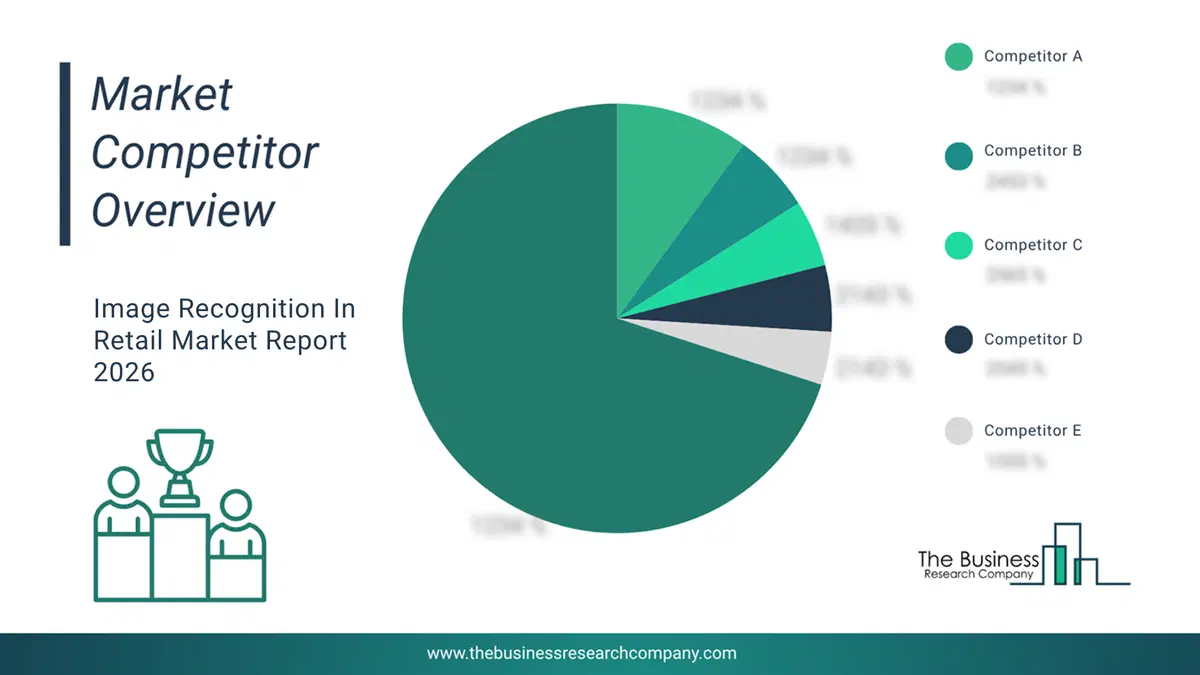
This chart is for illustrative purposes; the full report includes a detailed competitor analysis and comprehensive overview of the top 10 companies in the market.
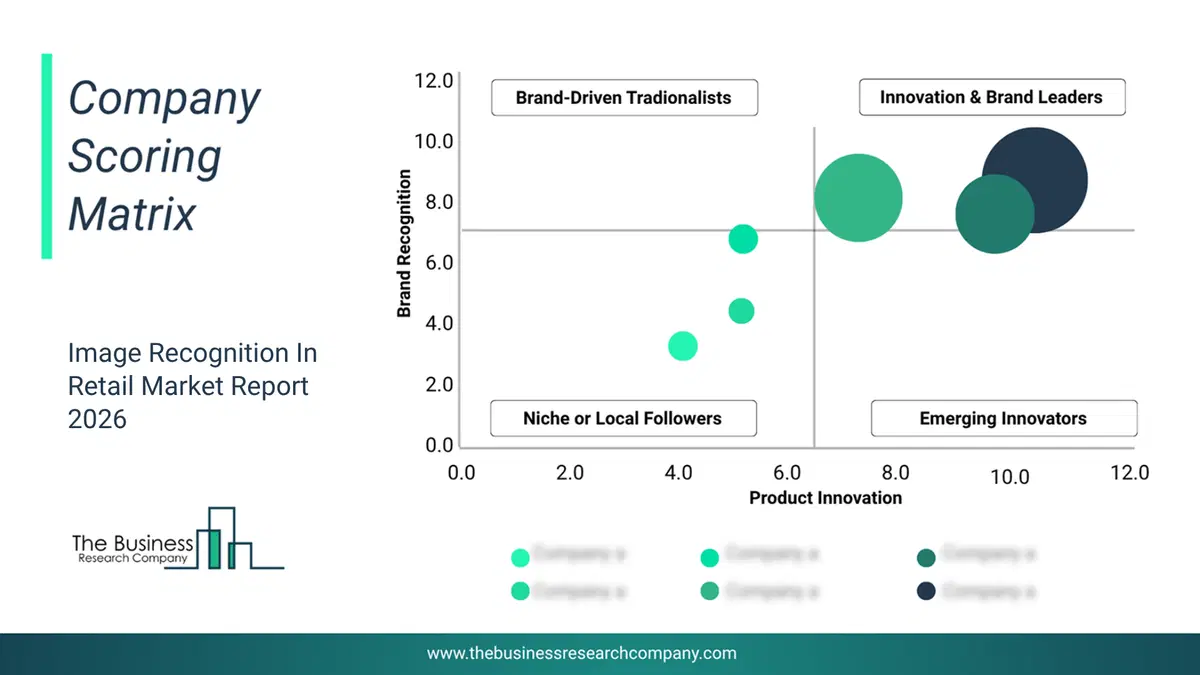
This chart maps companies by product innovation and brand strength, with bubble size indicating relative revenue, helping identify market leaders, challengers, and niche players. This is an illustrative chart; the full report provides a complete and accurate competitive analysis.
Global Image Recognition In Retail Market Trends and Insights
Major companies operating in the image recognition in retail market are increasing their focus on introducing AI-powered image recognition tools, such as Shopping Lens, to gain a competitive edge in the market. Shopping Lens is a feature that allows users to visually search and shop for items in the real world through their smartphones. For instance, in October 2023, Klarna, a Sweden-based financial services company, launched an AI-powered image recognition tool called Shopping Lens. This tool translates product images into search terms using artificial intelligence, guiding customers to the best deals available on Klarna's app. The tool aims to personalize and enhance the shopping experience for Klarna's approximately 150 million active users, aligning with the growing trend for AI shopping assistants and personalized experiences.What Are Latest Mergers And Acquisitions In The Image Recognition In Retail Market?
In March 2024, BigBear.ai, a US-based provider of AI-enabled business intelligence solutions, acquired Pangiam Intermediate Holdings LLC for $70 million. The acquisition aims to combine Pangiam's strengths in facial image recognition and advanced biometrics with BigBear.ai's existing computer vision capabilities. Pangiam Intermediate Holdings, LLC is a US-based provider of vision AI technology including image recognition and advanced biometrics for the global trade, retail, travel and digital identity industries.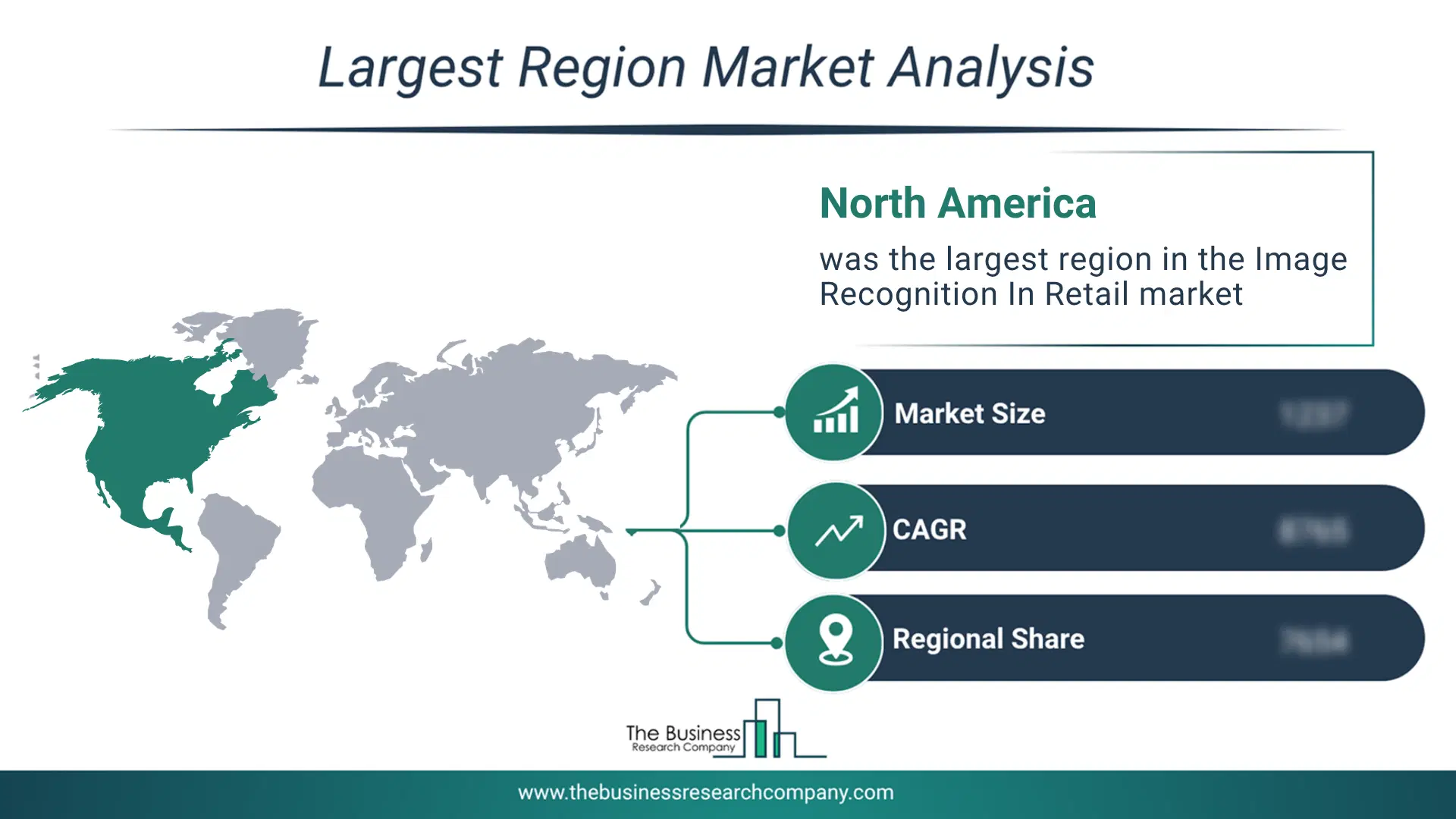
Regional Insights
North America was the largest region in the image recognition in retail market share in 2025. The regions covered in this market report are Asia-Pacific, South East Asia, Western Europe, Eastern Europe, North America, South America, Middle East, Africa. The countries covered in this market report are Australia, Brazil, China, France, Germany, India, Indonesia, Japan, Taiwan, Russia, South Korea, UK, USA, Canada, Italy, SpainWhat Defines the Image Recognition In Retail Market?
The image recognition in retail market consists of revenues earned by entities by providing image recognition in retail for planogram compliance, detecting empty shelves, assessing competition and personalized searches for customers. The market value includes the value of related goods sold by the service provider or included within the service offering. The image recognition in the retail market also includes sales of hardware and software that are used to provide image recognition solutions in retail. Values in this market are ‘factory gate’ values, that is the value of goods sold by the manufacturers or creators of the goods, whether to other entities (including downstream manufacturers, wholesalers, distributors and retailers) or directly to end customers. The value of goods in this market includes related services sold by the creators of the goods.How is Market Value Defined and Measured?
The market value is defined as the revenues that enterprises gain from the sale of goods and/or services within the specified market and geography through sales, grants, or donations in terms of the currency (in USD unless otherwise specified). The revenues for a specified geography are consumption values that are revenues generated by organizations in the specified geography within the market, irrespective of where they are produced. It does not include revenues from resales along the supply chain, either further along the supply chain or as part of other products.
This chart presents market attractiveness based on a quantitative evaluation of growth, competition, strategic alignment, and risk, offering a clear view of opportunity areas for decision-making. This chart is for illustrative purposes; the full report contains the complete analysis.

This chart highlights the Total Addressable Market (TAM) by estimating the maximum revenue opportunity using an assumption-driven approach, supporting strategic planning and opportunity sizing across markets. The chart is illustrative; the full report provides a more comprehensive analysis.
What Key Data and Analysis Are Included in the Image Recognition In Retail Market Report 2026?
The image recognition in retail market research report is one of a series of new reports from The Business Research Company that provides market statistics, including industry global market size, regional shares, competitors with the market share, detailed market segments, market trends and opportunities, and any further data you may need to thrive in the image recognition in retail industry. The market research report delivers a complete perspective of everything you need, with an in-depth analysis of the current and future state of the industry.Image Recognition In Retail Market Report Forecast Analysis
| Report Attribute | Details |
|---|---|
| Market Size Value In 2026 | $3.45 billion |
| Revenue Forecast In 2030 | $7.07 billion |
| Growth Rate | CAGR of 19.6% from 2026 to 2030 |
| Base Year For Estimation | 2025 |
| Actual Estimates/Historical Data | 2020-2025 |
| Forecast Period | 2026 - 2030 |
| Market Representation | Revenue in USD Billion and CAGR from 2026 to 2030 |
| Segments Covered | Component, Type, Deployment, Application |
| Regional Scope | Asia-Pacific, Western Europe, Eastern Europe, North America, South America, Middle East, Africa |
| Country Scope | The Countries Covered In This Market Report Are Australia, Brazil, China, France, Germany, India, Indonesia, Japan, Taiwan, Russia, South Korea, Uk, Usa, Canada, Italy, Spain. |
| Key Companies Profiled | Catchoom Technologies S.L., Ricoh Innovations Corporation, Blippar Ltd., Google LLC, Wikitude GmbH, Trax Retail Solutions Pte. Ltd., Snap2Insight Inc., ClarifAI Inc., Slyce Inc., ParallelDots Inc., NEC Corporation, Huawei Technologies Co. Ltd., Qualcomm Incorporated, Amazon Web Services Inc., Zippin Inc., Vispera Information Technologies Ltd., Hitachi Ltd., NVIDIA Corporation, International Business Machines Corporation, Intel Corporation, Toshiba Corporation, Honeywell International Inc., Sharp Corporation, Syte Visual Conception Ltd. |
| Customization Scope | Request for Customization |
| Pricing And Purchase Options | Explore Purchase Options |