
Immersive Virtual Stores Market Report 2026
Global Outlook – By Technology Platform (Virtual Reality Based Stores, Augmented Reality Based Stores, Mixed Reality Based Stores, Web-Based Three Dimensional Stores), By Deployment Mode (Cloud-Based, On-Premises), By Application (Retail And E-commerce, Fashion And Apparel, Real Estate, Other Applications), By End User (Retailers, Electronic Commerce Companies, Fashion Brands, Real Estate Companies, Consumer Electronics Companies, Other End Users) – Market Size, Trends, Strategies, and Forecast to 2030
Immersive Virtual Stores Market Overview
• Immersive Virtual Stores market size has reached to $4.32 billion in 2025 • Expected to grow to $12.91 billion in 2030 at a compound annual growth rate (CAGR) of 24.4% • Growth Driver: Rising Smartphone Usage Fueling The Growth Of The Market Due To Enhancing Mobile Connectivity And Interactive Shopping Experiences • Market Trend: Transforming Retail With Immersive Virtual Stores, AR-Enhanced Shopping Experiences, And Interactive Styling • North America was the largest region in 2025 and Asia-Pacific is the fastest growing region.What Is Covered Under Immersive Virtual Stores Market?
An immersive virtual store is a digitally created retail environment that allows users to interact with products and services in a highly realistic, three-dimensional space using virtual reality (VR) or augmented reality (AR) technologies. It enables customers to navigate aisles, examine products from different angles, and experience lifelike simulations of shopping scenarios, enhancing engagement and decision-making. These virtual stores leverage advanced graphics, interactive interfaces, and real-time data integration to provide an innovative and seamless shopping experience without the constraints of a physical location. The main technology platforms of immersive virtual stores include virtual reality-based stores, augmented reality-based stores, mixed reality-based stores, and web-based three-dimensional stores. Virtual reality-based stores refer to digital retail environments that use immersive virtual reality technology to simulate a physical shopping experience for users. The deployment modes include cloud-based and on-premises solutions. The applications include retail and e-commerce, fashion and apparel, real estate, and others, catering to key end users such as retailers, electronic commerce companies, fashion brands, real estate companies, consumer electronics companies, and others.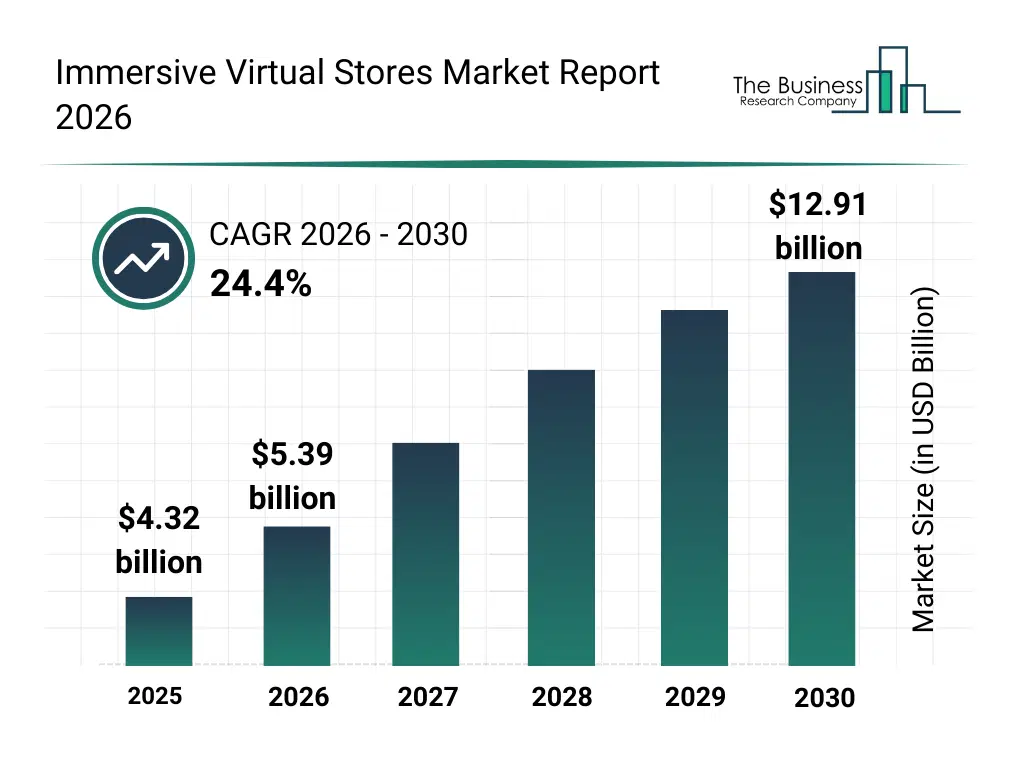
What Is The Immersive Virtual Stores Market Size and Share 2026?
The immersive virtual stores market size has grown exponentially in recent years. It will grow from $4.32 billion in 2025 to $5.39 billion in 2026 at a compound annual growth rate (CAGR) of 24.7%. The growth in the historic period can be attributed to increasing demand for interactive online shopping experiences, growing adoption of augmented reality tools in retail, rising use of three-dimensional product visualization, expansion of e-commerce platforms globally, and increasing retailer focus on digital customer engagement.What Is The Immersive Virtual Stores Market Growth Forecast?
The immersive virtual stores market size is expected to see exponential growth in the next few years. It will grow to $12.91 billion in 2030 at a compound annual growth rate (CAGR) of 24.4%. The growth in the forecast period can be attributed to growing integration of virtual reality commerce into omnichannel strategies, increasing adoption of cloud-based immersive store platforms, rising demand for personalized and immersive digital shopping journeys, expansion of virtual real estate and showroom applications, and increasing retailer investment in experiential digital branding. Major trends in the forecast period include technology advancements in real-time three-dimensional rendering, innovations in artificial intelligence-enabled virtual try-on systems, developments in web-based immersive environments, research and developments in spatial computing and mixed reality, and advancements in three-dimensional content creation pipelines.
Global Immersive Virtual Stores Market Segmentation
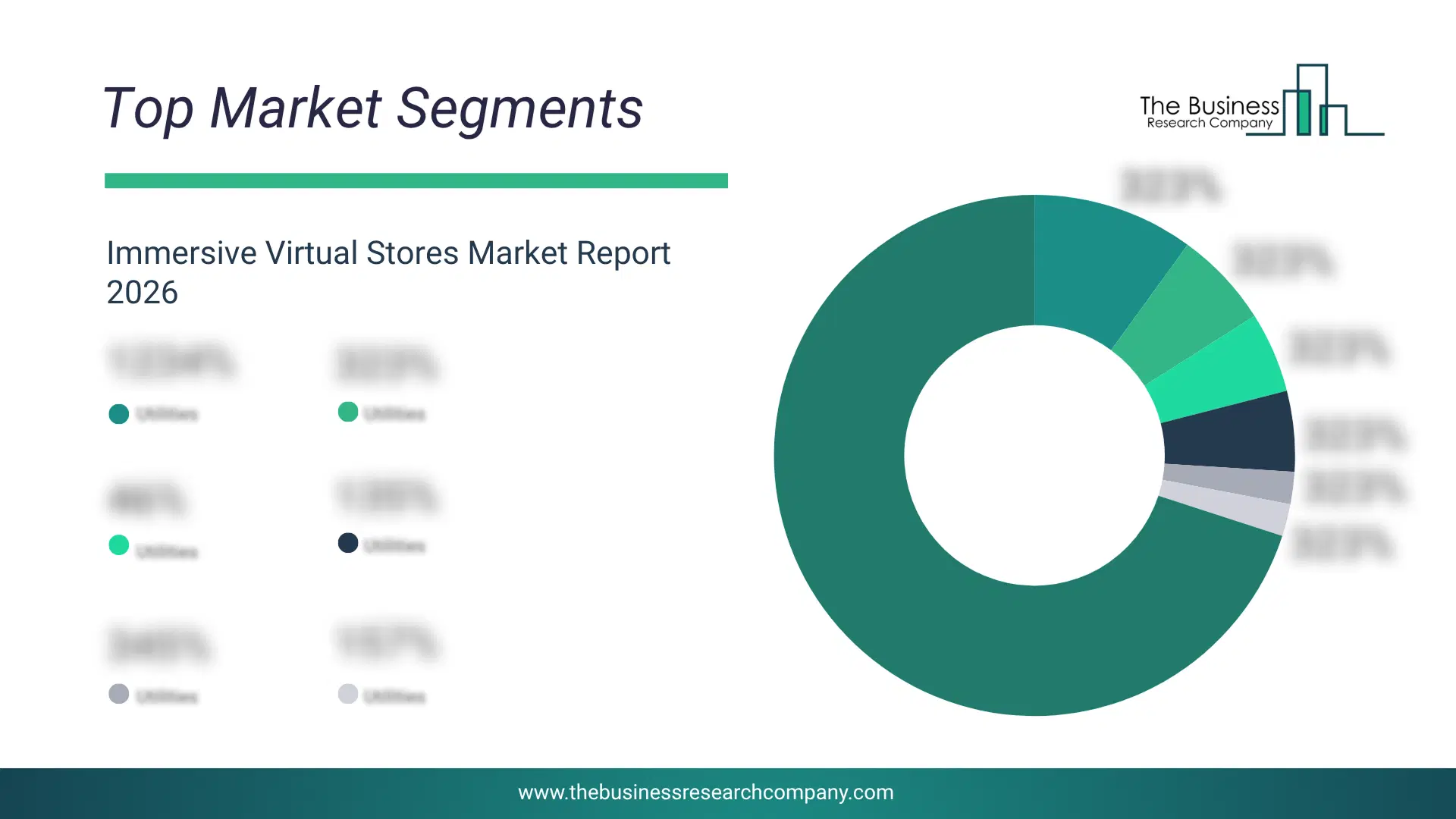
1) By Technology Platform: Virtual Reality Based Stores, Augmented Reality Based Stores, Mixed Reality Based Stores, Web-Based Three Dimensional Stores 2) By Deployment Mode: Cloud-Based, On-Premises 3) By Application: Retail And E-commerce, Fashion And Apparel, Real Estate, Other Applications 5) By End User: Retailers, Electronic Commerce Companies, Fashion Brands, Real Estate Companies, Consumer Electronics Companies, Other End Users Subsegments: 1) By Virtual Reality Based Stores: Headset Dependent Full Immersion Stores, Social Virtual Reality Platform Stores, Controller Based Navigation Stores, Room Scale Interactive Stores 2) By Augmented Reality Based Stores: Marker Based Augmented Reality Stores, Markerless Augmented Reality Stores, Projection Based Augmented Reality Stores, Mobile Application Augmented Reality Stores 3) By Mixed Reality Based Stores: Holographic Device Enabled Stores, Spatial Computing Platform Stores, Interactive Blended Reality Stores, Wearable Display Integrated Stores 4) By Web-Based Three Dimensional Stores: Browser Rendered Three Dimensional Stores, Game Engine Powered Web Stores, E-Commerce Platform Integrated Three Dimensional Stores, No Download Instant Access StoresWhat Is The Driver Of The Immersive Virtual Stores Market?
The increasing smartphone usage is expected to propel the growth of the immersive virtual stores market going forward. Smartphones refer to advanced mobile devices capable of internet connectivity, app usage, and real-time communication. Smartphone usage is rising due to rapid expansion of mobile internet connectivity, as it enables consumers to access online platforms and shop globally anytime, anywhere. Smartphone usage enhances immersive virtual stores by providing a portable and interactive platform for augmented and virtual reality shopping experiences. It improves customer engagement and convenience by enabling real-time product visualization, personalized recommendations, and seamless online purchasing from anywhere. For instance, in November 2024, according to Eurostat, the Luxembourg-based official statistical office of the European Union (EU), around 89% of EU residents aged 16–74 living in cities used their smartphones to access the internet in 2023, compared with 86% in towns and suburbs and 82% in rural areas. Therefore, the increasing smartphone penetration is driving the growth of the immersive virtual stores industry.Key Players In The Global Immersive Virtual Stores Market
Major companies operating in the immersive virtual stores market are Alibaba Group Holding Limited, Roblox Corporation, Unity Software Inc., HTC Corporation, Flexsin Technologies Pvt. Ltd., Vection Technologies Ltd., Trigma Solutions Inc., Decentraland Foundation, iCreative Technologies Pvt. Ltd., Esferasoft Solutions Pvt. Ltd., Pixelette Technologies Pvt. Ltd., Innowise Group, ByondXR Ltd., Emperia Ltd., rooom GmbH, KiXR Ltd., Digital Agents Interactive Inc., GlamAR Inc., VB Metaverse Ltd., Obsess Inc., Arimars Technologies Pvt. Ltd.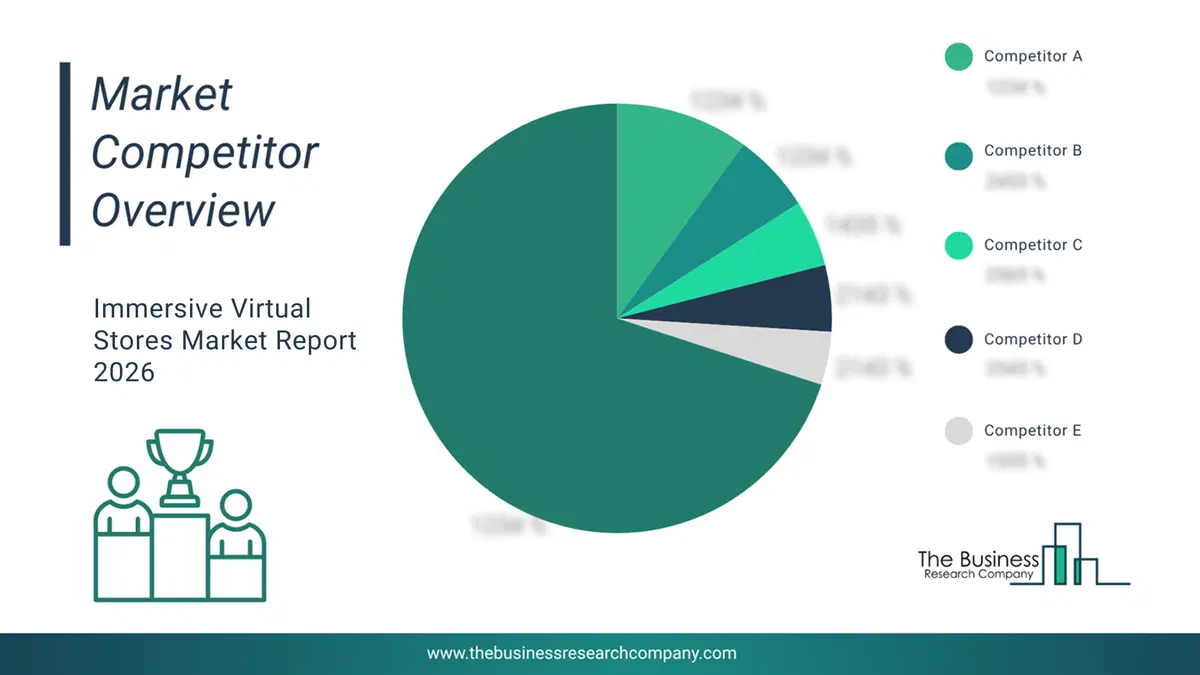
This chart is for illustrative purposes; the full report includes a detailed competitor analysis and comprehensive overview of the top 10 companies in the market.
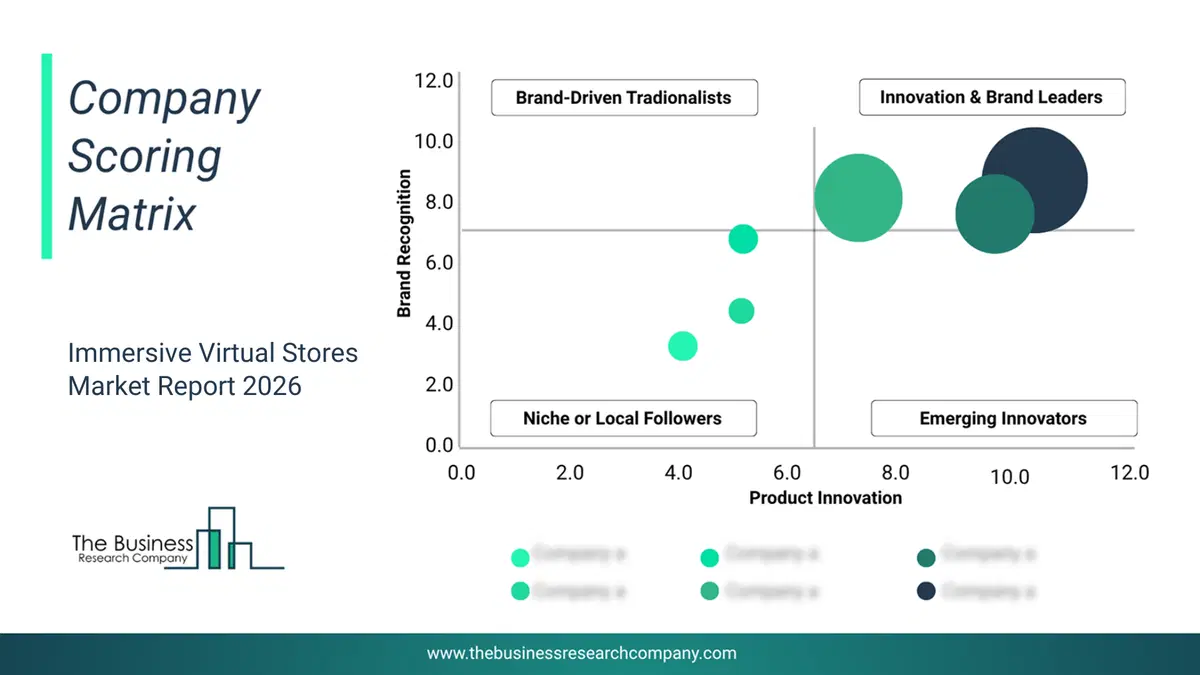
This chart maps companies by product innovation and brand strength, with bubble size indicating relative revenue, helping identify market leaders, challengers, and niche players. This is an illustrative chart; the full report provides a complete and accurate competitive analysis.
Global Immersive Virtual Stores Market Trends and Insights
Major companies operating in the immersive virtual stores market are focusing on developing advanced technologies, such as immersive AR-enabled virtual closet environments, to enhance customer engagement, elevate digital shopping, and bridge the gap between physical and virtual retail. Immersive AR-enabled virtual closet environments refer to augmented reality and spatial computing platforms that allow users to explore products in life-like 3D spaces, interact with merchandise intuitively, and experience highly realistic visuals that mimic in-store browsing digitally. For instance, in February 2024, J.Crew Group Inc., a US-based fashion retailer, launched the J.Crew Virtual Closet app on Apple Vision Pro, to bring an AR-enabled virtual closet experience to spatial computing devices. The experience allows users to browse and mix-and-match clothing in a hyper-realistic 3D environment, examine textures and materials at high magnification, and interact with stylists via SharePlay during FaceTime calls. This AR-enhanced virtual store not only enriches product discovery but also enables personalized styling and social shopping features that extend beyond traditional e-commerce.What Are Latest Mergers And Acquisitions In The Immersive Virtual Stores Market?
In January 2025, Infinite Reality Inc., a US-based digital media and immersive technology company, acquired Obsess Inc. for an undisclosed amount. With this acquisition, Infinite Reality expanded its immersive commerce and virtual retail solutions portfolio, integrating Obsess’s 3D storefront capabilities to enhance the development and delivery of interactive virtual shopping experiences for brands. Obsess Inc. is a US-based technology company that builds immersive 3D virtual store and virtual shopping environments for brands and retailers, enabling rich, interactive, and shoppable digital experiences.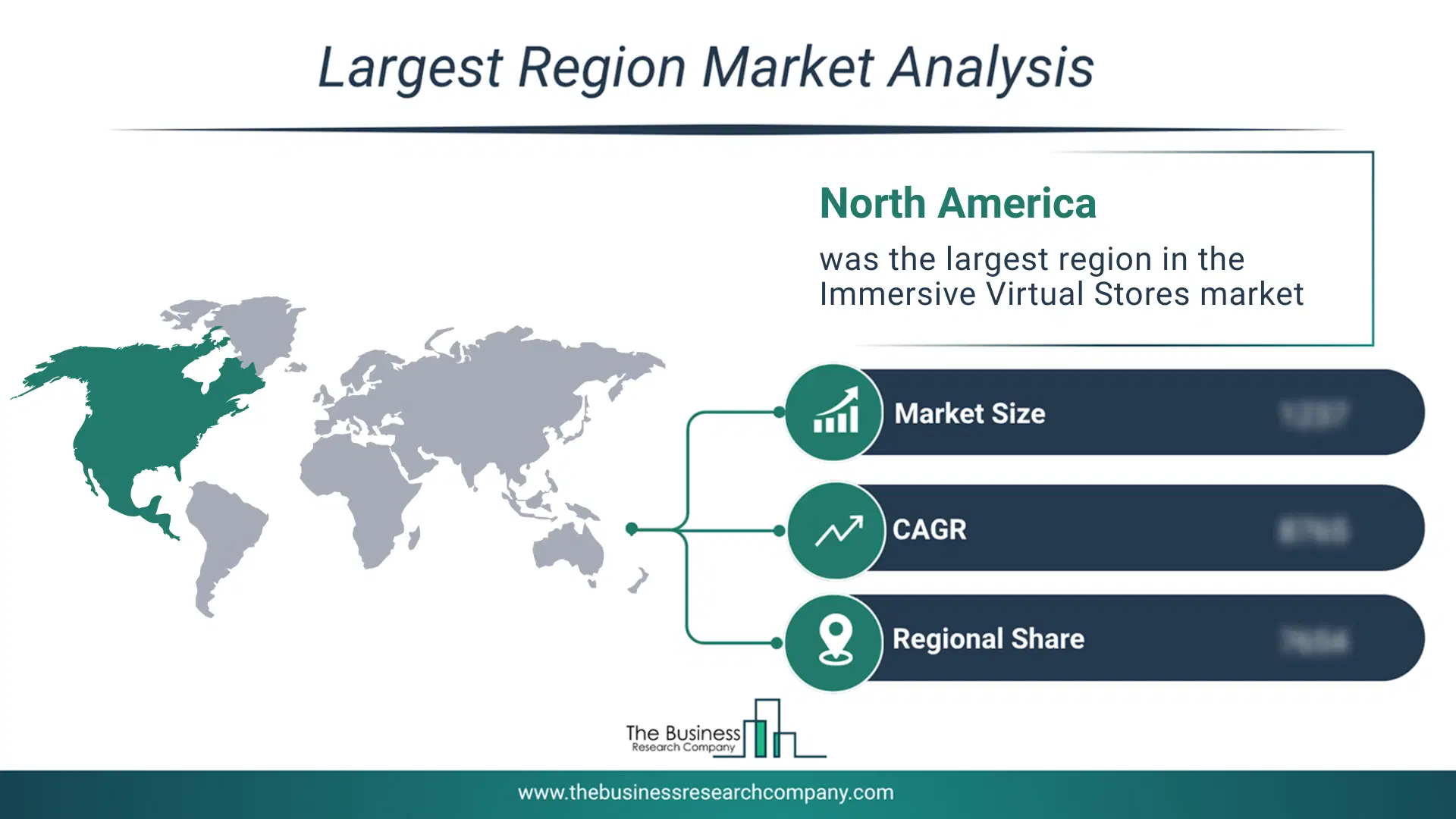
Regional Insights
North America was the largest region in the immersive virtual stores market in 2025. Asia-Pacific is expected to be the fastest-growing region in the forecast period. The regions covered in this market report are Asia-Pacific, South East Asia, Western Europe, Eastern Europe, North America, South America, Middle East, Africa. The countries covered in this market report are Australia, Brazil, China, France, Germany, India, Indonesia, Japan, Taiwan, Russia, South Korea, UK, USA, Canada, Italy, Spain.What Defines the Immersive Virtual Stores Market?
The immersive virtual store market consists of revenues earned by entities by providing services such as virtual store design and development, 3D product modeling, virtual reality (VR) or augmented reality (AR) environment creation, interactive user experience integration, platform hosting and maintenance, content management, analytics and performance tracking, software customization, and technical support for immersive retail solutions. The market value includes the value of related goods sold by the service provider or included within the service offering. The immersive virtual store market also includes sales of products such as virtual reality (VR) headsets, augmented reality (AR) glasses, motion sensors, haptic feedback devices, 3D cameras, interactive displays, VR controllers, servers and networking equipment for virtual reality (VR) or augmented reality (AR) platforms, and software licenses for immersive retail applications. Values in this market are ‘factory gate’ values, that is the value of goods sold by the manufacturers or creators of the goods, whether to other entities (including downstream manufacturers, wholesalers, distributors and retailers) or directly to end customers. The value of goods in this market includes related services sold by the creators of the goods.How is Market Value Defined and Measured?
The market value is defined as the revenues that enterprises gain from the sale of goods and/or services within the specified market and geography through sales, grants, or donations in terms of the currency (in USD unless otherwise specified). The revenues for a specified geography are consumption values that are revenues generated by organizations in the specified geography within the market, irrespective of where they are produced. It does not include revenues from resales along the supply chain, either further along the supply chain or as part of other products.
This chart presents market attractiveness based on a quantitative evaluation of growth, competition, strategic alignment, and risk, offering a clear view of opportunity areas for decision-making. This chart is for illustrative purposes; the full report contains the complete analysis.

This chart highlights the Total Addressable Market (TAM) by estimating the maximum revenue opportunity using an assumption-driven approach, supporting strategic planning and opportunity sizing across markets. The chart is illustrative; the full report provides a more comprehensive analysis.
What Key Data and Analysis Are Included in the Immersive Virtual Stores Market Report 2026?
The immersive virtual stores market research report is one of a series of new reports from The Business Research Company that provides market statistics, including industry global market size, regional shares, competitors with the market share, detailed market segments, market trends and opportunities, and any further data you may need to thrive in the immersive virtual stores industry. The market research report delivers a complete perspective of everything you need, with an in-depth analysis of the current and future state of the industry.Immersive Virtual Stores Market Report Forecast Analysis
| Report Attribute | Details |
|---|---|
| Market Size Value In 2026 | $5.39 billion |
| Revenue Forecast In 2030 | $12.91 billion |
| Growth Rate | CAGR of 24.7% from 2026 to 2030 |
| Base Year For Estimation | 2025 |
| Actual Estimates/Historical Data | 2020-2025 |
| Forecast Period | 2026 - 2030 |
| Market Representation | Revenue in USD Billion and CAGR from 2026 to 2030 |
| Segments Covered | Technology Platform, Deployment Mode, Application, End User |
| Regional Scope | Asia-Pacific, Western Europe, Eastern Europe, North America, South America, Middle East, Africa |
| Country Scope | The countries covered in the report are Australia, Brazil, China, France, Germany, India, Indonesia, Japan, Taiwan, Russia, South Korea, UK, USA, Canada, Italy, Spain. |
| Key Companies Profiled | Alibaba Group Holding Limited, Roblox Corporation, Unity Software Inc., HTC Corporation, Flexsin Technologies Pvt. Ltd., Vection Technologies Ltd., Trigma Solutions Inc., Decentraland Foundation, iCreative Technologies Pvt. Ltd., Esferasoft Solutions Pvt. Ltd., Pixelette Technologies Pvt. Ltd., Innowise Group, ByondXR Ltd., Emperia Ltd., rooom GmbH, KiXR Ltd., Digital Agents Interactive Inc., GlamAR Inc., VB Metaverse Ltd., Obsess Inc., Arimars Technologies Pvt. Ltd. |
| Customization Scope | Request for Customization |
| Pricing And Purchase Options | Explore Purchase Options |