
Industrial Hydraulic Elevators Market Report 2026
Global Outlook – By Type (Freight Elevators, Specialized Elevators, Service Elevators), By Control System (Semi-Automatic Control, Fully Automatic Control), By Load Capacity (Medium Duty, Heavy Duty, Extra Heavy Duty), By End-User Industry (Industrial Manufacturing Plants, Warehousing and Logistics Facilities, Power Generation and Utilities) – Market Size, Trends, Strategies, and Forecast to 2030
Industrial Hydraulic Elevators Market Overview
• Industrial Hydraulic Elevators market size has reached to $4.69 billion in 2025 • Expected to grow to $6.4 billion in 2030 at a compound annual growth rate (CAGR) of 6.4% • Growth Driver: Industrial Automation Trends Accelerating Market Growth Due To Rising Demand For Efficient Material Handling And Productivity • Market Trend: Innovative Low-Rise Hydraulic Elevator Solutions Enhancing Efficiency And Space Utilization • Europe was the largest region in 2025 and Asia-Pacific is the fastest growing region.What Is Covered Under Industrial Hydraulic Elevators Market?
Industrial hydraulic elevators are lifting systems that operate using pressurized hydraulic fluid to move a piston within a cylinder, enabling vertical motion. They are built with a strong mechanical structure to ensure reliable and stable performance in challenging industrial environments. The design focuses on delivering smooth, controlled movement and long-term operational efficiency through a fluid-driven mechanism. The main types of industrial hydraulic elevators are passenger elevators, freight elevators, automated elevators, specialized elevators, and service elevators. Passenger elevators are vertical transport systems designed to safely and efficiently carry people between floors in buildings. These systems operate using various control systems such as manual control, semi-automatic control, fully automatic control, and smart elevators and are categorized by load capacity into light duty, medium duty, heavy duty, and extra heavy duty. These elevators are commonly used by end-users such as hospitality, healthcare facilities, retail stores, industrial manufacturing plants, and museums and exhibition halls.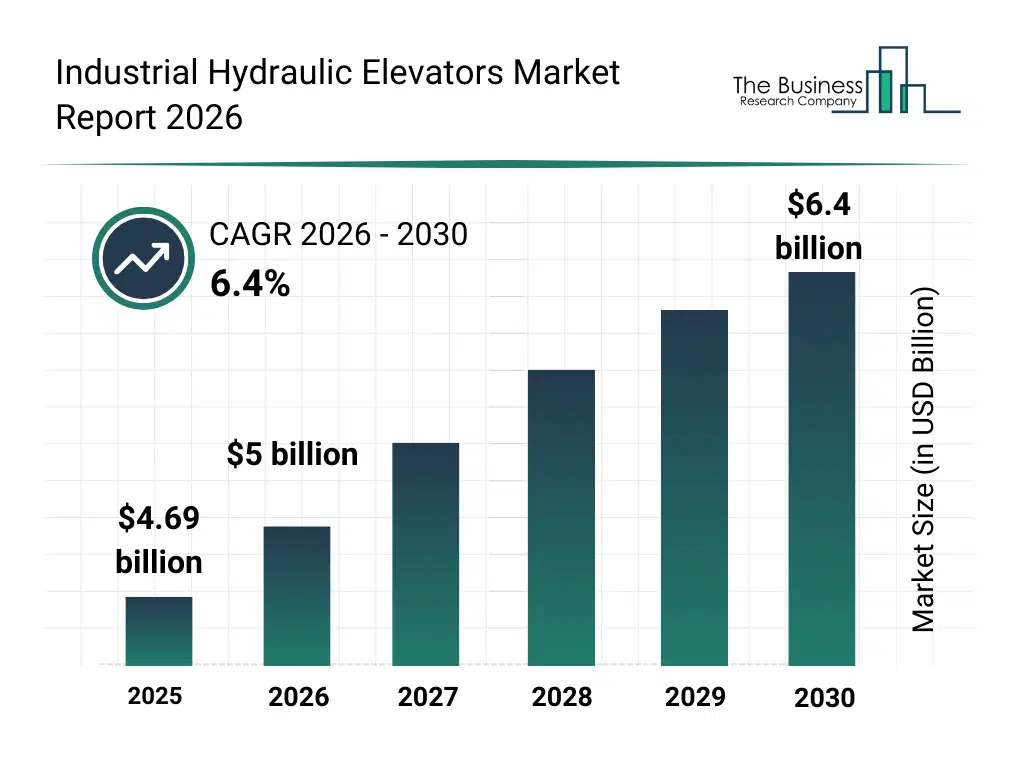
What Is The Industrial Hydraulic Elevators Market Size and Share 2026?
The industrial hydraulic elevators market size has grown strongly in recent years. It will grow from $4.69 billion in 2025 to $5 billion in 2026 at a compound annual growth rate (CAGR) of 6.7%. The growth in the historic period can be attributed to industrial expansion, factory automation growth, warehouse verticalization, demand for material handling systems, safety compliance requirements.What Is The Industrial Hydraulic Elevators Market Growth Forecast?
The industrial hydraulic elevators market size is expected to see strong growth in the next few years. It will grow to $6.4 billion in 2030 at a compound annual growth rate (CAGR) of 6.4%. The growth in the forecast period can be attributed to smart factory adoption, industrial infrastructure investments, demand for heavy duty elevators, growth of logistics facilities, automation of vertical transport. Major trends in the forecast period include heavy load handling elevator systems, adoption in industrial facilities, integration of smart control systems, focus on operational reliability, customization for harsh environments.Tariff Impact On Industrial Hydraulic Elevators Market
Tariffs have affected the industrial hydraulic elevators market by increasing prices of hydraulic cylinders, control systems, and steel components. These impacts are most prominent in manufacturing hubs across North America and Europe. Equipment costs have risen. However, tariffs are encouraging domestic production capabilities.
Global Industrial Hydraulic Elevators Market Segmentation
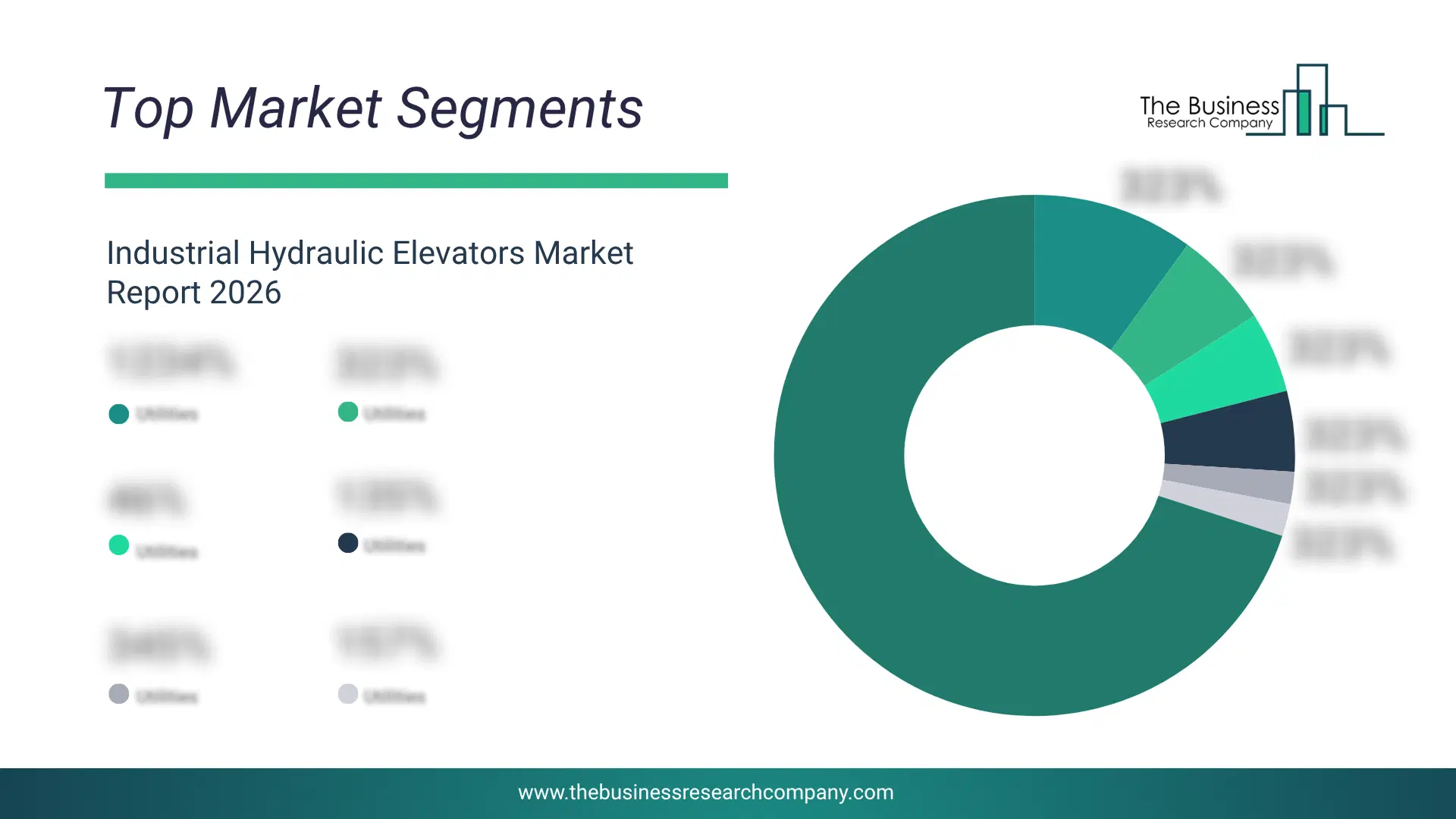
1) By Type: Freight Elevators, Specialized Elevators, Service Elevators 2) By Control System: Semi-Automatic Control, Fully Automatic Control 3) By Load Capacity: Medium Duty, Heavy Duty, Extra Heavy Duty 4) By End-User Industry: Industrial Manufacturing Plants, Warehousing and Logistics Facilities, Power Generation and Utilities Subsegments: 1) By Freight Elevators: Light-Duty Freight Elevators, Medium-Duty Freight Elevators, Heavy-Duty Freight Elevators 2) By Specialized Elevators: Explosion Proof Elevators, Clean Room Elevators, Marine Elevators 3) By Service Elevators: Dumbwaiters, Utility Elevators, Maintenance ElevatorsWhat Are The Drivers Of The Industrial Hydraulic Elevators Market?
The increasing industrial automation is expected to propel the growth of the industrial hydraulic elevators market going forward. Industrial automation refers to the use of control systems, including computers, robots, and information technologies, to manage and oversee industrial processes with minimal human involvement. The rise in industrial automation is driven by the growing need for enhanced productivity, as it allows for faster, continuous, and more efficient operations while reducing dependence on manual labor. Industrial hydraulic elevators enhance industrial automation by enabling seamless vertical material transport, which reduces manual handling and improves workflow efficiency in automated production lines. For instance, in September 2024, according to the International Federation of Robotics (IFR), a Germany-based non-profit organization, 276,288 industrial robots were installed in China in 2023, accounting for 51% of global installations, with the industry projected to grow at an average annual rate of 5–10% through 2027. Therefore, the increasing industrial automation is driving the growth of the industrial hydraulic elevators industry. The rising investment in infrastructure development is expected to propel the growth of the industrial hydraulic elevators market going forward. Investment in infrastructure development refers to the allocation of capital toward constructing, enhancing, or maintaining vital facilities. Investment in infrastructure development is rising due to rapid urbanization, which demands improved transportation, utilities, and public services to support growing urban populations and economic activities. Investment in infrastructure development fuels demand for industrial hydraulic elevators by supporting the construction of manufacturing units, storage warehouses, and industrial sites that depend on reliable vertical transportation systems for goods and workforce movement. For instance, in July 2024, according to the Office for National Statistics, a UK-based government agency, infrastructure investment in 2023 totaled $17.25 billion (£13.8 billion) in constant prices, marking a 3.9% rise from 2022. Therefore, the rising investment in infrastructure development is driving the growth of the industrial hydraulic elevators industry.Key Players In The Global Industrial Hydraulic Elevators Market
Major companies operating in the industrial hydraulic elevators market are Hidral S.A., KLEEMANN Hellas S.A., IMEM Lifts S.r.l., Orona Group, Savaria Corporation, IGV Group, Sicher Elevator Co., Ltd., Canny Elevator Co., Ltd., Yungtay Engineering Co., Ltd., Fuji HD Elevator & Escalator Co., Ltd., Johnson Lifts Private Limited, Escon Elevators Pvt. Ltd., ALMAS Lifts Private Limited, AVT Beckett Elevators Ltd., Stannah Lifts Holdings Ltd., Klefer Elevadores S.A., MP Ascensores S.A., Express Lifts Company Ltd., Doppler S.A., Maruthi Lifts, Sigma Elevators, A Star Elevator Pvt. Ltd.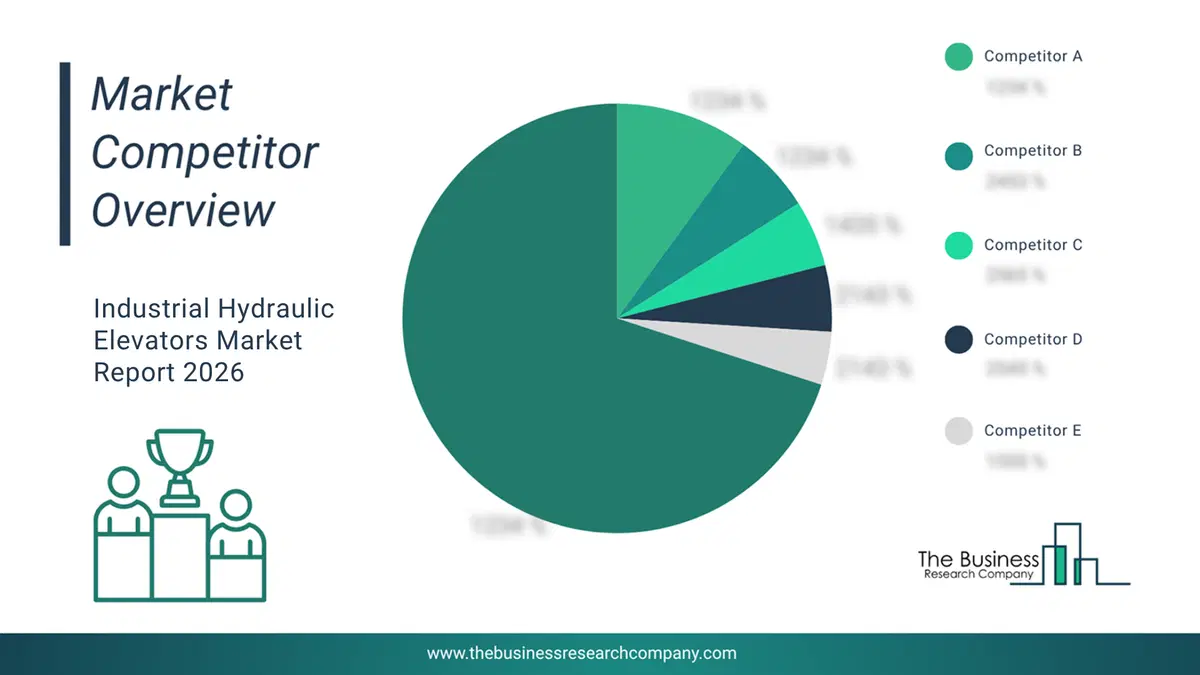
This chart is for illustrative purposes; the full report includes a detailed competitor analysis and comprehensive overview of the top 10 companies in the market.
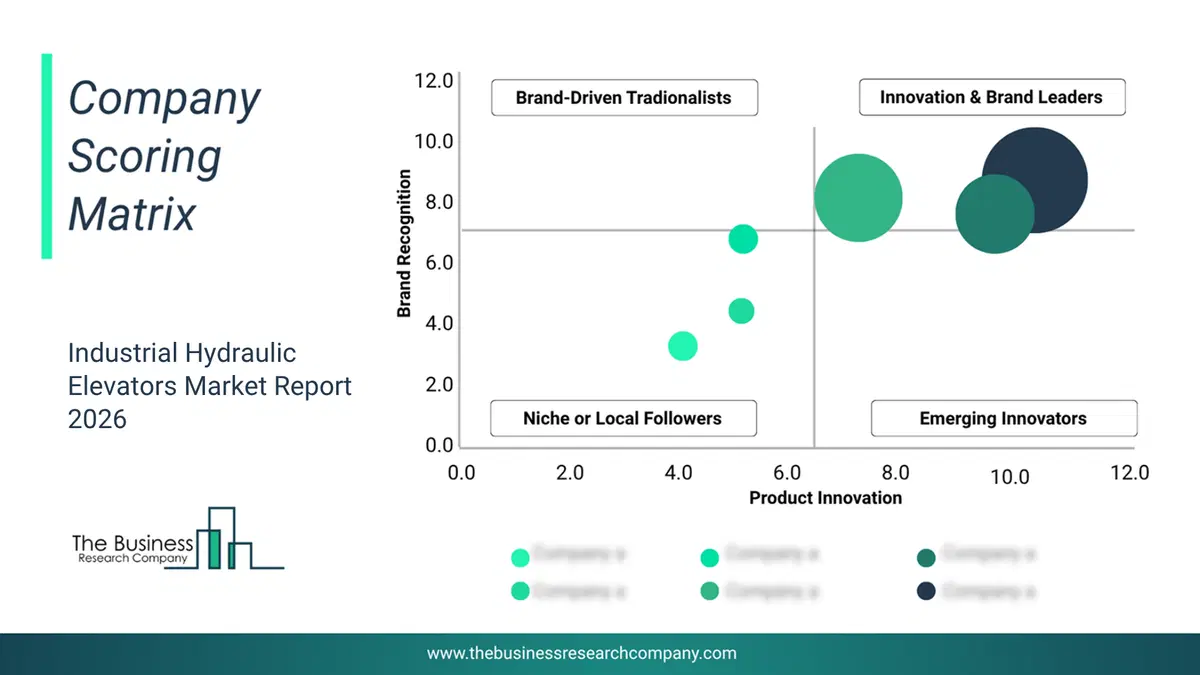
This chart maps companies by product innovation and brand strength, with bubble size indicating relative revenue, helping identify market leaders, challengers, and niche players. This is an illustrative chart; the full report provides a complete and accurate competitive analysis.
Global Industrial Hydraulic Elevators Market Trends and Insights
Major companies operating in the industrial hydraulic elevators market are focusing on developing innovative solutions, such as low-rise hydraulic elevators, to improve energy efficiency, simplify installation, and meet the needs of space-limited industrial settings. A low-rise hydraulic elevator refers to a vertical transportation system designed for buildings with up to five stories, utilizing hydraulic mechanisms to deliver smooth, efficient, and cost-effective movement. For instance, in January 2024, TK Elevator GmbH, a Germany-based manufacturing company, launched the EOX-H, an energy-efficient and sustainable hydraulic elevator tailored for low-rise buildings. This digitally advanced elevator offers a compact design, shorter lead times, and cost optimization for various budgets. Its benefits include enhanced safety and digital capabilities, eco and standby modes for energy savings, and predictive maintenance for improved reliability and extended service life.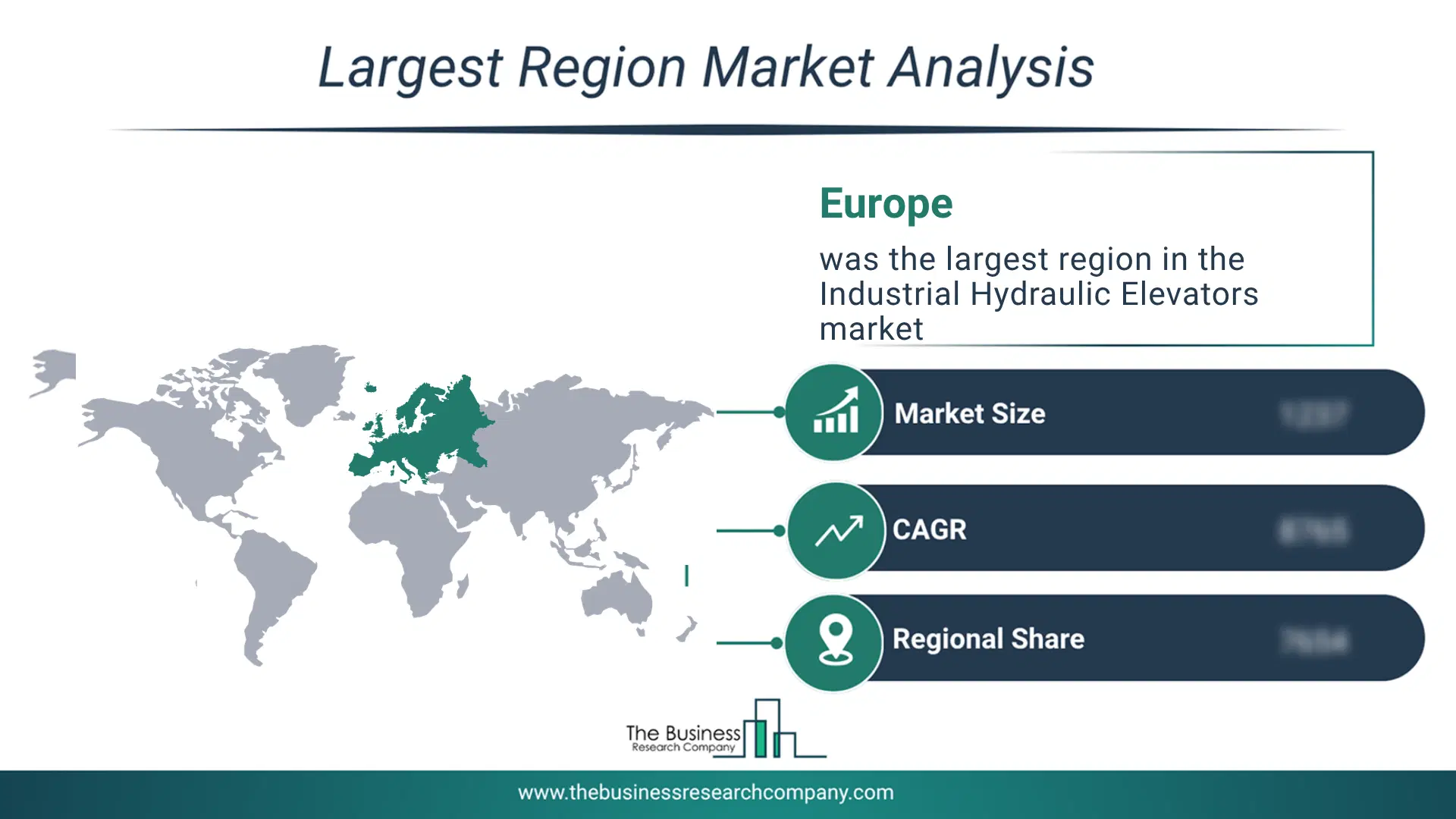
Regional Outlook
Europe was the largest region in the industrial hydraulic elevators market in 2025. Asia-Pacific is expected to be the fastest-growing region in the forecast period. The regions covered in this market report are Asia-Pacific, South East Asia, Western Europe, Eastern Europe, North America, South America, Middle East, Africa The countries covered in this market report are Australia, Brazil, China, France, Germany, India, Indonesia, Japan, Taiwan, Russia, South Korea, UK, USA, Canada, Italy, Spain.What Defines the Industrial Hydraulic Elevators Market?
The industrial hydraulic elevators market consists of sales of material lifts, elevator control panels, hydraulic cylinders, and scissor lifts. Values in this market are ‘factory gate’ values, that is, the value of goods sold by the manufacturers or creators of the goods, whether to other entities (including downstream manufacturers, wholesalers, distributors, and retailers) or directly to end customers. The value of goods in this market includes related services sold by the creators of the goods.How is Market Value Defined and Measured?
The market value is defined as the revenues that enterprises gain from the sale of goods and/or services within the specified market and geography through sales, grants, or donations in terms of the currency (in USD unless otherwise specified). The revenues for a specified geography are consumption values that are revenues generated by organizations in the specified geography within the market, irrespective of where they are produced. It does not include revenues from resales along the supply chain, either further along the supply chain or as part of other products.
This chart presents market attractiveness based on a quantitative evaluation of growth, competition, strategic alignment, and risk, offering a clear view of opportunity areas for decision-making. This chart is for illustrative purposes; the full report contains the complete analysis.

This chart highlights the Total Addressable Market (TAM) by estimating the maximum revenue opportunity using an assumption-driven approach, supporting strategic planning and opportunity sizing across markets. The chart is illustrative; the full report provides a more comprehensive analysis.
What Key Data and Analysis Are Included in the Industrial Hydraulic Elevators Market Report 2026?
The industrial hydraulic elevators market research report is one of a series of new reports from The Business Research Company that provides market statistics, including industry global market size, regional shares, competitors with the market share, detailed market segments, market trends and opportunities, and any further data you may need to thrive in the industrial hydraulic elevators industry. The market research report delivers a complete perspective of everything you need, with an in-depth analysis of the current and future state of the industry.Industrial Hydraulic Elevators Market Report Forecast Analysis
| Report Attribute | Details |
|---|---|
| Market Size Value In 2026 | $5 billion |
| Revenue Forecast In 2030 | $6.4 billion |
| Growth Rate | CAGR of 6.4% from 2026 to 2030 |
| Base Year For Estimation | 2025 |
| Actual Estimates/Historical Data | 2020-2025 |
| Forecast Period | 2026 - 2030 |
| Market Representation | Revenue in USD Billion and CAGR from 2026 to 2030 |
| Segments Covered | Type, Control System, Load Capacity, End-User Industry |
| Regional Scope | Asia-Pacific, Western Europe, Eastern Europe, North America, South America, Middle East, Africa |
| Key Companies Profiled | Hidral S.A., KLEEMANN Hellas S.A., IMEM Lifts S.r.l., Orona Group, Savaria Corporation, IGV Group, Sicher Elevator Co., Ltd., Canny Elevator Co., Ltd., Yungtay Engineering Co., Ltd., Fuji HD Elevator & Escalator Co., Ltd., Johnson Lifts Private Limited, Escon Elevators Pvt. Ltd., ALMAS Lifts Private Limited, AVT Beckett Elevators Ltd., Stannah Lifts Holdings Ltd., Klefer Elevadores S.A., MP Ascensores S.A., Express Lifts Company Ltd., Doppler S.A., Maruthi Lifts, Sigma Elevators, A Star Elevator Pvt. Ltd. |
| Customization Scope | Request for Customization |
| Pricing And Purchase Options | Explore Purchase Options |